|
||||||||||||||||||||||
 |
||||||||||||||||||||||
![F-22A Raptor, FB-22, F-22E, F-22N and Variants Index Page [Click for more ...]](APA/f-fb-22.png "F-22A Raptor, FB-22, F-22E, F-22N and Variants Index Page [Click for more ...]") |
 |
![People's Liberation Army Air Power Index Page [Click for more ...]](APA/pla-air-pwr.png "People's Liberation Army Air Power Index Page [Click for more ...]") |
 |
 |
 |
 |
 |
 |
![Military Ethics, Culture, Education and Training Index Page [Click for more ...]](APA/ethx-culture.png "Military Ethics, Culture, Education and Training Index Page [Click for more ...]") |
 |
||||||||||||
 |
![Russian / Soviet Weapon Systems Index Page [Click for more ...]](APA/rus-weps.png "Russian / Soviet Weapon Systems Index Page [Click for more ...]") |
 |
 |
 |

|
 |
 |
 |
 |
 |
||||||||||||
 |
 |
|||||||||||||||||||||
| Last Updated: Mon Jan 27 11:18:09 UTC 2014 | ||||||||||||||||||||||
|
||||||||||||||||||||||
|
||||||||||||||||||||||
|
||||||||||||||||||||||
|
|
|
|
|
|
|
|
|
|
|
||||||||||||
|
|
|
|
|
|
|
|
|
|
|
||||||||||||
|
|
|||||||||||||||||||||
| Last Updated: Mon Jan 27 11:18:09 UTC 2014 | ||||||||||||||||||||||
|
||||||||||||||||||||||
| AIR
5190 - The Perennial Lightweight Project - analysis of an Australian defence acquisition |
|||||||||||||||||||||||||||||||||||||||||||||||||||||||||||||||||||||||||||||||||||||||||||||||||||||||||||||||||||||||||||||||||||||||||||||||||||||||||||||||||||||||||||||||||||||||||||||||||||||||||||||||||||||||||||||||||||||||||||||||||||||||||||||||||||||||||||||||||||||||||||||||||||||||||||||||||||||||||||||||||||||||||||||||||||||||||||||||||||||||||||||||||||||||||||||||||||||||||||||||||||||||||||||||||||||||||||||||||||||||||||||||||||||||||||||||||||||||||||||||||||||||||||||||||||||||||||||||||||||||||||||||||||||||||||||||||||||||||||||||||||||||||||||||||||||||||||||||||||||||||||||||||||||||||||||||||||||||||||||||||||||||||||||||||||||||||||||||||||||||||||||||||||||||||||||||||||||||||||||||||||||||
|
|||||||||||||||||||||||||||||||||||||||||||||||||||||||||||||||||||||||||||||||||||||||||||||||||||||||||||||||||||||||||||||||||||||||||||||||||||||||||||||||||||||||||||||||||||||||||||||||||||||||||||||||||||||||||||||||||||||||||||||||||||||||||||||||||||||||||||||||||||||||||||||||||||||||||||||||||||||||||||||||||||||||||||||||||||||||||||||||||||||||||||||||||||||||||||||||||||||||||||||||||||||||||||||||||||||||||||||||||||||||||||||||||||||||||||||||||||||||||||||||||||||||||||||||||||||||||||||||||||||||||||||||||||||||||||||||||||||||||||||||||||||||||||||||||||||||||||||||||||||||||||||||||||||||||||||||||||||||||||||||||||||||||||||||||||||||||||||||||||||||||||||||||||||||||||||||||||||||||||||||||||||||
|
Part 1 of 2
AIR 5190 is the Defence project for acquisition of aircraft to succeed the DHC-4 Caribou short takeoff and landing (STOL) transports. The search for a new aircraft commenced in the mid-1970s and since then numerous types of light transport aircraft (LTA) have been proposed by industry. Some of these LTA have been assessed and found largely suitable but the project has continued without apparent resolution. Major causes of delay have been the customary iterative discussions between Defence and industry, consideration of aircraft not yet proven in service, and the difficulty of maintaining agreement on a target specification within Defence. An aggravating factor has been the intense annual competition for allocation of provisional funding. Recently as announced in Defence White Paper 2000 (DWP2000), planning for AIR 5190 has been revised. The Caribous are to receive an austere refurbishment to extend their life-of-type until about 2010 when they will be replaced. But though AIR 5190 seems set to continue on a slow and tortuous course, early replacement of the Caribou is probable. This article reviews ADF airlift and the history of AIR 5190, examines the characteristics of the short listed contenders and assesses the likely outcome of the project. ADF Airlift in the 20th Century The DHC-4 Caribou was developed by de Havilland Canada with an emphasis on STOL capabilities to enable use of short, confined and rudimentary airstrips with soft and rough surfaces and in wet conditions. First flight of the prototype was in July 1958 and production ended in 1973 with some 300 aircraft delivered. These included 29 to the Royal Australian Air Force (RAAF) and 159 to the US Army. Service with Air Force commenced in 1964 with delivery of 18 aircraft from an order placed in May 1963. An additional seven aircraft were delivered in 1966 and a final four between 1968 and 1971. Three were lost without crew fatalities in South Vietnam: one crashed on landing, one ditched and one destroyed by mortar fire. 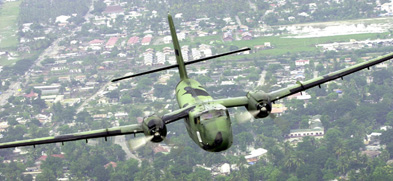 Caribou over Dili (Defence)
Currently 14 Caribou are in service with 38 Squadron with some of the off-lined seven in reserve for attrition and cannibalising. In other countries only 10 Caribou continue in military use: two in Costa Rica, two in Liberia and six in Malaysia (plus several in reserve). The main factors leading to retirement of the DHC-4 by other armed forces have been the maintenance and fuel needs of its 14-cylinder twin-row radial piston engines, lack of pressurisation of the cargo cabin, and the capabilities of more modern turbine-powered aircraft. To complement the Caribou in light tactical airlift, the ADF has six Boeing Vertol CH-47D Chinook helicopters. The Chinook's rear ramp and cabin - length 9.2m, minimum width 2.28m, minimum height 1.98m with an upper corner radius maximum of 39cm - are well sized and it can load standard 463L pallets or a 4x4 Perentie light truck (height reduced). The lift capability of the Chinook also results in its frequent use as a flying crane. For this role it has triple hooks for multiple slings and pendulum-inhibiting. The main hook is rated at 12.7 tonnes, and the forward and rear hooks are each rated at nine tonnes. In clean condition the Chinook has a maximum cruise speed at low altitude of 155kt, a service ceiling in or out of ground effect of less than 15,000ft and a normal operating radius of less than 300 nautical miles (nm). Hence as a transport it is less effective and more vulnerable than similar capacity fixed wing aircraft except in circumstances where hover or vertical takeoff and landing (VTOL) capabilities are required. 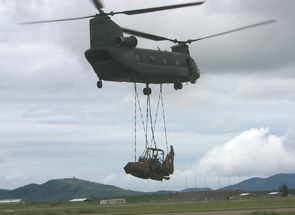 CH-47 with bulldozer (Army)
ADF airlift also has 68 utility helicopters: 25 Bell UH-1H Iroquois' and 36 Sikorsky S-70A-9 Blackhawks operated by Army, and 7 Westland Mk 50 Seakings operated by Navy. These helicopters have sling lift capabilities of about 1.5, 3.6 and 2.7 tonnes respectively but all lack a cargo ramp and hence are generally unsuitable for line-haul freighting. Moving up in capacity, Air Force has twelve Lockheed C-130H Hercules freighters with supplementary underwing fuel-tanks which have been in service as medium tactical transports since 1978. They are complemented by twelve C-130J-30 delivered in 1999 and 2000 under project AIR 5216 Strategic Airlift Capability as replacements for C-130E aircraft that had been primarily used for long-range freighting. The C-130J-30 has a fuselage stretched by fifteen feet to provide more space for low-density loads. Due mainly to higher power from its engines and propellers, it has better short field performance than the C-130H. Similar to the Caribou all versions of the Hercules freighter have reversible pitch propellers for use while manoeuvring on the ground and for routine braking during the landing run. If conditions permit use of aggressive profiles and maximum engine power and braking, then normal takeoff and landing runs and distances can be usefully reduced. The takeoff and landing figures for both the C-130H and C-130J-30 can be further reduced by carrying a light load and limited fuel but neither can match the STOL performance of the Caribou with its normal maximum load. See Table 1. 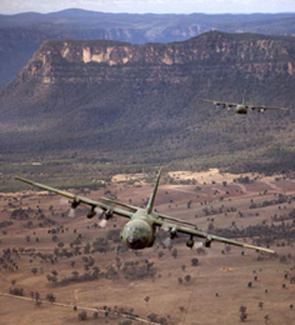 C-130Hs in the Blue Mountains (Defence)
PB1996-2000 described the project as AIR 5401 Medium Tactical Airlift Capability. It showed acquisition of aircraft as Phase 1 to be completed by 2004/05 in the cost category $500m - $1000m, and added Phase 2 as acquisition of a flight simulator in the cost category $20m - $200m. Provisional arrangements made at the time of signing for the C-130J-30s included no-cost options for acquisition of up to 26 more J-model freighters: 12 or more C-130J-30s or C-130Js, up to six KC-130Js, and for New Zealand up to eight C-130J to succeed its five C-130Hs and two Boeing 727-100 transports. These options were later reported to apply until 2002. The KC-130J is a dual role freighter/tanker with integral plumbing plus a palletised ancillary tank and underwing dispensing pods for hose-drogue refuelling of slow flying aircraft. The standard body C-130J and KC-130J are less likely to incur tail-scrape during short field operations so it seemed that from about 2005 the ADF Hercules fleet might comprise for example and at most: twelve C-130J-30, twelve C-130J and six KC-130J; or on a one-for-one replacement basis: twelve C-130J-30 and twelve C-130J with some of the latter in KC-configuration. The KC-130J was of special interest to the ADF because continuance and expansion of the ADF air-to-air refuelling (AAR) capability was being separately studied in project AIR 5402. During the 1970s and 1980s, Air Force acquired six ex-airline Boeing 707-338C passenger jets. One was destroyed in an accident with the loss of its crew, one continued as a VIP transport, and from 1988 to 1991 four were partially converted into strategic tanker/transports. In the conversion the under-floor hold of each 707-338C may have been fitted with tanks so that its total load could comprise fuel for transfer. However - due to what was officially described as concerns for international political sensitivity - the 707s were fitted only with underwing hose-drogue dispensing pods for AAR of probe-equipped aircraft such as the F/A-18 fighter, and not with an extendable tailboom for refuelling receptacle receivers such as the F-111 strike fighter. Also but for reasons of economy, the upper deck side-loading door (3.35m x 2.28m) was not lengthened for alternate transport of large pallets. Hence the secondary transport capability is limited to troops and 463L size pallets and containers. A full-flight simulator was ordered later in a phase of project AIR 5369. This was much delayed and the simulator was not delivered until late-1998. 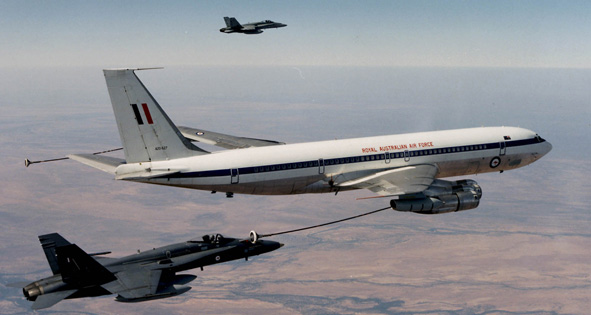 Boeing 707-338C refuelling F/A-18A (Defence)
AIR 5402 first appeared in PB1996-2000. Its scope was described as enhancement of the ADF's AAR capability in two phases. Phase 1 was initial aircraft acquisition in the cost category $200m - $500m to be expended from 1999/00 - 2003/04. Phase 2 was a follow-on acquisition phase in the cost category $20m - $200m with expenditure from 2000/01 - 2004/05. Capital investment funds are limited and each generation of aircraft tends to be replaced by a similar or smaller number of successors. With provisional allocation on a project by project basis it was likely that funds earmarked for AIR 5402 would provide only four or five aircraft of about the same size as the 707s. A force of five tanker/transports is generally regarded as the minimum needed to maintain two in refuelling orbits, supported by two in transit or on the ground and one in off-line maintenance. AIR 5402 Phase 1 might cover system items, a flight simulator and three tanker/transports; and Phase 2 would acquire two more. PB1996-2000 included another new project associated with AAR: AIR 5403 Noise Reduction for Boeing 707 Aircraft. It was described as acquisition of engine hushkits to comply with international and national noise regulations. The cost category was $20m - $200m with expenditure from 1997/98 - 1999/00. There was no mention of airframe refurbishment or avionics modernisation. Taken in conjunction with AIR 5402 the apparent purpose was to retain the 707-338s for only an interim period. In order to obtain more and more modern AAR capability as an enabler and force-multiplier for patrol, fighter and transport aircraft, it was possible that Defence would look to its other airlift project, AIR 5401 the C-130H upgrade and replacement. The fuel offload-radius capability of the KC-130J is inevitably lower than that of aircraft designed to operate only from paved runways. Also strategic tanker/transports are commonly large aircraft but the KC-130J has a useful capability especially when only short airstrips are available. This combined with concern to arrange for surge during a crisis or conflict situation indicated that some J-model Hercules' acquired under AIR 5401 would be KC-130Js in accordance with the option arranged under AIR 5216. Industry sources estimate the flyaway cost of a new C-130J at $US65m to $US70m. The more expensive KC-130J configuration is able to transfer more than 20 tonnes of fuel at a radius of 1,000nm, increasable during an emergency or conflict to about 30 tonnes at overload maximum all-up weight. As an approximation, the flyaway cost of a young but outmoded airline jet converted into a medium-weight tanker/transport and able to transfer 40 to 50 tonnes of fuel at a radius of 2,000nm is about 125% that of a new KC-130J. The flyaway cost of a similarly converted heavy tanker/transport with an offload of 80 to 90 tonnes at 2,000nm is approximately 175% of a new KC-130J. These ratios can be used also as a low estimate of the system cost of introducing each one of a new type of aircraft relative to the system cost of incrementing the number of J-model Hercules. Despite the low exchange rate of the $A, the scale of funds earmarked for AIR 5402 was sufficient for acquisition of five refurbished medium-weight tanker/transports, and almost sufficient for four medium-weight brand-new tanker/transports. It seemed unlikely that AIR 5402 would directly acquire the KC-130J but the approximate cost category was sufficient for five. Acquisition of three heavy tanker/transports was a remote possibility. A bigger problem in terms of declared scope and cost category was AIR 5401. If the twelve C-130H were to be replaced on a one-for-one basis by the C-130J, then expenditure for Phase 1 would be more than 50 percent above the Pink Book cost category. If additional funds could not be obtained, then AIR 5401 might acquire at least six C-130J or KC-130J and fund extensive refurbishment of six C-130H. Summarising the above paragraphs and using all planning outlines released for projects AIR 5401 and 5402 through until 1996, the ADF in about 2005 might have - or might have had - the following transport aircraft in addition to its LTA:
Similar expenditures could have delivered for example:
The competitive costs tendered for acquisition or lease might vary substantially from the estimates used in this summary. Depending also on funding, many other options could be developed and some would be more practical than Options A through C+. But this was the general context of airlift planning in the mid-1990s. It was in this context that the study for an aircraft to replace the capability of the Caribou began to move more rapidly. Development of Air 5190 The formal search for a successor to the DHC-4 Caribou began in 1976 when the Government initiated a project development including an industry feasibility study. As described in DWP1976, the purpose of the study was to obtain responses from manufacturers interested in development of an existing or new aircraft type to satisfy Australia's need for a tactical fixed-wing short range transport aircraft in the mid-1980s. The study received many responses from industry. One of the leading contenders was the DHC-5 Buffalo designed as a STOL turboprop successor to the Caribou with a pressurised cabin sized for 463L pallets and bigger vehicles. The Buffalo was designed also to complement the Chinook and the two aircraft have similar cabin dimensions. The US Army did not acquire the Buffalo and instead standardised on the Chinook. With a takeoff weight of about 19 tonnes the Buffalo can lift a payload of 5.5 tonnes from a 300m rough airstrip. At 22 tonnes all-up, this increases to 8 tonnes from a 600m prepared airstrip. It also carries these loads faster, higher and further than the Caribou. In late-1978 it was reported that the LTA study was being stopped due to pressure on the Defence budget and because no proposal fully satisfied the draft specification especially in regard to part-manufacture or assembly in Australia. Instead the Caribou life-of-type was to be extended and subject to fatigue studies the aircraft would continue in service into the late-1980s. At some time in the late-1970s or early-1980s, the continuing study for a successor to the Caribou received the serial AIR 5190. During the 1980s it was reported that the Canadians would seek to provide refurbished DHC-5 Buffalos to succeed the Caribou, and new-build utility helicopters for project AIR 87 (troop lift component since moved to AIR 5046) offset against acquisition of three or four Collins-class fleet submarines for their Navy. However this prospect evaporated due in part to development problems with the Collins-class. Also large expenditure was already committed or expected throughout the 1980s for acquisition of F/A-18 fighters, S-70A-9 helicopters and PC-9 trainers, and conversion of the 707-338s. 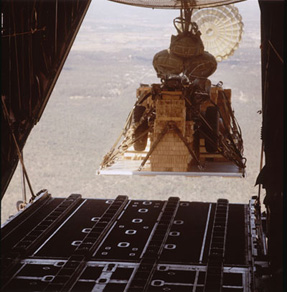 Pallet with trailer and stores being extracted from C-130 (Defence)
Planned expenditure on aircraft in the 1990s included that for acquisition of the C-130J-30 freighters, CH-47D helicopters and Hawk 127 lead-in-fighter/trainers, and for upgrade of P-3C maritime patrol/anti-submarine aircraft and F-111C and F-111G strike fighters. In 1990 it was reported that a rationalisation study for ADF air transport needs had recommended extension of the Caribou life-of-type to about 2000 pending examination of three options. The options were described - without comment on relative capability or cost - as acquisition of either eight more C-130H freighters, thirty more S-70A-9 helicopters or ten to twelve light fixed-wing transports. The next White Paper (DWP1994) noted that options to replace the Caribou capability were being reviewed in an Airlift Study and included fixed and rotary wing aircraft. Also in 1994/95, Defence included AIR 5190 as an unapproved project in the Pink Book. The publicly released version of PB1995-1999 described AIR 5190 as a light tactical airlift capability (LTAC) for acquisition of LTA to maintain the capability provided by the Caribou. The cost category was shown as more than $200m scheduled from 1997/98 to 2003/04 with a 1996/97 Year of Decision (YOD). This meant that a joint military/public service project team would prepare a more detailed feasibility and acquisition strategy and plan for comment within Defence. If review confirmed that the project could lead to a cost-effective solution, then the plan would be refined and - depending upon other provisional expenditure and priorities - might in that YOD be recommended to and approved by Government. Typically the plan would have four main steps: Invitation to Register Interest (ITR), short-listing of potential suppliers, formulation of a Request For Tender (RFT) followed by competitive selection. Less frequently a plan commences with a Request for Proposal (RFP) from a selected supplier or suppliers. Subject again to Government approval a contract might then be signed and thereafter funds would be obtained from the defence vote as approved in the annual budget. The project could be halted at any time prior to signature without prejudice to the Commonwealth. Also in 1995/1996, Defence was reviewing its latest Airlift Study which had as a major issue the needs of the Army 21 reorganisation. All options for tactical airlift must have been re-visited and examined in detail. Despite or as a result of recommendations from the Airlift Study, the entry for AIR 5190 was expanded in PB1996-2000 to show two concurrent phases: acquisition of LTA, cost category $200m - $500m; and acquisition of a full-flight/mission simulator, category 4, $20m - $200m; each with an Integrated Logistic Support system. The YOD and expenditure timeframes were slipped by one year. However, commencement of both phases was approved by Government in December 1996 as part of its new initiatives. Advancing to mid-1997 the annual Defence budget and activity report papers recorded that ADF airlift resources had been heavily tasked during 1996-97, particularly the Caribou on international drought relief operations in Papua and Irian Jaya. They noted also that C-130 aircraft had underflown allocated training and support hours due to involvement in and standby for contingency operations. The same papers revealed that the flying cost per hour of the Blackhawks had been only marginally below that of the Chinooks. This may have been due to Chinooks also being held on standby. Comparative figures were not provided for the Caribou and C-130. Statistics can be inadvertently distorted, however there were consistent rumours that operational costs for the Caribou were approximately the same per flying hour as for the C-130H. Even if distorted it was apparent that the Caribou needed a high level of engine maintenance. Also it had become the only ADF airlifter still using AVGAS which is more costly and difficult to handle than turbine fuel. Anyway and although the Caribou provided lesser capabilities, it was apparently regarded as indispensable and so had to be kept flying. Also in mid-1997 another Pink Book was issued. PB1997-2001 listed AIR 5190 as an approved project with two phases and no further details. For other airlift it included a revised entry for AIR 5401 Medium Tactical Airlift Capability. AIR 5401 Phase 1 was now to replace or refurbish the C-130H fleet in a cost category $500m - $1000m, expended from 1999/00 to 2003/04; Phase 2 was to replace or refurbish the C-130H simulator in a cost category $20m - $200m, expended from 1999/00 to 2002/03. The entry for AIR 5402 ADF Air Refuelling Capability had also been revised. Phase 1 was described as enhancement of the existing AAR capability incorporating the AIR 5403 Noise Reduction for B707 Proposal, with a cost category of $500m - $1000m, to be expended as previously from 1999/00 to 2003/04. Phase 2 was not mentioned. January 1997 and the ITR A world-wide ITR for AIR 5190 was issued in January 1997. It was followed by a 12 February industry briefing in Canberra for potential primes, their already selected and would-be partners and sub-contractors, and the media. Objectives specified for the ITR process were to:
The ITR included standard caveats and a disclaimer. Requirements could be varied at any time before requesting tender responses from industry. The proposed acquisition process could be varied at any time. Companies that did not respond to the ITR could be included in later acquisition processes. The project would not necessarily proceed. No financial support would be provided for expenditure in connection with the ITR. The main criteria specified for ITR short-listing were: the aircraft capability requirement; company management and finance including organisation with current and prospective teaming; track record on complex projects, technical and financial risk and mitigation strategies; and technical and design authorised contractor accreditations. Additional information to be supplied for early development of the RFT included: prospective delivery schedule; flyaway cost in 1996 dollars; intellectual property; export restrictions; plan for Australian Industry Involvement (AII); current accredited aircraft performance; engineering processes involved in aircraft structure and fatigue design and testing; reliability, availability and maintenance parameters for repair and failure; logistics support analysis; life-cycle costing; logistics support - training; follow-on support; and for Phase 2, provision of a flight simulator upgradeable for tactical mission training. The closing date for potential primes was 16 April 1997, and the draft schedule subject to Government approvals was release of RFT in late-1997, RFT closing date unspecified, contract signature in early-1999, and aircraft delivery 2000-2001. After short-listing, development of draft and final versions of the RFT would involve only the project office and short-listed primes. So the ITR and industry briefing have to be relied on for general details of the capability requirements. Tag G indicates provided as guidance; E, essential for compliance; I, important and should be provided; and D, desirable provided supply represents value for money. Double brackets have been used to distinguish expansion from the general content of the ITR and briefing.
The target specified for AII was at least 35% of the contract value, and emphasised long-term support of aircraft and simulator. These were expanded as: through-life support including deeper maintenance and provision of spares; repair of battle, corrosion and structural damage; software support for avionics, ground test and training equipment; manage, maintain, upgrade, adapt and enhance the LTA and specified systems (including test and support equipment) for its life-of-type and particularly during surge or short warning conflict; systems engineering and integration and software development. ((Intellectual property may be present in all the above and particularly in software.)) Priority 2 objectives were local manufacture of aircraft control surfaces, structural, avionics or system components; participation of ANZ industry in technical maintenance areas, fluid control and power systems, and fatigue testing. 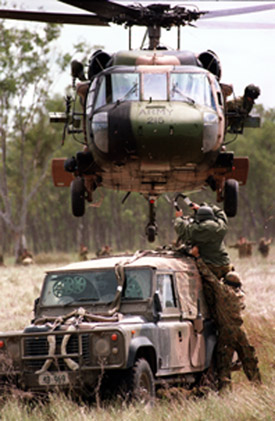 4x4 Perentie being hooked to Blackhawk (Army)
Only 27 LRPVs were acquired. The LRPV is a soft-top but already obsolescent. Several of the 4x4 Perentie variants - covering more than 1700 vehicles - could be used in the role for which the LRPV was primarily acquired: patrol on the Australian mainland carrying a 3-man special forces crew, light weapons and a motor bike. So the LRPV may have been specified in the ITR simply as an estimate of the size of a successor for many of the 6x6 Perenties. There was no mention of loading a typical engineer or construction vehicle such as routinely needed to maintain and extend rudimentary and short airstrips. The public record indicates that five companies responded formally to the ITR:
On 1 July 1997, the Minister for Defence announced that three companies had been short-listed as potential suppliers of new LTA: CASA with the CN235-300M and the C-295M, IPTN with the CN235-330; and LMATTS with the C-27J. The reasons for excluding the Ayres Loadmaster and the Field modified-Buffalo were not made public. However, the Loadmaster was entirely new and uncertified, so its proposal was fundamentally non-compliant. (In mid-2001 and despite orders and options for more than 300 commercial aircraft, Ayres is in Chapter 11 bankrupcy protection and seeking further funds to complete development of the LM200 basic version.) Contrastingly, the capabilities of the DHC-5 Buffalo were proven and closely matched those specified in the ITR. Hence, the Canadians could reasonably expect that their proposal for refurbished and modernised DHC-5D aircraft - whose production had ended in 1985 or 1986 - would make the shortlist at least. But despite new current-model engines and modernised avionics, Defence - with recent experience of corrosion in its Blackhawks and Orions - was evidently not prepared to shortlist a part-paper concept based on airframes more than ten years old even if refurbished to zero-time standard. Each of the four short-listed aircraft was also a part-paper concept for a then uncertified aircraft. But with some stretch of meaning those aircraft were variants of others already in service elsewhere, and the CASA, IPTN and LMATTS proposals were for new-build aircraft. The proposed aircraft had much else in common. All are fixed-wing with twin turboprop engines and a high power/weight ratio. Their short field landing depends upon precise computer-assisted approach to touch-down near the landing aim-point and rapid deceleration with synchronised use of reverse pitch, control surfaces and anti-skid braking to reduce the run and minimise damage to the airstrip surface. The aircraft undercarriages are of similar configuration and all were designed by Messier-Bugatti which is now part of the SNECMA Group. Each has two semi-retractable main units with two wheels in tandem on independent trailing lever suspension. The nose unit is forward folding and fully retractable. In a C-27J on the ground, the pressure in the oleo pneumatic shock absorbers can be varied to adjust the loading/ unloading height and attitude. The other contenders may have this feature also. Each of the contenders has a single point refuelling system and could be readily fitted with an AAR receiving probe. CASA CN235-300M The CN-235 was developed by CASA in conjunction with IPTN using a joint company - Aircraft Technology Industries (Airtech) - with an Indonesian president and a Spanish vice-president. Design work commenced in 1980. A prototype was rolled out in each country on 10 September 1983 and first flights occurred in late-1983. Separate final assembly lines were established in Indonesia and Spain but production of major assemblies was on a one-for-both basis. CASA was responsible for production with its sub-contractors of the cockpit and forward fuselage, centre fuselage, wing centre section and inboard flaps, and nacelles. IPTN was similarly responsible for the outer wings with flaps and ailerons, rear fuselage with ramp, vertical fin and rudder, tailplane and elevators. First flight of a production-standard CN-235-10 with CT7-7A engines was in mid-1986. During 1988 production moved to CASA's -100 and IPTN's -110 with CT7-9C engines. Further improvements to the fuselage and aerodynamic surfaces resulted in the -200 series with CASA's -200 and IPTN's -220 certified in 1992. Variants of the CN-235 include military transports designated CN-235M and maritime patrol versions usually designated CN-235MP. The overall dimensions of these aircraft have remained essentially the same across all models. The cabin is wide but has an airliner style cross-section with sloped shoulders and windows. There is a forward crew/passenger door on the starboard side, an emergency door on the port side, and a paratroop door on each side at the rear. The cabin can have high-density 4-abreast seating in its forward part with baggage behind. In the usual troop/cargo/airdrop arrangement, foldable sidewall seats are augmented by stowable seating. The cabin floor and ramp include a roller system, tie-downs and treadways. The local and area load ratings are similar to those of the C-130. Usable space is extended by the fixed-length ramp/door which can be closed while supporting part of a load. Clearance for loading/unloading and airdrop is increased by a further door opening upward into the rear fuselage. During 1990, Turkey entered into a license agreement to establish a third assembly line and build 52 military transports for its Air Force. The run was extended to add nine more in two maritime patrol versions for its Navy and Coast Guard. One of these was lost with its crew during takeoff on a test flight in May 2001. This closely followed the loss of two Turkish Air Force aircraft with 37 fatalities in January and May. Investigations have apparently focussed on aircraft handling at high weights, and Turkish pilots have criticised the lack of an in-country simulator to assist their practising emergency procedures. At some time during progression to the -200 series, CASA and IPTN agreed that they would develop variants independently and compete for orders. This involved changes also in the sourcing of some components and possibly sub-assemblies. CASA went on to develop the CN-235-300M and IPTN the CN-235-330. For the CN-235-300M, CASA changed from the CT7-9C engine to the CT7-9C3 with a 5% increase in baseline power and improved hot/high takeoff performance. The 4-bladed Hamilton Standard (now Hamilton Sundstrand) propellers were succeeded by a new 6-bladed design which provide 15% more thrust at takeoff power. Normal maximum all-up weight was increased by 500kg. A company brochure issued during 1997 listed other changes including: improved hydraulic system operating the flaps; increased pressurisation differential in cabin; new air-conditioning in cockpit and cabin; and as options underwing hard points rated at 800, 500 and 300kg; and a twin nose-wheel configuration for higher flotability on rudimentary airstrips. This may have reduced its CBR rating below the level 4 of earlier CN-235s. The brochure referred also to a redesigned instrument panel with dual flight management system, and an integrated engine data system (IEDS). This IEDS provides engine, fuel and warning data on two liquid crystal displays (LCD) and also records data for post-flight maintenance purposes. Certification of the upgraded aircraft was expected before end-1998, and a demonstrator was shown overseas during 1999. Further upgrade of the CN-235-300M was pending. On 15 February 1999, CASA and Sextant Avionique signed a contract for supply of a new fully integrated Topdeck avionics suite for the CN-235-300M and also the C-295M. The announcement of this contract noted that the avionics suite should be certified by the end of 2000 with deliveries to commence in 2001. The -300M for AIR 5190 may have been intended to have this suite, and it would definitely have been proposed with the twin nose-wheel unit. Orders for airline and military versions of the CN-235 from Airtech/CASA/IPTN exceed 250 with more than 230 delivered. The airline versions have each been offered in quick-change configuration but only about 50 have been ordered as few commercial operators are prepared to carry the costs of an aircraft designed with integral ramp. In early-1998 the Australian Defence Magazine reported that National Jet Systems (NJS) had placed an order for two aircraft from IPTN with an option for five more for prospective use in Australian and international coastal surveillance and maritime rescue. The current status of the order is not known, and for that role NJS - a subsidiary of FR Aviation/Cobham PLC - is already using several Bombardier-de Havilland Canada Dash 8 aircraft. These are of similar size to the CN-235 but lack its rear ramp. In 2001, there are more than 190 CN-235s in military service. They include more than 60 transport and maritime patrol aircraft with the air forces and navies of Brunei, Indonesia, Malaysia, Papua New Guinea, South Korea and Thailand. Recent orders include one by Pakistan in mid-2001 for four CN-235-220s from IPTN. IPTN CN-235-330 Phoenix IPTN uses the name Phoenix for all airline and military CN-235s from its assembly line. During 1997, the Indonesian airworthiness authority determined that - because IPTN had changed part of the wing leading edge on its CN235-220 military version - the pneumatic boot anti-icing system would have to be re-qualified to the original European Joint Airworthiness Requirement (JAR) Part 25 standard. This ruling delayed delivery of six aircraft to the Malaysian Air Force by more than 18 months. A brochure for the CN-235-330 referred to further improvements including CT7-9C3 turboprop engines, with an option for the CT7-11; new-model Hamilton Standard propellers; and an increase in normal maximum all-up weight from 16,000kg to 16,800kg. It noted that the -330 had excellent rough field, hot/high, and single-engine capabilities; and claimed a consistently demonstrated ability to operate from fields with a CBR of 2 and below. The aircraft may have been intended to have a dual nose-wheel but this was not displayed in the brochure, and it was unclear if the main units had been modified for a softer footprint. Operation at and below CBR 2 would definitely be at less than the maximum all-up weight. The brochure noted also that the -330 would have a 'glass' cockpit with databus integration of all major systems including a flight management system with full mission and conduct modes, inertial and global positioning and navigating, and an option for digital flight instruments or liquid crystal displays. As part of AII for AIR 5190, Honeywell Australia was involved in the electronic design and integration of the cockpit and would provide follow-on logistic support, while Hawker de Havilland/Tenix was already manufacturing metal and composite components for CN-235s and would provide through-life support of aircraft in Australia. Development and testing seemed to be progressing on schedule although a CN-235-10 and its crew were lost on 22 May 1997 during tests of a parachute extraction system probably intended for the -330. The cause was reported as apparent failure of a parachute harness which left a 4,000kg load on the ramp. In late-1997, the draft RFT being discussed by the project office and potential primes was reported as specifying shortened runway performance and increased maximum payload. According to some press reports, this led the chairman of state-owned IPTN and concurrently a Minister in the Indonesian Government to make a direct approach to the Australian Government. These reports were officially refuted. Nonetheless after visits by the project team to the primes, the draft RFT was apparently revised by early-1998 and all short-listed contenders were retained. Soon afterwards during the economic crisis in Asia, conditions on emergency loans provided by the International Monetary Fund to the Indonesian government prevented another injection of development funds into IPTN. The company was unable to obtain an alternative source of funding - understood to be about $US50m - to complete development, testing and certification of the -330. On 26 June 1998 IPTN announced its withdrawal from AIR 5190. Later the technical company representing IPTN would complain that the manufacturer had been close to obtaining the needed funding but this had not been finalised, in part because of a refusal to allow a 2-month extension of the deadline for responses to the AIR 5190 RFT. Development of the -330 was halted. Since then IPTN has concentrated its developmental resources on the N-250 regional airliner which is derived in part from the CN-235 and of similar size to the C-295M. CASA C-295M Development of the C-295M was commenced independently by CASA in November 1996. This followed a survey of potential customers which apparently revealed strong interest in LTA with greater payload weight and volume that the CN-235. CASA reportedly received some $US90m in development loans from the Spanish Ministry for Industry. The prototype was built by modifying a CN-235 and stretching its fuselage. This aircraft had its first flight in November 1997 and was joined in the flight test and validation program by a new-build prototype which first flew in December 1998. The production standard C-295M has some components and many sub-systems in common with the CN-235-300M. The wing has been strengthened to carry more powerful engines and propellers, and increased all-up weight; while the fuselage has been reinforced and lengthened by 3m. Sponsons on the C-295M are larger and the vertical fin and rudder have been extended. Fuel capacity has been increased by almost 50%. The main undercarriage units have been strengthened and fitted with larger wheels/tyres, and the nose gear has twin wheels. Similar to the CN-235-300M, air-conditioning in the cockpit and cabin has been improved, and the pressurisation differential has been increased to 0.38bar: equivalent to 7,900ft when at 25,000ft. Options include a receiving probe for AAR, and three hardpoints under each wing rated for 800, 500 and 300kg. 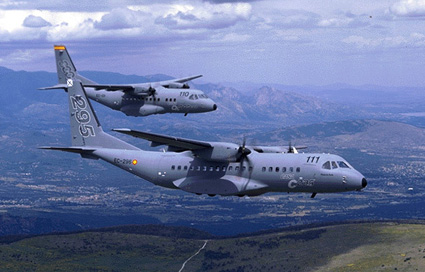 CN-235-300M and C-295M (EADS)
Commencing in 2001, new production C-295M aircraft will have a 'glass' cockpit similar to that planned for the CN-235-300M. The Topdeck avionics suite has an open architecture based on multiple central processor/control units and ARINC-429 and MIL-Standard-1553B digital buses. The configuration chosen by CASA has four main 15x20cm LCDs and provision for two head-up displays. Features include integrated inertial navigation system/global positioning system (INS/GPS), traffic alert and collision avoidance system (TCAS), ground proximity warning system, NVG compatibility, colour weather radar with search and beacon modes and vertical ground mapping, and computed airdrop release point capabilities. Sextant Avionique is also the prime contractor for integration of all systems in the cockpit including IEDS and full authority digital engine control (FADEC), communications and electronic warfare. Video images from forward-looking infra-red, low-light television and other electro-optical sensors can be shown on the main LCDs. Options include laser gyro navigation, enhanced TCAS, microwave landing system, and integrated communications, navigation and surveillance. Similar capabilities are provided in the glass cockpits of all modern airlifters, and integrating their complexities could delay certification of any new aircraft. The 3-year delivery timespan for the Spanish Air Force might have been set to provide for the possibility of such delay. As pre-committed offset for CASA's proposals for AIR 5190, Air New Zealand Engineering Services (AirNZES) was contracted to build elevators for Airbus A340 airliners. Arrangements for AII included AirNZES for through-life maintenance, and Adacel for simulator software. In promoting its aircraft CASA has emphasised their attributes as: * wide armed forces acceptance of the CN-235 as a cost-effective LTA; * development of the C-295M with the longest cabin in its class; * compatibility with loads carried by C-130s. However, CASA may be concerned that their cabin cross-section is more suitable for the transport of passengers/troops and mounded pallets than rectangular freight and vehicles. LMATTS C-27J Spartan The C-27J is an extensively modified variant of the Alenia G.222 which was first produced in Italy during the 1970s. In that timeframe also Lockheed was competing to meet the lower end needs of tactical airlift and proposing development of an L400 aircraft which was to be a cropped twin-engine derivative of its C-130 freighter. The L-400 was intended to carry a 10-ton payload over 500nm from a 1000m airstrip. However due probably in part to availability of the G.222, Lockheed did not proceed with the L-400 and instead directed its effort into upgrading the C-130. Final sales of the G.222 were modest with some 100 examples sold to nine nations including ten in a variant for the US Air Force designated the C-27 Spartan. The C-27 and most versions of the G.222 had a normal maximum all-up weight of 28 tonnes and were powered by General Electric T64-GE-P4D turboprop engines rated at 2,535kW driving 3-bladed propellers. The USAF C-27s were taken out of service and stored during the 1980s pending disposal or re-commissioning. In 1995 during development by Lockheed of the C-130J with new and more powerful engines and a modernised 'glass' cockpit based on a digital electronics architecture, Alenia Aerospace and Lockheed Martin Aeronautical Systems formed a joint team to study development of a similarly updated J-model of the C-27. One publicised conclusion of the study was that the C-27J should have the same external dimensions and improved STOL characteristics. LMATTS was officially formed in November 1996 as a 50/50-owned company to complete development of the aircraft with Alenia Aerospace - a subsidiary of Finmeccanica - as the design authority responsible for manufacture, flight testing and certification; and Lockheed Martin responsible for powerplant and avionics aspects, through-life support and marketing. 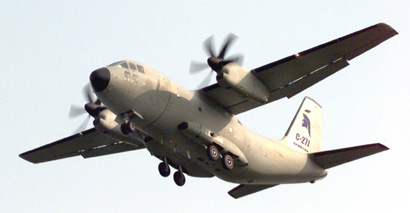 C-27J flyby (Lockheed Martin)
The production standard C-27J has the same basic engine, gearbox and propeller as the C-130J. For its twin engines the C-27J has a depopulated version of the cockpit developed for the C-130J with a MIL-Standard-1553B databus, dual Sanders mission computers, FADEC, GPS/INS and five LCDs integrated by Honeywell. Commonality between the cockpits has been advertised as 60 percent in line replaceable units and 80 percent in software. Also the C-27J nosecone is large enough to accommodate the same AN/APN-241 low-power/low-observable pulse Doppler colour radar by Northrop Grumman as installed in the C-130J. Radar modes include long-range weather (reported as 250nm) with detection of turbulence and wind-shear, vertical obstacle/ground mapping and moving map display, and aerial delivery. The new cockpit is arranged for two pilots whereas the original G.222 had a flight deck crew of three including a flight engineer/radio operator. Both old and new cockpits have jumpseats for a loadmaster or other observer. Load diagrams released by LMATTS confirm that in the C-27J the bulkhead between the cockpit and cargo cabin has been moved into the space previously occupied by the flight engineer and crew stairway/lobby. The external crew door has been retained in its original position on the forward port side of the fuselage but now opens into the cargo cabin, the length of which has been increased from 8.58m to about 9.6m. To assist load-splitting, the floor and hydraulically-operated rear loading ramp with integral tie-downs, rollers and treadways are designed to have the same strength as in the C-130. Unobstructed height over the ramp/door as stowed enables its full length to be used for cargo. The overall 11.4m long cargo space is sealed by an upward opening door that forms the underside of the rear fuselage. Maximum pressurisation differential for the cabin is 0.41 bar. Previous seating arrangements for 53 troops or 40 paratroops have been revised upward. Of greater utility relative to the G.222 and C-27, the load capacity of the C-27J has increased from three to four 463L pallets, and for Perentie vehicles from two 4x4 GS to one 4x4 GS plus one 6x6 LRPV. For use on the ground one sponson includes an outlet to enable transfer of fuel to another fixed-wing aircraft or helicopter. Alenia reportedly considered developing an austere hose-drogue tanker capability for the original G.222. It was to rely on the integral tanks without a supplementary tank in the cabin. That did not proceed and there were no apparent sales of any other AAR tanker kits linked to the G.222 or C-27 nor certification of either for use as a tanker. The C-27J might be offered with an option of roll-on/roll-off tank and hose-drogue dispensing unit conditional on certification. Testing of the production standard C-27J began during 2000. Certification to the European JAR Part 25 light transport standard was obtained in June 2001 and the publicised schedule expects military certification by the Italian Ministry of Defence in November 2001. There has been no report of delay due to changes in the airflow from its more powerful engines and propellers. The same combination in the C-130J affected its stall and icing characteristics and required modifications in software and hardware that lengthened the test and development program. Also as the US armed forces had not at that time placed an order for any J-models, certification had to be conducted by the US civil aviation authority rather its military equivalent. The flow-on affects delayed deliveries of new C-130Js and C-130J-30s - to first the Royal Air Force as launch customer and then the RAAF as second customer - by about two years. The launch order for the C-27J was placed by the Italian Air Force in November 1999, and was for 12 aircraft for delivery in 2001-2004. The C-27J is competing for service with the US Army as the platform for its Aerial Common Sensor (ACS) program, and with the National Guard as a successor for the Air Force Shorts C-23 Sherpa intra-theatre light transport. LMATTS has announced that if selected for the ACS a second assembly line could be established in the United States. Promotion by Lockheed has emphasised the attributes of the C-27J as:
Nonetheless a factor of concern to LMATTS must be the extent to which a lightly loaded C-130 could be used in lieu of a C-27J into and from a proportion of rudimentary and short airstrips. Also for Lockheed that success in selling the C-27J could in some instances reduce the sales prospects of its C-130J. Press releases indicate that the C-27J proposal had a list of companies arranged for AII. These included RLM Systems for software development and support, British Aerospace Australia and Lynwood Systems for test and diagnostic aids, and ADI Limited for computer-based instruction. Boeing Australia would receive work on Boeing 767 wings from Alenia, and was also sub-contracted to provide and manage through-life ground and logistic support. This involved Honeywell and Milflight for avionics, Standard Aero for engine maintenance, Safe Air NZ for propellers, Tenix for undercarriages, NJS for auxiliary power units, and Normalair-Garret for air-conditioning. More Recent History Reverting to late-1997: IPTN complained that the draft RFT discussed by the project office with potential primes specified shortened runway performance and increased maximum payload. For some mix of reasons, finalisation of the definitive RFT for Phase 1 took six months longer than originally scheduled. It was provided to the short-listed primes on 1 May 1998 with tenders due by 14 August. Contract signature was re-scheduled for mid-1999 with delivery of the aircraft to commence in late-2000/early-2001. The RFT for the Phase 2 simulator was re-scheduled for late-1998. On 26 June 1998 IPTN announced that it had withdrawn from the project. The primes and Defence might have counted on a win here leading to a boost in production and sales, and all presumably had expected that the Spanish, Indonesian and Italian air forces would become early customers for CASA, IPTN and LMATTS new aircraft. However they must have expected also that few new aircraft would be ready for any customer in late-2001, so the RFT included an option of leased aircraft for some interim period. CASA later reported it had proposed 14 ex-Spanish CASA C-212 Aviocar aircraft (max payload 3 tonnes / 230nm). LMATTS did not publicly disclose details of its proposals but these were reported as including lease of six G.222s or possibly C-27s previously used by the Italian or US air forces. No public version of the Pink Book was released during 1998 and the series was effectively discontinued. A compendium of Defence Major Capital Equipment Projects published in June 2000 included little data on planned expenditure. Much later it transpired that the next detailed summary of unapproved capital projects would be released in mid-2001. Defence continued to provide general information on planning and groups of projects, and project offices issued updates on individual projects. During October and November, a team from the AIR 5190 project office visited Italy and Spain for another round of flight and ground evaluations. At a military-industrial seminar on ADF airlift in late-1998, Air Force was explicit about various difficulties especially in respect of personnel, training and new aircraft. Its squadrons had too few current aircrew and maintainers to fly the required levels of operational missions, and a big move into simulation was being made to prepare, augment and support practical skills. Meanwhile current aircraft were hard worked and some needed refurbishment or replacement. (Many pilots are routinely posted on rotation to non-flying duties such as staff and projects. The reference to simulation may have included computer-based instruction-refresher/workaids for all musterings.) 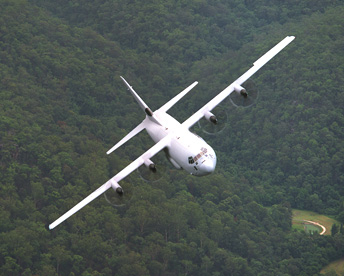 C-130J-30 (Defence)
The seminar did not discuss the financial dangers of early orders. Late delivery causing under-spend in programmed expenditure can ripple into later years. Acquisition projects are programmed with contingency margins for short internal delays and advances. Separate provision is made for exchange rate fluctuations. In any given year delivery of some in-stock or short lead-time manufactures can be accelerated and adjustments made between projects. Also a carryover of funds is specifically permitted in the Defence budget. With Government approval, it may also be possible for under-spend funds to be placed in a specific trust account held against delivery. There are limits on all such arrangements and in the worst case funds approved and budgeted but unspent in the fiscal year are effectively lost from the overall investment program. The system cost of the C-130J-30s was about $1.4 billion in contract-year dollars programmed over several years. In early-1999, Defence announced that the project team's evaluation of Phase 1 tenders - rumoured to have been completed in January - was being examined by the Defence Source Selection Board (DSSB) with a decision expected by April. If that proceeded and a recommendation was approved by Government, then it was planned to announce the preferred tenderer in May with contract signature in about August. The later schedule was delivery of aircraft to commence in early-2001, then test and evaluation trials, and entry into squadron service in late-2001. It was not clear if this was meant to involve new model or leased aircraft. In April 1999 the Spanish Air Force placed the launch order for nine C-295M with deliveries expected to commence in late-2000. The C-27J had yet to obtain its launch order. An item in the technical press commented the final countdown for AIR 5190 had begun; the DSSB was scheduled to meet on 28 April; contract signature was expected in August with initial deliveries in early-2001 followed by operational test and evaluation and aircraft entering squadron service in late-2001. Also in April the president and chief executive officer (CEO) of LMATTS commented that its 10,000 page proposal included options starting with 10 aircraft. Another news item referred to an LMATTS proposal for ten aircraft with an option for 5 more. Evidently both related to the acquisition rather than interim lease. The CEO was also reported as saying the C-27J had better overall performance than its competitors, and with a 6 tonne load was rated at 3G relative to 2.5G for the G.222. In July 1999 Defence announced that: the CN-235-300M would not be required; neither of the other tenders currently met all requirements; CASA and LMATTS had been asked to clarify and resubmit their tenders for the C-295M and C-27J; re-assessment and selection of a preferred tenderer would extend into 2000 with announcement and contract signature expected in February and May, and the first delivery unchanged in mid-2001. In August the Defence Reporter Australia & Asia-Pacific commented that it had learned from separate sources that each tenderer had offered 10 aircraft and that each had put in a satisfactory AII proposal. Also that from some source or sources, Defence's list of questions to assist CASA's review of its tender was 20 pages long and the list to LMATTS was 8 to 10 pages. Notwithstanding possible revision of the draft RFT to retain IPTN's CN235-330 - and presumably CASA's CN235-300M - this finally confirmed that the required capabilities did include a maximum payload larger than specified in the ITR. Also taken in conjunction with the comments of LMATTS' CEO and complaints of IPTN, it could be inferred that the draft RFT had required a shorter runway performance with a reduced load of about 6 tonnes. Had the 5 and 2.4 tonne loads specified in the ITR become 9 and 6 tonnes in the draft RFT? Even if these had been relaxed in the definitive RFT, the project had two competitors which could apparently deliver those capabilities. Neither was yet proven or available for the delivery timeframe but lease arrangements could suffice. However, tenders had to be revised, evaluated by the project office, its assessment examined by the DSSB and higher in Defence, and any recommendation for acquisition approved by Government. Also there was a budget crunch yet to be uncovered and another White Paper pending. ACKNOWLEDGEMENT. This analysis includes quoted material and substantial extracts from the following documents copyright Commonwealth of Australia reproduced by permission: AIR 5190 - Light Tactical Airlift Capability - Invitation to Register Interest for the Supply of a Light Transport Aircraft to the Australian Defence Force - AFMAT 5/97; AIR 5190 - Light Tactical Airlift Capability - Industry Brief - AFMAT 5/97; Australian Perspectives on Defence: Report of the Community Consultation Team - CCT, DPS September 2000; Defence 2000: Our Future Defence Force - DoD, DPS OCT010/2000; Media Release: Major Defence Capital Equipment Projects - MIN 146/01 22 May 2001; Defence Capability Plan 2001-2010: Public Version - DMO, DPS JUN004/01. TABLE 1: DHC-4 Caribou and C-130 Hercules
Notes. 1. Integral tanks hold 26,340 litres, each underwing tank 5,145 litres. Underwing tanks are standard on C-130H, optional on C-130J-30. 2. Takeoff/landing data is known or assumed to be for a flat, dry airstrip at SL, ISA + 15 or 20ºC, zero wind. 3. Safety reserve incorporated in payload / range parameters typically allows for a diversion of at least 100nm or 5% of range, and holding at low altitude for 30 or 45 minutes. 4. Payload / range bounds at RAAF reduced takeoff weight of 11,800kg: 2,700kg / 140nm and 1,000kg / 950nm. 5 & 6. With a payload of 11,340kg and fuel for more than 500nm, the C-130H using USAF maximum effort procedures has a takeoff run of approx 540m paved, 640m unpaved; the C-130J (and C-130J-30 with 9,640kg) has a takeoff run of approx 450m paved, 520m unpaved. 7. Range on full tanks at
economical cruising speed without cargo. TABLE 2: CASA and LMATTS Contenders
Notes. 1. Parameters estimated from other reference data are preceded by "est". 2. Vehicle load at normal max
takeoff weight: 3. Data is for normal STOL takeoff and landing profiles. Part
2 of 2
News of the launch order for the C-27J arrived in November 1999. The order was placed by the Italian Air Force and covered 12 aircraft for delivery in 2001-2004. In early February 2000, an Australian technical journal reported on developments in AIR 5190 and attributed the information to Defence. The LTAC project office had completed its assessment of the revised tenders and made a recommendation which had yet to be examined by the DSSB. The Defence position on the project was that it was not simply a replacement for the Caribou and if that had been the case the aircraft would have been re-engined years previously. CASA and LMATTS had been told to expect definite information in late-February or March. It was also generally known that the Defence budget was overstretched. Operational resources were heavily committed to the UN-endorsed deployment to East Timor, and preparations for security support during the Olympic Games. Rectification of the Collins-class submarines and procurement of the Hawk lead-in fighters/trainers and AEW&C aircraft were demanding a large component of the capital investment budget. The plans and schedules of all acquisition and infrastructure projects were under review and adjustments would be made for the near term. For the longer term, a White Paper was being developed for issue later in the year. Defence budget papers for FY 2000-2001 released in May 2000 mentioned an intention to review the ADF's tactical transport fleet including the way ahead for the Caribou. They referred also to studies to investigate life-of-type and supportability aspects for the aircraft. On 13 June the Defence Minister announced that the White Paper would be preceded by a public consultation process on defence and security issues. To further the process a small apolitical community consultation team was formed and a public discussion paper on defence was released on 27 June. The purpose of the discussion paper was to raise community awareness and outline aspects, contingencies and options for the next 15 years. It briefly analysed the environment, strategic, organisational, technology and resource issues and included a summary of current capabilities. The role of the consultation team was to co-ordinate a series of public meetings and discussions, receive and collate all forms of input, and provide a consolidated report to the Minister. In July 2000 technical journals were able to report authoritatively report that the LTAC project office had completed evaluation of revised tenders in November 1999, and that the DSSC had made a firm recommendation in late-February 2000. Defence had in June written to CASA and LMATTS advising them it had decided against a further extension of the tender process and that AIR 5190 was suspended but not cancelled. Defence had also briefed the primes on its reasons for not proceeding in the near term, and Air Force was to continue studies to determine how the Caribou could be kept in service for another 5 to 8 years. Several reports claimed a clear victory by CASA and attributed the information to usually well-informed sources. That could mean poor confidentiality within Defence or- equally well - inadvertent relay of rumour contrived by a publicity agent. One journal commented that aviation circles estimated CASA and LMATTS had each spent in excess of $10m in attempting to win the competition. Also in mid-2000, Defence Report 1999-2000 noted that a low sortie launch rate of 85% for the Air Lift Group as a whole was due to Caribou aircraft only achieving a rate of 55%. It attributed this to maintenance difficulties especially with engines, lack of current aircrew, and the pressure of operations in Timor. The community consultation team provided its report - Australian Perspectives on Defence - to the Minister on 29 September. The notes in the public version of that report relating to airlift, AAR, logistics and transport were:
In late-2000 the technical press reported that a group of several Australian companies and an American company Pen Turbo Aviation had proposed to Defence a private financed initiative for re-engining the Caribou, and that this was on similar lines to a study completed by de Havilland Canada during the 1980s. Pen Turbo had a prototype flying with the R-2000 Twin Wasp radials replaced by Pratt and Whitney Canada PT6A-67T turboprop engines (takeoff power 1,060kW) driving Hartzell 5-bladed propellers conveying a general improvement in hot and high performance. At the normal all-up weight of 12.9 tonnes and with STOL capabilities maintained, the DHC-4T prototype had demonstrated a 15 percent increase in maximum payload, substantial improvement in payload/range figures and a small increase in cruising speed. 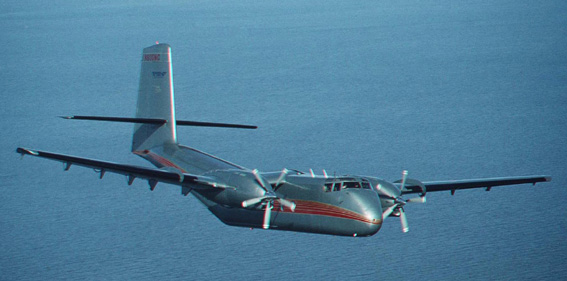 DHC-4T Turbo Caribou (Pen Turbo Aviation)
Overseas in late-2000, the C-27J and C-295M were engaged in a head-to-head competition in Switzerland. In December the Swiss defence authority summarised its evaluation as showing that the C-27J has superior flight and transport capabilities but the C-295M would have lower acquisition and life-cycle costs. The Swiss, who do not operate any C-130s, announced that they would order two C-295M. They disclosed also that this would necessitate procurement of some light off-road vehicles to complement in-service 4x4 armoured scouts which evaluation had shown to be portable only in the C-27J. A press release from CASA noted that contract signature was expected in October 2001 with delivery scheduled for 2003. This was the first export order for the C-295M. It was followed in March 2001 by an order from the United Arab Emirates for four aircraft equipped for maritime patrol. The C-27J was apparently not tendered. There may have been other direct competitions but these were not publicised by CASA or LMATTS. The public version of DWP2000: Our Future Defence Force was released on 6 December 2000. Notes relating to airlift, AAR, logistics and transport were: 8.27 "… An additional squadron (about 12 aircraft) of troop-lift helicopters to provide extra mobility for forces on operations. In particular, these helicopters will enhance our capability to operate off our newly acquired troop ships, HMAS Manoora and Kanimbla. These helicopters are planned to enter service around 2007." 8.32 "Our airlift capabilities will be enhanced by the acquisition of new aircraft to replace the Caribou from 2010, and by the refurbishment of our 12 C130H aircraft by about 2008. We plan to undertake a major program to provide better electronic warfare self-protection of our transport aircraft and helicopters from missiles by around 2004." 8.33 " … Logistics capacity will also be enhanced by a number of important programs including a major replacement program for Army's fleet of trucks, scheduled to start by 2008." 8.42 " …our AAR aircraft - four Boeing 707 aircraft - are close to the end of their effective life. Over the next few years they will need to be substantially refurbished or replaced if we are to retain an AAR capability …" 8.47 "… scheduled a major project to replace and upgrade our AAR capability. This project will acquire up to five new-generation AAR aircraft, which would have the capacity to refuel not only our F/A-18 aircraft but also our F-111 and AEW&C aircraft over a wide area of operations." On 22 May 2001, the Minister issued a statement on major capital equipment projects approved for Defence in the 2001/02 May budget. Thirty-eight projects had been approved and one of the new projects was an extension for the Caribou. Substantial details were provided for just five projects and one of them related to airlift so it is reproduced in full. " Extension of the Working Life of the Caribou Light Tactical Airlift.
This project will contribute to Defence Output 4: Air Force Capabilities." Corporate Developments Overseas In June 1999, there was an official announcement of planning for a merger of CASA and the German-American company DaimlerChrysler Aerospace AG (DASA) headquartered in Europe. This move was part of a general consolidation of the western European defence and aerospace industry which was reported to be having numerous discussions on ways to combine and compete with the giant North American companies Boeing and Lockheed Martin. In October 1999, DaimlerChrysler announced that its aerospace component DASA was to merge with France's Aerospatiale Matra to form a consortium to be known as European Aeronautic Defense and Space (EADS). This expanded a relationship between the two companies which together with British Aerospace (BAE) and other companies were producing the Airbus line of commercial aircraft. During late-1999 and early-2000, several reports noted that Finmeccanica the Italian state-controlled company and owner of Alenia Aerospace was determining how to rationalise some of its interests. These included how Alenia might be privatised, and that parts of the company such as the Space Division had already been established as independent companies. Finmeccanica was also reported as having discussions with BAE, the EADS partners and other entities. In April 2000, Finmeccanica and EADS agreed to form a joint venture military aircraft company to be formalised in early-2001. In May 2000, the multi-national European Commission gave conditional approval to the merger of DASA, Aerospatiale-Matra controlled by the conglomerate Lagardere and the French government, and CASA controlled by a Spanish state holding company SEPI. In the EADS consortium, CASA was planned to be the core of a Military Transport Aircraft Division. In July 2000, CASA formally joined EADS. Also there were reports that Alenia was discussing a proposed partnership with EADS agreed to by Finmeccanica in April and known then as the Joint Venture Company. One report noted that a spokesman for Alenia had said that although the joint C-27J program with Lockheed was not included in the joint venture talks it might be added later. There was little publicised comment or analysis of how Lockheed might view a proposed novation of its arrangement with Alenia Aerospace. In early-2001 EADS was reported as close to agreement with Finmeccanica regarding acquisition of the Aeronautics Division of the latter's Alenia Aerospace subsidiary. It was not clear from those reports if the earlier discussions or proposed partnership included the Space or other divisions of Alenia Aerospace. This was clarified in June 2001 when Defence Data published a summary of western European defence and aerospace company relationships (http://defence-data.com/ current/pagerip1.htm). The summary listed Finmeccanica as 50/50 owner with Lockheed of LMATTS, and through its ownership of Alenia Aerospace as 50/50 owner with EADS of the new European Military Aircraft Company (EMAC). Finmeccanica's contribution to EMAC evidently included what had been the Aeronautics Division or subsidiary of Alenia Aerospace. Projects and Airlift in the 21st Century In June 2001 a new planning document was released as Defence Capability Plan 2001-2010 (DCP2001) Public Version. DCP2001 replaced the Pink Book and similarly details all current Unapproved Major Capital projects and adds Approved Projects not yet let to commercial tender. Its introduction notes that planning of some proposals is not mature enough to fully detail each phase, and that such proposals are described in a single phase. Compared to the Pink Book, DCP2001 has longer notes for each project and includes more planning dates for the approval process but does not provide a bar chart of expected expenditure year-by-year. The year for completion of a phase and wind-down of expenditure for acquisition is sometimes mentioned in the notes. Extracts from the airlift projects are: AIR 130 Phase 2: Chinook Mid-life Upgrade Modernisation of 6 CH-47D medium lift helicopters within guidelines to be provided by the ADF Helicopter Strategic Master Plan. YOD 2007/08. In-service delivery 2010. Scale of expenditure $100m - $150m. AIR 5046 Phase 5/6: Additional Troop Lift Helicopters Phase 5 is capability definition study commencing in 2001/02. Phase 6 is to acquire about 12 aircraft to enhance mobility especially from newly acquired maritime warfare ships for troop transport, search and rescue, vertical replenishment and medical evacuation. Army has 36 Blackhawks with primary roles of Airmobile Operations and Special Missions. Blackhawk is not compatible with ship-borne operations. Navy has seven Sea Kings that provide utility lift in support of the fleet. Sea King is not optimised for combat operations over land. Solution will be a Military-Off-the-Shelf Helicopter taking into account commonality with existing aircraft. YOD 2001/02. RFP 2002/03. Contract 2003/04. In-service delivery (first) 2007. Scale of expenditure: $350m - $450m. AIR 5046 Phase 7: Blackhawk Mid-life Upgrade Modernisation of 36 S70-A-9 helicopters within guidelines to be provided by the ADF Helicopter Strategic Master Plan YOD 2005/06. In-service delivery 2010. Scale of expenditure: $750m - $1000m. AIR 5190 Phase 1A: Caribou Life Extension Decision not to proceed with Phase 2 ((sic)) in late 2000 has meant urgent action is needed to address Caribou support. Recovery program for re-instatement of deeper maintenance of Caribou, wound back in preparation for introduction of LTAC, will include long lead-time spares and clearance of the backlog of critical Engineering Change Proposals. Phase does not include provision for revised engine solutions. Activity already commenced and will be ongoing. Scale of expenditure: $100m - $150m. AIR 5190 Phase 2: Light Tactical Airlift Capability Aircraft will be a replacement for the current Caribou. Phase is also likely to provide for a Level 5 full-flight simulator. Possible options could include platforms such as the CN295 ((sic)), C27J, V22 Osprey or Chinook. Replacement options may be affected by solutions for AIR 5414 Phase 1 C-130H Refurbishment and recommendations flowing from an ongoing Airlift Study. YOD 2004/05. RFT release 2005/06. Contract 2006/07. In-service delivery 2010. Scale of expenditure: $750m - $1000m. AIR 5401 Phase 1: Medium Tactical Airlift Capability Improve on-line availability of C-130H out to the planned fleet withdrawal date of 2008. Requirements will focus on replacing poor performing avionics components and undertaking some structural work while aircraft is undergoing deep maintenance with prime contractor Qantas Defence Services. Avionics component unlikely to commence before mid-2002. Scale of expenditure: $30m - $50m. AIR 5402 Phase 1: ADF Air Refuelling Capability Replace and enhance AAR capabilities. To be capable of refuelling ADF fighter, strike and surveillance aircraft. Additionally enhance strategic airlift for forces deployed in-country or overseas. AAR now provided by three B707 which are operationally limited and approaching effective Life of Type. ((One of the four tankers was apparently retired early in 2001.)) Capability requires up to five new generation tanker/transports from 2006. Modification of aircraft to include boom/hose and drogue, and cargo systems. YOD 2002/03. RFT release late-2002. Contract 2003/04. In-service delivery 2006. Scale of expenditure: $1500m - $2000m. AIR 5414 Phase 1: C-130H Refurbishment Major refurbishment of existing C-130H fleet to extend platform life-of-type until at least 2020. Identified needs that may relate to this stage include systems, structures, avionics. YOD 2003/04. RFT release 2003/04. Contract 2004/05. In-service delivery 2008. Scale of expenditure: $450m - $600m. AIR 5416 Phase 2: EWSP for Selected ADF Aircraft Multi-phased proposal to develop comprehensive Electronic Warfare Self Protection (EWSP) capabilities for selected ADF aircraft. Phase 1 in progress includes development of radar warning receiver, and two competitive EWSP suites. Phase 2 will implement Blackhawk, Chinook and C-130J EWSP capabilities. YOD 2002/03. In-service delivery 2004/05. Scale of expenditure $150m - $200m. The project descriptions are informative. The AIR 5046 acquisition is planned as a Request for Proposal from one or more selected primes to provide specific aircraft. The AIR 5190 Phase 2 entry confirms that the current intention is to undertake an austere refurbishment of the Caribou. Its engines are not to be replaced. The references to options for AIR 5414 Phase 1 and a continuing Airlift Study imply that the C-130J is again being considered for AIR 5190. AIR 5401 bracketed with AIR 5414 has a lower scale of expenditure than envisaged in PB1997-2001 and it is planned to retain the C-130H for a further period. Project AIR 5416 does not mention the C-130H or AIR 5414. The scale of expenditure for AIR 5402 has been increased and would be sufficient for acquisition of five new medium tanker/transports or five heavy tanker/transports or tanker/freighters. There was no mention of AAR for any airlift aircraft. In general: project schedules have been compressed with YOD, RFT and contract in successive years. AIR 5402 is more rapid with about one year from YOD to contract. The projected total expenditure on airlift to 2010 is large. There are typographical errors in AIR 5190 and none - readily apparent - in the other airlift entries. In line with, as an adjunct to, or despite the planning outlines already released, a continuing study will be making recommendations for airlift and specifically AIR 5190. In the interim Defence had been making arrangements to meet International Civil Aviation Organisation Stage 3 noise limits and to phase out its remaining 707-338C tankers before the end of 2003. A closed briefing for invited aerospace companies and banks was held in Canberra in early-August 2001. Reports indicate that Defence plans to issue in September a RFP for lease of several AAR tankers to cover the period from 2002/03 until delivery of the AIR 5402 tanker/transports or tanker/freighters. The draft RFP had a commercial cost-cap of $30m per year for up to five years and was for dry-lease with aircrew and maintenance to be provided by Air Force. The closing date for proposals was planned for mid-October. With regard to the ALS, it would be useful to get ahead of the present and then look back on any aspect that may affect the future of AIR 5190. Such a survey might in particular reveal some change since the mid-1990s. Also aviation and defence journals have frequently commented that in the period 2010 to 2025 Defence will have to address block obsolescence of F/A-18 fighters and AP-3 maritime patrol/ASW aircraft and possibly F-111 strike fighters. Refurbishing or replacing each of those capabilities will be expensive, so overshadowing the ALS is the need for affordable actions on airlift that can be completed before any funding crunch in the period commencing 2010-2015. The ALS will be assessing needs and prospective solutions from top to bottom. It is convenient to start with AAR. However before surveying ALS it is useful to review news from overseas. Overseas Developments in Mid-2001 During July, Swiss authorities announced that the planned order for two C-295M would not proceed to signature in October 2001. Also in late-July Lockheed Martin issued a press release on airdrop testing just concluded at a US Air Force base using three C-130J-30s. It referred to completed tests as including parachute-assisted deployment of pallets weighing up to 42,000 pounds and paratroop drops from altitudes up to 25,000ft. The release also noted that the aircraft were the first stretched C-130Js fitted with an enhanced computer-controlled cargo handling system which allows pallets to be quickly transitioned from tie-downs to rollers. In late-August one aircraft was to be deployed to an operational airborne unit for further paratroop testing, and then delivered to a reserve unit during November. In early-August the journal Flight International reported on other developments relating to the Hercules. The US Air Force has awarded Boeing a $US485m contract to develop upgrade kits for C-130Es and C-130Hs as part of a proposed $US3.9b modernisation program for 519 aircraft. Outline planning is for two C-130H aircraft to be modified for flight testing beginning in 2004 with fleet upgrade from 2005 to 2014. Flight referred to anticipated results as a 20-30 year extension of service life, and limiting the procurement of new C-130Js to those needed to replace the oldest C-130Es which are to be retired. Separately it was reported that the modernisation program will include a glass cockpit with six LCDs, head-up displays and upgraded communications and installation of the AN/APN-241 weather radar. Additionally Flight International reported that Lockheed Martin expects an improvement in C-130J operational capabilities shortly with approval of the latest software standard (Block 5.3) by the Australian and US air forces. The company also said that it had fixed problems with a refuelling pod for the KC-130J by returning to a design used on earlier aircraft, and had during July completed testing a revised pod on the KC-130J for AAR of helicopters and F/A-18 fighters. The journal noted finally that the US Marine Corps has ordered 52 KC-130Js and expects a further 70 to be ordered for its reserve component. In late-August EADS announced that it had signed a contract with Polish authorities for eight C-295M aircraft to be delivered to the Polish Air Force from 2003 to 2005. As part of the arrangements EADS is to buy a majority shareholding in an aircraft company in Warsaw. Other entrants in the competition were the AN-32M produced by Antonov in the Ukraine, and the C-27J. The C-27J has yet to obtain its first export order. ALS and Air-to-Air Refuelling DCP2001 specifically mentions boom and hose-drogue systems but the ALS may not have to provide the refuelling boom (transfer rate approx 3,000 lpm, extended length approx 10m) on all tankers, or indefinitely on any tankers. Use of a boom does minimise individual transfer time and sub-system weight in the receiver, but its weight and bulk demand installation on the tanker fuselage. Also the short separation between a boom tanker and receptacle receiver is hazardous for both aircraft. Alternatively, the tanker with two or three lower capacity hose-drogue units (transfer rate approx 1,500 lpm, hose length approx 25m) can provide simultaneous transfer with redundancy. Use of hose-drogue units also means that hazard is somewhat transferred to the one or more probe receivers. The result is that - except for some large bombers - the fixed receiving probe has become a virtual standard on subsonic aircraft. The twelve C-130J-30s were delivered without probes but with appropriate pump and plumbing arrangements. Indicative drawings of the Boeing 737 Wedgetail - four on order for Aircraft Early Warning and Control (AEW&C) - show a fixed receiving probe.  F-111 refuelling from USAF KC-135R (Defence)
So notwithstanding any prospective support from and to American forces, Defence guidance might mandate hose-drogue/probe refuelling for selection of the fighter to succeed the F/A-18. At the least it will not mandate boom/receptacle refuelling. For expedient use and especially during surge the freighter/tanker with only hose-drogue dispensing units continues to have useful and - subsequent to the F-111s - probably general potential. Whenever practicable tankers operate from bases with long paved runways as needed to also support the operation of many types of fighter and patrol aircraft. Guidance will have included potential operating bases and also airstrip distribution, ranges to tanker orbits and for escort/ferry, loiter durations, approximate numbers of patrol and fighter sorties, and their approximate take-on quantities. In addition as part of the ALS preparation, AAR issues have been examined in detail by Carlo Kopp in Aerospace Centre Working Paper 82 (http://www.defence. gov.au /aerospacecentre/) and in two series of articles for Australian Aviation (April-May 2001 and Dec 1999-April 2000 repeating ACWP82). But for mainline refuelling the ALS has to determine the suitability, approximate size and number of medium or heavy strategic tanker/transports or heavy tanker/freighters as discussed in ACWP82. The latter are envisaged as conversions of large commercial aircraft with a nose door and capacity for outsize cargo in the main cabin. For some time also Defence has displayed interest in the potential of heavy strategic/tactical freighters and freighter/tankers. One contender is the EADS A-400M which is in development with more than two hundred on order for eight European countries. In most respects it resembles a scaled-up Hercules with a normal maximum payload of about 32 tonnes. There is a proposed freighter/tanker version with hose-drogue dispensing units. With J-model Hercules already in service, the prospect for ADF acquisition of the A-400M in the near-term is effectively zero. Also as the first twelve J-models were acquired in long-body J-30 configuration, Defence may have already determined that it cannot afford to acquire any aircraft with a capability to carry bulkier or heavier freight. However, for this a larger contender is the Boeing-McDonnell Douglas Globemaster III. It has a flyaway cost about twice that projected for the yet-to-fly A-400M. The turbofan powered C-17 is in-service with the USAF and four in an extended-range version have been obtained under a 7-year lease arrangement by the Royal Air Force to complement its 80 early and late-model C-130s. The C-17 has a normal maximum payload of about 75 tonnes. It can lift this load between airstrips with a takeoff distance of less than 2,400m and then fly 2,400nm and land within a distance of 900m. With a 50% load it can use 1,000m airstrips. Similar to the A-400M, a KC-17 freighter/tanker variant has been proposed with hose-drogue dispensing units, and optionally an AAR boom swivelled or offset below the ramp. At industry quoted prices the flyaway cost of the C-17 is about 250% that of a C-130J. With the cost of spare engines and other unique items, the system cost to the ADF of acquiring four KC-17s would equate to that of adding about twelve KC-130Js. The ADF might commit all of the funding provisionally allocated to AIR 5401 and 5414 toward acquisition of KC-17s. Conceivably, KC-17s could be acquired under AIR 5402 itself. However, C-17 aerodynamics are directed at reducing takeoff and landing requirements rather than economic cruise and loiter at altitude. Also Air Force is known to be wary of swing-role aircraft and understandably would prefer mainline AAR based on strategic tanker/transports or tanker/freighters. Surge capability is a different matter and for that the KC-17 would be a useful expedient. The same applies especially to KC-130 variants. From the bottom up, the ALS may be required to make recommendations on AAR for helicopters, and possibly other light aircraft. Some Blackhawks are currently equipped with long-range tanks for missions such as combat search and rescue. No helicopters or other LTA are currently equipped as AAR receivers or tankers. High capacity jet tankers are too capable and even at low speed generate too much turbulence for regular AAR of helicopters. Light transports have marginal cost-effectiveness as tankers because their fuel offload can support few aircraft and at limited range. Other customers are unlikely to procure a KC-295M or KC-27J and certification of either would probably involve direct or indirect funding from Defence. Buddy-refuelling of a light aircraft - or fighter - by a companion fitted with underwing tanks/hose-drogue units is practicable but expensive. It is sometimes employed by naval forces but only rarely in other situations. The most cost-effective solution is usually a medium size tactical freighter/tanker such as the KC-130 that can refuel any probe equipped aircraft, and during surge support a flight of fighters or a patrol aircraft at fairly long range. KC-130s and also some strategic tanker/transports are qualified for hose-drogue refuelling of helicopters including the Chinook and Blackhawk. Aircraft used predominantly as tankers are typically tasked at heavy takeoff weights but they tend to accumulate fewer flying hours than freighters and can have long useful lives. Hence upgrade and modification of several C-130Hs to KC-130Hs could be a viable option for the near term. This applies particularly because the US Air Force intends to upgrade some 500 early-model Hercules' to gain an extra 20 to 30 years of service life as freighters and special-purpose aircraft. Modification to produce KC-130Hs for the ADF would mean that local stocks of engines, spares, test and training equipment could not be rationalised, so unless KC-130H usage were constrained this could become a costly form of stopgap. If however New Zealand were to retain and refurbish its C-130Hs, then some or all deep maintenance on ADF H-models might be transferred there. DWP2000 did not mention AAR for any level of airlift. But for expedient AAR of combat aircraft and if necessary of airlifters, the near-term alternatives are: acquisition of KC-130Js; the less likely modification of C-130J-30s to KC-configuration with a fuel offload almost two tonnes lower; and modification of C-130Hs to KC-130Hs with these used almost exclusively as tankers to obtain return on investment. Eventually any KC-130Hs would have to be replaced, probably by KC-130Js. ALS Freighting and Tactical Transport In the middle, ADF airlift currently has the twelve C-130J-30s complemented by twelve C-130Hs, locally designated as strategic transports and medium tactical transports respectively. As in other Armed Forces and with more than 2,000 produced, the C-130s are proven and very capable. Presumably operations could use as many as practicable with aircrew numbers but the aircraft cannot be stretched across the entire spectrum of airlift tasks. Also there are other C-130s available in the Pacific at least and further examples in Asia.  C-130 Cargo Hold (Defence)
Going down in range and size, the argument for fixed wing LTA is sometimes criticised as being more about efficiency than effectiveness. That is valid but only for some missions. The loads delivered or picked up by an LTA can involve airstrips unusable by a C-130 at ranges impossible for a Chinook or other helicopter without air-to-air or surface refuelling. How many such airstrips may have to be used? Enough to consider AIR 5190 as a project. Long and slow flights by helicopters introduce hazards that are difficult to assess in terms of effectiveness or efficiency. However since the retirement of their Caribou, American forces have relied upon more than 700 C-130s complemented by about 300 heavy freighters and 900 heavy and 3000 utility helicopters. Soon the latter will be joined and some will be replaced by the V-22. With bigger responsibilities and resources, the small American freighter may have to be bigger than anyone else's. For work at low altitude, airlift needs flying cranes and probably more than six Chinooks. Also aircraft go off-line, are destroyed in accidents and by enemy action and concurrency has to be provided at all levels. For combat transport within possible range of shoulder-fired and crew-served weapons, utility helicopters with dual engines and a single rotor have better survivability than dual rotor aircraft. Airlift needs as many utility helicopters as can be funded in parallel with armed reconnaissance and fire-support versions. The V-22 might be considered for a light transport role such as the AIR 5190 LTAC, as a potential successor for the Chinook, or below those aircraft where - despite its higher speed and ramp - it would be confronted by the agile and robust utility helicopter. Light utility helicopters with a maximum payload of about one tonne are outside the scope of airlift. ALS in General In connection with delivery of the C-130J-30s, the options for further C-130s were reported as applying until 2002. These may have been extended. If not, the ALS will be required to make a recommendation. Input from New Zealand would be concentrated on Hercules and LTA including helicopters. The NZDF also operates six Lockheed P-3K maritime patrol/ASW (MPA) aircraft and in recent years it retired several British Aerospace-HS Avro Andover light fixed wing transports without direct replacement. If the NZDF plans to keep its five C-130Hs then - to support also its P-3Ks - the C-295M or MPA might be advanced as preferable to the C-27J. Alternatively, acquisition of the C-130J would probably preclude any new LTA. Possibly the NZDF will not procure any new airlifters. Input from the US would mention the advantages of commonality with equipment used by US Forces. If civilian agencies were asked for input on ADF airlift, then the National Disasters Organisation would probably stress utility helicopters and flying cranes, medium and possibly heavy freighters. The Australian Maritime Safety Agency would focus on improving fast-response search and rescue. The ALS has a complex task. Its big issues are:
Airlift Paths Excluding LTA Summarising the above paragraphs: for airlift and concurrency Defence needs a mix of aircraft. To enable and sustain combat airpower in a surge, mainline airlift has to be augmented by expedients. This applies regardless of the number of freighters, freighter/tankers and more specialised tanker/transports or tanker/freighters that can be afforded, and also contingent support from allies. Airline transports and freighters might be readily obtainable on short-term lease but that is unlikely to apply for tankers. As an expedient tanker - diverted from other military use - the KC-17 would be very capable and expensive. However, the KC-17 and also the strategic tanker are inappropriate for low-altitude refuelling of slow-flying helicopters and at higher levels have too much capacity for cost-effective AAR of other LTA. The KC-130 is less capable but more flexible for both tanking and freighting. If any LTA were to be fitted with AAR probes then the KC-130 or a similar aircraft would become essential. Some of the current C-130Hs could be refurbished and modified to KC-130Hs but eventually those would have to be succeeded, probably by KC-130Js for rationalisation. For heavy and bulky freight the strategic/tactical C-17 is far more capable than commercial freighters. If any offset had to be obtained between acquisition projects, then it could only come from the middle ground and the mooted replacement of the C-130H. The (K)C-17 is either a mirage or an outline on the horizon. In Defence's part of the world it may have to be investigated when it becomes more apparent. There is also a chimera. In the recent past Boeing has accepted late-model Airbus airliners as trade-ins on 777 airliners. In the future EADS might propose the A-400M with the C-130J-30 as a trade-in. The ALS and Defence have to deal with certainties - especially in funding - and provide adaptation to cater for uncertainties and intangibles. The big problem is not how to get from here to there, it is to keep moving well equipped and with standbys for whatever eventuates. In-line with all planning outlines for airlift projects in DCP2001, there are - exclusive of LTA and the LTAC project - four near-term options in prospect:
Further expenditure could deliver six new J-models, for example:
In early-August 2001, Aircraft & Aerospace Asia-Pacific noted that Defence planning is for the remaining three 707-338C tankers to be grounded by end-2002. Elsewhere it reported that the recently retired chief of Air Force had said the Timor operation showed the need for a large capacity short field airlifter. Also that he commented the life extension of the C-130H could be abandoned with several C-17s acquired instead. Excluding LTA and AIR 5190, this might be structured as:
Alternatives at somewhat lower capital cost would include:
Depending on acquisition/leasing and funding, many variations of options D through H+ could be developed and some would be more practical than any of the above. Most of the options would have the total number of Hercules reduced below 24. But in general there are two certain outcomes that bear on AIR 5190:
As a corollary to these, the LTAC to be acquired under AIR 5190 should be in service to provide flexibility for projects such as AIR 5401/5414 before the number of C-130s on-line as freighters begins to fall for reasons other than deep maintenance. Some elements in Defence have apparently been exploring and planning along these lines since before the mid-1990s when AIR 5190 appeared as an unapproved project in the Pink Book. Evidently that view gained wider support during 1997 and this has persisted into 2001. Back to AIR 5190 Within AIR 5190, industry expects iteration but not so much as to fundamentally change the nature of the project. In its studies Defence has exhaustively analysed the LTAC several times. Evidently each time a definite decision was reached, it was for LTA rather than more C-130s and/or more CH-47s while possibly accepting separately that more of each would be useful. So the next ITR or RFP is likely to resemble the 'definitive' RFT issued to the primes on 1 May 1998. Nevertheless DCP2001 implies that AIR 5190 might be revised to acquire additional Hercules - C-130Js or KC-130Js - instead of LTA. Parameters indicate that an almost fully loaded C-27J or C-295M (or a fully loaded CH-47D or V-22B) can readily land and takeoff from short and confined airstrips unusable by a C-130J and which the latter could not approach for a LAPES delivery. Also the system cost of adding five C-130Js is similar to the system cost of adding 12 CH-47Ds or introducing 8 CV-22Bs, 10 C-27Js, or 14 C-295Ms. Operating costs might favour the smaller number of Hercules but they would provide less concurrency. The ITR for AIR 5190 referred to a capability gap between the C-130 and Chinook. The Ministerial statement of 22 May 2001 described the gap in some detail. Effectiveness rates higher than efficiency. For the LTAC, effectiveness is filling the gap and efficiency is taking on part of the role that is currently performed by the C-130. Starting with a fresh sheet of paper, the main difficulty could be deciding the need for any tactical airlifters intermediate between a lower bound and a similarly straightforward upper bound. The ADF already has its twelve new C-130J-30s. Will these be adequate as heavy freighters or will they serve in the medium category and be complemented by bigger aircraft in the ADF or as obtainable on short-term lease or as contributed by allies ? Regardless of those larger questions, ADF airlift has an on-going need for light freighters. Periodic Defence assessment of the lower part of tactical airlift will reach the same conclusion as in the 1990s: extra Hercules would be less effective and less cost-effective than similar expenditure on suitable LTA. Extra Hercules in combination with extra Chinooks - for example 3 Hercules plus 5 Chinooks - might be practical in situations with a high density of suitable airstrips. However, typical loads for ADF aircraft within a combat zone do not consist of 90 troops or 20 tonnes of freight, or 30 troops or 9 tonnes of freight. Twenty troops plus two tonnes of stores, or eight troops plus two Perentie 4x4s seem much closer to the mark. Reliance upon the Hercules and Chinook would be inferior in terms of capability, concurrency and cost-effectiveness to Hercules and Chinook plus the C-295M or C-27J. The ALS might separately recommend acquisition of more Chinooks and more utility helicopters, but such aspects are outside the scope here. The case for the conventional fixed-wing LTA rather than the innovative Bell Helicopter Textron & Boeing V-22 Osprey tilt-rotor has to be examined in more detail. Development of the Osprey has been delayed by hardware and software problems related to engine tilting and cross-shafting, and attitude and flight control especially during transition and vertical descent. Four aircraft and 30 people have been lost during test, development and operational evaluation trials. The US Marine Corps has more than 400 MV-22s on order as transports and for air assault. Smaller numbers of HV-22s and CV-22s (about 50 of each) have been ordered by the US Navy for fleet transport, special warfare and combat search and rescue; and the US Air Force Special Operations Command for special missions and combat search and rescue. So the V-22 will finally be made to work to an acceptable standard and will enter large-scale use with US forces. It is optimised for forward flight and has both VTOL and STOL capabilities. See Table 3. Repetitive proposal of the V-22 as a viable candidate for AIR 5190 may result from Air Force attempts to reclaim a position in VTOL operations but it is more likely to reflect concern for the prompt recovery of downed aircrew. Army might see the V-22 as useful for interdiction but not if that led to a reduction in the number of utility helicopters. The V-22 has not been included in any publicly released list of candidates for the land/ship-based utility helicopters. As addressed in AIR 5406 Phases 5/6, these could be a marinised version of the Blackhawk with some commonality also with 16 Seahawk anti-submarine and surface warfare helicopters operated by Navy. The main alternatives are the Sea King and various derivatives of the Iroquois. 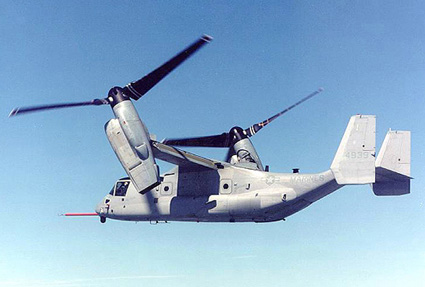 MV-22A in transition (Bell Helicopter)
The main argument for the V-22 is its capability for VTOL and the main argument against is the inefficiency of its highly loaded wing when used as a STOL aircraft. If one rotor was disabled in STOL mode, the V-22 could recover to an expedient airstrip. It is more expensive than the competitors and would provide less concurrency but it is an outstanding technical achievement. So this could be an instance of an unusually effective system versus a more efficient or notionally cost-effective alternative. The power needed to drive its rotors for VTOL does translate into a heavy potential payload in STOL mode but the V-22 cabin is smaller than that of the Caribou. Its capacity is non-compliant with the troop/paratroop and vehicle loads specified as essential in the ITR for AIR 5190. Conceivably the essential load criteria might be relaxed for AIR 5190 Phase 2. EADS and LMATTS might regard such a change as outright bias in favour of the V-22. One possible outcome is that they would compete only if compensated as in a funded RFP. In head-to-head competition the C-295M is less expensive to acquire and operate than the C-27J. Within a combat zone the ADF is unlikely to carry many more than 30 personnel in one LTA or probably any aircraft. For airstrip-airstrip transport of troops and aero-medical evacuation the two contenders are equivalent. System costs lessened by commonality between the C-27J and C-130J-30 probably favour the C-295M. Concurrency favours the C-295M. However, in any surge the ADF would be able to lease LTA from commercial sources. For example, the Australian civil register includes almost forty Dash 8 aircraft with a useful short-field performance and a maximum AUW of 15 to 20 tonnes. The Dash 8 is well suited for personnel transport. In general, defence funds are better directed toward acquisition or lease of military aircraft with strong features that are not usually available in commercial substitutes. Those features were specified as essential and important in the ITR. The guesstimate of typical tactical payloads several paragraphs above was 20 troops plus two tonnes of stores, and eight troops plus two Perentie 4x4s: approximately four to six tonnes. This is greater than the Caribou's normal maximum payload but six tonnes equates to just 55% and 80% of the normal maximum payloads of the C-27J and C-295M. Parameters indicate that the C-295M must have a STOL performance with a six tonne payload fairly close to that of the C-27J. For paratrooping, airdrop and transport of pallets the two contenders are equivalent. Transport of bulky and heavy freight and vehicles favours the C-27J. Loading trials for the US Army have confirmed the C-27J can transport two HMMWV trucks that are in the same 2-tonne cargo category as the 6x6 Perenties. The HMMWV is more representative of modern light tactical trucks. Current ADF light armoured vehicles - Bushmaster, LAV-25, and the M-113(mod) - have weights in the 10 to 16 tonne class. A bare M-113 has been loaded into a C-27J but in useful form it also is too large to be carried inside any LTA. Almost inevitably the ADF will acquire a smaller light armoured vehicle. Most examples of modern wheeled and tracked vehicles in this category weigh from 4 to 7 tonnes and typically their height over the turret is about 2m. The cross-section of the C-27J cabin is better suited for airlift of these and also engineer/construction vehicles. Nevertheless light trucks and armoured and engineer vehicles of lower overall height could be acquired. Also the cost of 1,000 or 2,000 sets of readily dismantlable cabs and ROPS for Perenties or successor vehicles could be defrayed against the lower capital cost of acquiring the C-295M. Knowledge of the offset and AII components is insufficient for comparative comment. AII might be decisive if one proposal was flagrantly inadequate or generously above the target figure of 35%. There is one qualification on AII: release of intellectual property especially that relating to software in the avionics, radar and in other airborne and ground systems. That was a problem during acquisition of the C-130J-30s. If repeated in AIR 5190 it could be decisive. However in connection with the order for the Wedgetail AEW&C system, Australia and America reached some general agreement on software. Presumably suitable agreements already applied or were included in the proposals for the C-295M and C-27J. Selection of the C-295M might usefully diversify sources of support and supply. For the ADF, accepting an unproven product and finding it has deficiencies could be a poor outcome but delay can result in poor interim capability. In terms of AIR 5190's ITR the Caribou was already inadequate and it still has to be maintained until after the date of contract signature for new LTA. The Caribou airframe could apparently go on for a long time yet. The big problem is its engines. Austere refurbishment of the Caribou is a cost-effective way to cover a short delay but it will be difficult to maintain the aircraft through to 2010 by scavenging on and for R-2000 engines. That austerity implies AIR 5190 is to be decided and will deliver interim or new model aircraft in useful time. Lease of interim aircraft outside AIR 5190 must have been considered and rejected on grounds of crews and training, inadequate performance, cost, lack of availability or concern for an apparent preference. Looking back, the Caribou could well have been upgraded with turboprop engines and more capable propellers at any time through the 1980s-1990s. Project managers have one rule, get the resources and use them quickly. In that respect they have the sharp mind of teenagers most of whom could express in direct words everything in this article. The latter especially do not see advantage in multiple layers of procedure to guard against the slightest possibility of reprovable error. Even with such precautions it is on paper - with the advent of the heavy tanker/freighter and the (K)C-17 - easy to query the C-130J-30 acquisition: perhaps the C-130J? Within AIR 5190 there is no need to wait until 2006/07 for selection and contract signature. That milestone is linked with but not necessarily determined by provisional funding allocated to projects on a year-by-year basis. Two maxims have been especially applicable and sometimes in conflict throughout AIR 5190: "Anything will do for a while, nothing will do forever", and "Best is the enemy of good enough except in simulation." From what is publicly known and can be inferred, CASA and LMATTS are keen to achieve sales and acquisition by the ADF carries well-earned kudos. By 2004/05 the performance of the C-295M and C-27J will have been tested and presumably validated in operational use by their launch customers, and possibly further validated by other early customers. In a pragmatic environment, the careful phasing of aircraft and a full-flight and mission simulator is axiomatic. If the primes compete comprehensively and each puts several unbadged aircraft on a ramp and arranges for a simulator ready to fly, then the delivery schedule of strategic tankers under AIR 5402 might be stretched to release some funds for early acquisition of LTA. That would be in line with an earlier outline of AIR 5402. The whole schedule for AIR 5190 Phase 2 could then be moved to the left. The difficulty with maxims is deciding which to apply when, and the reciprocal when to apply which. So planning has a third maxim: "Do what seems appropriate, preferably for the near and longer terms." On that basis leasing can be a prime contender. Defence is now aiming to sign for a modernised LTAC in 2006/07. Also and even if AIR 5402 does receive all its aircraft on a parochial schedule, the signature date for AIR 5190 Phase 2 could be moved earlier to obtain LTA on short-term lease and subsequent purchase. There are three residual questions regarding the competition itself. First and jumping over intervening steps in the process, how far to the left might contract signature for AIR 5190 Phase 2 be moved? Second, will the essential load criteria be revised downward to admit the V-22 and what would be the reaction of EADS and LMATTS? Third, regardless of walls erected to preserve confidentiality, how energetically would EADS be prepared to compete against part of itself in tendering the C-295M? Defence might anyway have to resort to a funded RFP competition. That could in part explain DCP2001's reference to the V-22 as a potential candidate for AIR 5190. Conclusion Defence has many projects resembling AIR 5190. Some of these are usefully delayed or progressed by upgrade, and others are established as new bases of capability and then subject to periodic upgrade. AIR 5190 was approved as a new capability during 1996 and the answer to be determined is which aircraft and when. There are dangers in trying to do comprehensive work and in predicting a definite outcome. This article has looked at only the Caribou, AIR 5190 and its contenders, and related aspects of airlift planning. Initially it was difficult to get past the mass of data from many sources; then the CN-235 as a substitute for the Buffalo, the cabin length of the C-295M, the cross-section of the C-27J, and AII. The issues that now stand out as vital are: STOL with a reduced load, capacity to substitute for the C-130, concurrency, intellectual property, and delivery of aircraft synchronised with a full-flight and mission simulator and with other projects. Naturally views change and also criteria in projects. It was fortunate the V-22 did not re-appear until late but its comparison with the Chinook and Blackhawk is interesting. Also it is likely that mention of the V-22 in DCP2001 was at least endorsed and possibly mandated by a shrewd committee with the power to direct change in previously essential criteria. The competition for the LTAC and the simulator are now in a revised Phase 2 with a YOD of 2004/05 and signature in 2006/07. In accordance with the standard project caveats, that new phase could be commenced with revised criteria and an expanded short-list. There can be certain benefits in having two heavyweights and projects have at least two other permanent difficulties: how to avoid gold plating, and promises of future performance. The schedule for AIR 5190 Phase 2 is timed to ensure that the brochure performance and reliability of the C-295M and C-27J and possibly the V-22 have been confirmed by service with their launch and preferably at least one other early customer. The C-295M and C-27J will reach that stage well before 2006/07. On the data and as suggested by its history, AIR 5190 Phase 2 will be moved to the left with YOD, approval, RFT or RFP, selection and signature completed earlier than now scheduled. Given the late in-service dates of the competing aircraft and the serpentine nature of the acquisition process that seems almost impossibly rapid. But it could be achieved despite and because of the press of other projects. If both the C-295M and C-27J prove reliable then - regardless of any change in the minimum essential load criteria, and of other likely contenders - the winner of AIR 5190 will be the one that has the better STOL and range performance with payloads of about six tonnes and nine tonnes. With the smaller load each can probably attain CBR3 and get closer to the Caribou, but the latter was not required to reach upward toward the C-130. However, the stretch of the C-295M fuselage was not accompanied by wing modifications to provide a STOL performance similar to that of the CN-235. On the basis of its STOL characteristics combined with payload/range capabilities and cabin cross-section, the winner will be the C-27J which Lockheed has been astutely and appropriately marketing as the mini-Hercules. It is a big light freighter and that has contributed to making AIR 5190 an awkward project. 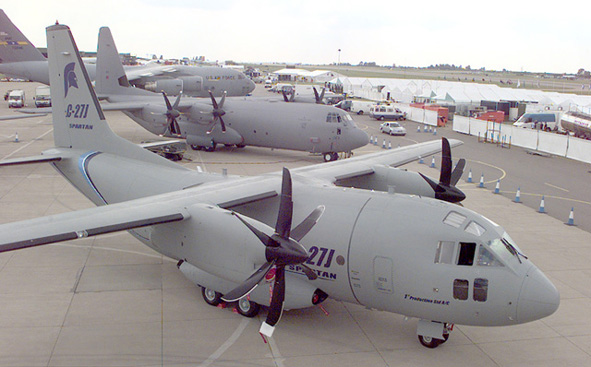 C-27J and C-130J-30 with C-17 in background. (Lockheed Martin) For the needs of ADF airlift the C-27J is better than the C-295M, and much better than the V-22 or more C-130s. As with all equipment, Defence would prefer to have an attrition reserve. That could mean acquisition of about 16 aircraft but with funding constraints the order will be for twelve C-27J with an option for several more. So finally there are two options which make AIR 5190 somewhat like the Nile. W. Probable: LMATTS manages to get things together and Defence bypasses interim aircraft. The ADF receives the simulator and first C-27J on lease or acquisition in about 2005 but may have to wait until about 2010 for aircraft 7 through 12. X. Less likely: LMATTS fails to arrange everything together and Defence accepts interim aircraft. They will be C-27s or G.222s which arrive in about 2005 so that aircrew can work through rough field landings before arrival of the C-27J simulator. The ADF receives the simulator and first C-27J in about 2010.
ACKNOWLEDGEMENT. This analysis includes quoted material and substantial extracts from the following documents copyright Commonwealth of Australia reproduced by permission: AIR 5190 - Light Tactical Airlift Capability - Invitation to Register Interest for the Supply of a Light Transport Aircraft to the Australian Defence Force - AFMAT 5/97; AIR 5190 - Light Tactical Airlift Capability - Industry Brief - AFMAT 5/97; Australian Perspectives on Defence: Report of the Community Consultation Team - CCT, DPS September 2000; Defence 2000: Our Future Defence Force - DoD, DPS OCT010/2000; Media Release: Major Defence Capital Equipment Projects - MIN 146/01 22 May 2001; Defence Capability Plan
2001-2010: Public Version - DMO, DPS JUN004/01. TABLE 3: Chinook, Osprey and Blackhawk
Notes. 1. Supplemented by one or more auxiliary tanks. See note 3. 2. CH-47D: castored rear
wheel units kneel for stowage; 3. CH-47D: three 3,025
litre auxiliary fuel tanks in cabin; |
|||||||||||||||||||||||||||||||||||||||||||||||||||||||||||||||||||||||||||||||||||||||||||||||||||||||||||||||||||||||||||||||||||||||||||||||||||||||||||||||||||||||||||||||||||||||||||||||||||||||||||||||||||||||||||||||||||||||||||||||||||||||||||||||||||||||||||||||||||||||||||||||||||||||||||||||||||||||||||||||||||||||||||||||||||||||||||||||||||||||||||||||||||||||||||||||||||||||||||||||||||||||||||||||||||||||||||||||||||||||||||||||||||||||||||||||||||||||||||||||||||||||||||||||||||||||||||||||||||||||||||||||||||||||||||||||||||||||||||||||||||||||||||||||||||||||||||||||||||||||||||||||||||||||||||||||||||||||||||||||||||||||||||||||||||||||||||||||||||||||||||||||||||||||||||||||||||||||||||||||||||||||
|
|||||||||||||
|
|
|
|
|
|
|
|
|
|
|
|||
|
|
|
|
|
|
|
|
|
|
|
|||
 |
|
|
|||||||||||
| Artwork, graphic design, layout and text © 2004 - 2014 Carlo Kopp; Text © 2004 - 2014 Peter Goon; All rights reserved. Recommended browsers. Contact webmaster. Site navigation hints. Current hot topics. | |||||||||||||
|
Site Update
Status:
$Revision: 1.753 $
Site History: Notices
and
Updates / NLA Pandora Archive
|
|||||||||||||
|
|
Tweet | Follow @APA_Updates | |||||||||||
|
|
|||||||||||||
|
|
|||||||||||||






