|
||||||||||||||||||||||
![Australia's First Online Journal Covering Air Power Issues [ISSN 1832-2433]](APA/APA-Title-Analyses.png "Australia's First Online Journal Covering Air Power Issues [ISSN 1832-2433]") |
||||||||||||||||||||||
![F-22A Raptor, FB-22, F-22E, F-22N and Variants Index Page [Click for more ...]](APA/f-fb-22.png "F-22A Raptor, FB-22, F-22E, F-22N and Variants Index Page [Click for more ...]") |
 |
![People's Liberation Army Air Power Index Page [Click for more ...]](APA/pla-air-pwr.png "People's Liberation Army Air Power Index Page [Click for more ...]") |
 |
 |
 |
 |
 |
 |
![Military Ethics, Culture, Education and Training Index Page [Click for more ...]](APA/ethx-culture.png "Military Ethics, Culture, Education and Training Index Page [Click for more ...]") |
 |
||||||||||||
 |
![Russian / Soviet Weapon Systems Index Page [Click for more ...]](APA/rus-weps.png "Russian / Soviet Weapon Systems Index Page [Click for more ...]") |
 |
 |
 |

|
 |
 |
 |
 |
 |
||||||||||||
 |
 |
 |
||||||||||||||||||||
| Last Updated: Mon Jan 27 11:18:09 UTC 2014 | ||||||||||||||||||||||
|
||||||||||||||||||||||
|
||||||||||||||||||||||
|
||||||||||||||||||||||
|
|
|
|
|
|
|
|
|
|
|
||||||||||||
|
|
|
|
|
|
|
|
|
|
|
||||||||||||
| |
|
|
||||||||||||||||||||
| Last Updated: Mon Jan 27 11:18:09 UTC 2014 | ||||||||||||||||||||||
|
||||||||||||||||||||||
| Assessing Progress on the Joint
Strike Fighter Program |
|||
|
|||
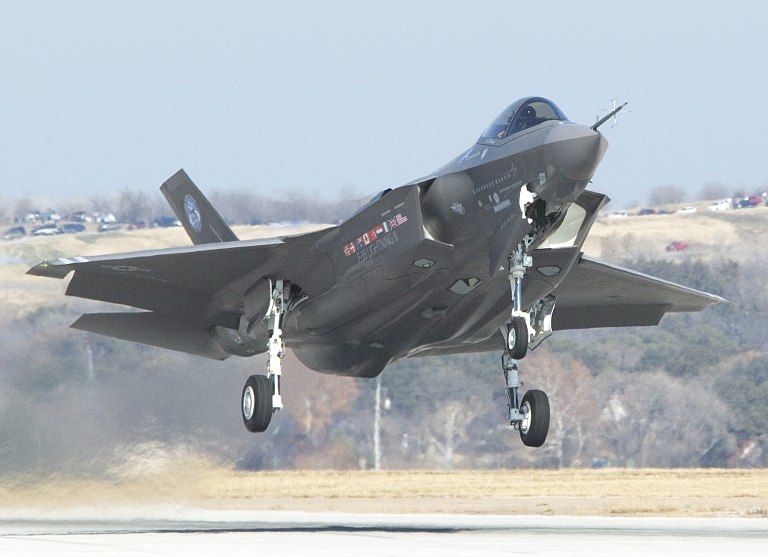 First flight of SDD JSF Prototype AA-1 in December, 2006. This aircraft is a 'non-representative prototype' which predates a series of structural and systems weight reduction measures. The aircraft is equipped with a dummy EOTS fairing under the nose (Imagery via Air Force Link). |
|||
Analysis of the F-35 Joint Strike Fighter program remains as challenging as ever, due mainly to the intensity of the marketing and public relations effort which pervades every aspect of the program. However, the last twelve months have seen a number of important developments, many of which can be subjected to scrutiny. Given the ~US$300B planned expenditures on this program, program marketing to partner nation politicians and the public has continued to exert a major influence on the program, generally at the expense of internal oversight and hard critical analysis of the state of actual progress. The latest problem to surface is one additional year's delay expected to be added to the SDD Phase of the program as a result ongoing difficulties in development. This delay came to light early May this year in the Netherlands' press (De Volkskrant, 10th May), when Defence Minister De Vries was challenged in the Dutch parliament over difficulties with the program. De Vries disclosed that a 'rescheduling' and a 'one year extension' of the SDD effort was discussed during the JSF International Steering Committee meeting in April, and intended to be announced later this year. The timing of this announcement is significant insofar as it would put the media backlash to a further delay into the period immediately following the US Presidential poll, when the media will be preoccupied with US election results. In Washington major developments centre upon a series of highly critical GAO (Government Audit Office) reports, especially the report released March last year (GAO-07-360). The GAO is the US equivalent to the Australian National Audit Office. The 2007 GAO report validated observations made by a number of independent analysts about problems inherent in the current program structure, management and risk analysis: “Accurately predicting JSF costs and schedule and ensuring sufficient funding will likely be key challenges facing the program in the future. JSF continues to pursue a risky acquisition strategy that concurrently develops and produces aircraft. While some concurrency may be beneficial to efficiently transition from development to production, the degree of overlap is significant on this program. Any changes in design and manufacturing that require modifications to delivered aircraft or to tooling and manufacturing processes would result in increased costs and delays in getting capabilities to the warfighter. Low-rate initial production will begin this year with almost the entire 7-year flight test program remaining to confirm the aircraft design….” “Total JSF program acquisition costs (through 2027) have increased by $31.6 billion and now DOD will pay 12 percent more per aircraft than expected in 2004. The program has also experienced delays in several key events, including the start of the flight test program, delivery of the first production representative development aircraft, and testing of critical missions systems…. Despite these delays, the program still plans to complete development in 2013, compressing the amount of time available for flight testing and development activities.” The JSF Program departs from recent US acquisition practices. The US DoD abandoned concurrent development and production acquisition strategies during the 1970s and has adopted since then a rigorous approach centred on extensive testing before funds are released for subsequent activities. Under this model a developmental design has to be proven before Low Rate Initial Production (LRIP) funding is released, and LRIP production examples have to pass a tough operational evaluation, before Full Rate Production funding is released. However, the JSF Program is following a very different model, as it is being allowed to progress into the LRIP phase while only a small percentage of the total mandated flight testing has been performed, while there have been ongoing delays in testing and development activities. This aspect of the program was earlier the subject of a critical analysis by the GAO (GAO-06-536) entitled “JOINT STRIKE FIGHTER: DOD Plans to Enter Production before Testing Demonstrates Acceptable Performance”, following earlier critical analysis (GAO-05-390) which concluded that “Increased program costs, delayed schedules, and reduced quantities have diluted DOD’s buying power and made the original JSF business case unexecutable. Program instability at this time makes the development of a new and viable business case difficult to prepare. The cost estimate to fully develop the JSF has increased by over 80 percent. Development costs were originally estimated at roughly $25 billion. By the 2001 system development decision, these costs increased almost $10 billion, and by 2004, costs increased an additional $10 billion, pushing total development cost estimates to nearly $45 billion. Current estimates for the program acquisition unit cost are about $100 million, a 23 percent increase since 2001. Ongoing OSD cost reviews could result in further increases to the estimated program cost. At the same time, procurement quantities have been reduced by 535 aircraft and the delivery of operational aircraft has been delayed.” 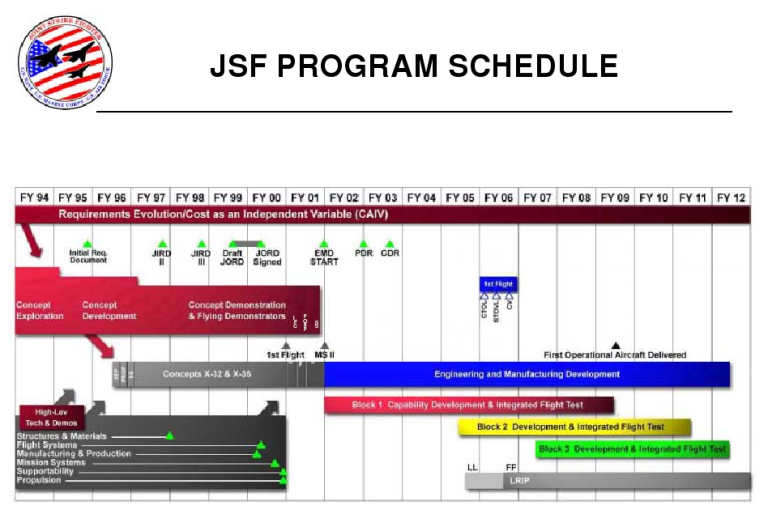 2001
JSF SDD Schedule.
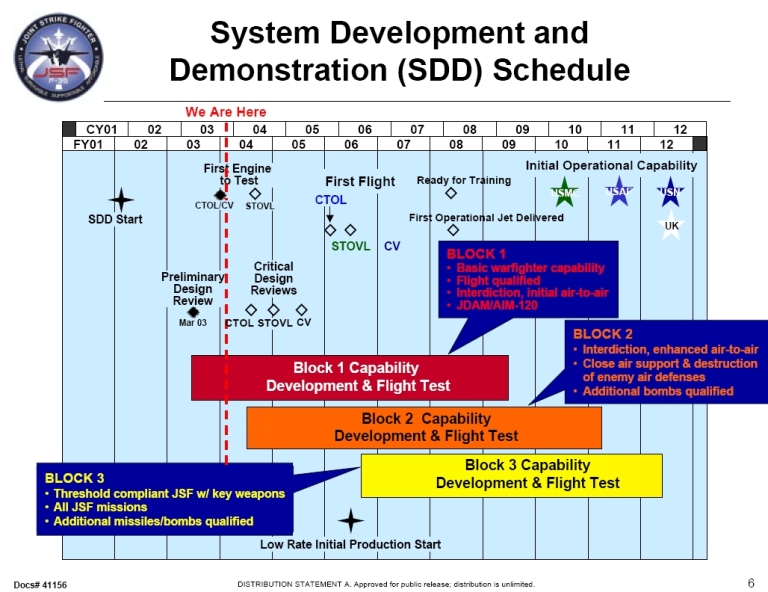 2003
JSF SDD Schedule.
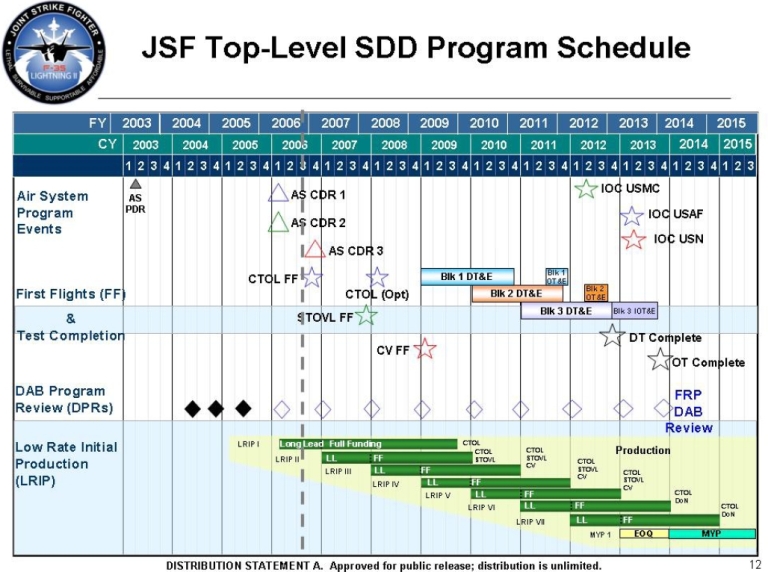 2006
JSF SDD Schedule.
Given the program's established track record of design problems, creeping delays and cost overruns, it was therefore no surprise for analysts when the latest GAO report (GAO-08-388) focused again on costs and especially unresolved risks. “Since last years report, the JSF program office estimates that total acquisition costs increased by more than $23 billion, primarily because of higher estimated procurement costs. The JSF development cost estimate stayed about the same. Development costs were held constant by reducing requirements, eliminating the alternate engine program, and spending management reserve faster than budgeted. Facing a probable contract cost overrun, DOD implemented a Mid-Course Risk Reduction Plan to replenish management reserves from about $400 million to about $1 billion by reducing test resources. Progress has been reported in several important areas, including partner agreements, first flights of a JSF prototype and test bed, and a more realistic procurement schedule.” “The midcourse plan carries the risk of design and performance problems not being discovered until late in the operational testing and production phases, when it is significantly more costly to address such problems. The plan also fails to address the production and schedule concerns that depleted management reserves. Cost and schedule pressures are mounting. Two-thirds of budgeted funding for JSF development has been spent, but only about one-half of the work has been completed. The contractor is on its third, soon to be fourth, manufacturing schedule, but test aircraft in manufacturing are still behind, the continuing impacts of late designs, delayed delivery of parts, and manufacturing inefficiencies.” “We believe that JSF costs will likely be much higher than reported. The estimates do not include all costs, including about $6.8 billion for the alternate engine program. In addition, some assumptions are overly optimistic and not well documented. Three independent defense offices separately concluded that program cost estimates are understated by as much as $38 billion and that the development schedule is likely to slip from 12 to 27 months. Discrepancies in cost estimates add to program risks and hinder congressional oversight. Even so, DOD does not plan for another fully documented, independent total program life-cycle cost estimate until 2013.” What was most unusual is that the Pentagon JSF program office publicly criticised the auditors' report in the media, alleging that the GAO cost analysis were not correct, despite the GAO pointing out that documentation of costs in the program was problematic and presented difficulties in performing analysis. The GAO further pointed out that cost per flight hour for the JSF had exceeded the figure for the F-16, a benchmark for low cost fighter operations. Much of the GAO's ongoing concern about the JSF Program revolves around the nexus of cost and risk. Every risk which materialises adds to costs, and usually adds further delay to Initial Operational Capability (IOC). To date only a small fraction of the mandatory testing has been performed, leaving a great many unknowns or uncertainties in the domain of performance, capabilities, reliability and flight safety. What has fuelled the GAO's fears about the program has been the ongoing series of difficulties encountered during the SDD, many of them symptomatic of poorly managed design and project management processes. The saga of the weight reduction effort is a good example, as early in the SDD it was established that the airframe with systems installed was too heavy to perform, a critical definicency for the STOVL variant. This was followed by the SWAT (STOVL Weight Attack Team) effort intended to drive the weight of the design back to an acceptable number. The SWAT effort was followed by a major public relations campaign declaring publicly that the weight problem had been beaten. When the published target weight data for the JSF variants is tracked over time, it is clear that empty weight remains a major design problem. Between 2002 and 2006, the weight of the CV variant grew by 6.7%, the STOVL variant by 8.2% and the CTOL variant by 9.6%. An aircraft which is 10% over its empty weight target will see that 10% come out of disposable weapons payload in combat, or manifest through inevitable performance penalties across the board, especially in range or agility. This is not a trivial matter since in a aircraft with a combat weight of ~40,000 lb, 10% excess weight translates to ~4,000 lb, which for a JSF sized aircraft is of the order of its nominal internal bomb payload, or ~20% of its internal fuel payload. If weapons and fuel are retained, the 10% comes out of Specific Excess Power, to the detriment of performance. In the longer term, the aircraft will end up without growth potential over its operational life, particularly in regard to space, engine and electrical power, and equipment cooling capacity. The redesign effort resulting from these weight problems has delayed flight testing considerably, as the much publicised first SDD flight test vehicle does not represent the LRIP airframe configuration in performance terms, and can thus be used only to flight test systems. There are other factors of concern in regard to capability in this program. One is the progressive slippage in capabilities planned for each production Block of the design, following the progressive stripping of many weapons clearances out of the SDD and into production phase spiral development. Tracking the presentation slides showing planned weapons clearances is an enlightening experience. 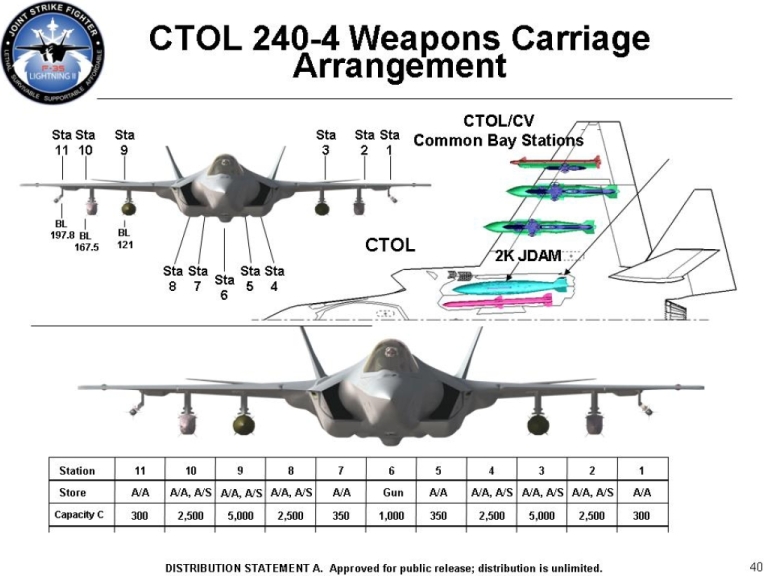 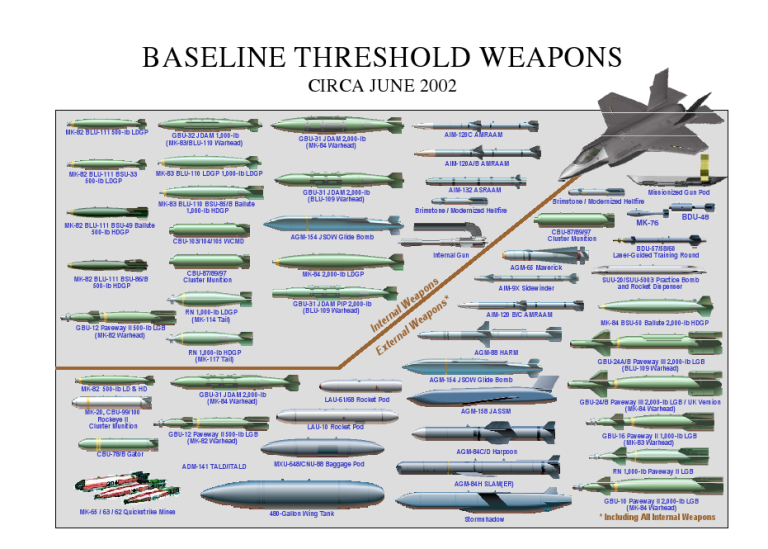 2001 Baseline
SDD Threshold Weapons.
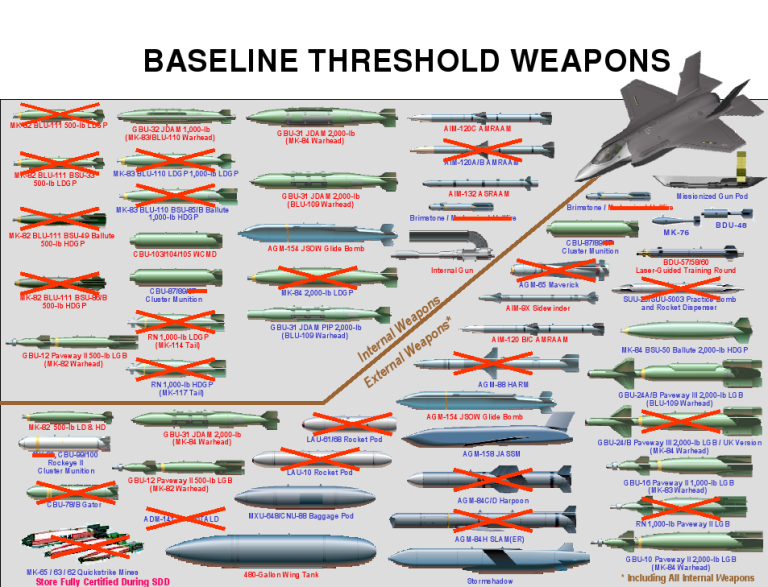 2003 SDD Threshold Weapons. 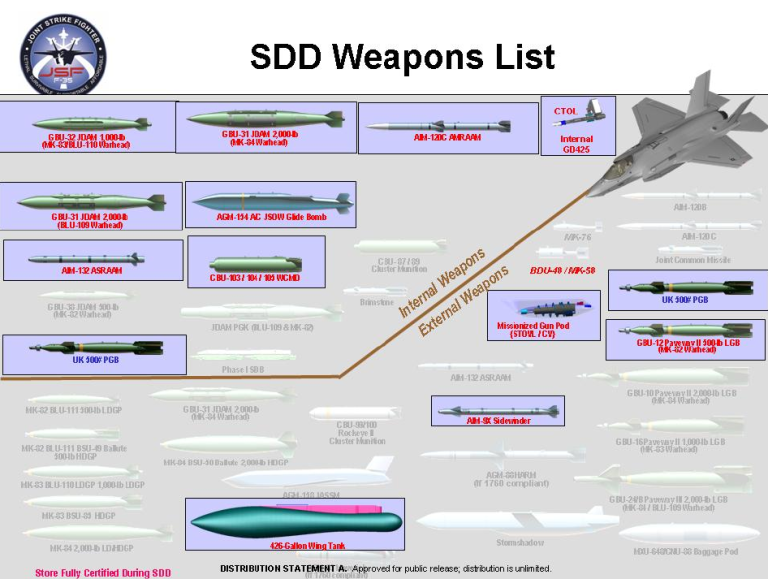 2005
SDD Threshold Weapons. Since then the GBU-39/B SDB has been reinstated,
and the external fuel tank and WCMD deleted [Contract
370-06 28/04/2006/N00019-02-C-3002]
A worthwhile comparison is the planned breakdown of capabilities against JSF production blocks, for 2006 and 2008. In June 2006 the capabilities of Block 1 “Initial Warfighting Capability” were defined as “Flight qualified, baseline air-to-air and air-to-ground weapons qualified. Pilot and maintenance training can commence”. In May 2008 the capabilities of Block 1 were defined as “Support for AI [Air Interdiction] mission (limited target set), allowing meaningful operational test.” Thus, over the last two years the Block 1 aircraft lost its air-to-air capability and its strike capability has been restricted. In June 2006 the capabilities of Block 2 “Close Air Support and Interdiction” were defined as “Qualifies additional air-to-air and air-to-ground weapons. Services can start planning deployments and staffing operational units”. In May 2008 the capabilities of Block 2 were defined as “Added support for CAS with expanded target set (sensor detection and weapon prosecution).” In effect, over the last two years the Block 2 has been constrained to what appears to be less than the capability of the earlier Block 1. In June 2006 the capabilities of Block 3 “Suppression of Enemy Air Defences” were defined as “Qualifies additional air-to-air and air-to-ground weapons for use. Service Initial Operational Capabilities are acheivable”. In May 2008 the capabilities of Block 3 were defined as “Follow-on build to incorporate advanced decision aids, threshold weapons, and limited objective functionality.” Similarly, the Block 3 falls clearly well short of the IOC capabilities package marketed so actively in 2002. What we see here is a well established trend of reducing the aircraft's capabilities planned for each block, with a resulting concurrent slippage of capabilities as a whole. The open question, assuming the program achieves IOC, is what the actual capabilities of the IOC aircraft will be. Conspicuously, air to air capabilities are not particularly visible in the 2008 definitions. The problems observed with weight and the clearly limited success of the weight reduction effort have been paralleled by other problems in early testing and design validation. Several are notable.
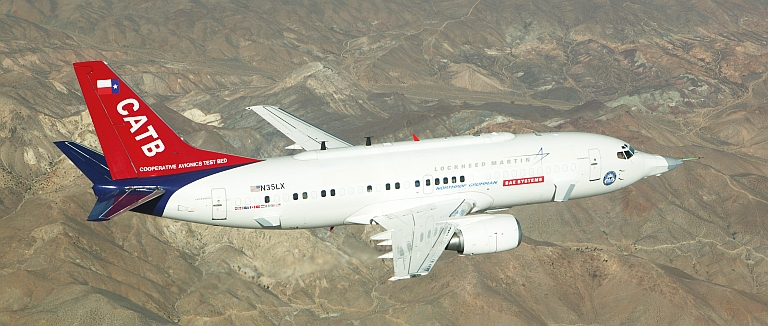 Delays to the CATB airborne systems
integration testbed will in turn delay critical testing and validation
of the JSF software, the most complex in any fighter to date.
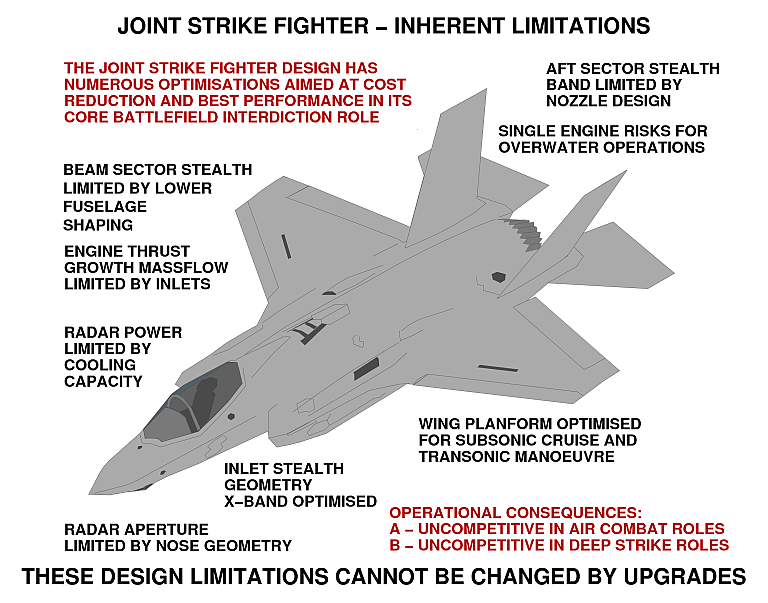
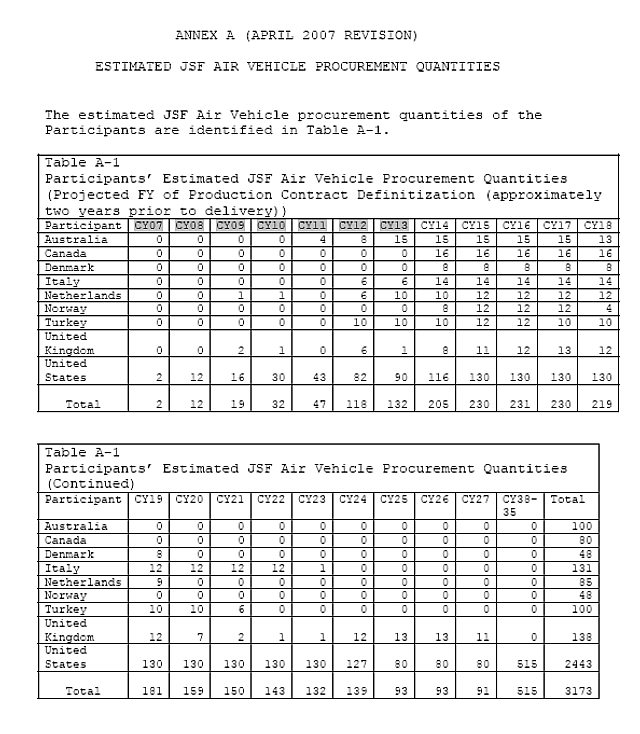 The undersizing of the F-35C generator begs some serious questions about the basic integrity of the design process employed in the SDD, as it is a fundamental design consideration and one which should never “slip between the cracks” during product development. As all experienced design engineers know, one of the first tasks in any design process is to identify and pin down the critical performance constraints for key systems or design components. Evidently this did not occur in the design of the JSF electrical system, for reasons never properly explained by the project office or manufacturer. In designing and developing an aircraft intended to provide a generational edge, many risks will inevitably arise. The resulting, almost inevitable, cost and schedule impacts can, within limits, be accepted, but only so long as the design continues to demonstrate a high probability that the aircraft will meet or exceed its prime specification requirements. In the case of the JSF, the contrary has been demonstrated time and again, establishing a solid trend of increasing delays and declining capabilities. From a project management perspective, the JSF is showing all of the symptoms of a program which is in serious difficulty. The slippage of schedules, the migration of capabilities across Blocks, the nature of the development and test problems observed over the last year, and the failure of the program's managers to institute a transparent and deep audit of progress and risks across the program are all of the typical “textbook” warning signs of trouble which are taught in any university level technical and project management classes. No less concerning is the incessant barrage of public relations material produced around the program, much of it clearly crafted to focus observers away from the more fundamental issues. Why the JSF program is in difficulty, is in hindsight very clear, as the program had five enormous encumbrances built into it from the outset:
|
|||
|
|||
|
Additional Imagery - Prototypes 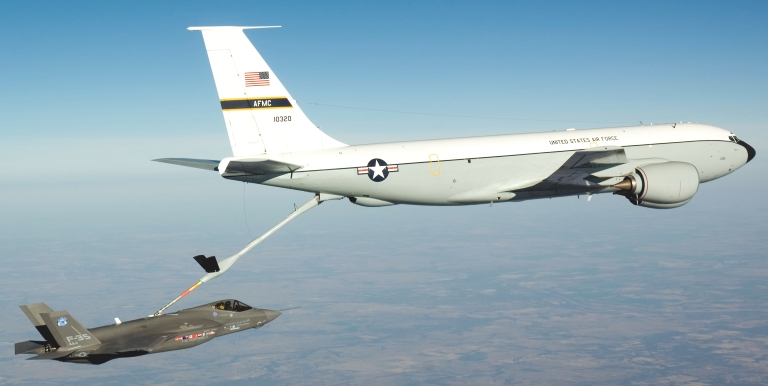 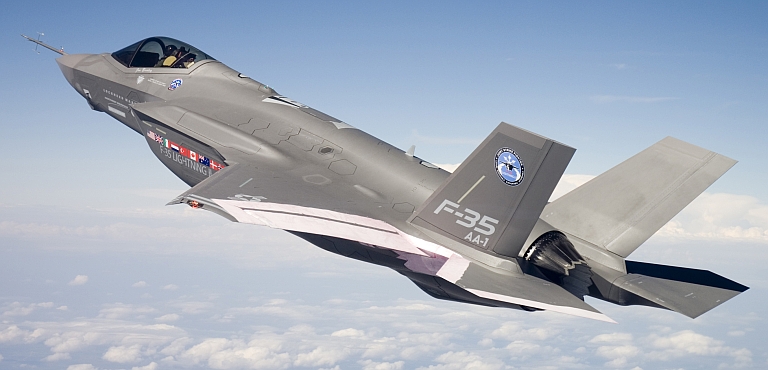 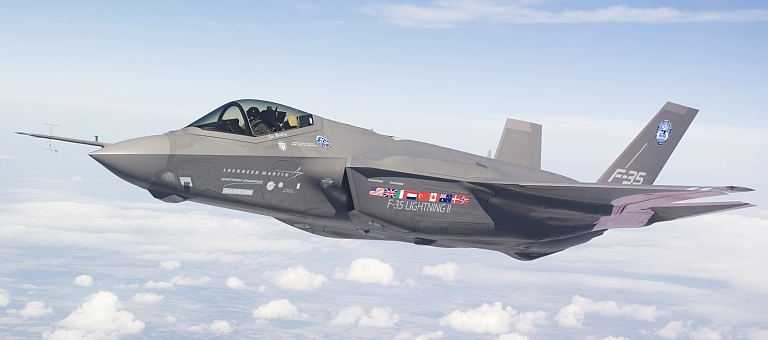 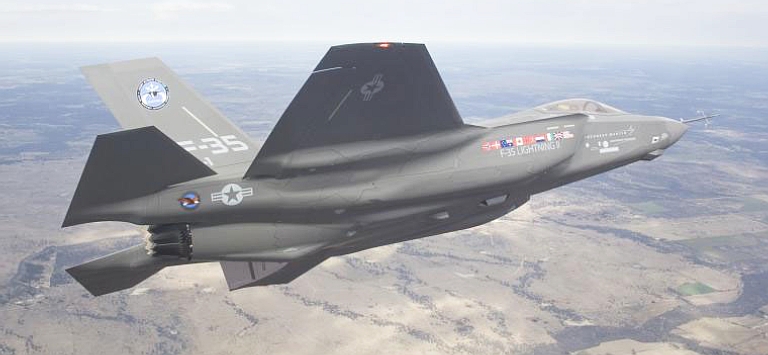 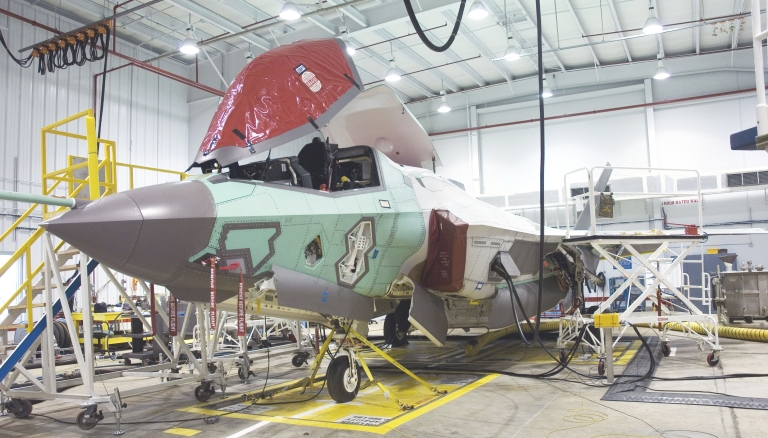 |
|||
 |
|||
Imagery
Sources: Author; www.jsf.mil, US DoD.
|
|||
|
Air Power Australia Analyses ISSN 1832-2433  |
|||
|
|||||||||||||
|
|
|
|
|
|
|
|
|
|
|
|||
|
|
|
|
|
|
|
|
|
|
|
|||
| |
 |
|
|||||||||||
| Artwork, graphic design, layout and text © 2004 - 2014 Carlo Kopp; Text © 2004 - 2014 Peter Goon; All rights reserved. Recommended browsers. Contact webmaster. Site navigation hints. Current hot topics. | |||||||||||||
|
Site Update
Status:
$Revision: 1.753 $
Site History: Notices
and
Updates / NLA Pandora Archive
|
|||||||||||||
|
|
Tweet | Follow @APA_Updates | |||||||||||
|
|
|||||||||||||
|
|
|||||||||||||






