|
||||||||||||||||||||||
 |
||||||||||||||||||||||
![F-22A Raptor, FB-22, F-22E, F-22N and Variants Index Page [Click for more ...]](APA/f-fb-22.png "F-22A Raptor, FB-22, F-22E, F-22N and Variants Index Page [Click for more ...]") |
 |
![People's Liberation Army Air Power Index Page [Click for more ...]](APA/pla-air-pwr.png "People's Liberation Army Air Power Index Page [Click for more ...]") |
 |
 |
 |
 |
 |
 |
![Military Ethics, Culture, Education and Training Index Page [Click for more ...]](APA/ethx-culture.png "Military Ethics, Culture, Education and Training Index Page [Click for more ...]") |
 |
||||||||||||
 |
![Russian / Soviet Weapon Systems Index Page [Click for more ...]](APA/rus-weps.png "Russian / Soviet Weapon Systems Index Page [Click for more ...]") |
 |
 |
 |

|
 |
 |
 |
 |
 |
||||||||||||
 |
 |
|||||||||||||||||||||
| Last Updated: Mon Jan 27 11:18:09 UTC 2014 | ||||||||||||||||||||||
|
||||||||||||||||||||||







| Legacy
Air Defence System
Vehicles Technical Report APA-TR-2008-0601-C |
| by
Dr Carlo Kopp, AFAIAA, SMIEEE, PEng Updated April, 2009 Updated June, 2009 Updated April, 2012 Text © 2008 - 2012 Carlo Kopp |
 |
|
Legacy
system mobility upgrades are detailed under:
|
2K12/3M9/9M336/9M9 ZRK Kub/Kvadrat/SA-6 Gainful SAM System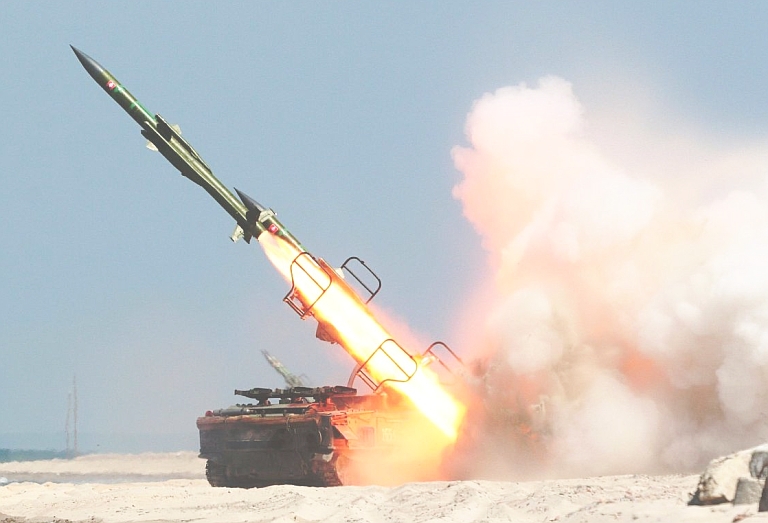 3M9ME Gainful SAM launch from 2P25 TEL (Image © Miroslav Gyűrösi). The Kub/Kvadrat system is best
known for its initial success during the 1973 Yom Kippur conflict when
this
system earned the nickname "three fingers of death". The SA-6 Gainful
became one of the most widely deployed mobile area defence SAM systems,
used by the Soviet PVO-SV, most Warsaw Pact armies, and a wide range of
export clients in the Middle East, Africa, with India becoming the
biggest user in Asia.
Deployed initially during the late 1960s, the SA-6 has been subjected to a wide range of upgrades, as a result of which many different configurations exist. In Soviet service it was replaced primarily by the 9K37/M/M1 Buk/Buk-M/M1 (SA-11 Gadfly). A typical SA-6 regiment comprises a regimental headquarters, an acquisition radar package, comprising a mix of PRV-16 Thin Skin-B heightfinder radar, a Score Board-A IFF interrogator, one VHF-band P-12/P-18 Spoon Rest or UHF-band P-15 Flat Face search radar and five SA-6 batteries. Sometimes the S-band 1S12/P-40 Long Track search radar, on the tracked AT-T chassis, is associated with the SA-6 system. A typical battery comprises one tracked 1S91 Straight Flush engagement radar vehicle, four tracked 2P25 SPU TELs, and four ZIL-131 T7M transloader vehicles, each with a large hydraulic crane centrally located on the tailboard and three reserve missiles. Resupply rounds are typically carried by up to 15 ZIL-131V or ZIL-157V 9T227 semi-trailers, with six missile rounds each, supported by two Ural-375 9T31 crane trucks. The Straight Flush family of radars uses two antenna elements. The first is an S-band search radar, the second a steerable CW illuminator at the top of the vehicle turret. The missiles use command link midcourse guidance and semiactive terminal homing, with later variants using monopulse seekers for jam resistance and accuracy. 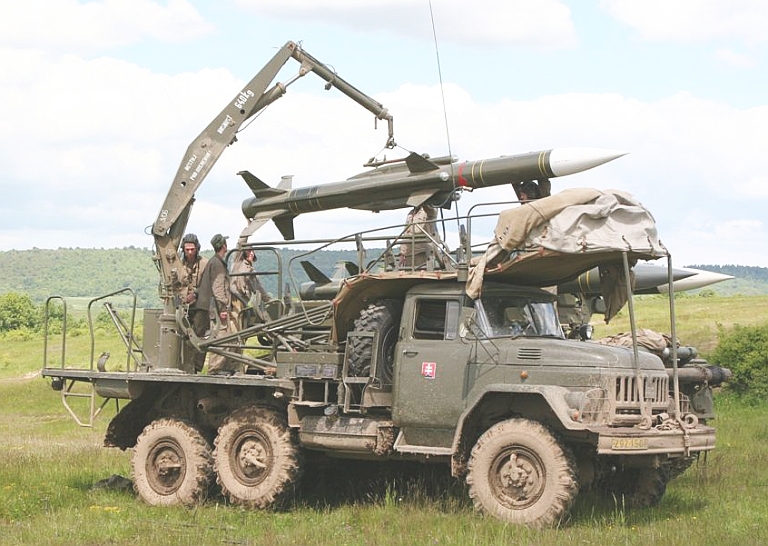 2T7M
Gainful transloader of the Slovakian Army (Image © Miroslav
Gyűrösi).
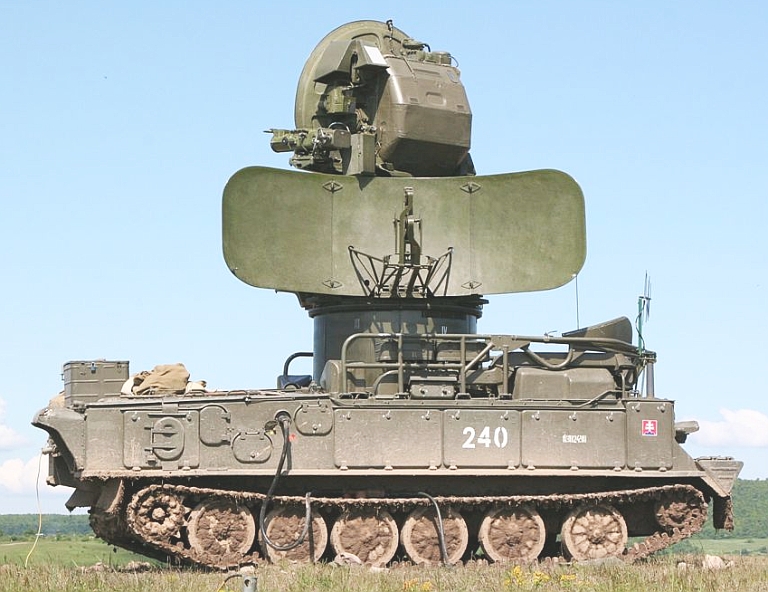 1S91M2
Straight Flush of the Slovakian Army (Image © Miroslav
Gyűrösi).
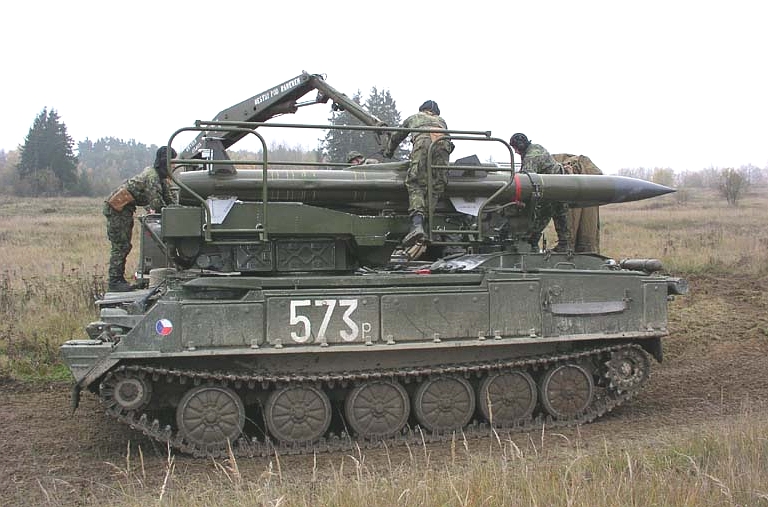 2P25 TEL of the Czech Army during reload operation (Czech Army image). 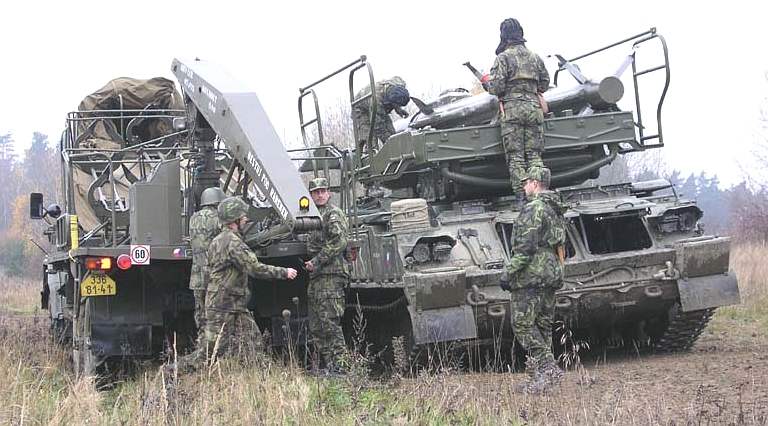 2P25 TEL and 2T7M transloader of the Czech Army (Czech Army image). 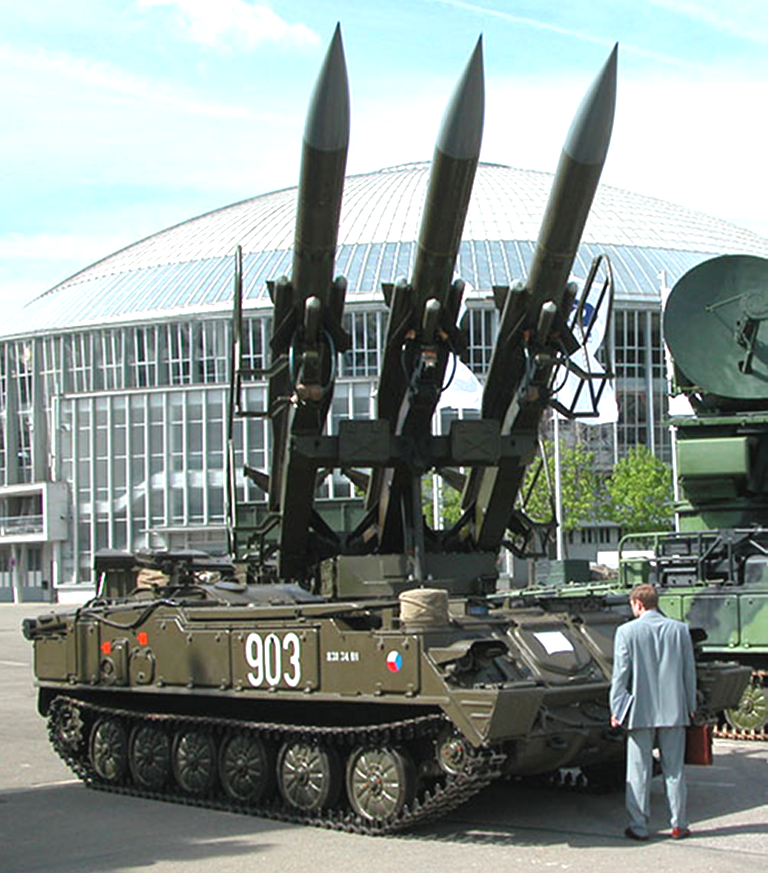 2P25 TEL of the Czech Army on display (Czech Army image). 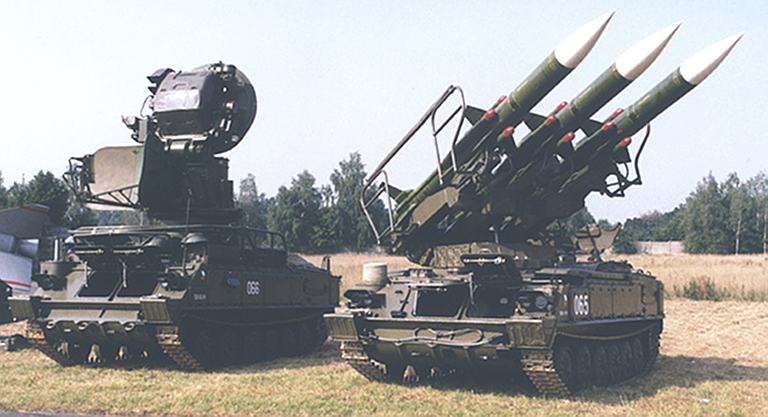 Straight Flush and 2P25 TEL of the Czech Army (Czech Army image).  The
P-40/1S12 Long Track S-band acquisition radar is often cited as the
mobile acquisition component in Kub/Kvadrat SAM batteries, although its
primary purpose was supporting the SA-4 Ganef system. It uses a
modified tank chassis to provide high cross country mobility. The
antenna stows flat on the roof of the vehicle. Eight stacked beams are
used for heightfinding.
|
S-200 Volga/SA-5 Gammon SAM System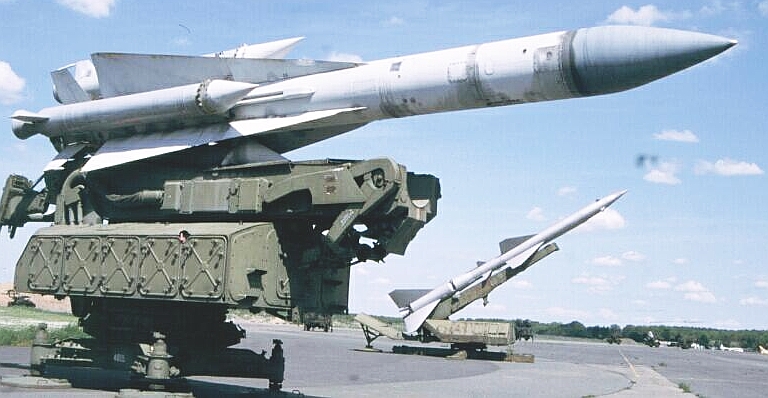 The
semimobile 5P72 series launchers used with the SA-5 are often installed
in permanent revetments (below).
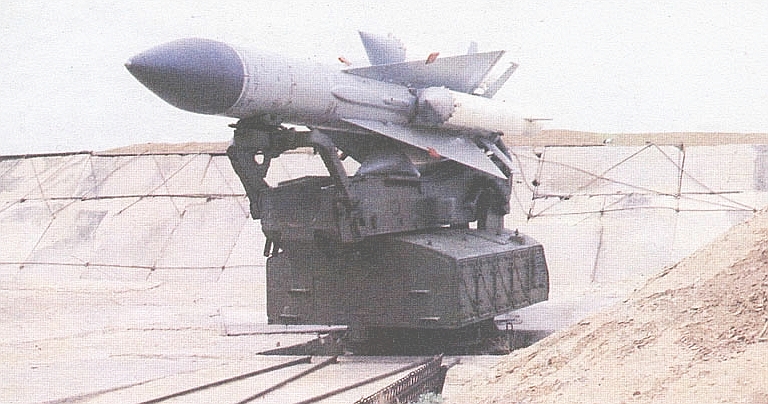 The legacy S-200 family of 160 nautical mile range class long range SAMs has been largely replaced by more recent variants of the S-300PMU family of systems. Nevertheless the system is of some interest as it was exported to a number of Soviet client states, including ByeloRussia, Uzbekistan, Bulgaria, the Ukraine, Czechoslovakia, Hungary, Poland, India, North Korea, Libya, Syria, and more recently Iran. Much of this proliferation occurred after the 1998 fire sale of former PVO-S warstock and inventory, as the S-200 was phased out of Russian service. While built as a semi-mobile system, the S-200 battery components were often sited in fixed concreted revetments. The 6 to 8 GHz band 5N62V Square Pair FMCW illuminator radar and 5P72 series launcher are both deployed by tow tractor. The 5V21 and 5V28 missile rounds are carried by the 5T82 transloader semitrailer. Typically six launchers are supported by a single 5N62V Square Pair, using a P-14 / 5N84A Tall King or P-35 Bar Lock acquisition radar. 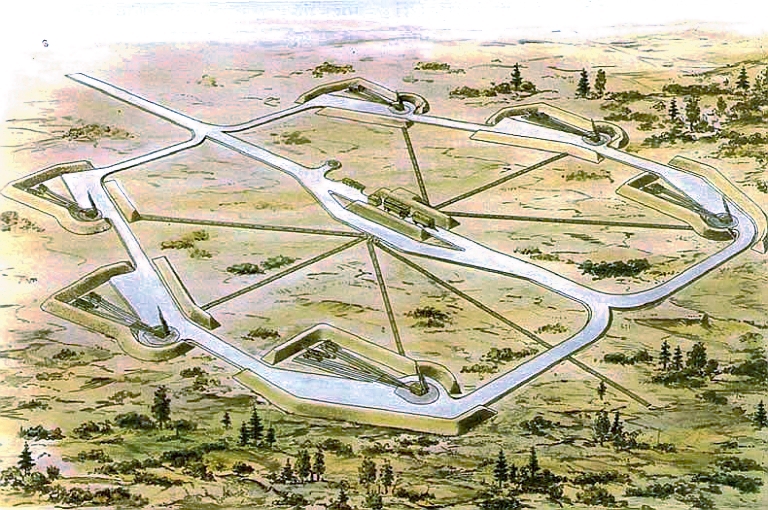 S-200 battery deployment illustration from Soviet technical manual. Note each launcher has a pair of transloaders with ready 5V28 rounds (RuMoD). 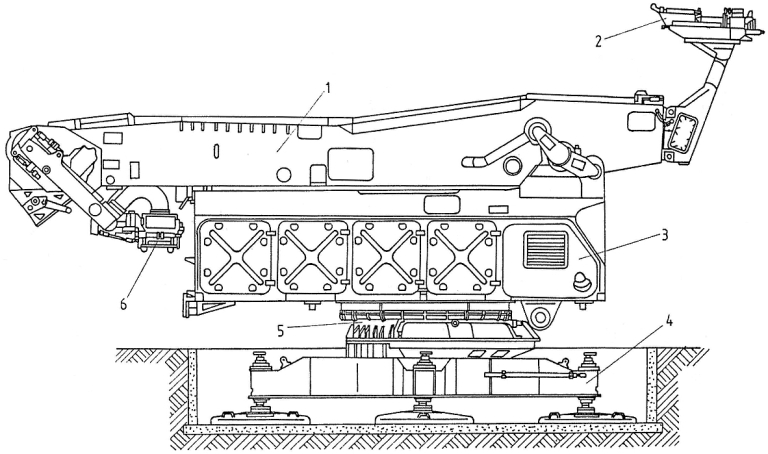 5P72VE launcher in recessed placement. 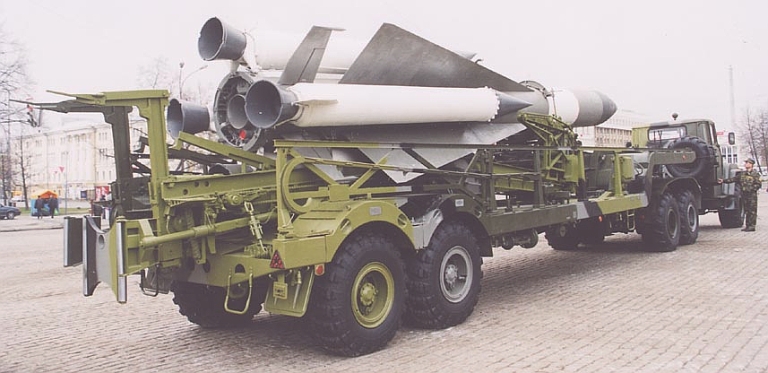 The 5T82 transloader semitrailer,
this
example towed by a KrAZ-260. Below, 5T82 towed by KraZ-255. Note the
tarpaulin shroud which can be deployed to cover the missile.
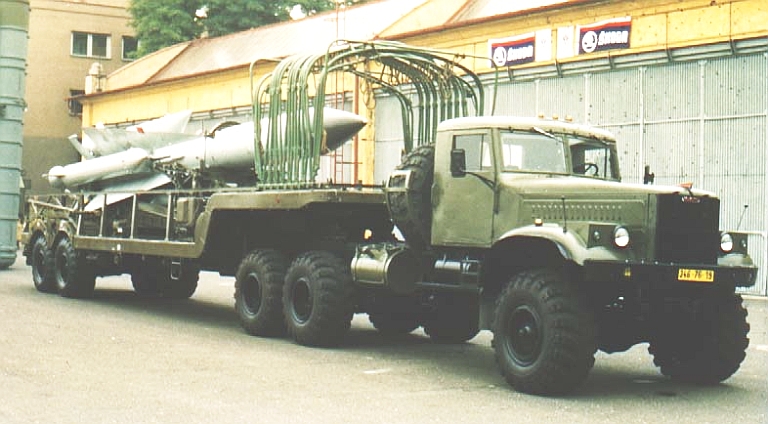 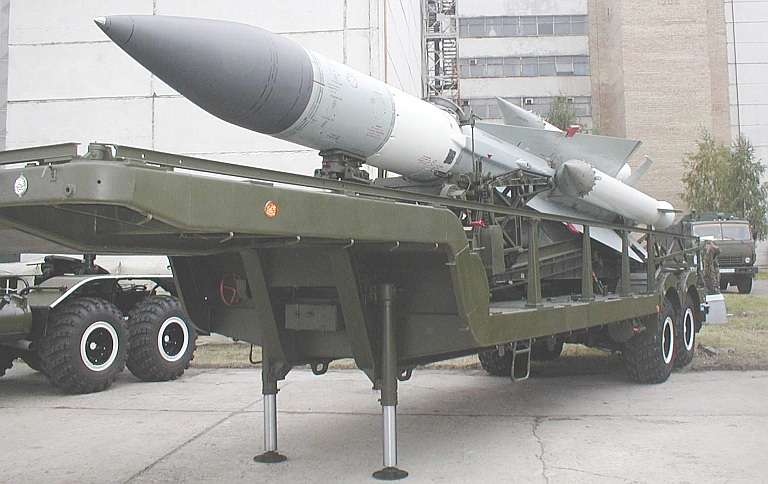 A
5T82 disconnected from the tractor.
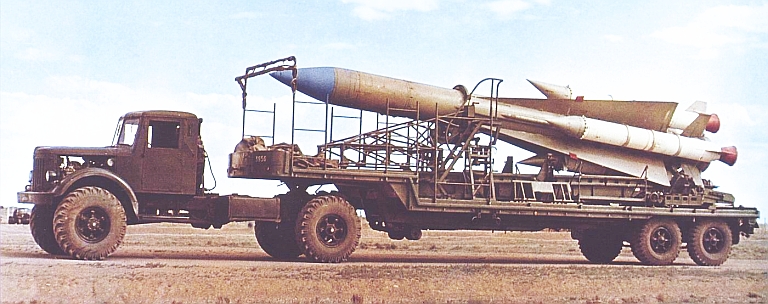 Earlier SA-5 variants were carried by the 5T53 transporter semitrailer (above). A more recent transporter is the 5T53M, used to carry missiles in containers (below). 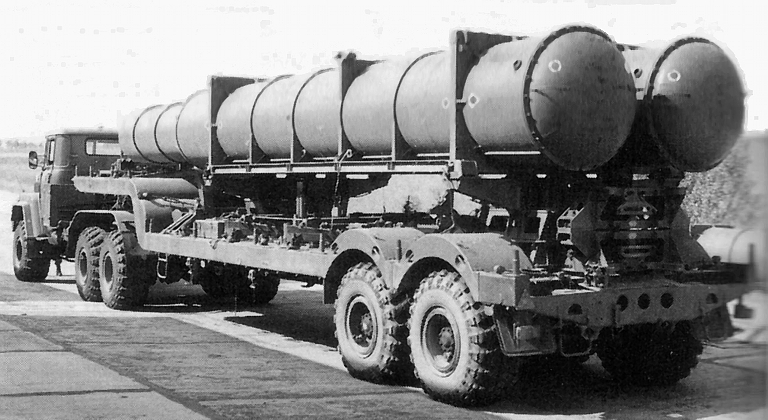 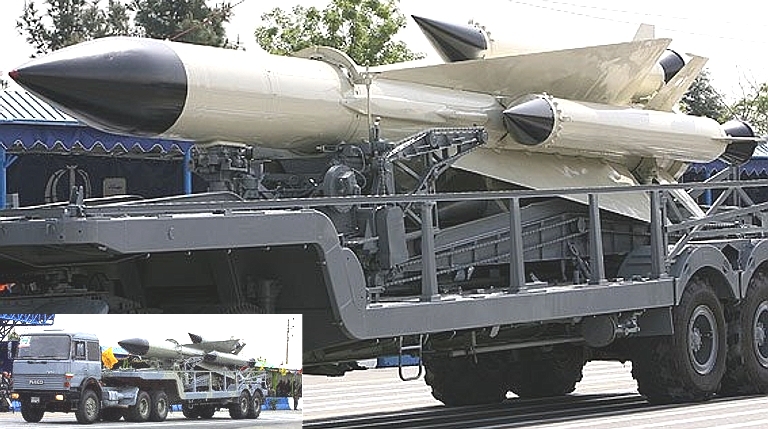 Iranian
5T82 transporter/transloader carrying a
5V28 round. The Kraz-260 is replaced by an Iveco 6 x 6 tractor.
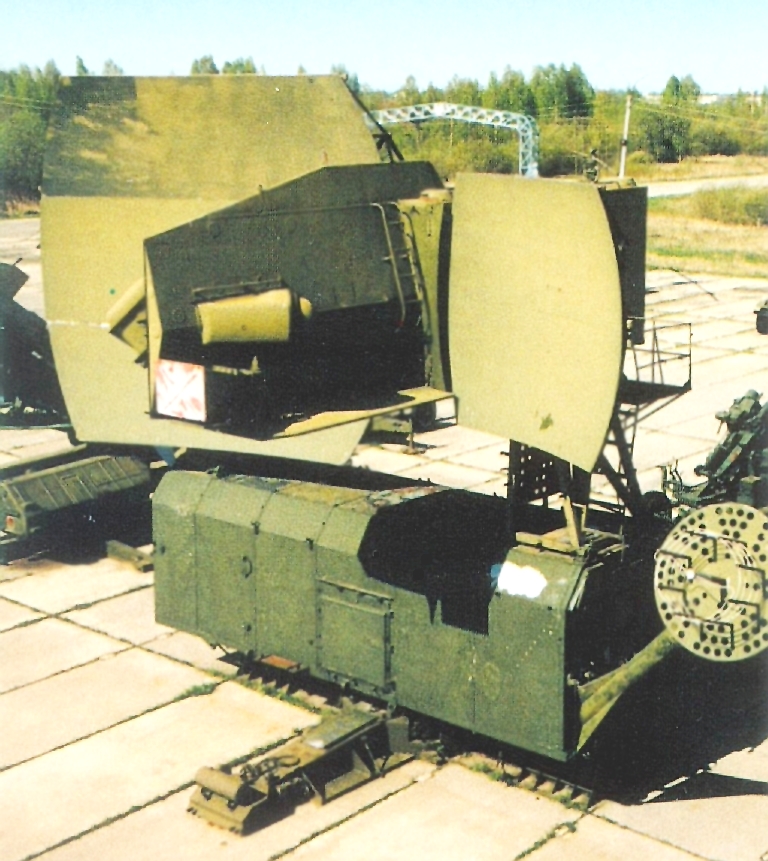 5N62 Square Pair 'Illumination and
Guidance Radar'. This FMCW long range target illuminator uses separate
paraboloid sections each for the transmit and receive paths, with the
central body used to prevent spillover. The radiating elements from the
antenna feeds are mounted on the central body.
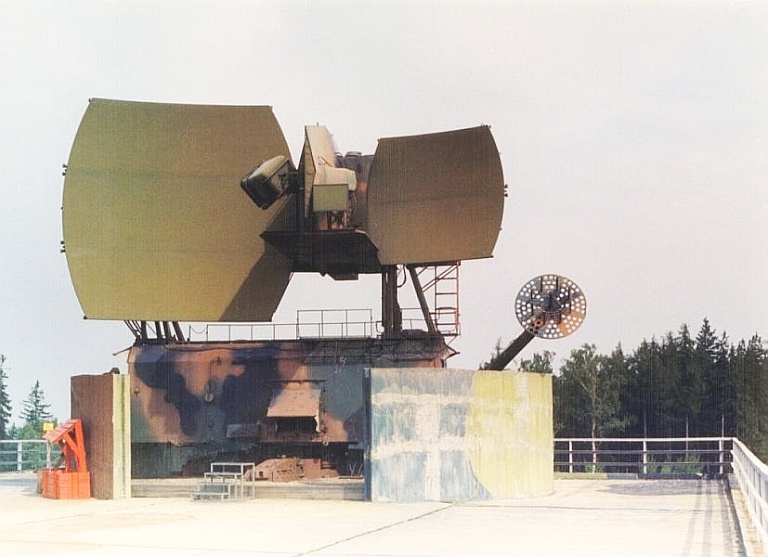 Much
like
other SA-5 battery components, the 5N62 Square Pair FWCW illuminator is
more than often installed in a fixed concrete revetment, or as this
example shows, an elevated fixed concrete platform. The system is
transported using a convoy of trailers, one each for the K-1 and K-2
cabins, with three for the disassembled antenna package (via
www.s-200.de).
 Semi-mobile configuration of the improved K-1M cabin with 5N62 Square Pair FWCW illuminator on display at Kecel in Hungary. Note the Square Pair at maximum elevation angle in the background (Image © Miroslav Gyűrösi). 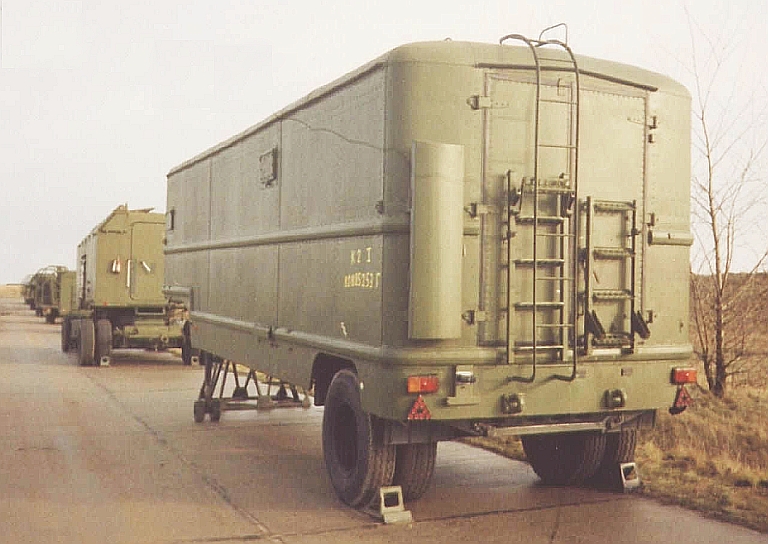 The K-2 trailer
(foreground) and
K-1 trailer (background)(via www.s-200.de).
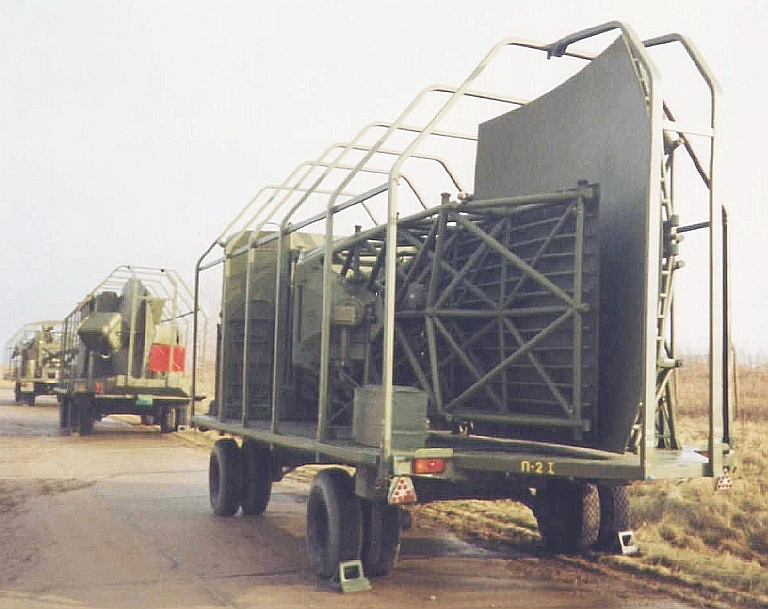 5N62 Square Pair antenna
stowed
for transport (via www.s-200.de).
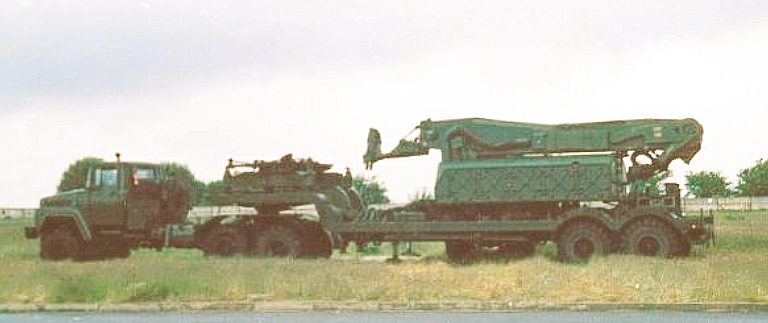 The 5P72 launcher is carried by semitrailer, this example towed by a KrAZ-260 (via www.s-200.de). 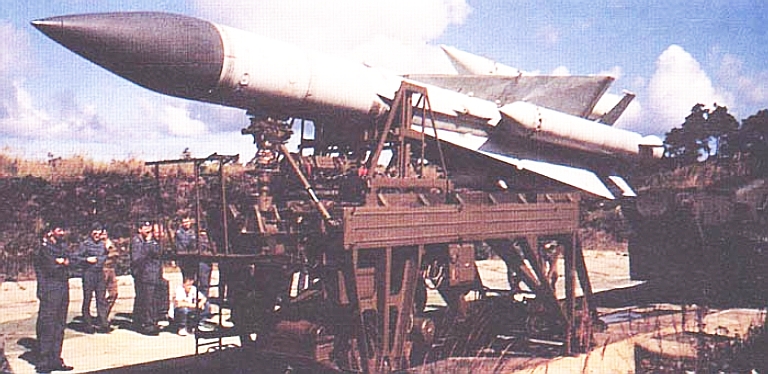 The
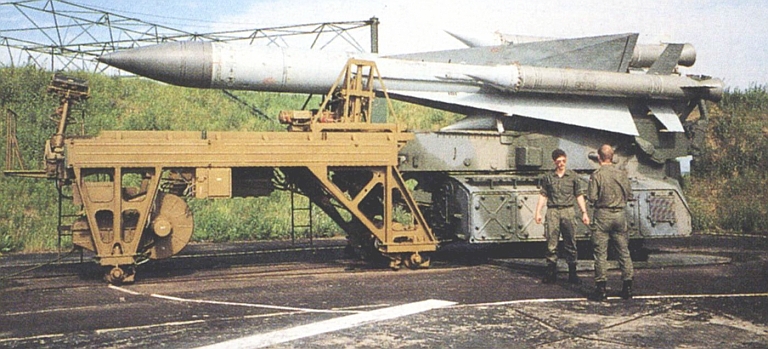
cumbersome 5Yu24 rail loader was used to transfer the missile from the
5T53 transporter to the 5P72 launcher (above and below)(via
www.s-200.de).
 |
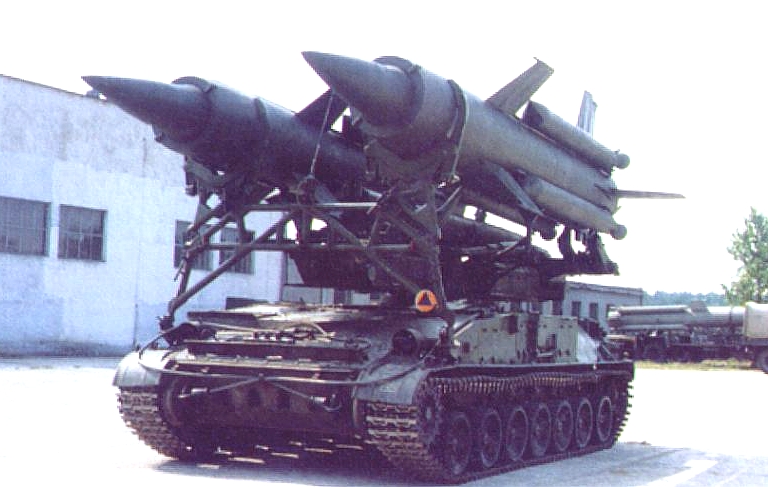 2P24
TEL in stowed configuration for transit.
The Krug / SA-4 Ganef was the
first fully mobile battlefield area defence SAM system deployed by the
Soviet PVO-SV. It was intended for division level area defence. The
principal acquisition radar was the P-40/1S12 Long Track. Missile
guidance and target tracking was performed by the 1S32 Pat Hand radar.
Batteries could also be integrated with the 9S44 Krab K-1 combat
support system which was intended to fuse data from multiple
acquisition radars to facilitate target tracking and battery control,
these could be the P-10 Knife Rest, P-12/18 Spoon Rest, P-15/19 Flat
Face, P-15M Squat Eye and P-40/1S12 Long Track. IOC was achieved in
1965, with the last variant deploying in 1974.
A typical battery composition is one Pat Hand with three TELS, with three batteries supported by a single Long Track. The large 2.5 tonne Novator 3M8 missiles were kerosene powered ramjets with isopropylnitrate turbopump driven internal power. The 750 kW peak power X-band Pat Hand engagement radar provided fine tracking of the target, coarse tracking of the 3M8 missiles, and command uplink transmissions. Later variants included an adjunct optical tracker. The 2P24 TEL, 1S12 Long Track and 1S32 Pat Hand were all built on the Metrovagonmash GM-123/124 series tracked chassis, common to a range of other Red Army equipment, and can be deployed for use in five minutes. The single round 2T6 transloader was based on the Ural 375 truck. A wide range of variants were developed over the long service life of the design. The four basic variants were the 3M8 Krug, Krug A, Krug M and Krug M1. Additional cited variants are the M2 and M3 subtypes. Range is cited by Russian sources at typically ~27 NMI, with altitude up to 80 kft. When the USSR collapsed the Krug was being replaced by the S-300V / SA-12 system. The system was operated by a number of Warsaw Pact states, but was retired by the Czechs, Germans and Hungarians during the 1990s. It remains in use with a number of former Soviet republics, Poland and Bulgaria. 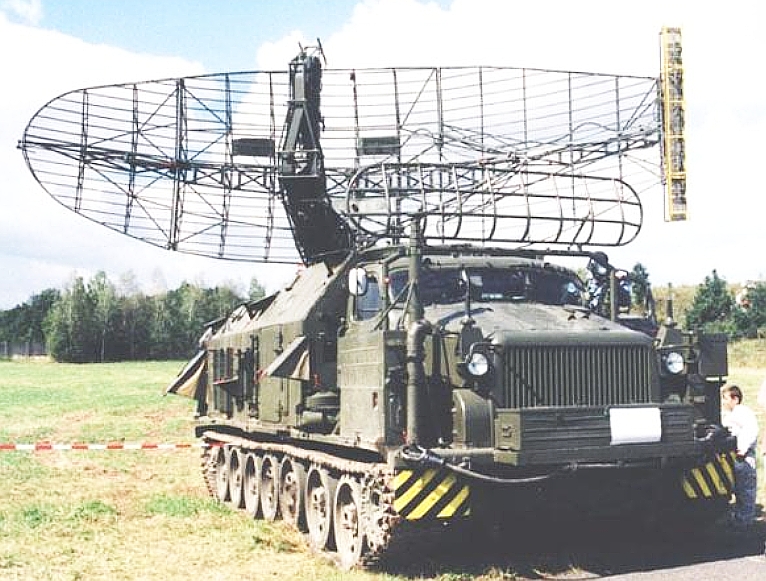 The P-40/1S12 was the primary acquisition
radar for the SA-4, although the system was designed to make use of
other radar types including the Spoon Rest, Flat Face and Squat Eye.
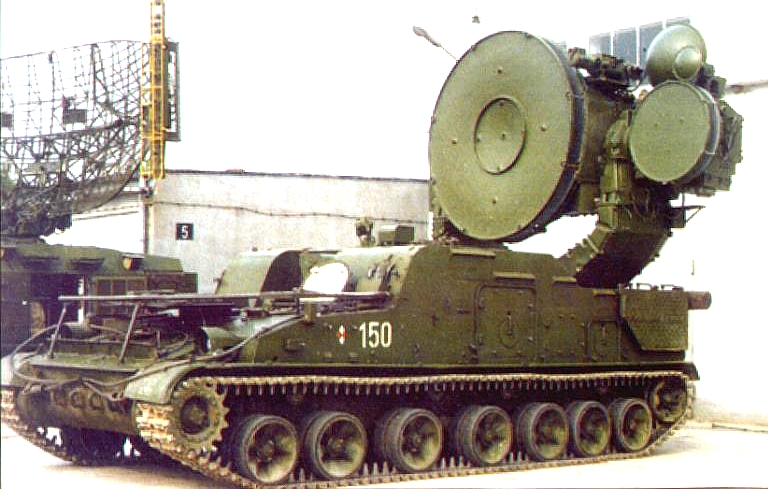 1S32
Pat Hand engagement radar.
|
S-125
Neva/Pechora /
SA-3 Goa SAM System
|
| |
|
|
HQ-2A/B / CSA-1 / S-75 / SA-2 Guideline SAM SystemTransloaders and TEL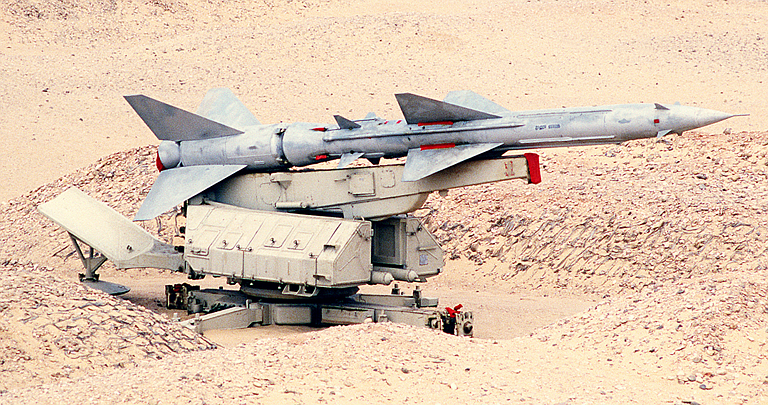 A
Soviet supplied S-75 Guideline and SM-90 launcher operated by Egypt in
1985 (US DoD).
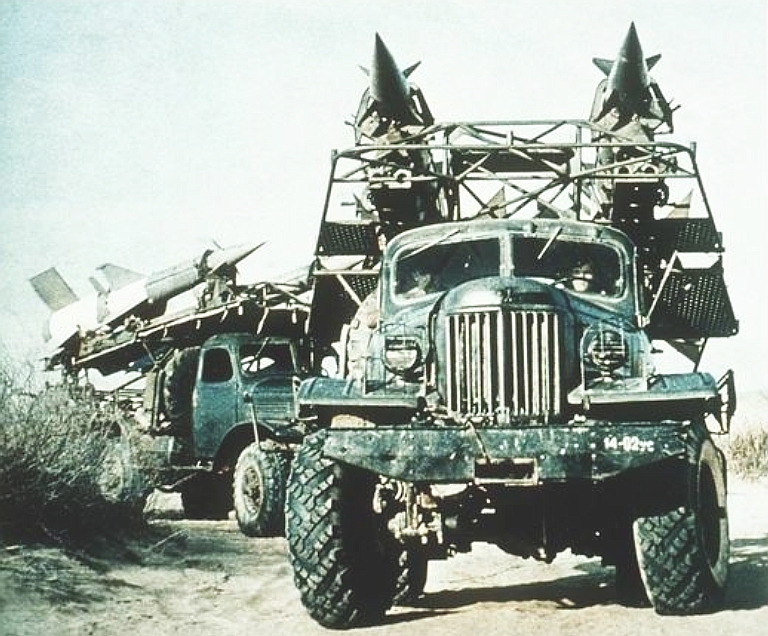
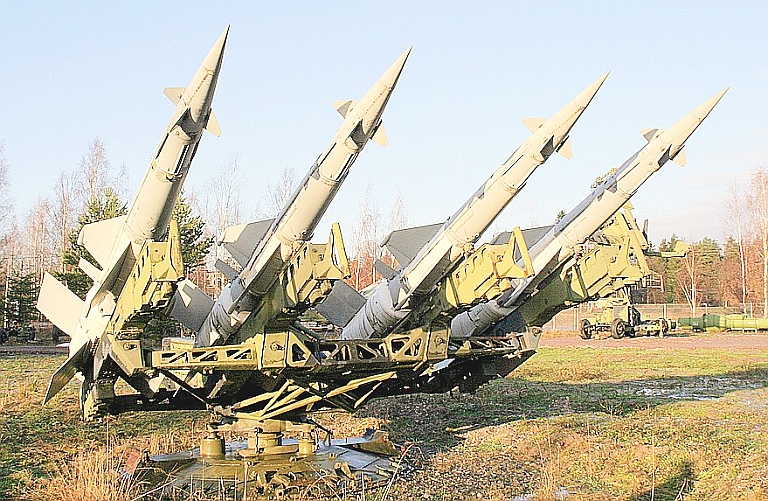
The S-75 / SA-2 Guideline family of SAM systems remains the most widely exported area defence missile system, and was supplied in large numbers by the Soviets to Warsaw Pact nations, Third World Soviet allies and other non-aligned nations. Over thirty nations deployed one or another variant of the SA-2, and China manufactured indigenous derivatives well after this design was out of production in the Soviet Union. The basic design qualifies as semi-mobile, requiring several hours to set up or redeploy a battery. Typical battery composition is a single SNR-75 Fan Song series engagement radar, six SM-90 single rail launchers, and multiple PR-11AM transporter/transloader trucks carrying reload rounds for the SM-90s. Many S-75 operators deploy the system in fixed sites, with revetments using concreted pads and bays, and/or earthwork berms, to protect the missile system components. The PLA reverse engineered the
Soviet V-75/S-75 Dvina / SA-2 Guideline SAM system during the 1960s,
including the SNR-75 Fan Song radar, the SM-90 launcher and the PR-11AM
transporter/transloader. Since then the PLA developed a significantly
improved HQ-2B variant.
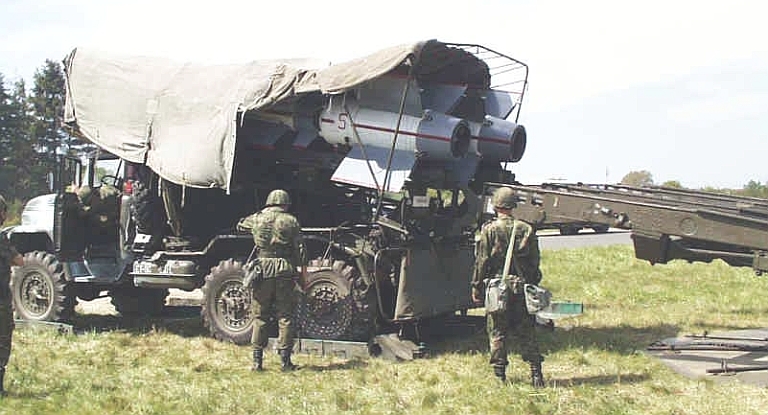
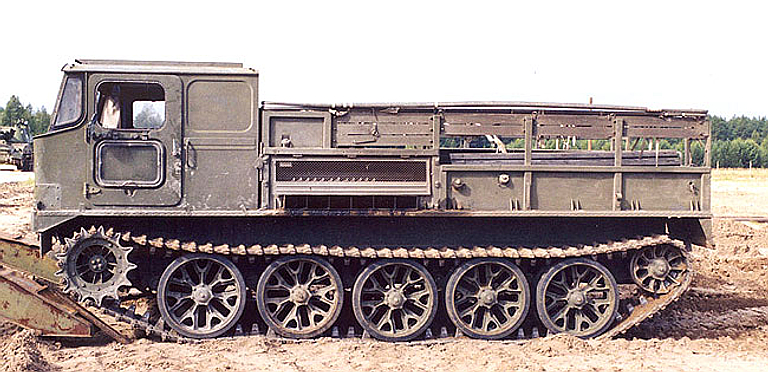
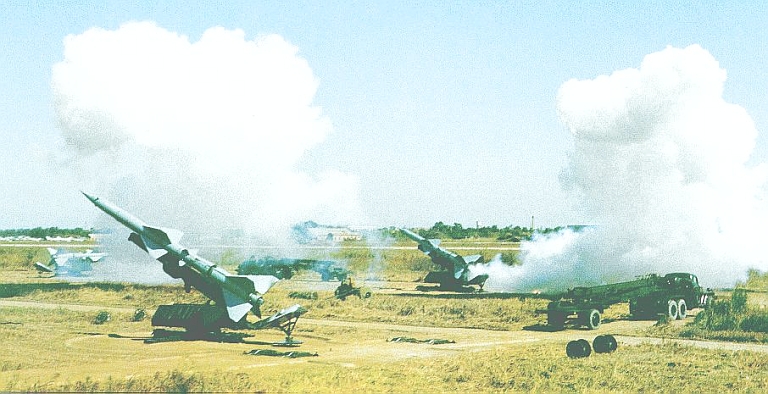
There are at this time two known fully mobile TEL designs for the S-75, one developed by the Chinese and one by the Cubans. 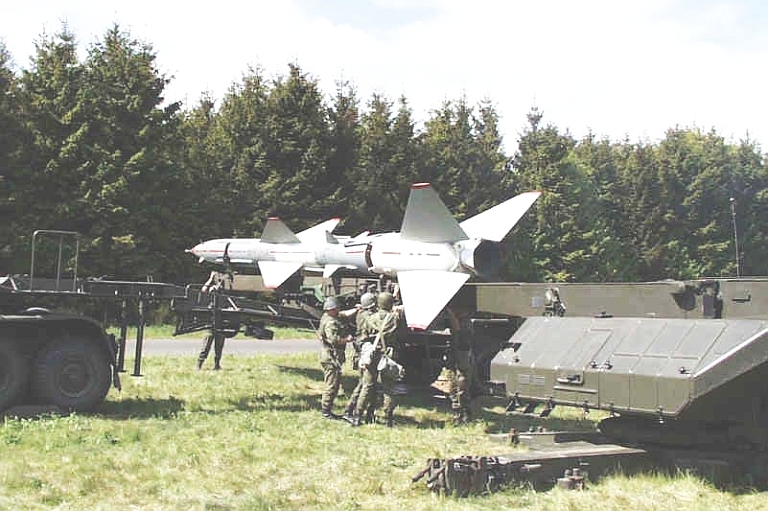 Loading the SM-90 from a PR-11AM transloader. 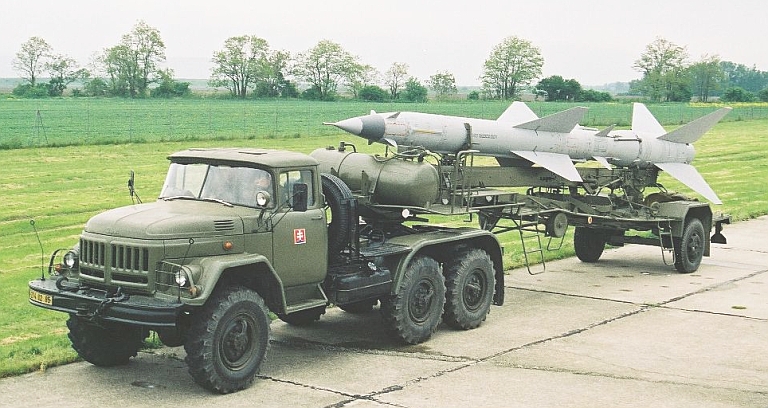 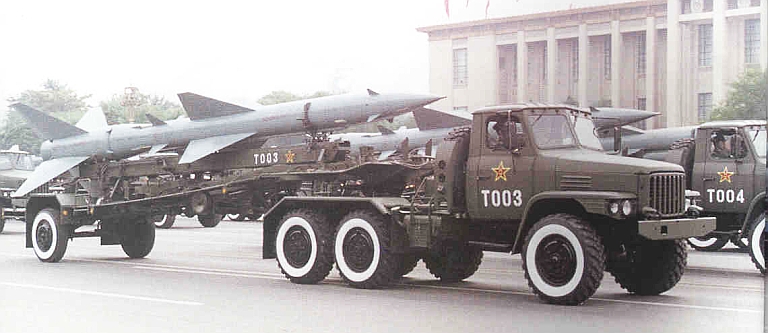 Reverse engineered PLA PR-11AM transporter/transloader, with a late model tractor. 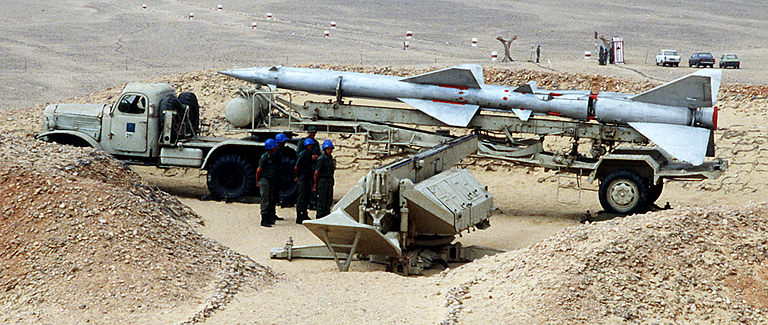 A Soviet supplied S-75 Guideline and early model PR-11AM transporter/transloader, operated by Egypt in 1985 (US DoD). Technical Report APA-TR-2008-0601-C |
|
|||||||||||||
|
|
|
|
|
|
|
|
|
|
|
|||
|
|
|
|
|
|
|
|
|
|
|
|||
 |
|
|
|||||||||||
| Artwork, graphic design, layout and text © 2004 - 2014 Carlo Kopp; Text © 2004 - 2014 Peter Goon; All rights reserved. Recommended browsers. Contact webmaster. Site navigation hints. Current hot topics. | |||||||||||||
|
Site Update
Status:
$Revision: 1.753 $
Site History: Notices
and
Updates / NLA Pandora Archive
|
|||||||||||||
|
|
Tweet | Follow @APA_Updates | |||||||||||
|
|
|||||||||||||
|
|
|||||||||||||