|
||||||||||||||||||||||
 |
||||||||||||||||||||||
![F-22A Raptor, FB-22, F-22E, F-22N and Variants Index Page [Click for more ...]](APA/f-fb-22.png "F-22A Raptor, FB-22, F-22E, F-22N and Variants Index Page [Click for more ...]") |
 |
![People's Liberation Army Air Power Index Page [Click for more ...]](APA/pla-air-pwr.png "People's Liberation Army Air Power Index Page [Click for more ...]") |
 |
 |
 |
 |
 |
 |
![Military Ethics, Culture, Education and Training Index Page [Click for more ...]](APA/ethx-culture.png "Military Ethics, Culture, Education and Training Index Page [Click for more ...]") |
 |
||||||||||||
 |
![Russian / Soviet Weapon Systems Index Page [Click for more ...]](APA/rus-weps.png "Russian / Soviet Weapon Systems Index Page [Click for more ...]") |
 |
 |
 |

|
 |
 |
 |
 |
 |
||||||||||||
 |
 |
 |
||||||||||||||||||||
| Last Updated: Mon Jan 27 11:18:09 UTC 2014 | ||||||||||||||||||||||
|
||||||||||||||||||||||
|
||||||||||||||||||||||
|
||||||||||||||||||||||
|
|
|
|
|
|
|
|
|
|
|
||||||||||||
|
|
|
|
|
|
|
|
|
|
|
||||||||||||
| |
|
|
||||||||||||||||||||
| Last Updated: Mon Jan 27 11:18:09 UTC 2014 | ||||||||||||||||||||||
|
||||||||||||||||||||||
When America’s Stealth Monopoly Ends, What's Next? |
||||||||
|
Air Power
Australia - Australia's Independent Defence Think Tank
|
||||||||
| Air Power Australia NOTAM 4th March, 2009 |
||||||||
|
||||||||
|
||||||||
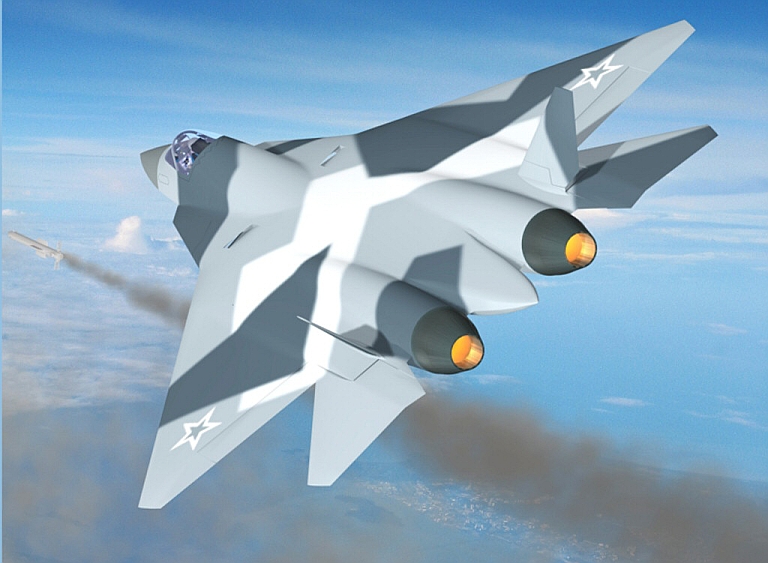 PAK-FA rendering by NPO Saturn. Unlike the JSF, the stealthy PAK-FA is being designed with air superiority performance and high agility as the primary consideration. To date only speculative renderings have been released, making assessments difficult (Saturn NPO). |
||||||||
|
||||||||
| For three decades the United States has
held the undisputed monopoly on the most important military technology
of the Cold War era - stealth. That monopoly is set to end over the
coming decade as the Russians, Indians and likely Chinese deploy
a new generation of military aircraft designs. Available to any client
with the cash, these high technology products will obsolete the large
fleets of legacy Cold War equipment the West has relied upon since the
end of the Cold War to maintain global stability, as well as rendering
the planned
F-35 Joint Strike Fighter impotent. A world in which any nation with the cash can procure stealthy manned or robotic aircraft, or cruise missiles, will be very different from the world we see now. Many of the fundamental assumptions made about America’s hitherto undisputed strategic primacy will collapse, unless Americans take stock now and start seriously planning for this future. The Russians have two stealth aircraft designs in the current development pipeline, intended to be deployed operationally between 2010 and 2020. The Chinese are claimed to be working on a stealthy follow-on to the J-10 Sinocanard fighter, and have displayed models of supersonic stealthy unmanned vehicle designs. The first of the two Russian designs is an unmanned robotic strike and reconnaissance vehicle, similar in concept to the US X-45 and X-47 UCAV/UCAS designs. One of the mockups, designed by the MiG bureau, was shown to Western media in 2007, and is designated the SKAT (skate). This ten tonne vehicle is a “batwing” design with a planform modelled on the US B-2A bomber, but less refined detail shaping compared to existing US designs. The second of these designs is the PAK-FA (Перспективный Авиационный Комплекс Фронтовой Авиации - Future Aviation System For Tactical Aviation), a multirole tactical fighter intended to compete with the F-22A Raptor in the air, and with the F-35 Joint Strike Fighter in the marketplace. The PAK-FA will replace the Russian Sukhoi Flanker series as the primary fighter in the Russian Air Force, and will become the principal export fighter for Russia’s booming defence industry. The prototype of the PAK-FA was intended to fly in 2008, but has been delayed to this year, so to date no useful imagery of this design exists. The Russians have made numerous public statements which do provide some indication of what the design aims for this aircraft are: it is intended to be stealthy, highly agile to prevail in close air combat, it is intended to be fitted with an evolution of the 20 kiloWatt class NIIP N035 Irbis E phased array radar, and to be powered by a pair of 35,000 lbf class supersonic cruise turbofan engines. On paper, these cardinal parameters put the PAK-FA in the class of the F-22A Raptor. The first question any observer will properly ask is whether the Russians have the basic technology to design, develop, test and produce a credible state-of-the-art stealth fighter. The key technologies required for this include shaping design techniques, absorbent material and coating techniques, digital flight control technology, rectangular engine nozzle technology, engine hot end technology, and Low Probability of Intercept (LPI) digital radar and networking technology. Shaping techniques are the most important prerequisite technology for stealth design - their purpose is to scatter radar waves illuminating an aircraft away from the threat radar. Good examples of smart shaping design include the F-117A, B-2A, YF-23A and F-22A Raptor, as well as the proposed FB-22A. The F-35 Joint Strike Fighter engine nozzle and lower fuselage areas are examples of especially poor shaping design . Effective shaping techniques permit an aircraft to be built with a 100 to 1,000 fold lower radar signature compared to a conventional design of similar size. The two principal tools required to perform proper rigorous shaping design are computer based simulation tools, typically based on physical optics, diffraction and surface travelling wave mathematical modelling, and measurement tools and test range facilities to verify that shapes designed on a computer actually work as intended. With commodity desktop computers now outperforming the supercomputer technology used by US defence contractors during the 1970s and 1980s, and Russia’s surplus of high quality PhD graduates in mathematics, physics and electrical engineering, the ability of Russian industry to produce good stealth shaping design is limited only by the investment made in personnel, measurement tools and test ranges. As the SKAT UCAV mockup shows, current Russian design technique is converging on US design technique. What is often forgotten in the West is that Russian designers have a long history of cherry-picking the best ideas from extant Western designs, incrementally improving them, and fusing them together to produce an end product that outperforms its Western predecessors. Classic examples include the AS-4 and AS-6 supersonic cruise missiles, improving on the British Blue Steel, or the Sukhoi Flanker, which fused key ideas from the US F-14, F-15 and F-16 fighters to produce an original new design outperforming all three US fighters. With a wealth of imagery available detailing the US F-117A, B-2A, A-12A, YF-23A and F-22A Raptor, the Russians have a defacto library of sound and well proven ideas to work with. There is no need for Russian industry to reinvent the wheel, as US engineers have paved the way with a wealth of creative thinking. Driving the signature of a stealth aircraft down further, into the size of tennisballs, golfballs and marbles, is done by the application of radar absorbent structures, materials coatings, and low signature seals, fasteners, antennas and other detail components. Russian industry has a long history of creative and original developments in coating technologies and materials science. Recent disclosures include a coating which reduced the radar signature of the engine inlet tunnels in the Su-35BM Flanker by a factor of 30 in the centimetre radar band. Other technologies the Russians have developed include multilayer laminates which rotate the polarisation of surface travelling waves to suppress trailing edge reflections. The Russians mastered digital flight control technology during the 1990s and have been using it in the supermanoeuvrable Su-30MKI/MKM, Su-35BM and MiG-35 designs, to an advantage. There is sufficient maturity in this technology now to make a highly manoeuvrable stealth fighter, not unlike the F-22A. The technology of rectangular exhaust nozzles used in all proper US stealth designs to control radar and infrared signatures, is also well within the reach of Russian industry, which trialled a rectangular thrust vectoring nozzle during the early 1990s. In terms of engine technology, the Russians built the Al-41F supercruise engine during the 1990s and since then migrated its hot end technology into the Al-31F-117S for use in the Su-35BM. A 35,000 lbf class supercruise engine for the PAK-FA is therefore a non-issue. In radar the choice of mature Russian hybrid phased array technology for the PAK-FA over immature active array technology is a short term measure. It took US radar designers a decade to transition from the quad module technology used now in Phazotron’s Zhuk-AE to current single channel module technology. By 2020, probably sooner, the Russians will have mastered this, emulating US designs. That technology will permit the addition of the wideband frequency hopping techniques and stealthy antenna arrays, which characterise current US Low Probability of Intercept (LPI) AESA radars and top end datalinks. The most recent generation of Russian radars use fully digital processing chains, which opens up the full gamut of sophisticated processing algorithms, which have appeared in US radars during this decade. There can be no doubt that the Russians possess all of the basic technologies required to design an F-22 class supercruising and agile stealth fighter - the basic aerodynamic, shaping and propulsion design of the F-22 was performed over a decade ago. When the PAK-FA is unveiled later this year we will see exactly how effective Sukhoi’s design engineers have been in fusing these technologies together to produce a new design. We can be confident that the design will be an effective supercruiser and it will be highly agile. The only uncertainty at this stage is in how stealthy it will be. How stealthy does the PAK-FA need to be to defeat US legacy fighters? A radar cross section of only -20 dBSM would deny early Beyond Visual Range (BVR) missile shots using the AIM-120C/D AMRAAM to all current and planned US fighters. Doing any better, like -30 dBSM or -40 dBSM, simply increases the level of difficulty in prosecuting long range missile attacks. The consequence of this is that missile combat will be compressed into shorter distances and shorter timelines, putting a premium on the stealth, supersonic persistence and close combat agility of US fighters. A larger portion of engagements will be at visual range, and most BVR engagements will end up taking place inside 30 nautical miles. Only the F-22A Raptor is viable in an air combat environment where the PAK-FA is deployed, and the F-22A will not provide a 144:0 kill ratio against the PAK-FA. The F-35 Joint Strike Fighter struggles to survive against the conventional Su-35BM Flanker, with only its -30 dBSM class front sector stealth keeping it alive in some BVR combat situations. Against even a -20 dBSM class PAK-FA, the F-35 falls within the survivability black hole, into which US legacy fighters such as the F-16C/E, F-15C/E and F/A-18A-F have already fallen. Americans need to start thinking about which strategic niche they wish to occupy in 2020. The stealth monopoly cannot last forever, and the US must now confront the prospect of a future in which the asymmetric advantage of US stealth is no longer absolute, but rather incremental. There is a big difference, operationally and strategically, in using stealthy jets against opponents who have none, versus using stealthy jets against opponents who also use stealthy jets. Incremental differences in stealth performance will matter, but much less in such “symmetric” stealth vs. stealth conflicts, compared to past asymmetric conflicts. The most fundamental and immediate conclusion is that US planning for the future of its fighter fleet must be architected around the F-22A Raptor and improved future derivatives, since only this aircraft will be survivable in a future globalised market for stealthy combat aircraft. |
||||||||
|
||||||||
| Air
Power
Australia
Website - http://www.ausairpower.net/ Air Power Australia Research and Analysis - http://www.ausairpower.net/research.html |
||||||||
 |
||||||||
| |
||||||||
|
|||||||||||||
|
|
|
|
|
|
|
|
|
|
|
|||
|
|
|
|
|
|
|
|
|
|
|
|||
| |
|
|
|||||||||||
| Artwork, graphic design, layout and text © 2004 - 2014 Carlo Kopp; Text © 2004 - 2014 Peter Goon; All rights reserved. Recommended browsers. Contact webmaster. Site navigation hints. Current hot topics. | |||||||||||||
|
Site Update
Status:
$Revision: 1.753 $
Site History: Notices
and
Updates / NLA Pandora Archive
|
|||||||||||||
|
|
Tweet | Follow @APA_Updates | |||||||||||
|
|
|||||||||||||
|
|
|||||||||||||