|
||||||||||||||||||||||
 |
||||||||||||||||||||||
![F-22A Raptor, FB-22, F-22E, F-22N and Variants Index Page [Click for more ...]](APA/f-fb-22.png "F-22A Raptor, FB-22, F-22E, F-22N and Variants Index Page [Click for more ...]") |
 |
![People's Liberation Army Air Power Index Page [Click for more ...]](APA/pla-air-pwr.png "People's Liberation Army Air Power Index Page [Click for more ...]") |
 |
 |
 |
 |
 |
 |
![Military Ethics, Culture, Education and Training Index Page [Click for more ...]](APA/ethx-culture.png "Military Ethics, Culture, Education and Training Index Page [Click for more ...]") |
 |
||||||||||||
 |
![Russian / Soviet Weapon Systems Index Page [Click for more ...]](APA/rus-weps.png "Russian / Soviet Weapon Systems Index Page [Click for more ...]") |
 |
 |
 |

|
 |
 |
 |
 |
 |
||||||||||||
 |
 |
 |
||||||||||||||||||||
| Last Updated: Mon Jan 27 11:18:09 UTC 2014 | ||||||||||||||||||||||
|
||||||||||||||||||||||
|
||||||||||||||||||||||
|
||||||||||||||||||||||
|
|
|
|
|
|
|
|
|
|
|
||||||||||||
|
|
|
|
|
|
|
|
|
|
|
||||||||||||
| |
|
|
||||||||||||||||||||
| Last Updated: Mon Jan 27 11:18:09 UTC 2014 | ||||||||||||||||||||||
|
||||||||||||||||||||||
F-22A Raptors for the Marine Corps
|
||||||||||||||||||||||||||||||||||||||||||||||||||||||
|
Air Power
Australia - Australia's Independent Defence Think Tank
|
||||||||||||||||||||||||||||||||||||||||||||||||||||||
| Air Power Australia NOTAM 9th February, 2009 |
||||||||||||||||||||||||||||||||||||||||||||||||||||||
|
||||||||||||||||||||||||||||||||||||||||||||||||||||||
|
||||||||||||||||||||||||||||||||||||||||||||||||||||||
 The F-22A Raptor is the only fighter
available to the Marines which has the firepower, performance and
survivability to effectively defend the beachhead. With excellent short
field performance it is well suited to shore based operations from
forward locations (C. Kopp image).
|
||||||||||||||||||||||||||||||||||||||||||||||||||||||
| The USMC has a proud, 233 year history of
unexcelled service to their country. Projecting US power from US
Navy ships, they are the first to engage the enemy, often in deadly
fights where weakness brings rapid death and high casualty
rates. In amphibious assaults, they take and hold territory
to provide safe bases for US and Coalition operations. If the
President wants something difficult done, he asks the Marines. In the very near future, the Marine’s military dominance could come to a crashing, jarring halt. Their equipment is obsolete, overmatched and out of life. In their next embarked transit to a battlefield, they could be ferociously attacked with modern weapons of war. The nightmare for the USN is to have a swarm of supersonic anti-ship missiles target the Carrier Battle Group. The formula for missile saturation swarm attack is simple – count the number of Aegis class DDGs, multiply by four, then add a few for good measure. Launch the missiles so they overwhelm the defences. Attack aircraft could be Sukhoi Flankers with one to four supersonic missiles apiece, the modified H-6K Badger that can carry up to six missiles with an un-refuelled radius over 2,000+ nautical miles, or the Tu-95M/142 Bear with multiple wing and fuselage hard-points and a combat radius of almost 4,000 nautical miles. K Supersonic weapons include the Kh-41 BrahMos / Yakhont ‘Stallion’, the Kh-41 ‘Sunburn’ and the 3M54 ‘Sizzler’. 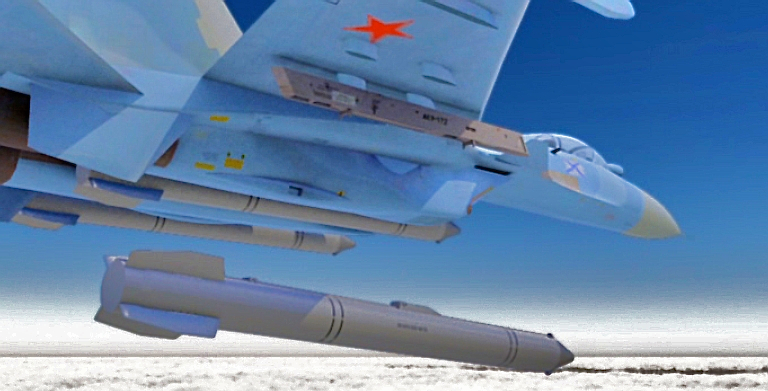 Digital rendering of the air launched supersonic Novator 3M-54AE Sizzler being released from an Su-33 Flanker D. The F/A-18A-D, F/A-18E/F and F-35 Joint Strike Fighter all lack the performance to credibly intercept such threats (Novator). 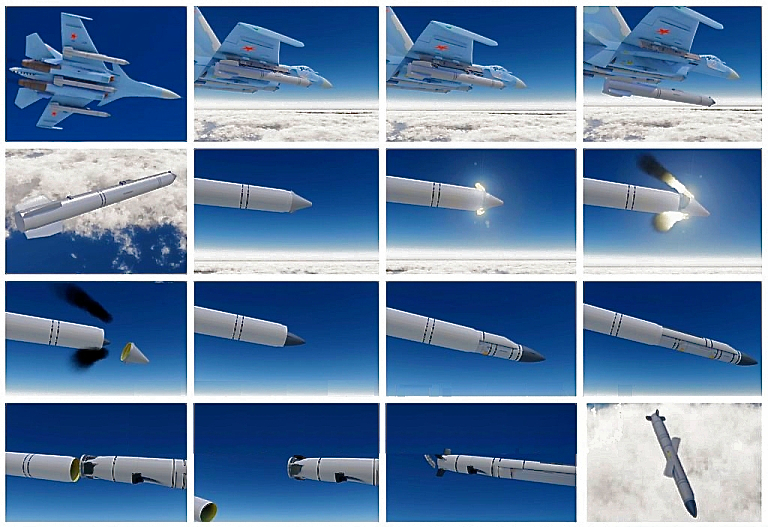 Digital rendering of the launch sequence for the supersonic 3M-54AE Sizzler. Rather than redesign the missile airframe to accommodate hard points, Novator opted to use a canister not unlike the encapsulated sub launch Harpoon arrangement. Once the canister is clear of the aircraft, the nosecone is jettisoned, the missile ejected, upon which it deploys its wings and tail controls, starts its turbojet engine, and cruises until the target is acquired. Not depicted is the terminal stage of the missile's flight, where the subsonic cruise airframe is jettisoned and the supersonic rocket propelled kill stage engages the target at a speed in excess of Mach 2.5. The US Navy have publicly acknowledged that they as yet do not a viable defence against this weapon (Novator). 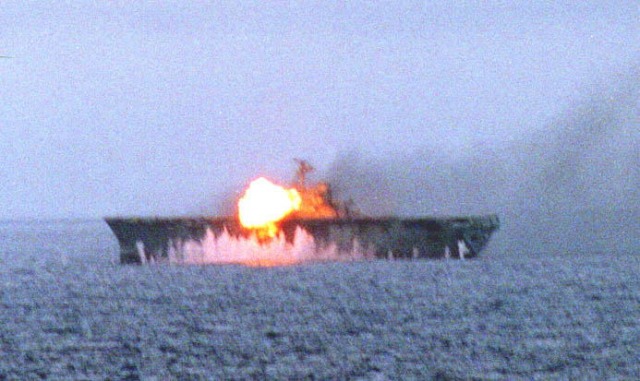 Above former LPH-9 USS Guam under attack by the JFK's CVW during an exercise in October, 2001 (USN image). Below former USN LST Schenectady takes a hit by multiple JDAMs, the vessel sank 1.5 hrs later (USAF image). Amphibious ships, laden with fuel and munitions, are highly vulnerable to guided munitions. Case studies include Anzio, Salerno, and the Falklands. 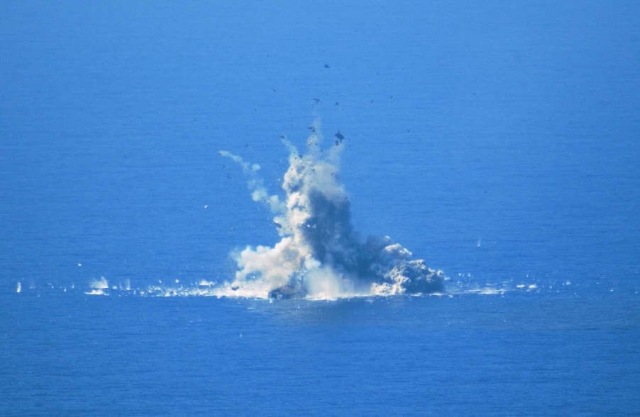 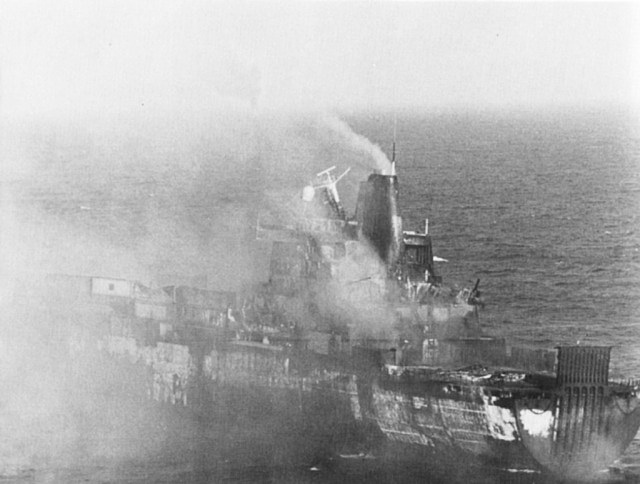 The Atlantic Conveyor burned out after being hit by a single Aerospatiale AM39 Exocet ASCM launched by an Argentinian Super Etendard strike fighter. The Royal Navy suffered heavy losses in the Falklands including two LSTs and one RORO transport (UK MoD image). If the Marines are lucky, and reach the assault point, more bad things will await them. The future enemy Integrated Air Defence System (IADS) is a symbiotic coupling of air combat fighters (ACFs) and Surface-to-Air Missiles (SAMs), with active and passive multi-spectral sensors that guide the air and ground intercepts of incoming fighters and cruise missiles. The SAMs protect the ACFs bases, and the ACFs protect the SAMs. If the USMC attempts to assault a shore without air dominance, the enemy can attack the Marines and the USN unhindered. A Sukhoi Flanker can carry up to three KAB-1500 guided bombs. If the fill is thermobaric, and the bombs GPS or EO guided and air-fused, then a single Sukhoi can annihilate a battalion of Marines in the tough transit from ship-to-shore. These same weapons create such an over-pressure, they will break the back of many ships. The Marines are often given a raw deal with their equipment. They are assigned the toughest jobs, but are given hand-me-down, tired and ineffective war-craft. While their courage and aggression may have compensated for second-rate equipment in the past, this is not a safe policy to extrapolate into the future. In modern warfare, the old F/A-18A/C/D Hornets have little capability against new Sukhois and SAMs. The ‘Super Hornet’ is already obsolete. The much delayed, untested, battlefield interdictor Joint Strike Fighter was never designed to impose air dominance against modern ACFs, nor will it penetrate a modern IADS with SAMs that can detect and fire on the radar returns from pigeons when the radar reflections of the Joint Strike Fighter will be more of the size of a goose. Courage in the face of a technologically superior enemy unjustly results in the death of many fine warriors. So, if the USMC is going to spearhead future US military operations, why not give them the sharpest spear? Suspend disbelief, inter-service rivalry,
and prior political
commitments for a few minutes. Imagine replacing the following
eight
USMC Fighter Attack Squadrons of old, worn-out F/A-18s with new F-22A
Raptors – some 96 aircraft.
|
||||||||||||||||||||||||||||||||||||||||||||||||||||||
| Marine
Corps Fighter Attack Squadrons |
||||||||||||||||||||||||||||||||||||||||||||||||||||||
Table: Wikipedia
 The Marines' existing fleet of F/A-18
variants is wholly outclassed in
the air by late model Russian Sukhoi
Flankers,
and has very poor survivability against double
digit SAM systems. The
aircraft would suffer prohibitive combat losses squandering scarce and
valuable Marine Corps pilots. The limitations of the F-35B Joint Strike
Fighter and F/A-18E/F
would lead to
a similar outcome (US DoD image).
|
||||||||||||||||||||||||||||||||||||||||||||||||||||||
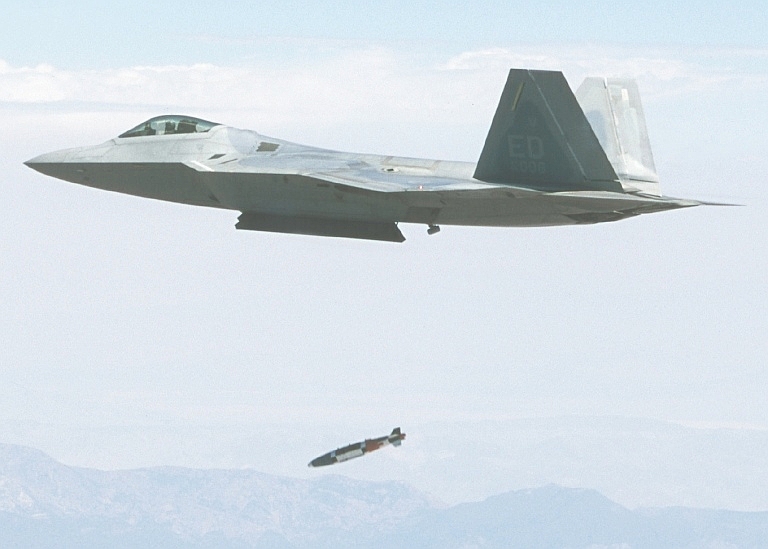
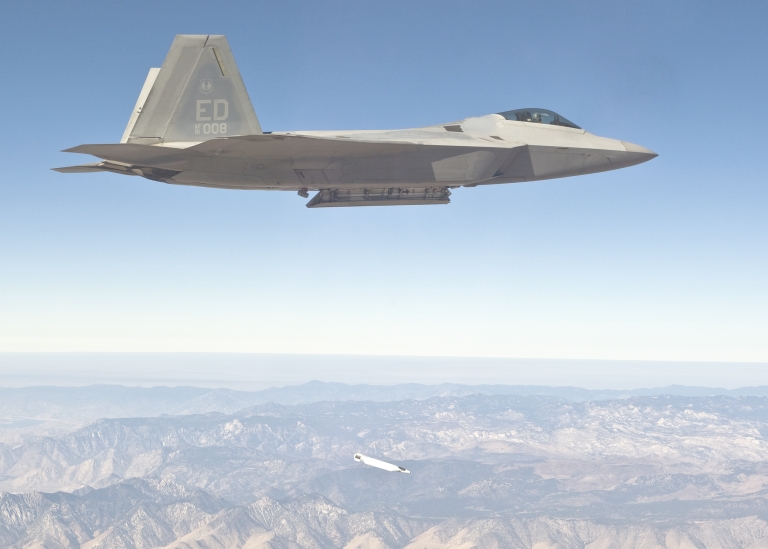 The internal guided bomb payload of the
F-22A Raptor is identical to the planned payload of the F-35B STOVL
Joint Strike Fighter, either two JDAMs,
or eight Small
Diameter Bombs. Above, an F-22A
Raptor
drops a GBU-39/B Small Diameter Bomb from
its weapons bay during a test
mission
Sept. 5, 2007. Below, Maj.
John Teichert, USAF, of the 411th Flight Test Squadron
performs the first supersonic release of the 1,000 lb GBU-32 Joint
Direct Attack Munition over the Mojave test range, on the 14th July,
2005. The F-22A has a ~50 percent greater
external weapon payload
potential compared to the F-35A/B (US Air Force).
  The Marine Corps has a distinguished
history of shore based operations. Above VMF-214 in the New Hebrides,
below Marine Corps F-4Us supporting troops in Korea, 1950 (US DoD).
 |
||||||||||||||||||||||||||||||||||||||||||||||||||||||
| No change
of role is required – intercept and destroy enemy aircraft, and support
the amphibious force. Let the Marines develop their own tactics,
but here are some suggestions. Their first task is to get the USN Battle Task Group safely to the amphibious assault point. With careful routing, by flying top cover, the Raptors can find and destroy missile carrying aircraft before they reach an anti-ship missile launch point. Supersonic anti-ship missiles are fearsome weapons, but they consume prodigious amounts of fuel in the process. So while their ‘below radar horizon range’ is longer than ship’s radar and missile systems, it is still quite close to the battle group - typically 100-200 nautical miles. The Raptors need to ‘sanitize’ this launch doughnut, killing the launch aircraft before release, preferably enroute to their attack and well away from the CSG/CVBG. In the fog of war, some ‘leakers’ always get though, but if the number is much reduced, then the Aegis DDGs can cope with the attack. At the amphibious assault point, USMC air power must ‘kick down the door’ for their assaulting ground forces. They must cut the symbiotic link between the ACFs and the SAMs. They do this by engaging the ACFs first. If the enemy fighters show, they are destroyed. If they don’t show, then the Raptors move onto the SAMs, killing them in a Destruction of Enemy Air Defences (DEAD) operation with close-in Small Diameter Bomb attacks before the SAMs can ‘shoot-and-scoot’. Now, the argument against this new capability for the USMC, is that it is ‘land-based’, and couldn’t possibly give the USMC 24/7 air dominance coverage when and where it needs it. This argument needs to be tested in the crucible of detailed operations research. The Marines have been operating successfully from shore basing for many decades, so the argument that the Marines must operate off carriers only is ideological, and specious. What we already know is that the F-22A has superior range/payload performance to the STOVL F-35B Joint Strike Fighter in all regimes, and better short field performance than both the STOVL F-35B and CTOL F-35A Joint Strike Fighter variants when both are flown as conventional fighters off runways. This is a key performance criterion, as there are many 4-5,000 ft airstrips the F-22A can use with undiminished range and payload, which the F-35 cannot. The F-22A has an identical internal payload of JDAMs or SDBs as the STOVL F-35 Joint Strike Fighter, but does so with twice as many air to air missiles onboard. Where does the USN need to get to, how will it get there, and can it be protected by the USMC Raptor fleet along the way? Can some innovative ‘gap-filling’ solutions be found? For example, would it be possible to refuel a patrolling Raptor from a carrier based aircraft, perhaps a rejuvenated KS-3 Viking ‘mini-tanker’? Could the USMC afford to buy the F-22A? Well, yes, in fact. Financial provision has been made for purchase of the Joint Strike Fighter – the World’s most costly combat aircraft. Look at the USMC Headquarters page on its Aviation Plan ‘Brainbook 2008’ Aviation Ref Guide (Brainbook) - May 2008, Page 22. Over the 08-13 FYDP, acquisition of 91 Joint Strike Fighter’s are planned for a Weapon System Unit Cost of $14,412.3M. Forgetting the complexities of ‘X-Year’ dollars, this makes the average acquisition cost of a Joint Strike Fighter of $158.4M. The F-22A’s Unit Procurement Cost is currently around $140M, therefore there are quite significant savings to be had, moreso, as a fair chunk of the Joint Strike Fighter $3,957.1M RDT&E could be saved, as this work has been wholly completed for the F-22A Raptor. These savings do not account for the greater cost/benefit i.e. "bang for buck" provided by the F-22A vs F-35B. The Marines could invest some of these funds in the latest sea-lift Patriot batteries, to provide essential IADS coverage of their Forward Operating Bases. Conversely, can the USN and the embarked USMC afford NOT to have Raptors to impose air dominance around its Task Groups? Massed, saturation supersonic missile attacks raise the spectre of ship and personnel losses of the scale experienced at Pearl Harbour or Guadalcanal – only this time in blue water where the causalities would be higher. A USMC fleet of Raptors protecting the USN fleet during combat operations seems to be very inexpensive insurance for the coming years. The USAF should rejoice at the prospect of the USMC being armed with the F-22A Raptor. The 96 aircraft would add 50% to the existing planned fleet of 183. If a desperate situation arises as described in the much quoted RAND Study (see below), then the Marines can fight side-by-side with the USAF. They could become the linchpin, bringing the mighty combat power of the USN, USMC and the USAF together to fight and win whenever and wherever needed. The Department of the Navy (DoN) and the Pentagon should be happy since such a plan provides an additional avenue for return on the investment so far made in the Joint Strike Fighter Program particularly in the systems areas with their inbuilt and advanced interoperability, supportability and sustainability enabling simple porting across to the F-22A. The new President and his Administration should be pleased with this advancing on return of investment with the overall plan generating far more jobs for Americans over the next five years than the Joint Strike Fighter Program could ever achieve over the same period for the same price. The additional bonus being achieving far greater capability in shorter time at far lower risk than the Joint Strike Fighter Program offers. Even if the F-35B STOVL Joint Strike Fighter survives the fundamental design problems, which have bedevilled it since its conception, the Marines still end up with an aircraft which lacks the firepower, performance and survivability to do the job required. A deep rethink of the future of Marine Corps fighter aviation is needed, and it is needed now. The United States Marine Corps deserves no less.  |
||||||||||||||||||||||||||||||||||||||||||||||||||||||
|
|
||||||||||||||||||||||||||||||||||||||||||||||||||||||
Related ReadingPrecision
Guided Munitions in the Region [Click for more ...]
Warship Vulnerability [Click for more ...] Assessing Joint Strike Fighter Air Combat Capabilities [Click for more ...] Surviving the Modern Integrated Air Defence System [Click for more ...] The Russian Philosophy of Beyond Visual Range Air Combat [Click for more ...] F/A-18E/F Super Hornet vs. Sukhoi Flanker Analysis [Click for more ...] Sukhoi Flanker Analysis [Click for more ...] F-22A Raptor Analysis [Click for more ...] Joint Strike Fighter Analysis [Click for more ...]  [Please embed this graphic and link on your website] |
||||||||||||||||||||||||||||||||||||||||||||||||||||||
| Air
Power Australia Website - http://www.ausairpower.net/ Air Power Australia Research and Analysis - http://www.ausairpower.net/research.html |
||||||||||||||||||||||||||||||||||||||||||||||||||||||
 |
||||||||||||||||||||||||||||||||||||||||||||||||||||||
| |
||||||||||||||||||||||||||||||||||||||||||||||||||||||
|
|||||||||||||
|
|
|
|
|
|
|
|
|
|
|
|||
|
|
|
|
|
|
|
|
|
|
|
|||
| |
|
|
|||||||||||
| Artwork, graphic design, layout and text © 2004 - 2014 Carlo Kopp; Text © 2004 - 2014 Peter Goon; All rights reserved. Recommended browsers. Contact webmaster. Site navigation hints. Current hot topics. | |||||||||||||
|
Site Update
Status:
$Revision: 1.753 $
Site History: Notices
and
Updates / NLA Pandora Archive
|
|||||||||||||
|
|
Tweet | Follow @APA_Updates | |||||||||||
|
|
|||||||||||||
|
|
|||||||||||||