|
||||||||||||||||||||||
 |
||||||||||||||||||||||
![F-22A Raptor, FB-22, F-22E, F-22N and Variants Index Page [Click for more ...]](APA/f-fb-22.png "F-22A Raptor, FB-22, F-22E, F-22N and Variants Index Page [Click for more ...]") |
 |
![People's Liberation Army Air Power Index Page [Click for more ...]](APA/pla-air-pwr.png "People's Liberation Army Air Power Index Page [Click for more ...]") |
 |
 |
 |
 |
 |
 |
![Military Ethics, Culture, Education and Training Index Page [Click for more ...]](APA/ethx-culture.png "Military Ethics, Culture, Education and Training Index Page [Click for more ...]") |
 |
||||||||||||
 |
![Russian / Soviet Weapon Systems Index Page [Click for more ...]](APA/rus-weps.png "Russian / Soviet Weapon Systems Index Page [Click for more ...]") |
 |
 |
 |

|
 |
 |
 |
 |
 |
||||||||||||
 |
 |
 |
||||||||||||||||||||
| Last Updated: Mon Jan 27 11:18:09 UTC 2014 | ||||||||||||||||||||||
|
||||||||||||||||||||||
|
||||||||||||||||||||||
|
||||||||||||||||||||||
|
|
|
|
|
|
|
|
|
|
|
||||||||||||
|
|
|
|
|
|
|
|
|
|
|
||||||||||||
| |
|
|
||||||||||||||||||||
| Last Updated: Mon Jan 27 11:18:09 UTC 2014 | ||||||||||||||||||||||
|
||||||||||||||||||||||
Numbers Matter:
|
||||||||
|
Air Power
Australia - Australia's Independent Defence Think Tank
|
||||||||
| Air Power Australia NOTAM 16th February, 2009 |
||||||||
|
||||||||
|
||||||||
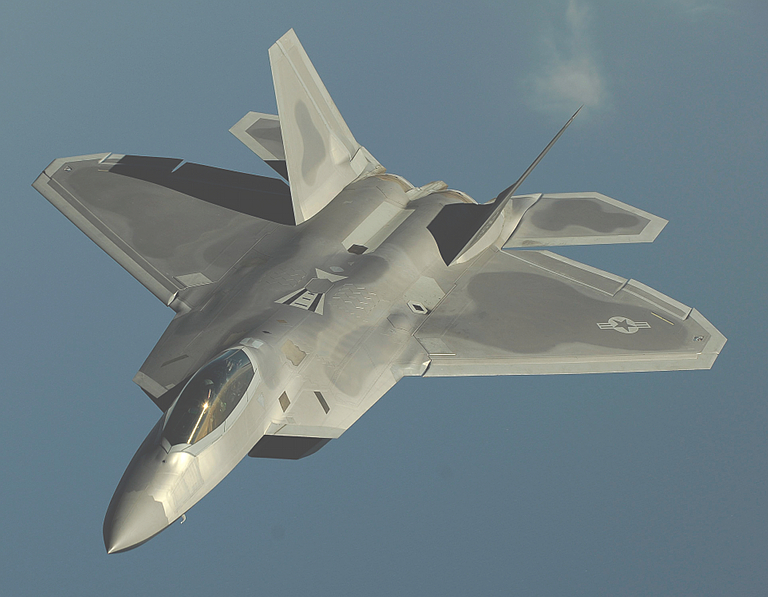 The F-22A Raptor is the only US fighter aircraft design in existence or planned which has the capability to penetrate and survive the advanced air defence weapons now proliferating globally. Unless the US deploys a minimum of 500-600 of these aircraft, it will lose the ability to access hostile airspace with acceptable losses in aircraft and aircrew (US Air Force image). |
||||||||
| The Obama
Administration is in an invidious strategic position, which it
inherited from the preceding administration. Not only must it grapple
with the worst economic meltdown in recent memory, but also it must
prevail in the protracted Global War On Terror, and maintain America’s
long term strategic position that is critical to global stability. To
achieve the latter it must maintain and recapitalise the US fleet of
Cold War era combat aircraft, a task that is not simple given the
extent to which the Bush Administration neglected and arguably
mismanaged this effort. Central to whether the US can maintain its global strategic posture is having sufficient numbers of F-22 Raptor fighters, as the Raptor is the only production combat aircraft prior to the “2018 bomber / NGB” which can operate and survive in advanced contemporary and emerging threat environments. Evolutionary advancements in the technology used in Russian and Chinese fighter aircraft, Surface to Air Missiles, and supporting radar systems have made this so. When the US Air Force launched the F-22 program over two decades ago, it sought to deploy around 750 of these multirole fighters, to replace over 600 F-15 variants and 60 F-117A stealth fighters. At that time the F-22’s stealth capabilities and performance were specified to defeat a projected future Soviet air defence threat. Two decades later that exact threat capability has materialised - exactly as then predicted by USAF technological strategists – but on the global stage, rather than the territories of the Soviet Union and the Warsaw Pact. The common catchcry of F-22 critics that the aircraft is “designed to defeat an non-existent Soviet threat” is little more than a convenient deception: these threat capabilities do now exist but are being exported globally, making it very likely that the US will have to soon confront them in combat, as compared to the defunct scenario of fighting WW3 against the Soviets. The Bush Administration’s SecDef Donald Rumsfeld arbitrarily chopped the F-22 program down to 180 aircraft. Subsequently, DepSecDef Gordon England, and his supporters conducted a systematic campaign to promote the F-35 Lightning II Joint Strike Fighter (JSF) over the F-22A Raptor, and to entrench the Rumsfeld edict. This campaign was characterised by intimidation and political bullying - many good men who questioned this unstated policy experienced unplanned career changes as a result. The Bush Administration justified its pro-JSF/anti-F-22 campaign using two items of pure fiction. The first item of fiction is that the F-35 is somehow comparable in capability to the F-22, the second item of fiction that the F-35 is somehow much cheaper than the F-22. There is ample hard evidence that both ideas are at best wishful thinking, which in itself raises important questions about governance function and institutional integrity inside the Bush era Pentagon. The strategic reality of the coming decade is that if the US wishes to retain the deterrent capability it has enjoyed since 1991, it has no choice than to build and deploy up to 750 F-22 Raptors, with a bare bones minimum of around 500-600 F-22 aircraft for a credible strategic effect. Any significantly lesser number will result in the need to fly vulnerable legacy aircraft in harm’s way, or almost as vulnerable F-35 Joint Strike Fighters. The inevitable result will be lost aircraft and many dead pilots. If the Obama Administration yields to the Rumsfeld edict for the US Air Force, and terminates the F-22, there will be a considerable price to be paid for it by Americans, both domestically and on the global stage, in the short, medium and long term. The first casualty will be the President’s drive for integrity in public service governance and management, as the endorsement of a policy that emerged as a direct result of all of the institutional dysfunctions the President aims to fix, provides a precedent that every single underperforming bureaucrat will exploit to the limit to block and evade institutional reform. The latter years of the Bush era in the Pentagon were characterised by the unrestrained use of political power to suppress professional debate and expert analysis to favour the Bush Administration’s pet projects, of which the F-35 is the largest and most expensive. The second casualty will be the credibility of the President’s effort to stimulate the US economy. In a recent article Tom Donnelly and Gary Schmitt of the American Enterprise Institute point out that up to 100,000 American workers would be likely to lose their jobs as a result of F-22 termination. What Donnelly and Schmitt did not discuss is that these jobs are mostly in high technology companies, many of which depend on the F-22 program for survival since there is no other substantial market for the advanced technologies they produce. The systemic damage to America’s defence aerospace industry would likely rival the calamity that brought down Britain’s industry in the 1960s, the termination of the TSR.2 bomber. These domestic considerations make a compelling case for the Obama Administration to keep the F-22 in production. Global strategic considerations make it imperative for the US that many more F-22s be built. |
||||||||
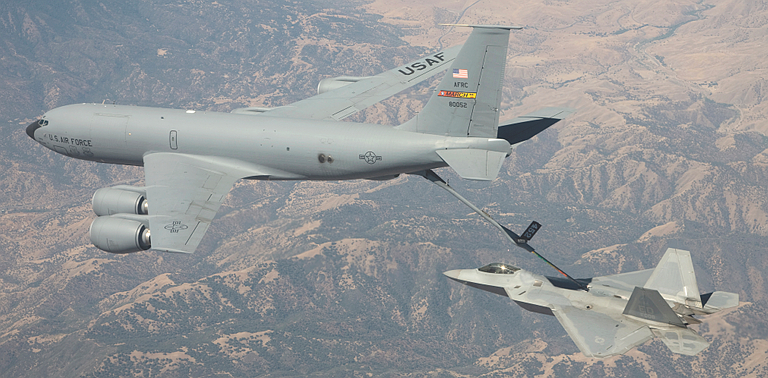 One of the Obama Administration's stated
policy aims is to “...preserve our unparalleled airpower capabilities
to deter and defeat any conventional competitors, swiftly respond to
crises across the globe, and support our ground forces.” The two most
urgent priorities in achieving this goal are the recapitalisation of
the fighter and aerial refuelling tanker fleets. Depicted is an F-22A
refuelling from a 1960s built KC-135R during trials of a new synthetic
fuel (US Air Force image).
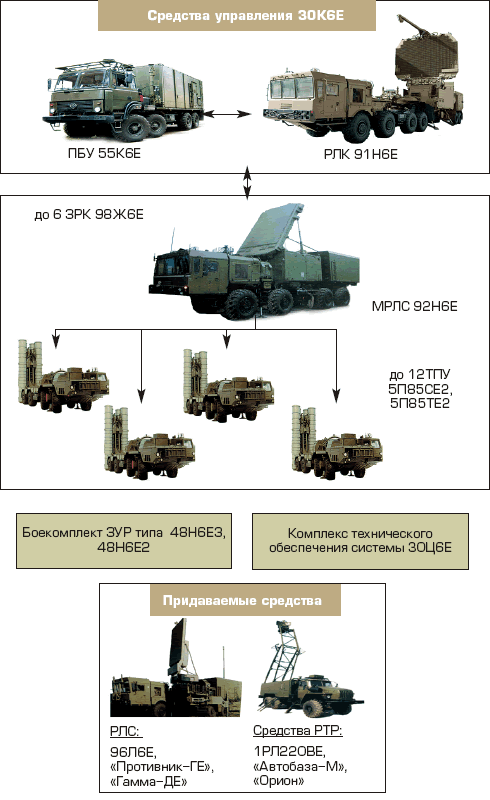 Advanced Surface to Air Missile systems
like this new Russian S-400 / SA-21 can inflict very high loss rates on
all current and planned fighter aircraft, other than the F-22 Raptor.
Unlike Soviet era missile systems which were easily defeated by
jamming, anti-radar missiles, and stealth, newer Russian technology is
highly mobile, jam resistant, equipped with defensive decoys, and
supported by a diverse range of low band "counter-stealth" radars and
passive sensors (Almaz-Antey image).
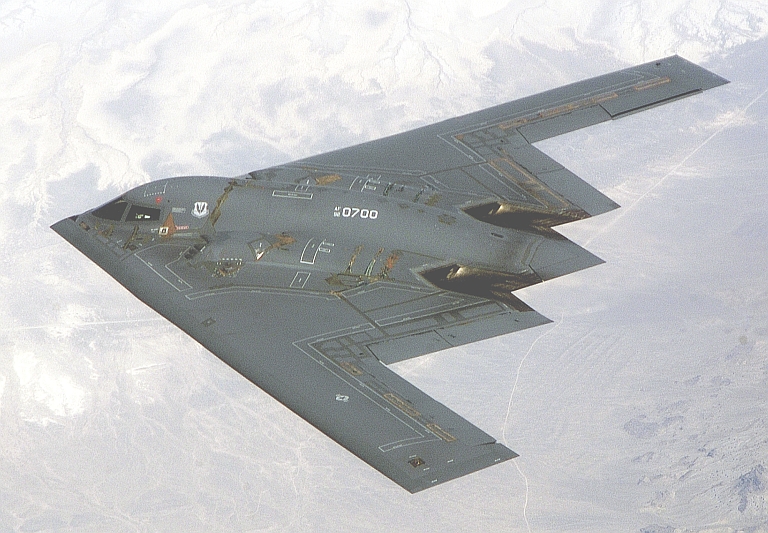 The B-2A
Spirit is the only operational type in the US inventory, other than the
F-22, which can survive in a modern IADS. Only twenty one were built
due to the post Cold War budgetary collapse, and one was recently lost
in an accident. The small fleet size will see these capable aircraft
reserved for attacking targets which require unique munitions, such as
large bunker busting bombs (US DoD image).
|
||||||||
| The global
proliferation of advanced and highly mobile Russian missile systems
like the SA-15, SA-19, SA-20, SA-21 and SA-22, as well as advanced
Su-30MK and Su-35BM Flanker fighters is rendering US air power
increasingly ineffective. The strategic problem is that these advanced
and modern weapons are being bought largely by nations that do not have
friendly strategic agendas relative to the United States. Iran has acquired the SA-15 and in now deploying the SA-20, and has publicly discussed purchases of other advanced systems. Iran also has a long running agenda to destabilise Iraq to strengthen its own position in that region, and has been implicated in numerous incidents during the insurgency. Iran has also sponsored terrorism against Israel, destabilising the Palestinian territories and Lebanon in the process. Terminating the F-22 sends a clear message to Tehran that the US is abandoning any thought of using force against Iran in the future, as Iran will deploy increasing numbers of advanced Russian weapons over time as its cashflow from increasing demand for energy exports grows. Given Tehran’s past conduct, it is likely to accelerate its long running campaigns against Iraq and Israel. With many more F-22s built, Tehran can rest assured that the US can conduct an air campaign against its new Russian weapons with absolute impunity, at any time. Terminating the F-22 sends a clear message to Israel that the US will never honour the Clinton Administration’s promise to supply the F-22 to Israel. In the West Pacific region the US faces the challenge of China’s long running arms buildup. Central to China’s investment has the purchase of advanced Russian SA-15 and SA-20 missile systems, and advanced Flanker fighters. As the Pacific Vision exercise last year, and supporting RAND analysis demonstrated, the US does not have a strong non-nuclear deterrent posture relative to China. While Beijing is currently choosing a policy of non-confrontation, should the US strategic posture in Asia fail to match China’s ongoing military growth, Beijing will have many more options available to weaken US influence in Asia. Terminating the F-22 sends clear message to Beijing that the US does not wish to contest China’s growing military might in Asia. It also sends a clear message to US allies in this region, especially Japan, that the US is ceding its long term position in Asia to China. Tokyo will be especially upset if the F-22 is terminated. Japan has lobbied hard to procure this aircraft and was rebuffed repeatedly by the Bush Administration. The message F-22 termination sends to Tokyo is simple: “the US cares so little about Japan’s defence that it will not sell Japan the equipment it needs, and is not prepared to invest enough to protect Japan”. Other US allies in Asia are likely to draw much the same conclusions as the Japanese. When former DepSecDef Gordon England publicly supported Canberra DoD bureaucrats in their effort to steer Australian politicians away from the F-22, to the F-35, there were numerous complaints in Australian editorials and blogs that the US was treating its closest and most loyal ally with contempt. While the Canberra DoD bureaucrats favour the F-35, most strategically minded Australians would strongly prefer the F-22 Raptor. Closer to home the US has the ongoing problem of Venezuela. The Chavez regime, which is intensely hostile to the US, offered to buy $30 billion of advanced Russian military equipment over coming years, according to Russian sources last July. Russia is actively marketing the Su-35BM Super Flanker, and the SA-20/SA-21 missile systems to Venezuela. While Venezuela lacks the strategic potential for mischief which characterises Iran, it is nevertheless not in the US interest to weaken its ability to deter this regime. In conclusion, the strategic cost to America of terminating the F-22 program vastly outweighs, domestically and globally, the dollar investment required to build more of these unique and advanced aircraft. The upcoming F-22 decision will be a litmus test of the new Administration, both in the domestic and foreign policy areas. |
||||||||
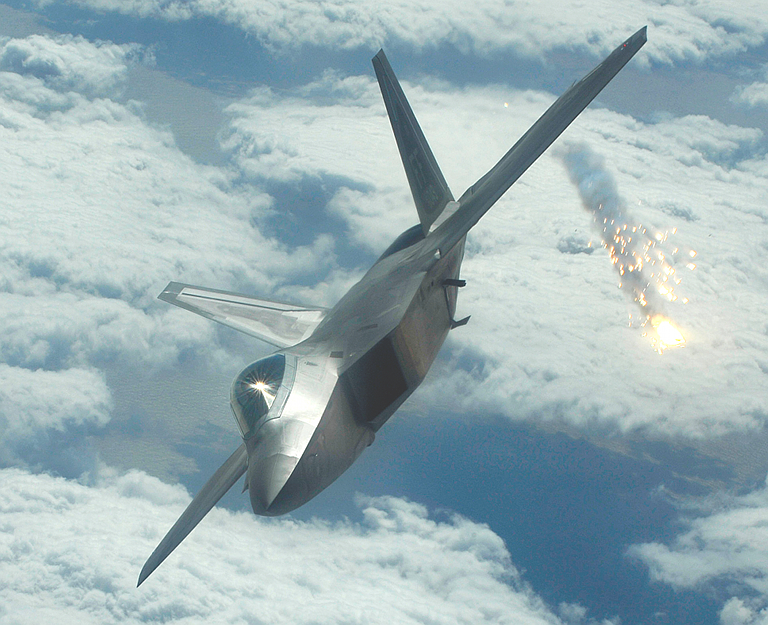 F-22A Raptor during air combat exercises
in Japan this January. Japan has been lobbying repeatedly to procure
the F-22A and will have an operational requirement for 100 or more
aircraft. Israel's requirement will be around 100 F-22A aircraft, while
Australia's strategic need will exceed 50 aircraft easily (US Air Force
image).
|
||||||||
| Air
Power Australia Website - http://www.ausairpower.net/ Air Power Australia Research and Analysis - http://www.ausairpower.net/research.html |
||||||||
 |
||||||||
| |
||||||||
|
|||||||||||||
|
|
|
|
|
|
|
|
|
|
|
|||
|
|
|
|
|
|
|
|
|
|
|
|||
| |
|
|
|||||||||||
| Artwork, graphic design, layout and text © 2004 - 2014 Carlo Kopp; Text © 2004 - 2014 Peter Goon; All rights reserved. Recommended browsers. Contact webmaster. Site navigation hints. Current hot topics. | |||||||||||||
|
Site Update
Status:
$Revision: 1.753 $
Site History: Notices
and
Updates / NLA Pandora Archive
|
|||||||||||||
|
|
Tweet | Follow @APA_Updates | |||||||||||
|
|
|||||||||||||
|
|
|||||||||||||






