|
||||||||||||||||||||||
 |
||||||||||||||||||||||
![F-22A Raptor, FB-22, F-22E, F-22N and Variants Index Page [Click for more ...]](APA/f-fb-22.png "F-22A Raptor, FB-22, F-22E, F-22N and Variants Index Page [Click for more ...]") |
 |
![People's Liberation Army Air Power Index Page [Click for more ...]](APA/pla-air-pwr.png "People's Liberation Army Air Power Index Page [Click for more ...]") |
 |
 |
 |
 |
 |
 |
![Military Ethics, Culture, Education and Training Index Page [Click for more ...]](APA/ethx-culture.png "Military Ethics, Culture, Education and Training Index Page [Click for more ...]") |
 |
||||||||||||
 |
![Russian / Soviet Weapon Systems Index Page [Click for more ...]](APA/rus-weps.png "Russian / Soviet Weapon Systems Index Page [Click for more ...]") |
 |
 |
 |

|
 |
 |
 |
 |
 |
||||||||||||
 |
 |
|||||||||||||||||||||
| Last Updated: Mon Jan 27 11:18:09 UTC 2014 | ||||||||||||||||||||||
|
||||||||||||||||||||||







PLA Mechanised Infantry Division Air Defence SystemsPLA Point Defence SystemsTechnical Report APA-TR-2009-0301 |
||||||||||||||||||||||||||||||||||||||||||||||||||||||||||||||||||||||||||||||||||||||||||||||||||||||||||||||||||||||||||||||||||||||||||||||
| Martin
Andrew,
BA(hons),
MA,
PhD,
RAAF(Retd) March 2009 Updated May, December 2009 Updated August, 2010 Updated April, 2012 © 2009 - 2012 Martin Andrew  |
||||||||||||||||||||||||||||||||||||||||||||||||||||||||||||||||||||||||||||||||||||||||||||||||||||||||||||||||||||||||||||||||||||||||||||||
|
||||||||||||||||||||||||||||||||||||||||||||||||||||||||||||||||||||||||||||||||||||||||||||||||||||||||||||||||||||||||||||||||||||||||||||||
BackgroundWith the operational
art of the PLA now firmly rooted in the concepts and doctrine of
modular forces
creating independent battle groups within the division, augmenting it
seamlessly with heavier forces.[1] Battle groups are generally based around
a battalion and the PLA is
going towards a three-level command structure of corps, brigade and
battalion. The divisional
structure remains for administration in many military regions
containing
brigades instead of regiments to accommodate the battle group concept.
The idea
behind brigade and battle groups is to ‘adapt to informationalised
warfare and
to enable more rapid decision making on the battlefield’.[2] In the PLA, the primary
difference between a regiment and a brigade is that the brigade is
capable of
independent operations whereas a regiment is directly subordinate to
the
division, as it does not have the headquarters staff to carry out
independent
operations. |
||||||||||||||||||||||||||||||||||||||||||||||||||||||||||||||||||||||||||||||||||||||||||||||||||||||||||||||||||||||||||||||||||||||||||||||
PLA Armoured and Mechanised Infantry Brigade Structures[3]The
People’s Liberation Army’s 112th Mechanised Infantry Division was the
first
unit using the new structure and when unveiled in 2006 is claimed by the
PLA to be two generations ahead of its predecessor.[4] The
division is organised and
equipped to fight as
independent
battle groups on mountainous and urban terrain, its equipment being
lighter in
weight and firepower than those of the PLA’s divisions tasked to defend
the
nation against aggressors equipped with main battle tanks. Its theatres
of
operation are Xinjiang and Tibet where the division’s lighter vehicles
and
support weapons can operate in areas where the communications
infrastructure
can be described as poor at best.
There
are three mechanized infantry companies to the battalion and three
battalions
to the brigade with three brigades in the division giving a total of
351 Type
86 infantry fighting vehicles (IFVs). These are supported by an
artillery
brigade of 72 PLZ89 122mm self-propelled guns and a tank battalion of
99 Type
96 main battle tanks. Type 89
armoured command vehicles are liberally provided throughout the
division down
to the company level to provide command and control.
Intelligence and electronic warfare assets are held at
the divisional level in a battalion and distributed as required. Although described as a light division
the PLA generally classes wheeled units as light and tracked units as
heavy. The
new mechanised infantry brigade has four mechanised infantry
battalions, one
armoured battalion, one fire support battalion, one engineer battalion
and one
communication battalion. Each
mechanised infantry battalion has three mechanised infantry companies,
each of
three platoons with each company having 13 infantry fighting vehicles;
four in
each platoon and one headquarters vehicle. Each
armoured brigade has three armoured battalions for a total of 99 main
battle
tanks, one mechanised infantry battalion, one artillery battalion with
18
self-propelled guns and one air defence battalion of 18 AAA guns. Each armoured battalion has three
armoured companies, each of three platoons with each company having 11
main
battle tanks; three in each platoon and two headquarters vehicles. There are no tanks at the battalion or
brigade headquarters. A complete
armoured brigade contains 2,200 soldiers.[5] The
Type 86 infantry fighting vehicle, a Chinese copy of the Russian BMP-1,
is
being updated by replacing its existing 73mm low velocity gun turret
with the
new Chinese one man ‘universal turret’ containing a 30mm chain gun
which has
impressive performance against light armour, can disable many main
battle
tanks, and can be used in an anti-helicopter role.[6] The
other combat tracked vehicles in the division, other than the tanks,
are based
on the indigenous Type 89 armoured fighting vehicles.
The support company of the battalion comprises one 100mm
mortar company of 10 vehicles with one mortar per vehicle and a fire
control
vehicle, an automatic grenade launcher (AGL) platoon in two vehicles
with two
AGLs each; one anti-tank platoon in two vehicles sharing three
anti-tank guided
missile systems, normally the Hong Jian
8. There are a total of 18 Type 89 series armoured vehicles in each
brigade
providing 54 anti-tank guided missile systems in the division. The
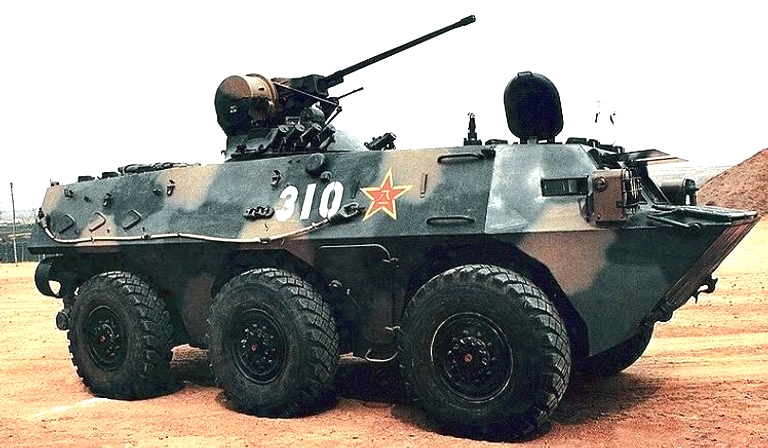
wheeled units are equipped with the WZZ551 family of vehicles. In 1990 the first vehicle was introduced
into service as the Type 90 (WZ551A) IFV was equipped with turreted
25mm
automatic cannon, and in 1992 the Type 92 (WZ 551B) was introduced as a
cheaper
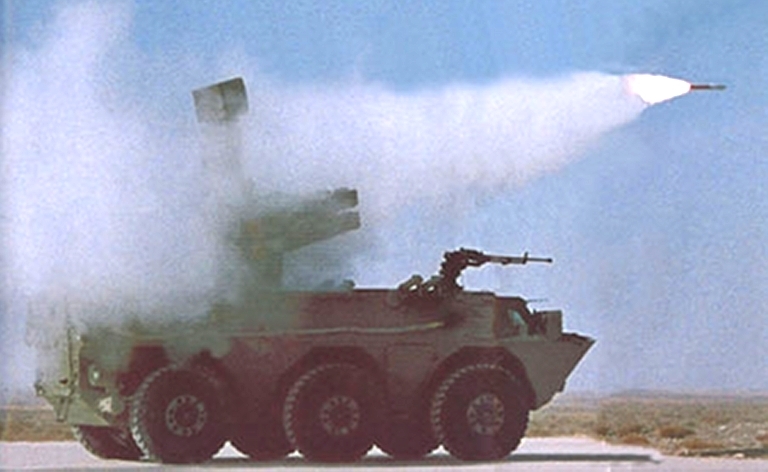
APC with the semi-open turret used on the ZSD89 APC. The WZ551D air
defence version
using the heat seeking PL-9 point defence SAM round was developed but
not put
into production. The Type 02
assault gun mounting a 100mm high velocity gun in a turret is in
service and
the self-propelled gun version mounting the same gun as on the PLZ89 is
due
into service shortly. The
division headquarters comprises an engineer battalion, an electronic
warfare
battalion, a chemical defence battalion, the division headquarters
(company
sized), an air defence troop and a guard company for HQ protection. Logistics is provided by corps assets
attached to the battle groups as required. Mechanised
formations based on this model are well equipped with organic air
defence
assets, intended to deploy with the units and provide mobile point and
limited
area defence capabilities against opposing aircraft and helicopters. Within
each mechanised infantry battalion there is an air defence platoon of
three
vehicles with four Hongqi6 (HY-6) man
portable air defence system (MANPADS) missile launchers per Type 89 APC
vehicle,
for a total of twelve. A
division has 27 air defence vehicles and has 108 Hongqi6
MANPADS
available
for
air
defence at any time. They
come
under operational control of
the air defence brigade commander. The
divisional air defence brigade comprises one battalion of 24 towed 57mm
anti-aircraft guns and one battalion of 18 towed twin 37mm
anti-aircraft
guns. An air defence platoon of
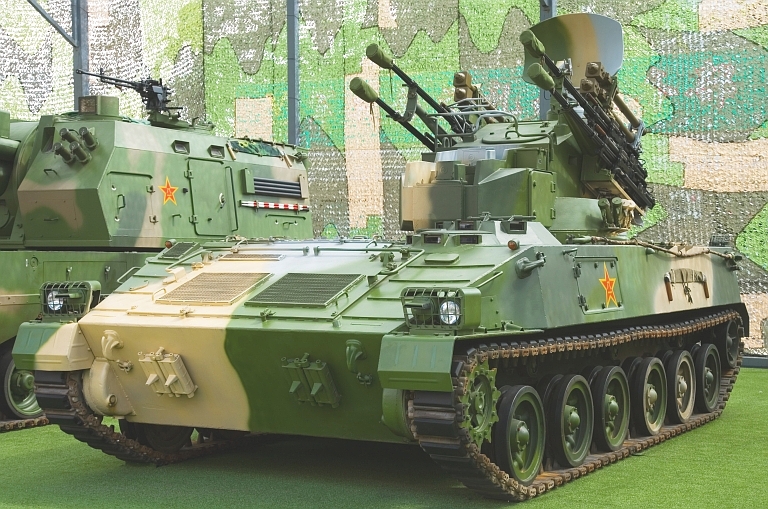
six Type 95 self-propelled combination AAA/SAM vehicles and one of
light
surface-to-air missiles are attached to the artillery brigade. The
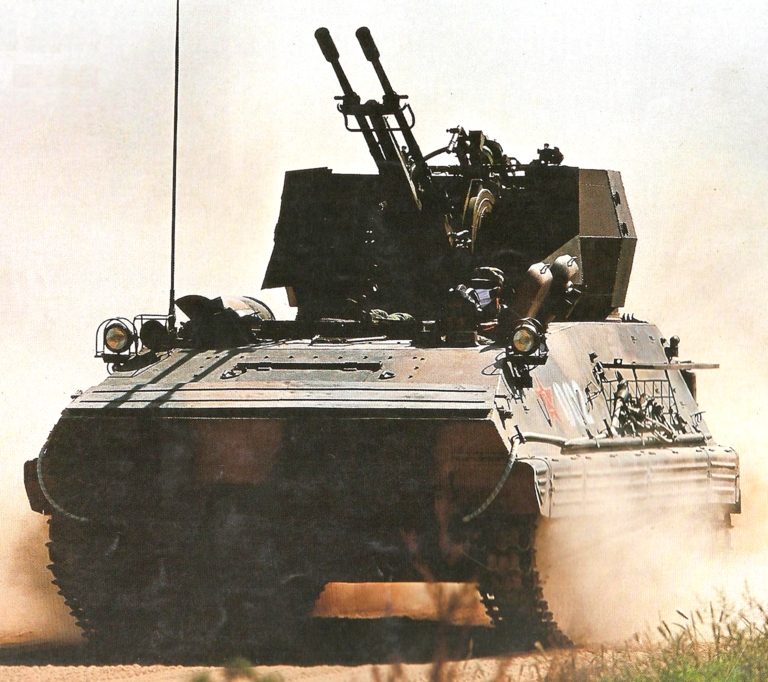
Type 95 SPAAG/SAM system uses the same hull as the PLZ89 122mm
self-propelled
gun, with a turret mounting four 25mm automatic cannon and can be
fitted with
four QW-2 IR-homing, short-range surface-to-air missiles, the Chinese
equivalent of the Russian Igla-1 (SA-16 Gimlet). |
||||||||||||||||||||||||||||||||||||||||||||||||||||||||||||||||||||||||||||||||||||||||||||||||||||||||||||||||||||||||||||||||||||||||||||||
Self-Propelled Air Defence Systems |
||||||||||||||||||||||||||||||||||||||||||||||||||||||||||||||||||||||||||||||||||||||||||||||||||||||||||||||||||||||||||||||||||||||||||||||
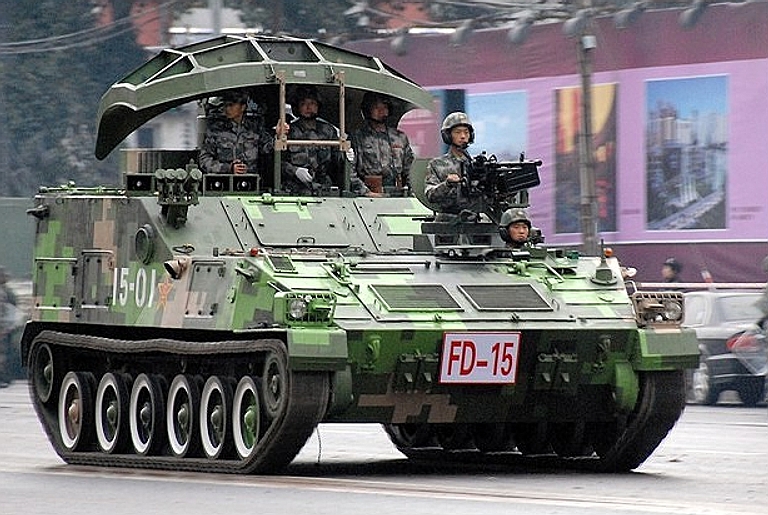
Type 95 SPAAG[9]
The
Type 95 SPAAG is a PLA attempt to produce a capability equivalent to
the
ZSU-23-4M4, providing a mix of gun and heatseeking missile armament.
The system
is equipped with a CLC-1 search radar,
claimed to
operate in the S-band. Target tracking is provided a thermal imaging
and TV
system with a laser rangefinder. The
Type 95 is armed with four gas operated 25 mm guns, providing an
aggregate rate
of fire up to 1600 rounds/min, and up to four QW-2 heatseeking
missiles, based
on the PLA MANPADS, can be carried. Accompanied by a battery
acquisition and
command vehicle equipped with a CLC-2 search and acquisition radar with
its large
antenna, an air defence battery of six Type 95 SPAAGs is used to
protect
divisional artillery assets. To
simplify maintenance the Type 95 uses the same standard hull as PLA
artillery
vehicles including the Type 83 152mm and PLZ-89 122mm self-propelled
guns, the PLZ89
122m self-propelled anti-tank gun and the PHZ89 122mm self-propelled
multiple
rocket launcher. 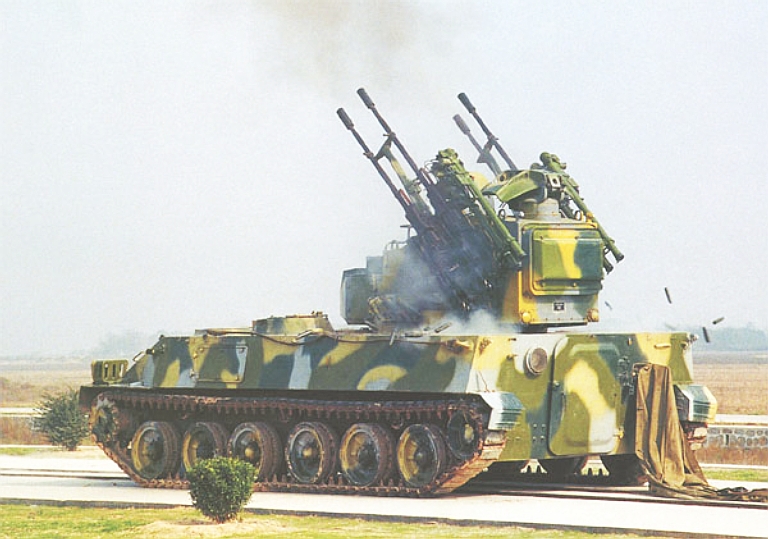 Type 95 SPAAG firing with guns elevated and CLC-1 radar stowed. 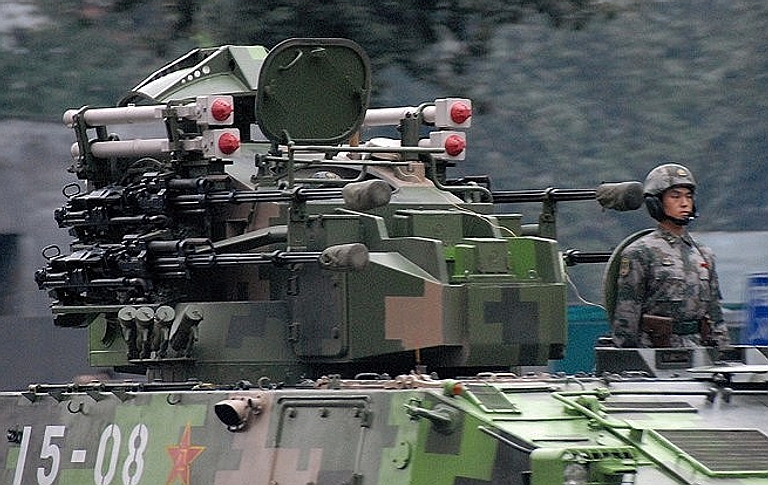 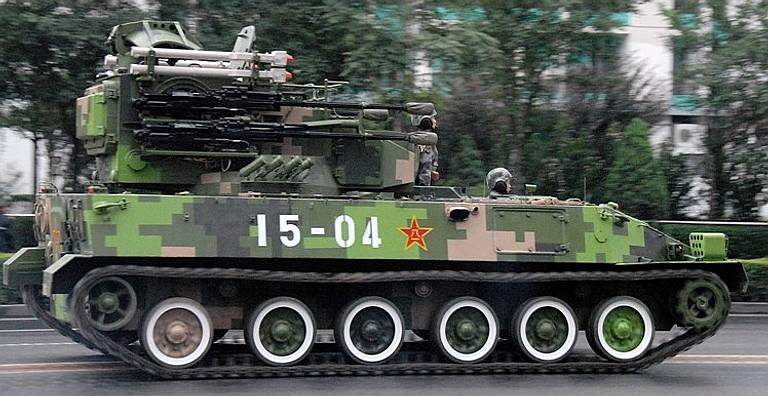 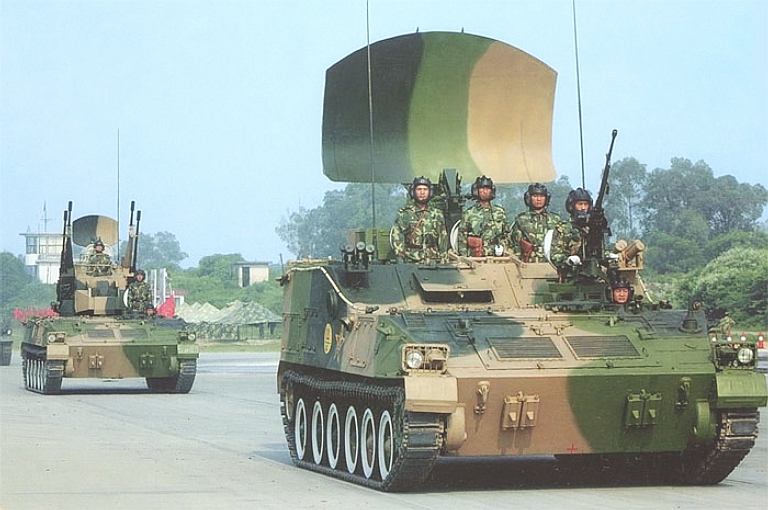 Type
95 battery command vehicle
with CLC-2 search radar deployed (above) and stowed (below).
 Ludun 2000 / LR66 / Type 347G / 30 mm SPAAG/SPAAGM[9][36][42]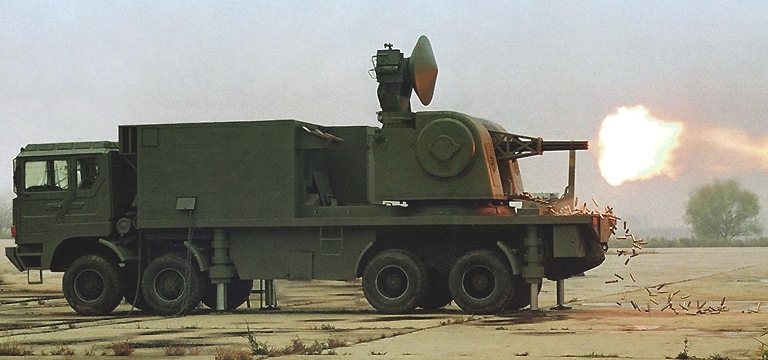 LD-2000 demonstrator during trials. The Ludun-2000
is a Chinese copy of
the Thales
Nederland Goalkeeper 30 mm close-in weapons system (CIWS) mounted on
the rear a
8 x 8 single cab flat bed truck and generator and system container
behind the
cabin.
The Type 730B gun is a copy of the General Electric GAU-8 30 mm x 173 mm seven-barrel Avenger gun used on the A-10. It fires at 4,200 rounds-per-minute with the APDS round having a muzzle velocity of 1,150m/sec and the HE cartridge of 920m/sec. There are two 500 round cylindrical magazines either side of the gun. The system can intercept targets flying at a velocity of Mach 2 or below. Although a target can be optically tracked up to 18 km, a cruise missile with a radar cross section of approximately 0.1 m2 can be detected at 12 km, optically tracked using a charge coupled device at five km. The gun has a maximum effective range of 2.5 km, its intercept engagement range between 1000 to 1,500 m and a maximum ground range of 3,000 m. The response time of 9.8 sec is given the system is able to simultaneously track and prioritise 48 targets. In the anti-aircraft role, the Ludun-2000 system is claimed to be as effective as a battalion of 18 Type 65 twin 37mm anti-aircraft guns. In the counter rocket and mortar (C- By design, the LD-2000 is essentially a land based derivative of the existing PLAN Type 730 CIWS, itself modelled on the closed loop tracking US Phalanx CIWS and EU Goalkeeper CIWS. Production vehicles are intended to be based on the Wanshan WS-2400 chassis, common to the HQ-9 SAM system. The engagement and tracking radar as yet undesignated, operates in the Ku-Band. More recent imagery depicts the addition of a mast mounted search radar and six launch tubes for the TY-90 Surface-to-Air-Missile. While intended to fulfill much the same role as the Russian Pantsyr S1 / SA-22 system, the LD-2000 is hampered by older technology acquisition and engagement radar technology in comparison with its Russian competitor. The cited use of SLC-2 / AN/TPQ-37 Block 1B Firefinder artillery locating radar indicates an intent to address this capability limitation. This radar is however optimised for the CBR role, which differs in geometry from the Counter-PGM roles. This will limit the system's ability to acquire and track low signature targets, especially guided weapons. To date no evidence has emerged showing the integration of extant PESA air defence engagement radars such as the H-200 or SJ-231 with the LD-2000 system, both of these radars providing the power-aperture performance and beam-steering agility required to make the LD-2000 genuinely effective in killing salvoes of high angle low signature smart munitions. A single H-200 or SJ-231 supporting three, four or six LD-2000 fire units makes for a formidable point defence capability. Current acquisition radar technology does not preclude further development of this system as China's industry eventually masters PESA and AESA antenna technology. A mature LD-2000 variant has the potential to be a very effective terminal defence weapon against supersonic and subsonic guided weapons. 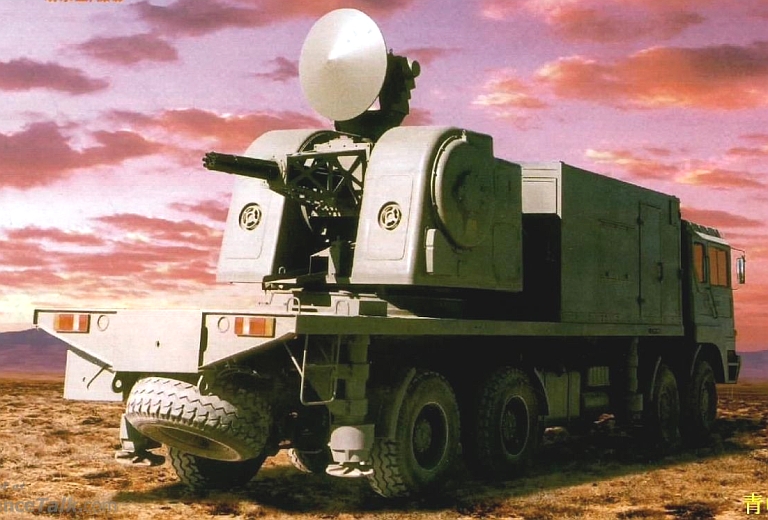 LD-2000 demonstrator image from Norinco brochure. 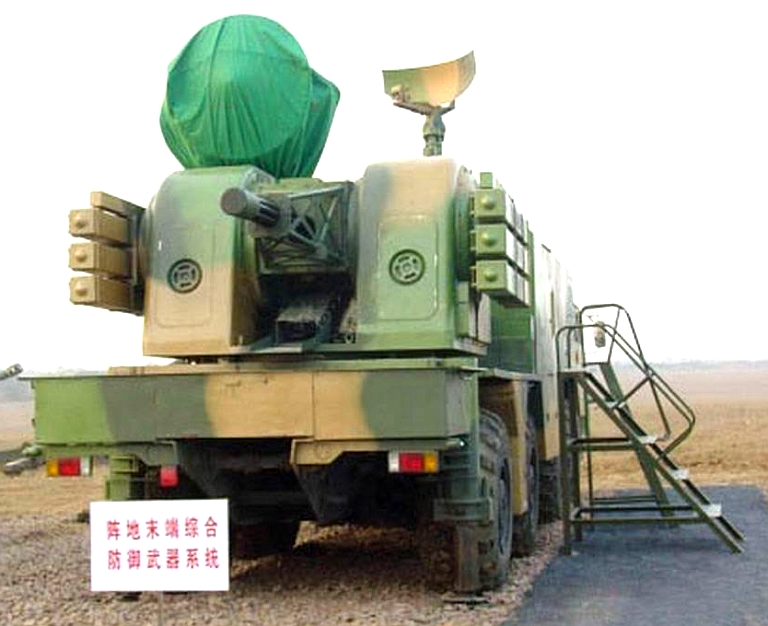 LD-2000 SPAAGM variant with six
TY-90 launch tubes, on WS-2400 chassis. Elevating acquisition radar
appears to be a variant of the YJ-17 series.
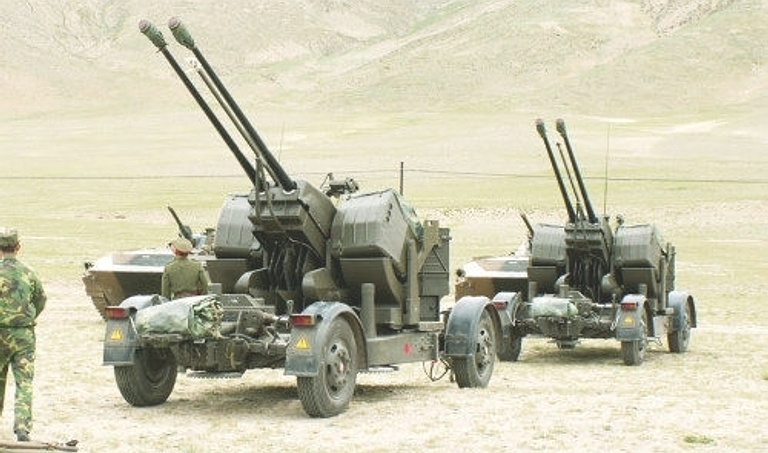
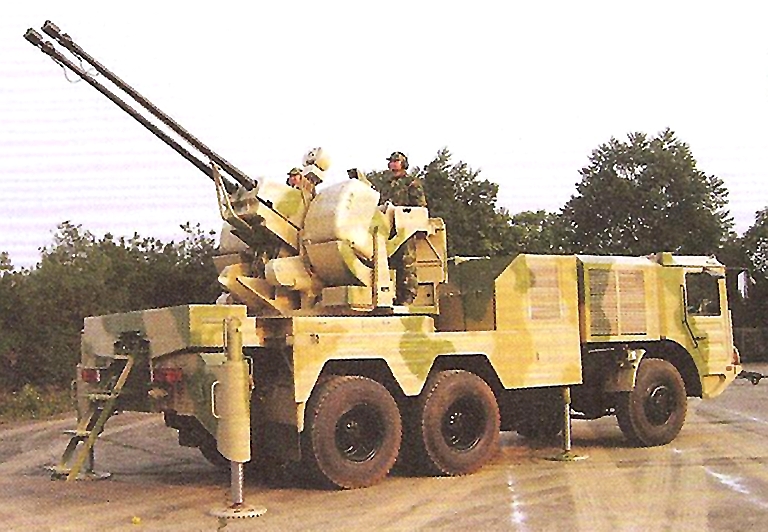 Recently unveiled, the CSSA-1 is a self-propelled variant of the Type 90 35 mm AAA system, previously only available as a towed AAA piece. The system is based on a licensed Oerlikon GDF-002, and is credited with a 1175 m/s muzzle velocity, 3200 metre effective range, and 2 x 500 rounds/min rate of fire, with 360° traverse and +92° to -5° elevation. A Type 902 engagement radar is usually associated with the Type 90 AAA system, based on the Oerlikon Skyguard I/II system. The Super Fledermaus / Skyguard radar and GDF guns were used in the German Gepard SPAAG. 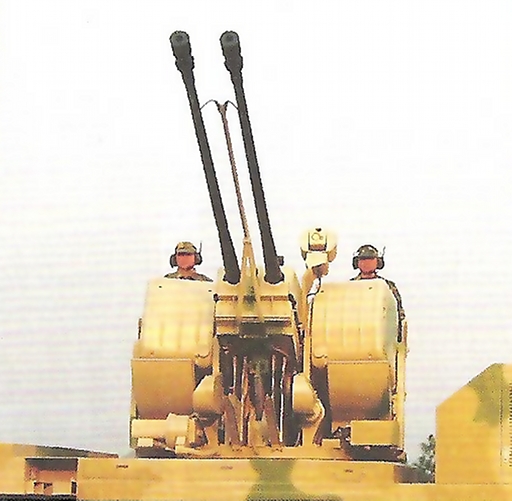 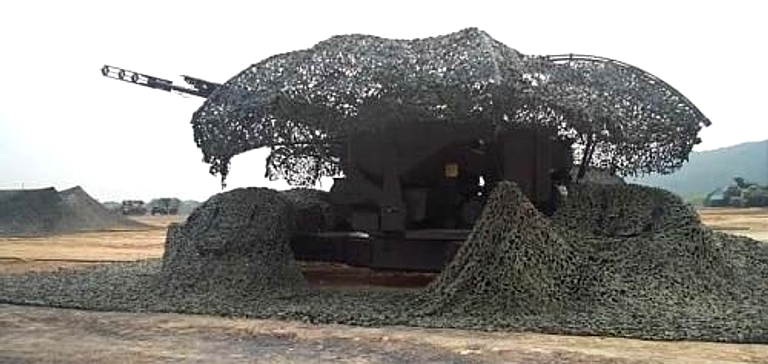 Type
90
35
mm
towed AAA gun, deployed and stowed.
 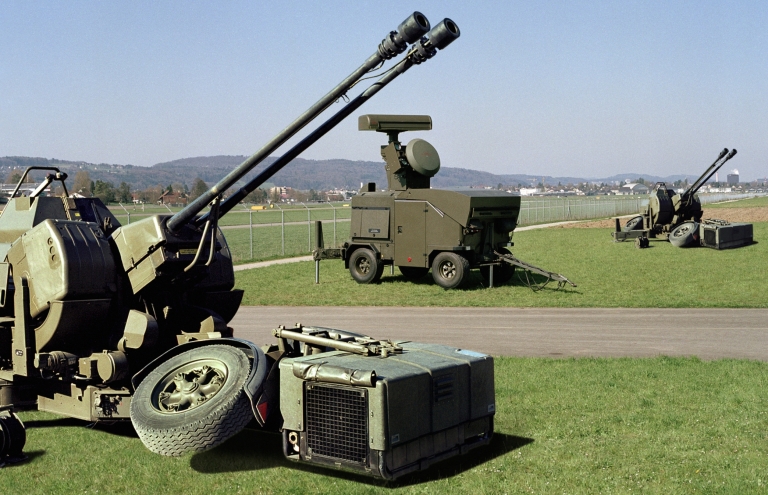 Oerlikon-Contraves GDF/Skyguard III
35 mm
gun and engagement sensor, comprising acquisition and engagement radars
and electro-optical tracker (Rheinmetall/Oerlikon).
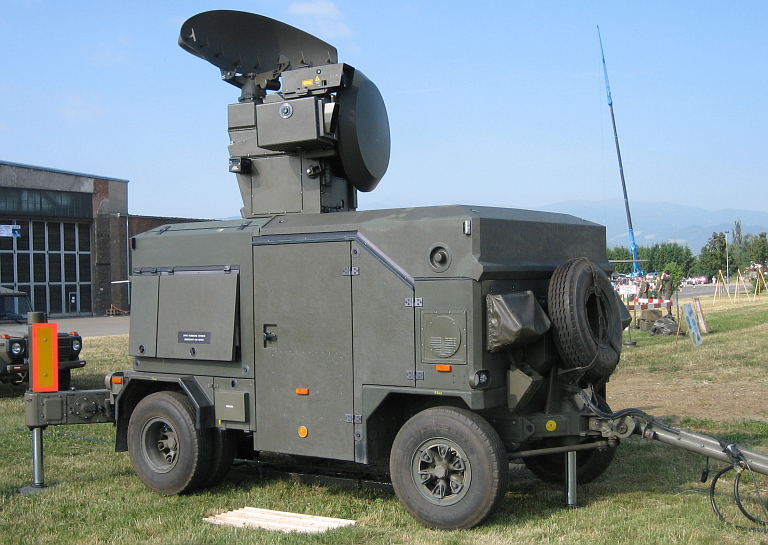 The Type 902 radar system is claimed to be
based on the depicted Skyguard I/II acquisition and engagement radar
system (Wikipedia image)
TD-2000D AAGM[9]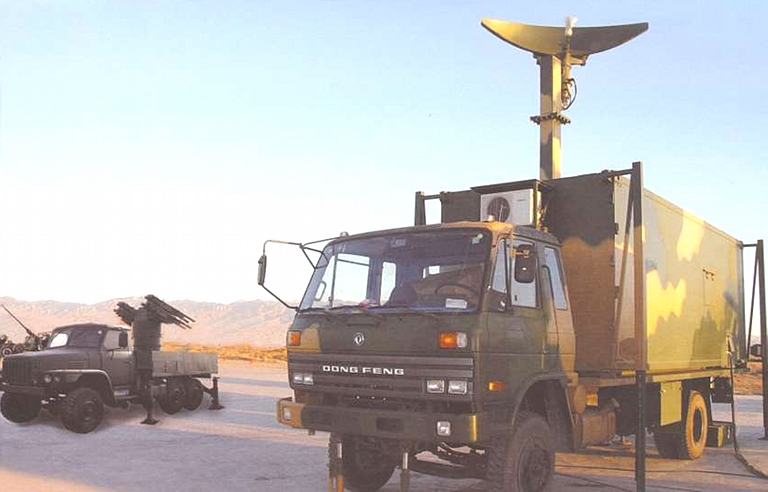 The CPMIEC TD-2000B system is
an integrated package combining QW-1 or QW-2 MANPADS launchers on a
vehicular chassis, towed 57 mm guns, and an acquisition/engagement
radar and fire control processing package. A typical battery combines
six 57 mm guns, one eight round launcher, and a single radar vehicle,
equipped with what appears to be a JY-17 variant.
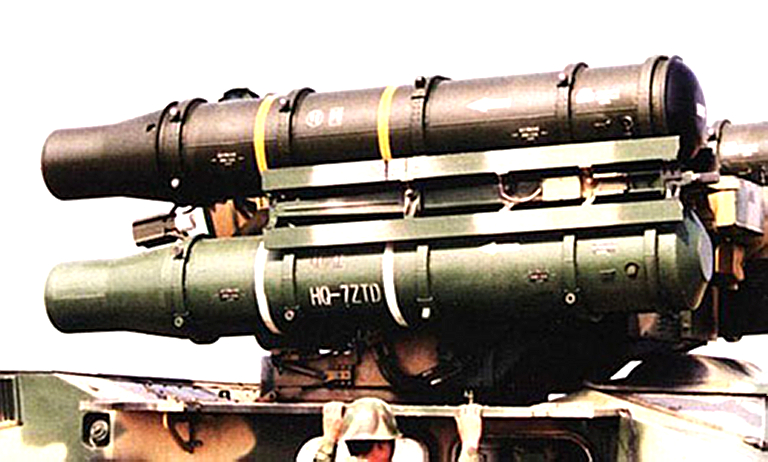
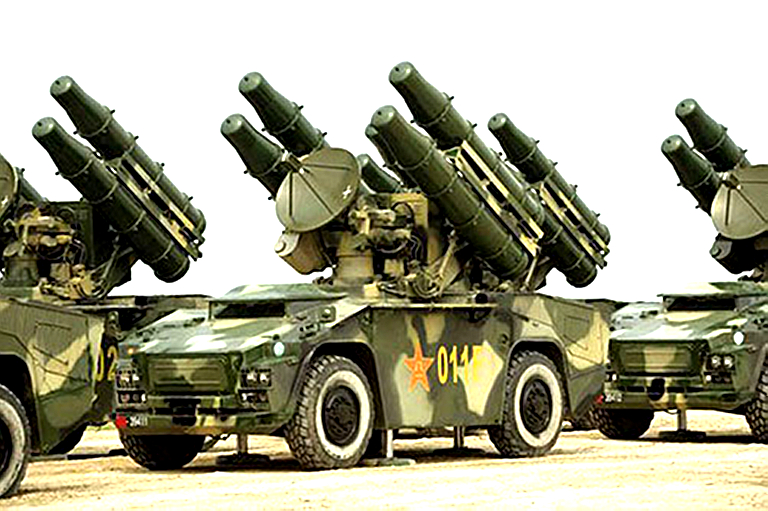
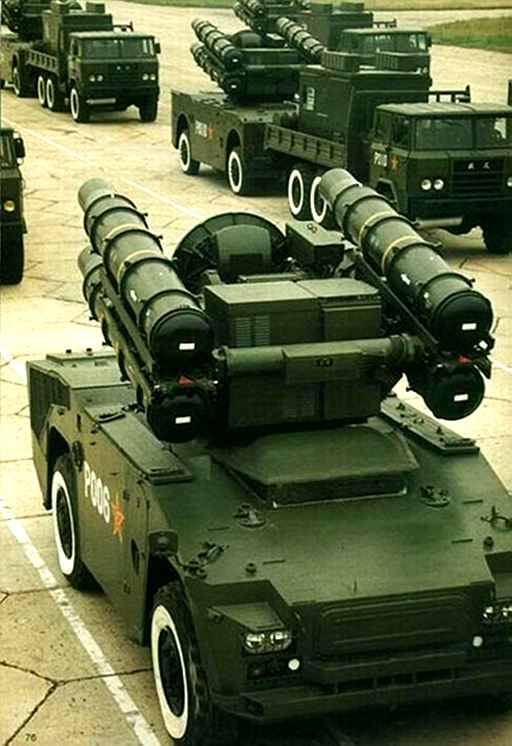
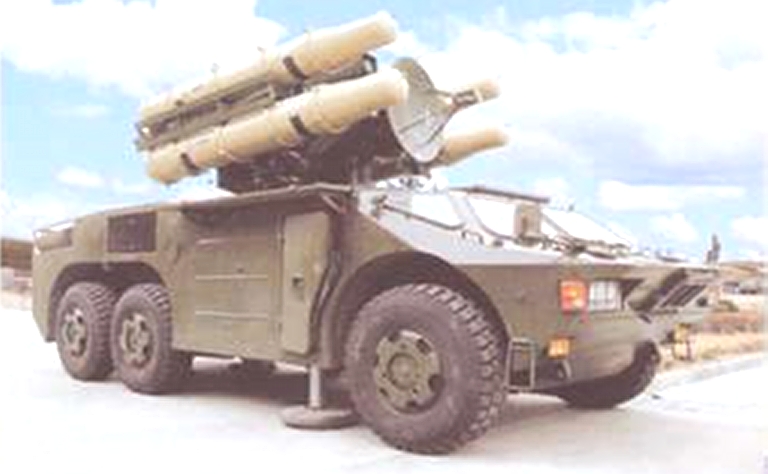
HQ-7/FM-80/FM-90 / CSA-4 Crotale[9]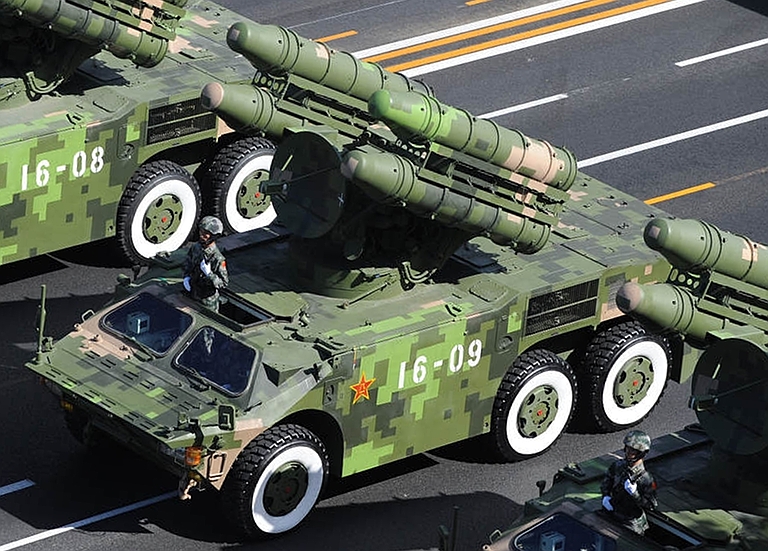 China continues to manufacture and export the cloned Crotale SAM. The latest HQ-7B/FM-90 Crotale variant is carried on a new Chinese designed 6 x 6 AFV chassis, replacing the cloned French Thomson-Hotchkiss P4R chassis. Additional image [1] (via Chinese internet). The
HQ-7 is a Chinese clone of the French Thales/Thomson CSF Crotale SAM.
During
the 1970s the French supplied samples of the Crotale
which
was promptly reverse engineered. The cloned Crotale has been built in
two
configurations, a high mobility variant for PLA Army units on a 4 x 4
cloned French Thomson-Hotchkiss P4R armoured
vehicle, and a less mobile PLA-AF air field defence system, using
either a
trailer or a truck platform. The Thomson-Hotchkiss P4R vehicle uses either a diesel or
gasoline engine driving an alternator which powers electrical motors
driving the wheels. Chinese sources sometimes label the P4R as a B-20.
A naval variant of the Crotale as also been developed. A four round elevating tube launcher
turret is
used, mounting the Ku-band Automatic Command to Line Of Sight monopulse
radar
dish antenna. Export variants are the FM-80 and improved FM-90 with a
FLIR
tracker and
longer ranging missiles. HQ-7/FM-80/90 batteries are typically
supported by an
acquisition radar system, the FM-90 usually on a new design indigenous
6 x 6 light armoured personnel
carrier.
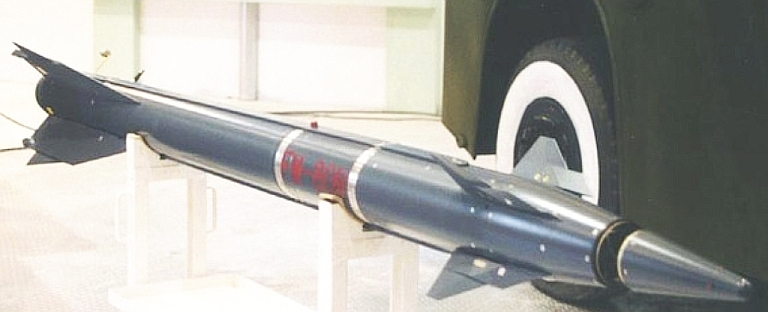 The HQ-7 Crotale round on display. 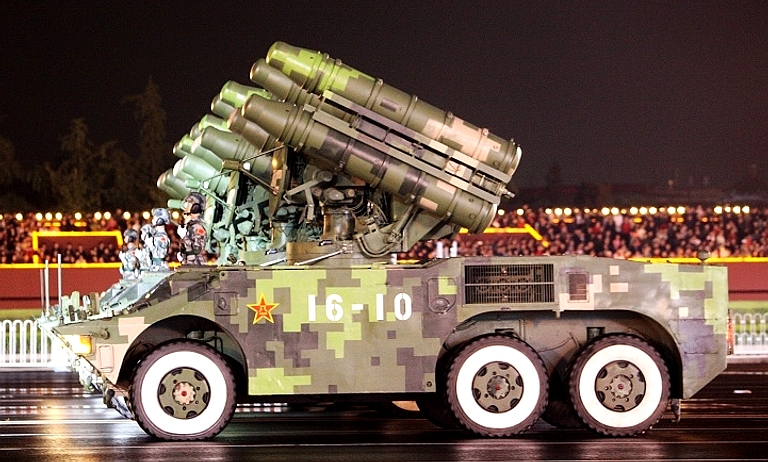 FM-90 TELAR on parade in 2009 (via Chinese Internet). 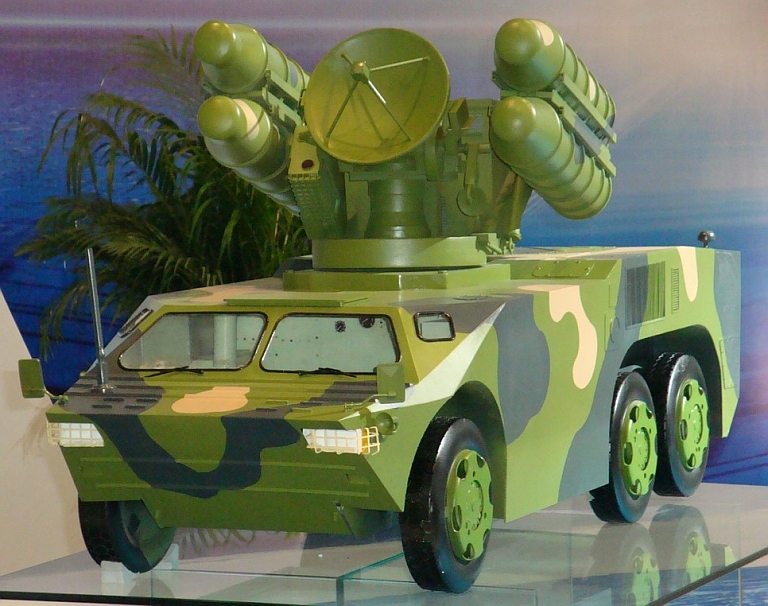 FM-90 Crotale display model at Zhuhai,
2008. The acquisition radar uses a planar array with a boresighted IFF
array. The engagement radar appears to be identical to the earlier
FM-80 configuration (image ©
2009,
Zhenguan Studio).
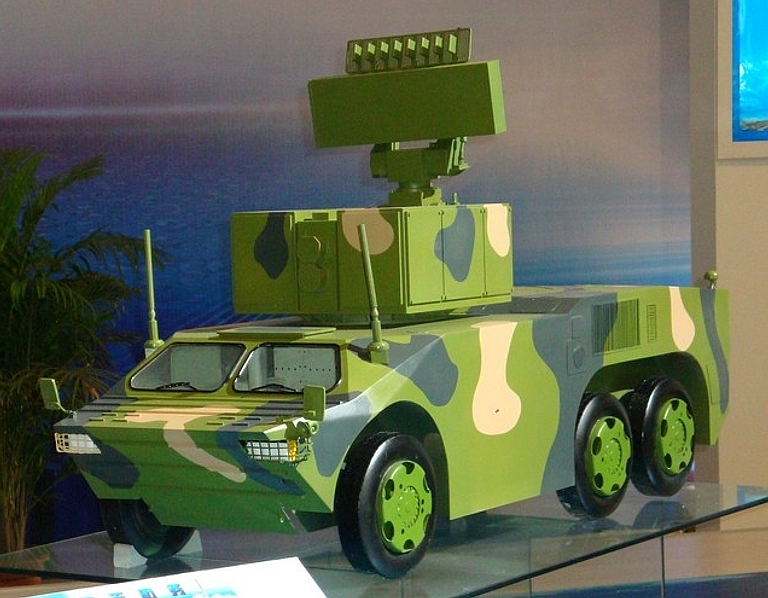 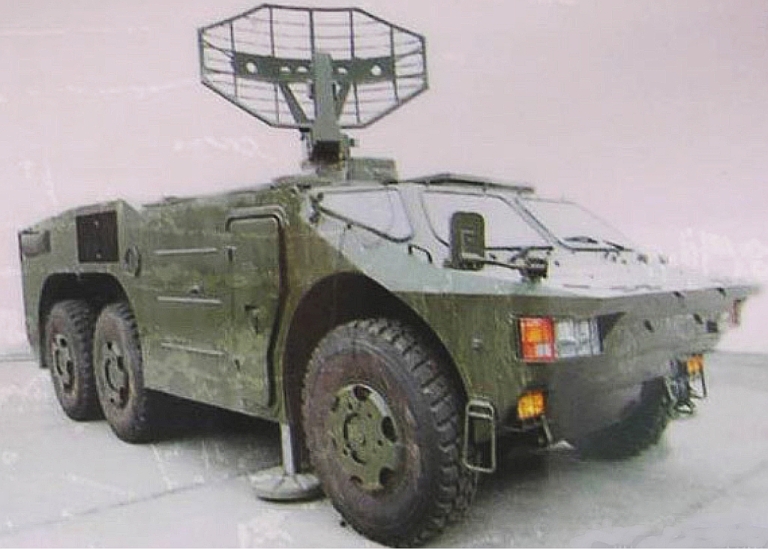 Acquisition radar vehicles
for a
HQ-7/FM-80 battery. The design concept follows the Soviet Dog Ear model
used
with the 9K35 / SA-13 Gopher. Two radar types have been disclosed, a
concave
reflector design and a newer planar array design.
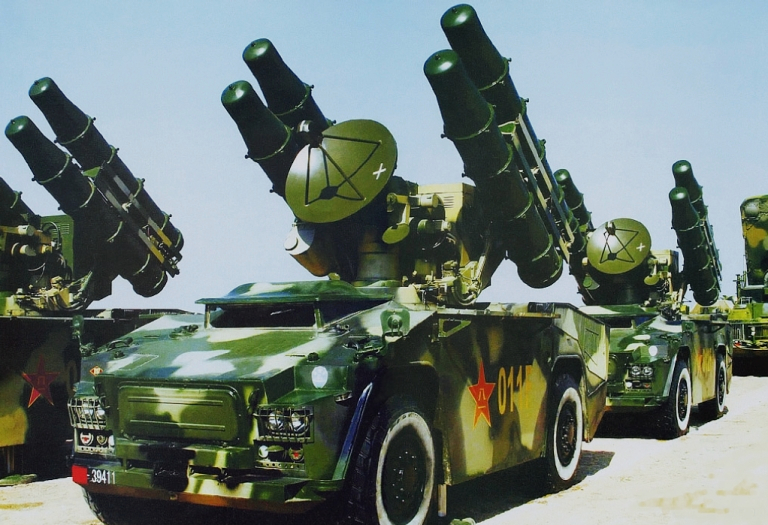 The earlier self propelled HQ-7/FM-80 variants employ a reverse engineered variant of the original Thomson-Hotchkiss P4R electrically driven armoured chassis which weighs in at 32,965 lb / 14,950 kg (all images Chinese internet). 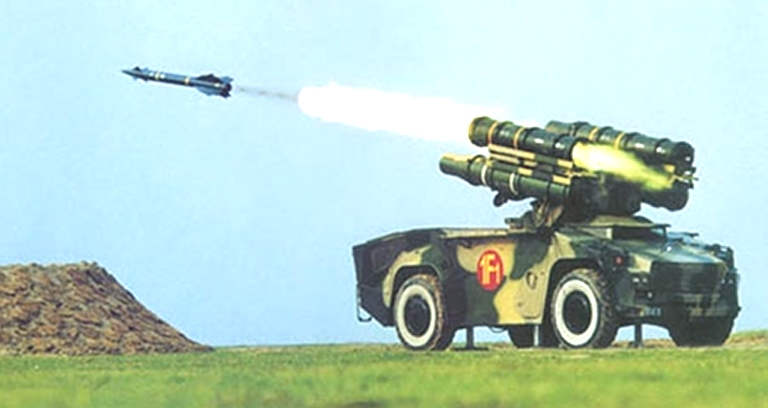 Late
model
FM-80
Crotale
launch from cloned Thomson-Hotchkiss P4R chassis.
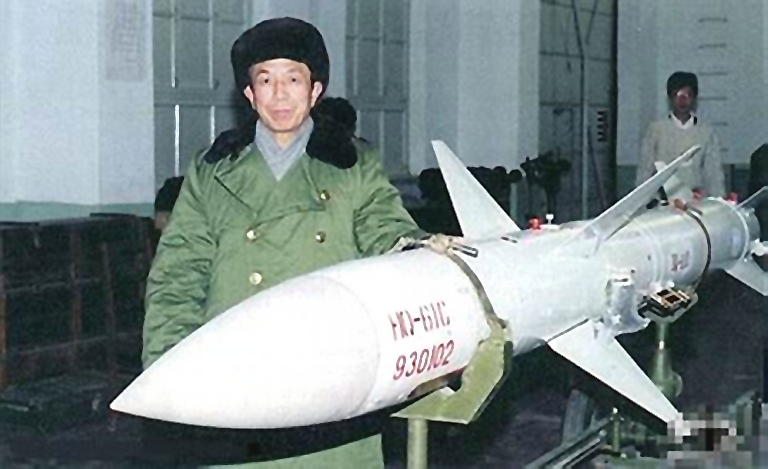
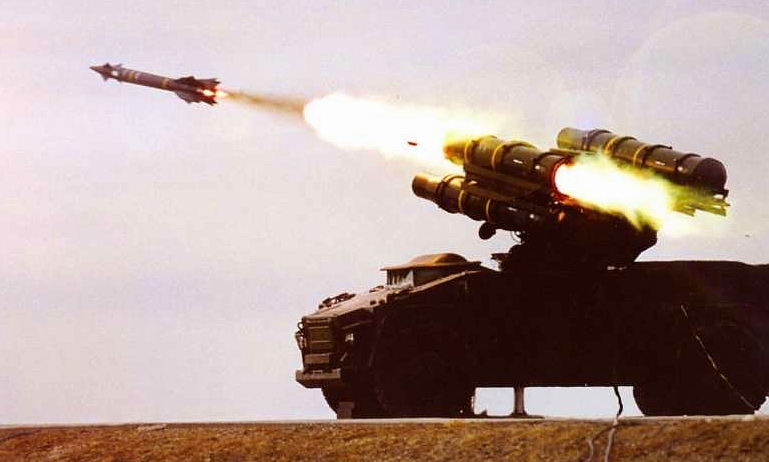    Note the PLA-AF towed HQ-7 variant in the background, below the foreground. 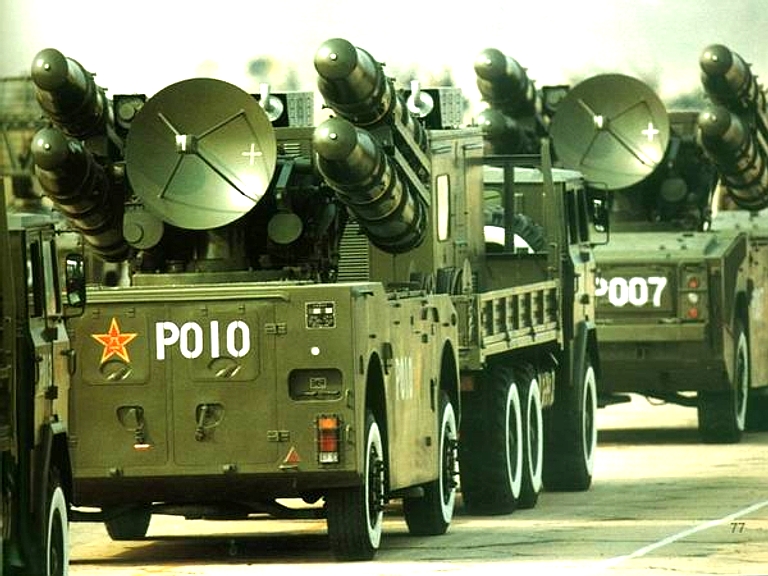 HQ-6/HQ-61[9]
The
US DoD credits the PLA with 30 “HQ-6” launchers, most likely referring
to the
HQ-61 series point defence SAMs deployed during the 1980s. Based
conceptually on the cloned Alenia Aspide missile, itself which is
based
on the US
RIM-7E/F
Sparrow, the HQ-61 is much larger and heavier and equipped with a
semi-active radar
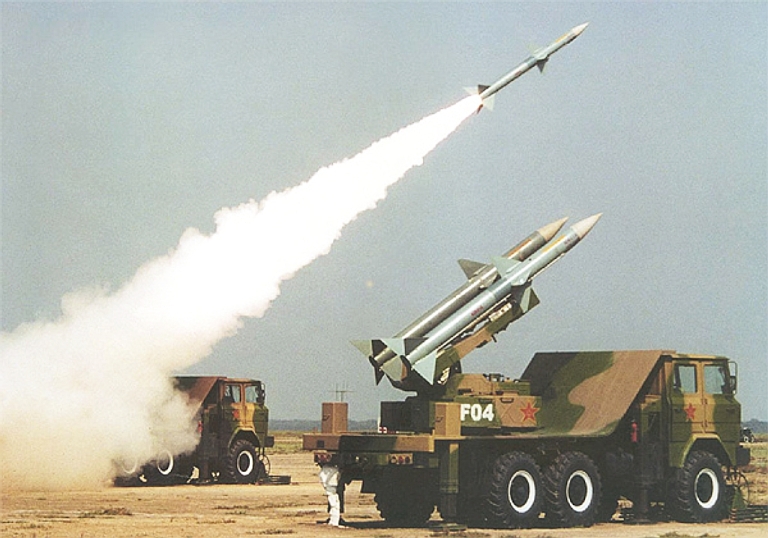
homing seeker and midcourse command link guidance. A 6x6 YanAn SX2150
truck
carries two rounds on a slewable elevating launcher. Guidance is
provided by
the Type 571 radar system. The cumbersome HQ-61 series has been largely
superceded
by the HQ-7 and HQ-64 point defence SAMs.
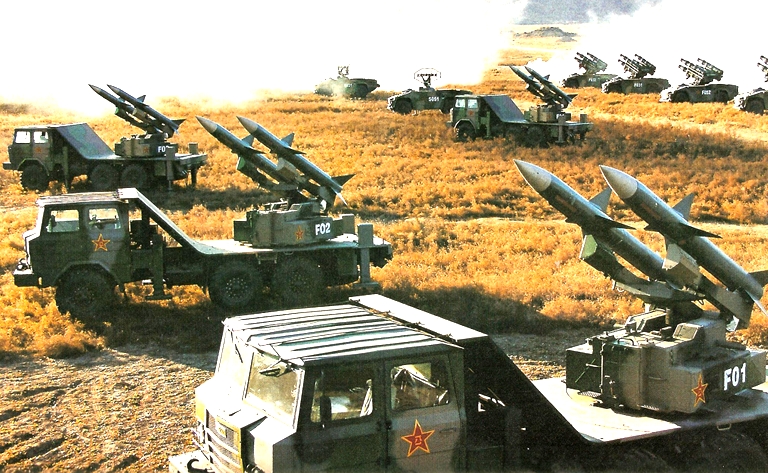 A
mixed
deployment
of
the
HQ-61 and HQ-7 Crotale.
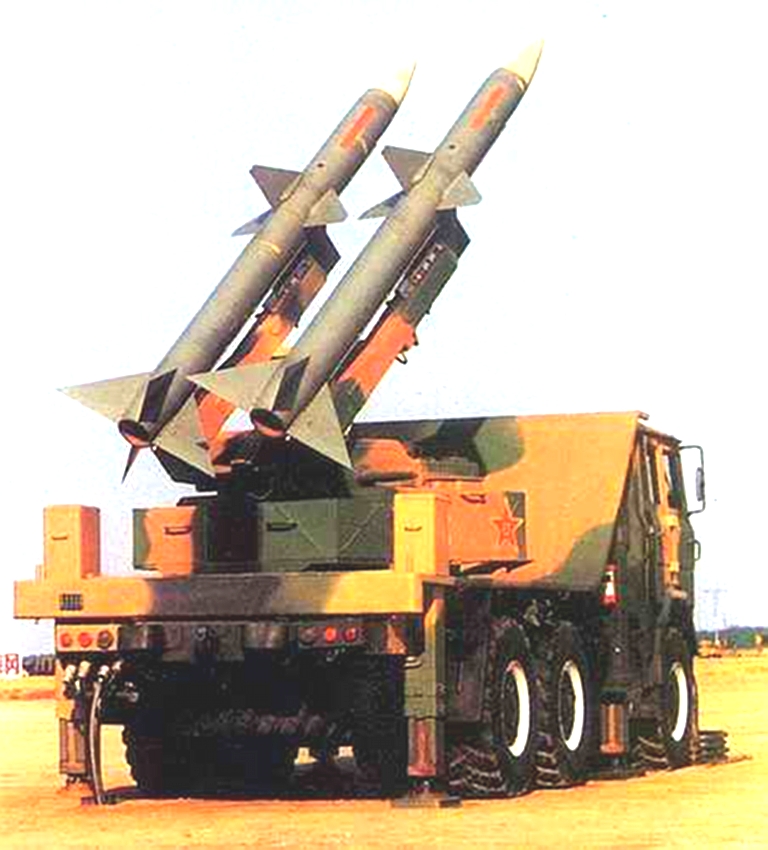 HQ-61
6
x
6
TEL vehicle.
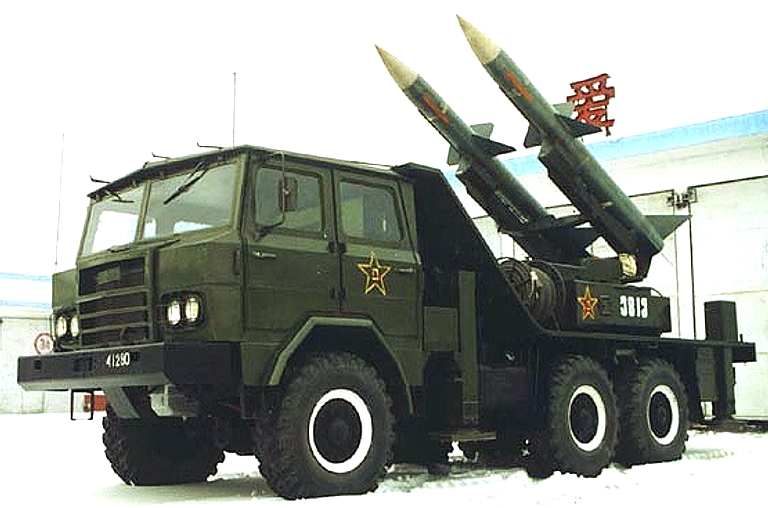 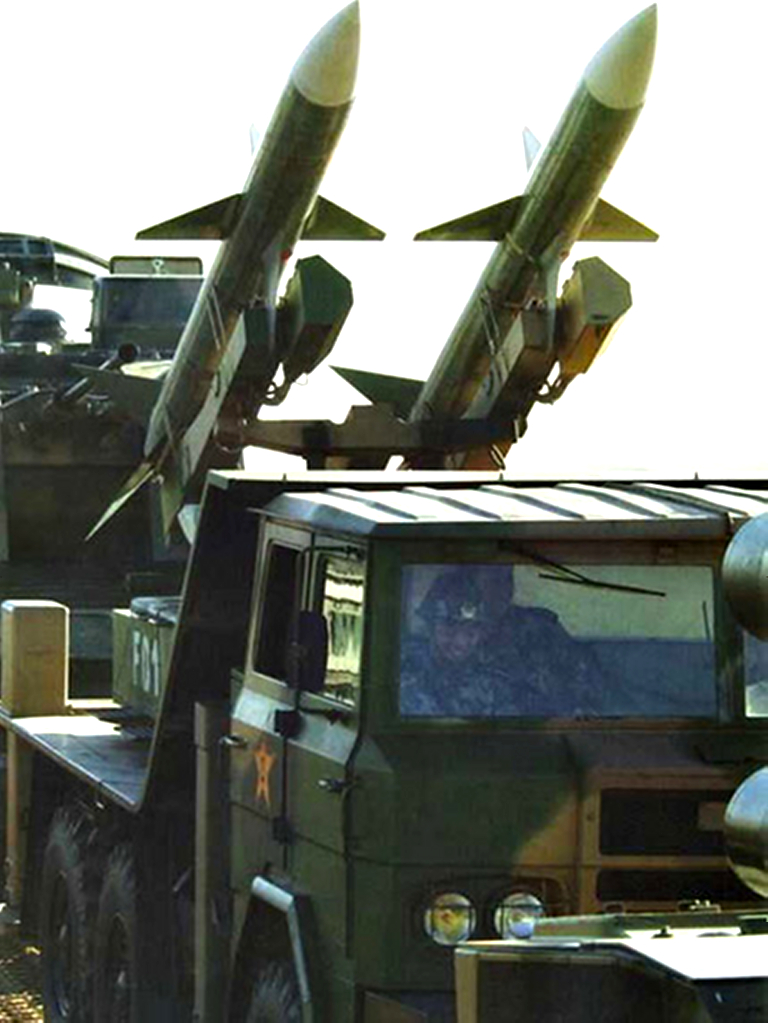  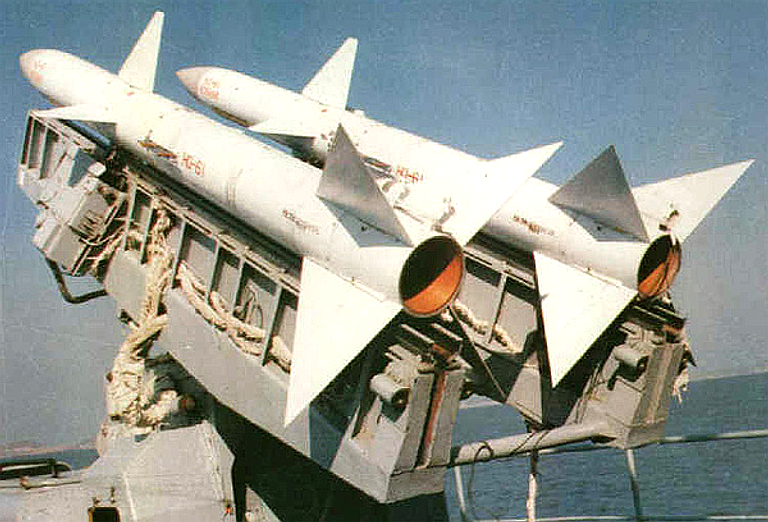 Navalised
HQ-61
variant.
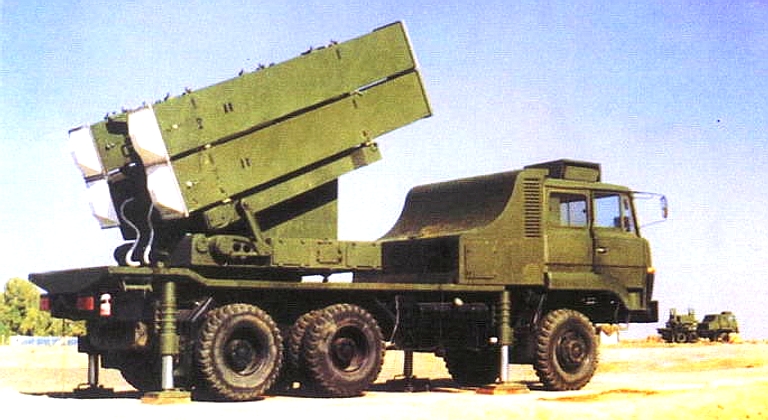
LY-60 / HQ-64 Aspide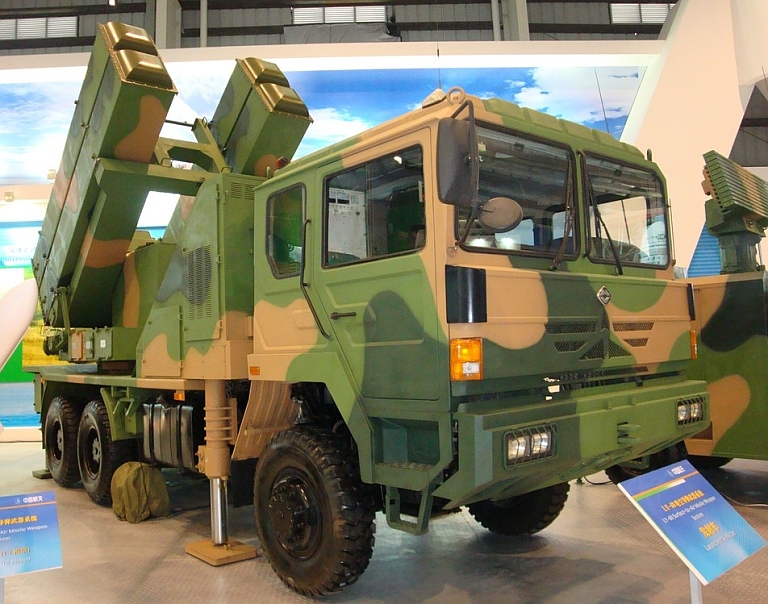 The
LY-60
four
round
TEL (image © 2009,
Zhenguan Studio).
The CPMIEC LY-60 is a direct
clone of the Italian Selenia (Alenia) Aspide Mk.1, itself derived from
the
RIM-7E Sea Sparrow. This missile is frequently cited as the direct
replacement for the conceptually similar but much bulkier HQ-61. Recent
literature shows a four round LY-60 TEL which is based on the naval box
launcher mount, similar to the US Sea Sparrow and original Aspide
designs. Like the Aspide / Sparrow, the LY-60 appears in naval and
mobile point defence SAM configurations, and as an AAM for fighter
aircraft, designated as the FD-60 or PL-10.
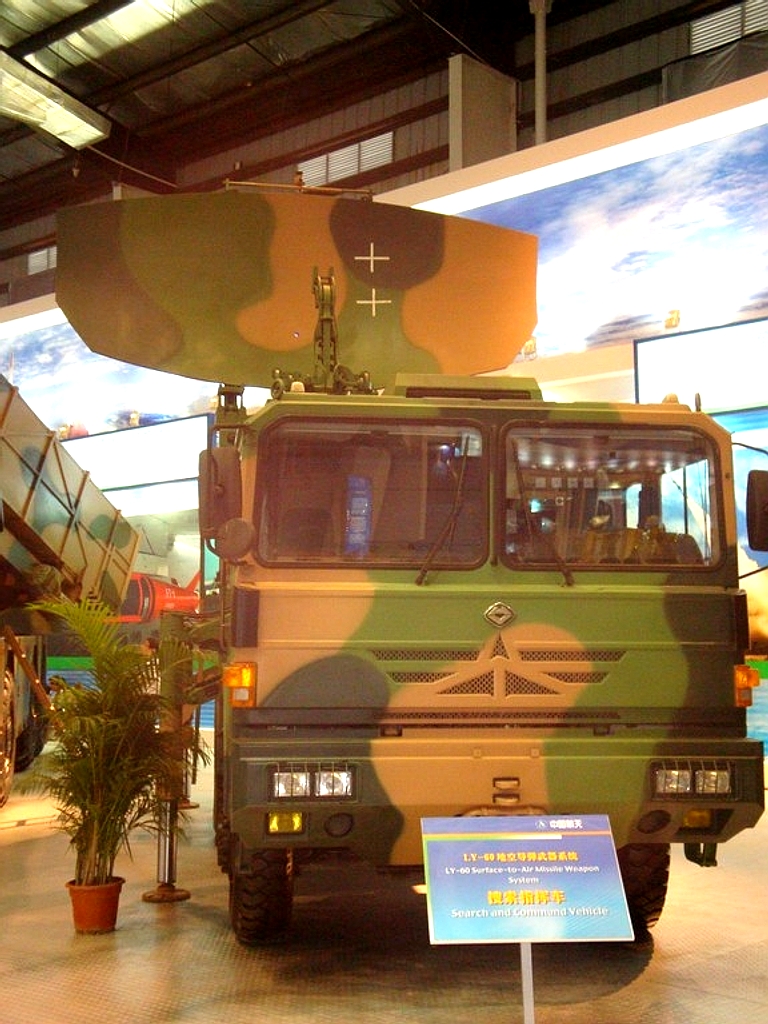
The missile is a semi-active homing design, reliant on a CW illuminator which is cued by an acquisition and tracking radar. Cited battery composition is one acquisition radar, three engagement radars and six TELs, with eight support vehicles providing missile transport, backup and primary power supply, missile test, electronics maintenance, mechanical maintenance, tools and spares. The acquisition radar is likely to be a derivative of the CLC-2 series operating at 2.9 ~ 3.4 GHz, or the YLC-6M. The engagement radar is a truck mounted variant of the naval LY-60 engagement radar, which is a single channel X-band design with providing CW illumination of the target. Until recently, no good imagery was available for the radar package, specifications remain unstated. CPMIEC brochures claim the capability to engage low flying aircraft and cruise missiles. Other sources claim the capability to detect 40 targets, track 12, and engage three.[36]
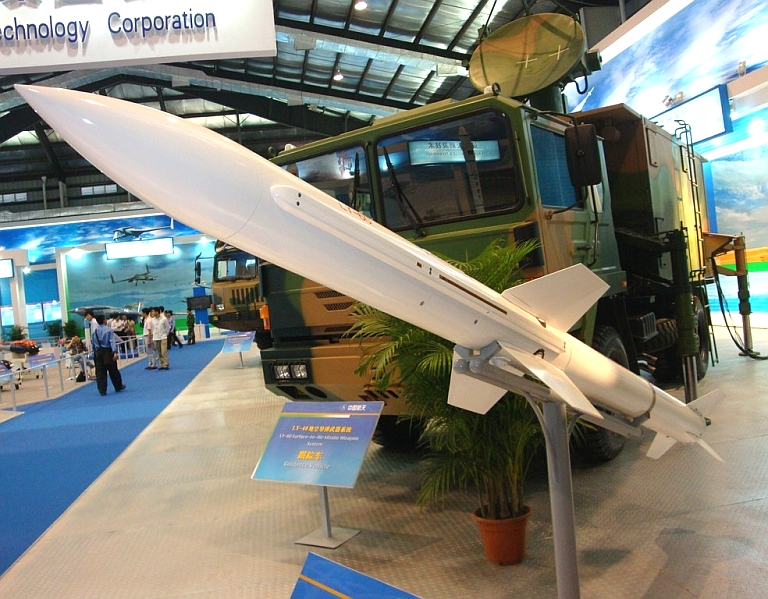 The
LY-60 displays the same clipped wings as the box launch late model
Aspide. In the background, the engagement radar with a CW
illuminator (image © 2009, Zhenguan Studio).
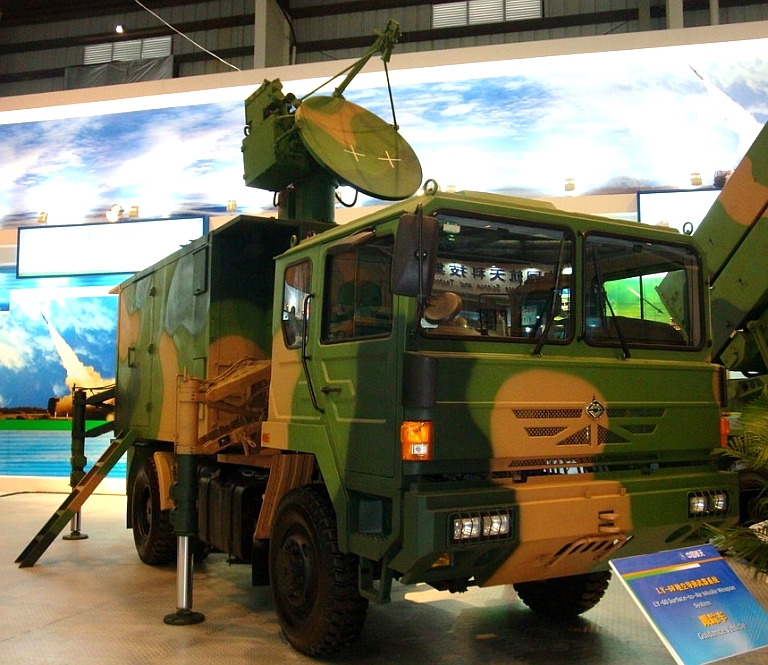 The
LY-60 engagement radar with a CW illuminator/tracker (image © 2009,
Zhenguan Studio).
 The LY-60 acquisition radar. This design is nearest in configuration to the YLC-6M series, and is likely a direct derivative (image © 2009, Zhenguan Studio). 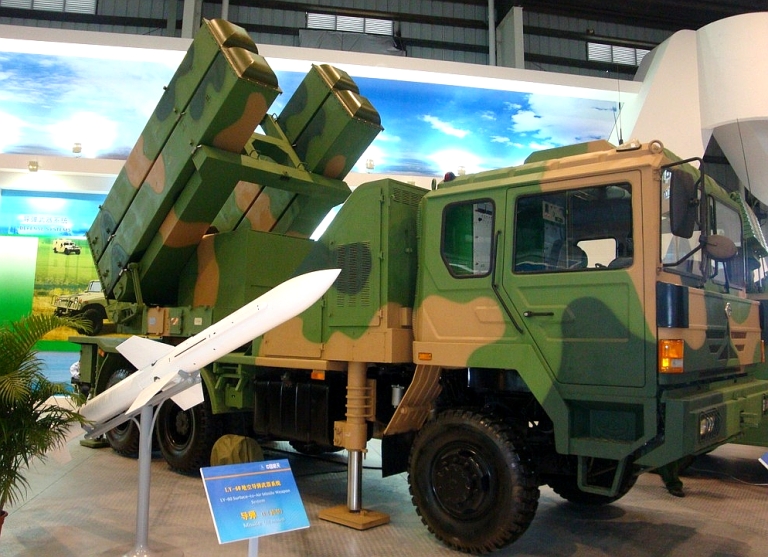 The
LY-60
four
round
TEL,
below detail of box launchers (images © 2009,
Zhenguan Studio).
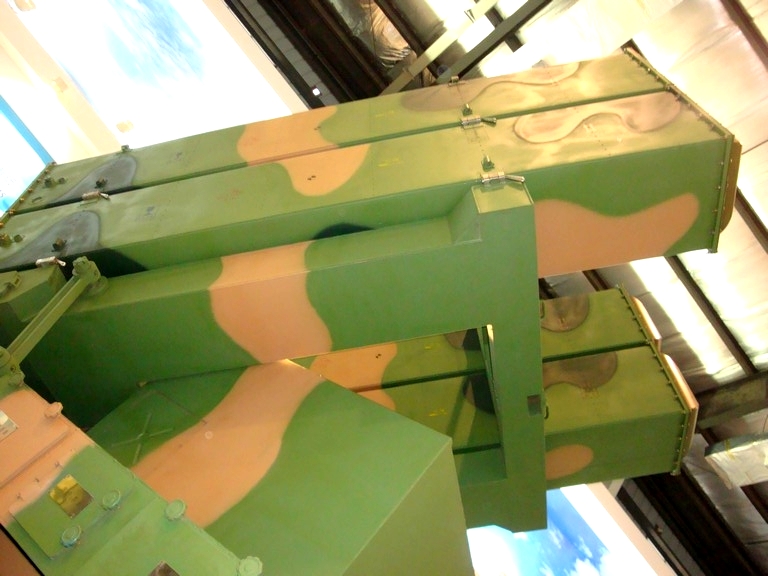  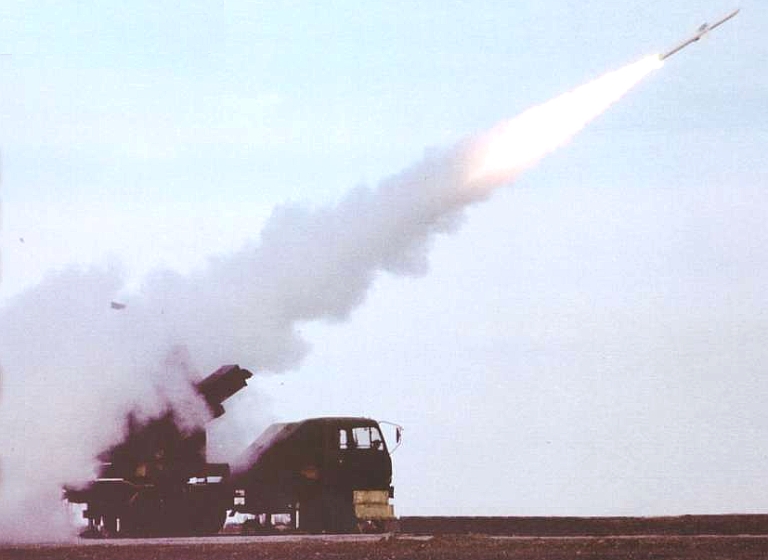 LY-60
launch.
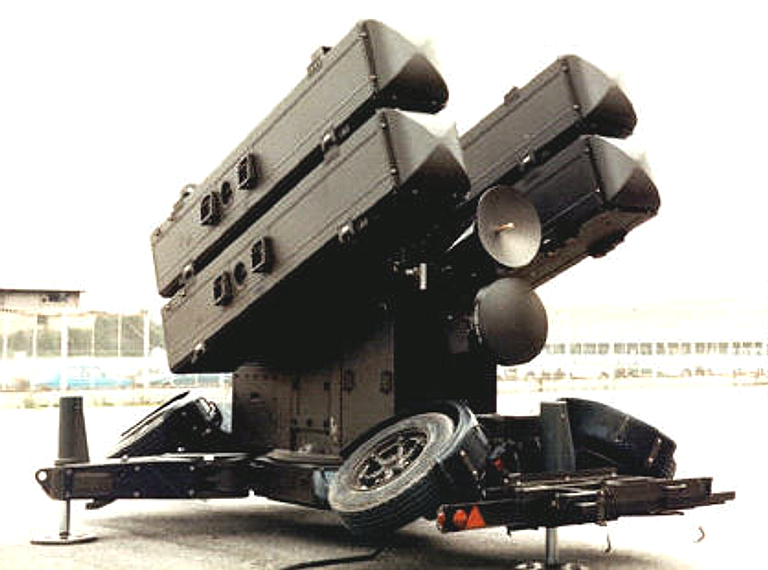
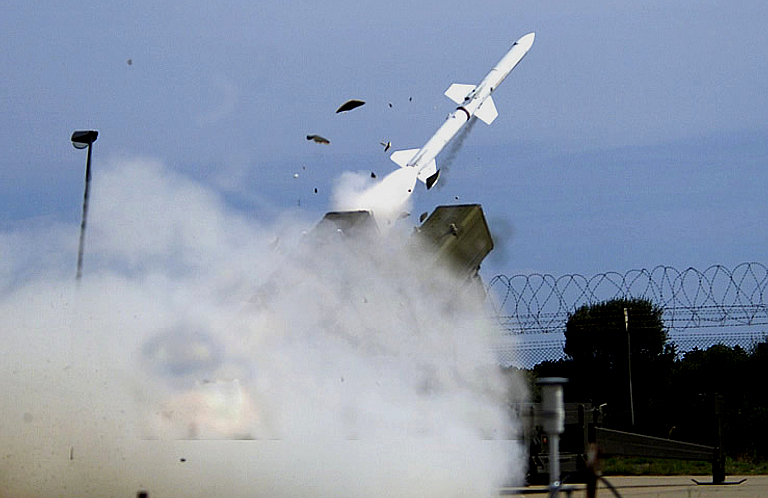 Above/below Alenia SPADA/Aspide towed
launcher. The tracker and CW illuminators are colocated on the mount,
no such antennas being visible on the LY-60 TEL.
 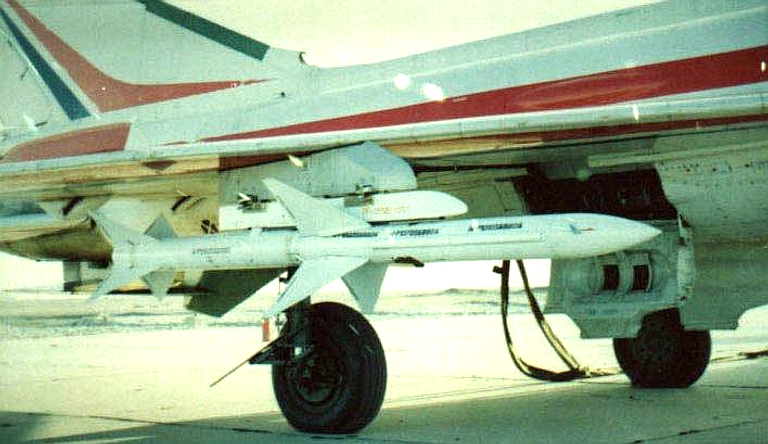 PL-10/FD-60 air launched variant of the cloned Aspide. |
||||||||||||||||||||||||||||||||||||||||||||||||||||||||||||||||||||||||||||||||||||||||||||||||||||||||||||||||||||||||||||||||||||||||||||||
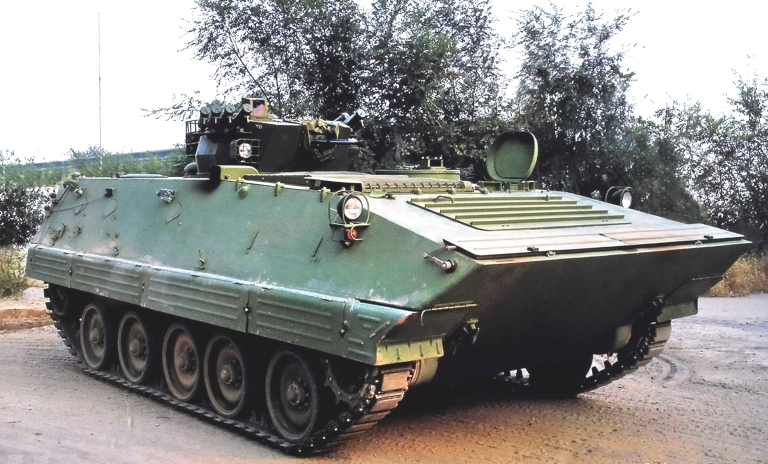
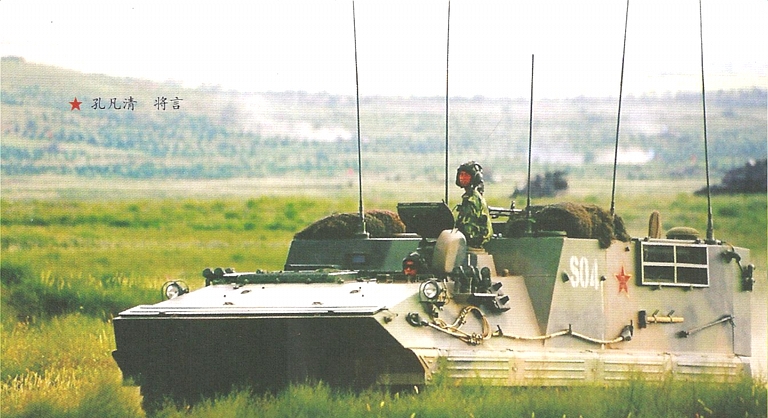
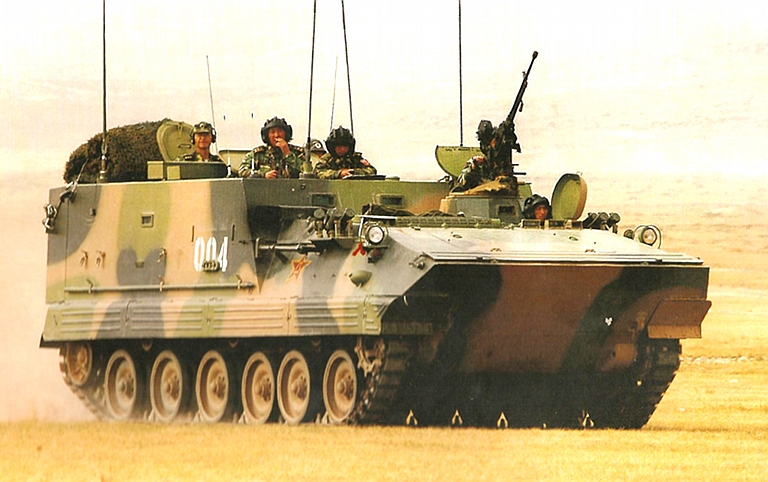
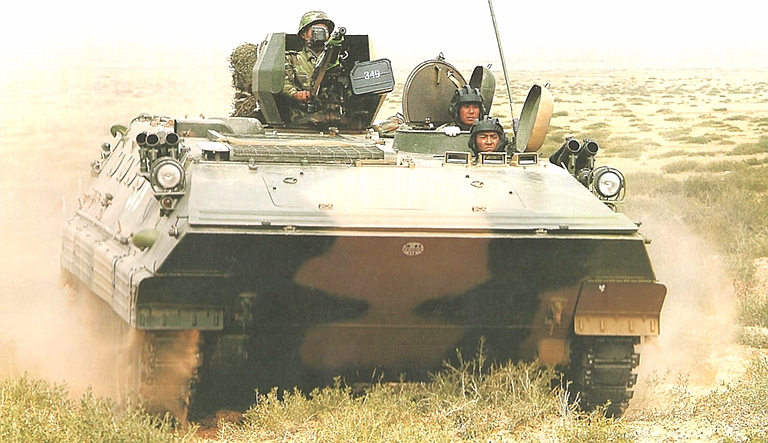
Type 89/ZSD89 Air Defence Missile Carrier[10]
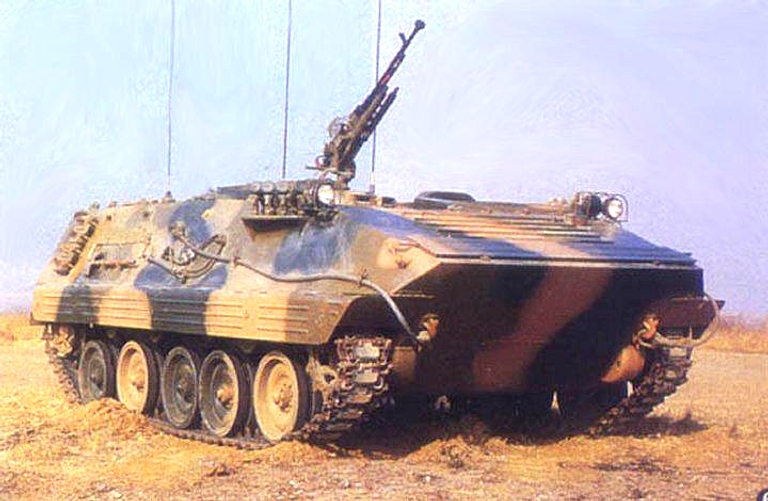
The
Type 89/ZSD89, also known as the WZ534, is 6634mm long, 3148mm wide,
1890mm
high at the top of the hull and 2556mm high including the 12.7mm
semi-enclosed
turret, which is a copy of the turret used on the M113 ACAV during the
Vietnam
War. The supercharged diesel
engine is rated at 319 horsepower and gives the vehicle a top road
speed of
65km/hr and 6.5km/hr in the water. The
vehicle
has
a
maximum
road range of 500km and 61km in
the
water. With a combat weight of
14.5 tons, the power to weight ratio of 22hp/ton enables the ZSD89 to
climb a
32 degree slope. There are four
twin 76mm grenade launchers, two sets on both sides just behind the
glacis
plate. There are four vision blocks and rudimentary firing ports on the
right
side, one of each in the smallish rear door which swings outwards, and
three of
each on the left hand side of the vehicle. The
lack
of
a
rear
folding ramp like on the M113 is a
severe drawback. The
12.7mm heavy machine gun has 1050 rounds stored in the vehicle and
provides
close in air and ground defence. Four Hongqi 6 MANPADS are
carried along with spare missiles. There
would be around nine air defence gunners who would
operate the
missiles, man the 12.7mm machine gun and listen to the air defence net
for
targets. The vehicle itself has a two man crew, comprising a driver and
vehicle
commander. FB-6A “Avenger” SAM System[11]
The FB-6A is a copy of
the United States Army’s AN/TWQ-1 Avenger system which mounts the
Stinger short-range surface-to-air missile on an octuple launcher on a
HMMWV chassis. The HMMWV variant employed is the aluminium body Shenyang SFQ2040.
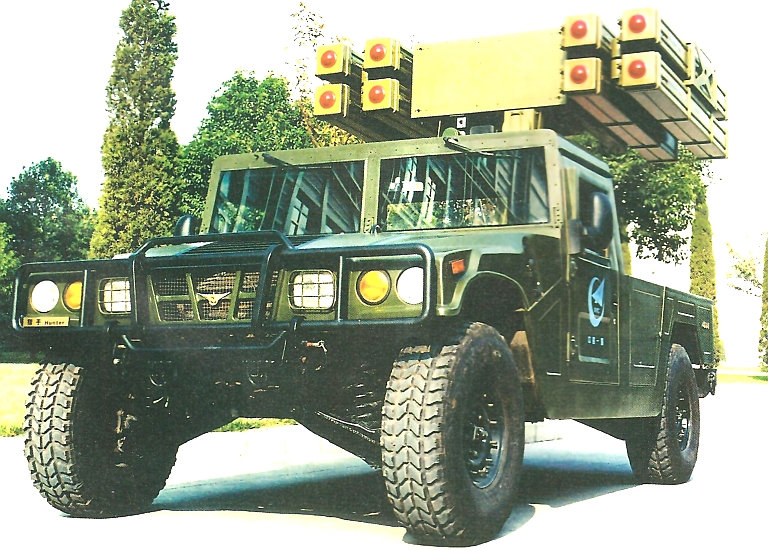
Designated the FB-6A it uses the TY90 surface–to-air missile that is 1,862 mm long, 90 mm in diameter and weighs 20 kg. The missile is quoted as having an effective range of between 500 to 6,000m; can engage targets flying at altitudes from 15 to 4500 m; and can reach Mach 2.2. The launcher is quoted, as being able to acquire a target a 12 km, a reaction time of 2 to 3 seconds and the vehicle and launcher are a direct copy of the HMMWV. 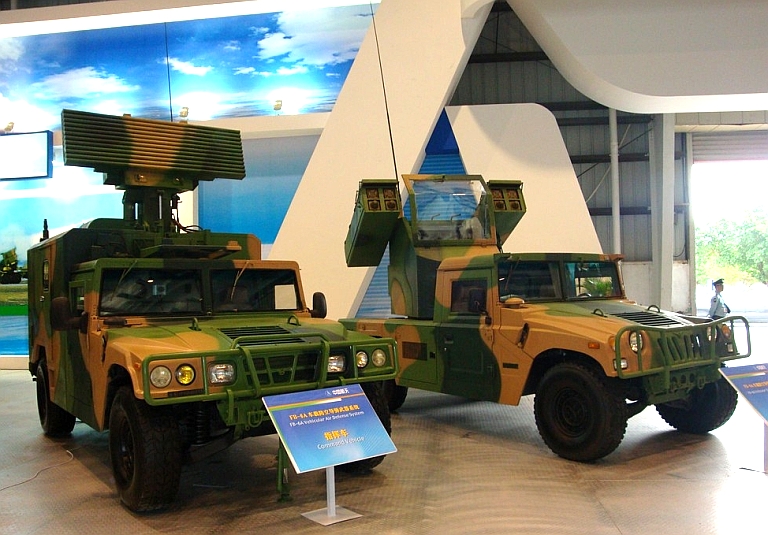 Above, FB-6A engagement radar and TEL, below FB-6A engagement radar, both carried on the Shenyang SFQ2040 HMMWV (image © 2009, Zhenguan Studio). 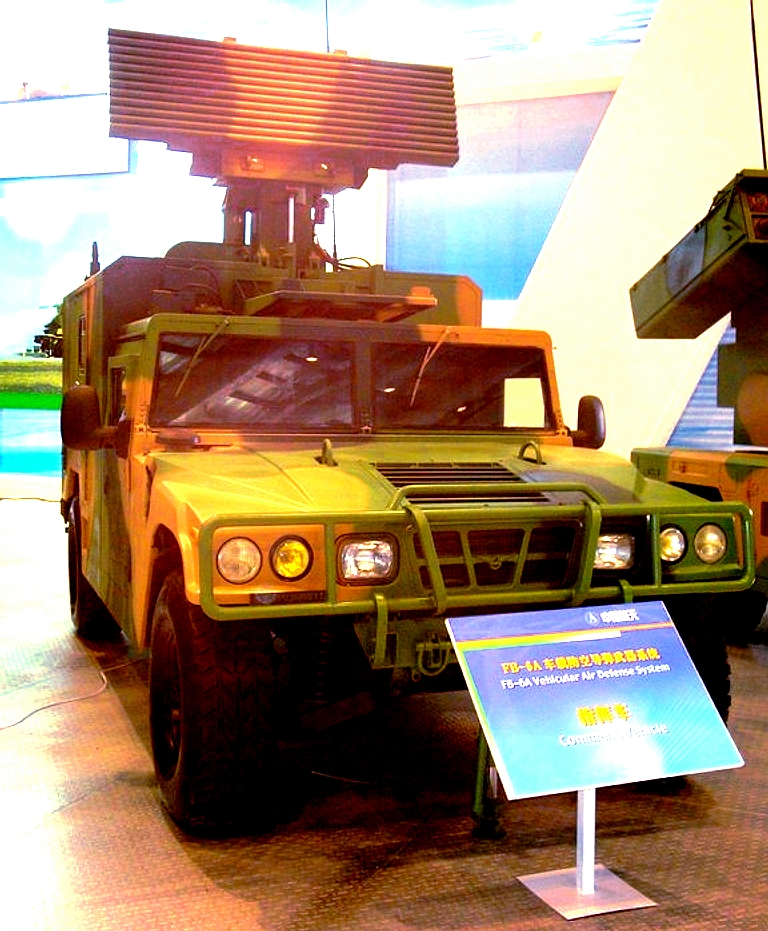 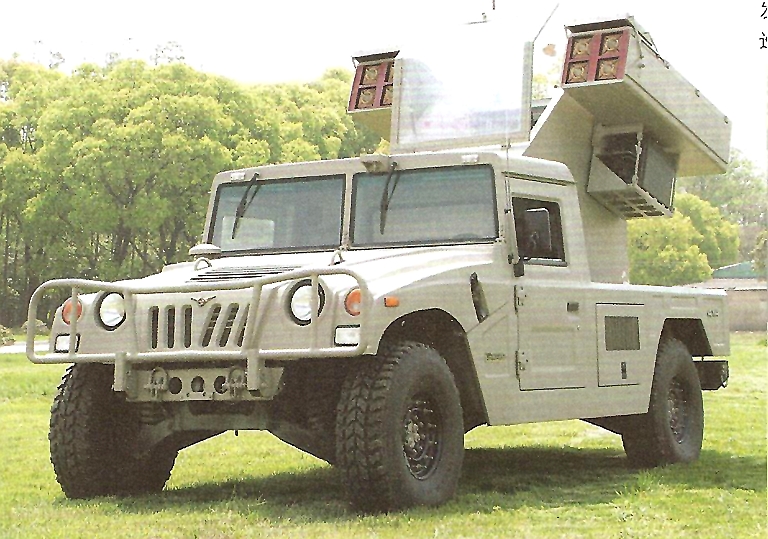 LS-II ADS “PLA SLAMRAAM/Chapparel” SAM System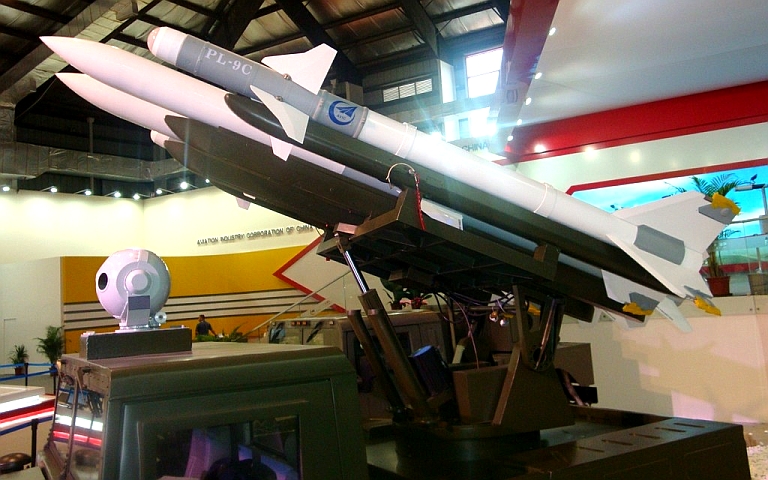 LS-II ADS TEL with a pair of SD-10/PL-12 active radar guided missiles and a pair of PL-9C heatseeking missiles (image © 2009, Zhenguan Studio). The Lie Shou “Hunter” II Air Defense System or “LS-II ADS” was displayed publicly at the Zhuhai 2008 exhibition. It is a Chinese analogue to the US MIM-120/MPQ-64 Sentinel “SLAMRAAM” point defence system, but with the important distinction in a mixed missile armament, comprising two SD-10/PL-12 and two PL-9C. The SD-10/PL-12 is an analogue of the AIM-120 AMRAAM, but with better range performance, and equipped with the Russian designed Agat 9B-1103M active radar seeker. The PL-9C is an analogue of the AIM-9H/L Sidewinder. The LS II is therefore a defacto hybrid of the Chapparel and SLAMRAAM concepts, but with a self propelled engagement/acquisition radar rather than the towed MPQ-64 radar used with the SLAMRAAM. Both the TEL and the engagement/acquisition radars are carried on the Dong Feng EQ-2050 HMMWV. The TEL is equipped with an electro-optical acquisition and tracking sensor mounted on the cabin roof. The radar is a planar array design, likely operating in the X-band. 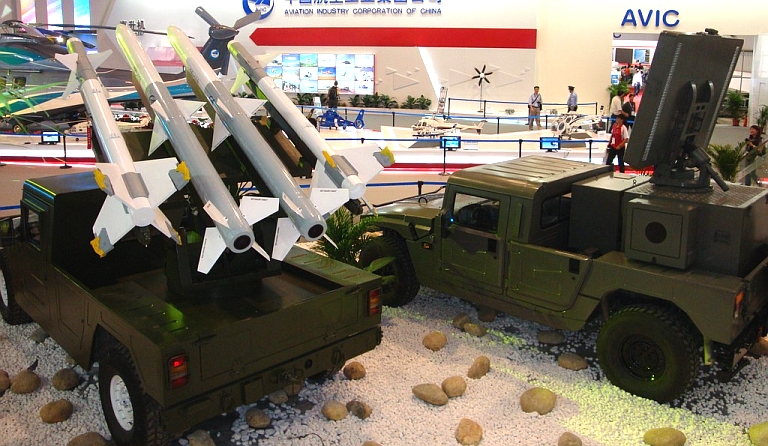 LS-II
ADS TEL and engagement/acquisition radar (image © 2009, Zhenguan Studio).
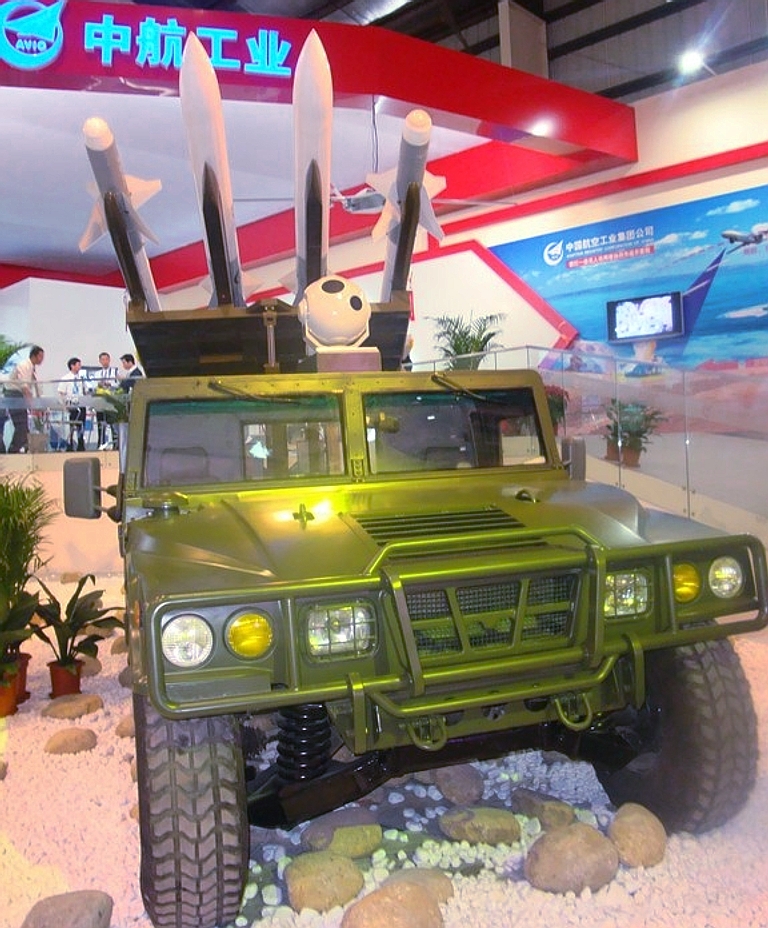 LS-II ADS TEL (image © 2009, Zhenguan Studio).
 LS-II ADS TEL EO system (image © 2009, Zhenguan Studio).
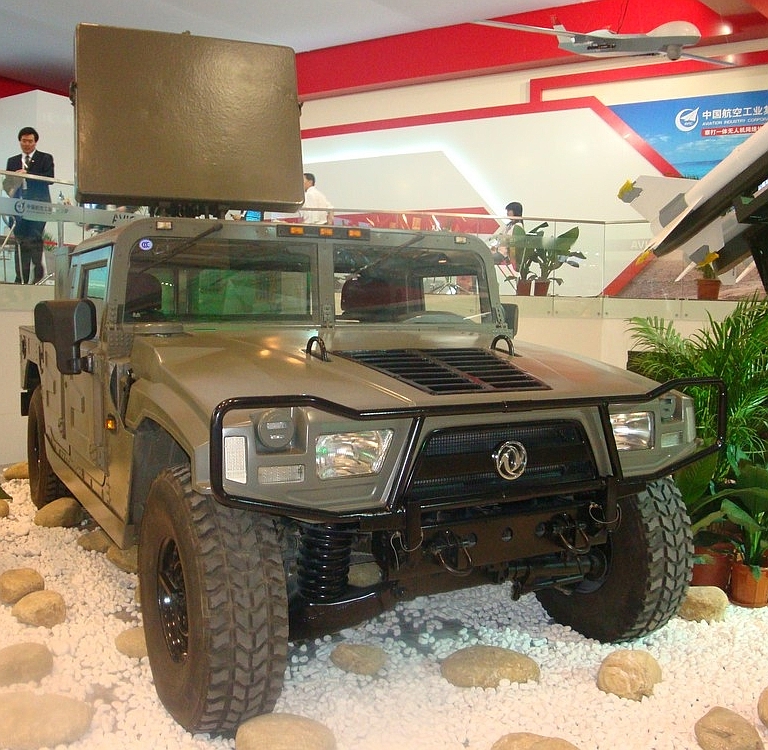 LS-II
ADS engagement/acquisition radar and antenna (image © 2009, Zhenguan Studio).
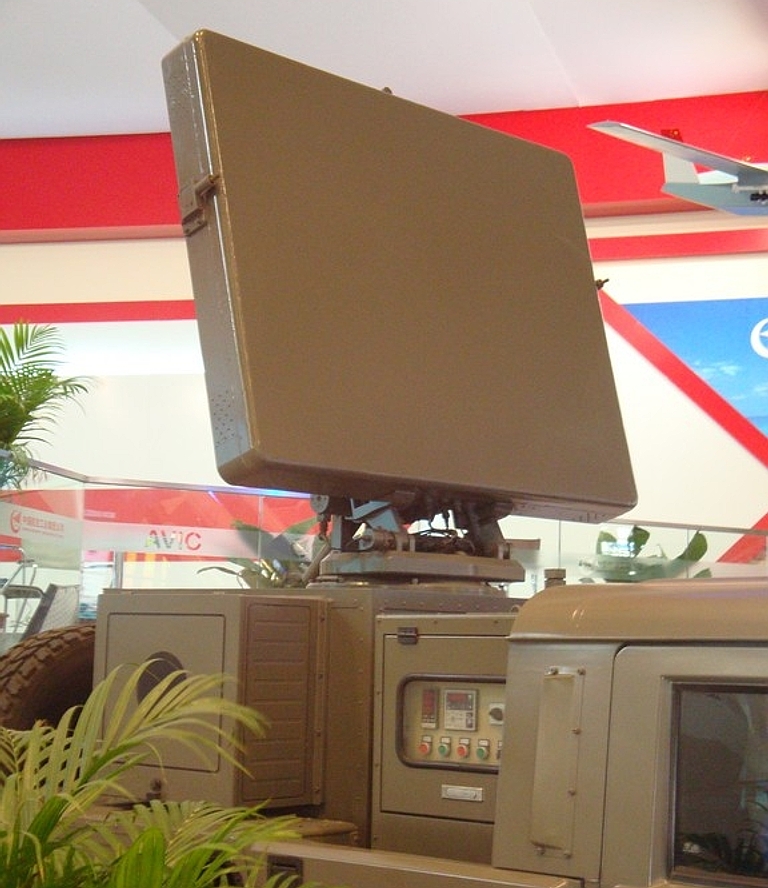 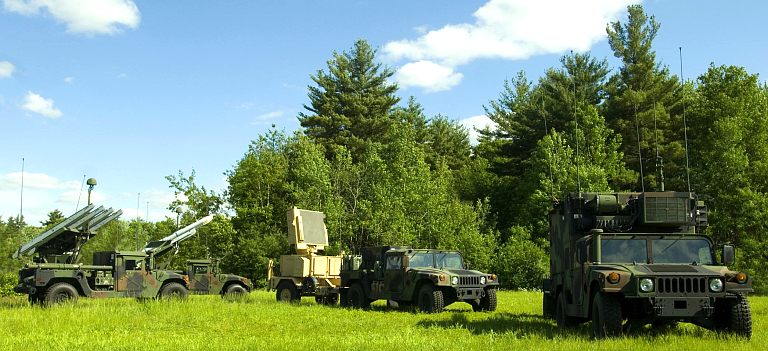 SLAMRAAM
battery
with
two
TELs,
MPQ-64 radar and C3 vehicle (US Army).
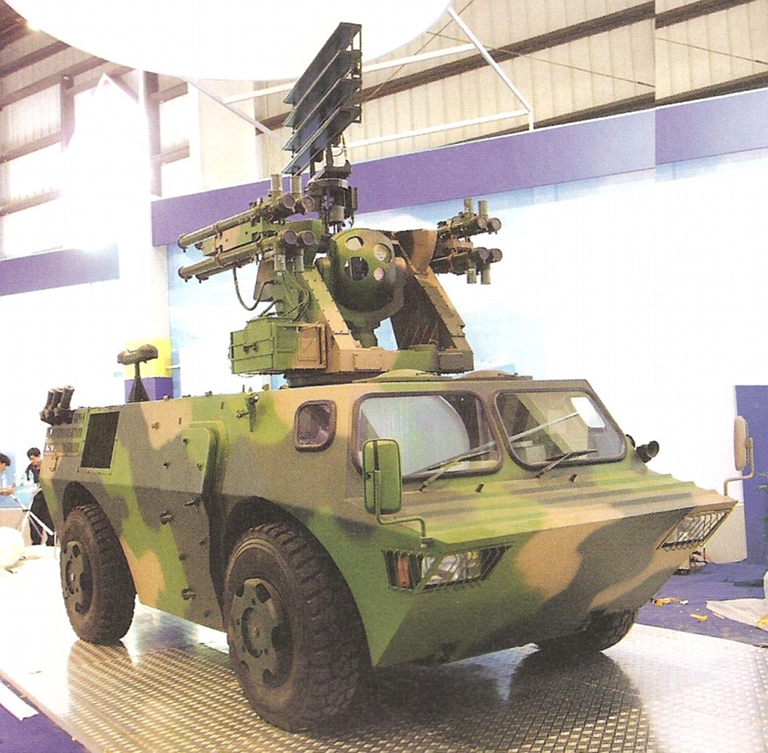
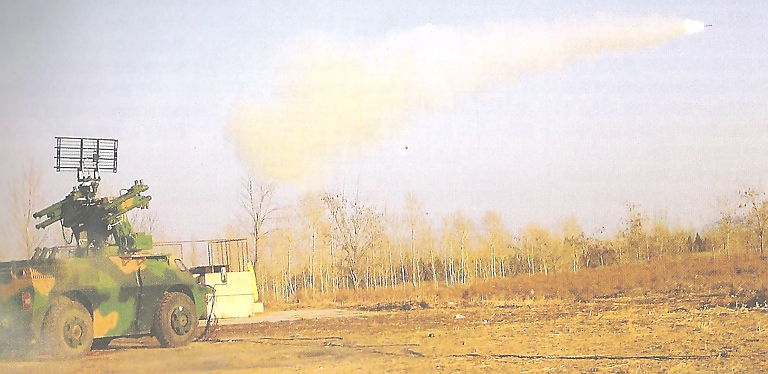
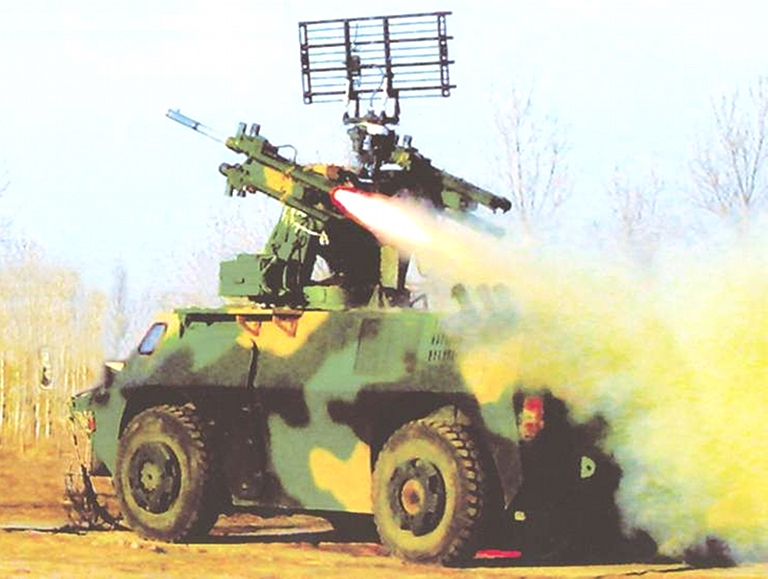
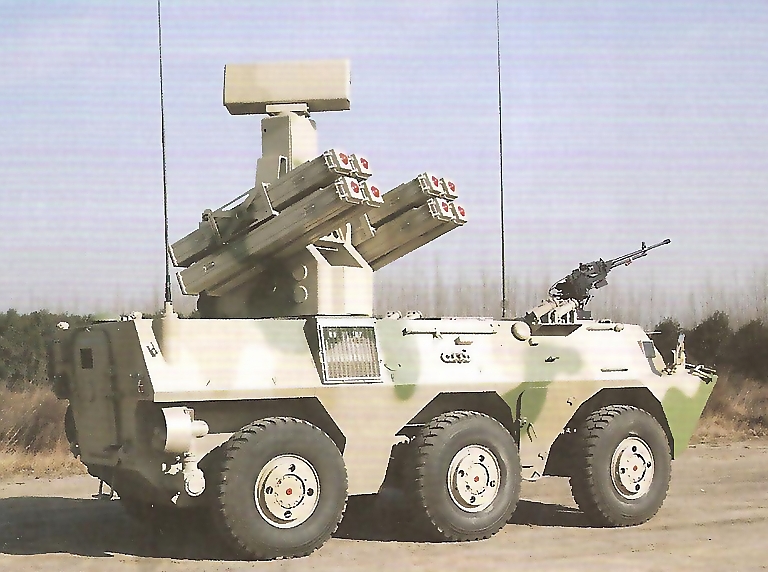
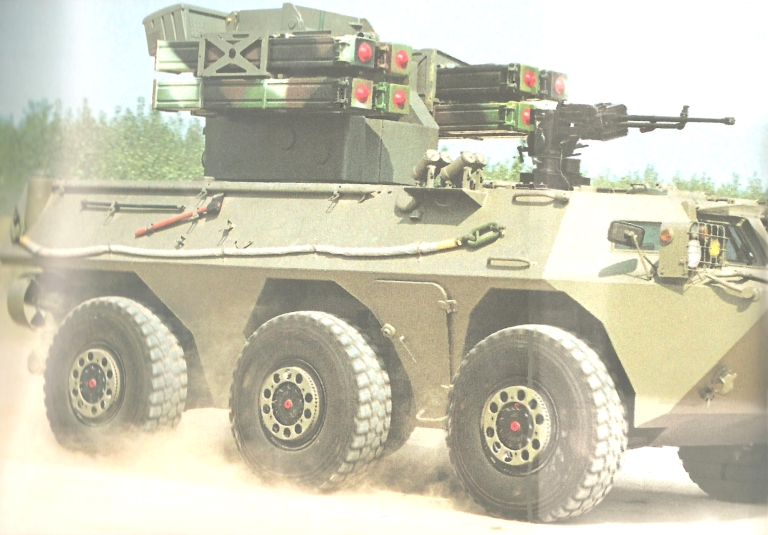
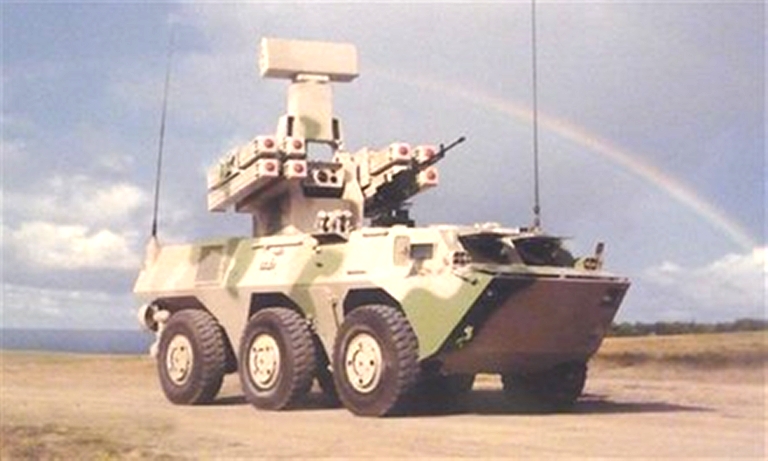
FLV-1/FLG-1/FL-2000 Wheeled Air Defence Vehicle[12]
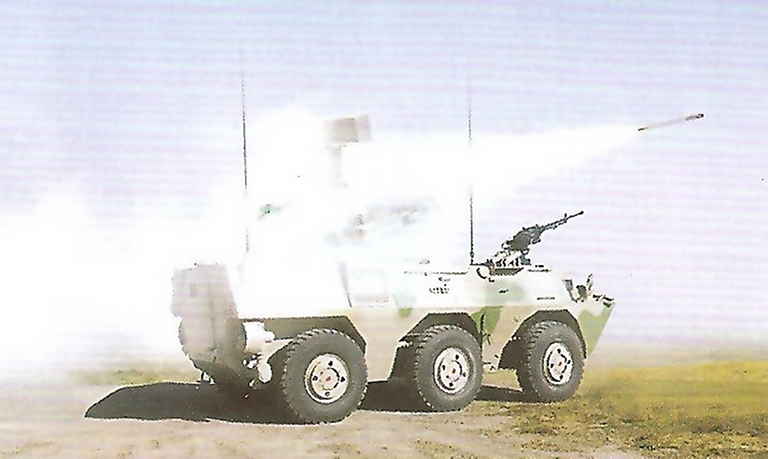
The
FLV-1 close in lightweight air-defence weapon system is based on the WZ
551
four wheeled armoured vehicle.[13] This
vehicle
appears
to
be
half
way between the United States Army’s AN/TWQ-1 Avenger system which uses
the
Stinger short range surface-to-air missile on an octuple launcher on a
HMMWV
chassis, and the Russian 9K31 Strela-1 system (SA-9 ‘Gaskin’) based on
the BRDM
4 x 4 chassis. The
FLV-1 uses the rear engine version of the WZ 550 4 x 4 chassis but has
only
two-wheeled drive. The FLV-1
weighs 8.5 tonnes, is 5.5 metres long and the rest of the chassis is
the same
as the WZ 550. The engine produces
132kw of power with a maximum road speed of 90 km/hr. There
are six smoke dischargers in two rows of three at the rear of the
vehicle. The FLV-1 carries a pintle
mounted 7.62 mm machine gun at the front of the vehicle for local
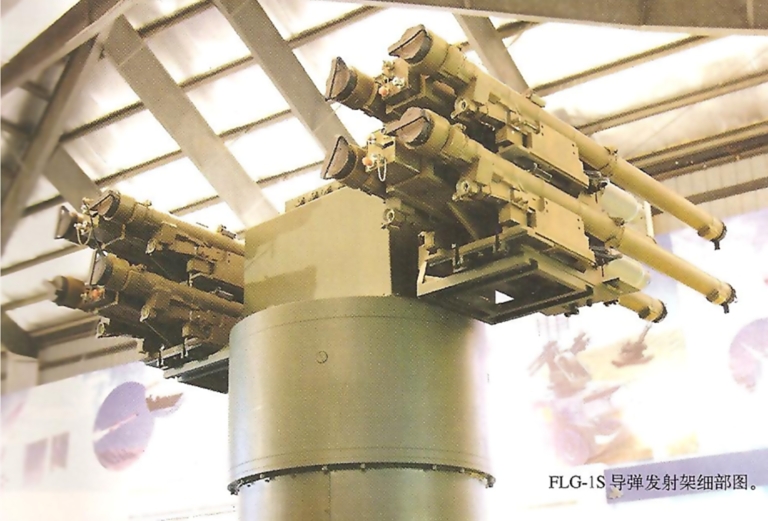
defence. The octuple launcher turret
houses two
quad launchers for the QW-1A lightweight surface-to-air missiles. There is a FLIR, laser rangefinder, and
most probably a laser designator, contained in a ball mount between the
missiles with a search radar mounted on the top of the system. The search radar appears to be a variant of the NRIET AS-901
series, an L-band MTI with ~20 km range. The FLV-1 can be used
for used
for independent close in protection of high value assets.
The FL-2000 is a derivative of the FLV/FLG-1 series.
The FLG-1 is a derivative of the
FLV-1
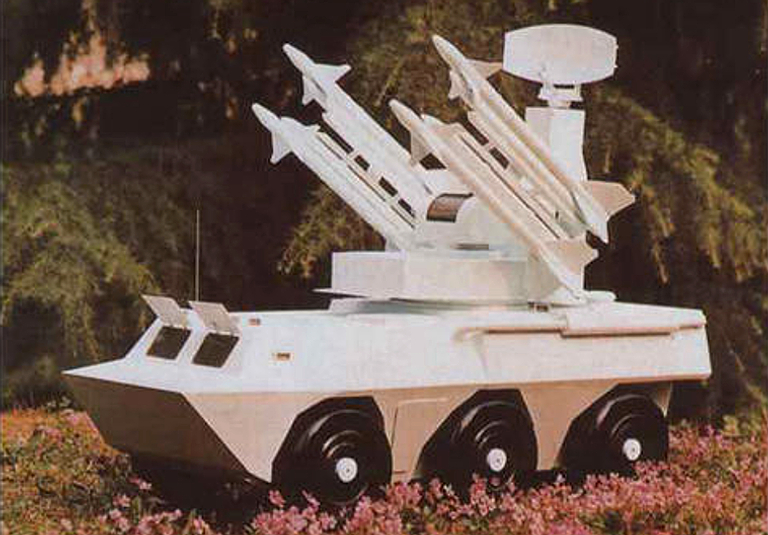
series. WZ551D Wheeled Air Defence Vehicle Launcher[14]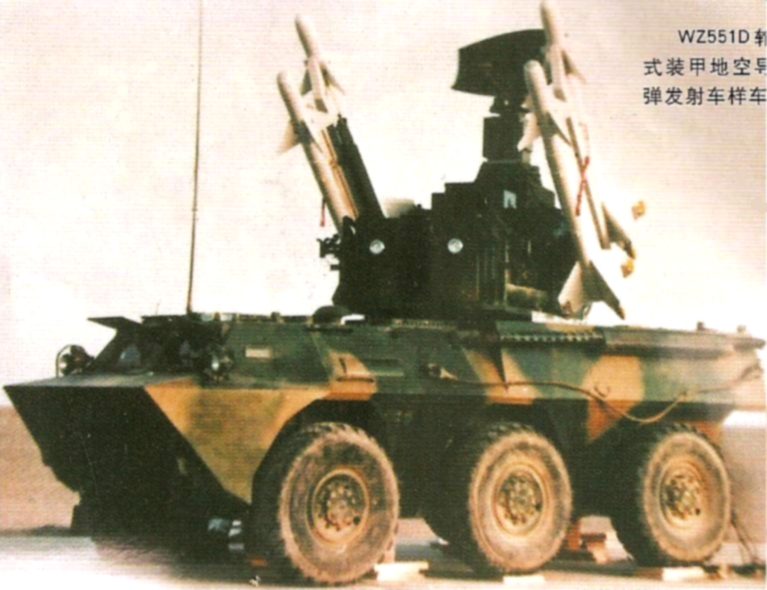 WZ551D demonstrator.
The
WZ551D wheeled air defence vehicle was ordered in 1987 as an air
defence
variant of the WZ551 family, using the PL-9 surface-to-air missile
system. The
PL-9 is conceptually closest to the
AIM-9P and appears to be an evolution of the PL-5 series missile, although Chinese sources
claim the missile outperforms the AIM-9L/M. It was not a success as only one
prototype was
built and tested. The vehicle was a transporter, launcher, and
radar unit (TLAR) and its
use was between the Russian 9K35 Strela-10 (SA-13 Gopher)
and
the 9K331 Tor (SA-15
Gauntlet) tracked surface-to-air missile systems. The WZ 551D carried a quadruple
launcher, similar in shape to the then contemporary U.S. MIM-72A/M48 Chaparral surface-to-air
missile (SAM) system which used an M54 missile
launcher mounted on the M730 surface-to-air missile (SAM)
system vehicle. Atop the launcher on the WZ551D was a search and
acquisition
radar which folded forward when not in use and for traveling to lower
the
vehicle’s silhouette. The
WZ551D was 6.65m long, 2.8m wide and had a height of 3.4m with the
radar folded
and 5m with the radar upright. It
weighed 16t ready to fire with four missiles and a crew of between four
and
six. The prototype vehicle did not even have proper seating, with one
seat a
folding chair. The F8L413F 188kW four-stroke diesel engine gave it a
power-to-weight ratio of 11.8kW/t, a top road speed of 85km/hr and a
maximum
range of 800km. It could surmount a 0.5 m vertical obstacle and wade
through 1.2m of water. Its radar had a search radius of 20km at altitudes
from 50 to 4000m with an electro-optical tracking system providing
passive
tracking and back up. Why it never
entered service is unknown, but it could have been due to the changing
nature
of the threat and system itself. The
WZ551D was designed to
engage attack helicopters but the new fire and forget anti-tank guided
missiles
like Hellfire II have made many such surface-to-air missile systems
obsolescent,
as their silhouettes makes them readily identifiable and targeted by
attacking
aircraft, both fixed and rotary wing. The
PL-9
Air-To-Air
Missile
is
used
in this application as a Surface–To-Air Missile. [15] It is an all aspect missile
guided by a target’s thermal signature. Its
surface-to-air
variant
weighs
120kg,
is 2.99m long and
like all the
PL-9 versions has a diameter of 167mm, which compares favourably to the
AIM-9
Sidewinder’s 127mm. Its maximum
speed is reported as Mach 2 and the version on the defunct WZ551D had
a
reported
slant
engagement
range
of 10km and could engage targets up to an
altitude of
4,000 m.
|
||||||||||||||||||||||||||||||||||||||||||||||||||||||||||||||||||||||||||||||||||||||||||||||||||||||||||||||||||||||||||||||||||||||||||||||
COMMAND, CONTROL AND COMMUNICATIONS |
||||||||||||||||||||||||||||||||||||||||||||||||||||||||||||||||||||||||||||||||||||||||||||||||||||||||||||||||||||||||||||||||||||||||||||||
Type 81 Armoured Command Vehicle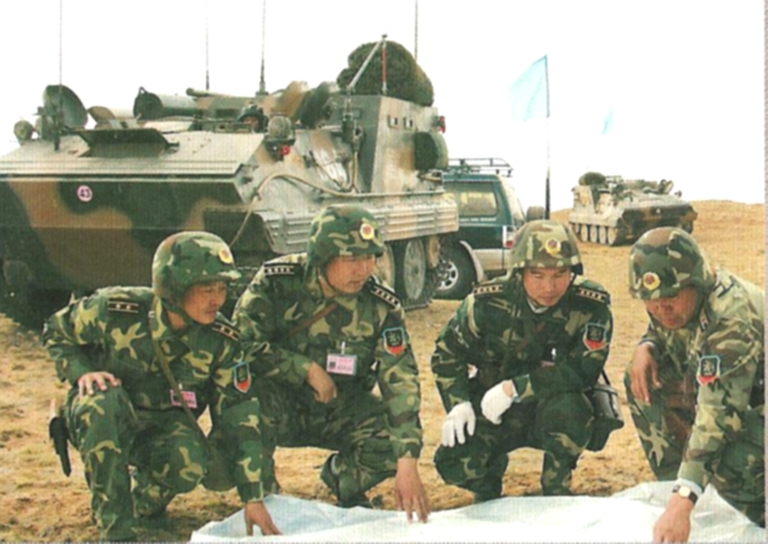 The Type 81 ACV is also designated the WZ701 and is based on the Type 63 and uses the same extended hull as the WZ750 ambulance.[32] The vehicle weighs 13 tons loaded for combat and contains seating for two crew forward of the rear and up to eight personnel in the rear. This makes for a crowded vehicle which includes a seat against the rear door and normally the personnel in the rear varies from 3 to 5. A battery fire control vehicle would have less personnel for example. The Chinese ACV version in the article was equipped with five Type A-220 short wave/FM radios, one Type 714B back pack radio and one Type 339 facsimile machine. The Type 81
armoured command vehicle based on the Type 63 hull has had similar
modifications to the Type 63C to enable it to provide command and
control of
amphibious landings. The PLAN
modified version is designated the Type 81C. |
||||||||||||||||||||||||||||||||||||||||||||||||||||||||||||||||||||||||||||||||||||||||||||||||||||||||||||||||||||||||||||||||||||||||||||||
ZZM88 Armoured Cryptographic and Communications Centre Vehicle[39]The ZZM-88 is an armoured
cryptographic and communications centre vehicle for units equipped with
vehicle mounted and back pack frequency hopping and later radio sets.
It has two roles. Firstly, it provides remote re-keying of
cryptographic protection, or daily keys, for frequency hopping radio
sets automatically via radio transmission. The second is
providing command and control nets using packet switching for higher
level headquarters units. It is co-located with the highest
level command vehicle to provide cryptographic and communications
support. At the air defence headquarters it can provide dedicated
secure real time nets for fire control, data linking and communications.
The vehicle is equipped with a, VRC-8000 vehicle mounted radio, a PRC-18 back pack radio, a Z/TCP-1 rapid battery recharger, VIC internal communications system, one single voice (broadcast) system which could be used for the crypto keys, four two voice communications systems, one three voice communications system and one separate radio remote control internal main vehicle intercom. The FJ-10/2-2 crew environmental control system keeps the internal temperature of the vehicle habitable for the six crew, even when outside it is 45 degrees Celsius. The ZZM-88 was introduced in 1992 initially to units operating the then new Type 79 main battle tank which introduced the VRC-8000 radio into PLA service. The vehicle would be co-located with a Type 81 armoured command vehicle to provide higher echelon units with a battlefield command and control net, and utilises the same hull as the Type 81 armoured command vehicle. Combat loaded it weighs 12.9t and is 5.576m long., 2.978m wide and 2.187m high including the sight on the Type 59 12.7 x 108mm heavy machine gun, with a hull height of 2.198m. The ground clearance is 435mm and it is powered by a 190kW diesel engine which gives a maximum ground speed of 61km/hr, a torque of 56.7kP and a maximum speed in water of 6km/hr. The vehicle has a maximum road range of 500km, 61km in water and 420 rounds of 12.7 x 108mm ammunition carried for the machine gun. 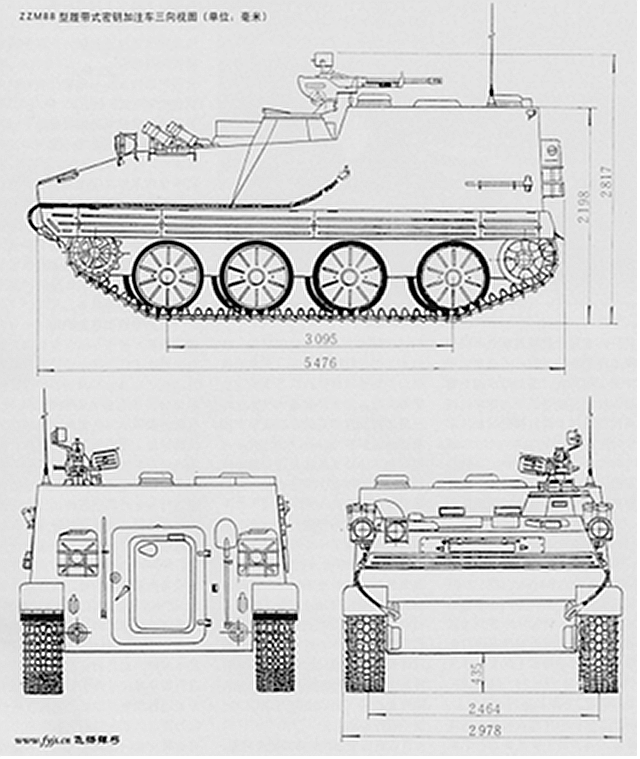 |
||||||||||||||||||||||||||||||||||||||||||||||||||||||||||||||||||||||||||||||||||||||||||||||||||||||||||||||||||||||||||||||||||||||||||||||
Man Portable Air Defence Systems |
||||||||||||||||||||||||||||||||||||||||||||||||||||||||||||||||||||||||||||||||||||||||||||||||||||||||||||||||||||||||||||||||||||||||||||||
QW-2 and HY/FN-6/FN-16 Man Portable Air Defence Systems[16]
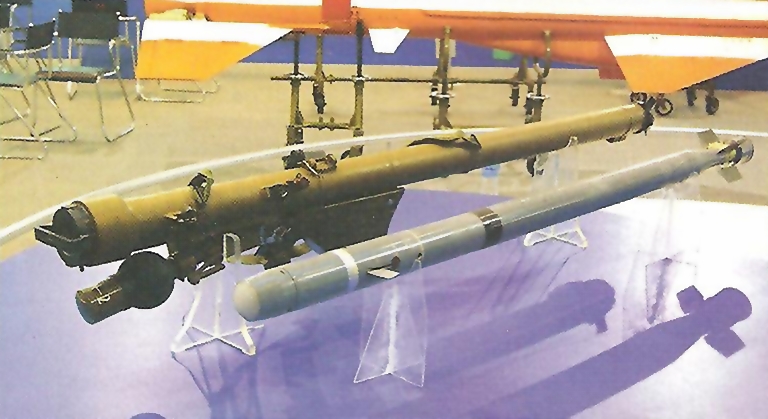
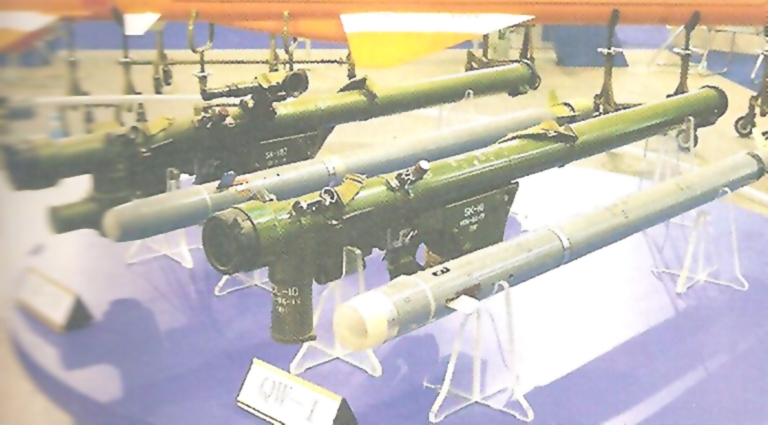
The QW-2 is a
reverse engineered copy of the Russian 9K310 Igla-1 (SA-16 Gimlet). The infrared seeking missile is 72mm in
diameter is 1.59m long and weighs 11kg. It
has a launch speed of 25 m/sec and can engage a target
at a distance
between 500m to 6,000m at an altitude from 10m to 4,000m.
All up, the system weighs 18.4kg and
has a shelf life of ten years. In
action, the reaction time is five seconds with a reported 75% chance of
intercepting a target.
QW-1 and QW-1M MANPADS are predecessor
variants to the QW-2 series.
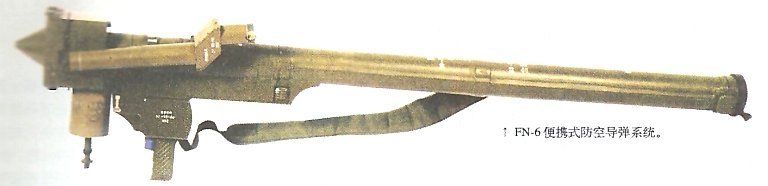
The HY/FN-6
is
an infrared seeking missile with a diameter of 71mm, a length of 1.495m
and a
weight of 10.77kg. All up with the
launcher the system weighs 17kg and can intercept a target going
600m/sec. The
launcher can be equipped with a night sight and an IFF system similar
to the
AN/PPX-1 fitted to the FIM-92 Stinger. 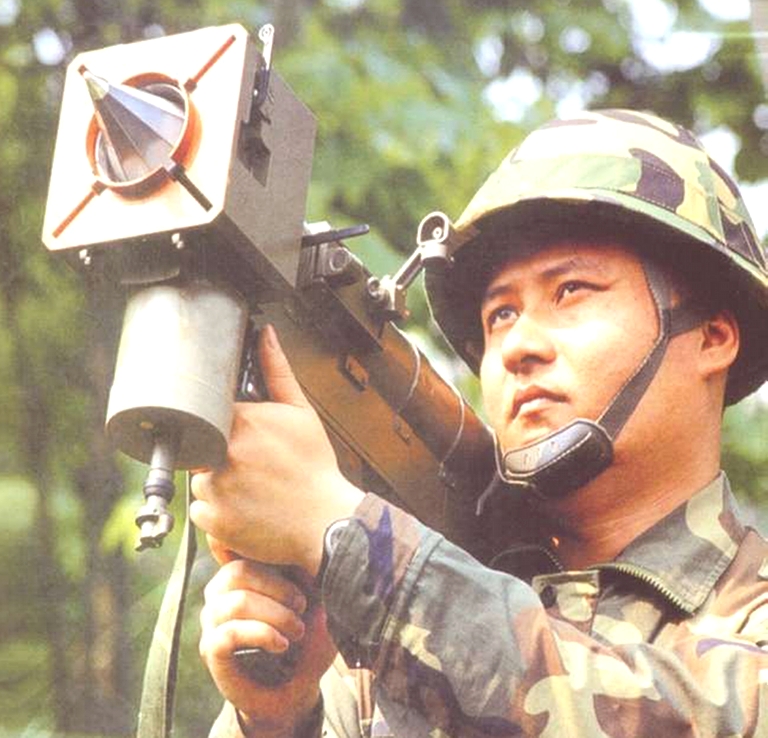
HY/FN-6
MANPADS.
The FN-16 an improved version of the FN-6 and is also an infrared seeking missile with the missile having a diameter of 72mm, a length of 1.6m and can do an 18g turn. The FN-16 can engage a target flying between 10 and 4000m altitude up to up a range of 3km although the missile has a lethal range of 6km. weight of 10.77kg. All up with the launcher the system weighs 18kg, is 1.7m long and can intercept a target going 600m/sec[38]. 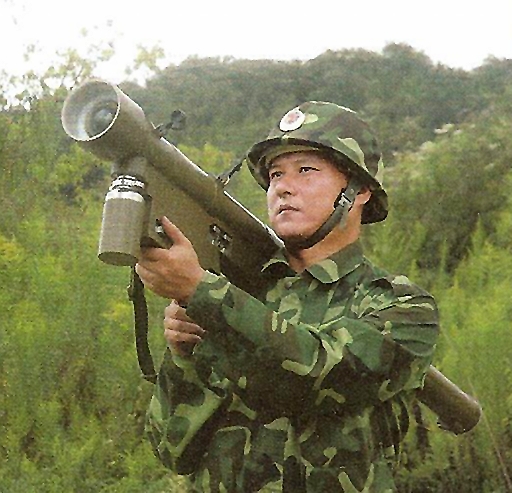 FN-16 MANPADS. |
||||||||||||||||||||||||||||||||||||||||||||||||||||||||||||||||||||||||||||||||||||||||||||||||||||||||||||||||||||||||||||||||||||||||||||||
Large Calibre Anti-Aircraft Machine Guns |
||||||||||||||||||||||||||||||||||||||||||||||||||||||||||||||||||||||||||||||||||||||||||||||||||||||||||||||||||||||||||||||||||||||||||||||
|
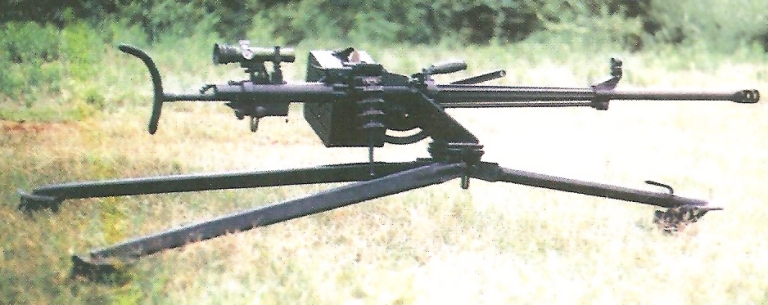
QJG02 14.5mm Anti-Aircraft Machine Gun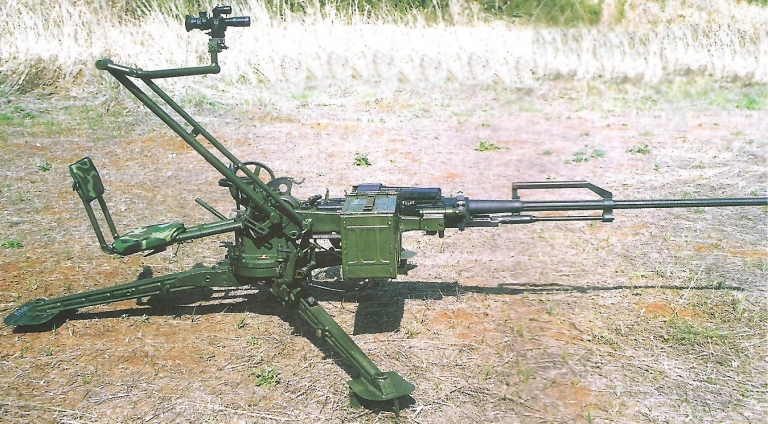 China has developed a lightweight 14.5mm anti-aircraft machine gun designated the QJG02.[17] The weapon is designed to replace the Type 56 copy of the Russian ZPU-1 that comes in at 413kg.[18] Despite a double baffle muzzle brake, the weapon would jump around on fully automatic fire. This is not unlike firing a .50 M-2 Browning on a hard surface. The weapon would have been very handy for the Mujahideen during the Russian invasion of Afghanistan but has been rendered obsolescent at best by MANPADS. This weapon remains nevertheless effective against rotary wing aircraft and low flying transports. Once broken down into six man portable loads, the heaviest weight is less than 20kg. It has a rate of 600rpm and an effective range of 2,000m; however its effective rate of fire is 100rpm. It was introduced with two new 14.5 x 114mm rounds, the DGJ02 APDS-T and the DGE02 APHEI-T. 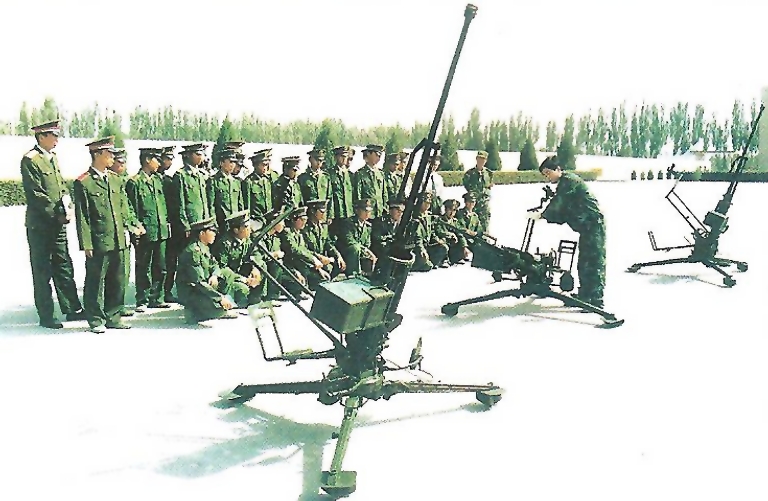 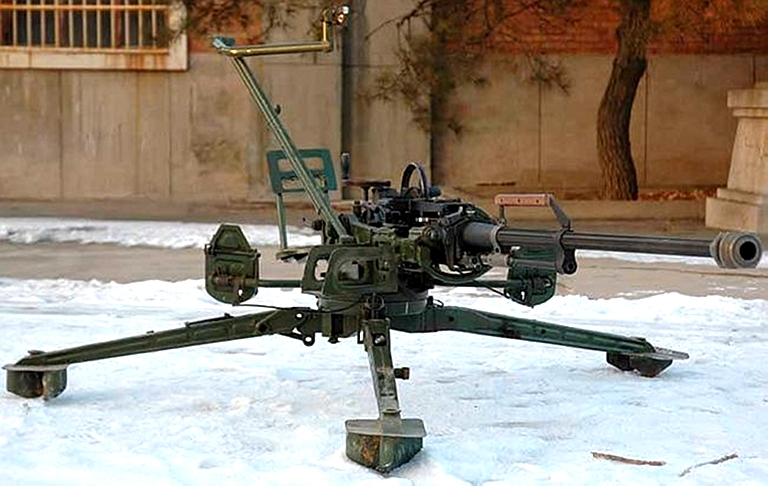 W95A .50in Heavy Machine Gun[19]The
Chinese Defence Industries are now offering the W95 12.7mm heavy
machine gun in
12.7mm x 99mm, based on the PLA’s W85 heavy machine gun in 12.7mm x
108mm. The gun itself weighs 28 kg without
the
tripod and is 2050mm long overall. The
heavy barrel, the rear half which is heavily fluted,
is 1002mm long
and the weapon has a cyclic rate of fire of 650-750 rounds per minute
and an
effective rate of fire of 80 – 100 rounds per minute.
It is designed to operate in
temperatures from -150C to 700C.
Representing
another doomed attempt to replace the M2 Browning heavy machine gun, it
will
probably be offered to Third World countries that are under a U.S.
embargo
against the supply of spare parts for their M2 Browning heavy machine
guns. Given the popularity and
numbers of M2s in the world, spare parts are readily available from
many
suppliers, and this is a forlorn hope. Some
may
be
bought
by
countries in an attempt to spite the
United States
but the numbers would be small. QJZ89 12.7mm x 108mm Heavy Machine Gun[20]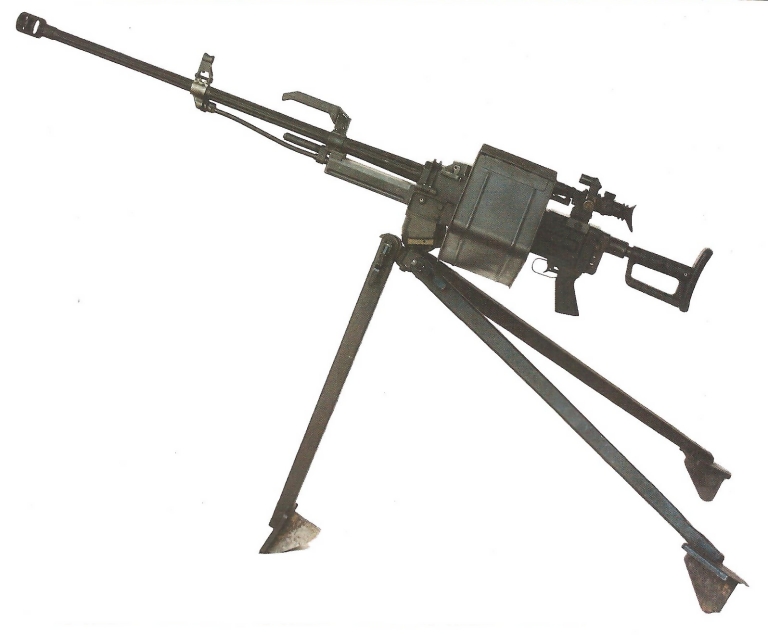 The
Type 77 was developed further and entered into PLA service as the QJZ89
12.7 x
108mm heavy machine gun. The QJZ89 weighs 17.8kg empty and its simple
tripod weighing
8.5 kg yields a total weight of 26.3 kg. The
weapon’s
overall
length
is
1,640mm with barrel length
being
1003mm. The muzzle velocity is
quoted at 825m/sec and the effective range 1,500 m.
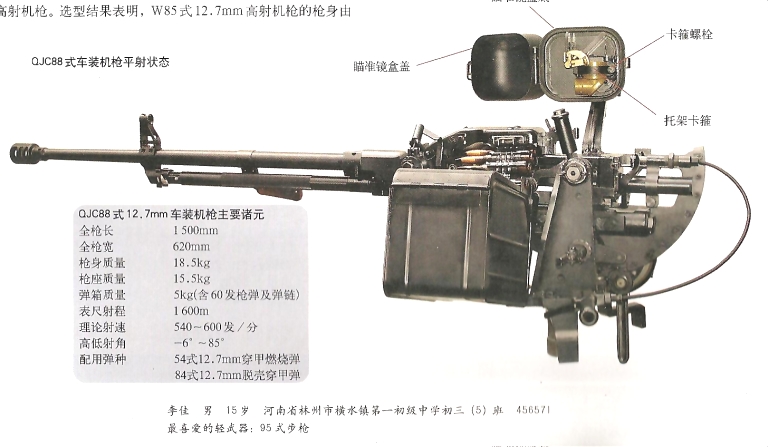
A 50 round drum feeds from the left. QJC 88 12.7 x 108mm cupola anti-aircraft machine gun[21]
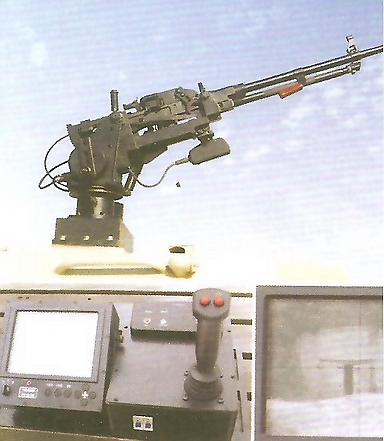
The new cupola mounted
anti-aircraft machine gun is 1500mm long and 620mm wide.
It comes in two parts, the main body
weighs 18.5kg and the mount is 15.5 kg. Its
elevation
ranges
from
-60 to +850
and has a
rate of fire of 540 to 600 rounds per minute. It
can
fire
the
Type
54 12.7mm family of cartridges and the
Type 84 12.7mm APDS cartridge. Type 85 12.7mm x 108mm Heavy Machine Gun[22]
The
Type 85 12.7 x 108mm heavy machine gun is a “product improved” version
of the
Type 77, and is as simple a design as a 12.7mm machine can be. With the tripod laid flat, the
Type 85 is 2050mm long and 1160mm wide. It
has a rate of fire of 650 – 750 rpm and depending on
the
tripod’s configuration (it can be set up for anti-aircraft fire) its
elevation
is from -10 to + 800 and an arc of 3600. The complete system weighs 39.6kg with
its box magazine on the left hand side holding sixty rounds of link
ammunition. Type 77 12.7 x 108mm Heavy Machine Gun[23]
The Model 77
heavy machine gun is described as China’s first generation designed
12.7mm
anti-aircraft machine gun. The Type 85 is a “product improved”
version. The weapon is both
gas (three settings) and recoil operated. The ammunition
belt is
the standard DShK metal non-disintegrating link. The gun itself
weighs 21.3 kg, the tripod is 28.3kg and other attachments/accessories
weigh
6.5kg, for a total weight of 56.1kg. The rate-of-fire is between
650 to
750 RPM, its range against aircraft is 1,600m slant and up to an
altitude of
800m. The muzzle velocity is between 810 to 825m/sec and its
maximum
ground range is 7 km. 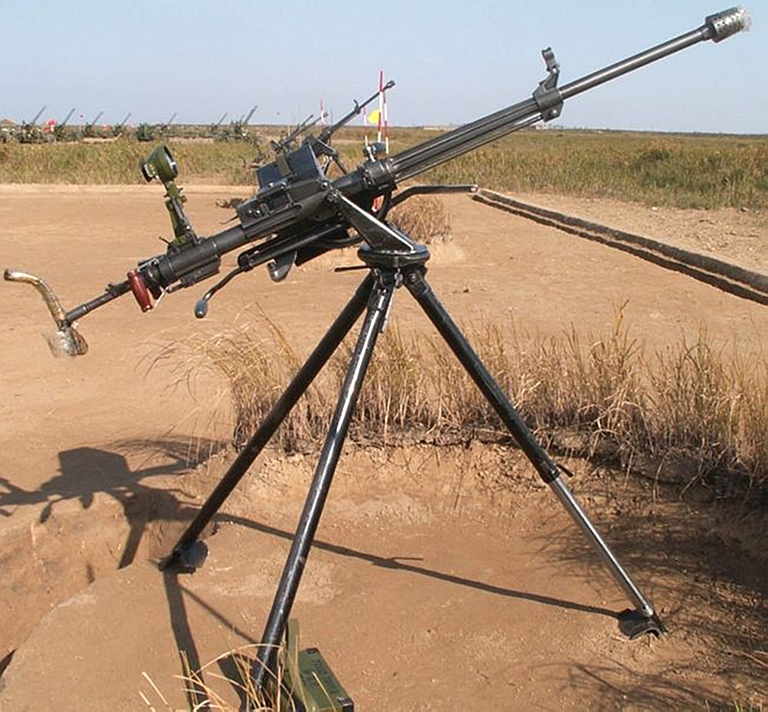 Type 58 Twin 14.5 x 114mm Anti-Aircraft Gun System[40]A copy of the Russian ZPU-2, the Type 58 twin 14.5 x 114mm anti-aircraft gun system provided Chinese units a small self-contained mobile system able to be set up almost anywhere. The weapon swivels on its integral circular mounting and has a single towing trail. Its two wheels rotate upwards on their axles to provide a stable firing platform. In traveling configuration, it was 3.900m long by 1.6m wide by 1.5 m high with guns in a horizontal position. Ready to it was 3.9m long, by 1.6m wide by 1.1m high. Its two magazines could each hold 150 round of ammunition in non-disintegrating link belts, weighed 42kg, and fully loaded for combat the Type 56 weighed 1,000kg with 600 rounds of ammunition.. Each gun fired at 600 rpm giving a total firepower of 1,200 rpm. In the anti-aircraft role its effective slant range is given as 1,000m and a 2,000m effective ceiling. Type 56 Quad 14.5 x 114mm Anti-Aircraft Gun System[41]A copy of the Russian ZPU-4, the Type 56 quad 14.5 x 114mm anti-aircraft gun system provided Chinese units and fixed sites a high firepower powerful and light anti-aircraft system. On a small four-wheel mount, the equipment could be towed behind a light vehicle. To permit accurate firing the two side stabilisers swung out, the wheels swung upwards and the jacks screwed down so the ordnance sat on cruciform shaped mount. In traveling configuration, it was 5.545m long by 1.86m wide by 2.3 m high with guns in a horizontal position. Ready to it was 4.33m long, by 2.68m wide by 1.97m high. In an emergency, it could be fired in the traveling position. Its four magazines could each hold 150 round of ammunition in non-disintegrating link belts, weighed 42kg, and fully loaded for combat the Type 56 weighed 2,150kg. Each gun fired at 600 rpm giving a total firepower of 2,400 rpm. In the anti-aircraft role its effective slant range is given as 1,000m and a 2,000m effective ceiling. Heavy Machine Gun Cartridges[24]Colour
Identification of Chinese
Small Arms Cartridges from 1958-1987[25]
Lead Core
No colour on
projectile Steel
Core
Prior
to 1975 silver tip and from 1975 no colour Incendiary
Red
tip Incendiary
– Tracer Red
tip Tracer
Green
tip API
Prior
to 1967 black tip with red band. After
1967 tip changed to black only API – T
Prior
to 1967 purple tip with red band. From
1967 tip changed to purple only Explosive
flash White tip Chinese
Military Heavy Machine Gun
Cartridges Issued 1950-1987[26]
The
following are the rounds that have been issued for military issue
during the
period 1951 to 1987 and use the Chinese meaning of the word Type
54 high shooting machine gun armour penetrating incendiary round (12.7
x 108mm
FMJ) with a black tip which has a red band, Type
54 high shooting machine gun armour penetrating incendiary tracer round
(12.7 x
108mm FMJ) with a purple tip which has a red band, Type
56 high shooting machine gun armour penetrating incendiary round (14.5
x 114mm
FMJ) with a black tip which has a red band, Type
56 high shooting machine gun armour penetrating incendiary tracer round
(14.5 x
114mm FMJ) with a purple tip which has a red band, Type
56 high shooting machine gun incendiary round (14.5 x 114mm FMJ) with a
red
tip, and Type
56 high shooting machine gun shun dan
(translates as twinkling & sudden and violent) round (14.5 x 114mm
FMJ)
with a white tip. This is an
explosive that gives off a bright flash upon detonation.
Obviously it can also be used as a
ranging round. 12.7 x 99 Browning Machine Gun Cartridges
The
12.7 x 99mm heavy machine gun cartridges are produced for export and
are direct
copies of United States military ammunition. The
Chinese
and
comparable
designations
are: Chinese
United
States M202
M17
Tracer M205
M2
AP M206
M8
API M207
M20
API-T M208
Mss
Ball Type 54 12.7
x 108mm
Used
in the Type 54, 77 and 85 heavy machine guns, the cartridge and weapons
are
generally used in the air defence role. The
primary
cartridges
in
Chinese
service are the armour
piercing
incendiary; armour piercing incendiary – tracer, and armour piercing
discarding sabot. The
API cartridge uses a copper jacketed lead sheathed steel core
projectile with
the incendiary compound in the projectile’s rear. It
can
vary
in
weight
from 116 to 126g, and from 145.5 to
147mm in length. Its muzzle velocity
is between 810 and 825m/s and the chamber pressure id 294.3MPa. At 100m it has a not less than
90% average of penetrating 20mm of steel plate set at 200;
and at
70m can penetrate 15mm of steel plate with a not less than 80% chance
of the
incendiary compound igniting. The
API-T cartridge uses a copper jacketed lead sheathed steel core
projectile with
the incendiary compound in the rear and the tracer compound behind that. It can vary in weight from 112 grams
upward. Its muzzle velocity is between 810 and 825m/s and the chamber
pressure
is 294.3MPa. At 100m it has
a 90% probability of penetrating 15mm of steel plate set at 450;
and
at
70m
can
penetrate
15mm of steel plate with a not less than 80%
probability of
the incendiary compound igniting. The
APDS incendiary projectile uses a tungsten penetrator inside a sabot. The cartridge weighs between 98.7 to
108.7g and its velocity at 25m is 1,150m/sec. Its
chamber
pressure
is
326.3MPa
and at 100m, against a 15mm
steel plate set at 450 has an average penetration rate of
not less
than 60%. DV06 12.7 x
108mm dual projectile[27]
The
DVD06 12.7mm shuandtoudan (dual projectile round) is 146 to
147mm long
and the cartridge has a total weight of 140g. The first round
weighs 32g
and has a muzzle velocity of 750 m/s and the second weighs 36g and has
a muzzle
velocity of 700 m/s. The chamber pressure is 294 MPa and at 300m
the
projectiles have a 50% mean point of impact group of 45cm. They
can
penetrate 20mm of homogenous steel plate at 100m (hardness not given)
and 7mm
at 1,000m. They can be identified by two crimp dents behind
the
cartridge shoulder and has an elongated projectile when compared to
standard
12.7 x 108mm cartridges. The
cartridge can be used in the Type 85, 88 and 89 12.7 x 108mm heavy
machine
guns. 12.7 x 108mm
Helicopter Cartridges
There
are 12.7 x 108mm cartridges used in helicopter pylon pod mounted
solenoid fired
12.7mm machine guns.[28] These are the DVY 89 shi chuanjia
ranshao yeguang dan (armour piercing incendiary – tracer round)
which
is identified by a blue-grey/ultramarine tip on the copper jacketed
projectile;
and the DVB89 shi chuanjia baozhe ranshao
dan (armour piercing explosive incendiary round) which is
identified by a
silver tip on the steel jacket projectile. Type 56 14.5 x 114mm[29]
The
Type 54 has a planning range of 2,000m in air defence and 1,000m in
ground
defence. There are three major
Type 96 cartridges in service, API, API-T and APDS.
The
API cartridge weighs between 175 to 188g, with the projectile itself
weighing
between 63 to 64.8g, and having a muzzle velocity of between 980 to 995
m/sec
and a chamber pressure of 325MPa. Its
success rate at penetrating a 20mm steel plate set at
200 was
no less than 80% which was the same at 100m and the ignition of the
incendiary
compound was put at no less than 80%. The
API-T cartridge has an overall length of between 154.5 to 156mm, weighs
between
170 to 183g, with the projectile itself weighing between 58.2 to 61g,
and
having a muzzle velocity of between 995 to 1,015m/sec and a chamber
pressure of
319MPa. Its success rate at
penetrating a 20mm steel plate set at 200 was no less than
80% which
was the same at 100m against a vertical 20mm steel plate and the
ignition of
the incendiary compound was put at no less than 80%.
The tracer lasts over three seconds and burns out more
than
2,000m. Using
a tungsten core, this APDS cartridge, 98.7 between 108.7g and at 25m
has a
velocity of 1,150m/sec with a chamber pressure of 326.3MPa. The tungsten penetrator has a success
rate of penetrating a 15mm plate set at 450 of no less than
60%. Type 91 14.5 x 114mm APDS
Introduced
for use in the QJZ91 heavy machine gun which did not see service it can
be
described as the forerunner to the DGJ02 cartridge.
It was 173mm long overall and had a weight range of
between
98.7 and 108.7g, presumerably different designs were trialled. It had a velocity at 25m of 1,250m/sec
and a chamber pressure of 355.7MPa. It had
a success rate of no less than 80% in penetrating a
20mm steel
plate set at 500 at 1,000m. DGJ02 AP-T 14.5 x 114mm[30]
The
DGJ02 AP-T cartridge uses a 45g tungsten penetrator, wrapped in a
discarding
sabot with dual colour tracer to aid ranging. The
sabot
splits
and
leaves
the penetrator between 150 to
200m from the muzzle. It has a muzzle
velocity of 1,250m/sec and is quoted as being able to penetrate 20mm of
armour
plate set at an angle of 500 at 800m.
DGE02 APHEI
14.5 x 114mm[31]
The
DGE02 APHEI cartridge weighs between 175 and 188g.
At 800 m it is quoted as having a 90 percent chance of
being
able to penetrate 15mm of armour plate set at 300. At 300m
after
penetrating a 2mm soft steel plate (representing an aircraft skin) it
can
further penetrate a 1.2mm thick steel plate producing 20 fragments. Upon explosion between 75 and 95
incendiary pieces are formed which have an 80% chance of igniting
aviation
fuel. M203 API-T
14.5 x 114mm
Developed
for export, the M203 cartridge is identical in performance to the Type
56 14.5
x 114mm cartridge. CS/BFD06 14.5
x 114mm
The
CS/BFD06 is a high-explosive incendiary cartridge built for export. It has a total weight of 180g, an
overall length of 156mm with a muzzle velocity between 980 to 995m/sec
and a
chamber pressure of 319MPa. At
1500m it can penetrate 1.0mm of 08F steel then a 2mm aluminium plate
with 90%
success rate coinciding with an incendiary ignition success rate of
also 90%. |
||||||||||||||||||||||||||||||||||||||||||||||||||||||||||||||||||||||||||||||||||||||||||||||||||||||||||||||||||||||||||||||||||||||||||||||
Endnotes/References[1] ‘Zhongguo zengqiang jixiehua bubing shi gonglji nengli’, Tanke zhangjia cheliang, 2006 Niandi, 11Qi, Zhongdi 249, pp. 12 – 15. [2] “Military to be
restructured: Paper”, Xinuanet, 13
July 2005, ttp://www.xinhuanet/.com.sn/english , accessed
14
July
2006
[3] ‘Wai kanbao
dao Zhonnguo
jianshe gengduo
qingxing jixiehua
budui’, Tanke zhangjia
cheliang, 2008 Niandi, 1Qi, Zhongdi
263, pp. 26 – 28.
[4] ‘Zhongguo zengqiang
jixiehua bubing
shi gonglji nengli’,
op. cit.,
pp. 12 – 15.
[5] . ‘China’s military exercise Vanguard-2008 concludes’, Xinhuanet, 28 October 2008, http://news. [6] . Baryatinskiy, Mikhail. ‘The Protectress of the Infantry’, M-Khobbi, 5/2005, Issue 63,pp. 18 & 19. [7] . ‘Shui
wan changgong fa
tienlang ___ Zhongguo yanzhi
WXZ204 ludai shi hog qi
er haoyi
dikong
pp. 5 – 9. [8] ‘SA-2
Surface-to-Air Missile’, National Museum
of the USAF, http://www.nationalmuseum.
[9] Contributed by Carlo Kopp.
[10] ‘Xinxing biezhide guochen dierdai
zhuangjia shusongche ___ Zhongguo zixing yanzide
ZSD89
[12] ‘Zhongguo FLV-1 jincheng qingxing chezai fangkong daodan wuqi xitong’,
Bingqi Zhishi,
[13] The title of
the article translates as ‘ Chinese FLV-1 close in (near stage in
journey)
light type
[16] . ‘Zhongguo
xinxing duikong zhuhai’, Xiandai junshizao (CONMILIT), 2004 Niandi,
12 Qi,
[17]. ‘Zhuanti
QJG02 shi 14.5mm danguang gaoshshe
jiqiang pouxi’, Qing
Bingqi, 2005
Niandi, 2 Qi,
[19] . ‘(Yiran
suoqianglong) guodong
W95
shi 0.50 yingcu zhongjiqiang’,
Bingqi Zhishi, 2/2007,
[20] ‘Zhongguo QJZ89 shi 12.7mm zhongjiqiang’,
Qing
Bingqi, 2007
Niandi,
10 (xia) Qi,
[21] ‘QJC 88 shi 12.7mm chezhuang
jiqiang’, Qingbingqi, 2006 Niandi,
11Qi (shan), Zhongdi
234,
[22] ‘Zijiang benteng keji xingye ___ ji jiuliuwuliu
chang’, Qingbingqi, 2007 Niandi, 6 (xia) Qi
,
[23] ‘Zijiang benteng keji xinye _ ji jiuhuoli
chang’, Qingbingqi, 2007 Niandi, 6 (xia) Qi,
Zhongdi 249, pp. 40
& 41; ‘Zhongguo gaoshe jiqiang “diyi” 77 shi 12.7mm gaishe
jiqiang’, Qingbingqi, 2008 Niandi, 12 (xia) Qi,
Zhongdi 285, pp. 16 – 20.
[24]
Unless mentioned otherwise
the information comes from ‘Yingzao dande shijie: Zhonnguo
[25] ‘Tudigemiong zhanzeng guochandan
zhijie (xia)’, Qingbingqi, 2007 Niandi,
6 (shang) Qi ,
[27] ‘Zhongguo
xinxing gaoxiaoneng wushi
qidanyao ___ DVD06 shi 12.7mm shuangtoudan’,
Qing
[28] ‘Zhongguo xinxing
QJK99-12.7-1 xing hongkong jiqiang shejizhe’, Qing Bingqi, 2006 Niandi,
[29] ‘DGJ02 shi 14.5mm wuxin tuke chuanjie ranshao yeguangdan’, Qing Bingqi, 2005 Niandi, 2 Qi, [30].‘DGJ02
shi 14.5mm wuxin tuke
chuanjie ranshao
yeguangdan’, Qing
Bingqi, 2005 Niandi, 2 Qi,
[31] ‘DGE02
shi chuanjie baozha ranshao
dan’, Qing Bingqi, 2005 Niandi,
2 Qi, Zhongdi
192 Qi, pp.
22 & 23.
[33] Wujun dengbu
zuozhande
“Zhulijun” ___ Zhongguo 63C, 86B liangqi
zhuangjia zhantou
[34] ‘Yunchou weiwo jueshi qianli (xia) ___ Zhongguo yanzhide jikuanludai shi zhuangjia zhihuiche’, Tanke zhangjia cheliang, 2006 Niandi, 5 Qi, Zhongdi 243, pp. 5 - 10. [35] Andrew,
Martin. ‘Model 85 Armoured Command Vehicle’, GI Zhou Newsletter,
Number 42, 11 August 2006, p. 2.
[36] Wise, John, C, Chinese Radars. [37] ‘[Bachang jianxi yi zhangtain] “Yitian” fangkong daodan wuqi xitong’, Bingqi Zhishi, 2009, Niandi, 5A Qi, Zhongdi 268, pp. 24 – 26. [38] ‘Zhongguo xinxing duikong zhuhai’, Xiandai junshizao (CONMILIT), 2004 Niandi, 12 Qi, Zhongdi 335 Qi, pp. 11 & 13. Also ‘09 abuzhabi fangwa zhangshangde Zhongguo bingqi’, op. cit., p. 22. [39] ‘Zhuangjia zhanchede baomuibing __ Zhongguo ZZM88 xingludai shimiyao jiasheche’, Tanke zhuangjia cheliang, 2009 Niandi, 5 Qi, Zhongdi 283, pp. 5 - 10. [40] ‘Hingse tiankong “Budan wang” ___ 56 xilian, 58 shuanglian, 14.5mm gaoshe jiqiang (xia)’, Qing Bingqi, 2007 Niandi, 12 (shang) Qi, Zhongdi 259, pp. 12 – 16. [41] ‘Hingse tiankong “Budan wang” ___ 56 xilian, 58 shuanglian, 14.5mm gaoshe jiqiang (shang)’, Qing Bingqi, 2007 Niandi, 11 (xia) Qi, Zhongdi 259, pp. 20 – 24. [42] ‘“Ludan”-2000 luji jincheng fangkong fadao wuqi xitong’, Bingqi Zhishi, 2010 Niandi, 4A Qi, Zhongdi 290 Qi, pp. 38 & 39. |
||||||||||||||||||||||||||||||||||||||||||||||||||||||||||||||||||||||||||||||||||||||||||||||||||||||||||||||||||||||||||||||||||||||||||||||
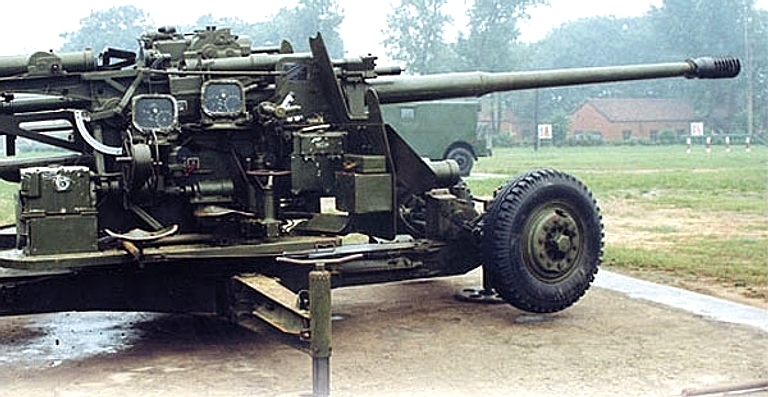 The
Type
59
/
KS-19
100 mm towed AAA gun.
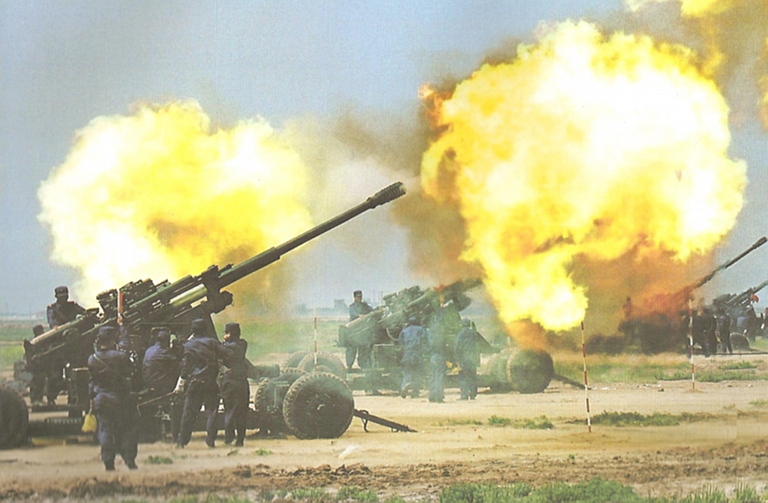 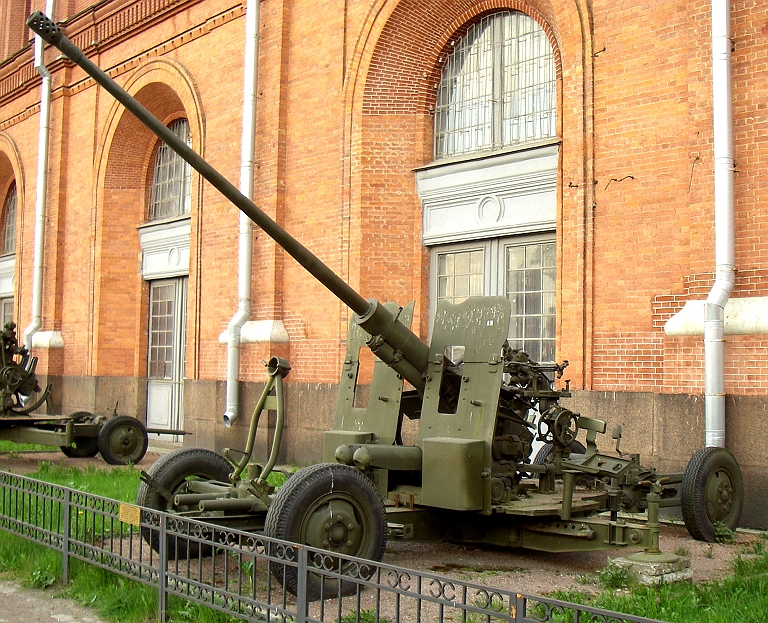 The
Soviet
S-60
57
mm
towed AAA piece was cloned for use by PLA units
(Wikipedia image).
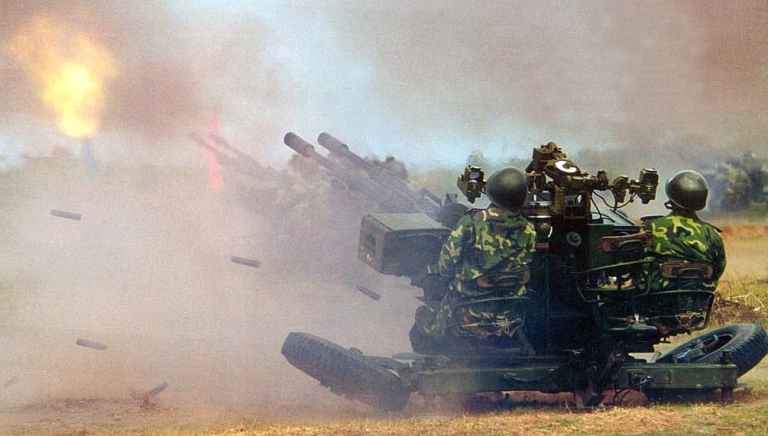 The
Type 85 23 mm towed AAA piece was
based on the Soviet ZU-23-2 and intended for export only.
|
||||||||||||||||||||||||||||||||||||||||||||||||||||||||||||||||||||||||||||||||||||||||||||||||||||||||||||||||||||||||||||||||||||||||||||||
| |
||||||||||||||||||||||||||||||||||||||||||||||||||||||||||||||||||||||||||||||||||||||||||||||||||||||||||||||||||||||||||||||||||||||||||||||
| Imagery
Sources: Chinese
Internet. Line Artwork: © 2000, 2007, 2008, 2009 Carlo Kopp |
||||||||||||||||||||||||||||||||||||||||||||||||||||||||||||||||||||||||||||||||||||||||||||||||||||||||||||||||||||||||||||||||||||||||||||||
|
Technical Report APA-TR-2009-0301 |
||||||||||||||||||||||||||||||||||||||||||||||||||||||||||||||||||||||||||||||||||||||||||||||||||||||||||||||||||||||||||||||||||||||||||||||

|
|||||||||||||
|
|
|
|
|
|
|
|
|
|
|
|||
|
|
|
|
|
|
|
|
|
|
|
|||
 |
|
|
|||||||||||
| Artwork, graphic design, layout and text © 2004 - 2014 Carlo Kopp; Text © 2004 - 2014 Peter Goon; All rights reserved. Recommended browsers. Contact webmaster. Site navigation hints. Current hot topics. | |||||||||||||
|
Site Update
Status:
$Revision: 1.753 $
Site History: Notices
and
Updates / NLA Pandora Archive
|
|||||||||||||
|
|
Tweet | Follow @APA_Updates | |||||||||||
|
|
|||||||||||||
|
|
|||||||||||||