|
||||||||||||||||||||||
 |
||||||||||||||||||||||
![F-22A Raptor, FB-22, F-22E, F-22N and Variants Index Page [Click for more ...]](APA/f-fb-22.png "F-22A Raptor, FB-22, F-22E, F-22N and Variants Index Page [Click for more ...]") |
 |
![People's Liberation Army Air Power Index Page [Click for more ...]](APA/pla-air-pwr.png "People's Liberation Army Air Power Index Page [Click for more ...]") |
 |
 |
 |
 |
 |
 |
![Military Ethics, Culture, Education and Training Index Page [Click for more ...]](APA/ethx-culture.png "Military Ethics, Culture, Education and Training Index Page [Click for more ...]") |
 |
||||||||||||
 |
![Russian / Soviet Weapon Systems Index Page [Click for more ...]](APA/rus-weps.png "Russian / Soviet Weapon Systems Index Page [Click for more ...]") |
 |
 |
 |

|
 |
 |
 |
 |
 |
||||||||||||
 |
 |
|||||||||||||||||||||
| Last Updated: Mon Jan 27 11:18:09 UTC 2014 | ||||||||||||||||||||||
|
||||||||||||||||||||||
|
||||||||||||||||||||||
|
||||||||||||||||||||||
|
|
|
|
|
|
|
|
|
|
|
||||||||||||
|
|
|
|
|
|
|
|
|
|
|
||||||||||||
|
|
|||||||||||||||||||||
| Last Updated: Mon Jan 27 11:18:09 UTC 2014 | ||||||||||||||||||||||
|
||||||||||||||||||||||
| In the Air Down Under |
| Journal
of Electronic Defense, January 2002 by Dr Carlo Kopp |
|
The Royal Australian Air Force (RAAF) is the spearhead of the Australian Defence Force, and is the most potent of the smaller air forces in the Asia Pacific region. Formed in 1921, the RAAF played an important role in the WW2 Pacific, North African and European campaigns, contributed to the UN effort in Korea, and flew Canberra bombers during the Vietnam conflict. Unlike many smaller air forces, which tend to develop force structures and capabilities in a rather ad hoc fashion, the RAAF has a very well refined doctrine which is used as the basis for force structuring, where not compromised by funding difficulties. In this respect, the paradigm followed by the RAAF is much closer to the USAF model than is typical for a smaller Western air force. This is an important distinction for EW suppliers operating in or entering the Australian EW market - many product marketing failures seen in Australia over recent years reflected vendor strategies based upon European precedents - characteristically such failures usually stem from a lack of understanding of the RAAF's basic doctrine and the roles and missions which fall out of that doctrine. A precondition for success in the Australian market is understanding that the client very frequently does things for very good reasons - and has a depth of doctrine and analytical ability to support the case. RAAF Force Structure and EW EW was not a high priority in Australian defence planning until the late 1980s, when important shifts occurred in doctrinal and strategic thinking. The 1991 Desert Storm campaign reinforced the developing change in paradigm, and EW assumed a progressively more important position within Australian defence planning. In the most recent strategic document, the Defence 2000 White Paper (Australian defence White Papers set out basic doctrine and force structure planning objectives, typically for a period of around a decade), an explicit commitment is made to upgrade the EW suite on the RAAF's F-111. Australian policy for many years is to acquire EW equipment with full source code for the internal OFPs, to provide the means of full domestic support and provision for QRC modifications in a crisis situation should the need arise. To best understand where future EW opportunities might lie, it is useful to briefly explore the RAAF's force structure and its roles and missions. The RAAF has a fleet of around 100 tactical fighters, comprising 82 Strike Reconnaissance Wing (Amberley) with F-111s and 81 Tactical Fighter Wing (Williamtown, Tindal) with F/A-18As. Affectionately labelled Pigs, the F-111s are the RAAF's heavy hitter and in many respects fulfill roles analogous to the B-52/B-1B and F-15E in the USAF - they are to perform strategic strike, theatre strike, interdiction, maritime strike, naval minelaying, SEAD/DEAD, Battlefield Air Interdiction and Close Air Support, armed with the GBU-10/12, GBU-24, AGM-84 Harpoon, sea mines, AGM-142 Popeye and in the future, the GBU-31 JDAM and AGM-158 JASSM. A glide wing kit equipped derivative JDAM-ER is in development, by Boeing-HdH in Melbourne. Current planning envisages that the F-111 fleet, comprising 21 F-111C and 14 F-111G (former SAC FB-111A) aircraft, will remain in service until at least 2020. While existing policy is to retire the aircraft at that time, a favourable outcome from a major airframe fatigue study in progress may yet see the aircraft operated longer, creating significant long term avionic, engine and EW upgrade opportunities. The current Block Upgrade Program involves the progressive digitisation of the aircraft's complete avionic suite, the most recent addition including VMEbus Bold Stroke style RISC processors - a glass cockpit is also a future possibility. The F/A-18A was acquired in the mid-1980s as a replacement for the Mirage, to perform as an air superiority fighter, air defence fighter, and to supplement the F-111 fleet in performing interdiction, maritime strike, Battlefield Air Interdiction and Close Air Support. As the aircraft is Australia's only air superiority fighter, it effectively subsumes the roles performed by the F-15C and F-16C in the USAF, as well as the air to mud role which is the primary use of the USN/USMC F/A-18C-D fleet. While the Bug is popular with RAAF pilots, the aircraft's limited operating radius is poorly suited to the Australian geographical environment - the Australian continent covers an area comparable to the CONUS, with a large area of ocean to be patrolled in wartime - in a region where Russian Backfires, cruise missiles and the potent Su-27 and Su-30 are proliferating. A major issue producing some uncertainty with the 71 strong F/A-18A fleet is airframe fatigue life. This is because the aircraft is much more frequently flown in high G air combat, in comparison with the USN/USMC fleet, reflecting its different role in Australia. Current planning is for the F/A-18A to be replaced, under the AIR 6000 fighter replacement program, from 2012. Whether this retirement date can be reached is unclear at this time - the F/A-18A is currently being retrofitted with the APG-73, AIM-120 AMRAAM, AIM-132 ASRAAM, JTIDS, IFF interrogator and new mission computers / displays under the AIR 5376 Hornet Upgrade Program (HUG). The centrepiece of the RAAF's current force structure expansion is the new Boeing 737 Wedgetail Airborne Early & Control system, with the Northrop Grumman MESA/Tophat L-band phased array radar/IFF system. Acquired under the AIR 5077 program, this aircraft is a pocket AWACS providing a substantial portion of the capability of an E-3 in a narrowbody twin package. The aim is to use the Wedgetail in a similar role to the E-3, both for continental air defence but also to support strike packages and expeditionary deployments. Four of these aircraft are on order, with 3 options. Concurrently the RAAF is planning to replace its four elderly Boeing 707-338C tankers with a new generation aircraft, under the AIR 5402 program. Current planning appears to be centred on a medium sized tanker, either based on the 767 or A330 airframe, with up to 5 aircraft to be acquired. There is an ongoing doctrinal debate in progress over the size and number of future tanker aircraft, as the planned number is arguably inadequate for the stated RAAF capability goals in the 2000 White Paper. The F-111C/G and F/A-18A are supported in maritime strike roles by 19 P-3C/AP-3C Orion LRMP aircraft. The RAAF P-3Cs perform the traditional P-3 ASW, ASuW and minelaying roles, but also provide a substantial electronic reconnaissance capability - public reports indicate that two aircraft were further enhanced with a SIGINT package. The AP-3C fleet was fitted during the 1990s with the Elta ALR-2001 ESM system, based on the EL/L-8300, which has been progressively upgraded since its introduction. While the USAF does not currently equip its AWACS and tanker aircraft with EW suites, the RAAF plans to do so. While the loss of a single AWACS or tanker would not significantly impact USAF fleet strength, this is not the case for the RAAF, who are currently planning EW packages for both fleets. RAAF EW Programs The events of the September 11 have created some difficulty in exactly predicting how the RAAF's EW programs will evolve in the near term. The possibility of expeditionary deployments to support the US led coalition effort will produce pressure to field planned upgrades faster, while operational expenditures will bite into the available DoD budget. As the Australian DoD has defacto clamped down on all public disclosures of any substance, pre September 11 public documents provide the best indication of likely trends - with the caveat that some unexpected shifts in timing and scope may arise. The RAAF F-111C and F-111G fleet is undergoing a progressive Block Upgrade Program which includes a significant EW component the latter portions of which fall under the AIR 5416 program:
At the time of writing the configuration of the full F-111 EW upgrade suite was yet to be disclosed. Public documents indicate that the package will incorporate a new Radar Warning Receiver (RWR), Defensive ECM (DECM) and Missile Approach Warning System (MAWS), with A$150-200M allocated against a planned 2008/2009 IOC for an undisclosed number of aircraft. While a large investment has been made into developing the ALR-2002A, it is unclear whether this RWR will eventually replace the ALR-62 - the unique 6 channel architecture of the ALR-62 would require a specialised derivative of an existing 4 channel RWR to fit the F-111's antenna bays. The new DECM arrangement was originally planned to be internal, to exploit the coverage provided by the ALQ-94/137 antenna bays - again it is unclear whether the replacement package will be internal. Similar uncertainties surround the issue of MAWS selection, indeed the budgetary allocation may not provide sufficient funding for a MAWS concurrently with the vital RWR and DECM upgrades. While a JTIDS installation for the F-111 was discussed at one stage, it does not appear in current public documents. Another interesting issue related to the F-111 is the possibility of reviving some former USAF EF-111A Ravens stored at AMARC, and fitting them with an ICAP-III derivative system. While a strong strategic case exists for an RAAF EF-111A, the Australian DoD has repeatedly balked at the perceived expense of recovering, operating and upgrading some of these aircraft - no specific studies have been disclosed. Uncertainties also surround the future of planned F/A-18A EW upgrades. Original planning for the AIR 5376 HUG included a replacement for the early model ALR-67(V)2 and ALQ-126 defensive equipment, and CMDS. Given some uncertainty about the achievable fatigue life of the airframes, and the amortization period between originally planned EW upgrade IOC and intended 2012 F/A-18 retirement, the case for a comprehensive EW upgrade may be weak. Should the upgrade proceed, it is likely the Australian ALR-2002B will be competed against a later ALR-67 variant. The AIR 5077 Wedgetail AEW&C program is expected to include a comprehensive EW ft, including ESM, CMDS and directed IRCM system, with MAWS and RF jammer discussed at various stages. The configuration has not been disclosed at the time of writing, although a derivative of the ELta ALR-2001 ESM, common to the RAAF P-3C and RAF Nimrod 2000 is to be used. It is most likely that a subset of the AIR 5077 Wedgetail EW package will be adopted for the AIR 5402 tanker fleet to provide commonality across both types. The centrepiece of the RAAF's EW planning is the restructured AIR 5416 Echidna program (named after a spiny marsupial). This program has a colorful history, originally it was planned to provide a common EW suite for the F-111, C-130H/J, and Army S-70A-9 Blackhawk, CH-47D Chinook helicopters - a complex and ambitious goal which inevitably lead to delays and program restructuring. The AIR 5391 (F/RF-111C EW Upgrade) and AIR 5394 (EWSP for ADF Transport Aircraft) coalesced in 1998 into AIR 5416, which was frozen in 2000 and then revived in 2001. The domestically designed and built ALR-2002 RWR was to be the mainstay of this program, if found capable of meeting specified goals. Specialised variants built around a common core were to be fitted to all of these platforms. The ALR-2002A (F-111C/G) underwent trials in September 2000, the ALR-2002B (F/A-18A) has been form fit checked and the ALR-2002D (S-70A) underwent antenna testing at RADC in September, 1999. Summary The RAAF is small by US standards, but in terms of capability packs considerable punch for its size. EW has steadily grown in priority, but funding pressures and the complexities of dealing with block obsolescence of large portions of the aircraft fleet have introduced delays and uncertainties into a number of long planned upgrade programs, arguably exacerbated by the events following September 11. Despite these uncertainties, vendors will find some good opportunities over the longer term since the RAAF has a stated intent to provide defensive suites on most if not all of its aircraft types. This produces a very different market model against other smaller air forces - one which other air forces should observe very carefully. |
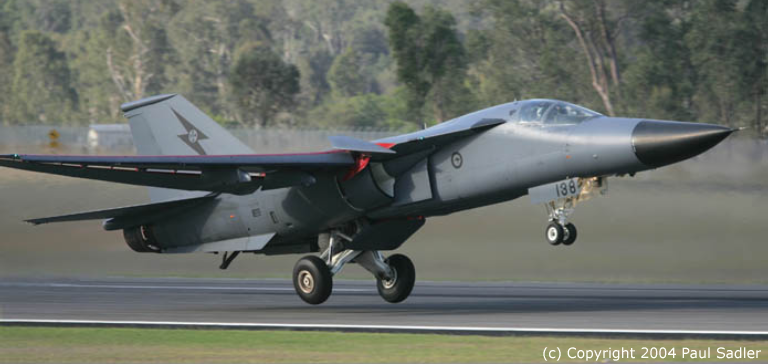 |
| Australia's most potent asset is its fleet of 35 GD F/RF-111C and F-111G bombers, which are to be retained until at least 2020. The aircraft fulfill roles analogous to the F-15E and B-52H/B-1B in the USAF, performing precision strike, maritime strike, strategic bombing, battlefield strike and close air support. A comprehensive EW upgrade is planned, although some F-111Cs are receiving the DRFM based Elta EL/T-8222 pod as an interim upgrade (Paul Sadler Photo). |
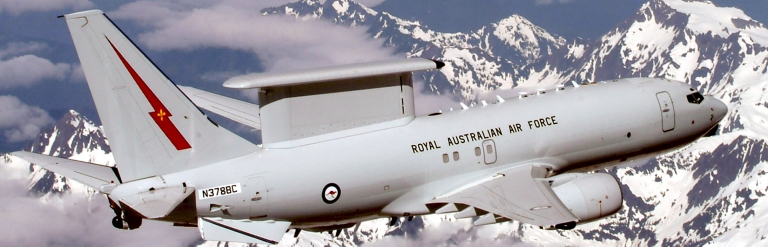 |
| The centrepiece of the RAAF's force structure modernisation is the new Boeing/Northrop-Grumman Wedgetail AEW&C system, which employs the solid state MESA Active Electronically Steered Array, a variant of the Elta ALR-2001 (EL/L-8300) ESM, and is to carry directed IRCM and CMDS. The Wedgetail is best described as a Pocket AWACS, offering a substantial portion of the E-3's capability in a smaller and cheaper package (Boeing). |
|
|||||||||||||
|
|
|
|
|
|
|
|
|
|
|
|||
|
|
|
|
|
|
|
|
|
|
|
|||
 |
|
|
|||||||||||
| Artwork, graphic design, layout and text © 2004 - 2014 Carlo Kopp; Text © 2004 - 2014 Peter Goon; All rights reserved. Recommended browsers. Contact webmaster. Site navigation hints. Current hot topics. | |||||||||||||
|
Site Update
Status:
$Revision: 1.753 $
Site History: Notices
and
Updates / NLA Pandora Archive
|
|||||||||||||
|
|
Tweet | Follow @APA_Updates | |||||||||||
|
|
|||||||||||||
|
|
|||||||||||||






