|
||||||||||||||||||||||
 |
||||||||||||||||||||||
![F-22A Raptor, FB-22, F-22E, F-22N and Variants Index Page [Click for more ...]](APA/f-fb-22.png "F-22A Raptor, FB-22, F-22E, F-22N and Variants Index Page [Click for more ...]") |
 |
![People's Liberation Army Air Power Index Page [Click for more ...]](APA/pla-air-pwr.png "People's Liberation Army Air Power Index Page [Click for more ...]") |
 |
 |
 |
 |
 |
 |
![Military Ethics, Culture, Education and Training Index Page [Click for more ...]](APA/ethx-culture.png "Military Ethics, Culture, Education and Training Index Page [Click for more ...]") |
 |
||||||||||||
 |
![Russian / Soviet Weapon Systems Index Page [Click for more ...]](APA/rus-weps.png "Russian / Soviet Weapon Systems Index Page [Click for more ...]") |
 |
 |
 |

|
 |
 |
 |
 |
 |
||||||||||||
 |
 |
|||||||||||||||||||||
| Last Updated: Mon Jan 27 11:18:09 UTC 2014 | ||||||||||||||||||||||
|
||||||||||||||||||||||
|
||||||||||||||||||||||
|
||||||||||||||||||||||
|
|
|
|
|
|
|
|
|
|
|
||||||||||||
|
|
|
|
|
|
|
|
|
|
|
||||||||||||
|
|
|||||||||||||||||||||
| Last Updated: Mon Jan 27 11:18:09 UTC 2014 | ||||||||||||||||||||||
|
||||||||||||||||||||||
| F-111
Upgrade Options Parts I - IV |
||||||||
|
||||||||
|
Part I Status Quo The RAAF's Strike Recce Group (SRG) comprising 36 F/RF-111C/G bombers is without doubt the ADF's most potent asset, capable of projecting air power against maritime and surface targets to combat radii of 1000 NMI from land bases, without inflight refuelling. In the low threat density and technologically unsophisticated broader regional air environment of the last two decades, the F-111 was until recently unchallenged. Current ADF planning sees the F-111 as a frontline combat asset in service until 2020, with the SRG winding down and consolidating F-111 operations from about 2015 onward. Purchased during the sixties and delivered during the mid seventies, the F-111C carried an analogue nav-attack system and for the period a capable defensive package. During the eighties the aircraft were further modified to accommodate the then state of the art podded AVQ-26 Pave Tack thermal imaging laser equipment, for the delivery of laser guided and dumb bombs, form all altitudes. This upgrade also saw the capable Harpoon ASCM integrated on the aircraft. The original F-111C Pave Tack/Harpoon "classic" avionic system was a unique hybrid and cumbersome to maintain. The RAAF fought long and hard during the late eighties to secure funding for a digital nav attack system, which would be supportable with spares, much cheaper to maintain, much more reliable and capable of later accommodating the new generation of "smart" munitions. The new system was installed under the Avionic Upgrade Program (AUP), and was originally permitted only to improve maintainability - the then DoD bureaucracy vehemently opposed any capability growth on the F-111. The AUP offensive avionic system is built around a dual redundant pair of AP-102A mission computers, a pair of AN/ASN-41 Ring Laser Gyro Inertial Navigation Systems supplemented by a MAG-R GPS receiver, includes a pair of digital cockpit displays, and a digital Stores Management System (SMS) common to the F/A-18. The core offensive avionic upgrade was supplemented by incremental upgrades to the existing AN/APQ-165 real beam mapping analogue attack radar (ARS) and the vital AN/APQ-128 Terrain Following Radar (TFR), bringing them up to the AN/APQ-169 and AN/APQ-171 configurations respectively. A wholly new Digital Flight Control System was fitted. An important result of the AUP program is that the new avionic system provides a defacto Mil-Std-1760 "smart" interface to the four swivel pylon weapon stations, enabling the integration of virtually any modern "smart" weapon. The only non-compliance with the Mil-Std-1760 interface lies in the provision of a lower power feed voltage, a feature common in many Mil-Std-1760 implementations and usually accommodated by weapon designers. At this time much of the AUP production phase upgrade has been completed and it is expected that the last aircraft will be finished within the next 12 months. All indications are that despite some modest delays in the early phase of the AUP program, the upgraded aircraft are delivering superb reliability and accuracy well in excess of the specified requirement. From a technological perspective, the AUP is an outstanding success for the RAAF and one which will significantly improve the aircraft's operational availability, while reducing aircrew workload and improving system accuracy. The fifteen F-111G aircraft, acquired during the early nineties by the previous government, are to be upgraded with a new generation digital avionic package to bring them to a similar standard to the F-111C, and allow them to deliver guided munitions. The aircraft as delivered have a very accurate older generation digital offensive avionic suite, which is however no longer supported, and cannot integrate guided weapons. Funding has yet to be approved, the configuration of the upgrade, under program AIR 5404 Phase 2 (Precision Weapons Modification), was at the time of writing still in the process of being decided. AIR 5404 was scoped to support only capabilities extant in the F-111C AUP. The retirement of the F-111 from USAF service has been a mixed blessing. The dismantling of the USAF's support infrastructure means that many facilities, such as that for cold proof testing, have to be recreated in Australia to allow ongoing operation of the aircraft. On the plus side, this means that Australian industry will benefit significantly, and we also now have access to an almost inexhaustible supply of spares parked at the Davis Monthan AFB boneyard. Needless to say the RAAF have been busily buying up whatever components the USAF did have in stock, often at bargain prices. Some components with limited shelf lives, such as pyrotechnics, will have to be custom manufactured to provide ongoing support. While being the sole operator of the type means that we no longer have the USAF's logistical system to rely upon, it also removes the constraints of having to comply closely with USAF aircraft configurations to chase the arguably illusory cost savings of commonality. Current Upgrade Programs One benefit we have seen from the winding down of the USAF fleet is the availability of later built, slightly higher thrust powerplants. The RAAF will be refitting its fleet of aircraft with the TF-30-P-109 engines used previously in the F-111D and EF-111A, for the F-111C this is an almost "drop-in" replacement, for the F-111G this will produce a hybrid engine using the P-109 fitted with the "straight" tailpipe of the FB-111A/F-111G P-107 engine. The P-109 engines will provide a slightly higher level of thrust for improved combat and takeoff performance, and arguably some improvement in reliability since they will not be "driven" as hard as the older engines to meet currently required aircraft performance. The use of a common engine across the C and G models will save money in supporting the type, indeed this was the primary driving argument behind the upgrade. The biggest upgrade program in the pipeline for the SRG is the Echidna (AIR 5391 and 5394) program, aimed at providing the F-111 (and C-130H/J, S-70, CH-47) with a state of the art and architecturally common defensive suite. The aircraft in service carry the now obsolete and unsupported ALR-62 (V)5 (the (V) 6, 7 variants remain supportable for the time being) Radar Warning And Homing (RHAW) equipment, and a mix of ALQ-94 and ALQ-137 Defensive Electronic CounterMeasures (DECM) systems. Optimised to defeat the SovBloc IADS of the late seventies and early eighties, the ALR-62/ALQ-94/137 package was highly capable in its day, well matched to the Iraqi IADS of 1991, but by contemporary standards it is technologically obsolete and becoming rapidly unsupportable. The intent of the Echidna program was to exploit if possible the DSTO developed ALR-2002 Radar Warning Receiver, a state of the art digital design providing world class performance and capabilities. The 2002 is to be complemented by a suitable jamming package, and expendables, and the system is to employ an integrated architecture allowing for optimal employment of expendables and jamming. Earlier disclosures indicate that the new system is to be effective against pulse mode, continuous wave, and monopulse threats, and is to include a Missile Approach Warning System (MAWS). Whether the RAAF will opt for a towed decoy has not been stated at this time. The RAAF has been discrete about the specific configurations bid for Echidna, the program is running a little late primarily as it grew during its early life to accommodate shared configurations for other RAAF types. This has imposed a considerable burden in terms of program complexity in technology, integration and management. While the intent of saving taxpayers dollars through commonality was clearly well intended, in perspective this requirement may introduce considerable delays to IOC, clearly an issue for a front line asset such as the F-111. It is unclear at this time whether the RAAF will opt to continue with the program in its existing form, or alter the main plan to accommodate the F-111 separately from the remaining types. If replacement of the F-111's defensive suite is the first priority, then there would be considerable merit in splitting the F-111 requirement off from the slow movers in the program. The issue will be in how to implement this without compromising the capability of the end product, since a stop gap podded DECM solution, at the time of writing being decided under the F-111 Interim EW Capability Requirement, will never match the capability of a well integrated internal suite. Well integrated here meaning a system with proper growth provisions, such modularity, and bussing and if applicable, waveguides of appropriate bandwidth. While a podded solution does offer the flexibility of rapid replacement, it also adds drag, radar signature and ties up hardpoints, as well as typically having inferior angular coverage to a well designed internal suite. Pods typically cover only a nose and tail sector, and cannot effectively cover the critical upper hemisphere forward sector against fighter/AAM attack, unless carried on a wing station instead of munitions. Podded DECM was a Vietnam period "Quick Reaction Capability" measure which has persisted with the generation of aircraft designed in the period predating internal DECM systems. The obsolescence and marginal tactical utility of the ALR-62/ALQ-94/137 package on the F-111 suggest that priority should be given to meeting the needs of the F-111 at the earliest possible time. The second major upgrade program for the F-111 is the AIR 5398 guided munitions program, intended to provide the aircraft with a broad suite of modern weapons for use in reactive (ie self defensive) defence suppression (SEAD) and precision standoff attack against area and hardened point targets. The stated purpose of AIR 5398 is therefore to improve aircraft survivability in well defended environments. Until this program is implemented, the primary weapon of the F-111 will remain the trusty Paveway II Laser Guided Bombs (LGB). While these are cheap and effective weapons, they require that the aircraft close to within 3-5 NMI of the aimpoint which can compromise the aircraft's survivability by exposing it to SAM and AAA defences. The RAAF has already committed to the Israeli designed Rafael AGM-142 Popeye (formerly Raptor) rocket propelled inertial/imaging/datalink guided standoff missile. The AGM-142 is in the initial phases of integration with the aircraft, and we can expect an IOC early in the next century. The AGM-142 outranges almost all area defence SAMs and is a highly accurate and lethal weapon, carrying either a unitary blast fragmentation warhead or a hardened case penetrator. The AGM-142 will be used for attack on heavily defended point targets, for lethal SEAD and as a heavyweight supplement to the Harpoon in maritime operations. The AIR 5398 program was originally divided into several requirements, to provide an antiradiation missile for self defence, and a family of weapons for attacking other classes of target, using penetration warheads or submunitions. The intent was to exploit the capability of the new digital weapon system to support a wide range of munitions, and increase the aircraft's lethality and survivability. Clearly this was long overdue. The result of the RAAF's initiation of AIR 5398 was a deluge of bids by US, European and Israeli vendors of guided weapons. In effect, almost everything in marketplace has been offered. The RAAF has not been very forthcoming with information on the current status of this program, but it is known that it is currently being rethought to minimise the number of weapon types (ie airframes) to be acquired, in turn to minimise the cost overheads of software integration, clearance testing, logistical support and training. Until further disclosures are made, it is unclear exactly what package of weapons will be acquired to the meet the latter phases of the program. This in turn will determine the most likely contenders. A major issue in the context of AIR 5398 is that of supporting targeting sensors on the F-111. The aircraft is at this time reliant wholly upon its sixties technology analogue low resolution real beam mapping attack radar, which is not adequate to the task of providing good identification of aimpoints prior to the launch of AGM-142s and likely other weapon types to be acquired under this program. This is not an issue for the US or Israelis, since both have high resolution SAR/GMTI radars for this purpose. The primary launch platform for the AGM-142 in IDF service is the upgraded F-4E, fitted with a Norden APG-76 SAR/GMTI radar, which has 3 ft square resolution at 30-40 NMI of standoff range. Since the mooted Stand Off Imaging program (SOI), intended to fit several F-111s with a weapon bay mounted SAR/GMTI reconnaissance radar, is for all practical purposes dead at this time, the RAAF will not have the reconnaissance and targeting capability which is required to robustly target any of the standoff weapons which will be acquired under AIR 5398. Targeting anti-radiation missiles or more lethal munitions for self defence (or SEAD) demands range known launch conditions if good standoff ranges and unambiguous targeting are to be achieved, and this suggests that a rangefinding receiver package will be a necessary supplement to the existing Echidna package. There are further good reasons why both a SAR/GMTI and rangefinding receiver should be introduced on the F-111, and these will be discussed later. Regional Developments Clearly the AIR 5391 and AIR 5398 programs address many important capability and supportability shortfalls in the upgraded F-111 and its weapon suite. However, Australia's strategic position and available guided munitions and sensor technology have been evolving dramatically since these requirements were initially drafted. It is therefore a good idea to explore the resulting implications. In the strategic context, we have seen the commitment by major players in the broader region to acquire large numbers of the Su-27SK and Su-30MK strategic fighters, tankers and AEW&C aircraft, supplemented by the latest Russian air-air missiles and SAMs. In practical terms, this ratchets up the baseline capability of broader regional air defences. AEW&C/tanker supported Flankers means that round the clock CAP coverage can be provided out to respectable combat radii. The deployment of the Buk M1/SA-11 Gadfly, the S-300PMU-1/SA-10D Grumble, S-300V/VM / SA-12A/B/C Gladiator/Giant and the 9M331 Tor / SA-15 Gauntlet means that all altitude SAM coverage can be provided for high value targets with very modern weapons, all of which are fully mobile or semi-mobile. The fighter/AEW/tanker capability will not mature for about a decade, since much training, support and doctrinal effort will need to be expended to match current Western competence in this area. However, as this capability matures, an F-111 will require a supporting fighter escort CAP to ensure that it can penetrate unmolested by fighters to weapon launch ranges, in its planned configuration. Penetration speed will also need to be increased, and this will incur a combat radius penalty if not offset by other measures. A better defensive AAM than the AIM-9M will also be necessary since its short range and cumbersome target acquisition are not credible in the face of the R-77 Adder and R-73/74 Archer. The SAM and supporting radar capability in the broader region will mature much faster and we can expect a respectable capability by about 2005, since these weapons will directly slot into existing air defences and C3 networks, built around established Russian doctrinal and training systems. We can also expect to see the first generation of Russian designed Low Probability of Intercept (LPI) radars deploying in the next decade, based upon evolved variants of existing Russian phased arrays. The Flanker is a likely first candidate. This will require a major improvement in the capability of the F-111's defensive avionic package, since the warning system will need to have a defacto ESM capability to provide extended detection range and the ability to detect LPI threat radars. The increased mobility of the newer SAMs deploying regionally also means that strike supporting SEAD operations will have to be more responsive, the "prebriefed" mission profile will most likely be stale by the time the aircraft arrive in the target area. The implication of this is that an Emitter Locating System (ELS) or similar capability will be almost essential. Weapons and Technology Developments Without doubt the most important technology to deploy on a large scale in recent years are GPS guided bombs, glidebombs, dispensers, and supporting Synthetic Aperture/Ground Moving Target Indicator (SAR/GMTI) attack radars. The combination of SAR/GMTI and GPS guided bombs will supplant the thermal imager and Laser Guided Bomb in USAF/USN service as the primary sensor/weapon package for strike operations during the coming decade. The recent development of pseudo-differential (ie GAM/GATS) guidance techniques for GPS guided bombs, whereby the bombs are programmed to track the same satellites as the bomber, has improved accuracy to the point where the GPS guided bomb approaches or matches the accuracy of the LGB, with the benefit of multiple autonomous drops in a single pass through a solid overcast. Given that there is no cost penalty in mass produced GPS guided bombs, against LGBs, the LGB has now been outclassed in capability across the board. Moreover, anti-jamming antenna packages for such bombs are now rapidly approaching deployment, essentially nullifying the only reasonable technical argument against their wide scale use. Wide Area Differential GPS (WADGPS) is now maturing, and will be a viable means of further accuracy improvement over the next decade. Accuracies better than LGBs have been demonstrated. The US services are now committed to buying over 80,000 GBU-31/32 JDAM GPS guided bomb tailkits, to equip virtually all frontline fighters, including many types without thermal imager/ laser designator capability (http://www.jdamus1.eglin.af.mil:82/map.html). Importantly, GPS guided weapons do not lose accuracy with increasing launch ranges, and thus GPS has become an enabling technology for low cost standoff glide bombs and dispensers, which until now have been expensive due to the demand for highly accurate inertial systems. Aided by GPS, the cheapest RLGs (Ring Laser Gyro) become more than adequate. The US services are committed to the AGM-154 JSOW glide dispenser, and reports from the US indicate that there is growing interest within the USAF bomber community in a winged variant of the GBU-31/32 JDAM (producing in effect a JDAM based equivalent to the Australian Kerkanya proposal). Weapons such as the JDAM, JSOW and any Kerkanya clones are not a substitute for the AGM-142 and similar powered weapons, since they are much slower, lack "operator-in-the-loop" high precision interactive guidance, and typically will not match the kinetic energy of a missile on impact. Moreover, their range is under most conditions inferior to a powered weapon. However, under many conditions they will be adequate, and costing under $50,000 per round (JDAM at USD 18k), come in at about 5-10% of the cost of a powered munition. Therefore, they are excellent in terms of bang per buck, and since they provide much less exposure of the launch aircraft to opposing defences, compared to laser guided weapons, they enhance survivability by a decent margin. This is especially true of glide weapons like JSOW and Kerkanya (or clones), which offer 40-80 NMI range for high altitude drops, and up to 25 NMI for a low level toss. Other than weapons, another technology has blossomed very recently in the US. This is the use of adhesive applique laminates instead of paints for surface finishing the aircraft. The US is at this time gearing up for high volume production of such materials. While they offer better durability and cheaper application than camouflage paint, they also have another interesting characteristic. The laminate can be made of multiple layers, incorporating microwave lossy or radar absorbent materials. While a radar absorbent skin applique is not going to turn an F-111 into a B-2, it is a relatively cheap way of cutting radar cross section from major airframe features such as leading edges and nasty little corner reflectors. And every deciBel of RCS removed is one less deciBel for a threat radar to detect. Another important technology which has proliferated in the last few years are highly capable Helmet Mounted Displays, which combine a helmet embedded night vision capability (miniature single chip thermal imagers or NVG tubes), with computer generated symbology, all projected on the pilot's visor. Such displays can be used to "fuse" radar warning threat data, radar tracks, status information, and flight information into a single display, and provide for cueing of air-air and air-ground guided weapons. In effect, many portions of the traditional "glass cockpit" and HUD can be presented on the helmet visor. This means that the latest sensor fusion and data presentation techniques can be seamlessly integrated into an arbitrary cockpit, without having to go through a costly rearrangement of cockpit displays and instrumentation, a particular issue with the congested F-111 cockpit. Finally, we are beginning to see the deployment of compact and competitively priced precision direction finding and rangefinding receiver packages as adjuncts for fighter aircraft radar warning packages. These receivers allow the range known targeting of Anti-Radiation Missiles, significantly improving their standoff range and accuracy, as well as providing long range warning of threats hitherto impossible with low sensitivity radar warning receivers. With the trend to use Electronic Support Measures (ESM) class receivers as the baseline warning systems on fighters, the days of the conventional RWR are now numbered, especially with emerging Low Probability of Intercept radars. The following three parts of this series will explore potential technology upgrades which could follow on the AUP, AIR 5391 and 5398 programs, intended to provide the F-111 with a credible and adaptable combat capability through to 2020, exploiting technology which is now becoming available. |
||||||||
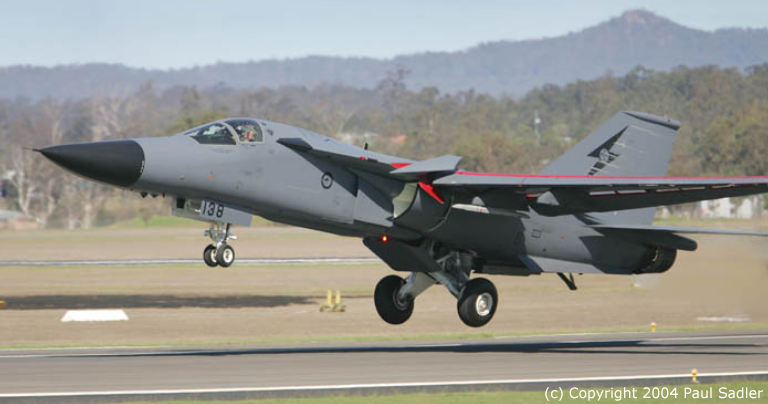 The current F-111C AUP program equips the F-111C with a modern, dual redundant, digital nav attack system, with a pair RLG INS and a GPS receiver. The upgrade includes a digital stores management system, a digital flight control system, a pair of digital cockpit displays, and incremental upgrades to the attack radar and TFR. The AUP package provides the aircraft with a highly reliable, low maintenance and very accurate nav attack system, capable of supporting a wide range of modern smart munitions reliant upon digital weapon station adaptors. 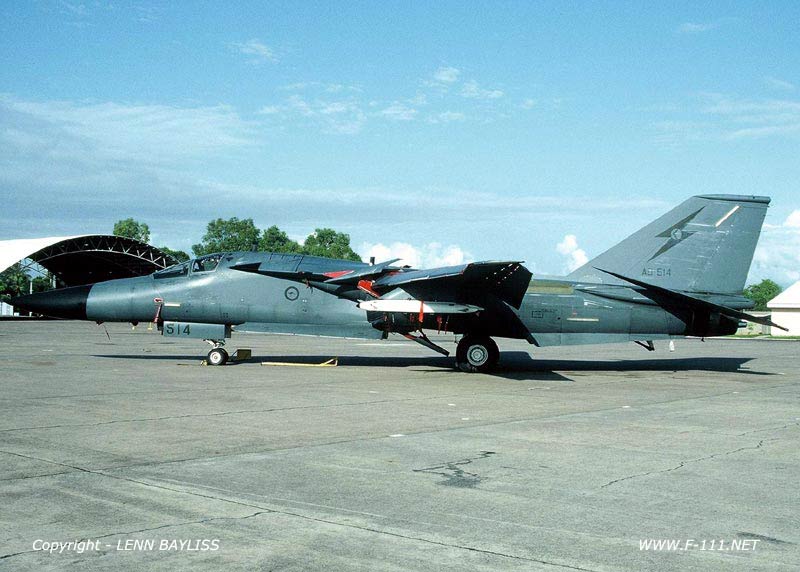 The F-111G aircraft will receive a major upgrade to their weapon system to provide a capability to support smart munitions, similar to that in the F-111C AUP. Under project AIR 5404, the RAAF is at this time deciding upon the configuration of the upgrade. The existing older generation digital weapon system on the F-111G is much less capable than that on the F-111C AUP, limiting the aircraft to the delivery of dumb bombs [Editor's Note 2005: AIR 5404 did not materialise, as a result of which the F-111G remains armed only with dumb bombs, or LGBs targeted by another platform. Retrofit or Mil-Std-1760C is not a challenge given the existing work done on the Block C-4 upgrade of the F-111C]. 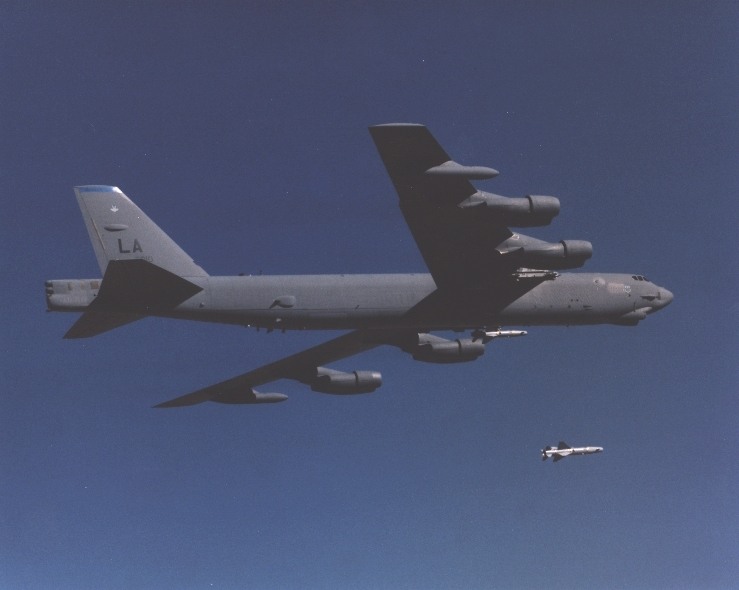 The AGM-142 is a potent weapon for attacking well defended targets, and is employed for this purpose by the USAF and the Israeli AF. However, to perform in this important role, it must be provided with the prelaunch coordinates of the intended target. Without a SAR/GMTI capable attack radar or a rangefinding and direction finding receiver package, this can become a very difficult task. This AGM-142 is being launched by a B-52G of the USAF's 20th Bomb Squadron (USAF).
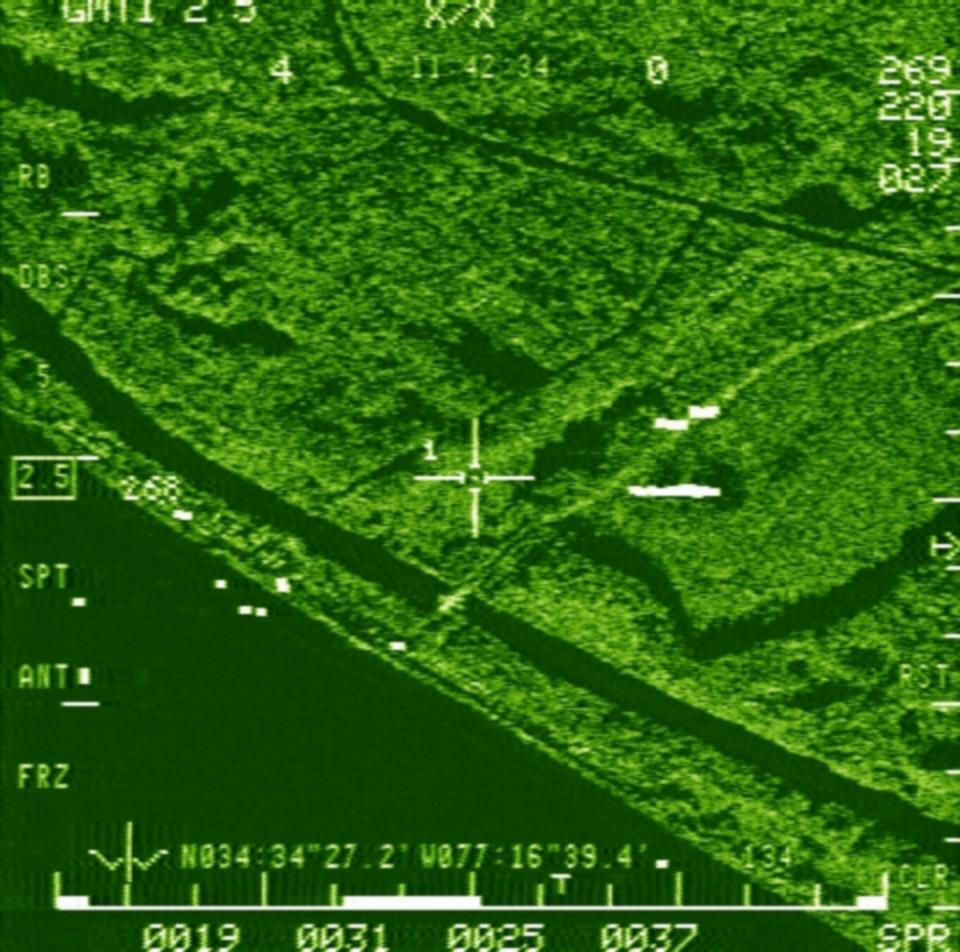
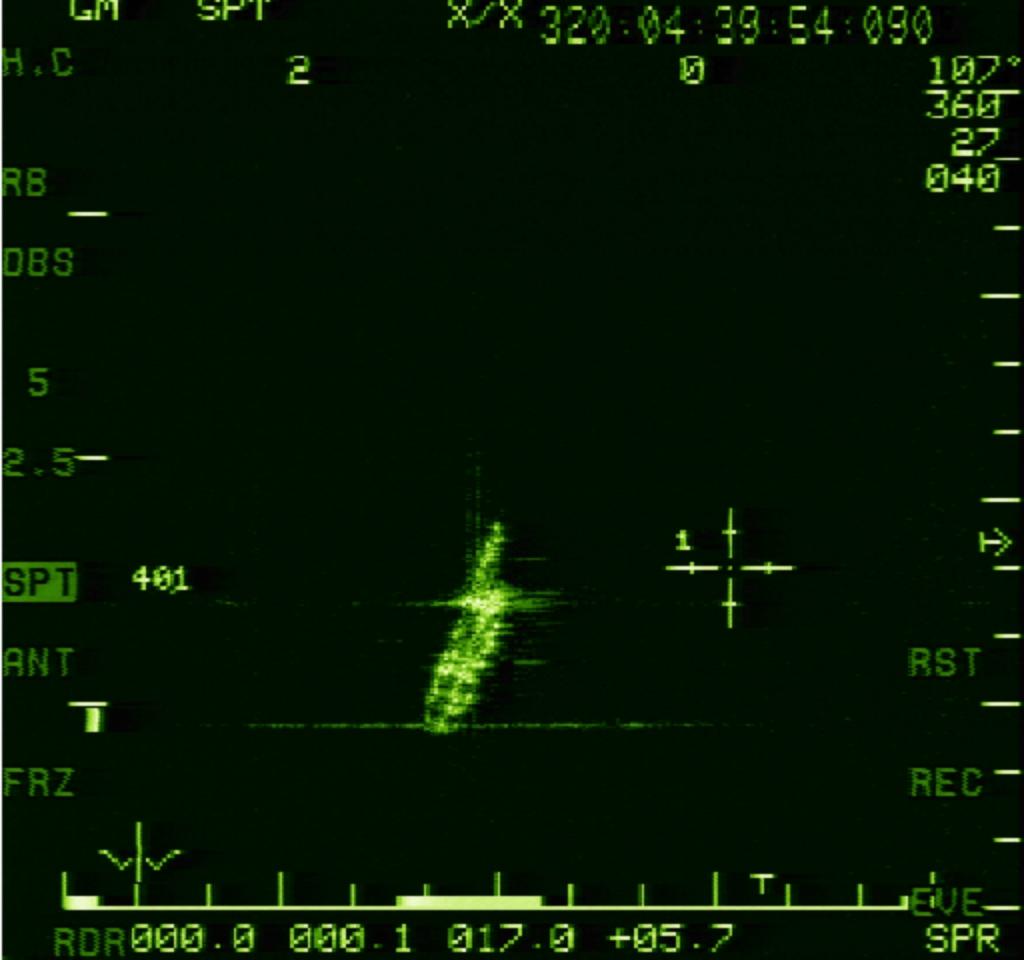
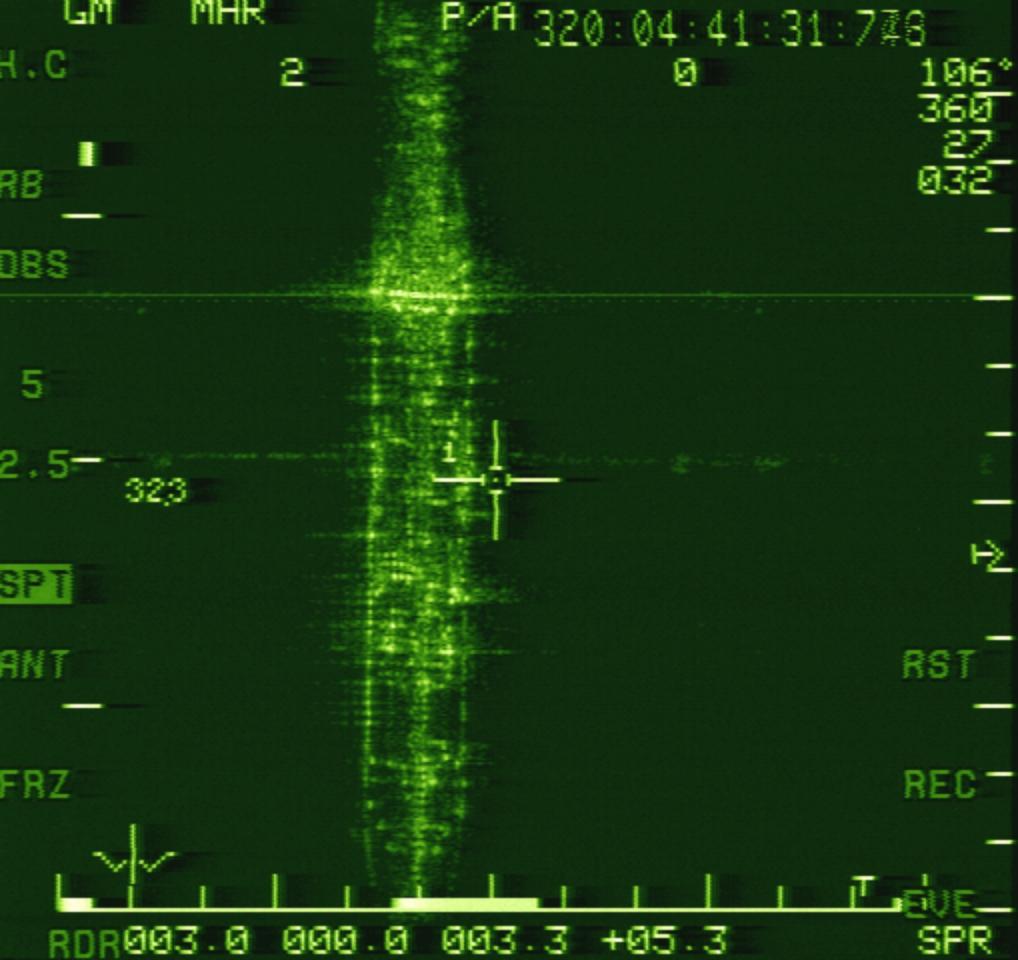
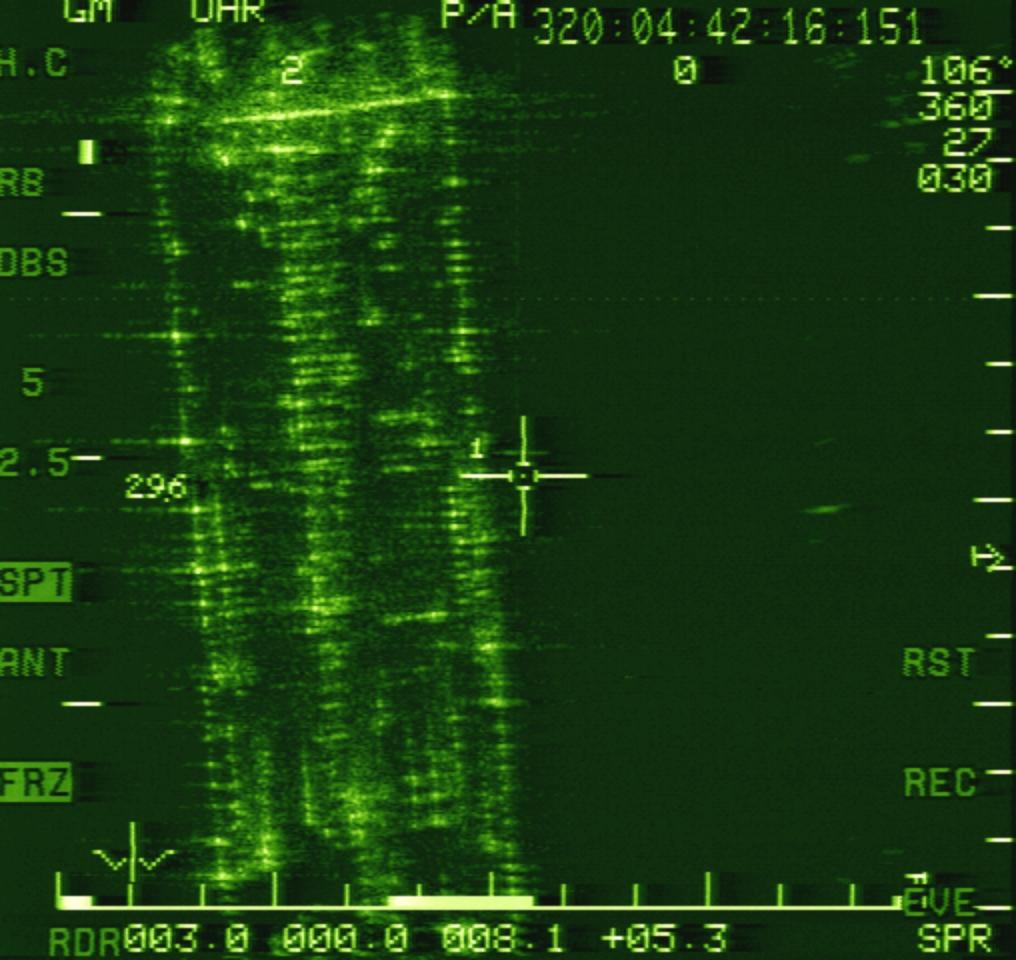
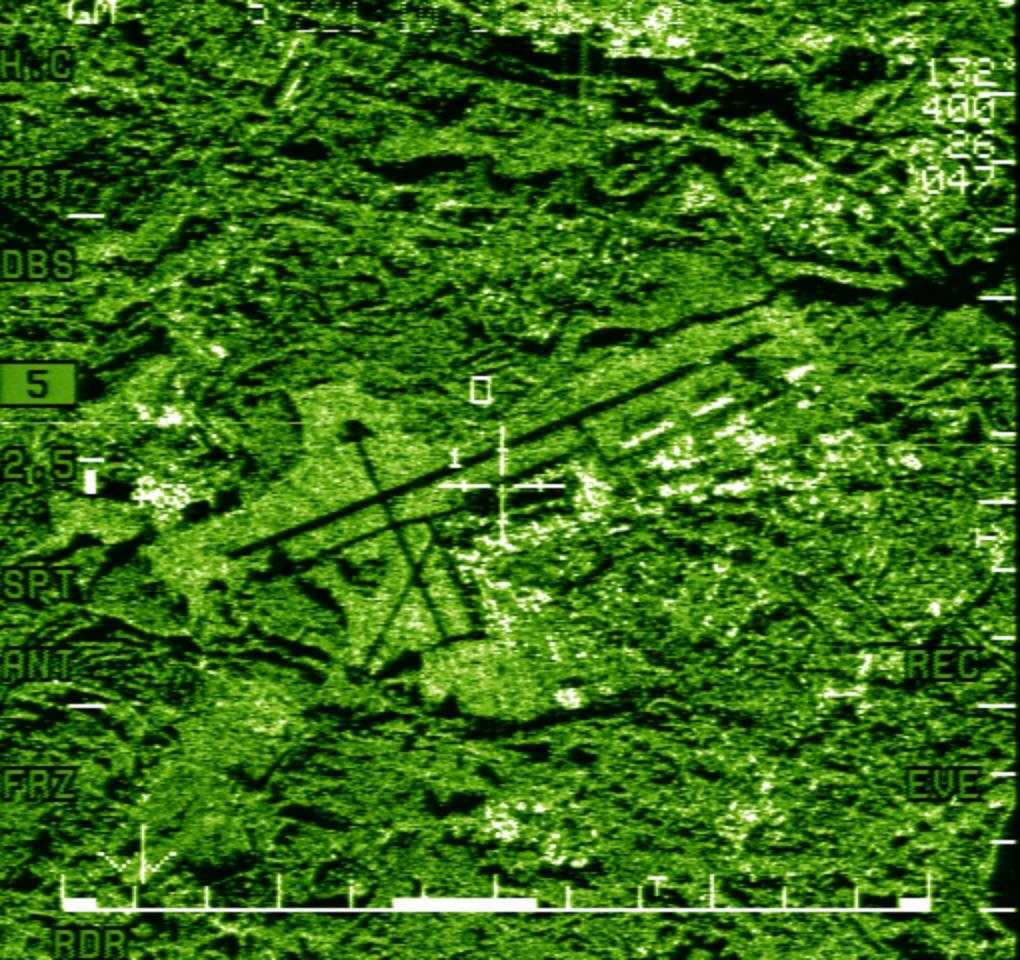
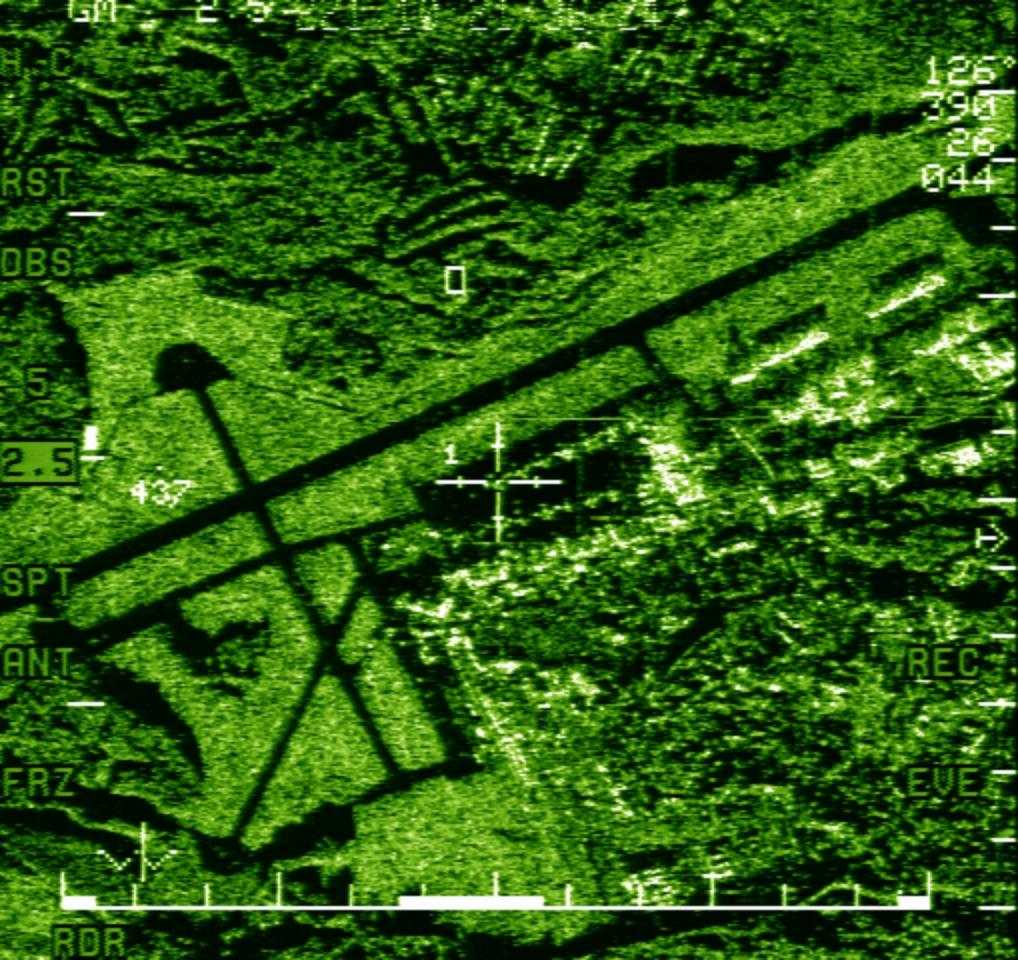
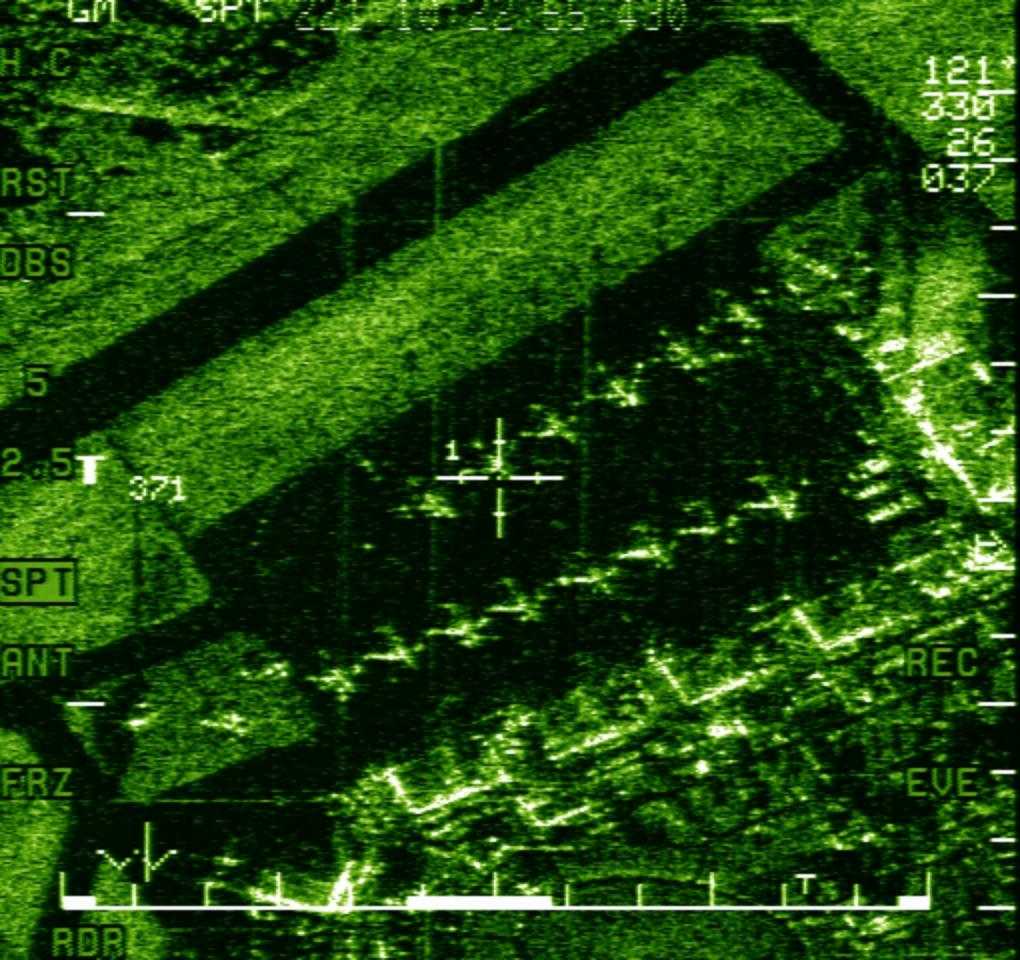
Without doubt the greatest weakness in the existing F-111C AUP/F-111G avionic suite is the absence of a modern Synthetic Aperture Radar / Ground Moving Target Indicator mode capable attack radar. The AGM-142 SOW and follow-on AIR 5398 standoff munitions will require such a radar for both supporting reconnaissance and effective inflight targeting of these weapons. This imagery was produced by the Norden APG-76 MMRS, which the Israeli Air Force use to target the AGM-142 from their upgraded F-4E Phantoms. The upper three images show Westover AFB at 45.8 NMI (18 metre resolution), at 43.7 NMI (9 metre resolution), at 37.8 NMI (3 metre resolution), the lower images show a tanker anchored in Delaware Bay at ranges of 40.1, 32.3 and 29.6 NMI and resolutions of 3, 1 and 0.3 metres respectively (Norden).  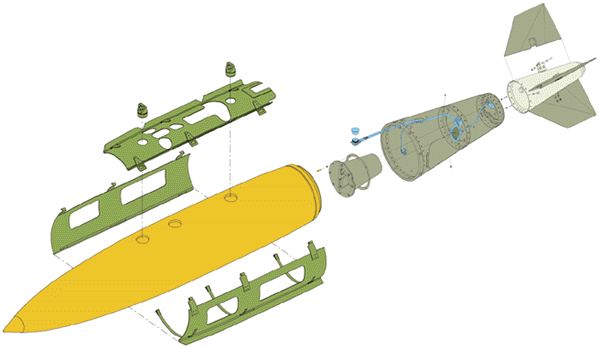 The GPS/inertial guided GBU-31/32 JDAM will supplant the Paveway as the primary guided bomb on US fighter and bomber aircraft. The JDAM is an autonomous weapon which is loaded with the GPS coordinates of the target prior to release, and in its baseline configuration provides similar accuracy and cost to the Paveway, with the benefit of genuine all weather operation, and better range performance. The USAF are to soon deploy an enhanced anti-jamming antenna package, as well as pseudo-differential targeting techniques on synthetic aperture radars. There is growing interest in the USAF bomber community in the deployment of a winged variant of the JDAM, similar in concept to the DSTO Kerkanya demonstrator (Boeing). |
||||||||
|
Part
II Performance, Signatures and Radar Warning Receiver
Part I of this feature explored existing upgrade programs on the F-111, and identified capability and survivability issues in relation to the evolving regional environment and technology base. In this second part we begin our exploration of potential follow on upgrades to extend the F-111 through to 2020. Given the changing broader regional environment, developing technology, and identifiable limitations in the existing and planned capability package for the F-111, we can in turn identify a series of specific upgrade measures to extend the aircraft tactically for the latter two decades of its operational life cycle. Survivability Issues It must be noted that survivability and offensive capability can often not be easily separated, in the sense that particular weapons and their delivery profiles may enhance both concurrently. Better basic defensive measures applied to the aircraft will enhance its offensive capability by allowing it to be used in conditions which would not be otherwise viable, and to target munitions more effectively. Increased lethality reduces the number of repeat missions which might need to be flown to kill a given target, and thereby improves force survivability in a sustained campaign. So the often peddled argument that money is better spent on purely defensive measures inherently misrepresents the issues. To address the survivability/lethality issues, we will need to focus on the four S', Speed, Signatures, Standoff weapons and Sensors. Speed and Sustained Speed Speed is vital to the F-111 both in the penetration of surface defences and the evasion of fighters. When penetrating at any altitude, speed denies the opponent response time, and every second which is taken away from a SAM system operator is another second they could use to set up and conduct an engagement. Fighters have finite fuel capacity, and the demands of high speed intercepts, be they off a runway or from a standing patrol, limit the fighter's time to engage the F-111. In many situations, the F-111 will simply outrun the fighter since it can sustain supersonic speeds at any altitude, including 200 ft AGL. Sustained high speed flight in the F-111 bites into fuel reserves, and the central issue is therefore how to minimise fuel burn at high speeds, or how to ensure that additional fuel is available. Three measures exist which can be used to improve high speed endurance. The first is the obvious answer, which is inflight refuelling. This means operational tankers in sufficient numbers to support the SRG. Ideally these would have booms, since the boom provides a much higher fuel transfer rate than a fighter sized probe/drogue package. The alternative would be to fit a probe to the F-111, and replumb the aircraft accordingly, accepting the fuel flow rate, drag and signature penalties of a fixed probe arrangement. It is unlikely that space could be found for a retractable probe, and flight testing would be more expensive. While a robust operational tanker force would be highly desirable, it is not the only means of improving aircraft penetration speeds. The other measure is to minimise the aircraft's drag. The drag contribution of the F-111's four external swivel pylons and stores is considerable, and drag once stores are released is often hardly better, due to the aerodynamics of the pylons, under some conditions. Empty pylon drag is typically of similar magnitude to the drag of the store. Indeed the FB-111A/F-111G has jettisonable pylons for this reason, the intent being to shed the pylons retaining only a short stub once weapons have been delivered. The option now of course exists to strip the jettisonable pylons from USAF F-111G stocks, and modify the C-model to accommodate them, accepting that these will need wiring changes to accommodate the AUP system's defacto Mil-Std-1760 interfaces, and also accepting that additional stocks would need to be built up if this is to be practiced operationally. Internal Weapon Carriage The resolution to the external stations drag problem is simple - use the internal weapon bay to carry munitions. At this time the internal bay is used for the Pave Tack, and the six weapon station bus decoder boxes (each in a slimline chassis designed to fit inside a Hornet pylon) . Pave Tack is simply not required for the delivery of GPS guided bombs, glidebombs or missiles. So should the weapon bay be activated, and GPS guided bombs, glidebombs or missiles be carried internally, then the aircraft can penetrate clean and exit the target area clean. Moreover, external tanks can be carried to increase the unrefuelled combat radius, and these are a relatively low drag store, compared to Multiple Ejector Racks or many munition types. The Harpoon would be a very attractive candidate for internal carriage since the missile is relatively draggy, and imposes speed restrictions on the F-111, as it was designed to be carried by the subsonic USN A-6E and P-3C aircraft. An air launch Harpoon fitted with folding wings, as used on the tube launched version, fits easily. The standard air launch version would appear to fit with very minimal vertical wing clearance. Both versions would require an adaptor shoe to offset the MAU-12 position suitably. The F-111 was built to the USAF SOR-183 requirement, and its primary design specification was to penetrate low and fast carrying a pair of internal nuclear weapons, either the B43, B57, B61 or AGM-69 SRAM. The Mk.84 2,000 lb and M118 3,000 lb bombs were cleared for internal bay drops by the USAF, but never used operationally from the internal bay. The weapon bay hardpoints have therefore been built for such loads. While clearance/separation testing will be required for weapons such as the GBU-31 JDAM, their similarity in aerodynamics, size and weight to the standard Mk.84 indicates this will not be an issue. 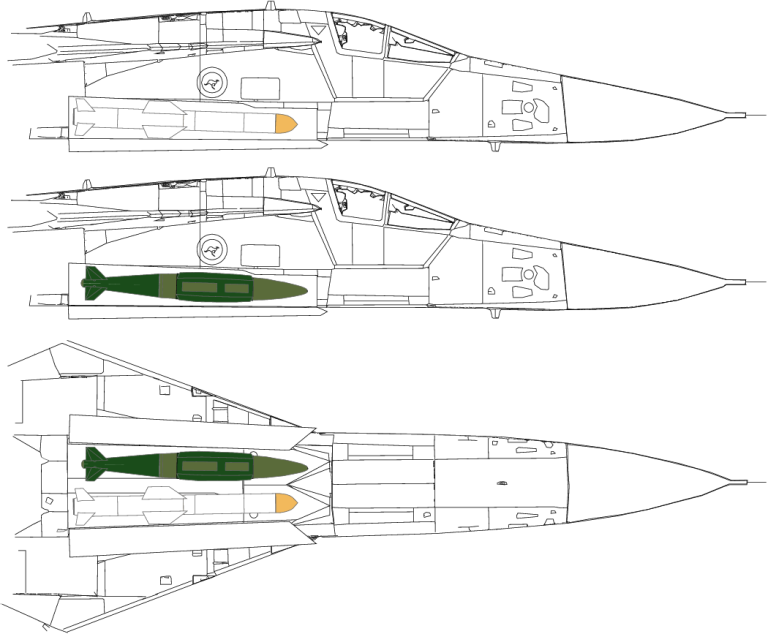 The F-111C aircraft bays have had the MAU-12 ejectors removed, the F-111Gs retain them. Activating the weapon bay on the F-111C and enabling stores control access to the stations is a relatively simple engineering task. The stores decoders must be relocated from the side of the bay into the upper rear bay, clear of stores and the Pave Tack cradle, and a cabling harness is required to couple them to the cable entry point into the weapon bay. Basically this is a wiring and sheet-metal chore. If the aircraft is to have six rather than four smart weapon stations, two more decoders need to be added and the stores control OFP (software) tweaked accordingly. But this modification can be done even more cheaply, if we choose have only four smart stations, which is not an unreasonable limitation from an operational viewpoint. Two simple solutions are possible. The first is the simplest, which is to bring the cables from the internal and inboard swivel pylon stations to a bracket mounted bulkhead connector, and then select the station by plugging the decoder into either, using a short cable harness. The unused connector terminating the cable harness would be sealed with a simple screw on cap. The alternative is a switching arrangement mounted in the weapon bay, used to reroute the signals from the decoder boxes, to select either the inboard swivel pylon stations, or the internal weapon bay stations. No changes would be required to the software, and the total installation cost will be confined to sheet-metal brackets, cabling harnesses and at most a some milspec switching hardware, or another simple sheetmetal bracket. Operationally, the Navigator needs to only remember that his inboard stations are in the weapon bay, and the ground crew need to select the stations accordingly during weapon loading. Neither are out of the bounds of existing operational practices. The only cost issue is that clearance testing will need to be carried out to determine the limitations of the installation. Since the USAF has already done much of this during early testing of the F-111, for standard stores such as Mk.84 series bombs, the process will be much simplified for aerodynamically similar stores. Whether the "expensive" six station approach is adopted, or the "cheap" selectable four station approach is used, the engineering overheads of this exercise are minimal and arguably well worth the effort in terms of performance to be extracted from the airframe. It should be noted that this modification does not in any way preclude the existing Pave Tack installation, the choice is simply whether to fit Pave Tack and carry external laser guided bombs, or remove Pave Tack and carry internal GPS guided bombs. The swap-in/out operation for the Pave Tack cradle and pod takes about a day to perform, and involves mounting the cradle and hooking it up to aircraft systems (hoses, cables). A useful and cheap enhancement to this modification is to provide automatic bay door opening under software control, similar to the AUTO mode in the F-111D/G. This is another low cost modification, involving primarily wiring and a minor addition to the mission computer software. Scheduling the doors to open automatically 2-3 seconds before the drop, and close immediately after the drop, minimises the time during which the open bay compromises the aircraft's signature, while also reducing crew workload during the critical delivery phase of the mission. Propulsion The third measure which can be applied to increase the aircraft's penetration speed and endurance is the fitting of a much better engine than the sixties TF30 series. The existing and funded engine upgrade from the TF30-P-3/P-107 to the TF30-P-108/109RA is in many respects a partial measure, aimed wholly at achieving spares commonality across the fleet, gaining a few percent of additional thrust as a byproduct. It is however a very cheap upgrade to perform, using boneyard hardware, and thus could be approved without the major internal political dramas associated with getting funding these days. The case study for an upgrade from a TF30 to a contemporary engine is the USN's F-14A+/D upgrade to the GE F110 engine (see table), replacing an engine almost identical in performance to the TF30-P-108/109RA being fitted by the RAAF. This upgrade involved primarily the insertion of a 1.27 metre annular plug behind the engine core to match the fuselage tunnel length between the shorter F110 and the longer TF30, the fitting of an inlet adaptor to match the slightly smaller fan to the inlet tunnel, secondary structure changes at most, the rescheduling of the variable inlet ramp, and the necessary flight testing. The F110 series is almost identical in weight to the TF30, and the commonly used F110-GE-129 IPE variant delivers 17 klb static dry thrust, and 29 klb static reheated thrust. The F-14A to F-14A+ (redesignated F-14B) upgrade produced remarkable results in aircraft performance, with a 43% increase in reheated thrust, a 37% increase in dry thrust, 30% lower fuel burn in reheat, 62% greater intercept radius, and about a 30% improvement in endurance on station and combat radius, all with a much more reliable engine with unrestricted handling. Variants of the F110 are now widely used on the F-16C, are the standard powerplant on the F-14B/D, and have been tested on the F-15E. What would such a powerplant do for the F-111 ? The first and most important improvement would be in the ability to sustain fast transonic or supersonic dry cruise for much longer when penetrating at any altitude, within Turbine Inlet Temperature (TIT) limits for the engine. A pair of late model F110-GE-129 EFE engines would provide the F-111 with about 50-80% more thrust at maximum continuous power rating, Mach 0.75-0.8, in comparison with the currently being fitted TF30-P-108/9s. In most regimes the engine Thrust Specific Fuel Consumption (TSFC/SFC) of the F110 is superior to the SFC of the TF30. The F-111's best defence against fighters has always been to outrun them, and with F110s fitted this tactic becomes much easier to apply, since the aircraft can sustain high thrust ratings much longer on any given fuel load. An important issue in evading the latest generation fighters is that of avoiding detection by Infra-red Search and Track, thermal imagers, or Night Vision Goggles. Use of reheat is highly counterproductive, in this respect, since the speed gained is at the cost of detectability. Even basic NVGs will allow visual detection of an aircraft in reheat at many miles of range. If the F-111 fitted with F110s can achieve the same dash performance on dry thrust, as the older TF30 delivers on low reheat, then it can run at high speed for much longer without the signature penalty of an afterburner plume. So the benefit of sustained speed is achieved, yet the aircraft is not more detectable than it currently is running on dry thrust. The second aspect of higher installed thrust which is of some usefulness tactically is that the aircraft can sustain much higher G in turning manoeuvres, without the need to light afterburners. Higher thrust to weight ratio improves sustained turn rates, a problem area with the heavily loaded F-111 even at optimal wing sweep settings. While this will never turn the aircraft into a dogfighter, it will improve the aircraft's basic manoeuvrability and this is always useful, particularly in evading SAM shots. Fitting an F110 variant would produce other benefits:
The F110 would permanently solve the ongoing issues with the provision of adequate bleed air capacity to support current, and particularly growth onboard aircraft systems. An example is the Pave Tack, which consumes a large proportion of available bleed air. While to date bleed air has not been a critical operational constraint for the RAAF, the USAF had endemic difficulties in this area. The original P-3 on the EF-111A could not deliver adequate bleed air to support the Environmental Control System (ECS), as well as the cockpit pressurisation, weapons bay cooling, overwing fairing seals, hydraulic accumulator pressurisation and other aircraft systems, under all operating conditions (since bleed air is drawn at the expense of engine performance). This produced a requirement to shut off the bleed air for take offs, to achieve acceptable single engine takeoff climb rates, and turn it on at 250 KT after takeoff. While the fitting of the P-109 to the EF-111 alleviated this problem to some degree, it was never considered to be completely solved. The earlier TF30 is simply at the lower limit of acceptable engine performance for the airframe and supported systems. The current production model of the F110 is the -129 rated at 29 klb in reheat, with 31 klb demonstrated. The latest variant is the -129 Enhanced Fighter Engine (EFE), rated at 32 klb reheated, 34 klb demonstrated, with growth to 36 klb. The latter employs a more efficient blisk (ie single part) fan, and a simplified afterburner with a 25% lower part count. GE claim that derating the -129 EFE to about 29 klb provides a 50% increase in the required service interval. Unit cost for the F110-129 is in the range of USD 3.5-4M, based on published figures. Whereas an upgrade to an arbitrary new engine would be quite demanding in terms of engineering effort, this is much less so the case with the F110, since the exercise was carried out by the US Navy on the F-14, replacing an engine almost identical to that being now fitted to the F-111. It follows therefore that with the experience gained by GE on the F-14 retrofit, and the RAAF with the P-109RA retrofit, the risks and engineering overheads of an F110 retrofit can be minimised. Given the F-14 experience, the modification effort would lie primarily in the insertion of a tailpipe plug, and adapting the inlet and new nozzle to the airframe. The other required modification will be rescheduling the variable inlet. The F110 massflow requirements are only slightly greater than those of the TF30. A refit to the F110 is not a new idea by any means, and was on the USAF F-111 squadron wishlist for many years. During the early nineties, GE proposed a refit to the USAF, and conducted preliminary engineering work. While exact numbers are not available, the expected engineering costs were of the order of USD 15-25M, and the estimated savings on support costs would pay for the upgrade in a 5-10 year in service period. The upgrade plan collapsed when the USAF decided on the early retirement of their F-111s. An upgrade initiated at this time would take about 3-4 years to complete. The only other modification which may be required is reskinning the wing leading edges with a more durable material (eg stainless steel) to better accommodate sustained high speed operations. In summary a refit of the F-111 fleet with an F110-GE-129 EFE is a major investment, but one which would produce some extremely useful improvements to the aircraft's basic aerodynamic capability, and signatures. This while reducing medium to long term support costs and demands for tanker support, the latter not a trivial saving with new build tankers worth about USD 130M per unit. A refit removes any system growth limits imposed by bleed air shortages in the TF30. The performance and signature gains in turn produce a major gain in survivability, especially when dealing with a fighter threat. Combining the use of internal stores with an F110 engine upgrade would result in truly blistering sustained speed performance at all altitudes. With a very useful combat radius improvement into the bargain, the case for a refit to the F110 is compelling. 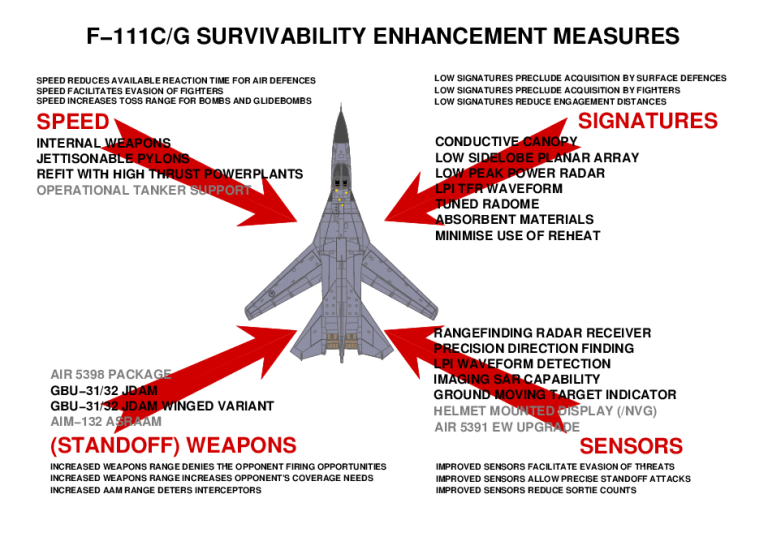 Signatures The next major area to be explored is that of signatures. The principal issues here are the radar emissions from the TFR, the attack radar and the radar skin paints reflected off the aircraft. The TFR is a robust and proven, incrementally upgraded sixties design. It is vital to low level penetration at night. However, it also broadcasts the aircraft's presence for tens of miles, not an issue in times past, but likely to become an issue in this day and age of competitively priced widely available EW equipment. Other than forgoing the low level profile, the only option here is to change the signal format to something less detectable. The expensive off-the-shelf solution would be to repackage the US Lantirn/APQ-174 navigation pod radar to wholly replace the existing AN/APQ-171 TFR. However, it may be also possible to modify or redesign the existing TFR receiver and transmitter to accommodate an LPI rather than straight pulsed waveform. Given the tactical payoff, it would be well worth investigating, and something well within the capabilities of DSTO. Alternately, the TF function could be subsumed by a dual redundant attack/TF radar. The emissions from the AN/APQ-169 attack radar, or any conventional replacement, are an unavoidable evil. While LPI radar technology is on the threshold of large scale deployment, it will be initially expensive. However, a newer technology radar with lower peak power output, less detectable waveforms, and a low sidelobe planar array antenna would be a distinct improvement over the existing ARS. If such a radar is used sparingly, and only in Synthetic Aperture spot mapping mode for for weapon delivery, the angular extent of its transmissions will be be much smaller, and it will be significantly less detectable than the AN/APQ-169. Reducing the radar signature of a conventional aircraft like the F-111 is not trivial, and will never provide the kind of stealth which comes with a true stealth airframe. However, dropping the forward sector signature down to a tenth of its existing size almost halves detection range and warning time for an opponent, so any dollars spent in this area are an excellent investment. There are a number of straightforward measures which are widely used in other types in service. The canopies can be conductively coated, radar absorber can be packed into the forward radar bay, a planar array antenna can be used, a "tuned" radome can be fitted, opaque to out-of-band radars, absorbent coating or laminates can be applied to the inlets and leading edges, and critical other parts of the airframe, and finally, the aircraft can penetrate using only internal stores. All of these measures involve established technology, but would require significant R&D effort by DSTO or a contractor to implement. Clearly the issues of speed performance and signatures are complementary, in that both are intended to compress an opponent's engagement timeline to the point, where the defence fails to perform effectively. Incremental improvements in both areas will therefore yield a nett dividend which is arguably much better than application of either measure alone. Moreover, some measures such as internal weapon carriage yield very useful returns in both areas. In summary, every dollar spent on performance improvement and signature reduction translates directly into a survivability improvement. Radar Warning Capabilities Electronic combat sensors are another critical aspect of survivability. In penetrating hostile airspace, an F-111 in 2010 will most likely encounter a wide range of threat radars, many with much lower peak power output than Cold War SovBloc systems and clones thereof, and most likely also a smattering of types with basic LPI (Low Probability of Intercept) features. The only robust means of dealing with such a capability level is to have a channelised receiver for the mid and upper radar bands with the sensitivity and signal processing capability to accurate detect and track such threats. With modern threats, knowing the range of the emitter is very useful, since it provides a much better indication of the threat's possible engagement envelope. Skirting about the edges of a SAM system's coverage is clearly much less dangerous than trying to cut through the heart of its coverage. If you penetrate faster, you require more warning time to react. Other important benefits accrue from knowing the precise range and direction to a threat emitter. Anti-Radiation Missiles can be fired reactively in optimal range known modes. Moreover, the Harpoon (and AGM-142) can be targeted without prior radar emissions in Range-Bearing Launch (RBL) mode, allowing much more precise selection of targets, while denying the victim early warning of an impending attack. Most importantly, the ASRAAM can be launched against threatening fighters in forward quarter engagement geometries. Rangefinding adjunct receivers are now becoming available as add ons to existing EW packages. Established designs such as the F-16CJ ASQ-213 HTS and F/A-18C LMC TAS employ interferometric techniques, combined with Phase Rate of Change, Differential Doppler or Time of Arrival (PRC, DD, DTOA) techniques, requiring additional interferometric antennas. An impressive recent development are adjunct receivers using Digital Radio Frequency Memory (DRFM) techniques, such as the LMC (formerly IBM Federal Systems) PRSS (Passive Ranging SubSystem), which are designed to use the existing RWR antenna package without change. Such receivers are "piggybacked" on to the existing RWR, sharing its antennas, and under its control via the Mil-Std-1553B mux bus. The RWR locks the DRFM receiver on to an emitter of interest, and continues to search while the position of the threat is measured. The position of moving and static surface and airborne emitters can be found. In 1995 US tests of the PRSS demonstrator achieved accuracies of about 250 ft CEP at 40 NMI, and sufficient accuracy for range known HARM shots in under 5 seconds. The accuracy of DRFM based adjunct receivers improves significantly with high accuracy INS/GPS navigation packages, such as installed in the AUP upgrade. The PRSS package fits into a single Milspec VME package (militarised COTS, rated to level 5 tactical Mil-Std-810E), and is cited at 55 lb (cca 25 kg). Fitting the ALR-2002 with a channelised Hi-Mid band receiver is an incremental, but non-trivial upgrade. A suitable DRFM based range/direction finding receiver can be incorporated as an adjunct. The FEB door mid-hi band antenna layout is particularly well suited to an adjunct receiver package, providing for bearing and elevation coverage. If proper provisions are made in the implementation of the Echidna suite, incorporation of these two capabilities can be performed as intermediate upgrades to the basic AIR 5391 package. In summary an LPI threat detection capability in the ALR-2002 will be essential, while an adjunct precision direction finding and rangefinding package would significantly improve survivability by facilitating early evasion of threats, improving the lethality of defensive anti-radiation weapons, providing a means of countering emitting hostile fighters in forward quarter geometries, and allowing silent attacks on emitting targets such as shipping. Part 3 of this series will continue our discussion of the long term upgrade options for the F-111. Special thanks to Kurt Todoroff (formerly Capt, USAF; F-111D / EF-111A pilot, instructor, and flight examiner) for his helpful comments on the draft of this paper. 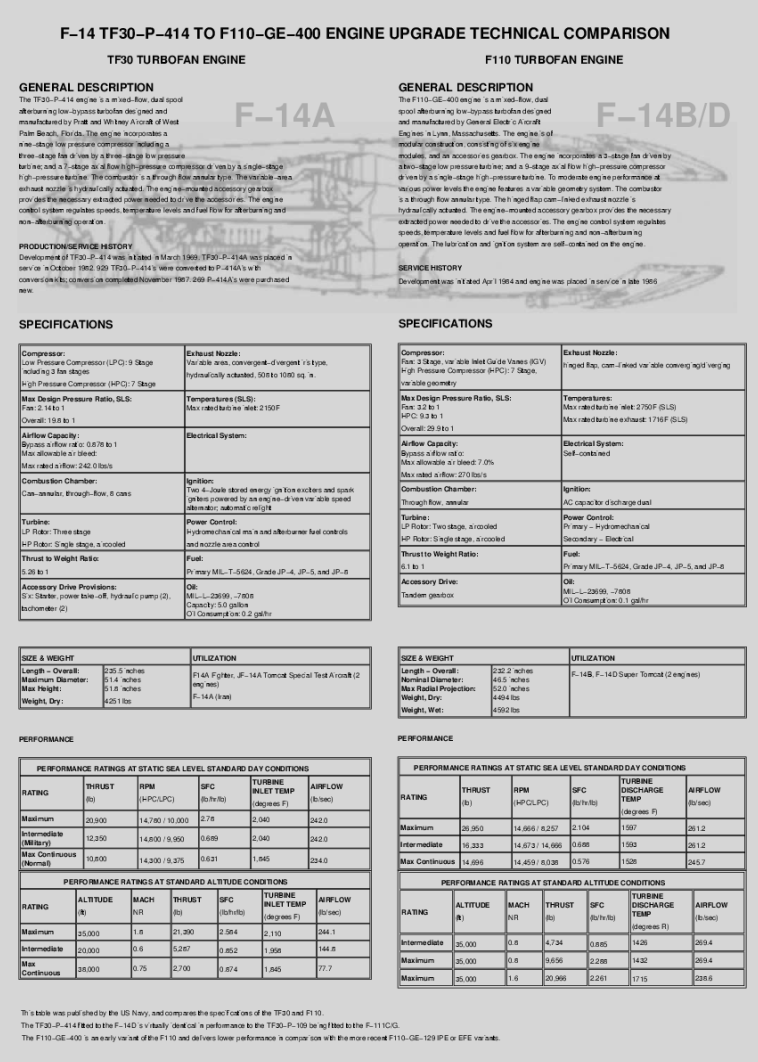 The USN fitted a portion of their F-14A fleet, and all new build F-14D with the current technology GE F110-GE-400 reheated turbofan, replacing the sixties technology P&W TF30 fans. While the upgrade required minimal modifications to the airframe, the results were outstanding - producing a 43% increase in reheated thrust, a 37% increase in dry thrust, 30% lower fuel burn in reheat, 62% greater intercept radius, and about a 30% improvement in endurance on station and combat radius, all with a much more reliable engine with unrestricted handling. Variants of the F110 are now widely used on the F-16C, are the standard powerplant on the F-14B/D, and have been tested on the F-15E. 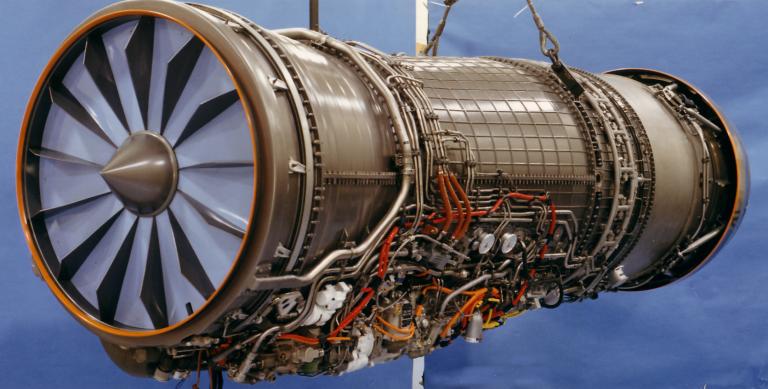 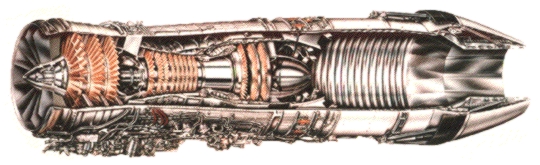 The GE F110-GE-129 IPE is the principal powerplant used in the late model F-16C. Originally designed as a powerplant for the B-1A bomber, the F110 was revised and became a competitive engine to the P&W F100 series. With a modern digital engine controller, the engine has superb handling and a high tolerance for poor inlet airflow. The latest developments of this engine deliver static afterburning thrust levels in excess of 32,000 lb, with growth to 36,000 lb, with SFC performance superior to the TF30 in all regimes (GE). 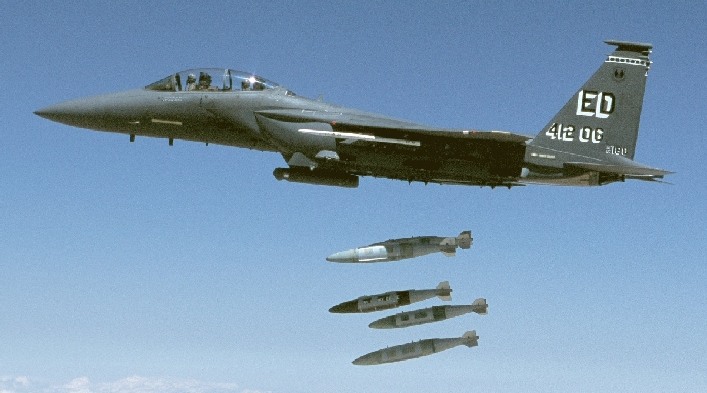 The GBU-31 JDAM will shortly become the USAF's standard guided bomb, carried by the B-2A, B-52G/H, B-1B, F-15E and F-16C. The baseline weapon provides precision or near precision accuracy in all weather conditions, and is a fully autonomous launch and leave weapon, with a delivery and carriage envelope virtually identical to the Mk.83/Mk.84 Slicks. The tailkit is available for the 1,000 lb Mk.83 and BLU-110, and the 2,000 lb Mk.84 and BLU-109. Depicted is a USAF B-1B rotary launcher carrying the bunker busting BLU-109/B variant of the JDAM. The JDAM would be the ideal candidate for an internally carried all weather guided bomb for the F-111C/G (USAF). 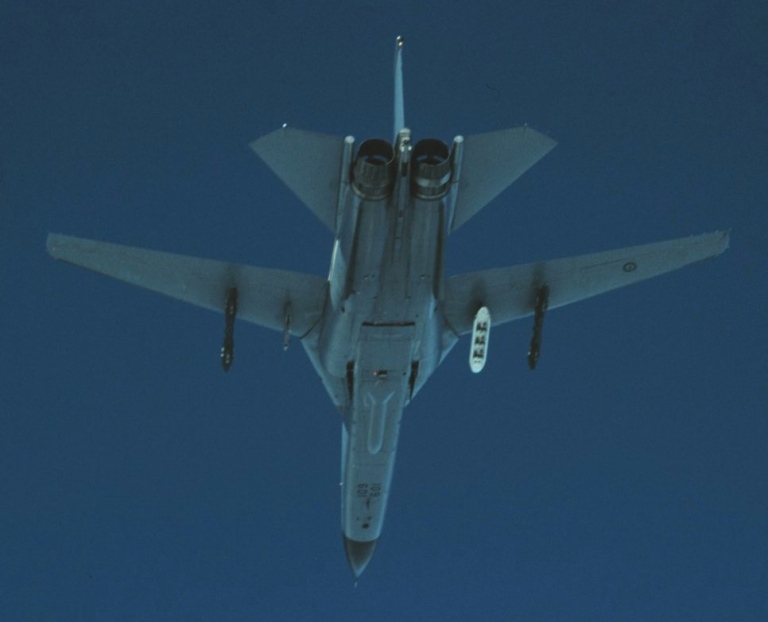 Retrofitting the F-111C/G fleet with a variant of the GE F110-GE-129 is a low risk proposition, given the prior TF30 retrofit effort to the F-14. This powerplant would be not only cheaper and easier to maintain in the longer term, but would also provide important gains in sustained high speed performance and combat radius. A conservative estimate based on the F-14 experience suggests that an F-111 carrying a pair of internal bombs could achieve a combat radius approaching 1400 NMI, avoiding the need for expensive tanker support in many situations. |
||||||||
|
Part
III Attack Radar, GPS Guided Bombs and Pave Tack
(Includes corrections to original) In the preceding part of this series, we explored a number of upgrade options which could enhance the long term survivability of the F-111. We continue in this part with a discussion of attack radar upgrade options, GPS guided bombs and Pave Tack. SAR/GMTI Attack Radar Issues The Attack Radar is a major issue within itself, as noted earlier. Clearly a high resolution SAR/GMTI radar (Synthetic Aperture Radar/Ground Moving Target Indicator) is a necessary supporting capability for the weapons package to be acquired under AIR 5398. In the simplest of terms, such a radar is an "enabling" capability to support the emerging generation of smart weapons, be they types currently planned for, or the GPS guided bomb/glidebomb. Many of these weapons have been designed with such radars in mind, and the AGM-142 is the prime example thereof. In some respects it is almost curious that the AIR 5398 weapons program was initiated without provisions for such a radar, since the operational difficulties associated with using long range weapons without such a supporting radar are formidable. The existing reconnaissance capability provided by four camera and IR line-scanner equipped RF-111Cs is simply no longer viable, and the idea of trying to overfly defended targets with these aircraft to collect targeting imagery for the next day's AGM-142 strike simply does not bear up to scrutiny. Until the RAAF acquires a suitable high resolution SAR/GMTI attack radar for portions of if not all of the F-111 fleet, it will be unable to genuinely get its worth from the weapons package planned under AIR 5398, due to a lack of supporting recce assets for prebriefed missions, and the inability to target these weapons accurately on sorties where robust prebriefing intel is not available. The luxury of sneaking up close to a target, eyeballing it with the Pave Tack, and then putting the weapon into a window is basically incompatible with the tactical model of a standoff weapon. Technology has evolved, but we have arguably not adapted our tactical and operational paradigm to match. See above The existing F-111C/G APQ-169 real beam analogue radar is ill matched to the task of targeting the AGM-142 SOW and the follow-on munitions to be acquired under AIR 5398, due to poor resolution at typical weapon launch ranges. This and the need for supporting targeting reconnaissance suggests that a modern SAR/GMTI capable attack radar should be very high on the list of priorities for the F-111. A number of off-the-shelf fighter radars now have this capability in various measures. The most capable radar in this class deployed operationally at this time is the Norden APG-76 MMRS, used by the Israelis to target the AGM-142 from the F-4E. The upper left pictures illustrate the radar and its installation in an IAF F-4E, the upper right image is a convoy crossing a bridge at 37.8 NMI range and 18 metre resolution, with the GMTI mode painting slow moving vehicles as white rectangles. The lower three images show F/A-18s at NAS Cecil Field taxiing from about 40 NMI range (Norden). Rescoping AIR 5398 to include a SAR/GMTI radar will not significantly impact overall program funding required, since more accurate weapon targeting means that lower weapon stock holdings will be required to achieve the same effect. Fitting a modern SAR/GMTI radar addresses the issues of targeting standoff weapons and providing strike support reconnaissance and Bomb Damage Assessment (BDA), if done properly. An aircraft returning from a strike can map areas of interest outbound from the target, from well outside the range of defences, and a GMTI capability adds additional intelligence into the deal. Indeed, comparing the cost of recce capable SAR/GMTI attack radars on the 35 F-111s vs the cost of a package of long range UAVs and/or recce satellites, the radars on the F-111 look very good indeed. A state of the art SAR/GMTI radar will provide SAR spot mapping with resolutions down to 1 ft or better, at ranges of about 30-40 NMI, with absolute positioning accuracies as low as 20 ft, if GPS is used on the F-111. The GMTI capability allows the detection and tracking of multiple low speed surface targets, and many types incorporate Non-Cooperative Target Recognition (NCTR) capabilities, allowing the identification of armour, soft-skinned vehicles, helicopters and even rotating radar antennas. This provides the capability to attack all surface targets in any weather, regardless of the cloudbase, using standoff weapons, GPS guided bombs, and even dumb bombs. The weather and cloudbase imposed limitations of the thermal imaging Pave Tack (or other such pods) become irrelevant. This is well and truly giving the F-111 a "Knowledge Edge" over the surface bound opponent, which are denied the sanctuary of inclement weather. If it moves, it is found and killed. Needless to say, SAR/GMTI revolutionises both strike/interdiction operations, as well as providing unprecedented capability to support Army operations with precision all weather battlefield strike and close air support, An important point to make here is that there are distinct technological differences between SAR/GMTI attack radars, and SAR/GMTI reconnaissance and surveillance radars. This appears to be an ongoing source of confusion in lay defence circles, who seem to be unable to distinguish the two categories despite their obvious differences in design and operation. A SAR/GMTI attack radar (eg APG-70, APG-73, APG-76, APQ-164, APQ-181) is optimised to produce small SAR/GMTI "spot maps" for targeting weapons, and for producing recce imagery and BDA imagery of specific target areas. Such attack radars typically employ a conventional nose mounted antenna, and usually include also conventional real beam mapping, Doppler Beam Sharpening and air-air engagement modes. Essentially they are digital multi-mode attack radars which incorporate the Digital Signal Processing power and the necessary signal processing algorithms to perform SAR imaging and GMTI target detection and tracking. Their primary optimisation is that of targeting weapons and providing supporting intelligence, with effective range performance between 30 and 100 NMI. Some have the ability to generate SAR strip maps, but usually with limited swath width and range. Many such radars incorporate software specifically to support GPS guided bombs and glide weapons, and will actually overlay the bomb delivery footprint over the radar map image, making the delivery almost trivial to fly, ie steer the "shape" over the selected aimpoint and pickle the payload. A SAR/GMTI reconnaissance and surveillance radar (Pave Mover, APY-3 (JSTARS), ASTOR, Ingara, Dornier ATLAS or AWARDS, Hughes ASARS or HiSAR, Norden APY-6) is optimised to produce large wide area "strip maps" to provide surveillance and reconnaissance over large areas of interest, at extended ranges. While these radars can be and are used to produce targeting intelligence for air strikes, their purpose is far more general. This class of radar typically employs a large sidelooking antenna in a ventral canoe shaped radome, or side mounted blister, and are carried on transports, UAVs, or dedicated recce assets. The radar is designed to typically produce maps to ranges of up to 200 NMI, including both SAR and GMTI imagery, usually with provisions for an operator to produce additional spot maps of areas of interest. Some radars in this category also include an additional vertically separated antenna and associated receiver package, which allow them to produce 3D maps, rather than simple 2D maps. Often the computer packages for such radars are built as ruggedised rather than Milspec systems, using commercial computer hardware and software. The simplest analogy is that SAR/GMTI attack radars are to SAR/GMTI surveillance radars, what Pulse Doppler Air Intercept radars are to AEW&C radars. A modern SAR/GMTI attack radar would also address to some degree the emissions issue, and a planar array antenna which is standard with such types would reduce the frontal radar signature of the aircraft. An issue which ought not go unmentioned in the context of the attack radar is the issue of the Law Of Armed Conflict (LOAC), and the "CNN Factor". Australia is now a signatory of LOAC, and therefore by law dropping bombs onto or shooting standoff weapons into the wrong target is essentially illegal. A bomber crew or their commanding officer can now be held responsible legally for any casualties produced by collateral damage on a strike sortie. And if the law does not act, we can rest assured that the mass media will, and therefore any bomb or missile which hits the wrong aimpoint will become the leading sound-bite on the six o'clock news, internationally. Given the "shoot-first, ask-questions-later" behaviour of much of the international media, and their all pervasive coverage, even a single bomb landing in the wrong place can compromise a government's political position when doing battle. Recent historical experience suggests that there are two leading causes of collateral damage: guidance failure in weapons and errors in targeting. The former is less serious, in the sense that a weapon which has lost its guidance impacts essentially randomly, and therefore is as likely to miss as it is to hit anything. Errors in targeting however will usually result in a perfectly executed attack against the wrong aimpoint, the destructive effect intended for a valid military target then being expended against hapless civilians. There is only one means via which such errors in targeting can be avoided. The quality of reconnaissance and targeting sensors must be improved to ensure that there is no ambiguity in the selection of targets. In this respect, a precision SAR/GMTI attack radar is an excellent tool, since it can image the target of interest and its surroundings under arbitrary weather/visibility conditions, precisely in relation to the bomber's geographical coordinates, even at ranges required for shooting standoff weapons. There are good military reasons for adopting a SAR/GMTI attack radar for the F-111, however, there are also just as good legal/political reasons for doing so. The consequence of not fitting such a capability to the F-111 will be diminished combat effectiveness when using standoff weapons, reduced survivability when using guided bombs, and increased political risks in the use of the aircraft, be it in regional combat operations, or international coalition operations. The the primary offensive sensor package on the F-111C AUP comprises the sixties technology APQ-169 real beam analogue attack radar, supplemented by the late seventies technology AVQ-26 Pave Tack thermal imager / laser designator. This sensor package is optimised for the blind radar/laser assisted delivery of dumb bombs, and the delivery of laser guided bombs with high accuracy. While the Pave Tack is now dated technologically compared to newer electro-optical/laser pods, it is still regarded to be a highly accurate sensor with excellent jitter performance, suitable for bombing from all altitudes. The APQ-169 is a variant of the APQ-113, with better ECCM and maintainability, adequate for the delivery of bombs at short release distances, but not accurate enough to target modern standoff weapons (82 WG RAAF). SAR/GMTI Attack Radar Technology There are several types which could be adapted to the F-111. The primary engineering issues are meeting the volume, power and cooling constraints of the existing APQ-169/171 installation, and adapting the antenna installation. The Forward Equipment Bay (LH) radar rack provides about 5 cubic feet of usable volume for the attack radar installation, a slightly lesser amount is available in the TFR rack (RH). Essentially, there are two approaches to solving the problem of a new attack radar. The first is the "sixties" strategy, employed in the F-111 and B-1A (APQ-144/130 common to F-111F), retaining the roll stabilised antenna pedestal, fitting a new SAR/GMTI attack radar, and either retaining, modifying or replacing with new technology the dual redundant terrain following radar. The second is the "eighties" strategy, used on the B-1B (APQ-164) and B-2A (APQ-181), which replaces the attack radar and TFR with a dual redundant attack and terrain following radar, which uses a shared fixed electronically scanned phased array antenna. In this scheme, one radar channel is in hot standby, while the other interleaves terrain following and attack radar modes, through the shared antenna. The APQ-164 TFR mode also concurrently scans to either side, to facilitate terrain masking, and by virtue of a much bigger antenna and better receiver, can provide the same range as dedicated TFRs with significantly lower emitted power levels thus reducing detectability even without specific use of LPI techniques. There are no technological or operational advantages to the "sixties" strategy, however it decouples the problems of terrain following radar capability from the attack radar capability, allowing either system to be modified or replaced separately. The "eighties" strategy, by virtue of current active electronically scanned array (AESA or "active phased array") technology, provides a smaller, lighter, very much more reliable and flexible installation, which by virtue of using a phased array antenna, can incorporate Low Probability of Intercept (LPI) modes both for the TFR and the attack radar. In the F-111, this approach would remove the troublesome roll stabilised antenna pedestal, and potentially provide greater roll angles limits in TF flight. The RCS of the antenna bay could be dramatically reduced, and space possibly freed in the FEBs. Solving the problem using the "sixties" approach suggests two immediate candidates for the attack radar, these are the Northrop-Grumman (Norden) APG-76 Multi-Mode Radar System, used on the Israeli F-4E upgrade, and the Raytheon (Hughes) AN/APG-73 to be fitted to the RAAF Hornet. In terms of existing SAR/GMTI modes, the more capable candidate at this time is without doubt the four channel APG-76, capable of producing genuine realtime SAR and GMTI imagery concurrently, with resolutions down to 1 ft, and tracking and identifying moving surface targets. A full package of air-air modes is included. The deployed variant of this radar is at 625 lb / 8.6 ft^3 too bulky for the F-111. It employs late eighties computer technology and a planar array antenna package designed for the F-4E. Recent development effort by the manufacturer has seen the signal and data processing software ported to C language, and the original vector and data processors replaced by a high speed COTS (Commercial Off The Shelf architecture) VME processor, with further improvements in resolution performance, support for precision bombing, moving target imaging, 3D SAR imaging, sea surface search, and all up weight reduced down to about 450 lb. Adapting it for an F-111 installation would require primarily repackaging, using a airborne tactical Milspec rated VME/COTS processor, and adapting the antenna/mount to the existing F-111 roll stabilised pedestal. Redesignated the APY-6, this radar has been bid for JP129, and this would offer potential for commonality. The AN/APG-73 multimode air-intercept radar to be installed in the Hornet upgrade (HUG) is another viable candidate, which in its RUG I/II variants has a respectable SAR capability, support for GAM/GATS (pseudo-differential) GPS guided bomb delivery, and optional provisions for reconnaissance strip mapping via an onboard recorder, which records raw video for ground processing. The radar includes an inertial sensor for very high resolution SAR imaging, but is not configured to process onboard such at this time. At 350 lb / 4.5 ft^3 the APG-73 is a relatively easy fit, and may not even require repackaging of its four line replaceable modules (WRAs), at most the transmitter packaging may need to be altered for a better fit, without displacing any AUP boxes from the rack. Again the antenna mount would need to be adapted to the F-111 pedestal. The radar is evolved from the APG-65 which has been adapted to the AV-8B Harrier and the Luftwaffe F-4F. While the APG-73 cannot at this time match the top end capabilities of the APG-76/APY-6, it could be modified to similar capability using software developed for the APG-70/AC-130U, and it would offer virtually 100% commonality with the HUG radar in hardware, identical software, and is almost a "drop in" fit. Since the radar is used in the USN F/A-18C/D/E/F, there would be no issues whatsoever with long term software and hardware upgrades and support. Solving the problem using the "eighties" approach suggests two candidates for the combined attack/TF radar, these would be a dual redundant APG-73 variant using the planned RUG III active phased array, or a dual redundant APG-68 variant using the Agile Beam Radar (ABR) active phased array, expected to deliver in 2001. Both of these radars have design provisions for automatic terrain following, and incorporate SAR and GMTI modes. Since such radars are modular, the system could either be built up to be symmetric, with identical radar configurations for both paths, or asymmetric, with the backup radar minimally configured to support only TF and basic navigation functions, thus reducing redundant package cost. The advent of active array antenna technology now allows such an installation in an aircraft the size of the F-111, without the weight and reliability penalties of dual TWT transmitters. Indeed, applying the Mil-Std-756B reliability model to either the APG-73 or APG-68 in dual redundant configuration yields an MTBF of 350-400 hrs, which is 2.5-3 times as reliable as the AUP APQ-171 TFR ! Both Raytheon and Northrop-Grumman produced their existing operational APQ-181 (B-2) and APQ-164 (B-1B) designs using hardware components from the APG-70 series and APG-68 respectively, and both thus have existing proven software and hardware to accommodate shared attack/TF radar operation. Both have extensive experience with LPI techniques through the B-2 and F-22 programs. Clearly there is no shortage of available technology in the marketplace. Other than cost considerations in integration and testing, the best medium to long term approach would be to employ a dual redundant attack/TF radar with an active array and LPI capability, based either upon the APG-68 ABR or APG-73 RUG III. However from a pure SAR/GMTI performance/capability perspective, the APG-76/APY-6/MMRS would appear to be a more attractive solution. From a cost/commonality perspective, the APG-73 RUG II would be the easiest solution. The GBU-31 Joint Direct Attack Munition With the USAF, USN and USMC now adopting the JDAM GPS guided bomb tailkit (http://www.jdamus1.eglin.af.mil:82/map.html) across their fighter and bomber fleets, a Kerkanya clone JDAM variant a very likely proposition in the near future, a SAR/GMTI radar would make such weapons easy to use while providing them with all weather accuracy competitive with the current Paveway II. The accuracy and flexibility of GPS guided bombs such as the JDAM depends wholly upon the targeting method used. The least demanding of aircraft sensor capability but least flexible is to bomb blind using nav-attack preprogrammed GPS coordinates derived from satellite or aerial photo/SAR reconnaissance, accuracy determined mostly by the quality of image registration. Much more flexible, but potentially limited in accuracy is targeting the GPS guided bomb using a real beam mapping (eg APQ-169) or Doppler Beam Sharpened radar. Equally flexible but much more accurate is delivery using a SAR/GMTI radar. The most accurate and flexible delivery is that using a SAR/GMTI radar and GAM/GATS GPS targeting (eg B-2 GAM/GATS or APG-70/73), or the same with Wide Area Differential GPS support. The latter modes achieve accuracies competitive with the best laser guided weapons, without any weather limitations. Other alternatives also exist, such as using a thermal imager / laser rangefinder, such as the Pave Tack, to accurately measure the target position and update the nav attack coordinates, and then use GAM/GATS GPS targeting, to provide similar accuracy to a laser guided bomb, albeit weather limited. Targeting the bombs using radar is thus the operationally most useful method, with the caveat that radar resolution and accuracy set the limits on achievable accuracy. Hence the importance of high resolution imaging SAR/GMTI modes. Typical radar targeting is wholly integrated, the user need only put the crosshairs on the intended aimpoint in the radar image, and squeeze a button to lock it in. Just before release, the GPS coordinates generated by the nav-attack software are downloaded into the bomb's internal computer. Since GPS guided bombs are preprogrammed before launch, it is feasible to program individual bombs in a payload for individual aimpoints in the target area. This is the approach used in the B-1B and B-2A, where multiple aimpoints are selected before release, and the bombs after launch each guide to their respective target. Therefore, a single aircraft in a single pass attacking a target such as an airfield, can allocate individual bombs to individual parked aircraft, fuel tanks, HAS', C3 buildings etc. It is worth noting that tossing a JDAM or winged JDAM from low level is somewhat less exposing an experience than tossing a Paveway, since the JDAM has more range than a Paveway due to better autopilot algorithms (in excess of 5 NMI for low level toss), and the JDAM is launch-and-leave, not requiring aircraft exposure to paint the target with a laser. Judicious choice of toss speed, angle and terrain would allow in many circumstances a delivery of the JDAM from below the radar horizon of the target thus wholly defeating the terminal defences of the target. The GBU-31 JDAM is now to become the USAF's standard guided bomb, carried by the B-2A, B-52G/H, B-1B, F-15E and F-16C. The baseline weapon provides precision or near precision accuracy in all weather conditions, and is a fully autonomous launch and leave weapon, with a delivery and carriage envelope virtually identical to the Mk.83/Mk.84 Slicks. The tailkit is available for the 1,000 lb Mk.83 and BLU-110, and the 2,000 lb Mk.84 and BLU-109. It appears at this stage that the USAF is also interested in a winged standoff JDAM variant, in effect a clone of the DSTO devised Kerkanya glidebomb. Depicted is a USAF B-1B rotary launcher carrying the bunker busting BLU-109/B variant of the JDAM(USAF Photo). Tactically, a typical profile would see the F-111 approach at low level, pop up at about 20 NMI for several seconds to get a SAR/GMTI spot map of the target, the navigator would then designate the chosen multiple aimpoints, and if necessary pop up again briefly at 10-8 NMI to refine the aimpoints. From that point on the aircraft remains at low level until the toss manoeuvre, which can be designed to minimise time above the radar horizon of the target defences. If conditions are right, the aircraft may never be exposed. Should a glidebomb variant of the JDAM be used, then the bomb can be tossed at 15-25 NMI. Moreover, the JDAM can be programmed with parameters such as target impact angle, enabling the bomb to hit the most vulnerable point on the specific target, thus no flexibility is lost in targeting. An important point not to miss here is that the navigator finalises the targeting of the JDAM at the 10-8 NMI point prior to release, and no further intervention is required, unlike during laser guided weapon delivery. The pilot completes the delivery by following the ADI/HSI steering cues, flying to the appropriate point and tossing the weapons. This means that the navigator can focus on electronic combat and defending the aircraft, during the critical delivery phase, rather than guiding his weapons. The survivability advantages in delivery profile against the Paveway are therefore further enhanced. One argument which seems to surface from time to time in relation to GPS guided bombs is "what if the US denies us access to the PPS crypto codes ?". This is now utterly immaterial, since the GPS dither on the civil C/A code is soon to be removed, the latest generation of anti-jam antennas provides enough margin to beat all but very clever jamming even of the C/A code, and finally the use of pseudo-differential (GAM/GATS) techniques nulls any residual C/A errors. If jamming succeeds, the bomb will revert to pure inertial guidance and at most lose some accuracy. If these arguments are still deemed inadequate, we can always point out that most of the weapons being bid under AIR 5398 rely almost wholly upon GPS midcourse guidance. Integration of the JDAM is very simple, primarily involving addition of existing software modules into the AUP Mission Computer and Stores Management System Operational Flight Programs (common to the the USN F/A-18C/E), and the necessary flight testing. The bomb is aerodynamically a straked Mk.83/84, and employs a standard Mil-Std-1760 smart interface, directly compatible with the AUP interfaces. Because of the GBU-31 JDAM's similarity in weight, shape and aerodynamics to the basic Mk.84, any clearance testing effort will be simplified and thus much cheaper to perform, as the USAF cleared the Mk.84 on internal and external stations early in the development of the F-111. Therefore there is no rational technical, operational or strategic argument for why the RAAF should not adopt the JDAM and a later glide variant to supplement the Paveways and later replace them as the primary low cost guided bomb. With comparable accuracy and cost, all weather operation, better range and the option of internal carriage, the JDAM outclasses the Paveway II across the board. It is well worth pointing out that the JDAM is much simpler to manufacture than a Laser Guided Bomb, since it is wholly devoid of any optical hardware. The licence manufacture of the JDAM in Australia is entirely feasible, with the exception of the HG1700 RLG package and the Silicon used in the internal hardware, every other part of the bomb could be manufactured locally. For GPS sceptics, this would enable the incorporation of locally developed antennas, receivers and software modifications to ensure that the weapon cannot be compromised. A final and no less important point on the use of the JDAM is that it's suitability for internal carriage further enhances survivability. With a two round internal loadout the aircraft can penetrate clean for best performance and best combat radius. With a four round loadout of two rounds internal, and two rounds on the outboard (3/6) swivel pylons, the drag is still less than half that of a four round external load of GBU-10s, with the additional benefit of more flexibility in sweep angles permitted. AN/AVQ-26 Pave Tack The final sensor related issue worthy of comment is the future of the Ford Aeronutronics AN/AVQ-26 Pave Tack, which has now been obsoleted by the USAF with the retirement of the F-111F. The Pave Tack is unusual in its class of thermal imager / laser designator pods, in that it is designed to be retracted when not being used, and to deliver weapons with high accuracy from low, medium and high altitudes. Retracting the pod removes a major drag penalty, while isolating the pod from the harsh environment of external carriage. The requirement to bomb accurately from high altitudes means that the Pave Tack has arguably the largest optical window and best mirror stabilisation / jitter performance of any thermal imaging pod in service today, since newer pods have been optimised for low level deliveries. The field of view of the Pave Tack is much better than that of most current pod designs. The problem the RAAF will have is maintaining the Pave Tack in the longer term. Its central computer is now hopelessly obsolete, the refrigerator is a high maintenance item, and the very bulky thermal imaging module, the AN/AAQ-9, is no less obsolete than the computer. The AAQ-9 is sixties rotating mirror / linear detector array FLIR technology which is not very reliable, and with a very low picture resolution (280x370 pixels) it does not do justice to the pod's optical system (see imagery). Moreover it operates in the 8-12 micron band which is not optimal for the tropics, since it suffers greater attenuation due to atmospheric water vapour at shallow slant angles typical of low level toss deliveries. Replacing the Pave Tack is problematic, since new thermal imager / laser designator pods can be up to several million dollars apiece, and would need to be carried externally thereby increasing drag, RCS, reducing pod lifetime, and tieing up stations. Moreover, making a major long term investment into the purchase and integration of a new type of pod makes little sense given the current trend to use GPS guided bombs instead of Laser Guided Bombs. The LGB is now becoming a niche weapon for fair weather attacks, primarily on moving battlefield targets and high value targets difficult to identify on radar. A good case can be made for a technology upgrade of the Pave Tack, since a modest investment into the existing design can produce an end product with performance equal or better to a new buy pod at a fraction of the cost (something to also consider in the context of putting a FLIR/designator on the G-models). The computer could be replaced with a current design Mil-Std-1750A unit, an AP102 variant, already used on the F-111, would be a good example. Rehosting the software to a new like architecture processor would verge on the trivial. The AAQ-9 thermal imager module could be replaced with a new technology design, to exploit the much greater reliability and far superior picture quality of current Focal Plane Array (FPA) technology, which can deliver 512x512 up to 1024x1024 pixel resolution. Texas Instruments abandoned a multiple IR band "image fusion" technology based upgrade for the AAQ-9, which would have been a swap-out box level upgrade for the Pave Tack, when the F-111F retired. Given the wide availability of high performance FLIR modules, this is by no means a difficult, risky or large task, more so given DSTO's proven expertise in this area. It is essentially repackaging. In summary, given the purchase and integration cost of new pods, a good argument can be made for acquiring additional boneyard Pave Tack pods and cradles, and upgrading these to current computer and thermal imager technology, for use across the whole F-111C/G fleet as standard equipment. Part 4 completes the discussion of possible future upgrades for the F-111. |
||||||||
|
Part
IV ASRAAM, HMDs, Integration and Supportability
In the preceding part of this series, we explored a number of upgrade options which could enhance the long term survivability of the F-111. In this final part, we will discuss remaining upgrade options for the aircraft. Defensive AAMs and Helmet Mounted Displays There is an excellent case for equipping the F-111 with the ASRAAM and a suitable Helmet Mounted Display. If dealing with hostile fighters, the ASRAAM is a seriously deterrent to a forward quarter BVR attack since it has competitive range performance with many BVR missiles, and the seeker sensitivity to acquire such against a clear night sky background. Moreover, due to its combination of inertial and thermal imaging guidance, it can be cued by a rangefinding RWR receiver package to acquire a specific fighter in a forward quarter engagement geometry, through an overcast. Under visual conditions, if a fighter bounces the F-111 in a beam or aft quarter attack, unless it can get a successful early shot, a tight turn by the F-111 will place the fighter within the visual acquisition envelope for an over the shoulder ASRAAM shot. Since the ASRAAM is compatible with the Sidewinder rail, the only integration issues are those to do with a Helmet Mounted Display, which are in many respects simpler than integrating systems into the airframe. An F-111 with a loadout of six or more ASRAAMS, a HMD, a passive targeting RWR and a modern multimode radar becomes a useful long range air defence asset, and serious threat to reconnaissance aircraft, maritime patrol aircraft, transports, and bombers without fighter escorts. The choices in HMD technology are growing rapidly, as many manufacturers are working on this technology. Alternatives range from simpler lightweight day-only HMDs for close-in fighter combat, to integrated HMD/NVG systems (ie NVGs embedded within the helmet) which project combined raster/stroke and NVG imagery on the pilot's visor. The latter are of particular interest, since with NVG compatible cockpit lighting they allow the F-111 pilot to see outside the aircraft at night, improving situational awareness in a manner not previously possible. Integrated NVG/HMDs thus combine the weapon cueing and flight information display capability of the HMD with the night vision capability of the NVG, without the cumbersome handing, limited peripheral vision and ejection hazards of clip-on NVG attachments. It is expected that PtSi or InSb Focal Plane Array FLIRs will later supplant NVGs in integrated night vision helmets, thus providing a true low cost head steered high resolution FLIR capability. A genuine integrated HMD/NVG solution provides in effect the capabilities usually found in a head steered navigation FLIR, a Head Up Display and a helmet mounted cueing device for weapons. The technology allows for features such as "virtual" instruments, "virtual" HUDs, "virtual" moving map displays, and EW warning displays. Instead of looking for "bugs" on the RWR scope, you see cueing boxes or bars outside the aircraft. Typical HMDs will blank out the symbology which might occlude instruments when the user is looking down into the cockpit. The absence of a HUD and navigation FLIR in the F-111 is often criticised, the emerging generation of HMD/NVG packages would allow an equivalent capability to added in at a very modest cost, with the additional ability to display sensor data without the costly and messy hardware penalties of a major cockpit rework. This is another area where a modest upgrade can provide important dividends in capability and survivability. What is particularly attractive about this technology is that it opens up opportunities to improve critical data presentation in a flexible and evolvable manner, addressing a large part of the "sensor fusion" data presentation problem. Major upgrades in imagery and data presentation can be achieved by simply altering software, and replacing or upgrading the HMD in use. With a mixed inventory of HMDs with varying capabilities, the optimal balance between cost and capability can be achieved. Integration is relatively painless, with software modules and a driver library added into the mission computer Operational Flight Program (OFP), very similar to that already used for the existing Programmable Display Generators (EXPDG), and a box of electronics (typically compact enough to fit into an F-5E) to drive the HMD tubes and support the head position sensing, attached directly to the Mil-Std-1553B databus. The existing AUP system can support this with no difficulty. Should a HMD be adopted to provide a virtual HUD, then the existing and somewhat ancient ASG-23/25 series Lead Computing Optical Gunsight becomes redundant and may be removed. The space occupied by the gunsight control panel is a good fit for an off the shelf colour flat panel AMLCD display, these are typically only 2-3 inches thick. Such a display would be well positioned for use as a pilot's SAR/GMTI radar display, moving map navigational and situation display, threat warning display, JTIDS track display or an integrated tactical situation display merging moving map, waypoint, threat warning and JTIDS track data. This is another "tack on" addition which could be directly integrated into the existing AUP architecture via the Mil-Std-1553B bus, and would significantly reduce pilot workload. Other technologies such as cockpit voice control of systems and spatial aural threat warning, the latter being developed by DSTO AMRL, are like the HMD basically "tack on" additions which can be readily grafted on to the existing Mil-Std-1553B bussed AUP architecture, with appropriate additions to the mission computer OFPs. Integration and Ongoing Upgrade Issues The last decade has seen an unprecedented growth in the capability of computer and digital signal processing hardware performance, and concurrently a significant drop in hardware costs per capability. Moore's Law, which states that computing performance doubles every eighteen months, is beginning to bite very hard. The rate of technology evolution has and continues to accelerate, with computer performance the primary technological "enabler" across the board. This has some important implications. The first is that the supportability life cycle of any single piece of hardware is contracting. In commercial computing, Silicon goes obsolete in 2 years, and the total life-cycle of any component, from design through production to total obsolescence, has contracted from about a decade or more, down to several years. This is also reflecting in shortening life cycles for Milspec components, be they Silicon, board level assemblies, or complete Line Replaceable Units (LRU). In practical terms, this means that supporting any hardware requires that you start throwing out unsupportable hardware, such as computer boards, after 5-10 years of operation, since you won't be able to buy any more spares. The other side of this effect is that capabilities are evolving now much faster, and to remain competitive, you must be able to adapt as quickly as other players do. This means that you have to upgrade more frequently. One or two decades ago, it was feasible and reasonable to schedule major block level technology upgrades for platforms at 10-15 year intervals, with the comforting knowledge that over that 10-15 year interval your aircraft would remain competitive, and you could get any spare you needed. This is no longer true. The current trend is to build weapon systems to be fully modular, using standard architectures and interfaces, such as Mil-Std-1750A, MIPS, i960 or COTS Alpha, PowerPC or SPARC for computers, Mil-Std-1553B/1773 for systems bussing, and Mil-Std-1760 for stores interfaces. The only part of the weapon system which retains some stability over the life of the system is the software running on the system's computers, which will be refined and improved over the life of the system, in an incremental fashion. Hardware is replaced on an ongoing basis, as components become obsoleted, and new weapons are deployed and integrated. This is a direct equivalent of the "Plug and Play" model which is central to commercial computing today, and a wide range of manufacturers provide chip, board and even LRU "drop in" upgrade hardware. Mil-Std-1750A computer chipsets currently available outperform those in the existing AUP installation many times over (to compare objectively, the AP102A computer in the AUP delivers about 1 DAIS MIPS performance, current technology can do 50 DAIS MIPS or better). Arguably, the ADF's whole funding model, and committee centred and program structured funding approval process is geared to a model which is becoming increasingly an artifact of history. The idea that we spend a given amount on a platform in a single block upgrade, and not touch it for a decade or two, is simply no longer representative of the evolving game in technologically centred warfare. Fortuitously, the F-111 AUP has given the aircraft a core avionic system which is well matched to this new model, and can continue to be incrementally upgraded throughout the remaining life of the system. The Echidna package will also fit this model nicely, if implemented properly as a modular, bussed, internal suite. From a long term supportability perspective, and also the perspective of technological adaptability to maintain competitiveness in combat, the remaining artifacts of the F-111's analogue and early digital heritage will become a problem. From either perspective, an excellent case can be made for the replacement of the remaining first generation avionic hardware on the aircraft, with current digital technology. Much of what has been proposed in this paper achieves exactly these two longer term objectives, aside from their evident utility in improving the aircraft's combat capability and survivability. Providing the F-111 with a current technology avionic suite in all areas produces a system which is fully supportable in the longer term, and provides the ability to adapt to any opposing technological developments very quickly, be it by upgrading internal systems or by integrating new weapons. The argument may be raised as to why it isn't better to replace the aircraft early with a current build F-15E, Eurofighter or F/A-18E, all modern digital multirole fighters. This bears some closer examination to determine precisely where these types differ in penetration and weapons capability from the F-111. All share a Mil-Std-1553B bussed architecture weapon system, which the F-111 has. However, they are fitted with new technology engines, DBS/SAR/GMTI capable multimode radars, modern EW packages, and will have Helmet Mounted Displays. All are inferior to the F-111 in combat payload radius and airframe design for high speed low level penetration. The F-111 upgrade package discussed in this paper essentially equalises the avionic advantages of newer types against the current F-111 AUP, and provides the low ownership cost of new technology, particularly the engines. What is important however is that this proposed F-111 upgrade package achieves this at a fraction of the cost of buying 35 new USD 50M multirole fighters, and provides anything up to twice the combat radius of these new types, ie much more bang for many less bucks. Another argument which may be raised is that "very smart weapons on dumb or not very smart aeroplanes" are more cost effective than "less smart weapons on very smart aeroplanes". The case of highly intelligent, relatively autonomous weapons, carried by aircraft with limited sensor packages is not supportable unless some very smart offboard sensors already exist, sensors which are both accurate enough to position a smart weapon for terminal homing, and sensors which are accessible by sufficiently fast and robust communications channels to allow a rapid response. It is argued that by keeping the complexity in the weapon, and taking it out of the aircraft, money can be saved. This model is in the simplest of terms, basically wrong. Experience in the US with both the Rivet Joint and the JSTARS has shown that dumb aeroplanes can be successfully directed into the vicinity of the intended target, but at that point the model fails most often since they are unable to locate the target accurately enough to engage it successfully. The accuracy and coverage of long range sensor platforms such as the Rivet Joint and the JSTARS is simply not adequate for remote weapon targeting, and may not achieve the required capability for 1-2 decades. The proof of this pudding lies in the actions of major overseas air forces. We see the proliferation of SAR/GMTI capable fighter attack radars. We also see the installation of the ASQ-213 HTS homing receivers on the F-16CJ HARM shooter, the US Navy effort on the TAS homing receiver, as well the UK's commitment to a passive targeting ESM on the Eurofighter instead of a conventional RWR. This is demonstrable proof of the fact that the "not very smart aeroplane" model is seriously wanting when it comes to getting the job done. An expendable one shot sensor, such as a missile or bomb seeker, is by its nature inferior in coverage and performance to a robust onboard sensor package. It must have smaller apertures, and a lesser number of apertures than carried by an aircraft, since it must be packaged into a very much smaller airframe volume. The only party who gains from the "very smart weapon" model is the vendor community, who instead of building several dozen or hundred targeting sensors for airframe installation, will be building several thousand for weapon seekers. The ADF does not have the resources to field multiple platforms in the class of the Rivet Joint and the JSTARS, or to deploy the the amount of satellite capability to provide suitable targeting intelligence, therefore it cannot even approach the offboard targeting capability the US has, even with the inadequacies that are forcing the US to upgrade sensor packages on their combat aircraft. Therefore it makes no sense for the ADF to place all of its eggs into the provenly inadequate model of "very smart weapons on not very smart aircraft, with smart offboard sensing", since it will never have the offboard sensor capability to support this model, and the model itself has yet to deliver the results claimed for it to date. For the F-111 this means a modern radar package, and passive targeting capabilities for the new EW package. Importantly, these additions in no way preclude the later addition of an offboard targeting capability. Conclusions It is evident that the best utilisation of the F-111 during the latter half of its operational life cycle, a twenty year period at this time, will require some further improvements to the aircraft's systems. These are not difficult to identify, the issue is not so much of whether they should be adopted, but rather one of how best to go about blending them into the existing and planned systems to provide the best tradeoff between cost and capability. In summary these are:
These are a package of possible upgrade measures which would enable the F-111 to remain viable and effective in the post 2005-2010 period, given the availability of suitable fighter escorts (ie Hornet replacements) in the 2010-2015 period, and essentially equalise the F-111's running costs, avionic and weapons capability against new build conventional multirole fighters. With the exception of the attack radar and powerplant replacements, all of these measures are either minor upgrades, or extensions to existing programs, which can exploit existing program management and funding structures. It is important to not lose sight of the fact that each of these measures contributes in several ways to enhancing the aircraft's survivability in a more competitive regional environment.
Importantly, this package reinforces the aircraft's strengths, and retains and enhances existing capabilities. The RAAF's existing Concept of Operations (CONOPS) combining fast low level penetration and standoff weapons is made to be more survivable, more accurate, more robust and more flexible. A separate issue is the acquisition of an operational tanker force with the capability to refuel the F-111. This is a major strategic force structure decision, and is not specific to the F-111, but has been discussed here due to its pivotal importance. The installation of the JTIDS/Link-16 datalink on the F-111 falls much into the same category, and has therefore not been discussed, it will be a vital capability for interoperability with the US, as well as providing the means of passing target and threat data between the F-111 and other platforms, such as the Wedgetail and surface assets. The adoption of a Wide Area Differential GPS network and integration of this capability into the F-111 has also not been discussed, since it is another major strategic force structure decision, not specific to the F-111. The issue of how much to spend on the F-111 to retain its capability in the latter half of its operational life is bound to produce some lively debate in Canberra. The aircraft is without doubt the ADF's most potent asset for maritime strike, counter-air strike, strategic strike and battlefield interdiction. Until a suitable replacement becomes available, which can match its diverse capabilities, replacement is simply not an option, cost factors aside. The earliest credible prospect is the planned F-15E replacement, an enhanced F-22 Raptor variant, which is unlikely to be available until 2015 or later. So the only option is to apply upgrades. We can expect that many a question will be asked as to why should further money be spent on the F-111. In perspective the best answer to this is to pose another question: "should we be pouring taxpayers dollars into assets of marginal utility, or pouring them into assets of proven high utility ?" In less formal terms, it is a simple question of whether to throw good money after bad, or invest it into the best asset we have. There are a number of surface bound assets in the current ADF force structure which have doubtful combat capability, and much less than the phenomenal sums of money proposed to be spent on these would clearly provide a much better return if invested into the F-111 force. Last year's strategic policy document stated that the "Knowledge Edge" is the ADF's top priority for the coming decade, and that defending the nation's air-sea gap is the primary focus in developing combat capabilities. Most of the upgrades proposed in this paper are specifically aimed at giving the F-111 a decisive "Knowledge Edge" over its opposition. As the most potent asset in the ADF's inventory of tools for defending the air-sea gap, be it by maritime strike or counter-air strike, investment of resources into the F-111 is wholly consistent with the government's stated strategic policy. There should be no argument in this matter. The resources can be made available, the technology is available, the risks are minimal and the purpose of the upgrades is in every respect consistent with stated policy. The time to act is now, so that the investment into the AUP production infrastructure can be exploited, and a good return in aircraft life cycle can be realised - there is nothing to be gained by procrastination. The USAF plans at this time to retain the B-52 until 2030. Stretching the F-111 to 2020 is a much less demanding task. Author's note: This series was compiled from the best available open source material, and is as detailed and accurate as is possible without engaging in specific engineering proposal development. The draft was reviewed both in the US and locally by a number of experts, including both former USAF F-111 aircrew and design engineers with experience on the F-111 and the powerplants discussed. The author would like to extend his sincere thanks for the support provided and advice given. 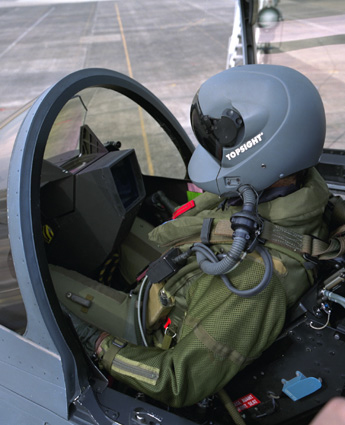 The latest generation of Helmet Mounted Displays for fighter applications enable the cueing of heatseeking missiles, and provide HUD like display of aircraft and weapons status and parameters, all projected at infinity on to a curved visor. A more recent development are binocular raster capable HMDs, which can display FLIR imagery. A number of current types also include fully embedded NVG tubes, which project directly on the visor, avoiding the cumbersome clip-on installation of existing NVGs. Depicted is the day only Topsight E, slated for use on the Rafale (Sextant Avionique). 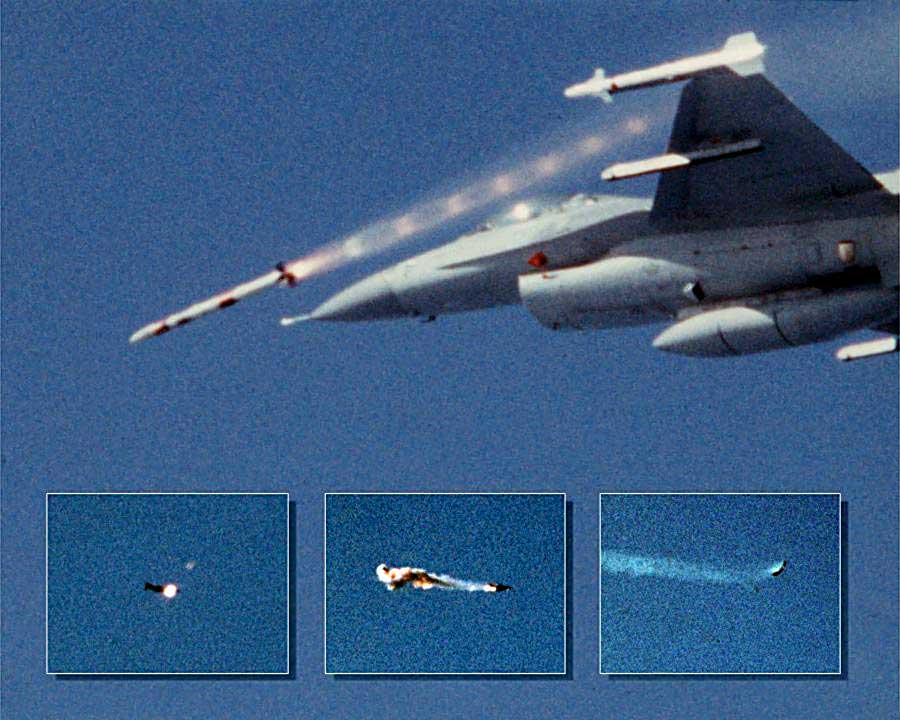 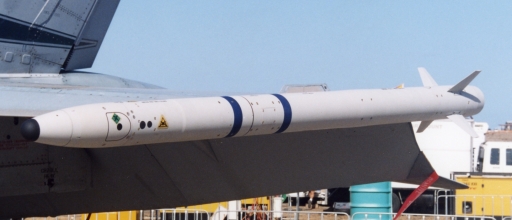 The AIM-132 ASRAAM is to become the RAAF's primary WVR AAM, carried on the F/A-18 Hornet. This missile would be a potent addition to the F-111, particularly if integrated with a Helmet Mounted Display, since the latter would allow the crew to fire the missile "over the shoulder" at any fighter which strays into their field of view. With range performance competitive with many BVR missiles, and support for passive targeting, the ASRAAM would make a forward quarter fighter intercept a potentially very risky proposition for an attacker (Matra-BAe). 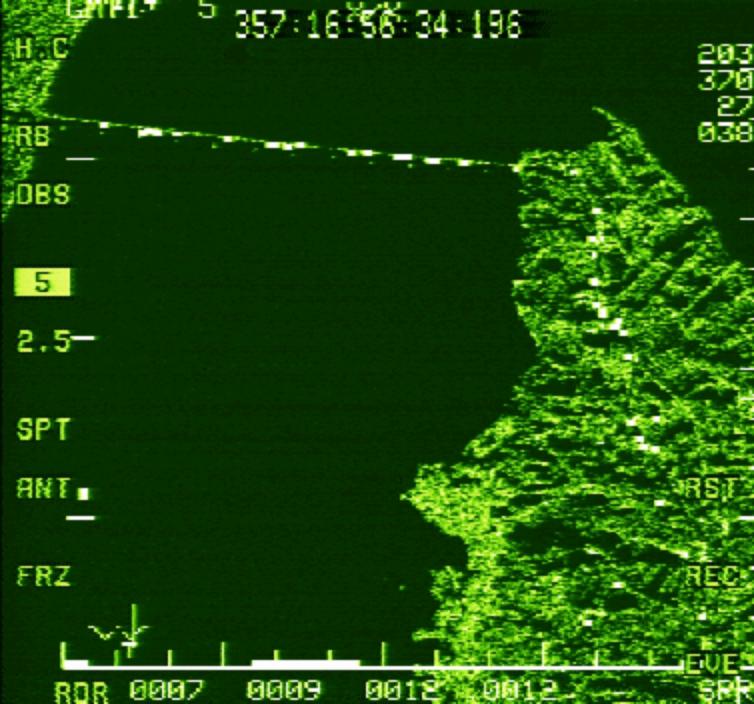 Without doubt the most urgent upgrade priority in the existing F-111C AUP/F-111G avionic suite is the fitting of a modern Synthetic Aperture Radar / Ground Moving Target Indicator mode capable attack radar. Weapons such as the AGM-142 SOW and follow-on AIR 5398 standoff munitions require such a radar for both supporting reconnaissance and effective inflight targeting of these weapons. This imagery was produced by the Norden APG-76 MMRS, which the Israeli Air Force use to support and target the AGM-142 from their upgraded F-4E Phantoms. The upper three images show Roswell AFB at 42.1 NMI (3 metre resolution), Langley AFB at 101.0 NMI (9 metre resolution), a road bridge at 37.8 NMI (18 metre resolution), the lower images show an LCAC hovercraft approaching a beach at 29.2 NMI (9 metre resolution), a convoy departing the beachhead, and helicopters departing a staging area, imaged at 27 NMI (9 metre resolution), and finally an image with 5 metre absolute registration accuracy, measured against a radar reflector. The rectangle is the Nav Box cursor, which surrounds the programmed coordinates. In the latter image, the radar was assisted by GPS (Norden). 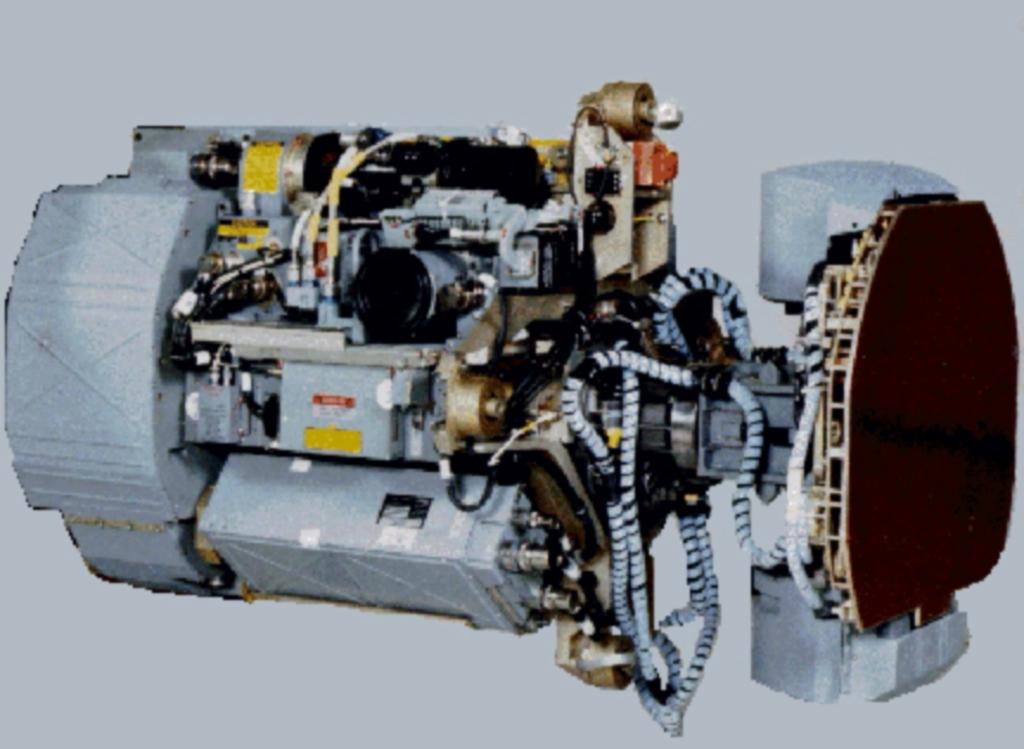
 Modern HMD technology allows the projection of critical flight, status, threat and engagement data directly on the pilot's visor. This example shows the pilot cueing an anti-radiation missile seeker against an offending threat emitter (Carlo Kopp). 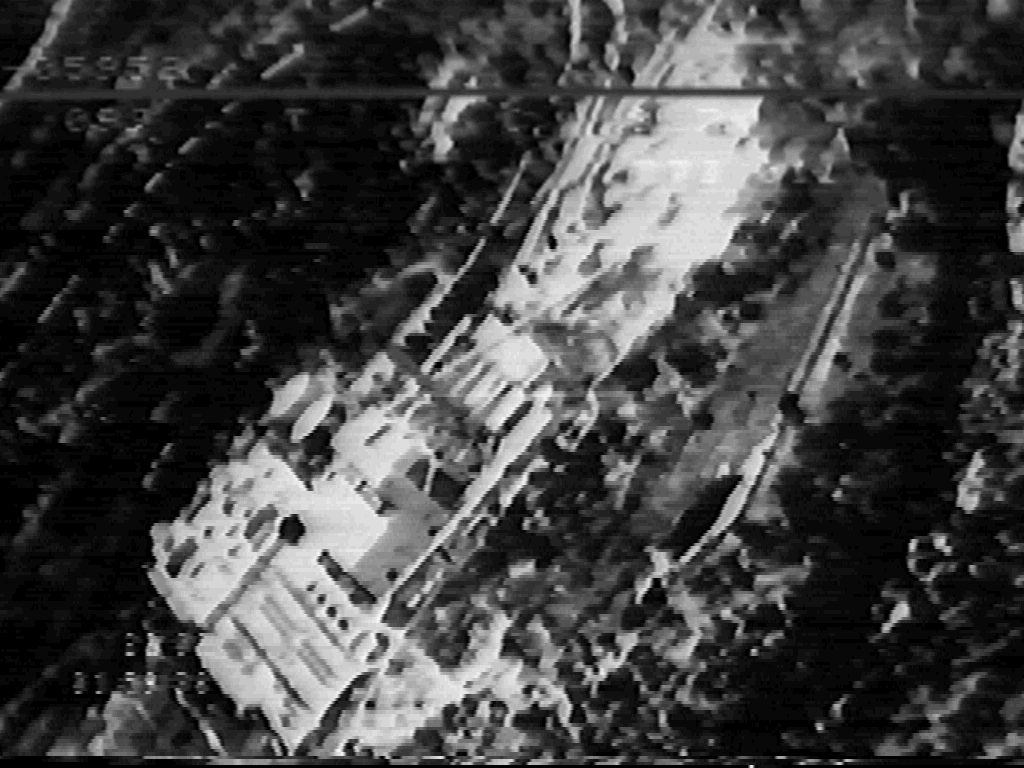 While the Pave Tack is now dated technologically compared to newer electro-optical/laser pods, it is still regarded to be a highly accurate sensor with excellent jitter performance, suitable for bombing from all altitudes. It primary limitation is poor resolution and moisture penetration in the tropics (82 WG RAAF). 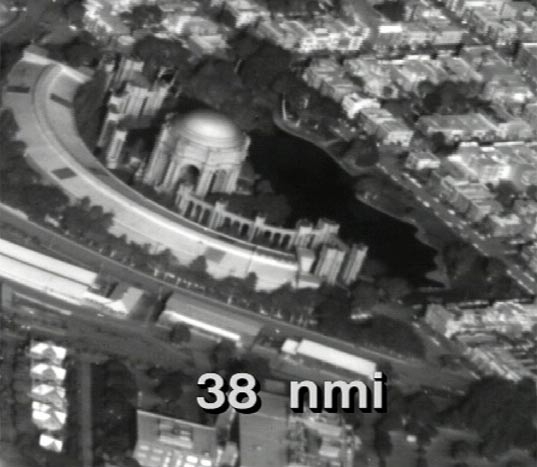 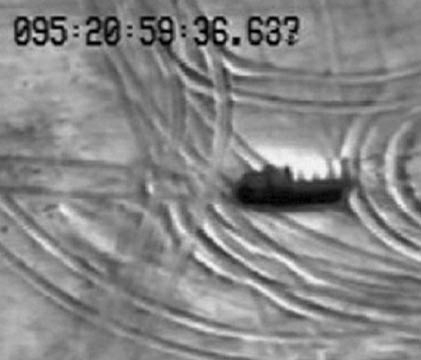 Current state of the art 8-12 and 4-5 micron band FLIR technology offers considerably higher image resolution and reliability than the sixties/seventies rotating mirror technology AAQ-9 FLIR imaging module in the Pave Tack. A good case can be made for a technology upgrade of the Pave Tack, inserting a current technology thermal imaging module into the existing pod design. The cost of buying up retired USAF Pave Tack pods and cradles, and refitting them with a new computer and thermal imaging module is a fraction of the cost of acquiring and integrating a new production pod design (Lantirn, Litening, TIALD), thus enabling the provision of a standardised installation across both the C and G model aircraft (Raytheon ATFLIR Imagery). |
||||||||
|
|||||||||||||
|
|
|
|
|
|
|
|
|
|
|
|||
|
|
|
|
|
|
|
|
|
|
|
|||
 |
|
|
|||||||||||
| Artwork, graphic design, layout and text © 2004 - 2014 Carlo Kopp; Text © 2004 - 2014 Peter Goon; All rights reserved. Recommended browsers. Contact webmaster. Site navigation hints. Current hot topics. | |||||||||||||
|
Site Update
Status:
$Revision: 1.753 $
Site History: Notices
and
Updates / NLA Pandora Archive
|
|||||||||||||
|
|
Tweet | Follow @APA_Updates | |||||||||||
|
|
|||||||||||||
|
|
|||||||||||||