|
||||||||||||||||||||||
 |
||||||||||||||||||||||
![F-22A Raptor, FB-22, F-22E, F-22N and Variants Index Page [Click for more ...]](APA/f-fb-22.png "F-22A Raptor, FB-22, F-22E, F-22N and Variants Index Page [Click for more ...]") |
 |
![People's Liberation Army Air Power Index Page [Click for more ...]](APA/pla-air-pwr.png "People's Liberation Army Air Power Index Page [Click for more ...]") |
 |
 |
 |
 |
 |
 |
![Military Ethics, Culture, Education and Training Index Page [Click for more ...]](APA/ethx-culture.png "Military Ethics, Culture, Education and Training Index Page [Click for more ...]") |
 |
||||||||||||
 |
![Russian / Soviet Weapon Systems Index Page [Click for more ...]](APA/rus-weps.png "Russian / Soviet Weapon Systems Index Page [Click for more ...]") |
 |
 |
 |

|
 |
 |
 |
 |
 |
||||||||||||
 |
 |
|||||||||||||||||||||
| Last Updated: Mon Jan 27 11:18:09 UTC 2014 | ||||||||||||||||||||||
|
||||||||||||||||||||||







| NIEMI/Antey
S-300V 9K81/9K81-1/9K81M/MK Self Propelled Air Defence System / SA-12/SA-23 Giant/Gladiator НИЭМИ/Антей Cамоходный Зенитный Ракетный Комплекс C-300В 9К81/9К81-1/9К81М/МК / «Антей 2500» Technical Report APA-TR-2006-1202 |
||||||||||||||||||||||||||||||||||||||||||||||||||||||||||||||||||||||||||||||||||||||||||||||||||||||||||||||||
| by
Dr
Carlo
Kopp, AFAIAA,
SMIEEE,
PEng First published 2003 Updated December 2006 Updated August 2007 Updated June December 2008 Updated July 2009 Updated November 2010 Updated May, June 2011 Updated April 2012 Text, Line Art © 2003-2012 Carlo Kopp |
||||||||||||||||||||||||||||||||||||||||||||||||||||||||||||||||||||||||||||||||||||||||||||||||||||||||||||||||
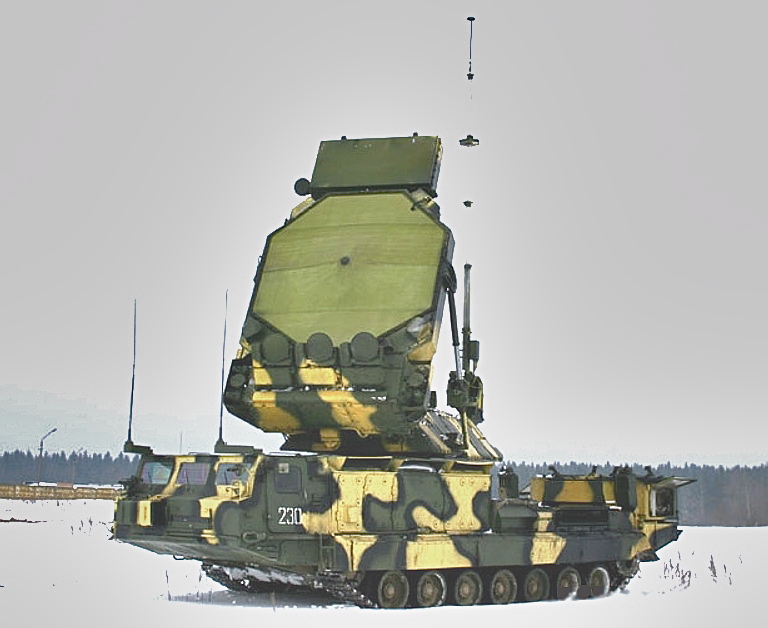
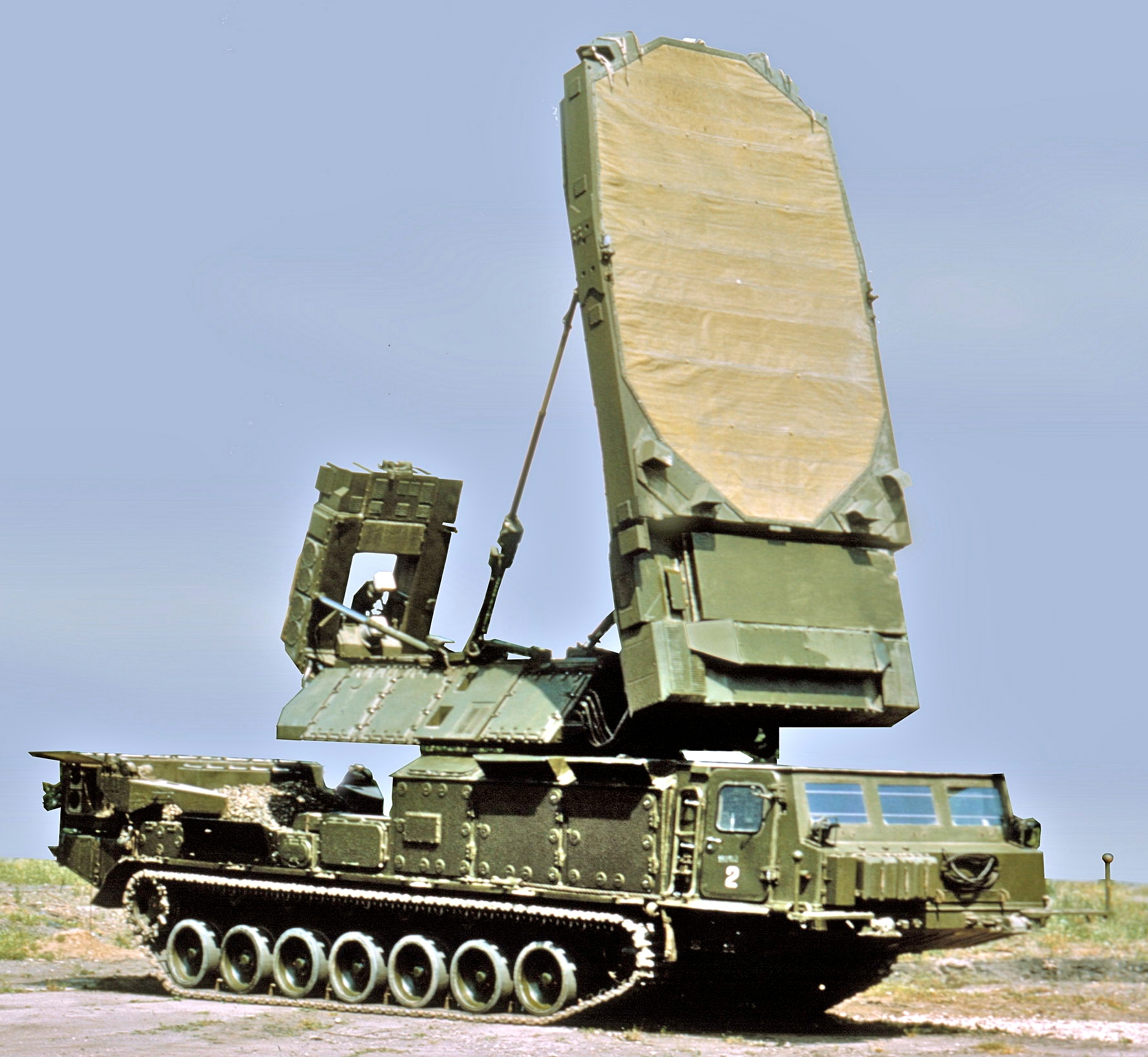
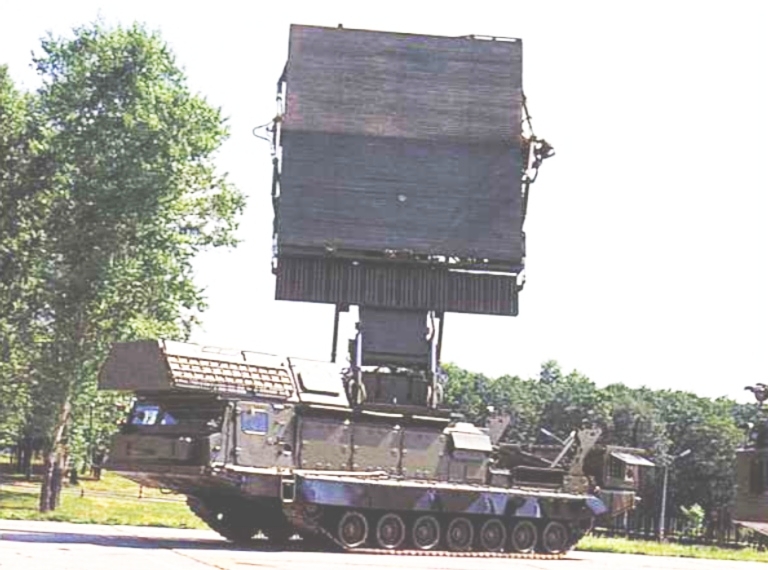
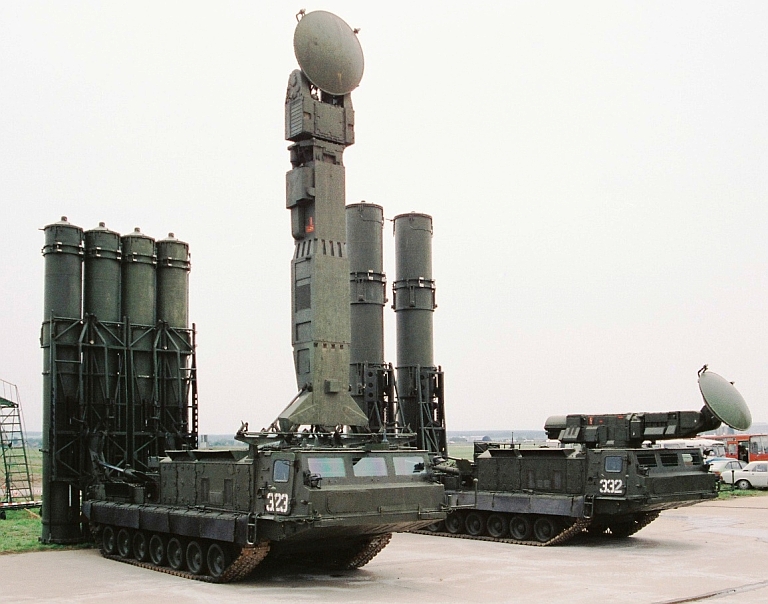 The S-300V/S-300VM/VMK/Antey-2500 is the world's only truly mobile Anti Ballistic Missile system, and later variants are claimed to be capable of intercepting 4.5 km/sec reentry speed targets. The large size of the Grill Pan phased array and TELAR command link and illuminator antennas is evident. The system provides the capability to engage very low RCS aircraft at ranges in excess of 100 nautical miles. Below: 9M82 Giant round (images © Miroslav Gyűrösi).  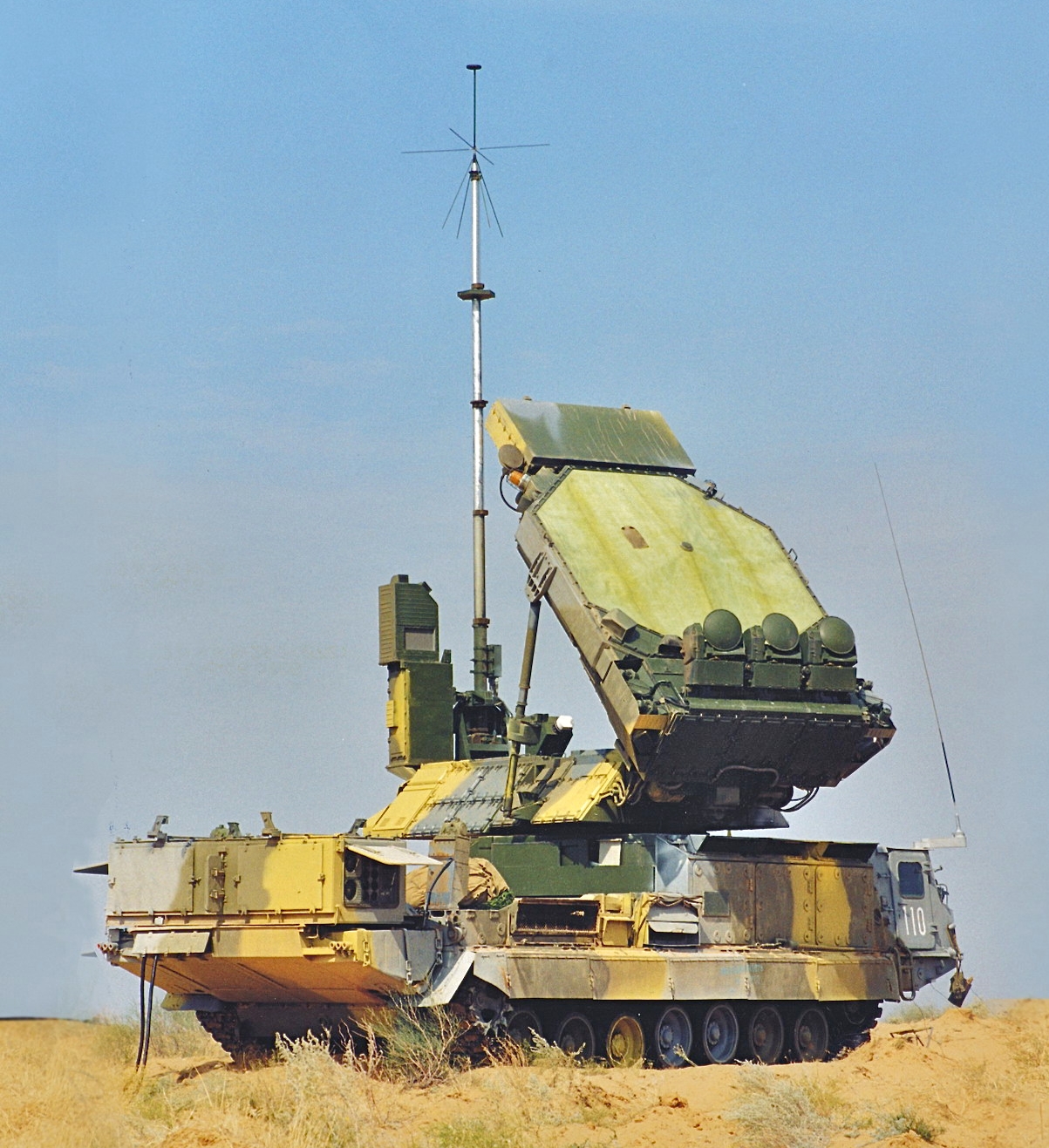 9S32 Grill Pan S-300V engagement radar deployed on an Article 830 series tracked vehicle (NIEMI image). |
||||||||||||||||||||||||||||||||||||||||||||||||||||||||||||||||||||||||||||||||||||||||||||||||||||||||||||||||
|
||||||||||||||||||||||||||||||||||||||||||||||||||||||||||||||||||||||||||||||||||||||||||||||||||||||||||||||||
Background The highly mobile Antey S-300V and
S-300VM remain one of the most lethal area defence SAM systems ever
developed, firing hypersonic missiles designed to engage aircraft,
cruise missiles and ballistic missiles.
Designed from the outset for high mobility and effectiveness against targets at all altitudes, the S-300V would have been a key player in any late Cold War conflict. This weapon was developed to provide not only long range area defence, but also to engage and destroy ISR assets like the E-3 AWACS, E-8 JSTARS and U-2, and tactical jammers like the EF-111A Raven and EA-6B Prowler. There have been repeated reports since the beginning of the decade in the Indian media that a buy of this system was imminent, but to date none has materialised. Numerous reports have also surfaced that the PLA is operating either an S-300V or S-300VM variant under the designation of HQ-18, although no hard evidence to support this claim has emerged as yet. From an Australian perspective the possible deployment of S-300V family of missiles in Asia is of major concern. Rapidly deployable, high survivable, and highly lethal, these weapons are especially difficult to counter and require significant capabilities to robustly defeat. The US Air Force currently envisages the F-22A Raptor as the primary weapon used to defeat these capable systems. It is important to note that no F/A-18 variant, nor the Joint Strike Fighter, were designed to penetrate the coverage of the S-300V/VM systems. The survivability of these aircraft will not be significantly better than that of legacy combat aircraft. Genesis of the Antey S-300V/SA-12A/B Gladiator/GiantWhile Antey's impressive S-300V family of SAM systems shares its earliest conceptual origins with the Almaz S-300P family, the two product lines diverged dramatically very early in their development histories. As a result, they share the same technology base but are essentially unique designs, optimised respectively for the needs of the prime customers, the V-PVO and PVO-SV. While the PVO-SV shared some static and semi-mobile radar systems with the V-PVO during the early 1960s, the PVO-SV deployed its own unique inventory of fully mobile SAM systems, reflecting its role of providing air defence cover for highly mobile Soviet tank and motorised infantry divisions. By the end of the 1960s the PVO-SV had deployed a three tier system, with the cumbersome ramjet powered command link guided 2K11/3M8 Krug / 1S12 Long Track / 1S32 Pat Hand / SA-4 Ganef system providing long range area defence, the quite effective 2K12/3M9 Kub / 1S91 Straight Flush / SA-6 Gainful system providing medium range area defence and the 9K33 Osa / 9K33 Romb / SA-8 Gecko, 9K31 Strela 1 / SA-9 Gaskin, and ubiquitous ZSU-23-4P SPAAG providing low altitude point defence. With the exception of the large 3M8/SA-4 Ganef this package was widely exported in the Arab world and Africa and whilst achieving some initial success against the Israelis in 1973 generally suffered greviously when applied against Western air power and electronic combat forces. By the early 1970s it was clear that a new generation of systems would be needed to challenge growing Western SEAD and EW capabilities. The S-300V system was to provide the top tier in the new air defence umbrella, directly replacing the 2K11/3M8 Krug / 1S12 Long Track / 1S32 Pat Hand / SA-4 Ganef system. Unlike first generation PVO-SV 3M8/SA-4 Ganef the S-300V would have a much broader role, encompassing both long range / high altitude air defence but also defence against US tactical ballistic missiles, specifically the Lance and high performance Pershing I/II, the FB-111A's supersonic AGM-69A SRAM standoff missile, and the new US Air Force MGM-109 Ground Launched Cruise Missile - a trailer launched nuclear armed Tomahawk variant based in the UK and Western Europe. As a result the S-300V would have to provide exceptionally good detection and tracking performance against low radar cross section targets, at very high and very low altitudes, while retaining the very high offroad mobility so typical of established PVO-SV tracked area defence SAM systems, and possessing exceptional resistance to the much feared USAF EF-111A Raven tactical jammer force. The S-300V was the result of these pressures - an expensive, complex but highly capable dual role SAM/ABM system which remains without equivalent to this day. It was to be an “Army level” or “Corp level” asset, protecting the centre of gravity of the Red Army's mechanised land forces against attack by nuclear and conventionally armed systems. The S-300V was supplanted by the enhanced S-300VM during the 1990s, using the 9S15M2/MT2E/MV2E, 9S19ME, 9S32ME and 9S457ME components, and improved 9M82M and 9M83M missiles. This system has been marketed as the “Antey 2500”, intended to highlight its capability to engage 2,500 km range IRBMs with re-entry velocities around 4.5 km/sec. The 9M82M has double the range of the 9M82 against aerial targets, at 108 nautical miles, and increased terminal phase agility - a single shot kill probability of 98% is claimed against ballistic targets. The S-300VMK is a proposed wheeled configuration of the design, using a BAZ 69096 10 x 10 all terrain truck chassis.
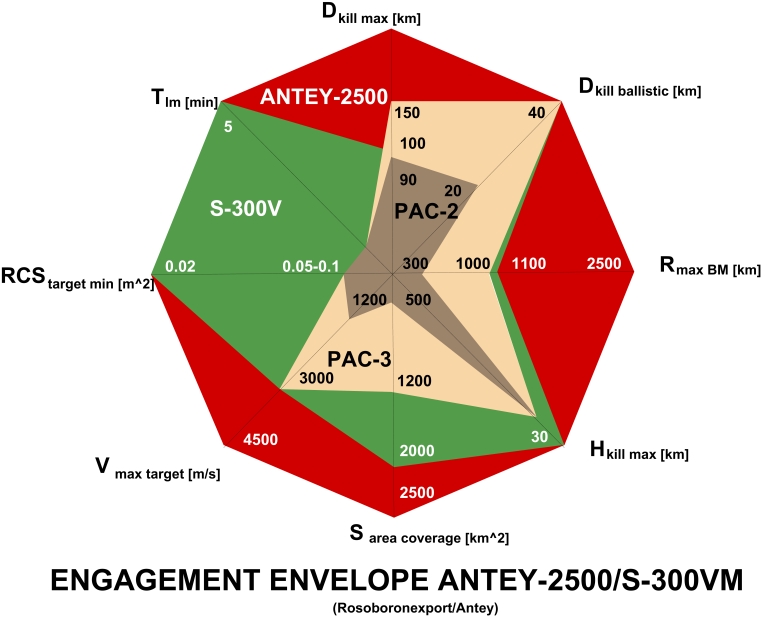
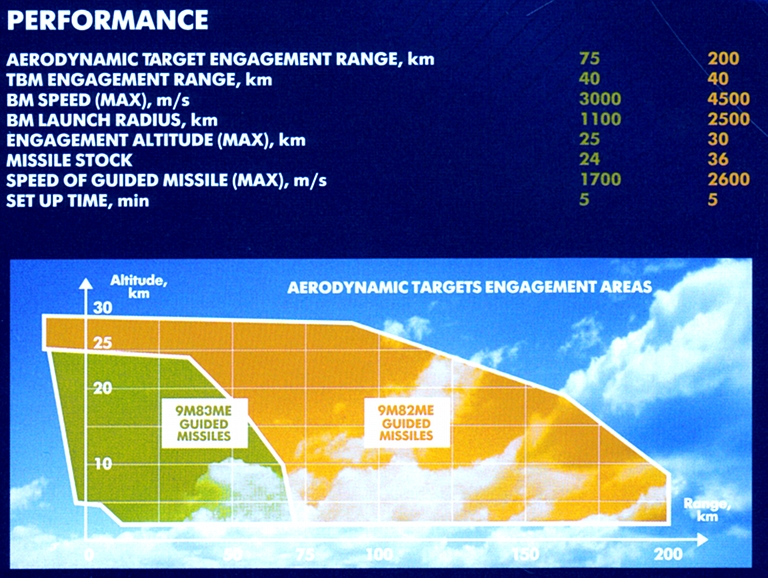 S-300VM
Kinematic
Envelopes (Antey)
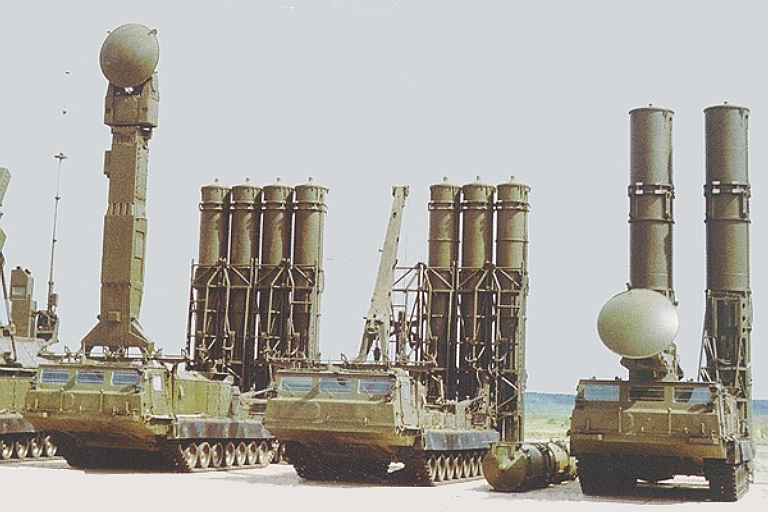 S-300V Battery components, above left to right, 9A83 TELAR, 9A84 TEL/TL with crane elevated, 9A82 TELAR, below left to right, 9S15 Bill Board acquisition radar, 9S457 CP and 9S32 Grill Pan engagement radar. 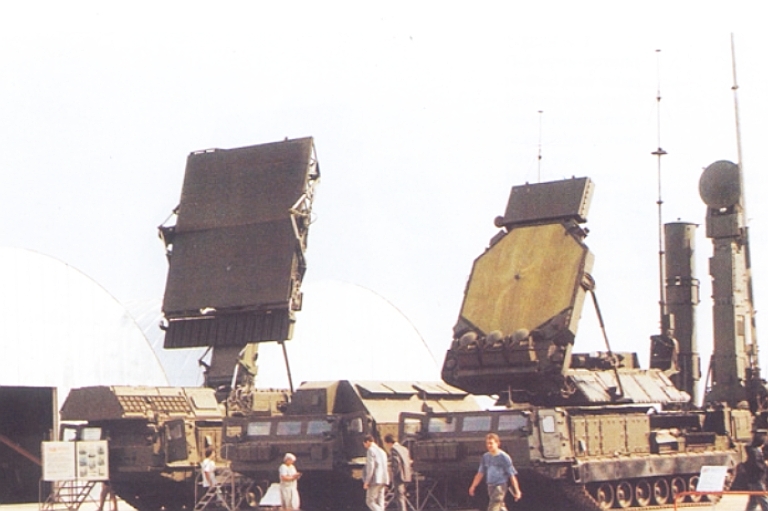 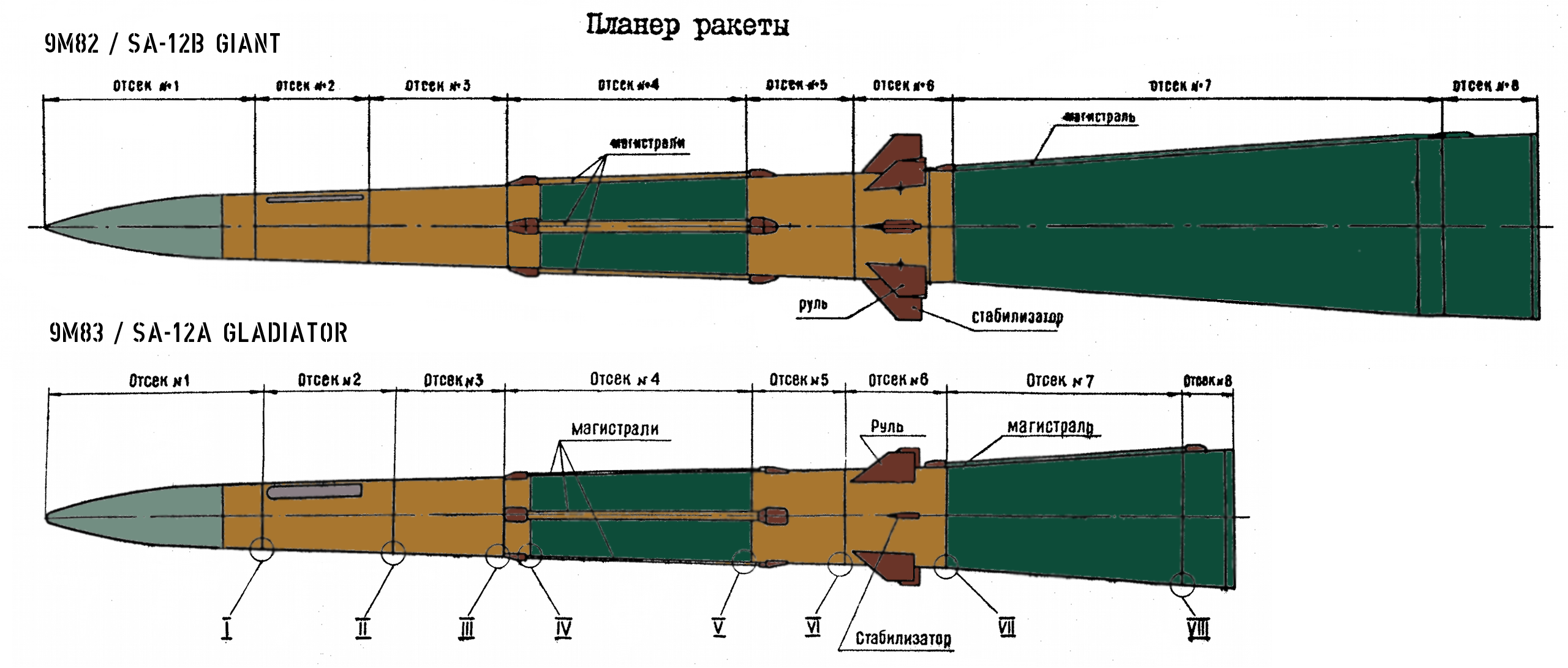 S-300V/VM/SA-12/23 System Design and IntegrationAll principal components of the S-300V system are carried on the “Item 830” series tracked vehicle, with gross weights between 44 and 47 tonnes per vehicle - the S-300V is not a lightweight system - and has similar offroad mobility to a medium tank. The S-300V system comprises no less than eight unique system vehicles, the 9S457 mobile command post, the 9S15 Bill Board acquisition radar, the 9S19 High Screen ABM early warning radar, the 9S32 Grill Pan engagement radar, the 9A82 and 9A83 TELARs (Transporter Erector Launcher and Radar), and the 9A84 and 9A85 TEL/Transloader vehicles.The paired acquisition radars are each optimised for their specific roles, with a limited overlap in capabilities, as the 9S15 Bill Board has some ABM early warning capability, and the 9S19 High Screen can acquire and track airborne targets. The 9S32 Grill Pan is more narrowly optimised as an engagement radar for missile guidance. The 9A82 and 9A83 TELARs each include high power CW illuminators for missile guidance and command uplinks, and also provide these guidance functions for the 9A84 and 9A85 TEL/Transloaders, which operate as slave TELs in the battery. Typical battery integration involves datalink tie-ins with the divisional level 9S52/9S52M Polyana DM series command posts, and the use of the Pori P1 series radar data fusion centre. Often S-300V / SA-12 batteries are supplemented with a 1L13-3 Nebo SV VHF-band 2D early warning and acquisition radar. The S-300VM / SA-23 retains the basic battery structure of the earlier variant, replacing individual components with revised designs.  S-300VM
/
SA-23
battery
composition
and
integration
(Antey).
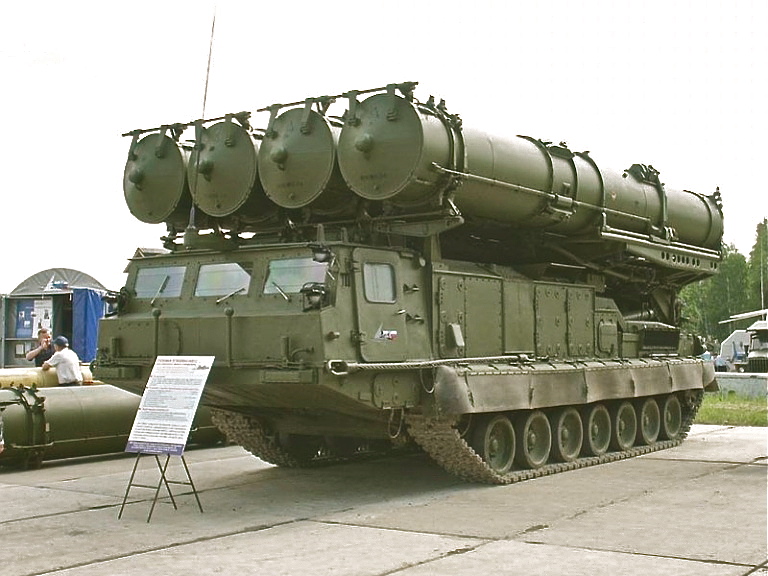
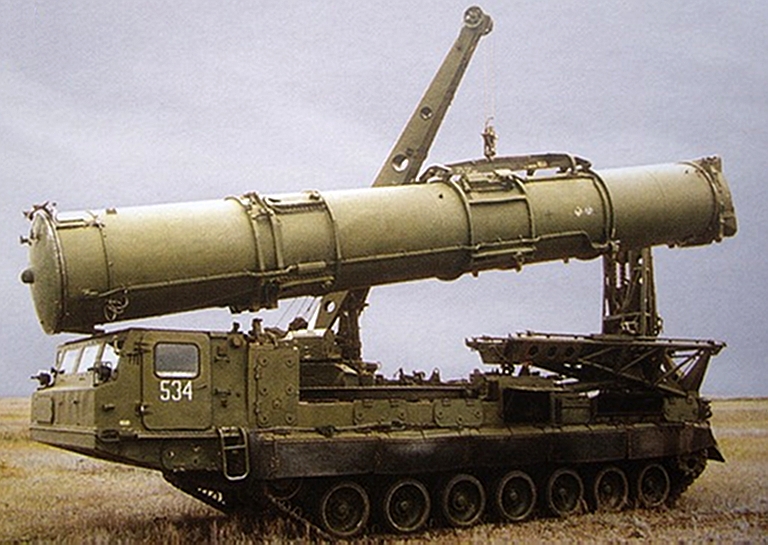
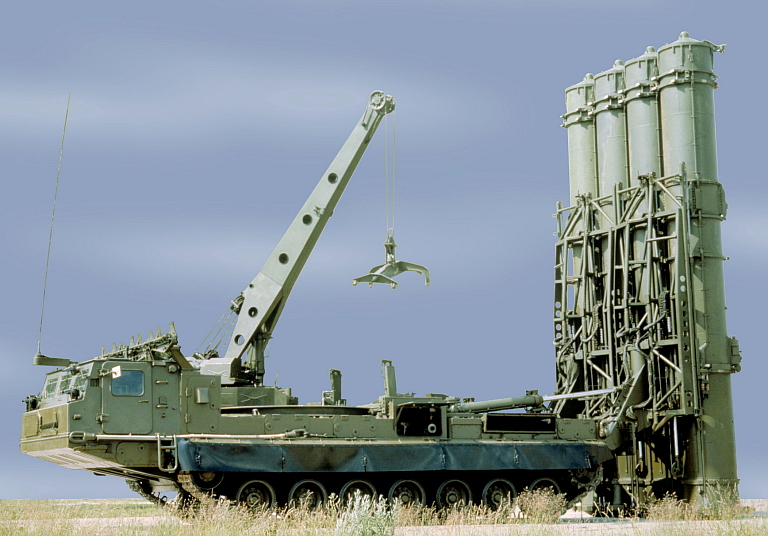
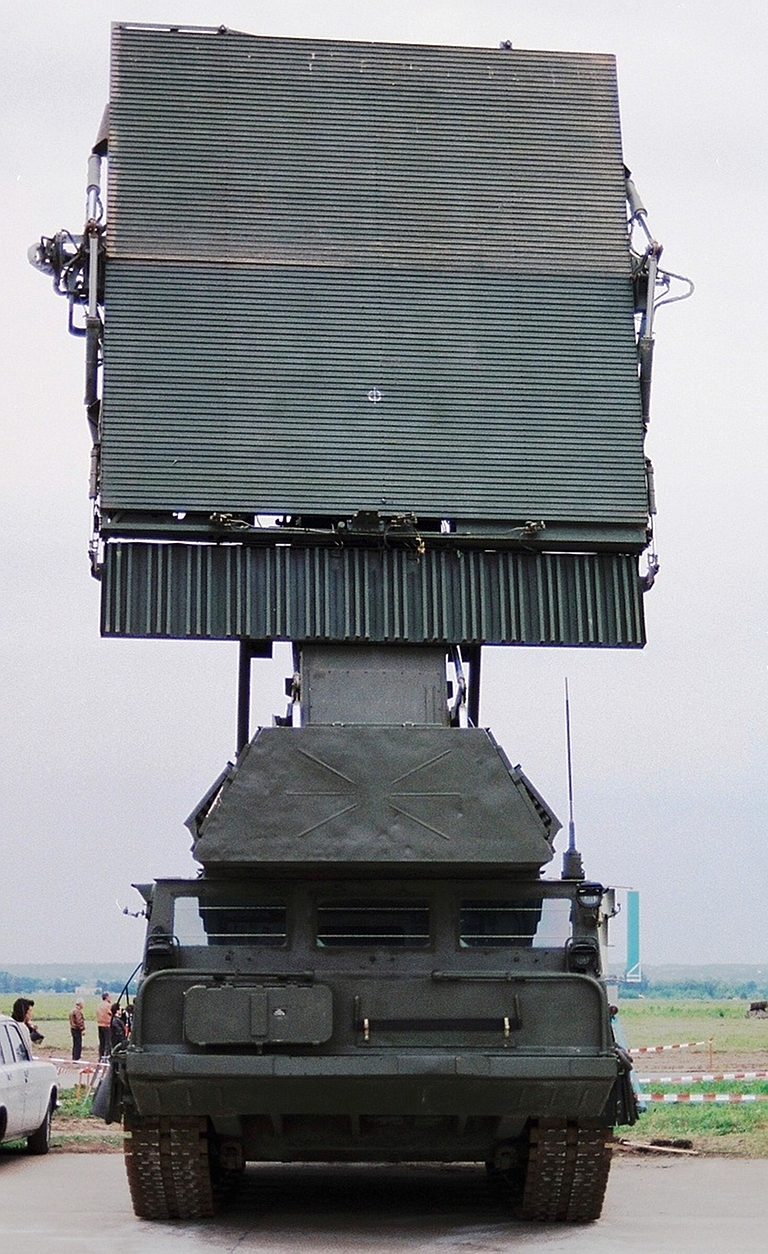
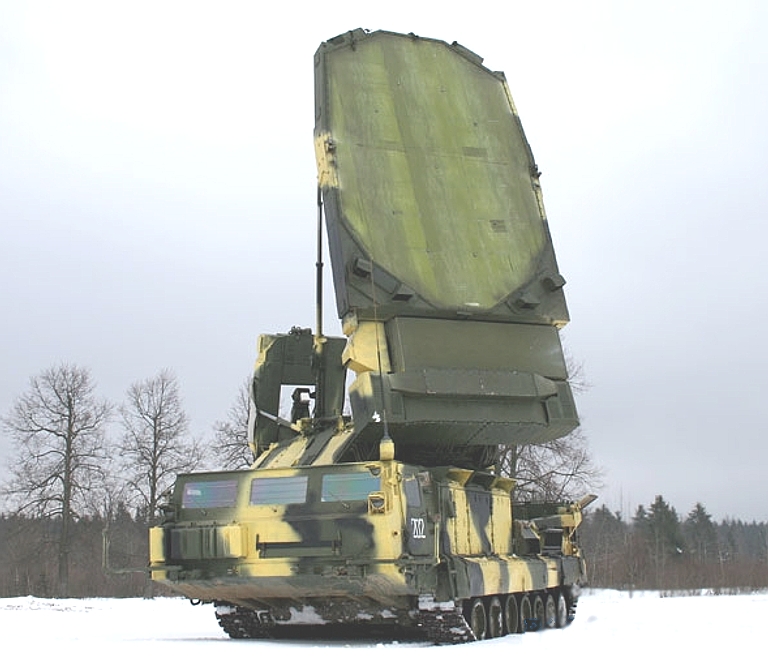
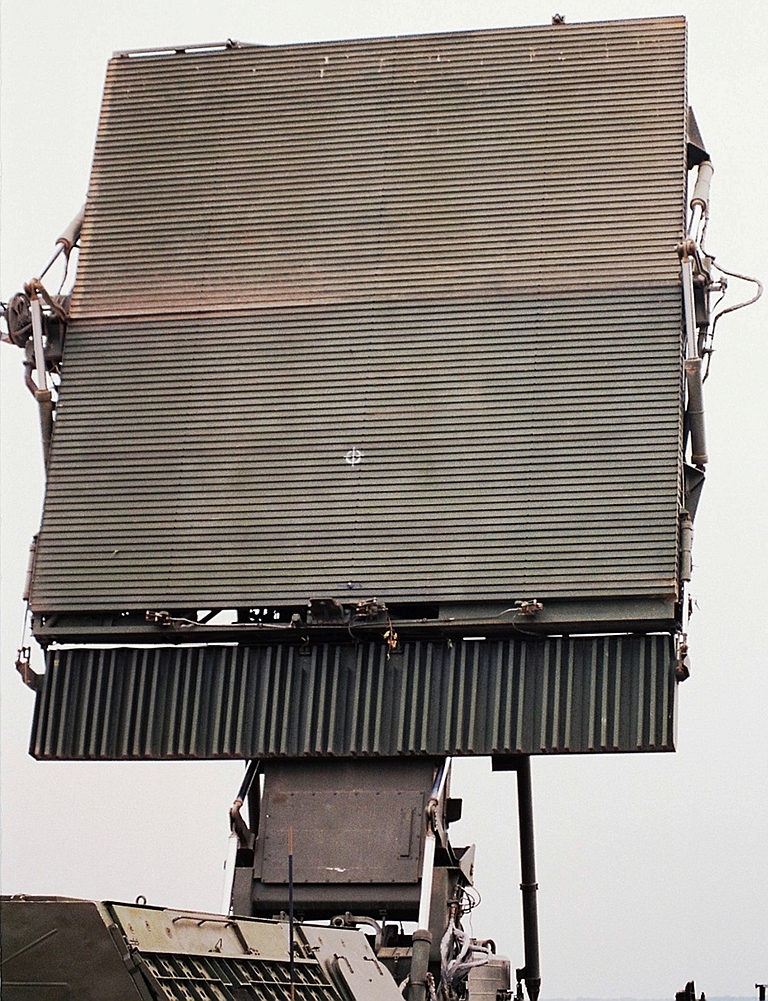
9S32 Grill Pan and 9S32M Engagement RadarsThe 9S32 Grill Pan is an engagement radar similar in concept and function to the MPQ-53 and 30N6, but larger with the antenna turret capable of slewing through ±340º. It will automatically acquire and track targets provided by the 9S457 command post, control the operation of TELAR mounted illuminators and generate midcourse guidance commands for up to 12 missiles fired at 6 targets concurrently. The S-300V system uses continuous wave illumination of targets and semi-active radar terminal homing, not unlike the US Navy RIM-66/67 series SAMs - the illuminators are carried on the 9A82 and 9A83 TELARs. Like the 9S19, the 9S32 is a high power-aperture, coherent, X-band phased array, but specialised for missile guidance producing a mainlobe of around of 1º in width. The TWT based transmitter is rated at 150 kW peak and 10-13 kW average power, with receiver sensitivity cited at 10-17 Watts. Cited detection ranges are about 80 nautical miles for fighter sized targets, 40 nautical miles for SRAM class missiles and up to 80 nautical miles for larger IRBMs. The radar uses monopulse angle tracking techniques, frequency hopping in all modes to provide high jam resistance, and chirped waveforms providing a high compression ratio. Three auxiliary receiver channels are used for cancelling sidelobe jamming. Two basic operating modes are used. In the first the 9S32 is controlled by the 9S457 command post and acquires targets within a narrow 5º x 6º field of view, alternately it can autonomously search and acquire targets within a 60º field of view. A telescoping mast datalink antenna is mounted aft of the array.A more detailed discussion can be found under Engagement and Fire Control Radars, with a detailed technical analysis of the design under David Barton's 9S32/32M Grill Pan Fire Control Radar.  While the S-300VM sees incremental improvements in most components, the 9M32M/ME engagement radar underwent a significant redesign, especially in the antenna. Brochure material produced by the manufacturer shows a design which can be best described as a hybrid of components from the Grill Pan and the High Screen. The larger aperture High Screen array is employed, combined with revised IFF array and interferometer / sidelobe blanker antenna array below the primary aperture. The high and low angle circular polarised monopulse space feeds are retained but repositioned for the different array geometry. The new enlarged aperture will exhibit almost twice the gain of the Grill Pan, much better angular resolution especially for targets near the zenith, and improved heightfinding performance. The 9S32M/ME will have a much higher peak power rating compared to the 9S32 Grill Pan since the additional range of the 9M82M cannot be accommodated by the ~3 dB power-aperture improvement produced by the larger antenna alone. A more detailed analysis will not be possible until good quality imagery of prototypes or production systems becomes available. 9A82 and 9A83 TELARs and 9A84 and 9A85 TEL/TransloadersThe 9A82 and 9A83 TELARs carry two Novator designed 9M82 / SA-12 Giant long range SAM/ABMs, and four 9M83 Gladiator SAM/ABMs respectively. Each TELAR is equipped with a steerable high gain antenna used to transmit midcourse guidance commands to the missiles and provide continuous wave illumination of the target for the missiles' semi-active radar seekers during the terminal guidance phase - one source cites 10-12 kW of CW power rating. The TELARs are controlled by the 9S32 Grill Pan using either cables or a bidirectional radio datalink, permitting the TELARs to return status information to the guidance radar. The 9A82 TELAR is optimised for engaging targets at higher altitudes, and can slew its antenna through 180º in azimuth, and 110º in elevation, while the 9A83 TELAR has an elevating and telescoping mast providing antenna coverage of the full upper hemisphere - this arrangement is intended to extend the engagement footprint against low altitude targets. The TELARs are supplemented by the 9A84 and 9A85 TEL/Transloaders, essentially dumb launchers which can be used only with guidance/illumination from a nearby TELAR, and equipped with hydraulic loading cranes instead of antenna booms. A more detailed technical analysis of the antenna design can be found under David Barton's 9A82 Giant and 9A83 Gladiator TELARs. 9S15/9S15MT Obzor / Bill Board Acquisition RadarsThe fully mobile 9S15 Obzor 3 /
Bill Board acquisition radar is a
mechanically rotated 3D radar system, with electronic beam steering in
elevation and an IFF array. It provides long range early warning of
aerial threats and low end TBMs such as the Scud A and Lance.
The 9S15 has two basic modes of operation. The first is optimised for a 12 second sweep and is claimed to provide a 50% probability of detecting a fighter sized target at 130 nautical miles. The second mode employs a faster 6 second sweep period, and is used to detect inbound TBMs and aircraft, with a reduced detection range of about 80 nautical miles for fighters, and 50 to 60 nautical miles for TBMs like the Scud A or Lance. Russian sources are unusually detailed on ECCM techniques used, claiming the use of three auxiliary receiver channels for cancelling sidelobe jamming, automatic wind compensated rejection of chaff returns, and provisions in the MTI circuits to reject jamming. A facility for precise angular measurement of jamming emitters is included. RMS tracking errors are quoted at 250 metres in range and about 0.5 degrees in azimuth/elevation, with the ability to track up to 200 targets. The system has an integral gas turbine electrical power generator for autonomous operation - a feature of most S-300V components. This radar provides a highly
mobile 3D search and acquisition capability, but is limited in low
level
coverage footprint by its antenna elevation. Its limited scan rate
makes it unusable for high performance IRBM acquisition and tracking,
which is the role of the 9S19 High Screen radar.
A more
detailed discussion can be found under Search
and Acquisition
Radars, with a detailed technical analysis of the design under
David Barton's 9S15/9S15M/MT
Obzor
3
/
Bill
Board
Three-Dimensional
Surveillance
Radar.
9S19/9S19M Imbir / High Screen ABM Acquisition RadarThe specialised 9S19 Imbir is a
high power-aperture, coherent, X-band phased array designed for the
rapid acquisition and initial tracking of inbound ballistic missiles
within a 90 degree sector. To that effect it uses a large passive phase
shifter technology transmissive array, using a conceptually similar
space
feed technique to the MPQ-53 and 30N6 series radars, producing a narrow
0.5 degree pencil beam mainlobe. The primary search waveform is chirped
to provide a very high pulse compression ratio intended to provide very
high range resolution of small targets. The design uses a high power
Travelling Wave Tube (TWT) source, very low sidelobes and frequency
hopping techniques to provide good resistance to jamming.
Three primary operating modes are used. In the first the 9S19 scans a 90 degree sector in azimuth, between 26 and 75 degrees in elevation, to detect inbound Pershing class IRBMs within a 40 to 95 nautical mile range box, feeding position and kinematic data for up to 16 targets to the 9S457 command post. The second mode is intended to detect and track supersonic missiles such as the AGM-69 SRAM, and sweeps a narrower 60 degree sector in azimuth, between 9 and 50 degrees in elevation, within a range box between 10 and 90 nautical miles, generating target position and velocity updates at 2 second intervals. The third mode is intended to acquire aircraft in severe jamming environments, with similar angular and range parameters to the second mode. The radar is claimed to produce RMS angular errors of around 12 to 15 minutes of arc, and a range error of a mere 70 metres (at max range 0.04%!). The peak power rating remains undisclosed. In function the 9S19 most closely resembles much newer Western X-band ABM radars, but is implemented using seventies generation antenna and transmitter technology, and is fully mobile unlike the semimobile US THAAD X-band radar, and Israeli Green Pine.A more detailed discussion can be found under Search and Acquisition Radars. |
||||||||||||||||||||||||||||||||||||||||||||||||||||||||||||||||||||||||||||||||||||||||||||||||||||||||||||||||
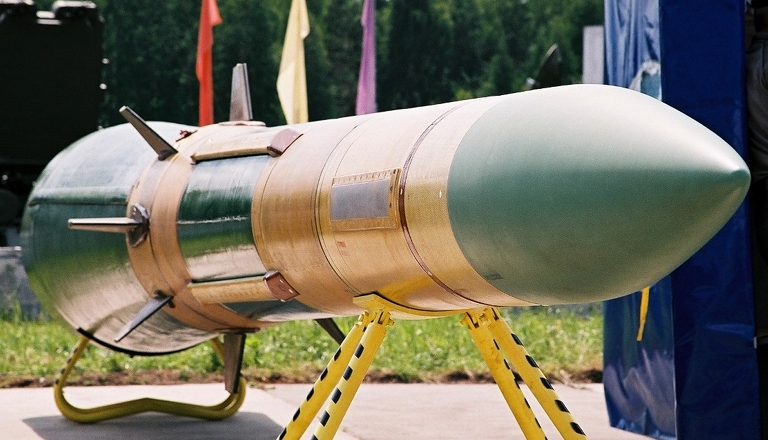 All 9M82 and 9M83 images © Miroslav Gyűrösi. 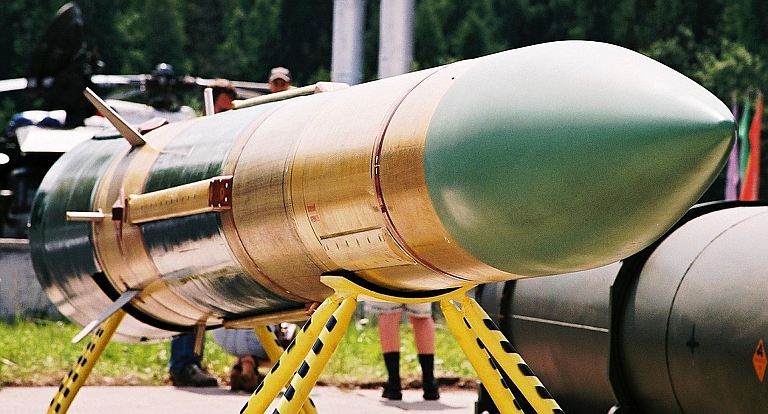 Novator 9M82 / SA-12B Giant and 9M83 / SA-12A Gladiator MissilesThe two stage 9M83 “Type I
Missile” / SA-12A
Gladiator
and 9M82 “Type II Missile” / SA-12B Giant are the guided missiles used
by the S-300V /
SA-12 system. The missiles are largely common in design, the principal
distinctions being different first stage boosters, different
control surface arrangements, and numerous detail differences.
The conical aerodynamic design and general configuration of both S-300V missiles is modelled on the earlier US Martin Marietta Sprint ABM which was similar in size to the 9M83 / SA-12A Gladiator but had performance closer to the 9M82 / SA-12B Giant. Both Soviet missiles, intended to kill both aerial and ballistic targets, outrange the more specialised Sprint ABM. The smaller 9M83 Gladiator
SAM/ATBM is intended to engage aerial targets at all altitudes,
including
cruise missiles, and smaller TBMs. The much larger 9M82 Giant has
higher kinematic performance and is intended to kill IRBMs, SRAM class
supersonic missiles, but also standoff jamming aircraft at long ranges.
Both weapons employ two solid propellant stages, with thrust vector control of the first stage (10,225 lb / 4,636 kg mass in the Giant and ~5,000 lb / 2275 kg in the Gladiator) and aerodynamic control of the 2,800 lb (1,200 kg) second stage, using four servo driven fins, and four fixed stabilisers. The guidance and control packages, and much of the weapon airframes are almost identical, the principal distinction being the bigger booster stage of the Giant and its larger stabilisers8,9. A cold start ejector is used to
vertically expel the missile from the 9Ya238/9Ya240 (9M82/9M83) launch
tube, using a spherical gas generator in the base of the tube,
the 9D128 first stage burns until exhausted, upon which the
missile jettisons the spent first stage and transitions to its 9D126
midcourse
sustainer powerplant. Immediately post-launch, once the
missile has cleared the launch tube, the 9D124 “declination powerplant”
is engaged. This is a short burn duration thruster system, which
employs several exhaust ports on the lower rim of the first stage
nozzle. The purpose of this system is to effect a post-launch pitching
manoeuvre to the intended target heading, and optimal elevation
(pitch/yaw) angle
for initiating the first stage motor burn. Once the missile has been
pointed in the desired direction, the first stage motor is started and
burns for 3.5 to 6.2 seconds in the 9M82, or 4.11 to 6.4 seconds in the
9M83. Flight control during the first
stage burn is effected by four internal nozzle ports for gas
injection Thrust Vector Control (TVC), in a manner similar to the
Martin-Marietta Sprint ABM and ARPA HIBEX demonstrator. While the US
designs injected liquid freon into the exhaust flow, the Novator design
draws high pressure exhaust gas upstream of the nozzle and injects it
into the exhaust stream at the point where the flow is described as
supercritical. The first stage has a truncated
conical shape, with most of the upper portion occupied by the annular
conically shaped bonded solid propellant motor, which exhausts into a
conventional bell nozzle, with TVC ports located close to the
combustion chamber exist aperture. An external cable duct is used to
carry electrical power and control signals to the two TVC control
systems in the first stage. Once the first stage it expended
it is jettisoned by pyrotechnic charge, and the kill vehicle 9D126
bonded solid propellant sustainer is ignited. The sustainer occupies
the portion of the fuselage which can be identified by the four
symmetrical external cable ducts, which connect the guidance systems in
the nose section with the aft section containing control surface
actuators and the electrical powerplant. The bell shaped sustainer
nozzle in the tail is fed by a central cylindrical exhaust duct which
passes through the aft fuselage section. Burn duration is cited at 11.2
- 17.2 seconds for both the 9M82 and 9M83. Observation of 9M82 Giant launch
footage confirms the stated stage burn durations, and also indicates
the use of an energy management profile, where the missile boosts
to an apogee, and post apogee flies a pulldown/pullup manoeuvre
before transitioning into a shallow dive as it closes with the the
intended target. Both missile types employ four
actuator driven cruciform tail control surfaces, and four fixed
stabilising fins, smaller than the control surfaces in the 9M83, and
equally
sized in the 9M82. Power for the actuators and guidance avionics is produced by the 9B153 gas turbine electrical powerplant, which drives two AC busses at 1,000 Hz, and two DC busses. High pressure gas is produced by an starting gas generator cartridge and a sustainer gas generator cartridge. During midcourse flight the
missile employs inertial
navigation. This is performed using the onboard 9B619 digital computer,
and a 9B627 inertial unit. Two midcourse guidance modes are
employed:
In the former mode it transitions to its semi-active homing seeker during the final 10 seconds of flight, in the latter 3 seconds before impact - a technique preferred for heavy jamming environments. The midcourse guidance system attempts to fly the most energy efficient trajectory to maximise range. The datalink channel antennas are
embedded in the cruciform tail surfaces. The endgame homing algorithm has
not been disclosed. The 9E49/DB-100N semi-active homing seeker will
generate
target angles and angle rates. It is likely that a P-nav algorithm with
lead bias is employed. The antenna is cued to the target pitch/yaw
angles during endgame closure by the onboard computer. Russian sources claim the dual plane monopulse two-channel X-band semi-active seeker can lock on to a 0.05 m2 RCS target from 16.2 nautical miles. A two channel radio proximity fuse is used to initiate the 9N127 330 lb (150 kg) class “smart” warhead which has a controllable fragmentation pattern to maximise effect. The missile is also equipped with a self destruct system. As the missile approaches the
target, it will perform a rolling manoeuvre to align the directional
warhead with the plane of the target. The proximity fused warhead
produces a high velocity stream of fragments in a narrow cone normal to
the axis of the missile. 9M82 Giant missile velocity entering the
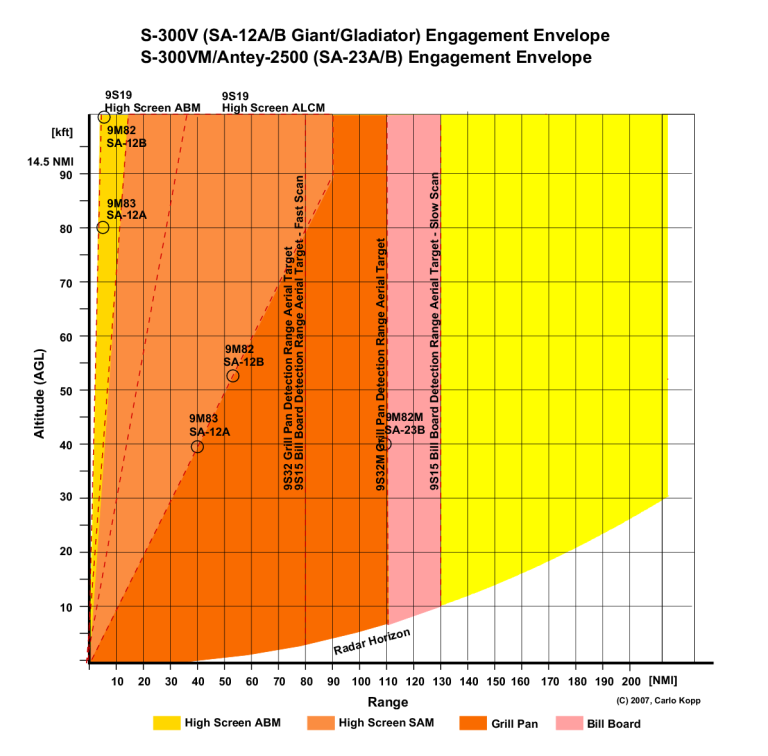
endgame is ~3.5 M. The engagement envelope of the baseline Gladiator is between 80 ft AGL to 80 kft, and ranges of 3.2 to 40 nautical miles, the Giant between 3,200 ft AGL to 100 kft, and ranges of 7 to 54 nautical miles. The system can launch the missiles at 1.5 second intervals, and a battalion with four batteries can engage 24 targets concurrently, with 2 missiles per target, and has a complement of between 96 and 192 missiles available for launch on TELAR/TELs. A TELAR can arm a missile for launch in 15 seconds, with a 40 second time to prepare a TELAR for an engagement, and 5 minute deploy and stow times - a genuine “hide, shoot and scoot” capability. The cited single shot kill
probabilities for the Gladiator are 50% to 65% against TBMs and 70% to
90% against aircraft, for the Giant 40% to 60% against IRBMs and 50% to
70% against the AGM-69 SRAM - ballistic missiles with re-entry
velocities of up to 3 km/s can be engaged. Russian sources credit the
missiles with endgame capability against 7-8G manoeuvring targets. The
later 9M82M and 9M83M are credited with a 30G endgame capability. The Soviets were terrified of
the EF-111A fleet operated by Tactical Air Command and equipped the
S-300V system with a facility for passive targeting of support jammers.
The 9S15, 9S19 and 9S32 have receiver channels for sidelobe jamming
cancellation and these are used to produce very accurate bearings to
the airborne jammer, this bearing information is then used to develop
angular tracks. The angular tracks are then processed by the 9S457
command post to estimate range, and the 9S32 then develops an estimated
track for the target jammer. A Giant missile is then launched and
steered by command link until it acquires the target.
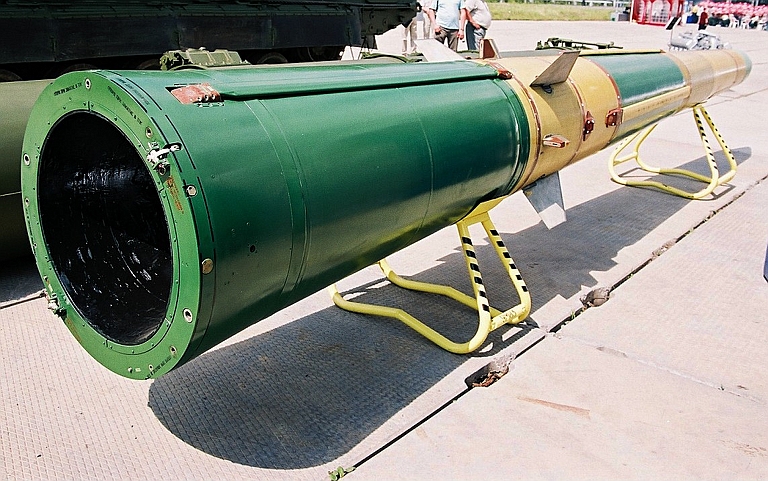
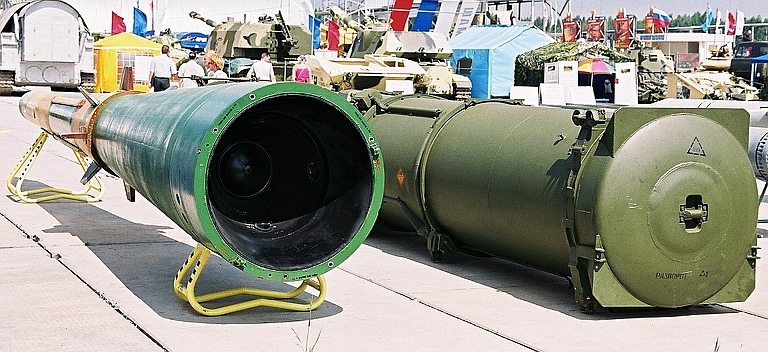 9M82
Giant
round and 9Ya238 transport container.
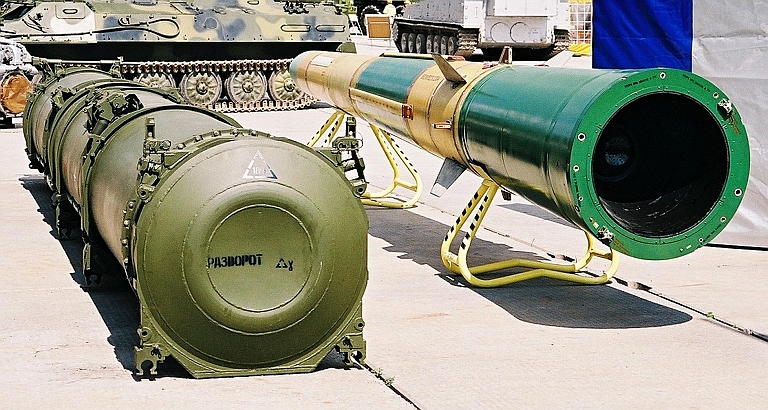 9M83 Gladiator round and 9Ya240 transport container. 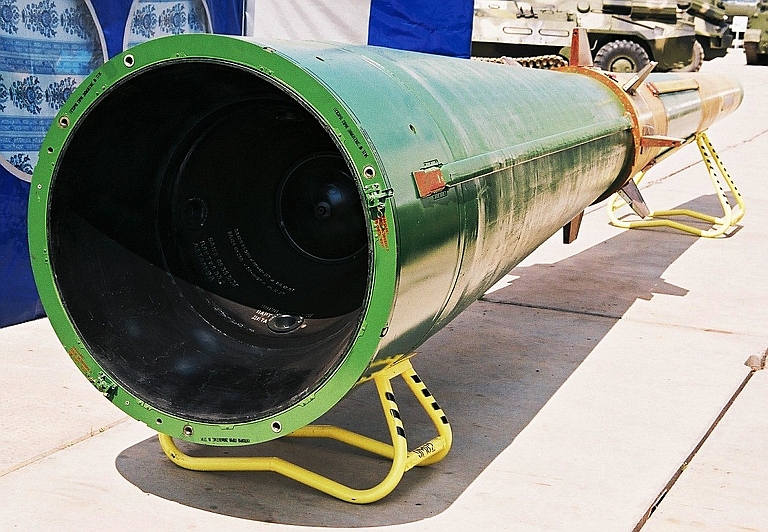 9M82
Giant
round nozzle detail.
9M83 Gladiator round nozzle detail.
|
||||||||||||||||||||||||||||||||||||||||||||||||||||||||||||||||||||||||||||||||||||||||||||||||||||||||||||||||
9M82 / SA-12B
Giant
and 9M83 /
SA-12A Gladiator Drawings
|
||||||||||||||||||||||||||||||||||||||||||||||||||||||||||||||||||||||||||||||||||||||||||||||||||||||||||||||||
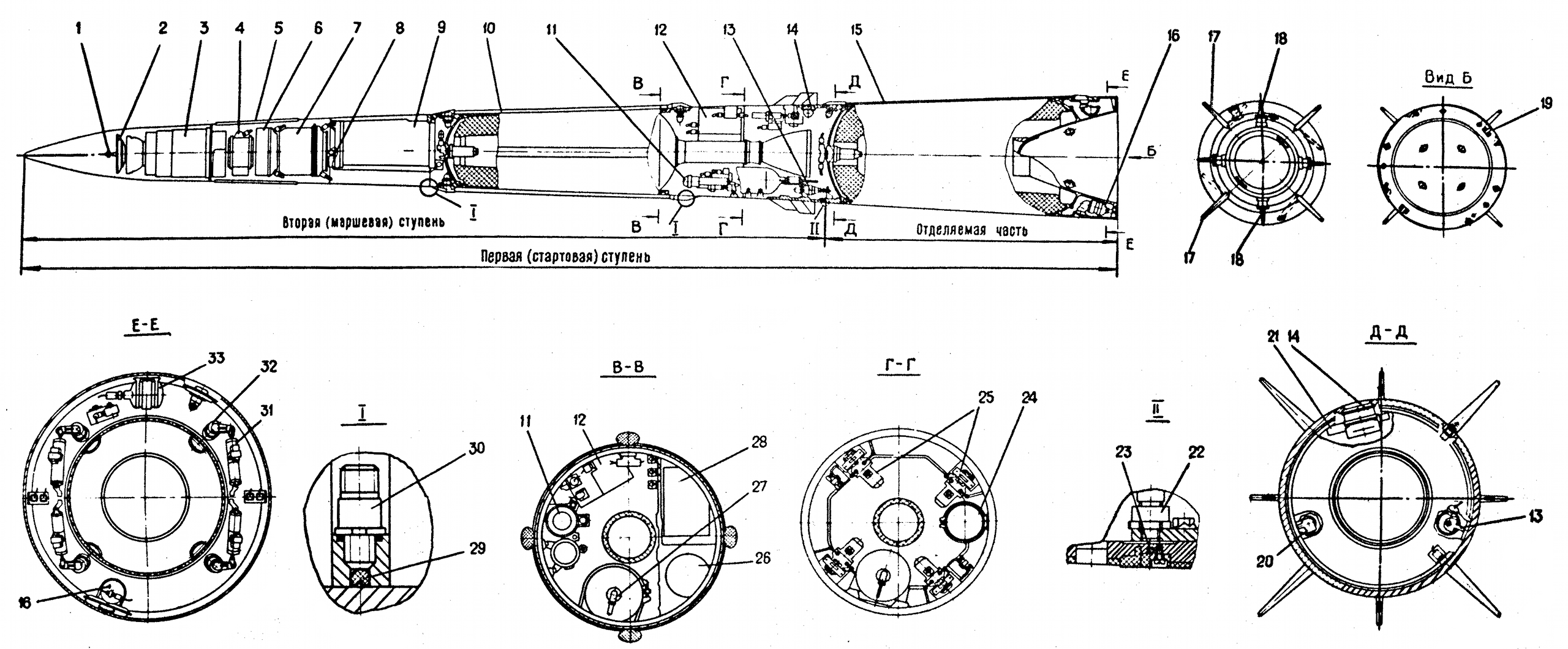
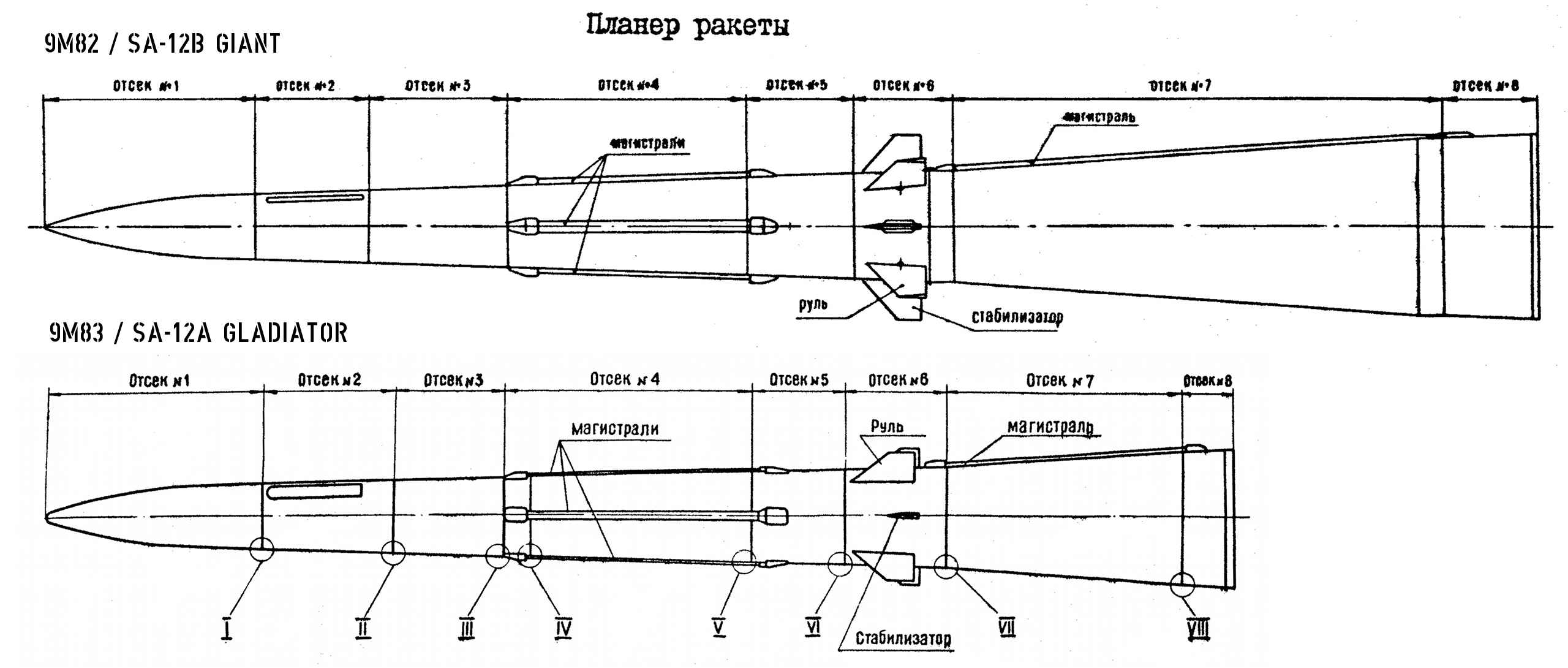 9M82 / SA-12B Giant and 9M83 / SA-12A Gladiator Missile Layouts [Click to enlarge]. 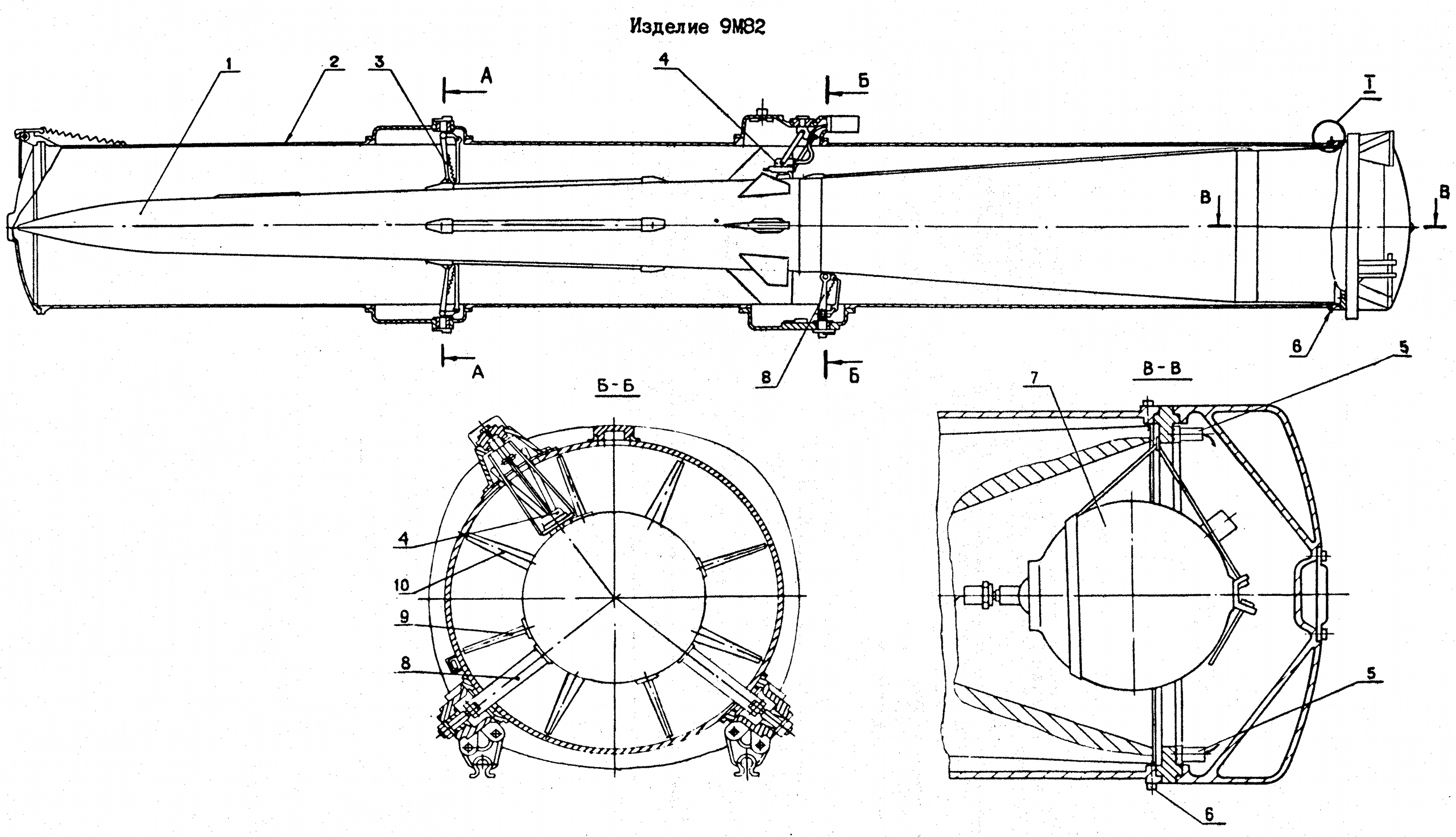 9M82 / SA-12B Giant 9Ya238
Missile Launch Tube / Transport Container. The spherical container (7)
in the base of the launch tube is the high pressure gas generator
pressure vessel for the cold launch system. The forward and centre
missile fuselage is held in position in the tube by supporting braces
(8) [Click to enlarge]. 9M82 / SA-12B Giant 9Ya238
Missile Launch Tube / Transport Container. The spherical container (7)
in the base of the launch tube is the high pressure gas generator
pressure vessel for the cold launch system. The forward and centre
missile fuselage is held in position in the tube by supporting braces
(8) [Click to enlarge]. 9M83 / SA-12A Gladiator 9Ya240
Missile
Launch
Tube
/
Transport
Container.
The
control
surfaces
are
folded
before the missile clears the tube, the short span stabilisers
are fixed in position [Click to enlarge].
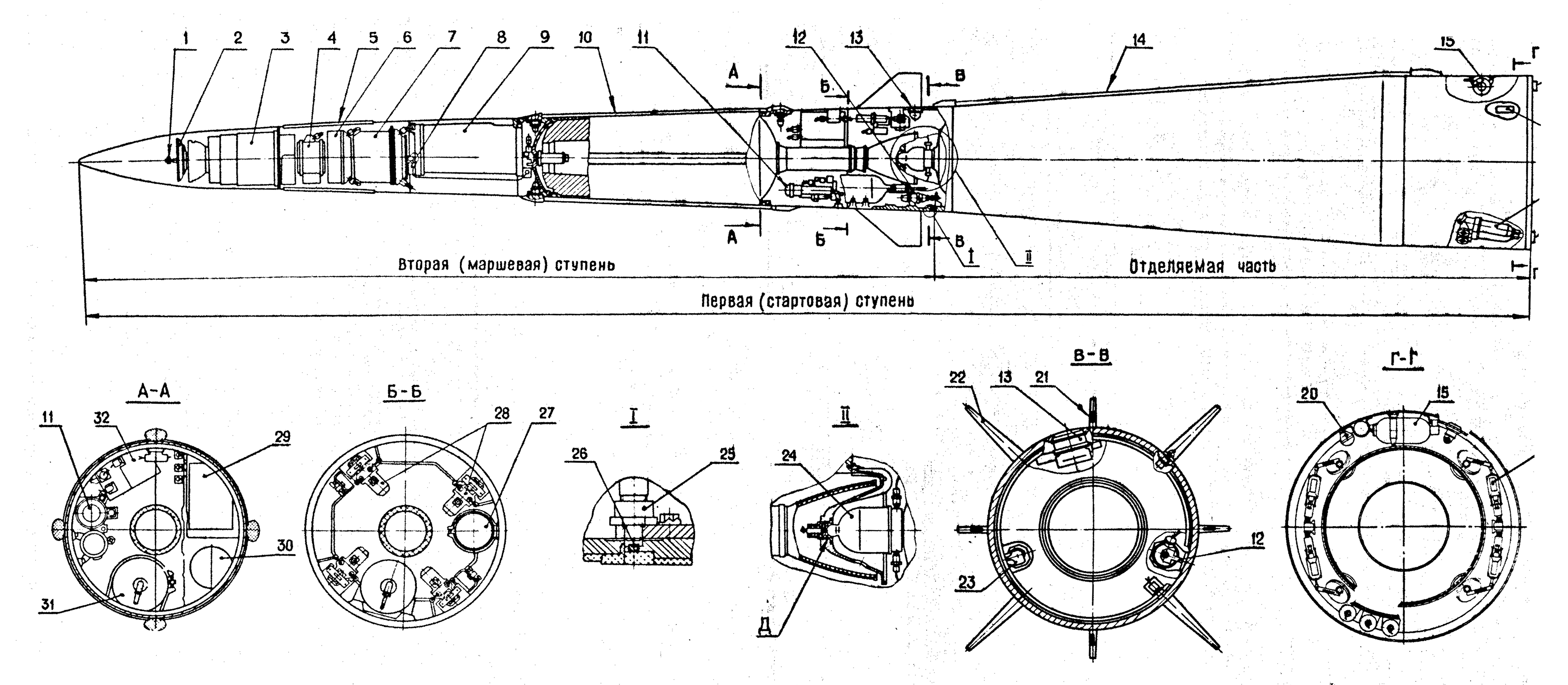 9M82 / SA-12B Giant Missile
Cutaway. 1 - Proximity Fuse Antenna; 2 - Seeker Antenna; 3 - DB-100N
Seeker; 4 - Proximity Fuse RF Module; 5 - Proximity
Fuse
Antenna;
6
Computer;
7
-
Inertial
Guidance and Navigation Unit; 8
- Safety Device; 9 - Warhead; 10 - Cable Duct; 11 - Gas Turbine Module;
12 - Connector; 13 - Connector; 14 - Cable Duct; 15 - Hydraulic Power
System; 16 - Switch; 17 - Gas Generator; 18 - Declination Thruster;
19
-
Control
Actuator;
20
-
Compensator;
21 - Stabiliser; 22 -
Aerodynamic Control Surface; 23 - Selector Switch; 24 - Stage
Separation Mechansim; 25 - Electrical Initiator; 26 - Explosive Charge;
27 - Kill Vehicle Gas Generator; 28 - Control Surface
Actuators
[Click to enlarge].
 9M83 / SA-12A Gladiator Missile Cutaway
[Click to enlarge].
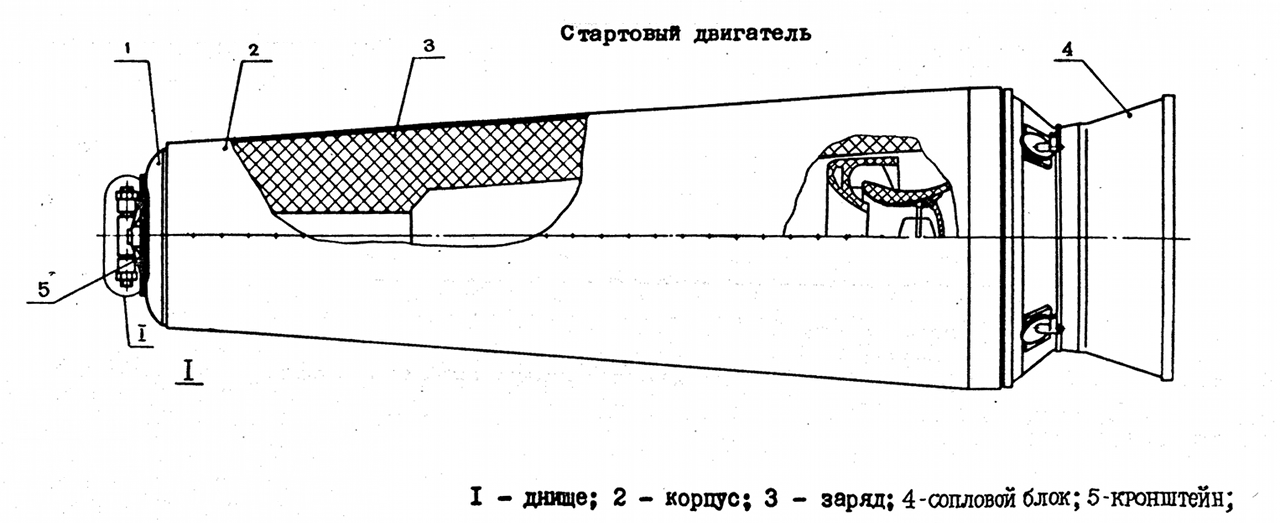 9M82 / SA-12B Giant Missile Booster
Motor [Click to enlarge].
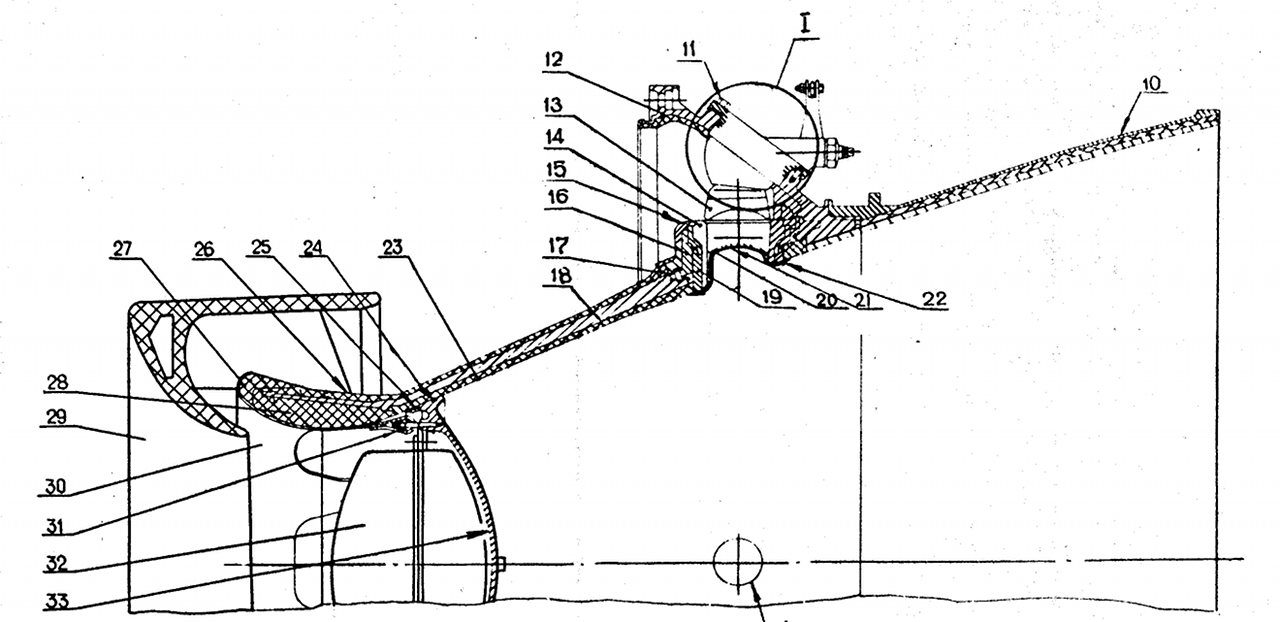 9M82 / SA-12B Giant Missile Booster Nozzle. I denotes the TVC port [Click to enlarge]. 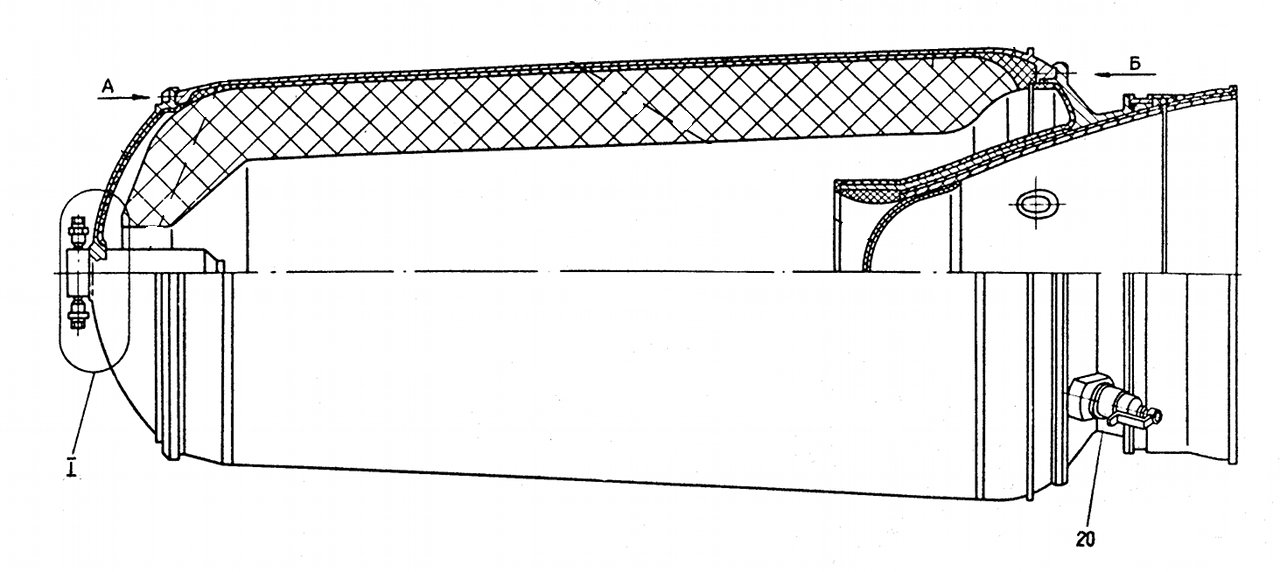 9M83 / SA-12A Gladiator
Missile Booster Motor
[Click to enlarge].
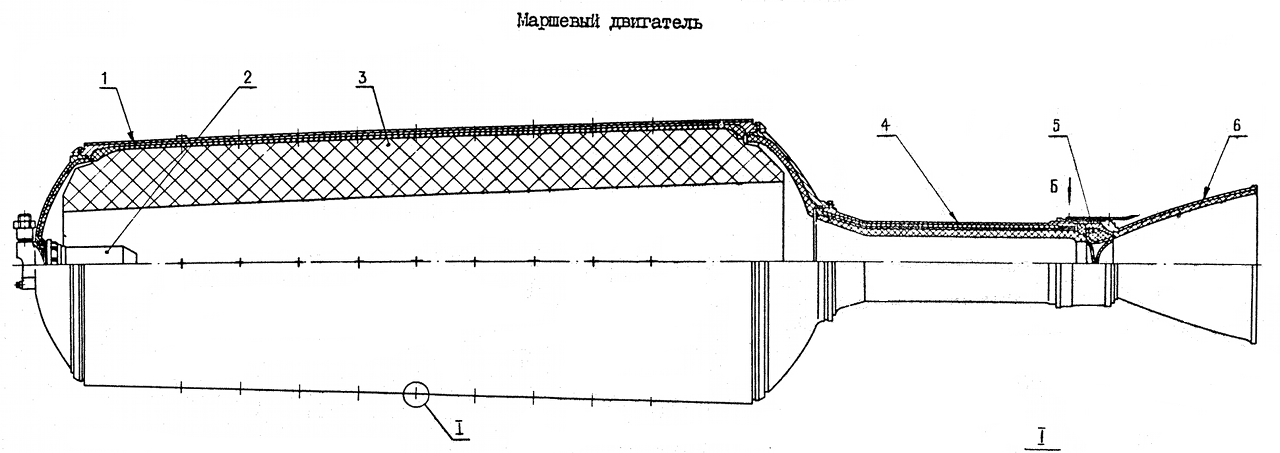 9M82 / SA-12B Giant Missile Sustainer Motor [Click to enlarge]. 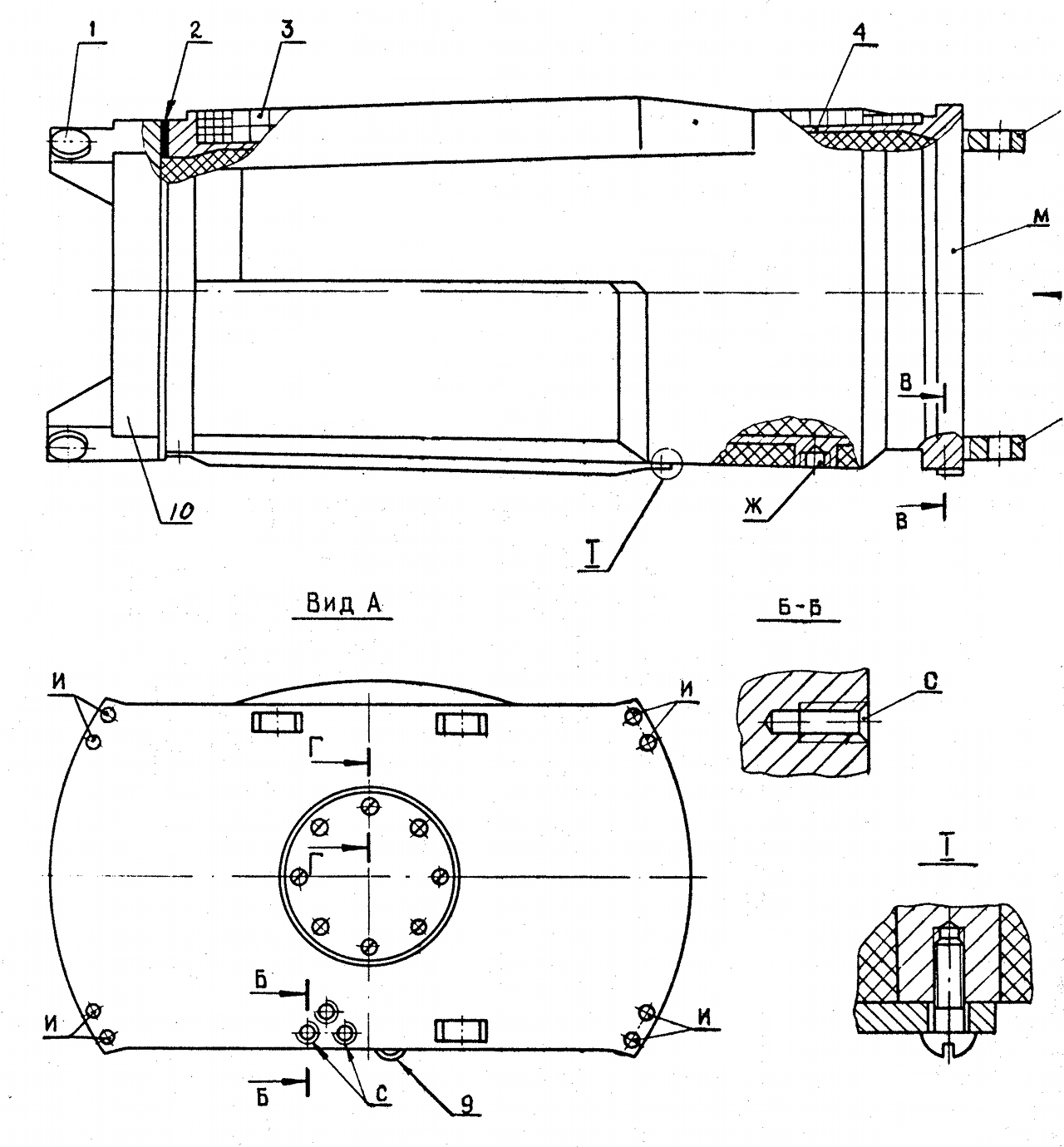 9M82
/
SA-12B
Giant
Missile
Warhead
[Click
to
enlarge]. 9M82
/
SA-12B
Giant
Missile
Warhead
[Click
to
enlarge]. |
||||||||||||||||||||||||||||||||||||||||||||||||||||||||||||||||||||||||||||||||||||||||||||||||||||||||||||||||
Planned Design Evolution and Variants The S-300V was intended to evolve over its
life cycle, like other Soviet SAM systems. The result of this process
was the enhanced S-300VM system which saw incremental improvements to
most components, extended range missiles, and a re-engineering of the
9S32 Grill Pan to employ a variant of the 9S19 High Screen space fed
phased array, with almost twice the aperture size. The variant was
marketed for export as the Antey-2500.
The failure to secure export orders since 1991, in constrast to its technologically simpler and cheaper to build sibling, the S-300P series, has impacted funding for the S-300V program. While a wheeled variant of the S-300VM, the S-300VMK, has been proposed, there is no evidence to date that this design has been prototyped. The long term future of the S-300V series is
not clear, as Russia's long term planning for PVO and PVO-SV units is
focussed on the S-400 and S-500 systems, evolved primarily from the
S-300P series. The S-300V/VM system remains on offer for export
clientele and should an export client be eventually found, others might
follow.
In the longer term the in-service inventory S-300V is acquiring similar evolutionary enhancements to the S-300P series. It is also likely that GPS/Glonass aided navigation hardware will be added at some stage to both the S-300V/VM to increase the accuracy of the inertial/compass navigation systems on the radars and TELAR/TELs. Known variants and subtypes include the:
The cited doubling of aerodynamic target engagement range would suggest the use of the kinematically improved 9M82M and 9M83M missiles, developed for the S-300VM, and possibly the much improved 9S32M Grill Screen engagement radar, also developed for the S-300VM. It remains to be seen what other portions of the S-300VM/VMK designs will migrate into the S-300V4. The term “deep modernisation” in Russian literature can often mean almost complete replacement of most of a legacy design. It is likely that the S-300V4 upgrade will be designated by NATO as an SA-23 system. 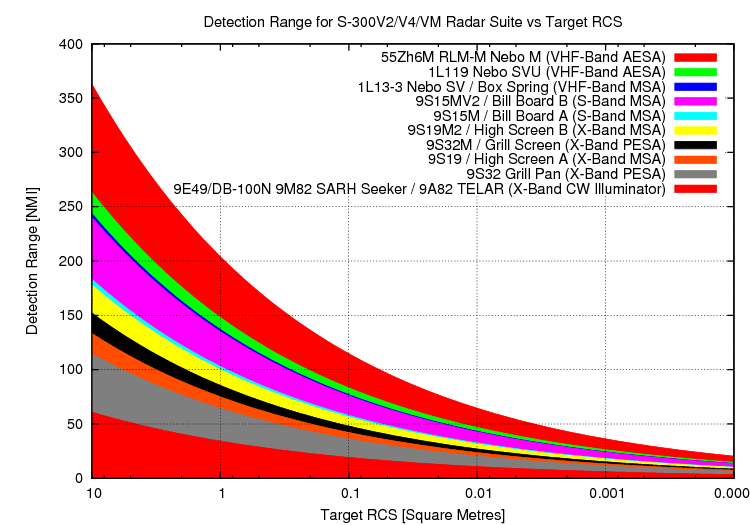 3K81M/S-300VM/VME/Antey-2500/SA-23The improved
3K81M/S-300VM/VM1/VM2/VMD/VME/Antey-2500 or SA-X-23/SA-23 is most
easily differentiated from the 3K81/S-300V by the
redesigned 9S32M/ME Grill Screen engagement radar, but no less
importantly it employs
kinematically superior 9M82M/ME missile rounds. The acquisition radars
are the improved 9S15M/MV / Bill Board B and 9S19M2 Imbir / High Screen
B. Cited range performance for the 9M82M missile was initially 200 km
against aerial targets, but more recently this is cited by the
manufacturer at 250 km.
Cited range improvements for the 9S15M2 Bill Board B are 320+ km versus the Bill Board A, and for the 9S18M2 High Screen B 250 km versus 175 km for the High Screen A. The most prominent change in the radar suite is the 9S32M Grill Screen, which employs the much larger space fed antenna design of the 9S32 High Screen, and a higher peak power. The cited range performance for a fighter sized target is in excess of 200 km, and likely better than 250 km given the more recently revised kinematic range for the 9M82M missile. While the range performance of the 9M82M/ME and 9M83M/ME missiles against aerial targets is not as good as the contemporary S-400 / SA-21 40N6 missile, the 9M82M/ME matches the kinematic range of the S-400 / SA-21 48N6E3, and outperforms the S-300PMU2 Favorit / SA-20B 48N6E2 missile, and all earlier 48N6 series missiles. In terms of performance against ballistic targets, the 9M82M/ME outperforms the 48N6E2 missile and provides almost identical performance to the much newer 48N6E3 missile. Importantly, the two stage S-300V/VM missiles are built for much higher acceleration than the S-300P missiles, also reflected in launch footage. The result is that for engagements against aerial targets, the S-300V/VM missiles have a shorter time of flight, and at similar ranges will have considerably higher kinetic energy for endgame manoeuvres compared to their single stage 48N6 series cousins. The cited average speed for the 9M82 missile across the whole trajectory is around 85-90% of the maximum speed cited for the 48N6E2/E3 missiles. The shorter flight time and higher endgame energy of the S-300V/VM missiles reduces available reaction time for the aircraft under attack, which will be reflected in higher missile lethality. 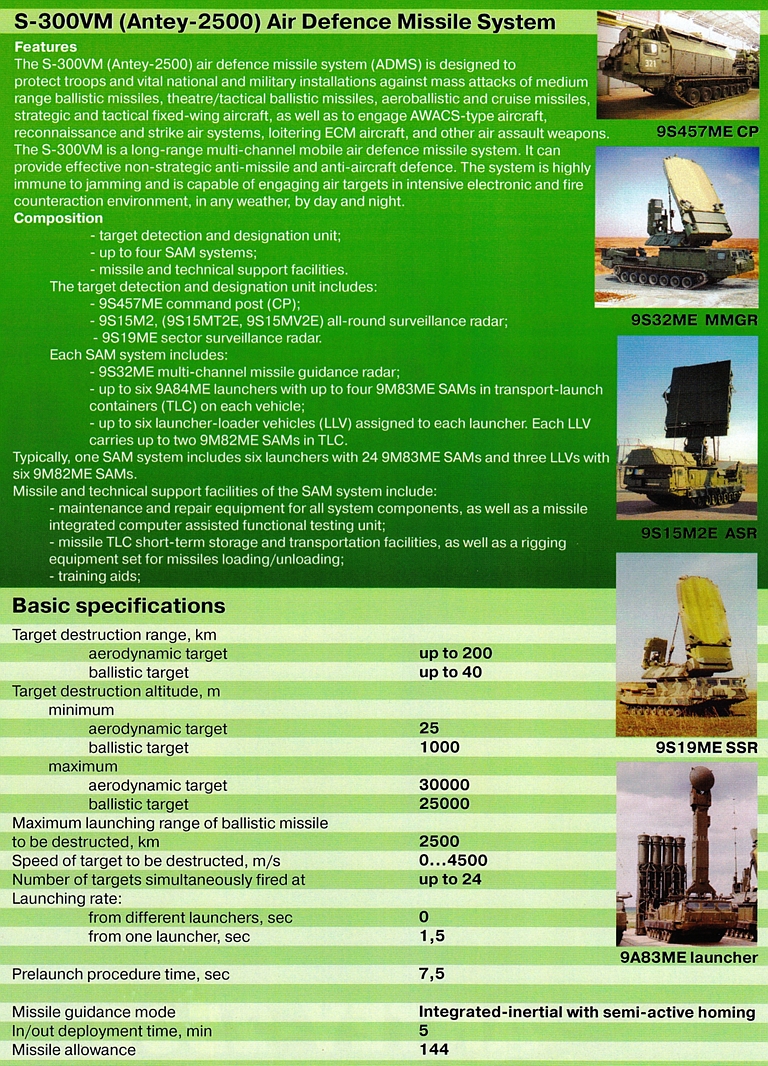 
3K81MK/S-300VMK/SA-23A proposal which emerged over
the last decade is the S-300VMK (K - Колесные),
a variant of
the S-300VM in which the Article 830 series tracked chassis is replaced
by the
BAZ 69096 10 x 10 all terrain truck chassis, a vehicle design more
frequently
associated with heavy cranes and drilling rigs. This vehicle family is
also used for the new S-400 Triumf 5P85TE2 TEL.
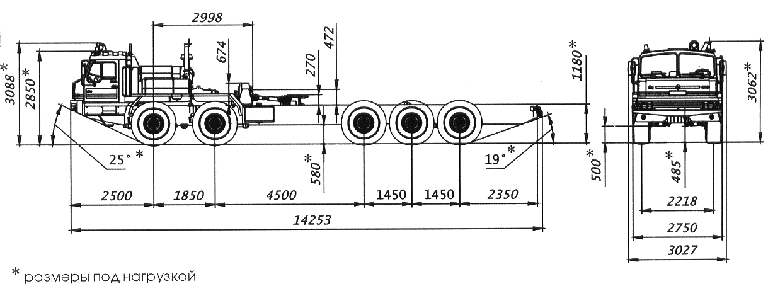 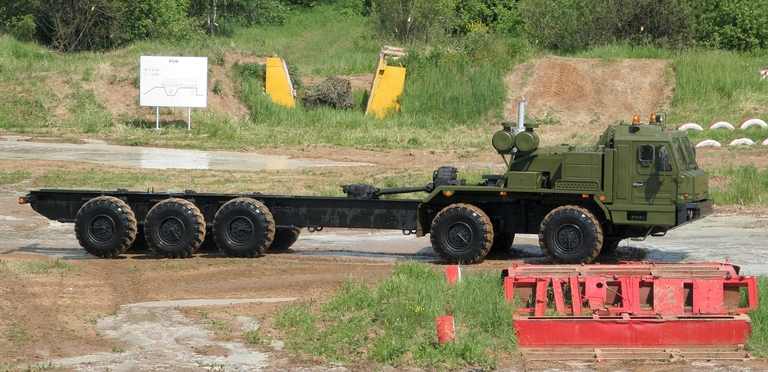 The
S-300VMK was to
be hosted on a variant of
the 10 x 10 BAZ-69096 (image © 2011 Michael
Jerdev).
The intent behind a wheeled chassis is likely to be compliance with the post 2005 Russian MoD policy change to wheeled SAM system chassis rather than tracked. A wheeled variant is less costly to procure and operate, and provides much higher road speed at the expense of cross country performance. Very little material has emerged to date on the S-300VMK and the design may have been shelved with the failure to secure export orders for the S-300V/VM product family. However, this does not preclude a future transplant of the extant S-300V radar/TELAR inventory to the BAZ 69096 chassis on operating cost and supportability grounds, as is occurring now with legacy ZRK Romb/SA-8B Gecko systems, which are being transplanted to new MZKT-6922 vehicles.  S-300VMK in stowed
configuration. The 9A82MK TELAR and 9A84MK, 9A85MK TELs are not
depicted. Note the large elevating mast on the 9S457MK CP (Russian
Internet - unknown author).
|
||||||||||||||||||||||||||||||||||||||||||||||||||||||||||||||||||||||||||||||||||||||||||||||||||||||||||||||||
Production and Exports
|
||||||||||||||||||||||||||||||||||||||||||||||||||||||||||||||||||||||||||||||||||||||||||||||||||||||||||||||||



 Provisional
data
-
Russian
sources.
Provisional
data
-
Russian
sources.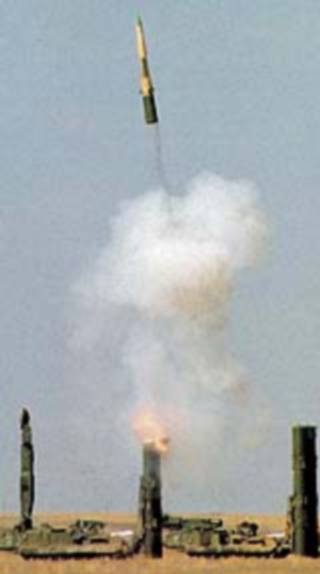 |
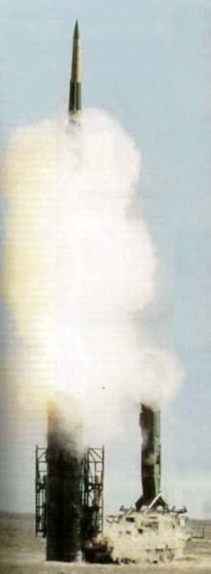 |
Like the S-300P series systems, the S-300V
uses the cold launch technique, originally developed for rapid reload
ICBM silos, ejecting the missile before its motor
is fired. These 9M83 SAMs are being launched from a 9A83 TELAR, which
uses its elevated directional antenna to provide the 9M83 with both
midcourse command updates and terminal phase high power continuous wave
illumination of the target. Antey claim the semi-active seeker will
acquire a 0.05 square metre RCS target at 16 nautical miles
(Rosvooruzheniye).
|
|
9K81 Technical Data
| Основные
характеристики
ЗРС
С-300В Principal Characteristics of the S-300V SAM System |
|||
| Зона
поражения аэродинамических целей, км Engagement Envelope for Aircraft Targets [km] |
|||
| - по дальности - in range |
до 100
|
||
| - по высоте - in altitude |
0,025...30
|
||
| Зона поражения
баллистических целей по высоте, км Engagement envelope for ballistic missile targets in altitude [km] |
1...25
|
||
| Максимальная
скорость поражаемых целей, м/с Maximum velocity of defeated targets [m/s] |
3000
|
||
| Число целей,
одновременно обстреливаемых дивизионом Number of targets concurrently engaged by a single battery |
24
|
||
| Число ЗУР,
одновременно наводимых дивизионом Number of SAMs, concurrently guided by battery |
24
|
||
| Темп стрельбы, с Rate of fire [sec-1] |
1,5
|
||
| Время подготовки
ЗУР к пуску, с Time to prepare SAM for launch [sec] |
15
|
||
| Время перевода
системы из дежурного режима в боевой, с Time to transition system from standby mode to operational mode [sec] |
40
|
||
| Боекомплект ЗУР
дивизиона (на ПУ и пускозаряжающих установках) Single battery missile count (on TELARs and TEL/Transloaders) |
96-192
|
||
| Вероятность
поражения ракеты "Ланс" одной ЗУР 9М83 9M83 Gladiator Single Shot Pk [-] vs Lance TBM |
0,5...0,65
|
||
| Вероятность
поражения самолета одной ЗУР 9М83 9M83 Gladiator Single Shot Pk [-] vs aircraft target |
0,7...0,9
|
||
| Вероятность
поражения головной части ракеты "Першинг" одной ЗУР 9М82 9M82 Giant Single Shot Pk [-] vs Pershing RV |
0,4...0,6
|
||
| Вероятность
поражения ракеты СРЭМ одной ЗУР 9М82 9M82 Giant Single Shot Pk [-] vs AGM-69A SRAM |
0,5...0,7
|
||
| Основные
характеристики
ЗУР
системы
С-300В Principal Characteristics of the S-300V SAMs |
||
| Наименование Designation |
9М83 / SA-12A Gladiator
|
9М82 / SA-12B Giant
|
| Длина, мм Length [mm] |
7898 (8570)
|
9913 (10525)
|
| Максимальный диаметр, мм Maximum diameter [mm] |
915 (930)
|
1215 (1460)
|
| Масса, кг: Mass [kg]: |
3500 (3600)
|
5800 (6000)
|
| - первой ступени - first stage |
2275
|
4635
|
| - второй ступени - second stage |
1213
|
1271
|
| Масса боевой части, кг Warhead Mass [kg] |
150
|
н/д
N/A |
| Средняя скорость полета,
м/с Average flight velocity [m/s] |
1200
|
1800
|
| Максимальная перегрузка,
ед. Maximum load factor [G] |
20
|
20
|
| Границы зоны
эффективного действия, км Engagement Envelope [km] |
||
| - дальняя - maximum range |
75
|
100
|
| - верхняя - maximum altitude |
25
|
30
|
| - ближняя - minimum range |
6
|
13
|
| - нижняя - minimum altitude |
0,025
|
1
|
| Потенциальная дальность
захвата ГСН цели с ЭПР 0,05 кв.м Seeker acquisition range for target with 0.05 m2 RCS [km] |
30
|
30
|
9K81 Battery Components
| 9K81
Battery
Components |
|||
| System |
Qty |
Function/Composition |
Vehicle |
| 9S32
Grill
Pan |
1 |
Self Propelled Engagement Radar | GM-833 |
| 9A82
(SA-12B) |
2 |
Transporter
Erector
Launcher
And
Radar |
GM-830 |
| 9A84 (SA-12B) | 1 |
Transporter
Erector Launcher /
Transloader |
GM-834 |
| 9A83 (SA-12A) | 4 |
Transporter Erector Launcher And Radar | GM-831 |
| 9A85 (SA-12A) | 2 |
Transporter Erector Launcher / Transloader | GM-835 |
| 9T82 | 2 | Missile Reload Transporter | |
| 9T83 | 2 | Missile Reload Transporter | |
| 9T447-1 |
2 |
Missile
Reload
Transporter |
|
| 9T325 |
1 |
Missile
Rigging
Station |
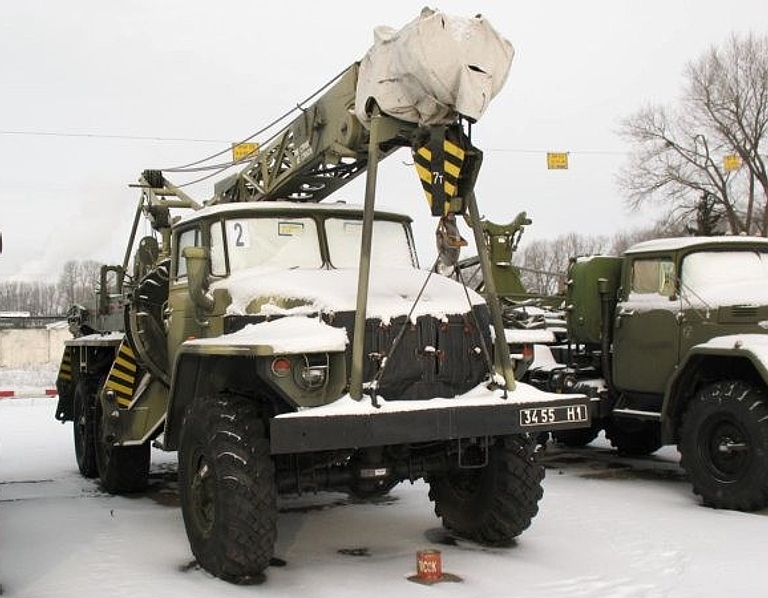
Ural-43203-1012 |
| 9В868-1/1R15 |
1 |
Equipment Repair/Test Station | Ural-43203-1012 |
| 9В898-1/1R16 |
1 |
Equipment
Repair
Station |
Ural-43203-1012 |
| 9V878-1 |
1 |
Equipment Repair Station | Ural-43203-1012 |
| 9V879-1 |
1 |
Equipment Repair Station | Ural-43203-1012 |
| 9V91 |
1 |
Mobile
Automatic
Test
Station |
ZIL-131 |
| 9V927 | 1 | Mobile Automatic Test Station | ZIL-131 |
| PES-100T/400-AKP1 |
1 |
Mobile
Power
Generator |
- |
| UKS-400V |
1 |
Mobile
Air
Compressor |
- |
| AGZ-M1 |
1 |
Mobile
Workshop |
- |
| 9F88 |
1 |
Training
Simulator |
- |
| 9M82UR/UD,
9M83UR/UD |
1+1 |
Training
Round,
Cutaway
Training
Round |
- |
| 9M82/9M83 |
24-48 |
Missile
Reloads |
- |
| 9K81
Battalion Components (4 Batteries) |
|||
| 9S457 | 1 | Self Propelled Command Post | GM-837 |
| 9S15MT
Obzor
3
/
Bill
Board |
1 | Self Propelled Acquisition Radar | GM-832
|
| 9S19M2
High
Screen |
1 | Self Propelled ABM Acquisition Radar | GM-836 |
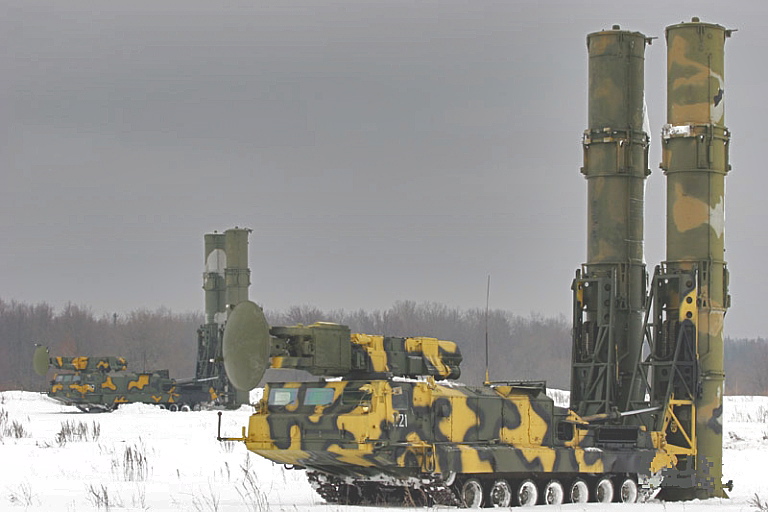
9A82/9A82M Transporter Erector Launcher And
Radar

9A82
TELAR
deployed (Image
© Miroslav Gyűrösi).
9A83/9A83M Transporter Erector Launcher And Radar
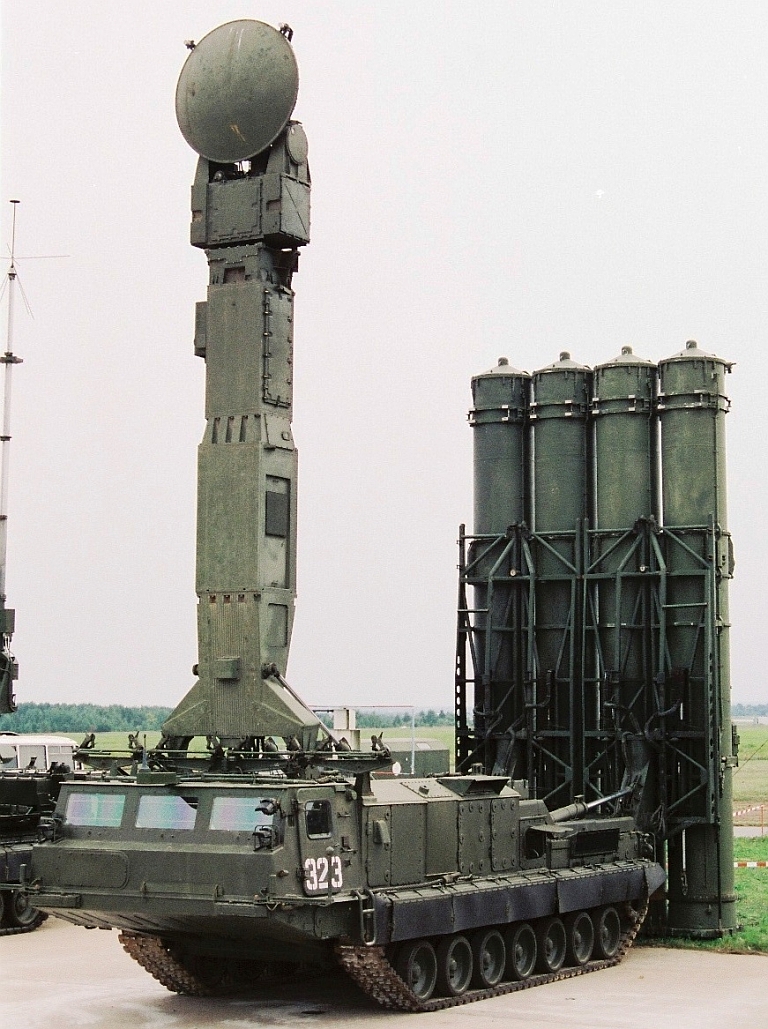
9A83
TELAR
deployed (Image
© Miroslav Gyűrösi).

9A83 TELAR stowed (Image © Miroslav Gyűrösi).
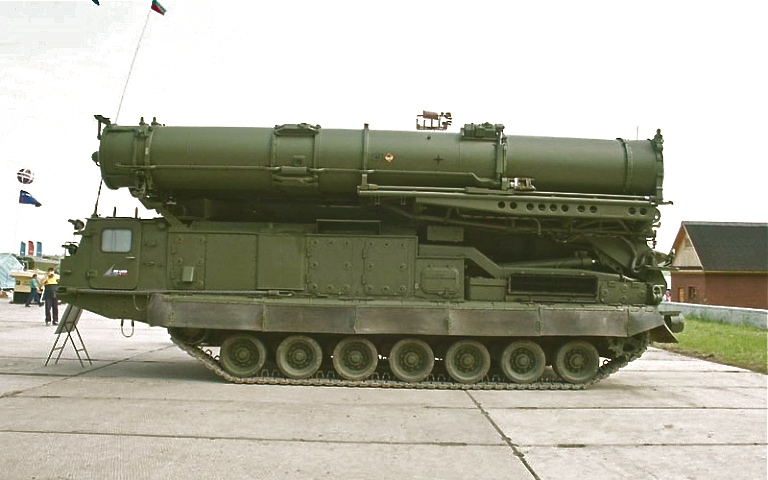
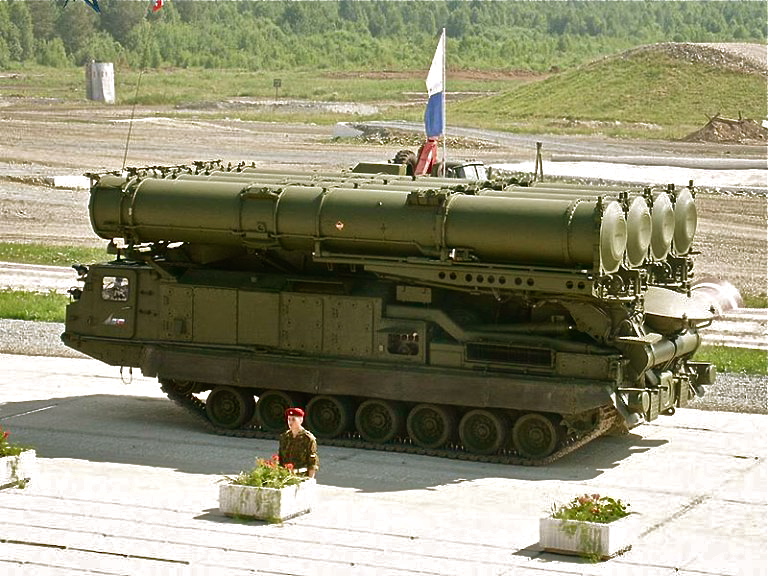
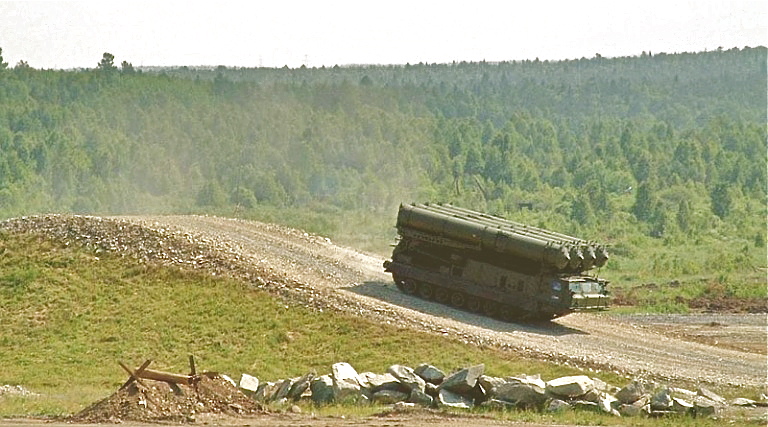
9A83
TELAR
Stowed.
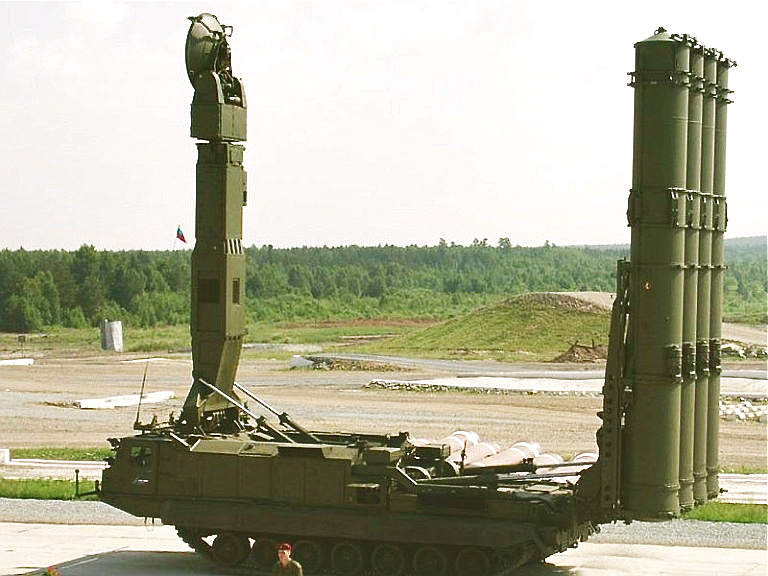
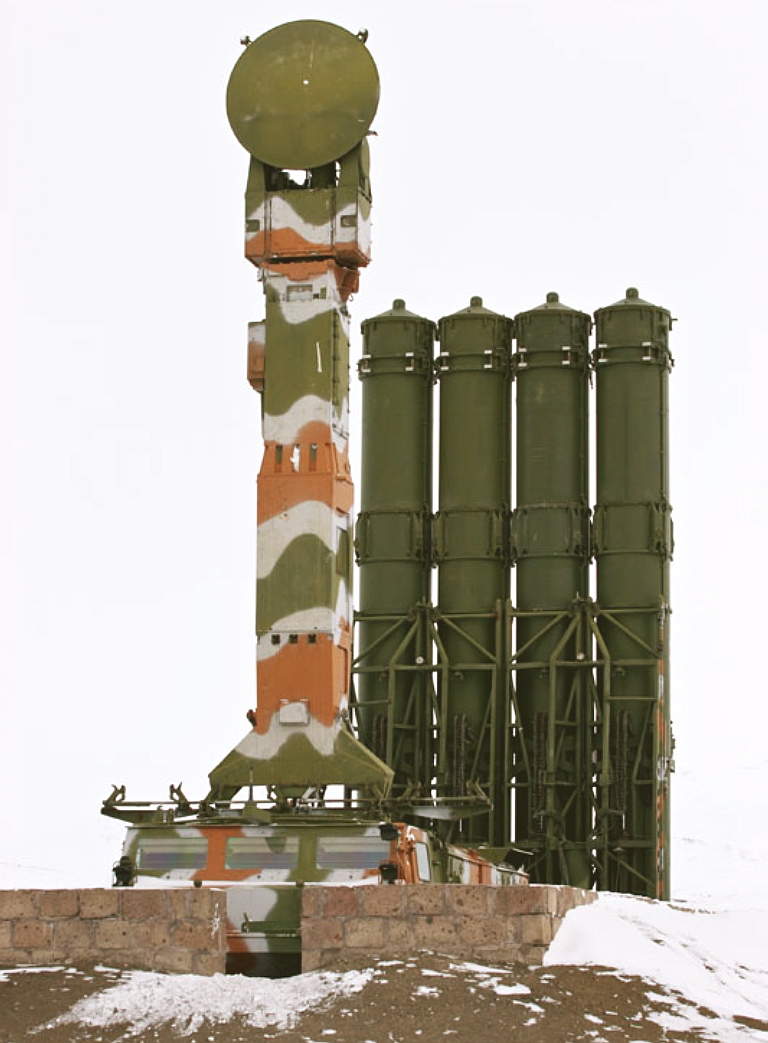
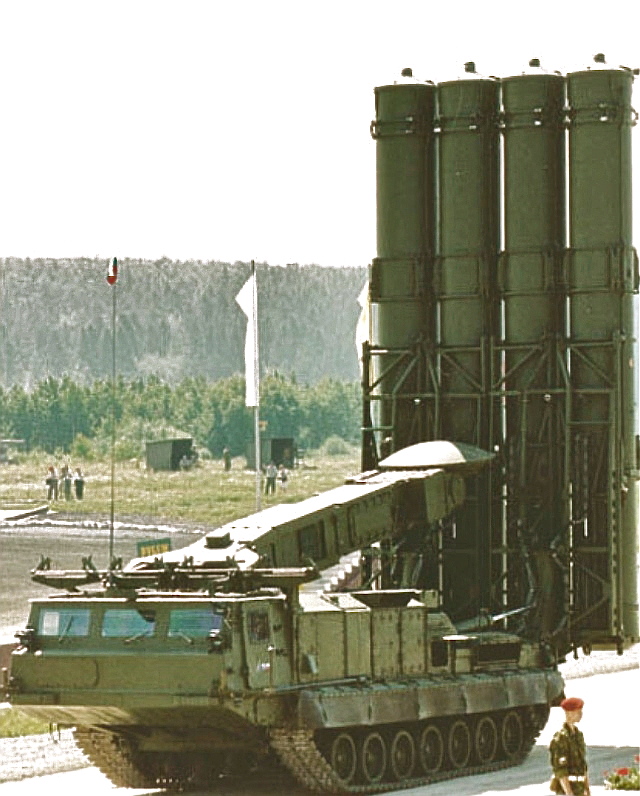
9A83 TELAR Deployment.
9A84 Transporter Erector
Launcher/Transloader
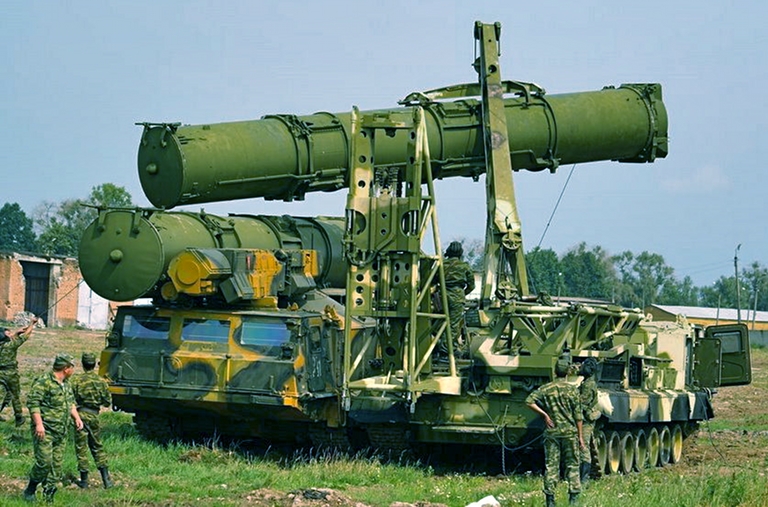

9S32 Grill Pan Engagement Radar

9S32M/ME Grill Screen Engagement Radar
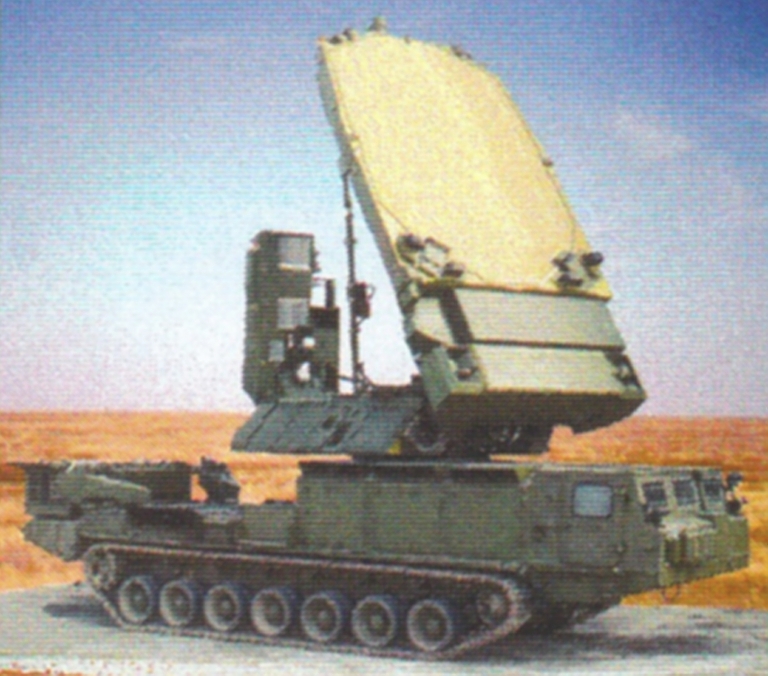
9S19 Imbir / High Screen acquisition radar (NIEMI image).
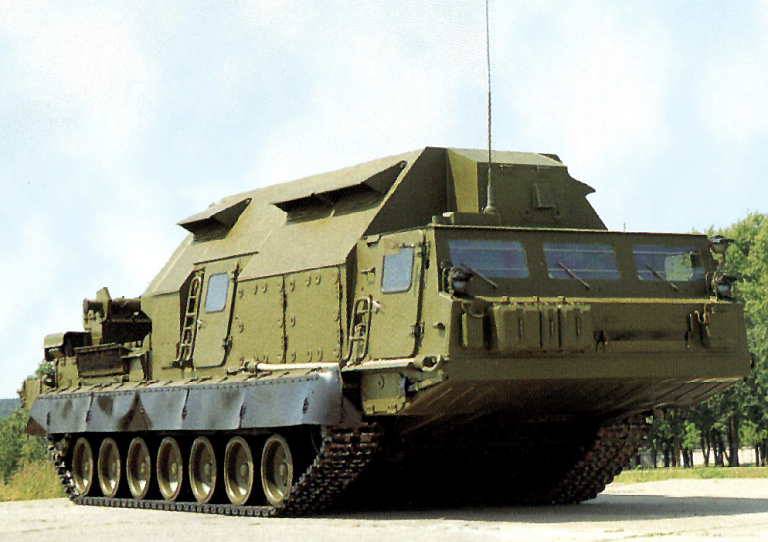
9S457/457M Self
Propelled Command Post
![[Click for more ...]](PVO-SV/000-9A82-2.jpg)
![[Click here ...]](PVO-SV/000-9A83-7.jpg)
Annex A -
Comparative Analysis Sprint ABM vs S-300V
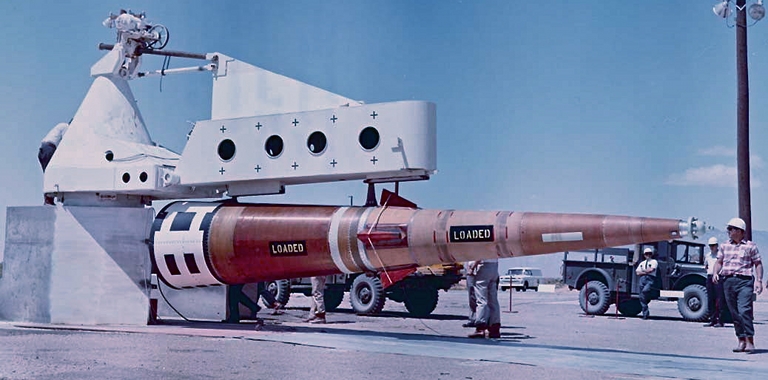
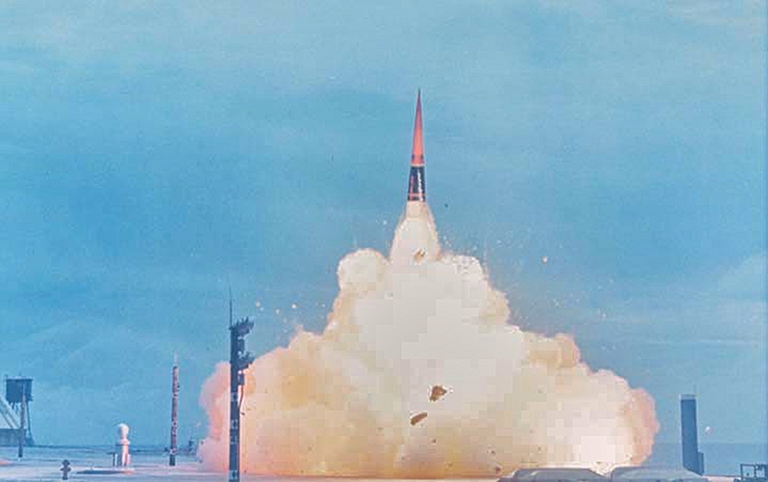
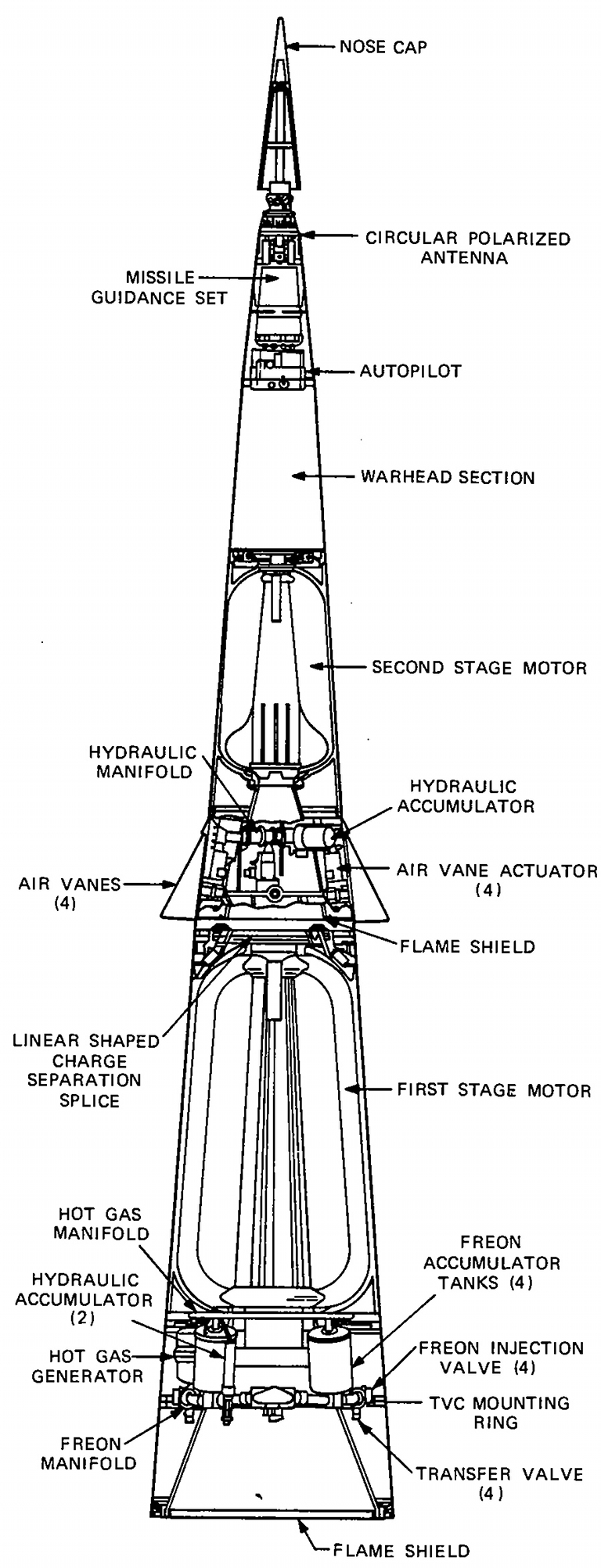
The Sprint was designed for unprecedented boost phase acceleration, using a two stage solid propellant design, and a unique conical airframe shape. The best summary of the control system design of the Sprint, later used in the HIBEX demonstrator, is by Baucom7:
“Sprint was cold-launched, with the interceptor ejected from its silo by a gas-powered piston. Once out of the silo, its powerful rocket motors rammed the missile through the dense lower atmosphere causing its skin to glow incandescently due to atmospheric heating. During first-stage burn, control forces were generated by a thrust vector control (TVC) system that injected Freon into the motor’s nozzle from four different points. (Freon was selected because of the experience gained with its use in the TVC systems of Minuteman and Polaris.) After booster separation, the second stage was guided by means of aerodynamic forces acting on small control vanes at the base of this stage.”
0.05 second.”
A parametric comparison of all three missiles is worthwhile, and summarised in Table A.1:
| Parameter |
Sprint
ABM |
9M83
Gladiator |
9M82
Giant |
9M82M
SA-23 |
| Length [m] |
8.20 m (26 ft 11 in) | 7.898 | 9.913 | 9.913 |
| Diameter [m] |
1.35 m (4 ft 5 in) | 0.915 |
1.215 | 1.215 |
| Weight [kg] |
3,500 kg (7,700 lb) | 3,500 | 5,800 | 5,800 |
| Speed | Mach 10+ | 3.6+ (mean) |
5.4+ (mean) | 7.8+ |
| Ceiling [m] |
30,000 (100,000 ft) | 25,000 | 30,000 | 30,000 |
| Range [km] |
40.0 (25 miles) | 40.0 (75.0 A/C) |
40.0 (100.0
A/C) |
|
| 1st Stage Propulsion | Hercules
X-265
solid-fueled
rocket; 2900 kN (650,000 lb) for 1.2 s |
2275 kg |
4635 kg | 4635 kg |
| 2nd Stage Propulsion | Hercules X-271 solid-fueled rocket | 1213 kg | 1271 kg | 1271 kg |
| Warhead [kg] |
W-66 thermonuclear (1 kT) | 150 | 150 | 150 |
The S-300V missiles therefore represent yet another example of US technology and concepts being adapted and improved upon by the Soviets.
References/Sources
- Said Aminov, Vestnik PVO, URL: http://pvo.guns.ru
- Александр Клочков, Зенитная ракетная система С-300В, RusArmy.com, URL:http://www.rusarmy.com/pvo/pvo_vsk/zrs_s-300v.html
- Александр Клочков, Зенитная ракетная
система С-300ВМ ("Антей-2500"), RusArmy.com,URL:http://www.rusarmy.com/pvo/pvo_vsk/zrs_s-300vm.html
- Зенитно-ракетная система С-300В / С-300ВМ
"Антей-2500", URL: http://rbase.new-factoria.ru/missile/wobb/c300v/c300v.shtml
- Michal Fiszer, Name of the Roses: Russia’s “joint” S-300 air defense system turned out to be nothing of the sort, Military Microwaves Supplement 2006: Special Report, Microwave Journal Online, Horizon House, URL: http://www.mwjournal.com/article.asp?HH_ID=AR_867
- Andreas Parsch, Martin Marietta Sprint,
Astronautix.com, URI: http://www.astronautix.com/lvs/sprint.htm.
- Baucom D.R., Developing Missile Flight Controls: From Guide Sticks to Impulse Thrusters, Advances in Technology, in Cameron R.H. (Ed), Golden Legacy, Boundless Future; Essays on the United States Air Force and the Rise of Aerospace Power, Air Force History and Museums Program, 2000, URI: http://www.afhso.af.mil/booksandpublications/titleindex.asp.
- ИЗДЕЛИЕ 9М82, Техническое описание, 9М82.0000 ТО, 1984 (Article 9M82, Technical Description, 9M82.0000 TO / Technical Order document, Soviet MoD).
- ИЗДЕЛИЕ 9М83, Техническое описание, 9М83.0000 ТО, 1982 (Article 9M82, Technical Description, 9M83.0000 TO / Technical Order document, Soviet MoD).
- Дмитрий АНДРЕЕВ, В русле модернизации, Красная звезда, 20/08/2010, URI: http://www.redstar.ru/
- Adrian Ochsenbein, SA-12 Gladiator/Giant, Technical
Report, Defence Threat Information Group, V.8, June, 2011.
- В. Ефремов, Ю. Свирин. Антей-2500. Военный Парад,
#25, 1998; URI: http://milparade.udm.ru/ru/25/034.htm
- ЗРС С-300ВМ («Антей-2500»), Almaz-Antey website;
Accessed August 2011, URI: http://www.almaz-antey.ru/catalogue/millitary_catalogue/
|
|||||||||||||
|
|
|
|
|
|
|
|
|
|
|
|||
|
|
|
|
|
|
|
|
|
|
|
|||
 |
|
|
|||||||||||
| Artwork, graphic design, layout and text © 2004 - 2014 Carlo Kopp; Text © 2004 - 2014 Peter Goon; All rights reserved. Recommended browsers. Contact webmaster. Site navigation hints. Current hot topics. | |||||||||||||
|
Site Update
Status:
$Revision: 1.753 $
Site History: Notices
and
Updates / NLA Pandora Archive
|
|||||||||||||
|
|
Tweet | Follow @APA_Updates | |||||||||||
|
|
|||||||||||||
|
|
|||||||||||||