Joint
Strike
Fighter
|
|
In
2002, in
a surprise decision, the then Defence Minister announced that the
planned
AIR 6000 flyoff to choose Australia's future fighter aircraft was to be
effectively stopped, with the developmental Joint Strike Fighter
declared to be the preferred aircraft type.
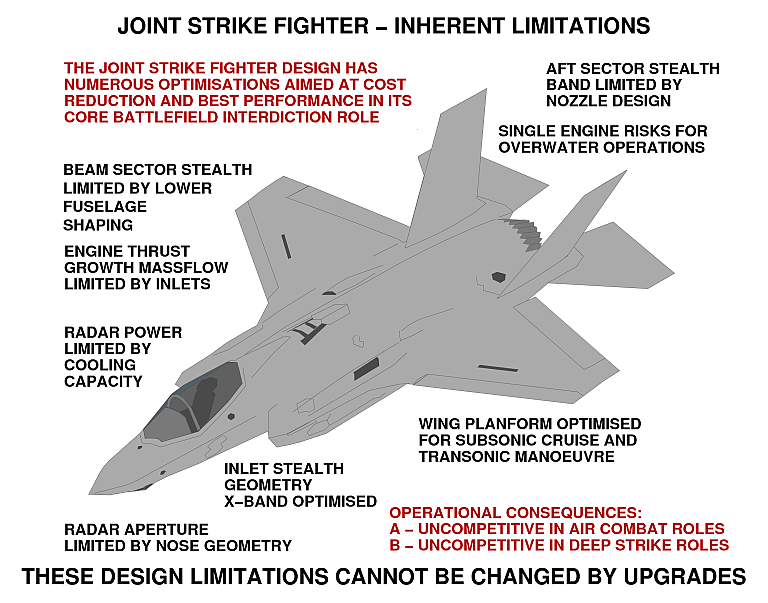
The Joint Strike Fighter is not designed to perform air
superiority roles, unlike the larger F-22A, and is not well adapted
to
performing the penetrating long range strike role filled by the F-111
until 2010.
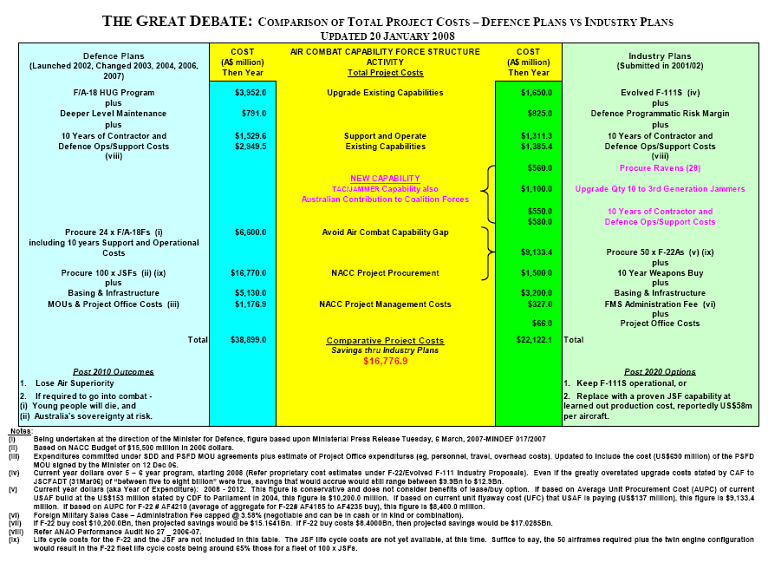
There
has
been considerable adverse press associated with JSF cost overruns,
project delays, and other difficulties observed in this program.
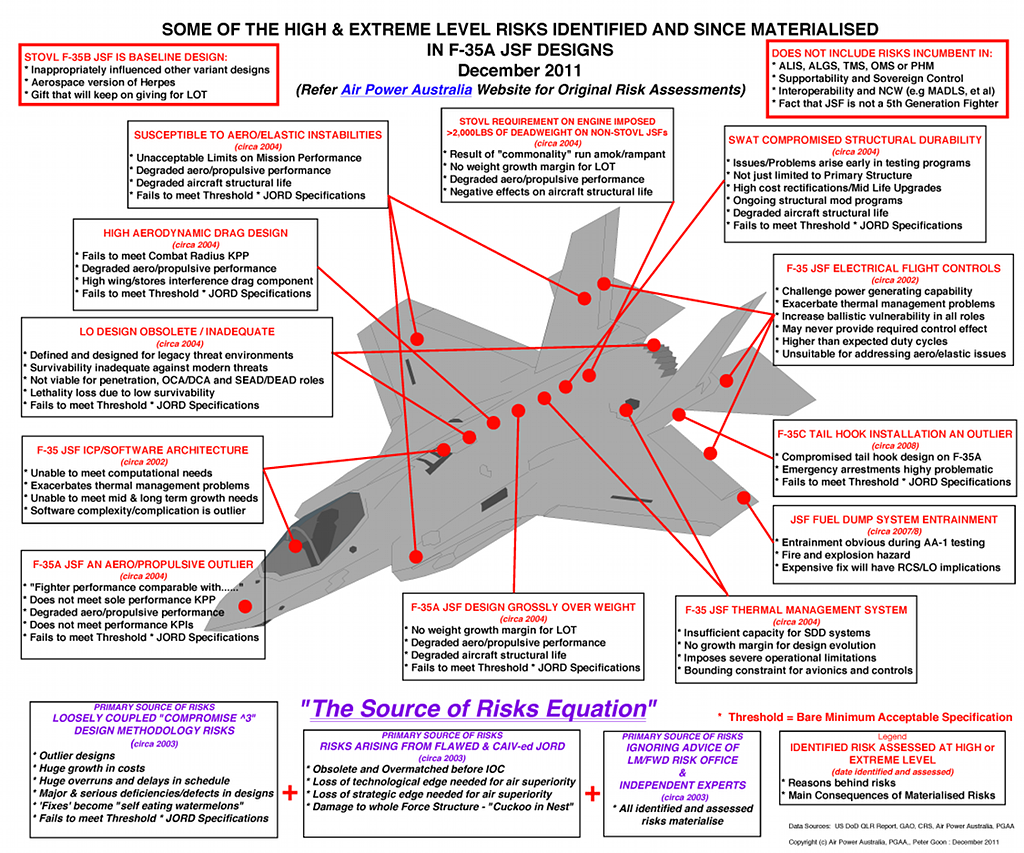
The JSF Program and resulting aircraft designs have, since the very
first days of the program, been burdened by fatal optimism, a total
indifference to what is real, placement of form over substance, the
acquisition malpractice of concurrency and the fact that the STOVL
F-35B is the baseline for all three variants, having dictated and
constrained most if not all key aircraft parameters in the definition
and resulting design of the other two JSF variants.
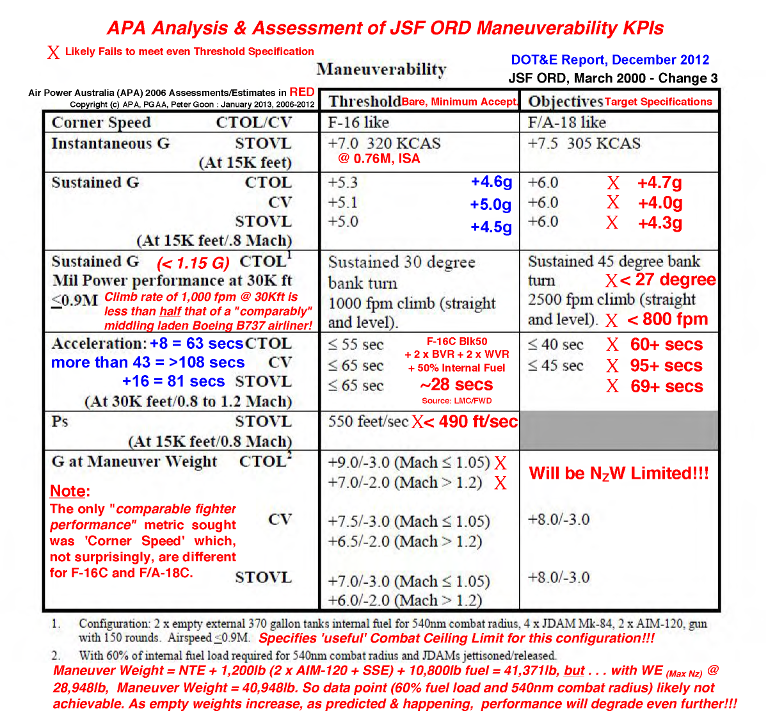
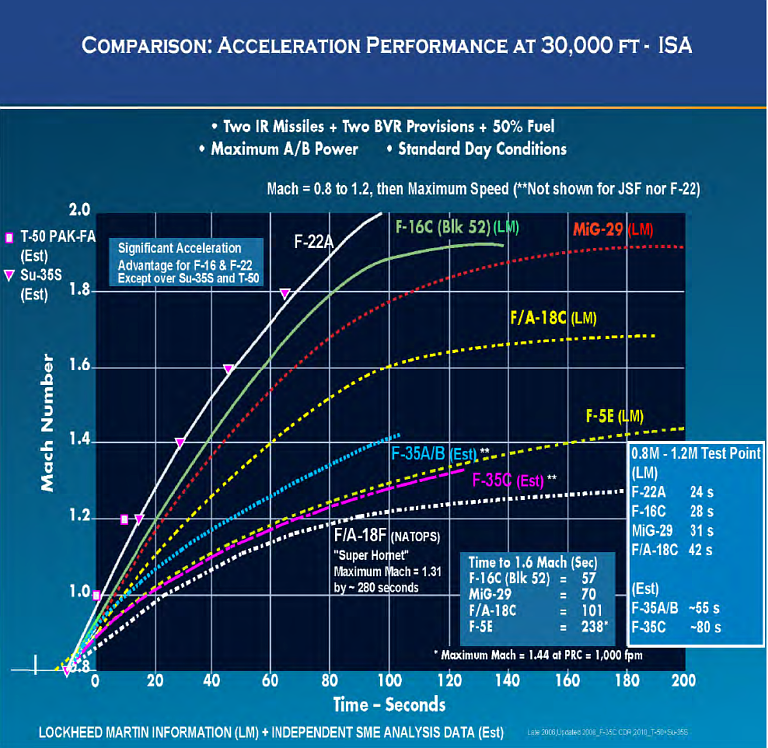
The F-35 JSF aircraft designs will not meet specification nor the
operational requirements laid down in the JSF JORD (Joint Operational
Requirements Document) by significant degrees, noting that these
operational requirements and resulting specifications, themselves, were
predicated on the capabilities of reference threats from an era past
and subsequently subjected to the illogical and deeply flawed process
known as CAIV (Cost As an Independent Variable).
The designs of all three JSF variants are presenting with critical
single points of failure while even the most basic elements of aircraft
design (e.g. weight, volume, aerodynamics, structures, thermal
management, electrical power, etc.) will almost certainly end up in
what Engineers call "Coffin Corner".
In essence, the unethical Thana Marketing strategy used to sell the
JSF,
along with the acquisition malpractice of concurrency in not only
development, production and testing but the actual designs of the JSF
variants, themselves, have resulted in the JSF marketeers writing
cheques
that the aircraft designs and JSF Program cannot
honour.
A more detailed summary of these points is available in Hansard,
Parliamentary Joint Committee on Foreign Affairs, Defence and Trade,
07/02/2012, Inquiry into the Department of Defence annual report 2010-11
and associated Submissions
by Air Power Australia. Further technical discussion can be found
in the OSD
DOT&E FY2012 Annual Report.
This website indexes a selection of relevant articles, submissions
and papers.
|
New - Canberra Senate Inquiry into F-35 Dec 2015 - Jun 2016
|
Senate Standing Committees on Foreign Affairs Defence and Trade
Submissions to Inquiry into the planned acquisition of the F-35 Lightning II (Joint Strike Fighter)
[Additional Documents] |
 |
First distributed publicly in
December, 2011.
|
| Is
the JSF Really a Fifth Generation Fighter? |
Modern Fighters
|
Current Threat |
5th Generation
Fighter Capabilities
|
F-22A Raptor |
T-50 PAK-FA |
Chengdu
J-20 |
F-35A JSF
Lightning II |
Gen 4++
Su-35S |
| USA |
Russia |
China |
International |
Russia |
| Super Cruise |
Yes
> 1.7 Mach
(0) |
Yes, ~1.8 Mach with persistence
(0) |
Yes
(0) |
No
(-1) |
Yes
(0) |
High Agility
Supersonic / Subsonic |
Yes
(0) |
Extreme Plus
(+1) |
Yes
(0) |
Neither
(-1) |
Extreme
(+1) |
| High Specific Excess Power
- Ps |
Yes
(0) |
Yes
(0) |
Yes
(0) |
No
(-1) |
Yes
(0) |
Thrust Vectoring Control -
TVC 2-D
|
Yes
2-D
(0) |
Yes
3-D
(+1) |
Accommodated
3-D
(0) |
No
(-1)
|
Yes
3-D
(+1) |
| Highly Integrated Avionics |
Yes
(0) |
Yes
(0) |
Yes
(0) |
Yes
(0) |
Yes
(0) |
| Electronically Steered
Array (ESA) Radar |
High Power Aperture
(+1) |
High Power Aperture
(+1) |
Yes
(0) |
Medium Power Aperture
(0) |
High Power
Aperture
(+1) |
| Sidelooking ESA Apertures |
Fitted For But Not With
(FFBNW)
(0) |
Yes
(+1) |
Insufficient
Data
|
No
(-1) |
Yes
(0) |
| High Situational Awareness
(SA) - Onboard/Offboard |
Yes
(0) |
Yes
(0) |
Likely
|
Yes
(0) |
Yes
(0) |
| Supersonic Weapons Delivery |
Yes
(0) |
Yes
(0) |
Yes
(0) |
No
(Bomber Doors / Toed-In Carriage)
(-1) |
Yes
(0) |
Large Thrust to Weight
Multi-Engine
Thrust Growth |
Yes
2 Engines
Large Growth
(0) |
Yes
2 Engines
Large Growth
(0) |
Yes
2 Engines
Large Growth
(0) |
Middling T/W
One Engine
Little Growth
(-1) |
Yes
2 Engines
Large Growth
(0) |
| High Combat Ceiling Loiter
/ Operate (plus > 7 deg/sec turn rate, sustained @ 30 kft) |
Yes
> 55 kft
Yes
(0) |
Yes
> 60 kft
Yes
(0) |
Yes
> 50 kft
Yes
(0) |
No
< 45 kft
No
(-1) |
Yes
> 55 kft
Yes
(0) |
| Very Low Observable RF
Stealth / Low Observables |
All Aspect Wideband
(+1) |
Yes or Partial
(0) |
Yes
or
Partial
(0) |
Yes but Partial
(0) |
Not Intended
(-1) |
Good
Non RF
Observables
|
Yes
(0) |
Yes
(0) |
Yes
(0) |
No
VOVS/WVE
(-1)
|
Not Intended
(-1)
|
| Large Internal Usable
Fuel Load (klbs)
|
Yes >18 klbs
PLUS
thermal
cooling
fuel load ~2,000 lbs
(0) |
Yes, ~22 klbs
includes fuel for
thermal cooling
(0) |
Yes, ~25 klbs
includes fuel for
thermal cooling
(+1) |
No, <18 klbs
MINUS fuel for thermal cooling
(-1) |
Yes
>23 klbs
(+1) |
| Internal Weapon Carriage
Hard Point Stations |
Yes
6 + 2
(0) |
Yes
6+2
(0) |
Yes
6 + 2
(0) |
Yes
4
(0) |
Partial
(Tunnel Pod)
2 - 4
(-1) |
ZOCT
Scoring
by 5th Gen Metrics |
+2 |
+4 |
+1
|
-10 |
+1 |
Table © 2009 - 2013, Peter Goon, Air
Power Australia, Peter Goon & Associates.
Update Source Documents:
Initial release table 8th November, 2009: http://www.ausairpower.net/APA-NOTAM-081109-1.html
T-50 PAK-FA Update Sources: http://www.ausairpower.net/APA-2010-01.html;
http://www.ausairpower.net/APA-2012-03.html
J-20 Update Sources: http://www.ausairpower.net/APA-J-XX-Prototype.html;
http://www.ausairpower.net/APA-2011-03.html
F-35 Update Sources: http://www.jsf.mil/gallery/gal_photo_sdd.htm;http://onlinelibrary.wiley.com/doi/10.1029/98RS02776/abstract;
http://www.wakenet3-europe.eu/fileadmin/user_upload/2nd_workshop/presentations/020-Barbaresco.pdf;http://www.jsf.mil/
|
|
|
|
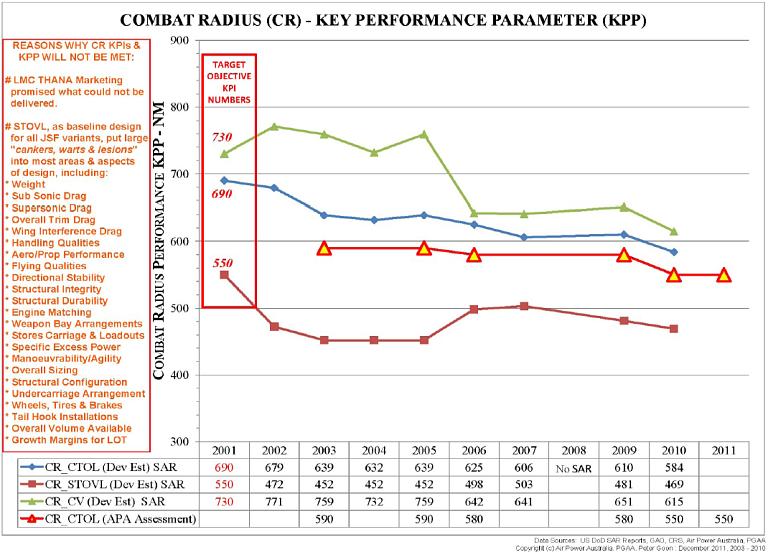
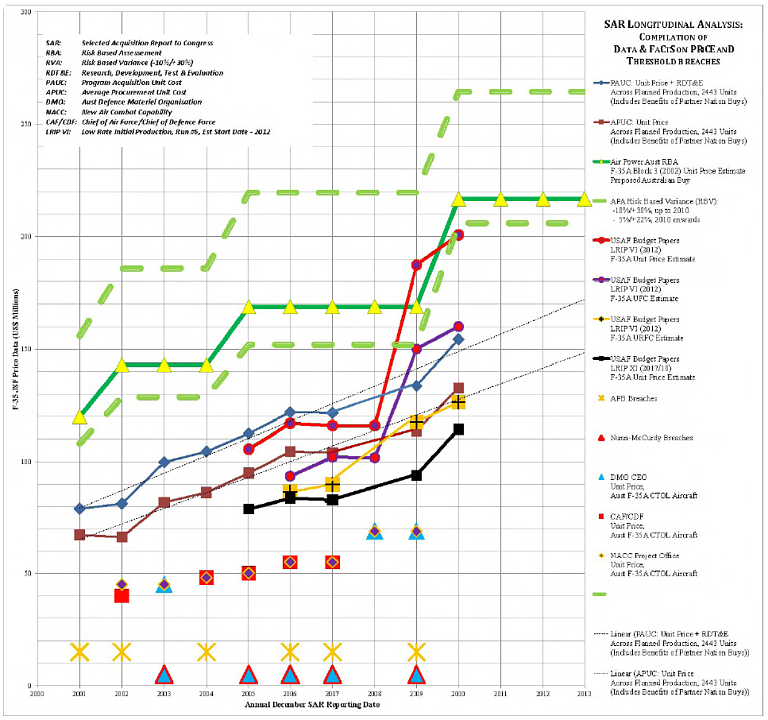
#1 - Joint Strike
Fighter Affordability Failure
The JSF program sets new
benchmarks for exceeding initially intended Unit Procurement Costs in a
weapon system being developed. These publications detail the scope,
scale and nature of the program's failure in this area.
|
|
|
Is
the
JSF
Affordable? An
Australian’s Perspective |
|
|
F-35
JSF
Program:
When is
“Affordability” Not? |
|
|
|
|
|
|
|
|
#2 - Joint Strike Fighter Survivability and Lethality Failure
The JSF program is almost
unique historically in the extent to which its intended survivability
and lethality are mismatched against the operational environment in
which the aircraft is intended to be used. These publications detail
the scope, scale and nature of the program's failures in these areas.
|
|
|
Assessing Joint
Strike Fighter Defence Penetration Capabilities |
|
|
Assessing Joint
Strike Fighter Air Combat
Capabilities |
|
|
How?
The Deadly Question for
the F-35 Joint Strike Fighter |
|
|
Fast Forward ‘Fast Transients’: John
Boyd, the F-22 and F-35 in 2016 |
|
|
Why
the F-22 and the PAK-FA have
the “Right Stuff” and why the F/A-18 and the F-35 do not |
|
|
PAK-FA,
F-35, F-22
and
“Capability Surprise” |
|
|
Coffin
Corners for the Joint
Strike Fighter |
|
|
Why
F-22A Raptor instead of
F-35A Joint Strike Fighter? |
|
|
F-35
Joint
Strike
Fighter vs
Russia's New Airborne Counter-Stealth Radars |
|
|
F-35 JSF:
Cold War Anachronism Without
a Mission |
|
|
Lockheed-Martin
F-35
Lightning II - Assessing
the Joint Strike Fighter |
|
|
JSF =
Thunderchief II? |
|
|
Is the JSF
really
good enough? |
|
|
F/A-22As, JSFs
and 21st
Century air combat |
|
|
JSF
F-35
Program:
How Many Miles
Does an F-35A Go On a Tankful of Gas? |
|
|
Air
Combat:
Russia’s
PAK-FA
versus the F-22 and F-35 |
|
|
Sukhoi's
Lightning Strikes the F-35 JSF |
|
|
F-35 JSF:
Can It Meet Canada's Needs? |
|
|
United
Kingdom: F-35 or F-22? |
|
|
Is the
Joint Strike
Fighter Right for Australia? Pt.1 / Pt.2 |
|
|
The Joint
Strike Fighter Decision |
|
|
Hedging the
Bet- JSF for
the RAAF? |
|
|
Lockheed-Martin
F-35
Joint
Strike
Fighter - Part 1 - A
Cold War
Anachronism? |
|
|
Lockheed-Martin
F-35
Joint
Strike
Fighter
- Part 2 -
Sizing up the
Joint
Strike Fighter |
|
|
Replacing the RAAF
F/A-18 Hornet
Fighter, Strategic, Operational and Technical Issues |
|
|
|
|
|
|
|
|
#3 - Joint Strike Fighter Governance Failure
The JSF program introduced an unprecedented
governance scheme in which the customer became a defacto marketing
entity acting on behalf of the supplier, and in which concurrent
development and production were planned for. These publications detail
the scope, scale and nature of the program's failure in this area.
|
|
|
JSF
Top
Level
Programmatic Risk Assessment / Issue 7.2 16 July 2010
|
|
|
F-35A
JSF: Not Even Second
Place... |
|
|
F-35
JSF: The Gamekeeper vs the
Poachers....
JET Mk.II Juxtaposition and
the 'Normalisation of Deviance' |
|
|
F-35
JSF Program:
Assessment of Top Level Programmatic Risks |
|
|
F-35
JSF:
See
No Evil, Hear No
Evil, Do No Good |
|
|
F-35
JSF and the SecDef's
Nightmare |
|
|
F-35
JSF: Becoming Your Own Peer
Threat . . .While Killing Off the “Best Bang for the Buck” Option - the
F-22A Raptor |
|
|
Mr
Secretary - Why Does the
Pentagon Say the JSF is a 5th Generation Fighter . . Really?
|
|
|
F-35
Joint
Strike
Fighter
Program: Collapse is a “When” Question, not an “If” Question |
|
|
JSF,
F-22,
C-17
and the Hon
Robert Gates: “Next war-itis” – Yet another dose of ‘alternate reality’ |
|
|
Accountability
vs
Indifference
to
What is Real |
|
|
JSF:
Through
the
Prism of Risk
Management |
|
|
JSF:
Dr Kopp Responds to Maj Gen Davis |
|
|
JSF:
WGCDR Mills Responds to Maj Gen Davis |
|
|
JSF
Alternate Realities: … and from
whence they come |
|
|
|
|
|
|
|
|
#4 - Joint Strike Fighter Operational Supportability Failure
The JSF program has
produced a design which will be unusually challenging to operate in
established operational environments, requiring unprecedented changes
to the operating environment rather than design. These publications
detail the scope, scale and nature of the program's failure in this
area.
|
|
|
F-35
SAR
31
Dec 09 Document: Request for Clarification No 002
|
|
|
F-35
Operating and
Support Cost / December 31, 2009 SAR
|
|
|
|
|
|
|
|
|
|
F-35 Joint Strike Fighter Topics
|
|
|
|
|
Carlo
Kopp
|
Air
Power
Australia
|
Mar
2007
|
Lockheed-Martin
F-35 Lightning II - Assessing
the Joint Strike Fighter |
Carlo
Kopp
|
APA
Analyses
|
APA-2009-01 |
Assessing Joint
Strike Fighter Defence Penetration Capabilities |
Carlo
Kopp
|
APA
Analyses |
APA-2008-08 |
Assessing Joint Strike Fighter Air Combat
Capabilities |
Carlo
Kopp
|
APA
Analyses |
APA-2008-03 |
Assessing Progress on the Joint Strike Fighter
Program |
| Chris
Mills |
APA
NOTAM |
Jul
2010 |
How? The Deadly Question for
the F-35 Joint Strike Fighter |
Peter
Goon
|
APA
NOTAM
|
Apr
2007
|
The Biggest Loser
|
| Peter
Goon |
APA
NOTAM |
Feb
2008
|
Why F-22A Raptor instead of
F-35A Joint Strike Fighter?
|
Chris
Mills
|
APA
NOTAM |
Jan
2009
|
Coffin Corners for the Joint
Strike Fighter
|
| Peter
Goon |
APA
NOTAM |
Feb
2009
|
JSF Alternate Realities: …and from
whence they come
|
Carlo
Kopp
|
APA
NOTAM |
Mar
2009
|
F-35 JSF: Cold War Anachronism Without
a Mission
|
| Peter
Goon |
APA
NOTAM |
Mar
2009
|
JSF: Through the Prism of Risk
Management
|
| Peter
Goon |
APA
NOTAM |
Arp
2009
|
F-22A Raptor: More Bang for the Buck
than F-35 JSF….with Far Less Risk
|
| Peter
Goon |
ADA
Defender
|
Q4
2005
|
Affordability
and the new air combat capability [PDF]
|
Carlo
Kopp
|
Defence
Today
|
Sep
2005
|
Fighter
Programs
Face
Uncertain
Future
[PDF]
|
Carlo
Kopp
and
Peter Goon
|
HeadsUp
Newsletter
|
Issue
318
|
Is the JSF
really
good enough? [PDF]
|
Carlo
Kopp
|
HeadsUp
Newsletter |
Issue
322
|
F/A-22As, JSFs
and 21st
Century air combat [PDF]
|
Carlo
Kopp
|
Australian
Aviation |
Nov
2004
|
JSF =
Thunderchief II? [PDF] |
Carlo
Kopp
|
Australian
Aviation |
Apr
2004
|
Is the Joint Strike
Fighter Right for Australia? Pt.1 [PDF]
|
Carlo
Kopp
|
Australian
Aviation |
May
2004
|
Is the Joint Strike
Fighter Right for Australia? Pt.2 [PDF]
|
Carlo
Kopp
|
Defence
Today
|
Sep
2002
|
The Joint Strike Fighter Decision |
Carlo
Kopp
|
Australian
Aviation |
Aug
2002
|
Hedging the Bet- JSF for
the RAAF? |
Carlo
Kopp
|
Australian
Aviation |
Apr
2002
|
Lockheed-Martin
F-35 Joint Strike Fighter -
Part 1 - A Cold War
Anachronism? |
Carlo
Kopp
|
Australian
Aviation |
May
2002
|
Lockheed-Martin
F-35
Joint
Strike
Fighter
-
Part 2 - Sizing up the
Joint
Strike Fighter |
Carlo
Kopp
|
Submission to
the Minister for Defence |
May
1998
|
Replacing the RAAF F/A-18 Hornet
Fighter, Strategic, Operational and Technical Issues |
|
|
The
Parliamentary Debate [Click for more ...] |
Related
Links [Click for more ...]
|

|
|
|
|
| What would an
F-22A Raptor look like in RAAF colours? |
|
 |
|
|
|
|
|
|
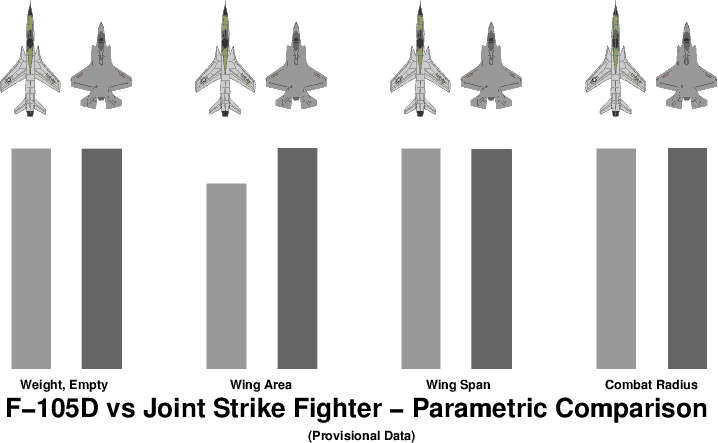
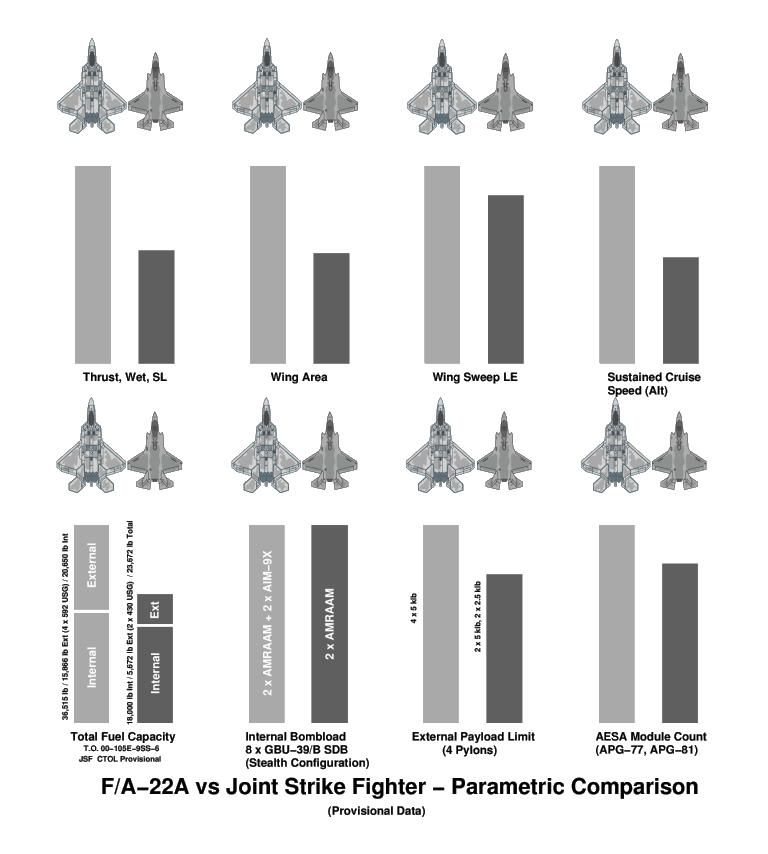
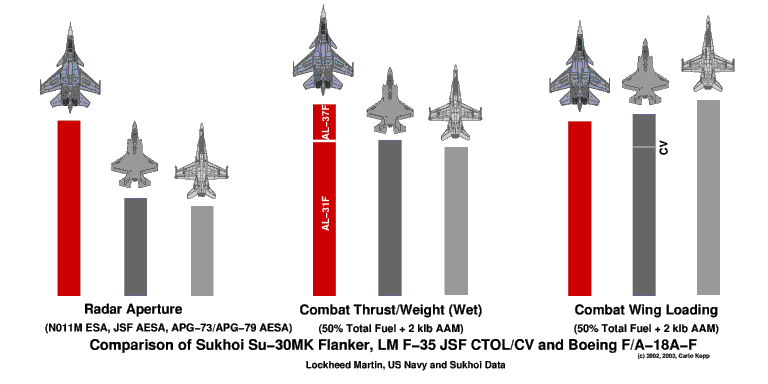
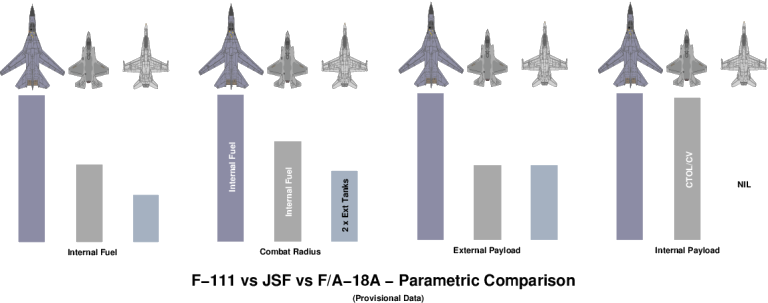
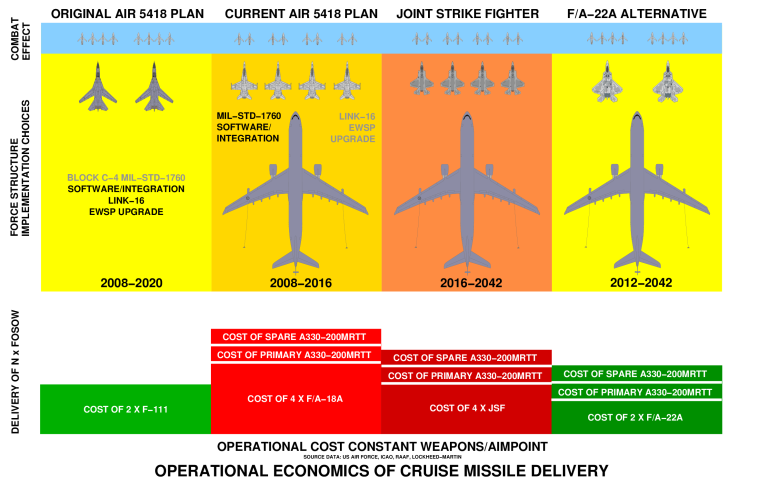
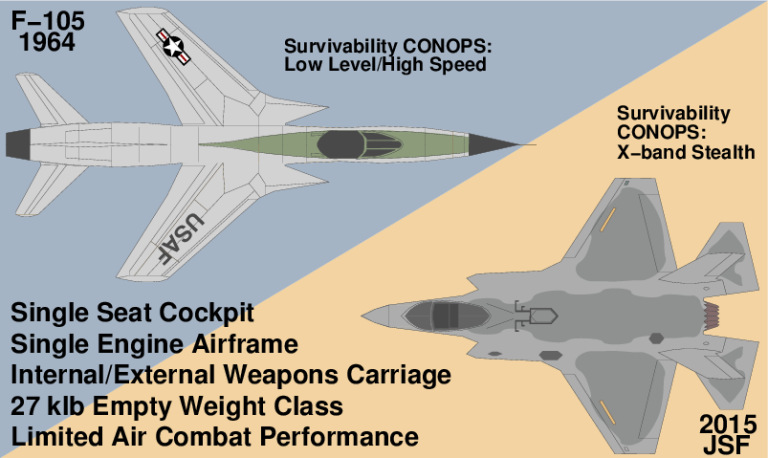
The
Joint
Strike
Fighter
best
compares
in
its
roles
and
missions,
sizing
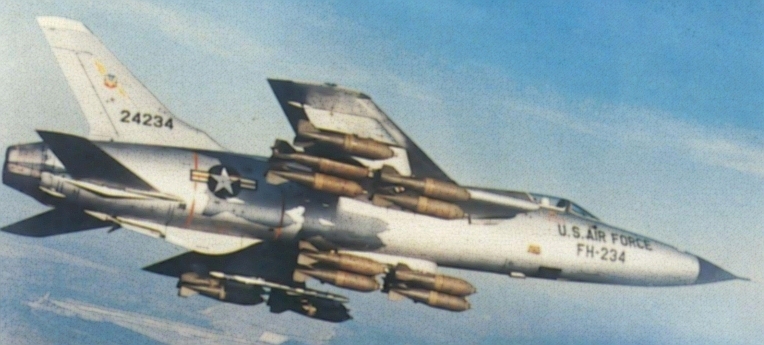
and relative capabilities to the Republic F-105D Thunderchief, the
workhorse of the US bombing effort during the Vietnam conflict. What is
remarkable is the extent to which a similar roles/missions requirement,
defined almost four decades later, produced a combat aircraft of nearly
identical size and weight. Like the F-105, the JSF is not
designed
to be a top end air superiority fighter, but is designed with was
intended to be a robust
self defence capability.
|
|
|
|
|
|
|

![F-22A Raptor, FB-22, F-22E, F-22N and Variants Index Page [Click for more ...]](APA/f-fb-22.png "F-22A Raptor, FB-22, F-22E, F-22N and Variants Index Page [Click for more ...]")

![People's Liberation Army Air Power Index Page [Click for more ...]](APA/pla-air-pwr.png "People's Liberation Army Air Power Index Page [Click for more ...]")


![Military Ethics, Culture, Education and Training Index Page [Click for more ...]](APA/ethx-culture.png "Military Ethics, Culture, Education and Training Index Page [Click for more ...]")


![Russian / Soviet Weapon Systems Index Page [Click for more ...]](APA/rus-weps.png "Russian / Soviet Weapon Systems Index Page [Click for more ...]")