|
||||||||||||||||||||||
 |
||||||||||||||||||||||
![F-22A Raptor, FB-22, F-22E, F-22N and Variants Index Page [Click for more ...]](APA/f-fb-22.png "F-22A Raptor, FB-22, F-22E, F-22N and Variants Index Page [Click for more ...]") |
 |
![People's Liberation Army Air Power Index Page [Click for more ...]](APA/pla-air-pwr.png "People's Liberation Army Air Power Index Page [Click for more ...]") |
 |
 |
 |
 |
 |
 |
![Military Ethics, Culture, Education and Training Index Page [Click for more ...]](APA/ethx-culture.png "Military Ethics, Culture, Education and Training Index Page [Click for more ...]") |
 |
||||||||||||
 |
![Russian / Soviet Weapon Systems Index Page [Click for more ...]](APA/rus-weps.png "Russian / Soviet Weapon Systems Index Page [Click for more ...]") |
 |
 |
 |

|
 |
 |
 |
 |
 |
||||||||||||
 |
 |
 |
||||||||||||||||||||
| Last Updated: Mon Jan 27 11:18:09 UTC 2014 | ||||||||||||||||||||||
|
||||||||||||||||||||||
|
||||||||||||||||||||||
|
||||||||||||||||||||||
|
|
|
|
|
|
|
|
|
|
|
||||||||||||
|
|
|
|
|
|
|
|
|
|
|
||||||||||||
| |
|
|
||||||||||||||||||||
| Last Updated: Mon Jan 27 11:18:09 UTC 2014 | ||||||||||||||||||||||
|
||||||||||||||||||||||
Why the F-22 and the PAK-FA have the “Right Stuff” and why the F/A-18 and the F-35 do not |
||||||||||||||||
|
Air Power
Australia - Australia's Independent Defence Think Tank
|
||||||||||||||||
| Air Power Australia NOTAM 30th March, 2010 |
||||||||||||||||
|
||||||||||||||||
|
||||||||||||||||
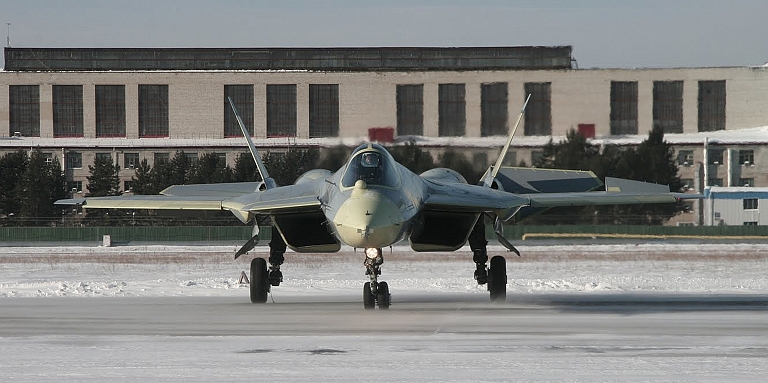 A PAK-FA prototype image released by Sukhoi/KnAAPO (Sukhoi). |
||||||||||||||||
|
South
China Sea, 16N, 114E, 2018. Captain Charles (Charlie) Brown is
flying Number 2 in a battle formation of four F-35Cs acting as
Offensive-Counter-Air ‘sweepers’ for a flight of four Super
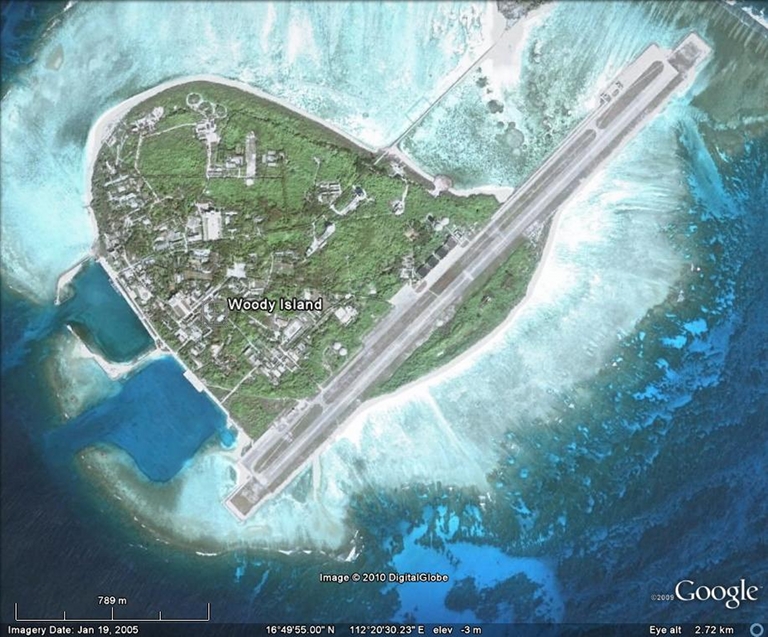
Hornets inbound for a JSOW strike on Woody Island. A large military
deployment on the Island is denying free passage throughout the South
China Sea, and several new oil drilling platforms have been active
around the Spratly and Paracel Islands. The United Nations is not
amused by this claim of sovereignty over the region, and has resolved
to remove the deployment by force.
The task has been assigned to the USN, and a Carrier Battle Group lead by CVN-76 Ronald Reagan is in the area. The plan is to cut the runway and disable the port facilities, then force a withdrawal from the Island under terms dictated by the UN/USN coalition task force. Number 3 of the F-35C sweepers gets a contact from his APG-81 radar, and the four inbound bogeys are shown across the network. Analysis of signals from the bogeys identifies them as Russian built Su-35S, previously seen moving on Woody Island by satellite recon. All the F-35Cs arm their four AIM-120D missiles and prepare for a ‘turkey shoot’, expecting to get ‘first-look, first-shot, first kill’. ‘Ah’, thinks Charlie, ‘this will be like the AN/AAQ-37 EO DAS advertisement: ‘manoeuvrability is irrelevant …let the missiles do the turning’. What Charlie Brown doesn’t realise is that such marketing hype was only partly right. In today’s day and age, manoeuvrability becomes irrelevant when faced with high agility, more particularly extreme agility, defined as extreme manoeuvrability + extreme controllability – a deadly combination best achieved with 3D TVC engines, widely spaced, interoperated with rapid response dynamic digital flight controls in airframes with highly relaxed static stability in the longitudinal and, in the case of the PAK-FA, directional axes. The Flankers with their extreme agility come in range at 60 miles, and the F-35C flight sorts targets and fires a pair of AIM-120Ds at each Flanker. The seconds tick by agonisingly slowly as the missiles fly out to their targets, and each pilot watches for the tell-tale radar bloom of a kill. The AN/ASQ-239 “Barracuda” Electronic Warfare system shows considerable activity from each Flanker and then …. a single bloom indicating one Flanker has been hit. |
||||||||||||||||
South China Sea Scenario
 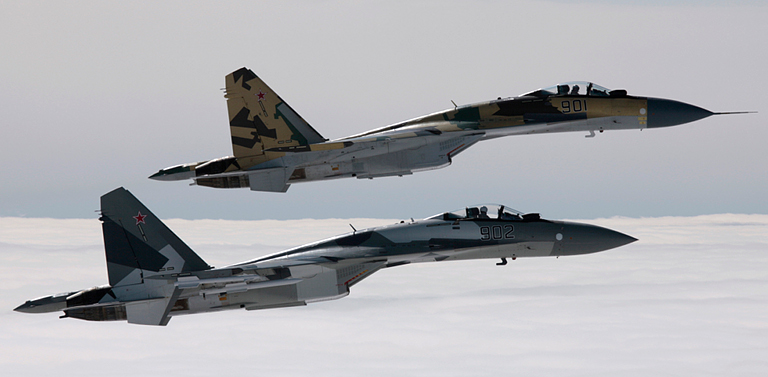 A
pair
of
Su-35S
prototypes, B/N 901 and 902 (KnAAPO).
|
||||||||||||||||
Range
is now 40 Nm and closing at 1,100 Nm/hr. The F-35C’s EO DAS
detects four missile launch “flares” from each Flanker, twelve in
all, and APG-81 radar detects missiles inbound. The F-35Cs each fire
their two remaining AIM-120Ds and turn sixty degrees to maintain
datalink command guidance of their missiles via the APG-81 AESA
antenna. The cockpit MFDs show that the Flankers have broken away
though 120 degrees, with the IRBIS-Es' swivelling antenna heads
maintaining guidance contact. The AIM-120Ds, now chasing a retreating
target, will fall short. The F-35Cs are not so lucky and they all
break as the EO DAS senses the incoming R-77M missiles. Small active
radiofrequency decoys and flares are ejected. One JSF is killed with
an R-77ME missile with an active radar seeker, another with a
tail-pipe hit from an R-77TE with an infrared seeker. Charlie’s
JSF is now on full burner, heading for the deck and passing Mach 1.3
when ‘whoomp’ – the back-end explodes, and the cockpit is
shrill with alarms and festooned with red displays of failure
warnings. There is no response from the stick and he reaches for the
ejection handle. A blast and excruciating pain as large chards of the
shattered canopy knife into his upper body, then silence as the
‘chute’ opens.
Charlie has a bird’s-eye view as the Flankers tear into the Super Hornet Strikers. JSOWs are jettisoned and they hurriedly fire their AIM-120C5s – all miss. The Super Hornet’s defensive ALE-55 decoy does a good-job on the R-77MEs with active radar seekers, but not those with modern imaging-infrared seekers. Two Super Hornets are lost to these BVR missiles. The three Flankers close, and rapidly dispatch the remaining two Strikers. One is killed with a pair of infrared R-73 Archers, and the other with a burst from the GSH-301 30mm cannon. And the final count: one Flanker killed, four F-35Cs and four Super Hornets killed for a Flanker vs USN Loss-Exchange Rate of 1:7. Fiction or Prediction? In the rapidly evolving world of future air combat, costly combat capabilities are being countered before the aircraft become operational. Those combat aircraft built to an obsolete specification are effectively dead before they fly. |
||||||||||||||||
|
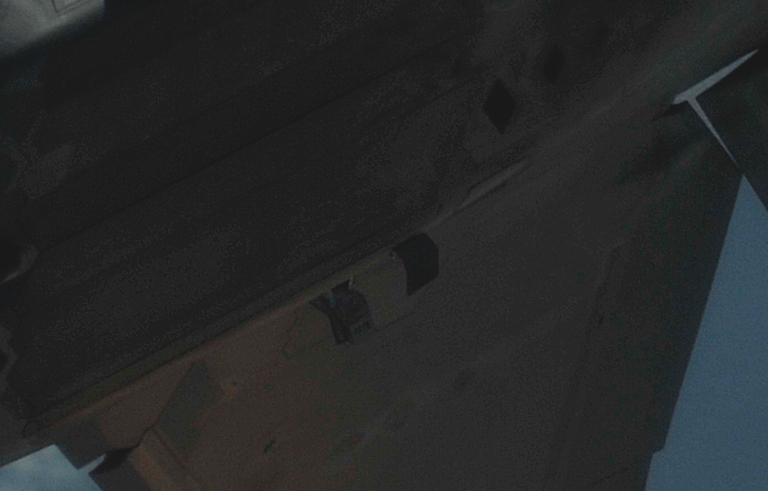
F-22A Raptor - Endgame Counter Measures 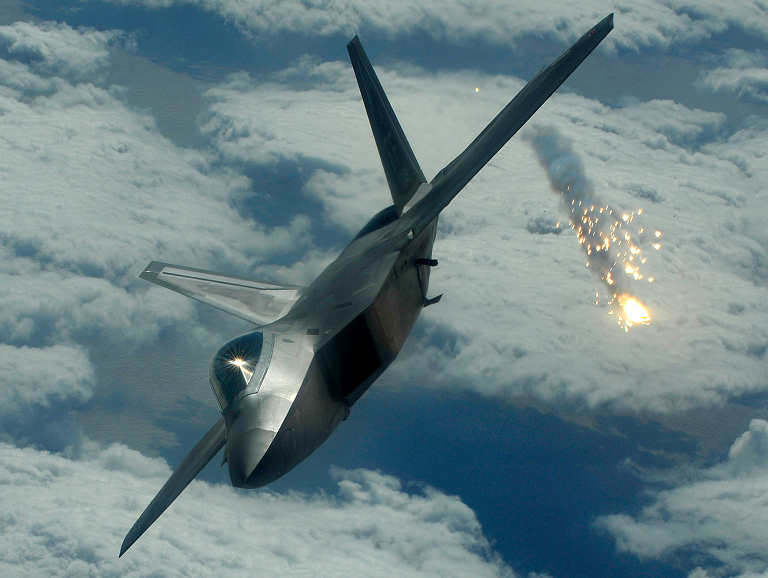 Above, below: F-22A Raptor ejecting flares from internal countermeasures dispensers (US Air Force). 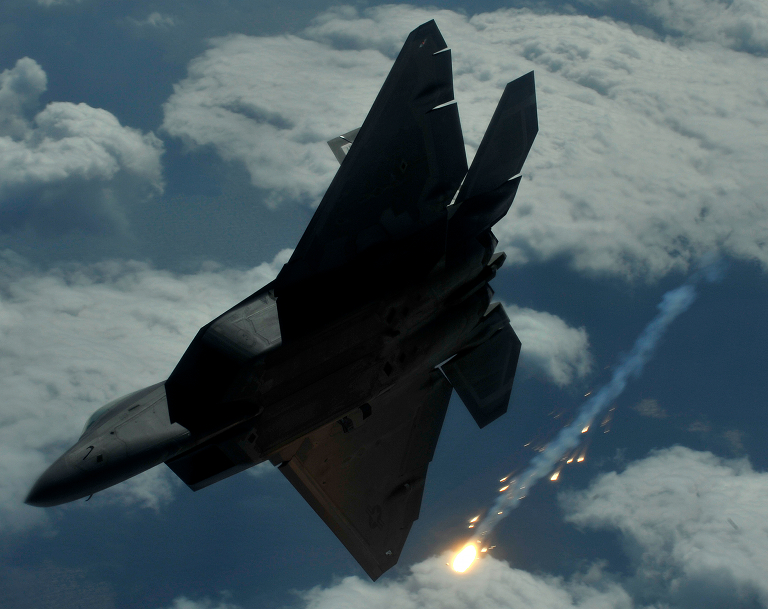  Above, below: left and
right countermeasures dispenser bay doors opened (US Air Force).
 |
||||||||||||||||
Take
‘stealth’
as
an
example. The original concept remains very
sound, but can lead, through intellectual laziness, to several design
and development consequences that will, if not addressed, lose future
air combat fights.
Stealth is incompatible with classical “endgame” active electronic countermeasures for two reasons: firstly radiating large amounts of power ‘gives the game away’ and secondly, large wideband wide-angle radiofrequency power emissions require large low-loss apertures, which are difficult to make highly stealthy. So the F-22A and the JSF are not reported to currently carry all aspect active electronic defences. Unless equipped with internal endgame radio-frequency countermeasures, if they are detected, their defences are limited and their loss rate can be high, especially if they are unable to defeat the inbound weapon kinematically1. Long-range missiles are also considered “not important” by many planners, because stealth allows a medium range missile shot before the adversary is aware you are there. Unfortunately, ‘Low-Observability’ is not the same as ‘No-Observability’. As fighter radars on large aircraft like the Su-35S and the PAK-FA deploy increased antenna size and much increased emitted radiofrequency power, and adopt advanced signal management though Active Electronically Scanned Arrays (AESAs), the formerly invisible tennis ball becomes a bright star. And a jet engine producing 40,000 lbs of thrust, is another bright star to a modern staring focal plane infrared sensor. The mantra ‘manoeuvrability is irrelevant … let the missiles do the turning,’ is another dangerous misconception popular in the contemporary planning community. If the enemy does not have stealthy aircraft, they have to rely on several layers of countermeasures, manoeuvre being one. And it works. Blasting a simple-minded missile with clever deceptive waveforms, putting a towed decoy in its path and confusing it with forward and rear firing chaff can hide the true target, making it miss. Simple Newtonian physics shows that an aircraft at Mach 0.9 with a 9G turning capability can easily out-turn and avoid Mach 3.6 missiles with a 40G turning capability. Another miss. Those who believe in the absolute impenetrability of ‘stealth’ create a deadly delusion: ‘you can’t see me, so you can’t fire at me, so I don’t need to care about terminal endgame countermeasures’. The problem is, the enemy can see the F-22A close up, can see the F-35 from quite a range, especially side and rear on, and can fire missiles with radar and infra-red seekers. So when these missiles close on an aircraft without effective terminal endgame countermeasures, they kill. The F-22A’s kinematics give it a fair chance of escaping a missile shot – the F-35 JSF very little chance. How does a Mach 1.5 JSF (JORD spec is Mach 1.5 S&L @ 30 kft ISA) escape a Mach 2.25 Sukhoi, especially when the Sukhoi has fuel to burn? So, the foregoing description of a future air combat fight tells the story of changing capabilities, changing tactics, and changing Loss-Exchange-Ratios. Why are we observing such a single-minded rejection of the need for effective endgame defences on Western combat aircraft? It is a direct by-product of a steadfast belief in Western military bureaucracies that most if not all future air combat will occur in the Beyond Visual Range (BVR) domain. There is no real evidence to support this idea, as the heavily “asymmetrical” conditions observed in air campaigns fought from 1991 through 2003 were unique and very unlikely to be repeated in the future. The advent of very long range “anti-AWACS” missiles, advanced conventional fighters like the Su-35S, and the stealthy PAK-FA, will result in far more “symmetrical” air campaigns, where the conditions permitting frequent or predominant Beyond Visual Range missile engagements will arise infrequently. Most air combat engagements will devolve into close combat, where “traditional” fighter virtues will be paramount. What follows then? Agility is important. Countermeasures are important. The effects can be summarised in this table:
How
the effects of stealth, countermeasures and agility play out depends
on the combatant’s relative capabilities and the tactics employed.
However, there is certainty about this: it is better to have superior
agility; it is better to have effective countermeasures; but it is best
to have both! The US Navy is putting its fragile eggs in the F-35 JSF and the Super Hornet basket. This is tactically very dangerous. F/A-18E/F/G: This aircraft has excellent
countermeasures, but if the adversaries
have equally good or better countermeasures and can out-manoeuvre the
Super Hornet’s missiles and airframe, then the inevitable result of
any engagements will be the destruction of the Super Hornets; and,
F-35 JSF: Because of the paradox of a stealthy aircraft actively jamming missiles, it is vulnerable to attack, especially within the rear-quarter from radar and infra-red guided missiles; once the aircraft is detected, then escaping from a much faster, more agile enemy is unlikely; high loss rates are predicted. The F-22A’s Raptor countermeasures capabilities have not been disclosed publicly. The passive sensors and systems are listed, but no public information is available, as it is for other types, on active, terminal countermeasures. The logic - or illogic if you will – that a stealth aircraft does not need them suggests there are none. However to remain effective, the F-22 needs to maintain its margin of superiority over newcomers like the PAK-FA and the Su-35S and actives countermeasures will be part of the capability solution, especially when engagements are closer, faster and at ranges where even VLO aircraft can be detected and tracked. Following the example of a very successful and cost-effective development of the F-15E from the F-15A&C, the F-22A needs to be developed along the lines of the Strike Eagle – a two-place, much enhanced “F-22E” fighter with the rear seat Weapons System Officer monitoring sensor feeds, advising the pilot and managing the passive and active terminal countermeasures – and, yes, it must have the agility and persistence to overmatch both the PAK-FA and the Su-35S. What they will also need is effective countermeasures that don’t compromise stealth. This capability must be deployed only when needed. The ALE-55 is a good example – a towed decoy that emits signal waveforms derived from the on-board RFS/ESM and countermeasures generator, with a fibre-optic cable that could be reeled out to meet threats and retracted or jettisoned after the threat has passed. Small, powered ‘smart’ air-launched decoys with an aircraft-like infra-red or radio-frequency signature are another. Manufacturers make stealthy gun-port openings and the F-22 has stealthy countermeasures bays on the fuselage sides, so they should be able to make stealthy electronic warfare openings large enough for effective countermeasures systems – the small and stealthy RFS/ESM antennas can collect the enemy’s signals continuously, the internal countermeasures generator forms the jamming waves for radar seekers, and directed energy for infrared seekers. The countermeasure bays open, ports blast out disruptive radiofrequency and infrared energy as needed, then the bays close and allow the fighter to fade back into the ether. 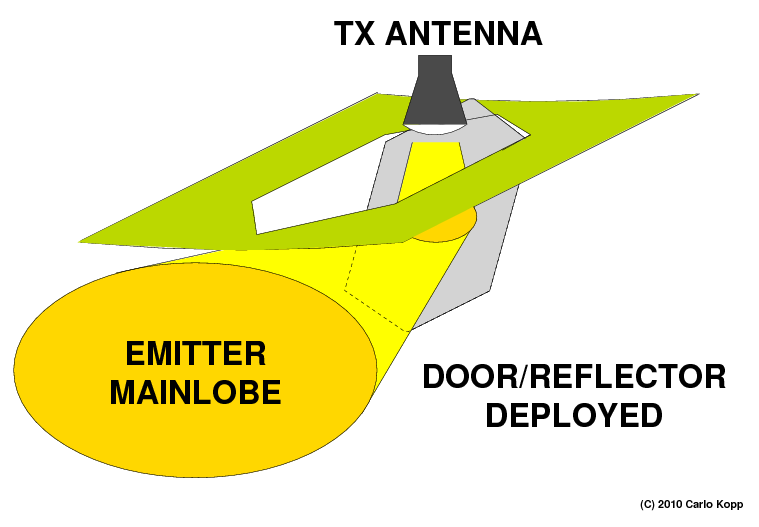 One advantage of true stealth aircraft is that their much lower radar signatures reduce the emitted power demands for an endgame electronic countermeasures suite. Rather than emitting kiloWatts, such a system can be viable emitting less than 100 Watts of power. While this has the enormous benefit of removing the need for large thermionic transmitters and supporting waveguides, it does not remove the need for jammer receiver hardware, processor hardware, techniques generator hardware, and embedded software, all of which incur maintenance, weight, volume, power and cooling demands. Large stealth fighters like the F-22 and PAK-FA are big beneficiaries, insofar as they are large enough to incorporate internal endgame countermeasures without significant performance and capacity penalties. The much less stealthy F-35 would require much more emitter power to protect its more vulnerable beam and tail sectors, while it is severely challenged in weight, volume, power and cooling, making integration of a robust all aspect endgame electronic countermeasures suite a difficult engineering challenge, for which a genuinely satisfactory design solution may not exist2. Some argue that the AESA radars fitted to the F-22A and the F-35 will be effective ‘Directed Energy Weapons’ (DEWs) that will destroy incoming missiles. There are three ‘difficulties’ with this notion. Firstly, AESA modules can only steer the energy beam within a cone angled about 120 degrees centred on the AESA boresight – leaving the remaining 240 degrees of the sphere unprotected. Secondly, AESA radars cover a limited bandwidth – how will its directed energy negate ‘out-of-band’ missile seekers, especially infra-red? Thirdly, ‘hardening’ missiles against DEW attack is a relatively simple and low cost exercise – there are already signs that this is taking place, e.g. active laser proximity fuses replacing radio-frequency fuses on Russian missiles. Finally, a ‘blinding glimpse of the bleeding obvious’. If the enemy can out-manoeuvre your missiles, then the converse of that infamous advertisement is: ‘if your missiles can’t do the turning, then smart aircraft are irrelevant’. What the F-22E needs is better missiles. The MBDA Meteor is a good start, as its throttleable ramjet lets it slow to a pace where it can do the required turning in the terminal stage. However, this missile needs an alternate seeker such as the Infra-red sensor in the AIM-132 AMRAAM. Future missiles need longer range – not necessarily to kill at greater distances, but to position to end-game places where its target has poor active defences or poor stealth performance. To conclude, resting on the laurels of the F-22A is not an option. The Su-35S has seriously dangerous and effective capabilities, even against an F-22A. The stealthy PAK-FA, albeit in an early phase of development, is showing naked air combat power in the form of extreme plus agility and persistence that, with the addition of advanced sensors, countermeasures and weapons, will likely soundly defeat the Raptor but will certainly annihilate the F-35 and the Super Hornet. Work on the F-22E needs to start immediately and be undertaken with the urgency required of a grave threat to the national defence and security of the USA and its Allies. |
||||||||||||||||
|
||||||||||||||||
 |
||||||||||||||||
|
||||||||||||||||
|
|
||||||||||||||||
| Air
Power
Australia
Website - http://www.ausairpower.net/ Air Power Australia Research and Analysis - http://www.ausairpower.net/research.html |
||||||||||||||||
 |
||||||||||||||||
| |
||||||||||||||||
|
|||||||||||||
|
|
|
|
|
|
|
|
|
|
|
|||
|
|
|
|
|
|
|
|
|
|
|
|||
| |
|
|
|||||||||||
| Artwork, graphic design, layout and text © 2004 - 2014 Carlo Kopp; Text © 2004 - 2014 Peter Goon; All rights reserved. Recommended browsers. Contact webmaster. Site navigation hints. Current hot topics. | |||||||||||||
|
Site Update
Status:
$Revision: 1.753 $
Site History: Notices
and
Updates / NLA Pandora Archive
|
|||||||||||||
|
|
Tweet | Follow @APA_Updates | |||||||||||
|
|
|||||||||||||
|
|
|||||||||||||