|
||||||||||||||||||||||
 |
||||||||||||||||||||||
![F-22A Raptor, FB-22, F-22E, F-22N and Variants Index Page [Click for more ...]](APA/f-fb-22.png "F-22A Raptor, FB-22, F-22E, F-22N and Variants Index Page [Click for more ...]") |
 |
![People's Liberation Army Air Power Index Page [Click for more ...]](APA/pla-air-pwr.png "People's Liberation Army Air Power Index Page [Click for more ...]") |
 |
 |
 |
 |
 |
 |
![Military Ethics, Culture, Education and Training Index Page [Click for more ...]](APA/ethx-culture.png "Military Ethics, Culture, Education and Training Index Page [Click for more ...]") |
 |
||||||||||||
 |
![Russian / Soviet Weapon Systems Index Page [Click for more ...]](APA/rus-weps.png "Russian / Soviet Weapon Systems Index Page [Click for more ...]") |
 |
 |
 |

|
 |
 |
 |
 |
 |
||||||||||||
 |
 |
 |
||||||||||||||||||||
| Last Updated: Mon Jan 27 11:18:09 UTC 2014 | ||||||||||||||||||||||
|
||||||||||||||||||||||
|
||||||||||||||||||||||
|
||||||||||||||||||||||
|
|
|
|
|
|
|
|
|
|
|
||||||||||||
|
|
|
|
|
|
|
|
|
|
|
||||||||||||
| |
|
|
||||||||||||||||||||
| Last Updated: Mon Jan 27 11:18:09 UTC 2014 | ||||||||||||||||||||||
|
||||||||||||||||||||||
|
Is the JSF Affordable? An Australian’s Perspective |
|||||||||
|
Air Power
Australia - Australia's Independent Defence Think Tank
|
|||||||||
| Air Power Australia NOTAM 17th July, 2010 |
|||||||||
Peter Goon, BEng (Mech), FTE (USNTPS), Head of Test and Evaluation, Air Power Australia |
|||||||||
|
|||||||||
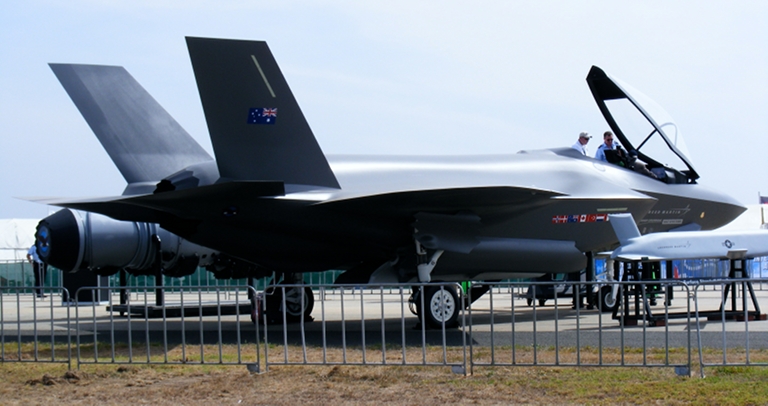 F-35 CTOL mockup on display at Avalon Airshow (image © 2009, Dr Carlo Kopp). |
|||||||||
|
In the not too distant future, if honesty, integrity and common sense prevail, the normal, standard, professional project management practices of Performance Assessments and Root Cause Analysis and Assessment, commonly known as PARCAA, that, for major U.S. Defense acquisition programs, have needed codification and enactment under U.S. Statute to be considered let alone put into effect (see Weapon Systems Acquisition Reform Act – WSRA of 2009, Public Law 111-23), will most likely conclude: “The root cause of the failed JSF Program is institutionalised groupthink that allowed a fighter aircraft development program based on “a total indifference to what is real” to become regarded as sound business practice, by both the contractors and their customers. The presence of positive feedback loops between an ingenious though deeply flawed and deceitful marketing strategy and the careerism of the politically avaricious in a significantly deskilled environment justified behaviours that led to a project that is “flawed from its inception”; has burgeoning and ongoing growths in costs/risks, and misplaced political commitment - political commitment which is now ensnared by terms like “too big to fail” (TBTF) and “there is no alternative” (TINA). Only reforms that institute negative feed-back loops between the capabilities promised and the capabilities required, based on hard data and facts determined by rigorous analysis, evidence based argument and real world testing, can stop the JSF Program from becoming the catastrophe it will surely be if allowed to continue in its current form.” Notwithstanding the practice of Root Cause Analysis and Assessment is the “looking-back-in-history-to determine the what, why and how of a failure, as well as the when, where and who” version of the forward looking predictive practices of Risk Analysis and Assessment, commonly referred to as Risk Management, this conclusion will almost certainly be linked to the many marketing mantras used to define the JSF Program, including: “Affordability is the cornerstone of the JSF Program.” This is the most stated and frequently declared basis of what is supposed to be the largest engineering project of all time, for developing and producing defence materiel – the Joint Strike Fighter (JSF) Program. Professional Engineering is often described as: “Engineering is the professional art of economically applying maths, science and technology to the optimum conversion of natural resources for the use and, preferably, benefit of humankind”. Put another way: “An engineer is someone who can do for fifty cents what any fool can do for a dollar.” So, being an Engineer includes thinking about affordability, doing things economically and minimising costs. In the Engineering Profession, as in all valued and honest human endeavours, “cost” is a measure of the quantity and quality of the processes applied and the resources that are used to produce an outcome. Therefore, costs are a consequence and not a cause. As well as “Affordability is the cornerstone of the JSF Program”, the Joint Strike Fighter Program has, as one of its fundamental tenets, another mantra known as “Cost As an Independent Variable” or CAIV, for short. Despite what the CAIV doctrine would have us believe, since costs are a consequence and not a cause, they actually can’t be “independent”; either of the processes or the resources that are used. Increase the processes and/or the resources used, say, by requiring more of an engineered outcome, the costs go up. Remove or reduce the requirements on an engineered outcome to lower the level of processes and/or the amount of resources to be used, the costs should come down. QED. Therefore, the concept of CAIV is not only unsupportable, mathematically, but it also not supportable, logically; otherwise known as a non sequitur. This particular non sequitur is one of the many logical fallacies that have been evident as the basis of the JSF Program’s marketing, PR and sales strategies since the contract was awarded to the Lockheed Martin Corporation over 8 years ago. The use of such logical-fallacy-based strategies falls under the recently coined term of “Thana Marketing”, after the Greek word “Thanatos” with its connotations of “dark death”, “merciless, indiscriminate behaviours deceptively performed” and “risky, self destructive acts”. Though, looking at the JSF Program, it could be said this is a prime example of “Thana Marketing on steroids”. The other logical fallacies observed in the marketing of the JSF Program include: “Red Herrings” – such as the promises of future in-country work diverting attention away from the real issue of providing Australia’s fighting men and women with the best, most cost effective capabilities for National Defence; “Argumentum ad Populum” – everyone else believes in the JSF, therefore it must be okay; “Appeals to Authority” – which stifle and discourage people, particularly those whose expertise lies in the political domain, from thinking critically for themselves, finding it easier to rely upon the hearsay, rumours and innuendos professed by others, thus providing the ultimate, though, flawed deniability, “. . .but that is what I was told ...”; and, “Argumentum ad Hominem” and “Argumentum ad baculum” - the tried and proven weapons of choice of the “mind-guards” of Groupthink, otherwise known as “Blacklisting”, “Sending to Coventry” or, more generically, “Shooting the Messenger”. In addition to these logical fallacies, there have been statements about the JSF which are, simply, not true; such as the many ardent claims that the JSF is “a truly Fifth Generation Fighter” and that other fabled assertion that the real Fifth Generation American Fighter, the F-22A Raptor, is so much more expensive than the JSF, by “two to three times”. Back in 2001/02, independent experts in the Aerospace Industry and Academia advised senior officials in the Australian Department of Defence and the Government that the unit price of the JSF was almost certainly going to end up being around the same price as for the F-22A Raptor, if not more. As further hard data became available, this advice was again provided to Defence and also the Australian Parliament, in 2003, 2004, 2006 and since, with the provision of said hard data as evidentiary support, in addition to the results of the parametric analysis upon which this advice was initially based. Moreover, the total price to buy and operate a fleet of JSF aircraft would be much higher than the more effective and efficient fleet based on the requisite number of the far more capable F-22A Raptor, which would also assure Australia has the ability to meet the strategic imperative of retaining regional air superiority. Coming back to today, the unit price for the F-35A JSF CTOL aircraft (the JSF variant which the Chief of Air Force in 2002 recommended the Australian Government buy) is more than the 2010 unit price for the F-22 Raptor – over 1.5 times or 52.4% more. Putting
this another way, the unit price being paid by the US Government for
each of the ten (10) F-35A JSF CTOL aircraft it is buying in 2010 is
more than 85 million US dollars over and above the 2010 unit price
being paid for the last four (4) F-22A Raptor aircraft it is buying. This difference, alone, equates to around 7
more Raptors while the total cost for the 10 x F-35A JSFs equates to
over 20 more F-22A Raptor aircraft “out
the factory door” for the US Air Force. The latest US Government estimate of the average procurement unit cost (APUC) for the F-35 JSF is US$133.1 Million, a simple averaging over the whole planned production of 2,443 JSF aircraft. The requisite reductions in costs needed to achieve this average overall unit cost are the result of anticipated efficiencies from “production learning curves” and other anticipated improvements in manufacturing. Though not likely to be reached till sometime after 2023, this JSF APUC figure will almost certainly still be more than the cost per aircraft out of the factory if another 50 to 100 production units of the F-22A are added to extend the Raptor production line out to, say, 2015. The
difference in unit costs between the JSF and F-22 (a.k.a. “savings”)
would
be
even
greater
if more Raptors were to be built, due to the
same efficiencies from “production learning curves” and
improvements in manufacturing upon which the JSF Program is relying
upon to eventually bring costs down to this latest estimated of the
JSF APUC (US$133.1 Million). Notably, this figure also happens to be
more than the unit flyaway cost (UFC) of the four (4) Raptors going
“out of the factory door”, as the following extract from an
official U.S. Government document shows: |
|||||||||
|
|||||||||
|
How can this be? How can the JSF aircraft and the JSF Program in which “Affordability is the cornerstone” cost much more than the F-22A Raptor? How can the public’s perceptions and the claims that have been made and continue to be made about the JSF Program and affordability be so out of kilter with the data and the facts as well as reality, itself? Quite simply, while Professional Engineers and the technologists charged with developing the JSF have been struggling with a myriad of challenges not of their making, the marketing and PR strategies of the JSF Program and their authors have built up a mythology centred around “a total indifference to what is real” which, in plain English, is the definition used by Princeton University’s Emeritus Philosophy Professor, Harry G. Frankfurt, to describe what we all know as “Bullshit”. One
of the larger forms of “a total indifference to what is real”
resides in the claim that “Affordability is the cornerstone of
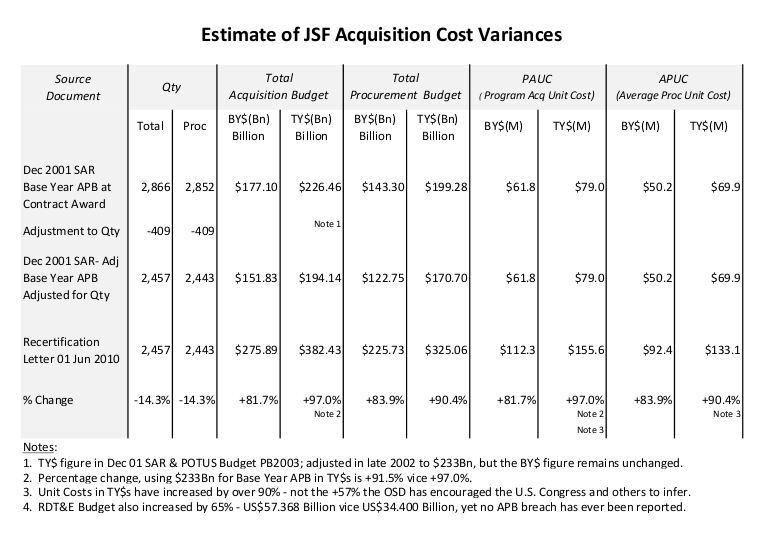
the JSF Program”, as the following APA analysis shows: F-35 JSF Program: When is “Affordability” Not? The basic arithmetic behind the increases in the budgets and costs can be done on the back of an envelope or via a simple spreadsheet, once you know (and understand) what the numbers and the various terms mean. |
|||||||||
 |
|||||||||
|
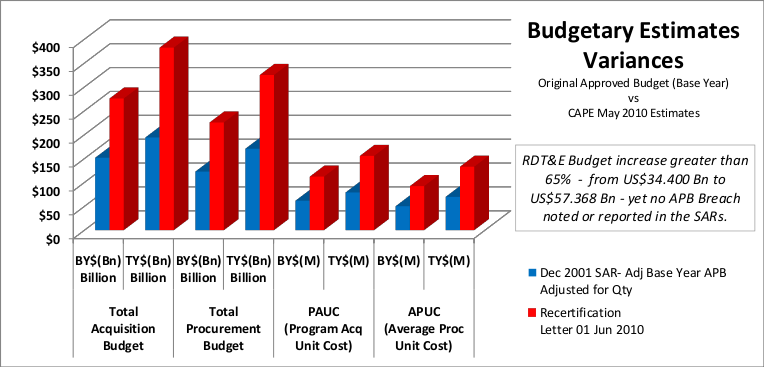
The Total Budget is the sum of the Procurement Budget and the Development Budget - what is called the RDT&E Budget. The Research, Development, Test & Evaluation (RDT&E) Budget is not explicitly shown in this chart, but it, too, has increased, by more than 65% - US$57.368 Billion vice US$34.400 Billion in TY$s yet, surprisingly, no APB breach has ever been noted or reported. Now the terms, TY$s (Then-Year Dollars) and BY$s (Base-Year Dollars) are very useful for two very good reasons. The TY$s include the time-value-of-money (TVM) economic factors (i.e. the effects of such things as inflation on the value of the dollar) and, thus, are estimates of what will likely have to be spent, that is, the costs, on engineering the outcome at the time the “Engineering” has to be done. As a result, the estimates of unit costs and the unit price, in TY$s, are also good indications and calibrations of what will have to be paid at the time of payment for or the procurement of the engineered outcome or product, respectively, the product, in this case, being the JSF aircraft. In terms of project management, the figures expressed in BY$s (Base-Year Dollars) are even more useful. The Base-Year is the year the contract was agreed between the US Government and the contractor. In the case of the JSF, the Base-Year is 2002 and the contractor is Lockheed Martin. Expressing the budget figures in 2002 dollars levels provides an apples to apples comparison since each dollar has the same value as it would have had in the Base Year – in 2002-dollars-worth. The important result from such a comparison is to show the changes in the budget estimates and actual expenditures, stripped of the perennial effects of economic factors, such as inflation. In the case of increases in the budget estimates and expenditures, this lays bare the effects of such things as the initial estimates of what has to be done (i.e. the planned activities), their incumbent risks, and the resulting costs, at the time of contract award, being “overly optimistic” and “grossly underestimated” and “effected by a series of execution [Executive] actions and a general intolerance for failing and reluctance to accept unfavorable information”, as were cited in the purported “Basis of Determination and Supporting Documentation” to the OSD’s JSF re-certification letter to the U.S. Congress, dated 01 June 2010, and the AT&L Acquisition Directive Memorandum of the following day. Most importantly, such comparisons show the effects of risks materialising and the resulting need for more processes and/or more resources to be used in trying to overcome the consequences (a.k.a. issues and problems) for engineering the outcome. A
simple graphical presentation brings all of this into stark relief: |
|||||||||
 |
|||||||||
|
Disappointingly though not surprising, the artisans of “a total indifference to what is real” found another use for BY$s – one that was never intended. When expressed in the equivalent of 2002 dollars, all the budgets, costs and, ultimately, the price of the aircraft appear a lot smaller than when they are expressed in the dollars that have to paid, the TY$s. This sleight of hand was used to great effect in creating the pretence that the JSF was going to, somehow, be the epitome of affordability. As to the question of what is the price of the JSF aircraft, the answer provided was, more often than not, couched in terms of an “average unit recurring flyaway cost, in BY2002 dollars”. This practice persisted, in full or in part, till the latter part of last year, 2009, when a new term was coined, “the unit recurring flyaway price” or “the URF Price”, for short, expressed in 2008 or, now, 2010 dollars. As disclosed in the APA analysis cited earlier, there is more to and rather less of the aircraft included in this “URF Price” which appears to be missing the costs for some fairly vital parts of the engineered outcome, such as the engine. Anyone unable to see through this dalliance with the art of deception are almost certainly doomed to remain captive to this most ingenious piece of high powered “Thana Marketing” ever seen, since the claim was made that the JSF is “a truly Fifth Generation fighter aircraft”. However, there is another load of “a total indifference to what is real” that requires spreading as thick and fast as possible if the JSF Program is to be kept on the OSD driven political life support system that has sustained it for all these years. The most skilled artisans of “a total indifference to what is real” are now engaged in trying to cover up the fact that the JSF is now obsolete before its time. Sadly for them and those involved with the F-35 JSF, the rest of the world has moved on in the 8 years since the JSF Program, now running 7 years behind schedule, was contracted to Lockheed Martin. Russian fighter aircraft specifically designed to defeat the F-22A Raptor, such as the in-production Sukhoi Su-35S Flanker and the in-flight-test Fifth Generation Fighter, the T-50 PAK-FA, already overmatch the JSF designs by a significant degree.; as do the latest anti-access and area denial weapon systems to emerge from Russia and China; as will the Chinese equivalent Fifth Generation Fighters being developed under the J-XX and J-12, et al, Programs. For the JSF capability to be competitive against these Reference Threats, then it would have to be able to defeat the F-22A. Any belief in this being even remotely possible now or ever would supplant all that has gone before in the JSF Program as the greatest piece of “a total indifference to what is real”, ever. In
Australia, there have been a number of Defence materiel acquisition “curtain raisers”
to the JSF Program, such as Project
Sea-1411
– the Super Sea Sprite Helicopter Project. This project is notable for having
wasted, in capital costs alone,
well over a billion dollars of tax payer funds, even after dire and
repeated warnings of its “failed
project” status and
inherent Extreme Levels of Risks since
the project’s inception. This misadventure produced no capability at all, while the provision of the capability still required for the fighting men and women of the Australian Defence Forces (our war-fighters) was put back some ten (10) years, with all the inherent opportunity and work around costs that go with that, measured in billions of dollars. On the Western Global stage, the “curtain raiser” that should have senior defence officials and politicians, alike, concerned about the JSF and the legacy it and they will leave future generations of their countries’ citizens is, undisputedly, the Global Financial Crisis or GFC. The JSF Program has many features in common with the GFC including very similar, if not the same, root cause. Like
“Thana Marketing”, the root cause of the GFC is something about
which those responsible and most of those who could have prevented it
dare not speak but those who saw it coming know all too well. |
|||||||||
|
|||||||||
|
Notes: 1 Further analyses can be found at: http://www.ausairpower.net/jsf.html |
|||||||||
|
Air Power Australia Website - http://www.ausairpower.net/ Air Power Australia Research and Analysis - http://www.ausairpower.net/research.html |
|||||||||
 |
|||||||||
| |
|||||||||
|
|||||||||||||
|
|
|
|
|
|
|
|
|
|
|
|||
|
|
|
|
|
|
|
|
|
|
|
|||
| |
|
|
|||||||||||
| Artwork, graphic design, layout and text © 2004 - 2014 Carlo Kopp; Text © 2004 - 2014 Peter Goon; All rights reserved. Recommended browsers. Contact webmaster. Site navigation hints. Current hot topics. | |||||||||||||
|
Site Update
Status:
$Revision: 1.753 $
Site History: Notices
and
Updates / NLA Pandora Archive
|
|||||||||||||
|
|
Tweet | Follow @APA_Updates | |||||||||||
|
|
|||||||||||||
|
|
|||||||||||||






