|
||||||||||||||||||||||
 |
||||||||||||||||||||||
![F-22A Raptor, FB-22, F-22E, F-22N and Variants Index Page [Click for more ...]](APA/f-fb-22.png "F-22A Raptor, FB-22, F-22E, F-22N and Variants Index Page [Click for more ...]") |
 |
![People's Liberation Army Air Power Index Page [Click for more ...]](APA/pla-air-pwr.png "People's Liberation Army Air Power Index Page [Click for more ...]") |
 |
 |
 |
 |
 |
 |
![Military Ethics, Culture, Education and Training Index Page [Click for more ...]](APA/ethx-culture.png "Military Ethics, Culture, Education and Training Index Page [Click for more ...]") |
 |
||||||||||||
 |
![Russian / Soviet Weapon Systems Index Page [Click for more ...]](APA/rus-weps.png "Russian / Soviet Weapon Systems Index Page [Click for more ...]") |
 |
 |
 |

|
 |
 |
 |
 |
 |
||||||||||||
 |
 |
|||||||||||||||||||||
| Last Updated: Mon Jan 27 11:18:09 UTC 2014 | ||||||||||||||||||||||
|
||||||||||||||||||||||







Almaz 5V21/28 / S-200VE VegaLong Range Air Defence System / SA-5 GammonЗенитный Ракетный Комплекс 5В21/28 / С-200ВЭ 'Вега'Technical Report APA-TR-2009-0603 |
||||||||||||||||||||||||||||||||||||||||||||||||||||||||||||||||||||||||||||||||||||||||||||||||||||||||||||||||||||||||||||||||||||||||||||||||
| by
Dr
Carlo
Kopp, AFAIAA,
SMIEEE,
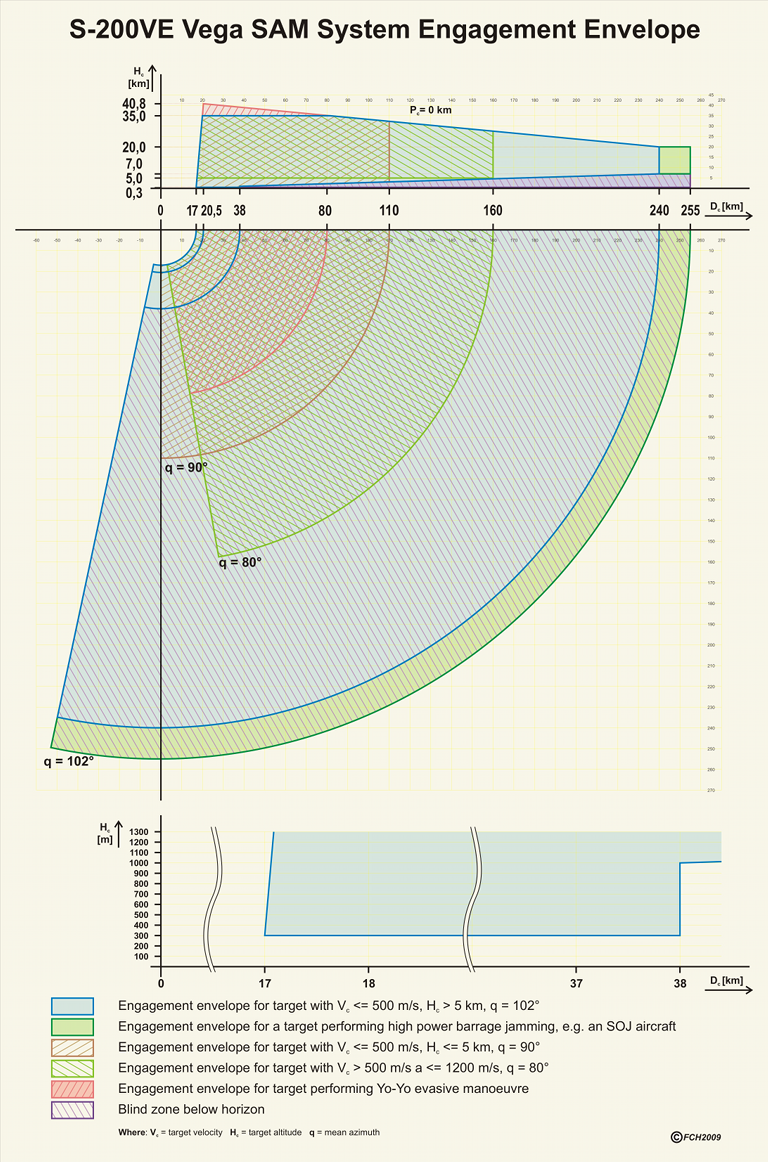
PEng June 2009 Updated January, October, 2010 Updated April 2012 Text, Line Art © 2009 - 2012 Carlo Kopp   [Please embed this graphic and link on your website] |
||||||||||||||||||||||||||||||||||||||||||||||||||||||||||||||||||||||||||||||||||||||||||||||||||||||||||||||||||||||||||||||||||||||||||||||||
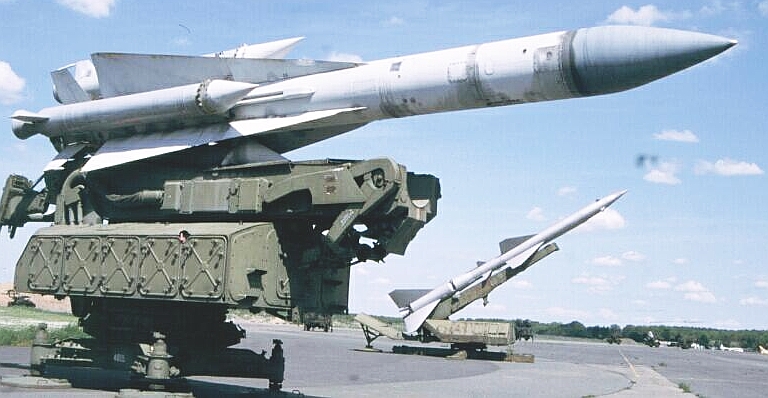 The 5V21/5V28 SA-5A/B/C Gammon missile is deployed on the semimobile 5P72 series launcher. The weapon is typically deployed at static semi-hardened SAM sites (via Vestnik PVO). |
||||||||||||||||||||||||||||||||||||||||||||||||||||||||||||||||||||||||||||||||||||||||||||||||||||||||||||||||||||||||||||||||||||||||||||||||
|
||||||||||||||||||||||||||||||||||||||||||||||||||||||||||||||||||||||||||||||||||||||||||||||||||||||||||||||||||||||||||||||||||||||||||||||||
BackgroundThe 160 nautical mile range
class Almaz S-200 missile system is the largest and longest ranging
Surface to Air Missile developed and operationally deployed by the
Warsaw Pact nations during the Cold War. While it has been completely
replaced by the S-300P series in Russian service, and retired without
replacement by most of the Eastern European nations which deployed it,
it remains widely used by various former Soviet republics, and notably
is the highest performing SAM operated by both Iran and North Korea. As
this weapon remains effective against undefended Intelligence
Surveillance Reconnaissance (ISR) platforms, aerial refuelling tankers,
and Electronic Attack platforms, it remains strategically significant.
With technology insertion upgrades on offer it may remain in service
well past 2020.
The S-200 was the pinnacle of second generation Soviet SAM designs. It was the last PVO SAM to use a liquid propellant sustainer powerplant with solid rocket boosters, and also the last PVO SAM designed around a static missile site deployment model. It was the first PVO SAM to introduce a semi-active homing seeker to replace the pure command link guidance scheme in the S-25 / SA-1 Guild, S-75 / SA-2 Guideline and S-125 / SA-3 Goa. The S-200 was also by far the most complex of the second generation of Soviet SAMs, much of that sophistication determined by its challenging performance and capability requirements. Almost 11 metres in length and weighing around 8 tonnes at launch, the S-200's 5V21/5V28 SAM round was immense by any measure. This, and the use of difficult to handle hypergolic fuels, restricted the weapon to static deployment at hardened or semi-hardened sites. The supporting systems for the S-200 make it by far the most complex of the Cold War SAMs, both in technological terms, and in battery structural terms. The primary motive behind the
large intellectual and material investment made by the Soviets in
developing and deploying the S-200 was the defeat of US Air Force and
RAF strategic bombers and the supersonic AGM-28 Hound Dog and Avro Blue
Steel nuclear armed cruise missiles they deployed. Superlative range
was essential to kill the bomber before it could release its supersonic
cruise missile, and high kinematic performance a requirement to defeat
the then anticipated US Air Force fleet of supersonic B-58 and B-70
bombers.
An initial requirement was issued in 1958, leading to a complex
development and demonstration effort to identify the best design
choices.
The challenging operational and performance requirements forced the use of many items of then advanced and immature technology, including early digital computers and continuous wave (CW) semi-active homing radar seeker technology. The use of CW illumination for terminal homing complicated the design considerably, requiring a more complex antenna and feed arrangement for the 5N62 Square Pair engagement and fire control radar developed for the system. The radio proximity fuse was also semiactive, relying on CW illumination of the target. The missile carried a downlink transmitter to send status information to the engagement radar. The critical design choice of four solid rocket strap-on boosters for launch was the result of extensive tradeoff studies emphasising deployability, a stacked arrangement was rejected due to the increased length of the semi-trailers used to transport the weapons. While a design wholly powered by solid rocket motors was explored, immaturity of propellants resulted in the design following the scheme in the earlier and smaller S-75 / SA-2 with a variable thrust liquid propellant sustainer (cruise) engine. Extensive tradeoff studies were performed to optimise the airframe and sustainer engine designs for the diverse needs imposed by possible distant subsonic bomber targets, or much nearer high flying supersonic bomber targets. Another major design challenge arose from the almost three minute flight duration at maximum range, resulting in significant skin heating at hypersonic cruise speeds, and rendering earlier techniques for powering internal electronic systems, hydraulics and turbopumps non viable. Immaturity of basic technology and sheer complexity resulted in a protracted development cycle, with the first production Angara systems only achieving IOC with PVO units in 1967. Curiously, the Soviets did not publicly disclose the existence of this weapon until 1983. Deployment of the S-200 to PVO units continued until the 1990s. In 1970s the Soviets had 1100 launchers (~180 batteries), with numbers peaking in 1985 with 2030 launchers (~338 batteries). The weapon was exported to most Warsaw Pact nations, and select client states including Libya, who made futile attempts to use the weapon against US Navy aircraft in the Gulf of Sidra. 5N62 Square Pair Engagement RadarThe 5N62 Square Pair is the
engagement radar for the S-200 / SA-5 Gammon SAM system series. It is a
coherent FMCW design with a capability to autonomously search small
volumes, track targets and provide illumination for the 5V21 and 5V28
missile seekers.
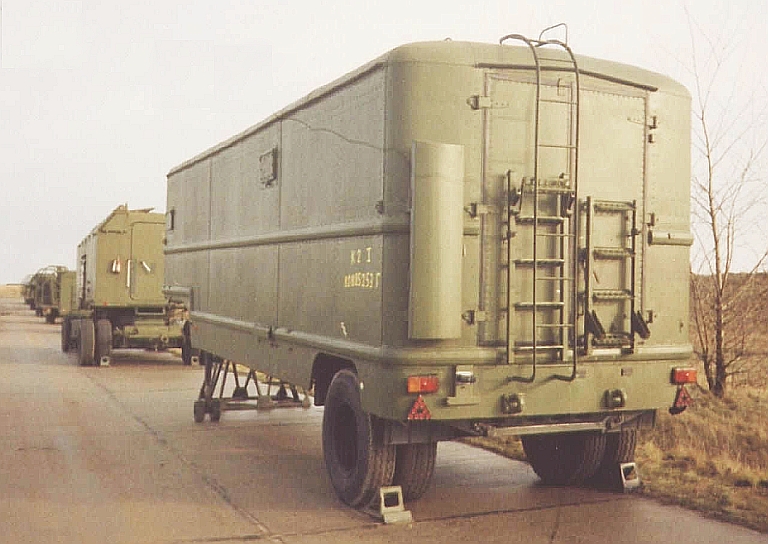
The K-1/K-1V/M Transmitter/Receiver Cabin houses the radiofrequency hardware and mounted the 5N62 antenna head. The K-2 Fire Control Centre van houses the operator consoles and supporting electronics. The K-3 Launch Control Centre van is used to control and sequence the individual 5P72 launchers with the 5V72 missile rounds. The K-9 Battery Command Post van is used to integrate track data provided by the acquisition radars, such as the P-14 Tall King or P-35/37 Bar Lock, and supporting heightfinders such as the PRV-17 Side Net / Odd Pair, and an IFF interrogator such as the 1L22 Parol. A more detailed discussion can be found under Engagement and Fire Control Radars. 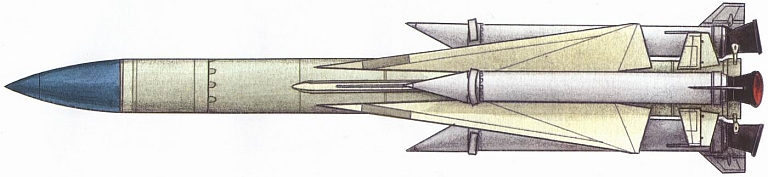 5V21
Missile
(Fakel
via Vestnik PVO)
 5V21 (V-860) and 5V28 (V-880) Surface to Air MissilesThe basic airframe configuration
of the V-860/880 missile round most closely resembles the much later US
Navy AIM-54 Phoenix AAM, reflecting very similar flight profiles and
kinematic requirements. Large and highly swept cruciform delta wings
are
employed for best lift/drag during cruise, and cruciform tandem control
surface are used to effect pitch, roll and yaw control. The missile's cylindrical
fuselage is divided into seven compartments, using a very modular
internal layout.
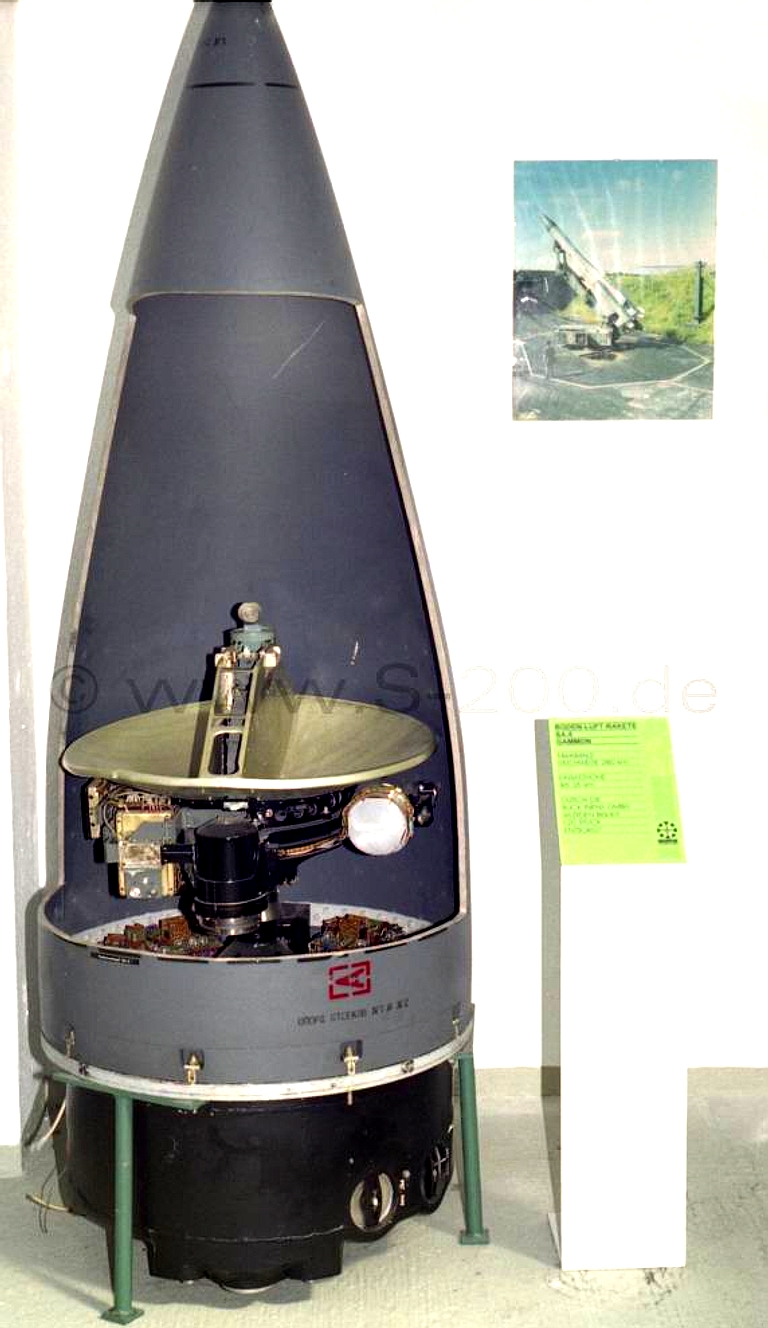
5G24
FMCW
semi-active homing seeker cutaway. Note the rate gyros on the antenna,
employed to provide stabilisation (via S-200.de) The 5G22 (5G23 and 5G24 in later
variants) coherent
FMCW semi-active homing superhet radar seeker is mounted in the nose. A
concave gimballed reflector antenna is used, with a waveguide feed, and
rate gyros are attached to the antenna to facilitate stabilisation. The
antenna is unusual in that the feeds for dual plane monopulse operation
are mounted on a dividing plate, with the concave reflector split into
a pair of semicircular reflectors. A
tail mounted aft looking antenna is used to sample the illumination
from the 5N62 Square Pair radar and produce a phase locked coherent
reference signal (not unlike the AIM-54A) for detection of the
backscatter off the target. The seeker is tuned to the illuminator
carrier and then locked on to the target while still on the launch
rail (LOBL). This limitation also applies to the fully passive
Home-On-Jam
mode intended for the engagement of standoff jamming aircraft, and
available in the later seeker variants. The choice of a FMCW operating
regime was driven by the effectiveness of Western electronic
countermeasures against earlier pulsed mode radars. Frequency modulated
continuous wave signals are inherently more resistant to narrowband
amplitude modulation jamming and AGWN like barrage jamming. The 5A43
inertial autopilot used a three axis accelerometer/gyro package and was
an important advance in Soviet missile design. It is employed to fly
the missile along a programmed flight profile without the
characteristic energy wasting deviations typical of the earlier S-75
and S-125 designs.
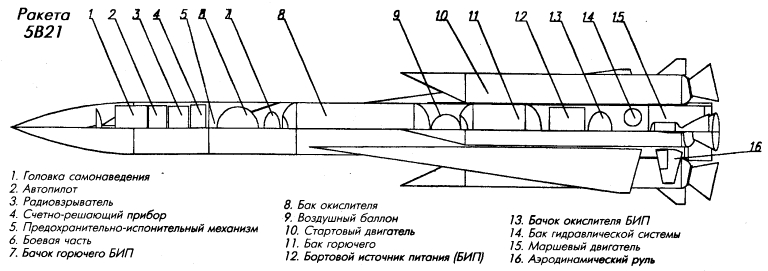
The 5E24 two channel radio proximity fuse is a semi-active design, which relies upon the illumination backscattered from the target, triggering at a programmed distance. Killing power was provided by the large 5B14Sh 217 kg blast fragmentation warhead, which produce ~37,000 spherical fragments in a 120° toroidal pattern, with a fragment mass of either 3.5 or 2 grams, and velocities between 1,000 - 1,700 m/s. To preclude an armed missile impacting on the surface in the event of a target near miss, the weapon also includes the 5B73 self destruct mechanism. The 5E23 computer was another innovation, it was introduced to calculate key parameters for use by the autopilot. The missile is equipped with a telemetry downlink used to communicate missile systems status to the launching battery, the transmitter doubling up as a tracking beacon for the Square Pair. Some sources also credit this channel with an uplink capability, specifically intended to initiate the warhead in nuclear armed variants, and to arm the radio proximity fuse and initiate the self destruct. The 5I43 (later 5I47) 65 SHP turbine onboard power supply provides power for the vacuum tube based (in early variants) electronics, control actuator hydraulics, and to drive the powerplant turbopumps (NB the term APU cannot be applied, even if its design resembles a modern APU, since the 5I43/5I47 is sole power supply in the vehicle). This complex high density design is modelled on the arrangement in the Scud ballistic missile, where main propellants are tapped to drive a gas generator, which drives a turbine coupled to the propellant pumps for the main engine. Unlike a ballistic missile, where control power is irrelevant once the main engine has ceased its burn, a SAM requires power to its systems until impact. As a result the 5I43 uses its own isolated fuel system, but burning the same fuel type as the cruise engine. The turbine in the 5I43 is spun up prelaunch by a one shot gas cartridge, upon which the hypergolic fuel is introduced into the gas generator and used to drive the turbine. In turn the turbine transfers torque to the main fuel pumps, a hydraulic pump, and a pair of electrical generators, with additional electrical transformers embedded in the unit. At launch the start and stable operation of the 5I43 is a precondition for main engine ignition, and subsequent solid booster initiation. If the turbine power supply fails to start, the missile launch is immediately aborted. The turbine power supply is the cause of the characteristic perpendicular smoke plume sometimes observed in footage of S-200 missile launches. The PRD-81/5S25/5S28 solid propellant boosters were initially tested using RST-43 and RSNDI-59 propellant, production units then using RAM-10K filler. After the 3-5 sec burn duration these strap-on solids are jettisoned. Separation is facilitated by shaping to exploit aerodynamic forces. The sustainer powerplant is an Isayev 5D12 single chamber design, replaced in later models by the improved 5D67. The design is not restartable in flight, but can be throttled from 3,200 kp to 10,000 kp, to optimise thrust across the flight profile, using pre-programmed settings issued by the mission computer. This capability is used to permit optimised profiles, trading range against climb rate and altitude. The powerplant is fuelled with the widely used, and toxic/corrosive, AK-27P oxidiser melange in a 1680 kg tank, and TG-02 fuel in a 586 kg tank. All propellants tanks are pressurised by a compressed air tank. The missile is prior to launch fed with electrical power and cooling air from the launcher. Once Built In Test (BIT) has completed, the seeker is tuned, and steered to acquire the target. Once target lock is achieved, the turbine power supply is started, and once stable the weapon transitions to internal power, and the sustainer engine is started. Only then are the solid boosters initiated and the missile can depart the launch rail. Initial 0.45 - 0.85 seconds of flight are unguided, upon which the autopilot is engaged and the controls go active. Russian sources do not describe the altitude profiles of the missile trajectory, but do state that during the first 30 seconds of flight the autopilot employs a constant lead angle control law, after which it transitions to a conventional P-nav algorithm. Operator training guide manuals translated from Russian and distributed to Warsaw Pact allies state that two primary flight regimes are employed, one for “close” and the other for “distant” targets, the transition being at slant ranges of 70 ~ 80 km (38 - 43 NMI). If a target is designated to be “close”, and with either tflight< 60 [sec] and H ≤ 20,000 [m] (shallow trajectory) or tflight< 70 [sec] and H > 20,000 [m] (steep trajectory), then a conventional P-nav control law is employed for the whole duration of the flight. If a target is designated to be “distant”, and with either tflight≥ 60 [sec] and H ≤ 20,000 [m] (shallow trajectory) or tflight≥ 70 [sec] and H > 20,000 [m] (steep trajectory), then the missile flies with two discrete control laws applied, one for midcourse flight, the other for terminal homing. The midcourse flight regime control law is a constant lead angle (ε=35º; β=0º or 15º) rule, with the missile switching over to the P-nav control law for terminal homing. This strategy was adopted to maximise range against distant targets, as the P-nav algorithm can be wasteful of kinetic and potential energy. 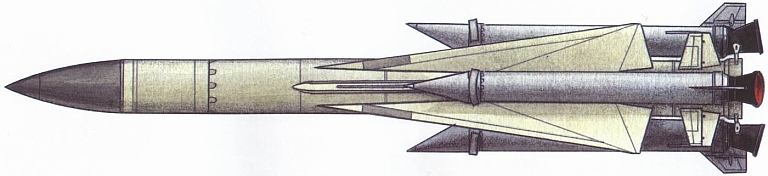 5V28
Missile
(Fakel
via
Vestnik
PVO)
 Highly detailed Soviet era Fakel cutaway
of the 5V28VE missile, marked “Sov. Secret”
(Restored version via
www.S-200.de - click diagram to expand).
 Production and Exports,
Further Development
|
||||||||||||||||||||||||||||||||||||||||||||||||||||||||||||||||||||||||||||||||||||||||||||||||||||||||||||||||||||||||||||||||||||||||||||||||
| Russian
Designation |
NATO Designation | Max
Range
[km] |
Notes |
| S-200
Angara
/
V-860P/5V21/5V21A1 |
SA-5A
Gammon |
180 |
|
| S-200V
Vega
/
V-860PV/5V21V2 |
SA-5B Gammon | 180 | |
| S-200V
Vega
/
V-880/5V28
/
V-880N/5V28N3 |
SA-5B Gammon | 240 | |
| S-200VE Vega E / V-880E/5V28E4 | SA-5B Gammon | 240 | |
| S-200M
Vega
M
/
V-880M/5V28M5 |
SA-5C Gammon | 300 |
|
| S-200D Dubna / V-880M/5V28M6 | SA-5C Gammon | 300 |
Production
until 1990s |
| 1
5G23 seeker
+ 5E24 fuse 2 5G24 seeker + 5E50 fuse 3 5G24 seeker + 5E50 fuse; V-880N nuclear armed variant for PVO. 4 Export variant with English language documentation. 5 Late production variant 6 Increased Square Pair Pout; 5P72D Launcher; limited number produced for Soviet then Russian PVO. |
|||
With the retirement of the S-200 from front line Russian service (with what appear to be only two remaining sites active in Russia) and most former Warpac nations' service, this system has been exported more widely. Iran is currently the single largest operator, with 6 to 7 active sites, and unknown quantities of reloads, launchers, and Square Pair systems.
| Operator |
S-200 Sites |
Operational (Active) S-200 Sites |
Notes |
| Iran | 7 Sites | 7
Sites
(Bandar
Abbas, Hamadan, Tehran S, Tehran E, Bushehr, Esfahan, Semnan) |
6 Active in
2007 |
| DPRK | 2 Sites | 2 Sites
/ 2 Batteries Each (Wonsan, Sariwon) |
1987 |
| Syria |
6 Sites |
4 Sites
(Masyaf, Dar'a, Shinshar, Khalhale) |
1982-83 |
| Libya | 8 Sites | 4 Sites / 2
Batteries
(Benghazi,
Sirte,
Tripoli, Misrata) |
1984 |
| Russia |
84 Sites |
2 Sites
(Norilsk, Kaliningrad) |
Voyska
PVO |
| Ukraine | 16 Sites | 4 Sites (Lviv,
Kiev, Kherson, Feodosiya) |
Former Voyska PVO |
| Belarus |
4 Sites |
2 Sites (Gudy,
Navapolatsk) |
Former Voyska PVO |
| Azerbaijan | 2 Sites | 2 Sites
(Mingechaur,
Zirya) |
Former Voyska PVO |
| Turkmenistan |
2 Sites | 2 Sites (Mary,
Yauzi) |
Former Voyska PVO |
| Kazakhstan |
8 Sites |
3 Sites
(Almaty, Karagandy, Sary-Shagan) |
Former Voyska PVO |
| Uzbekistan |
1 Site |
NIL (Tashkent) |
Former Voyska PVO |
| Georgia |
1 Site |
NIL (Tbilisi) |
Former Voyska PVO |
| Latvia |
5 Sites |
NIL (Liepāja,
Priekule, Rīga, Tukums, Ventspils) |
Former Voyska PVO |
| Lithuania |
2 Sites |
NIL (Šilutė,
Vilniaus) |
Former Voyska PVO |
| Estonia |
4 Sites | NIL (Keila,
Kuressaare, Tallinn, Tapa) |
Former Voyska PVO |
| Moldova |
1 Site | NIL
(Ialoveni/Chişinău) |
Former Voyska PVO |
| Mongolia |
1 Site | NIL
(Choybalsan) |
Former Voyska PVO |
| Germany
(DDR) |
4 Sites |
NIL
(Prangendorf, Badingen, Wolfsruh, Eckolstädt) |
WarPac
SAM
Belt |
| Czech
Republic |
2 Sites | NIL (Dobříš,
Rapotice) |
WarPac SAM Belt |
| Hungary |
1 Site |
NIL (Mezőfalva) |
WarPac SAM Belt |
| Poland |
1 Site | 1 Site
(Mrzeżyno) |
WarPac SAM Belt |
| Bulgaria | 1 Site | 1 Site / 2
Batteries (Dramsha) |
WarPac SAM Belt |
| Algeria |
Claimed |
Claimed | |
|
Sources:
O'Connor S. ,GEIMINT Blog, http://sites.google.com/site/imintandanalysis/home/SAMSiteOverview.kmz?attredirects=0&d=1; Also interactive map at http://rammstein.dfmk.hu/~s200/. |
|||
A digital upgrade to the S-200 system was being offered by Tetraedr using technology developed for S-125 / SA-3 Goa upgrades. The S-300PMU2 Favorit and S-400 systems are capable of controlling the 5N62 Square Pair, using the 30N6E2 or 92N6E to perform target tracking. More detailed discussion under Legacy Air Defence System Upgrades.
S-200 Technical Data
| Specifications
|
S-200А Angara | S-200V/VE Vega | S-200D Dubna |
| Target
Tracking
Capability |
1 | 1 | 1 |
| Missile Guidance Channels |
2 | 2 | 2 |
| Engagement Range [km] |
17-180 | 17-240 | 17-300 |
| Target Altitude |
0,5-40 | 0,5-40 | 0,3-40 |
| Missile Length |
10.6 | 10.8 | 10.8 |
| Missile Diameter [m] |
0.86 | 0.86 | 0.86 |
| Launch Mass [kg] |
- | 7100 | 8000 |
| Warhead Mass [kg] |
217 | 217 | 217 |
| Probability of Kill |
0.45-0.98 | 0.66-0.99 | 0.72-0.99 |
| Source:
http://www.peters-ada.de/s_200_1.htm |
S-200VE Battery Components
| S-200V/VE
Battery
Components |
|||
| System |
Qty |
Function/Composition |
Vehicle |
| K-1M
/
5N62
Square
Pair |
1-2 |
Control
Cabin
/ Engagement Radar |
Towed |
| K-2 |
1-2 |
Fire
Control
Centre
van |
Towed OdAZ-828 |
| K-3 | 2 |
Launch
Control
Centre
van |
Towed OdAZ-828 |
| K-9M | 1 |
Battery
Command
Post
van |
Towed |
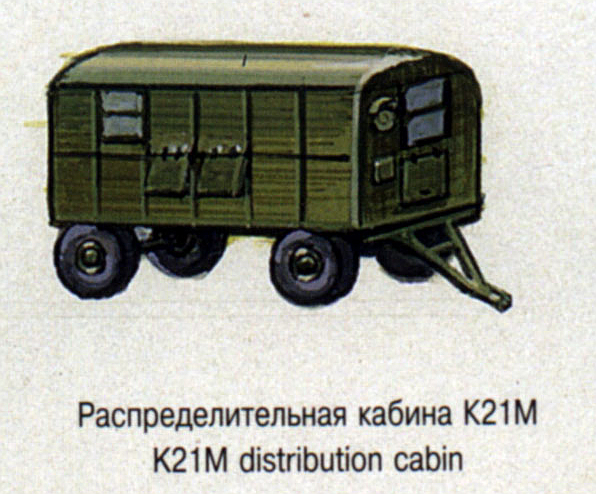
| K-21M |
1 |
Distribution
Cabin
van |
Towed |
| 5E79 |
1 |
Distribution
Cabin
van |
Towed |
| K-22 |
2 |
Converter
Cabin
van |
Towed |
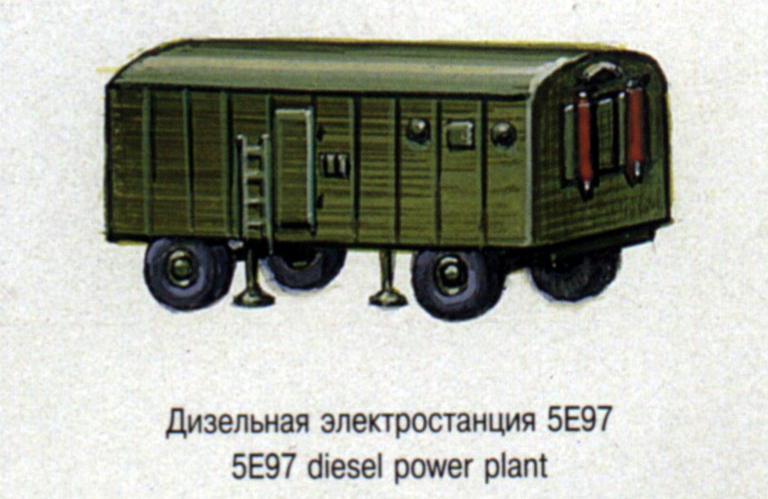
| 5E97 |
2 |
Diesel
Generator
van |
Towed |
| ESD200 |
2 |
Generator |
Towed |
| ESD30 |
1 |
Generator |
Towed |
| 5P72VE |
6-12 |
Launcher |
Flatbed |
| 5Yu24 |
12-24 |
Rail
Transloader |
Flatbed |
| 5Yu24ME |
24 |
Missile
Transporter/Loader |
Semi KrAZ-255B |
| 5T53/5T53M |
12 |
Missile Transporter | Semi KrAZ-255B |
| 5T82/5T82M/5T83/5T83M |
6 |
Missile Transporter/Loader | Semi KrAZ-255B |
| 5Ya75 |
1 |
Missile
Assembly
Cabin
van |
Semi |
| PRM200 |
1 |
Mobile
Workshop
van |
Towed |
| 5K43 |
2 |
Test
Equipment
Cabin
(Semitrailer) |
Ural-375 |
| 5L22A |
2 |
Fuel
Tank
(TG-02) |
Flatbed |
| 5L62A |
2 |
Oxidiser
Tank
(AK-27P) |
Flatbed |
| ZAK44Z |
2 |
Fuel
Transporter
(TG-02) |
Semi |
| AKS4-255B |
2 |
Oxidiser
Transporter
(AK-27P) |
KrAZ-255B |
| PKZ4-5207V |
2 |
Oxidiser Transporter (AK-27P) | Towed |
| UKS-400V |
2 |
Compressor |
ZIL-131 |
| 8T311M |
1 |
Chemical
Decontamination
System |
- |
| Kraz-255
/
KrAZ-260 |
18 |
Tow
Tractor |
- |
| 5N84AE Oborona-14 / Tall King C | 1 |
Long
Range
VHF-Band
Acquisition
Radar |
|
| PRV-17 Odd Pair | 1 |
Heightfinding
Radar |
|
| S-200V/VE Optional Battery Components | |||
| P-30
Periskop
/
Big
Mesh |
1 |
Long Range S-Band Acquisition Radar | Towed |
| P-35 Saturn / Bar Lock | 1 |
Long Range S-Band Acquisition Radar | Towed |
| P-37 / 1L117/1L117M / Bar Lock | 1 |
Long Range S-Band Acquisition Radar | Towed |
| 5N87
Back
Net
/
Back
Trap |
1 | Long Range S-Band Acquisition Radar | Towed |
S-200 Battery Deployment
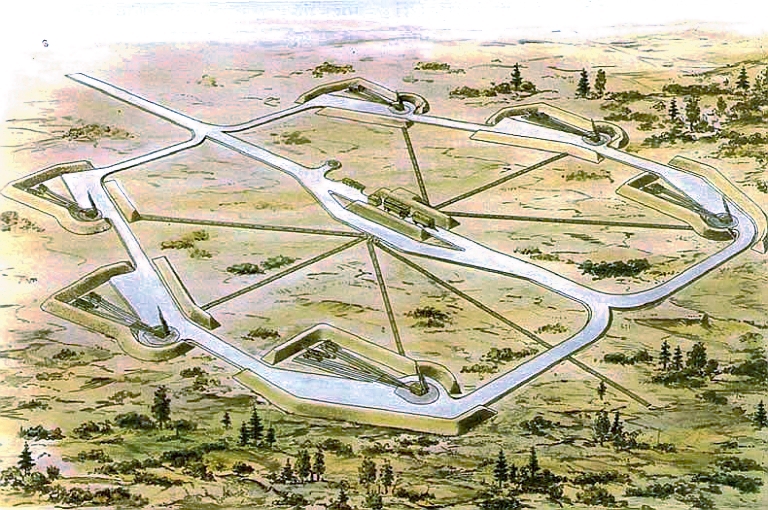
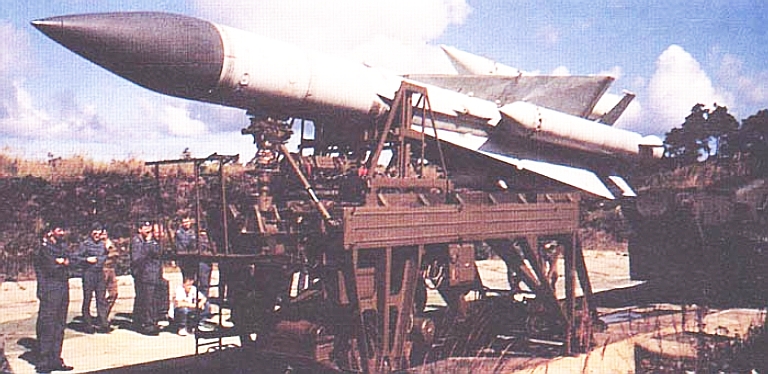
By modern standards the mobility of an S-200 battery is poor. All components of the battery were either integrated into towed OdAZ-828 series semitrailer vans, or carried on a flatbed semi-trailer. Cranes are required to load and unload most equipment, including the 5Yu24 transloaders and 5P72 launchers. A typical battery would include eighteen or more assigned tow tractors, usually KrAZ-255 in earlier variants, and KrAZ-260B in later variants. Iran employs imported Italian IVECO tractors for this purpose.
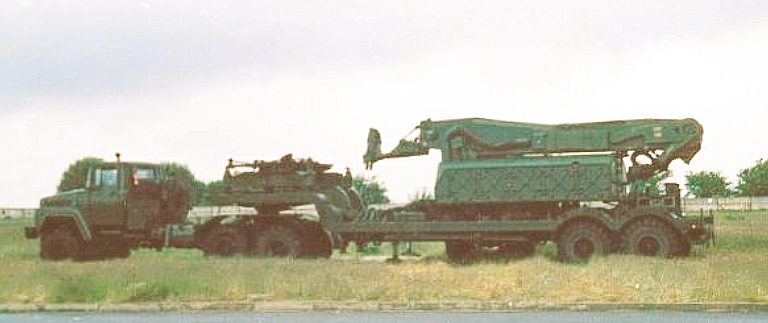
Later variants also used the towed 5Yu24M/5T83 transloader/transporter semi-trailer which offered more flexibility as it could directly load the launchers, supplanting the cumbersome rail mobile 5Yu24. This permitted operations from sites without elaborate concrete pads and rails.
Often later variants also employed a pair of 5N62 Square Pair radars to double the number of concurrent engagements. Frequently the Square Pair was located on elevated terrain, although in Czechoslovakia the radars were often deployed on large reinforced concrete platforms, accessible via a large ramp.
5P72/5P72V/VE Launcher
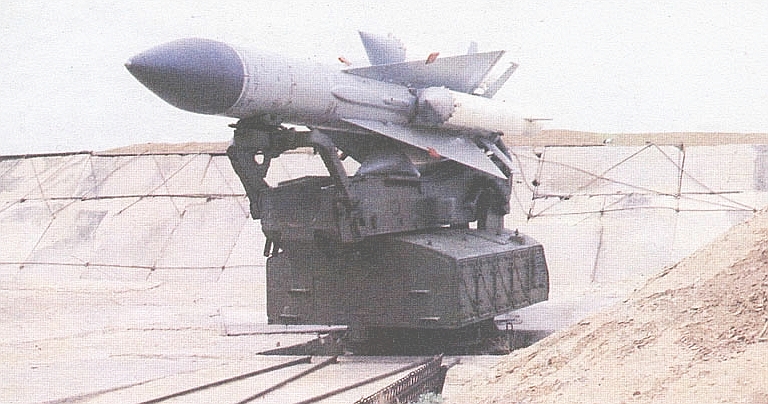
A revetted and recessed 5P72 launcher. Note the rails for the 5Yu24 transloaders.
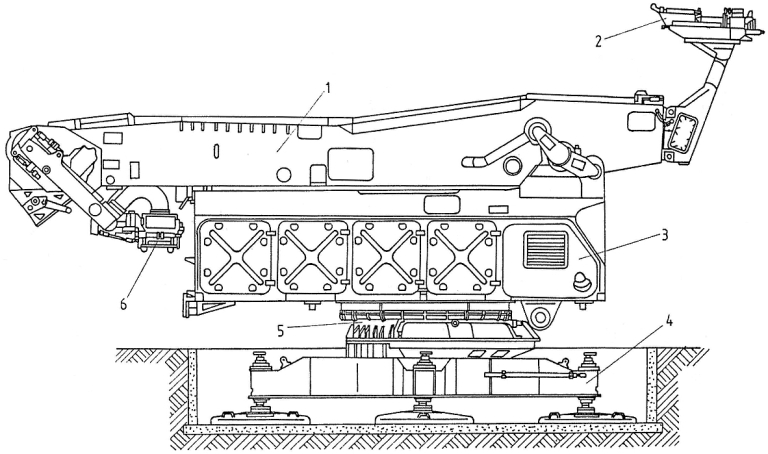
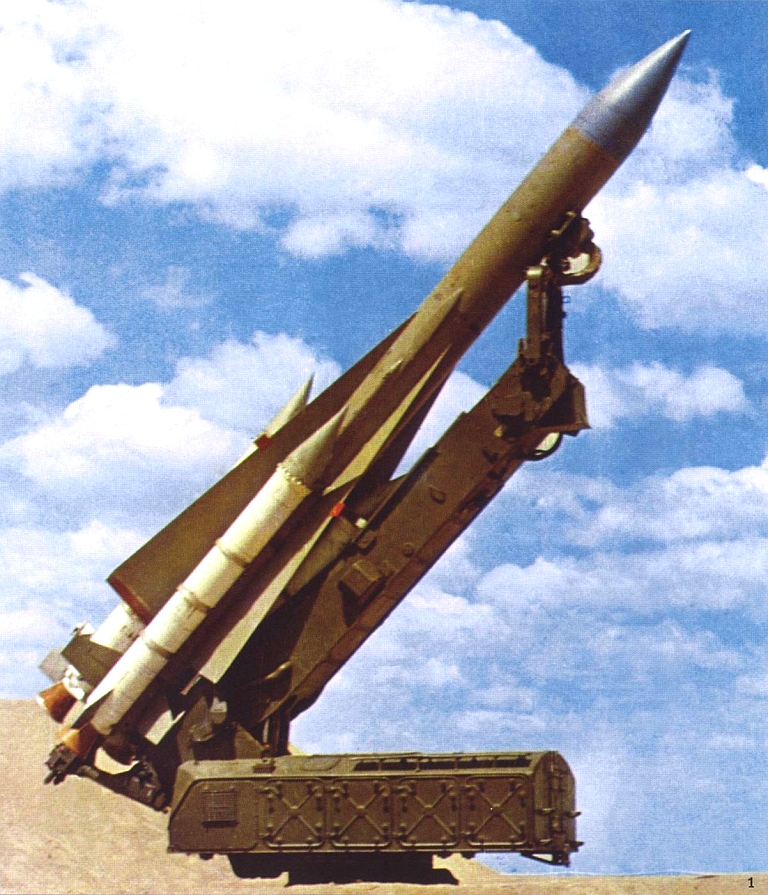
5P72VE launcher fully elevated.
5Yu24 Transloader
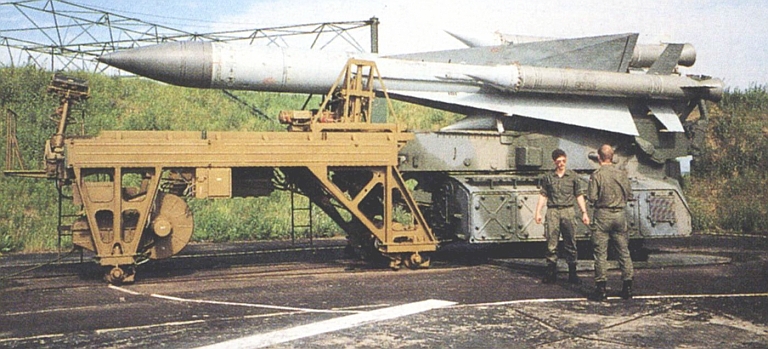
5Yu24M Towed Transporter/Loader
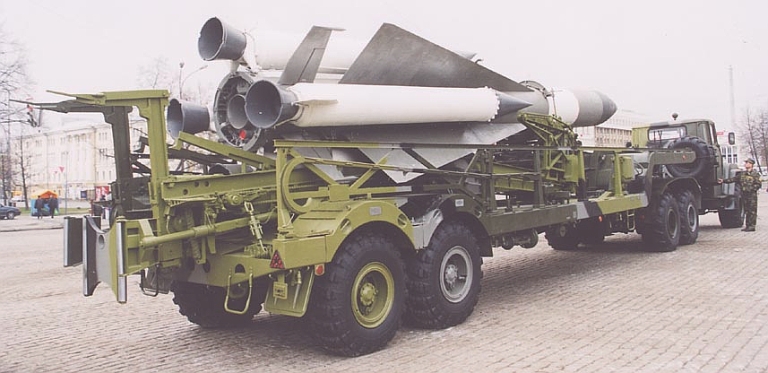
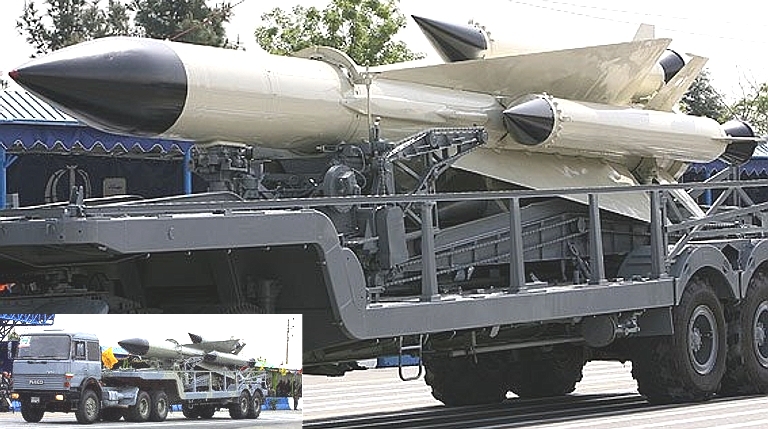
5T83 Towed Transporter/Loader
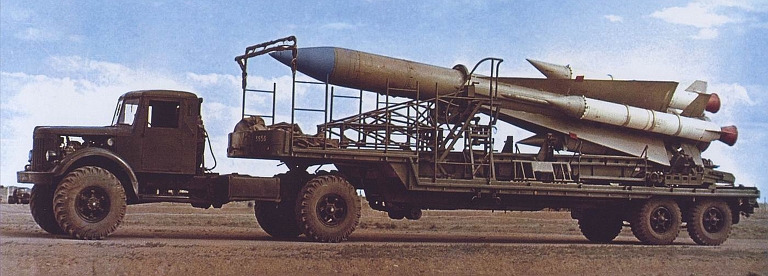
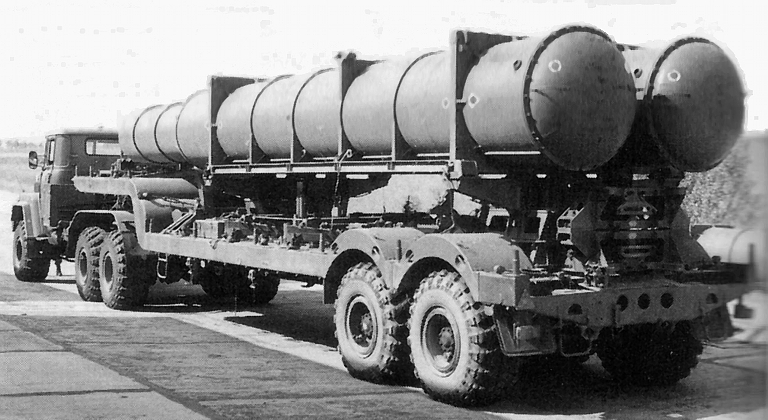
5T53M Towed Missile Transporter
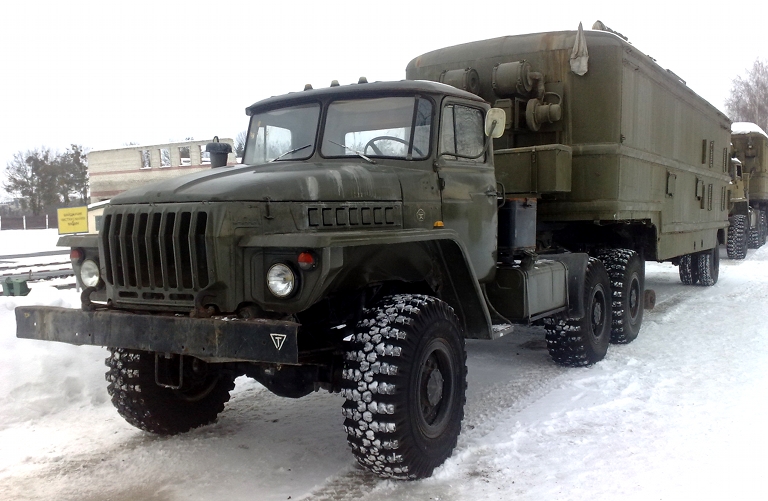
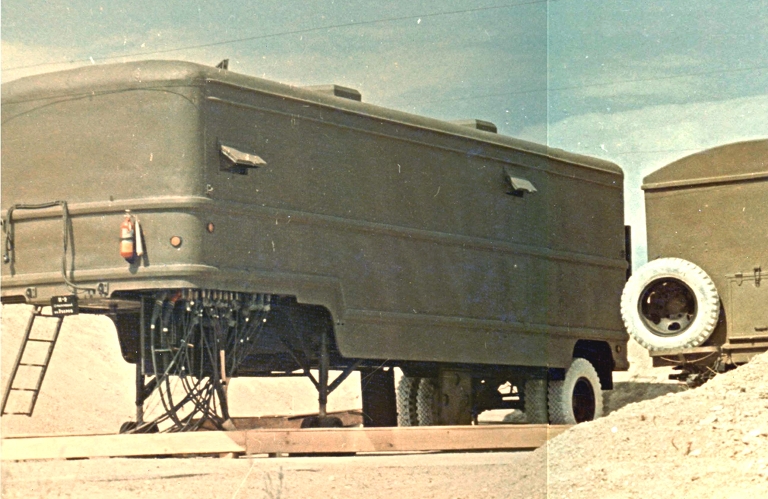
Almaz K-9/K-9M Battery Command Post
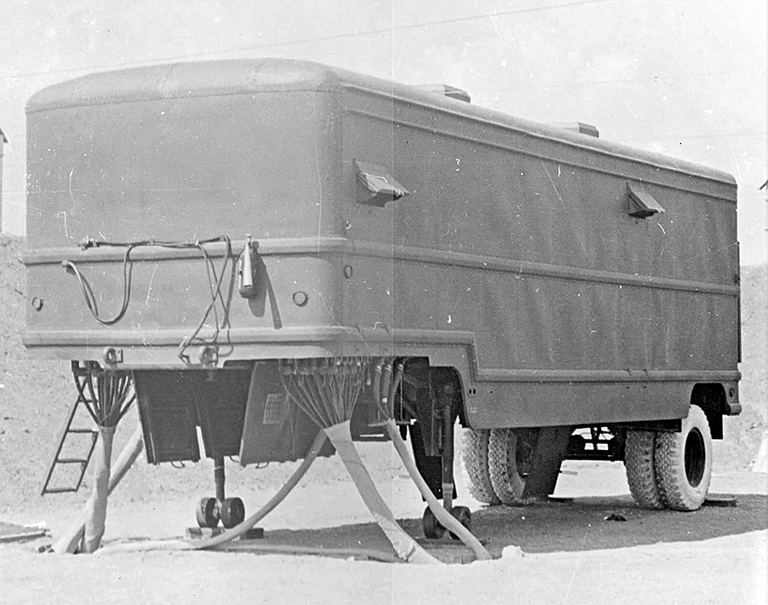
Early model S-200A Angara K-9 Battery Command Post van. Note the multiple cable harness connectors at the lower front of the van, and buried fixed site cable tunnels (Almaz brochure via Free SAM Simulator).
|
K-9/K-9M Battery Command Post
Stations
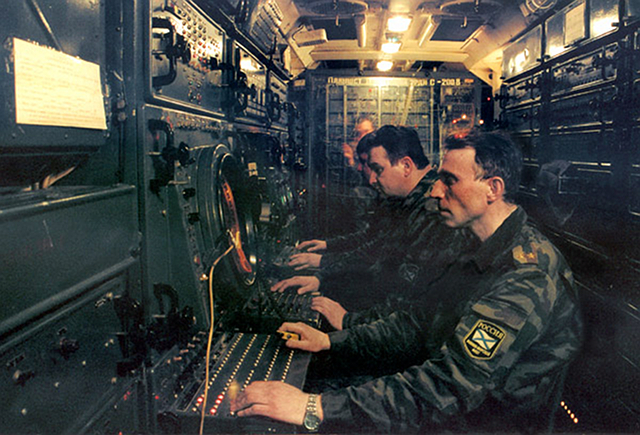 Each S-200VE battery employs
a single K-9 Battery Command Post van, which was used to control all
components of the battery. This van contained consoles and interface
electronics to monitor inputs from the P-14 Tall King C acquisition
radar, the PRV-17 Odd Pair heightfinding radar, and external IADS
command posts such as the 5S99 Senezh series. It is interfaced to one
or two K-2V Fire Control Centre vans, each of which controls the 5N62V
Square Pair FMCW engagement radar, and the K-3 Launch Control Centre (Russian
Internet
via
www.s200-wega.de).
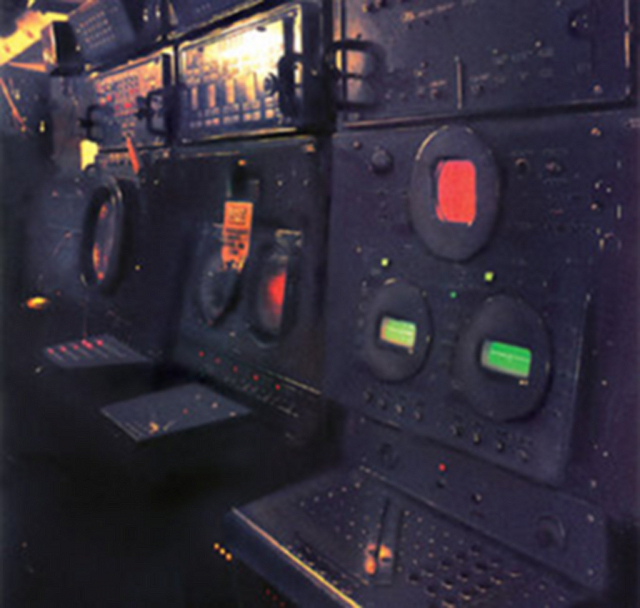 |
||
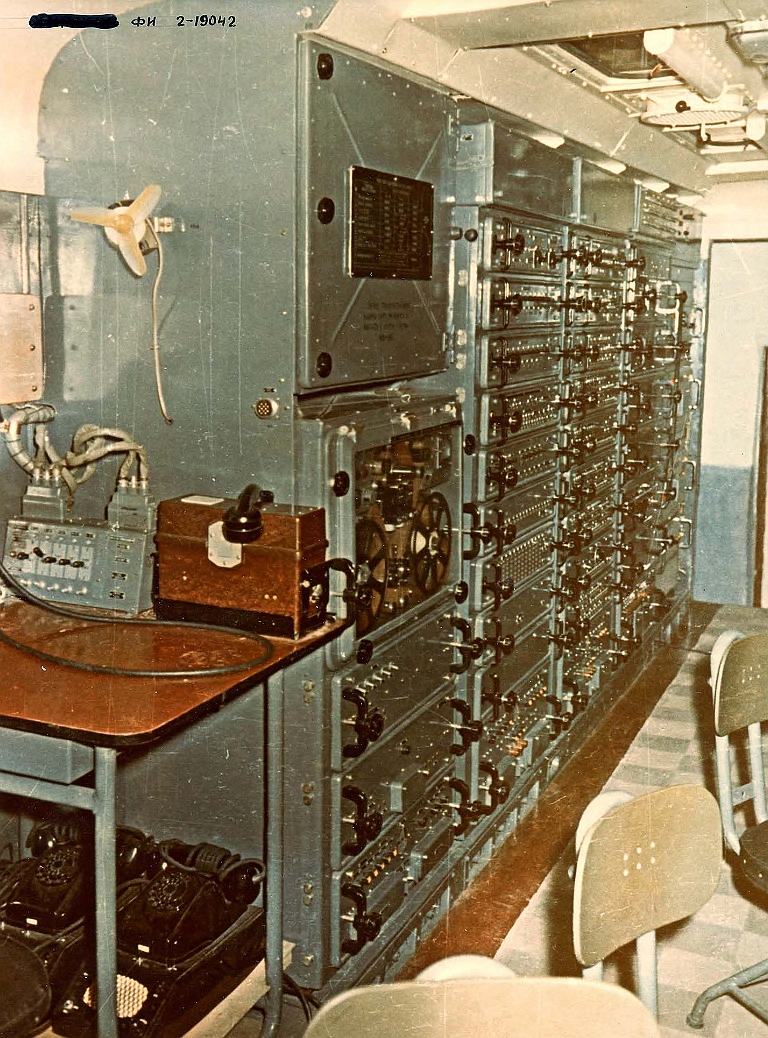
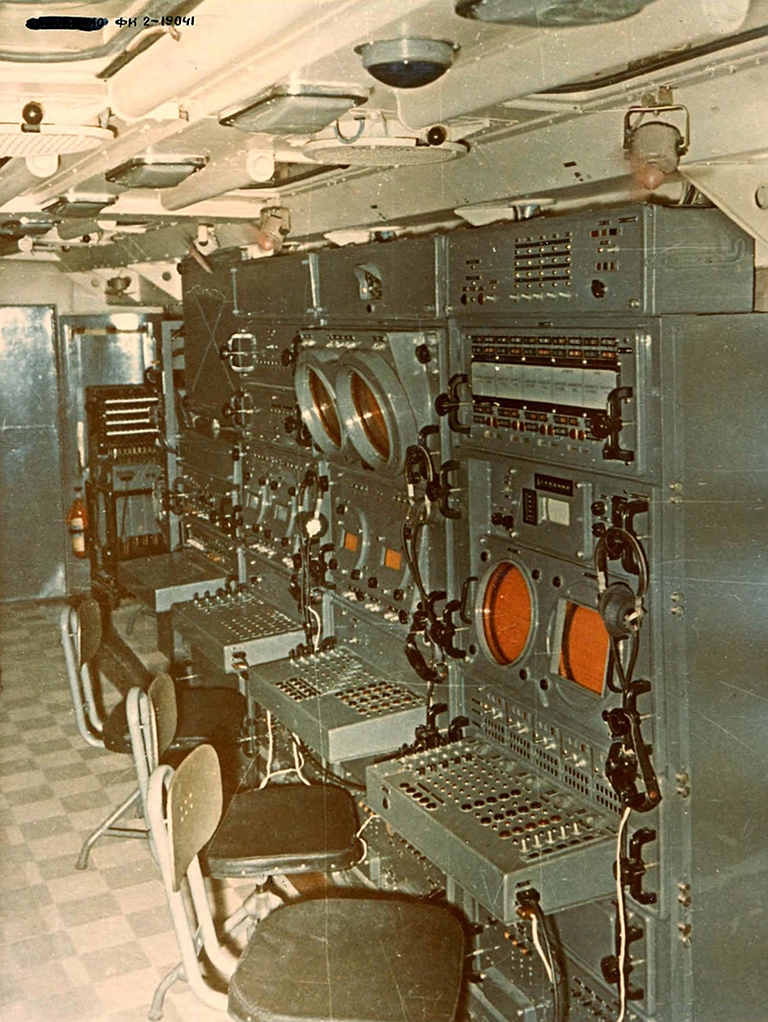
Almaz K-3 Launch Control Centre
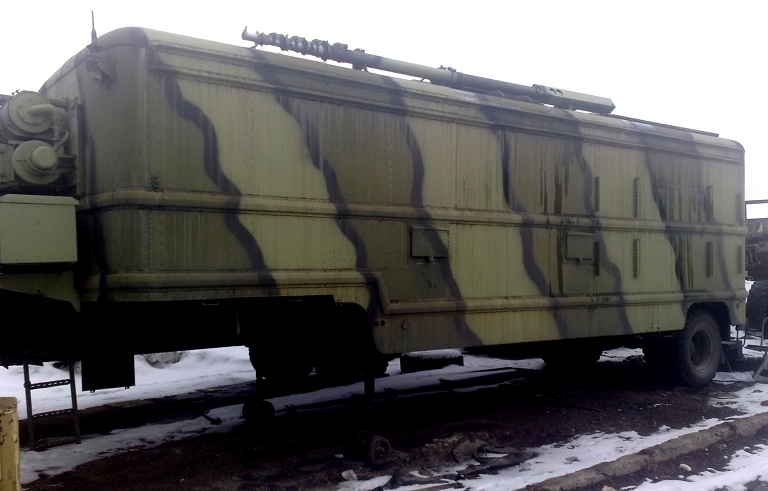
|
K-3 Launch Control Centre Stations
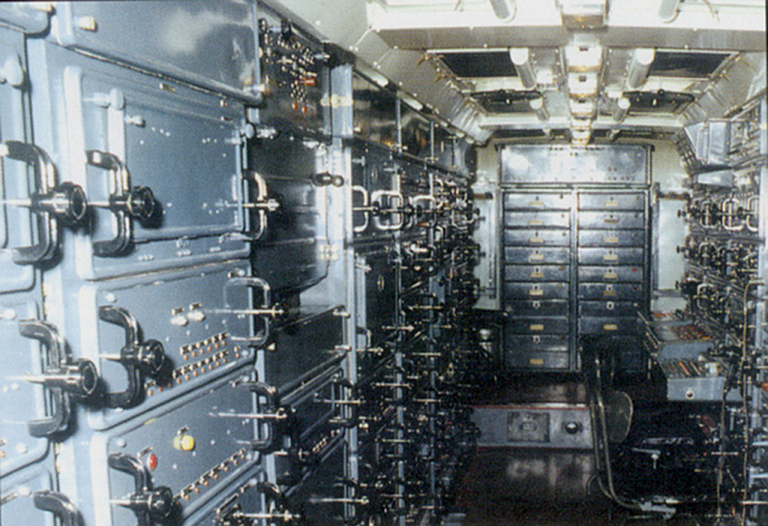 K-3 series LCC van interior (Russian
Internet
via
www.s200-wega.de).
The S-200/SA-5 series followed
the battery structure model introduced with the S-75/SA-2, but the
greater complexity of the larger and newer S-200/SA-5 saw the use
of wholly dedicated LCC vans, each of which was employed to
manage and launch from up to six 5P72 series single rail launchers. As
the liquid propellant propulsion and onboard power systems of the
5V21A/V/5V28 require careful management, these functions were performed
from the K-3 series vans. These operators would train and elevate the
launchers, perform prelaunch missile checkout, and then step through
the complex launch sequence, which included missile systems checks,
onboard turbine power system runup, and finally sustainer engine
ignition and runup. The solid rocket boosters were ignited as the last
step in the launch sequence, at which point an abort could no longer be
effected.
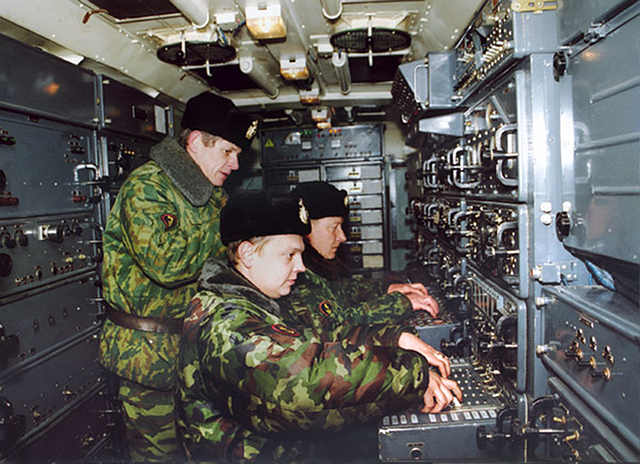 K-3 series LCC van crew (Russian
Internet
via
www.s200-wega.de).
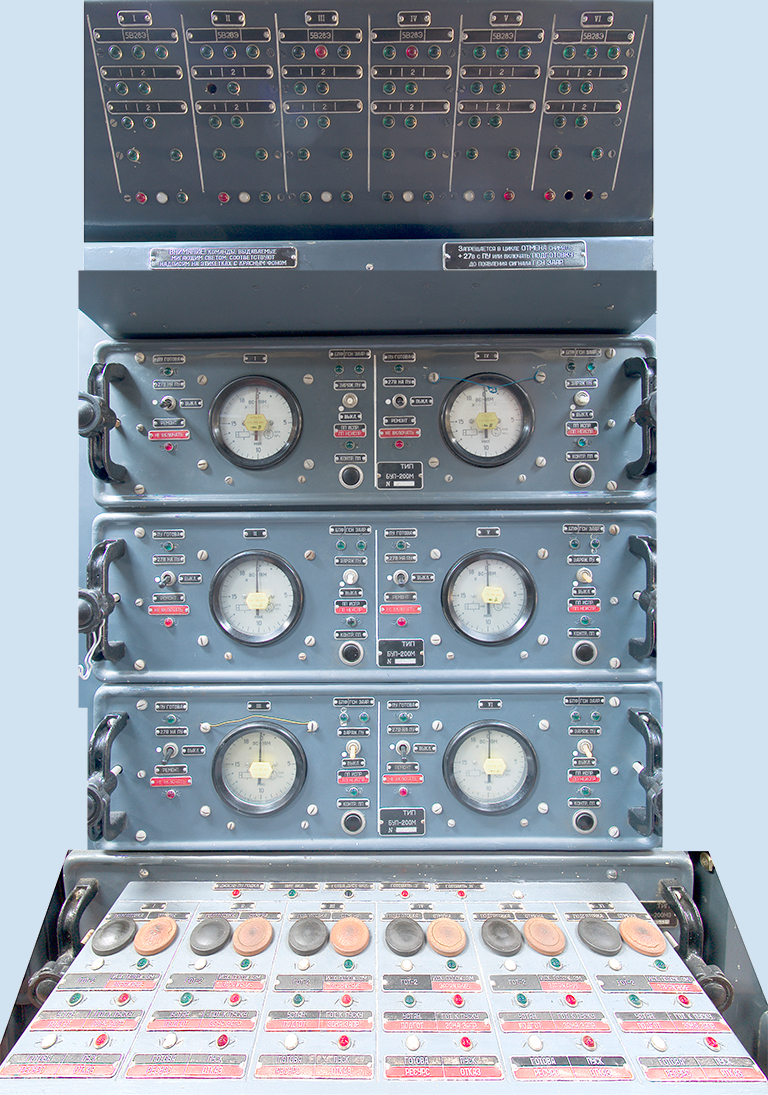 Above, below: K-3 series LCC
missile control and status panels, used for up to six
5P72
series
single
rail
launchers
(©
2010,
Free SAM Simulator, posted
with permission).
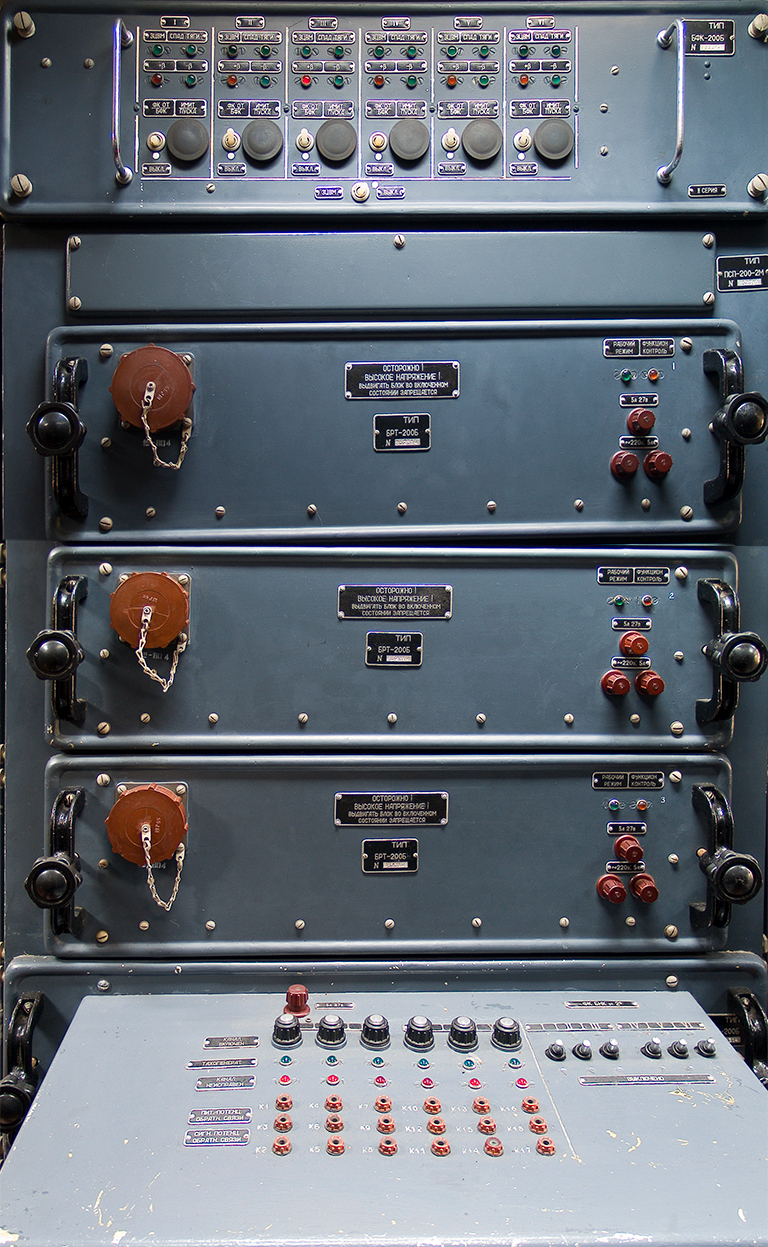 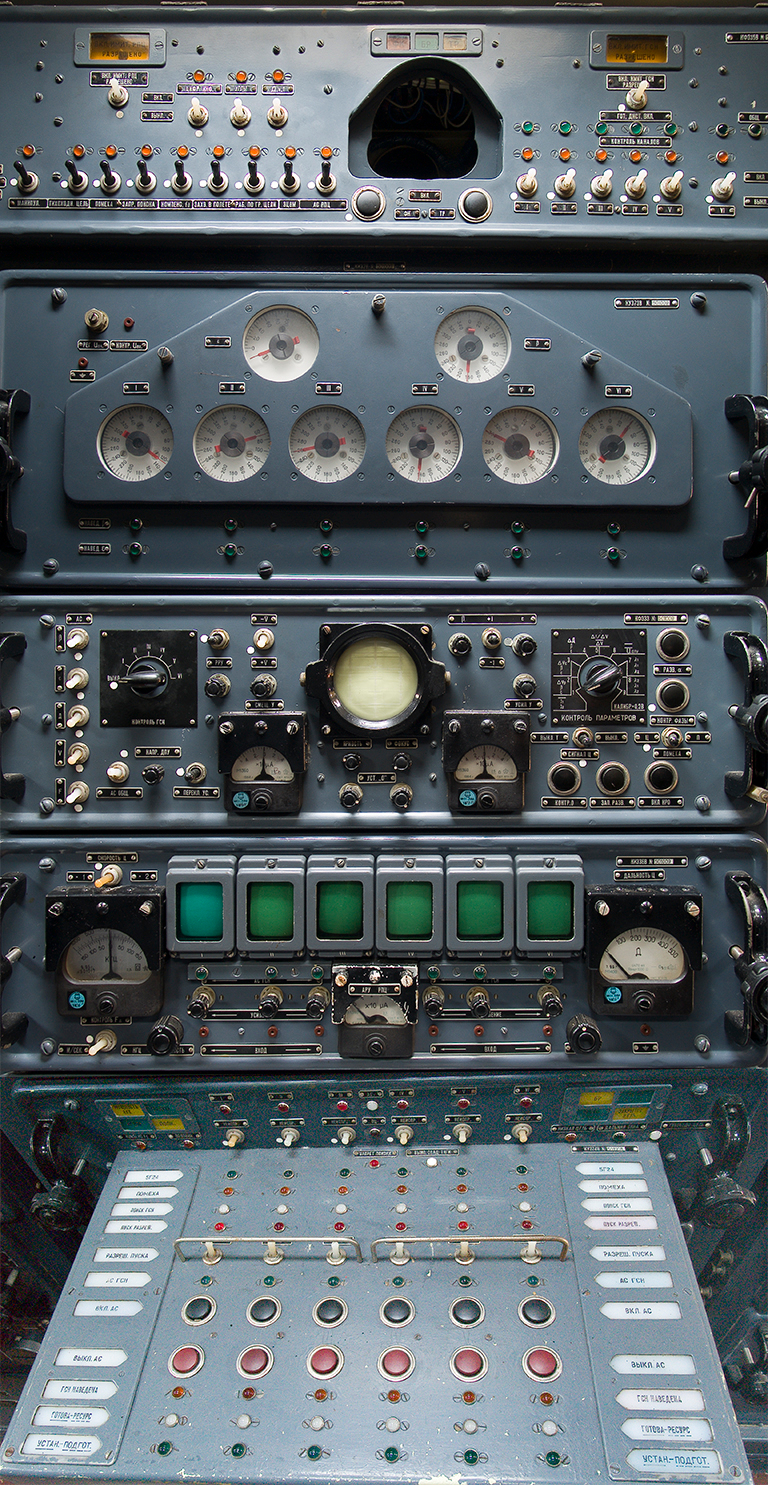 |
||
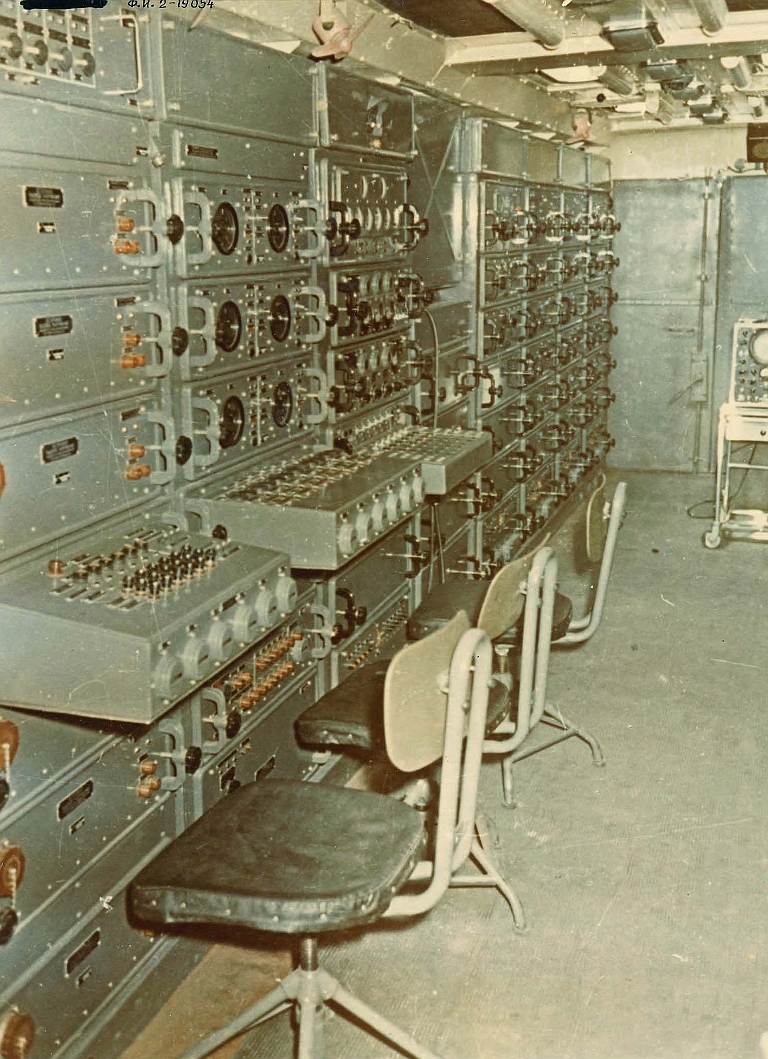
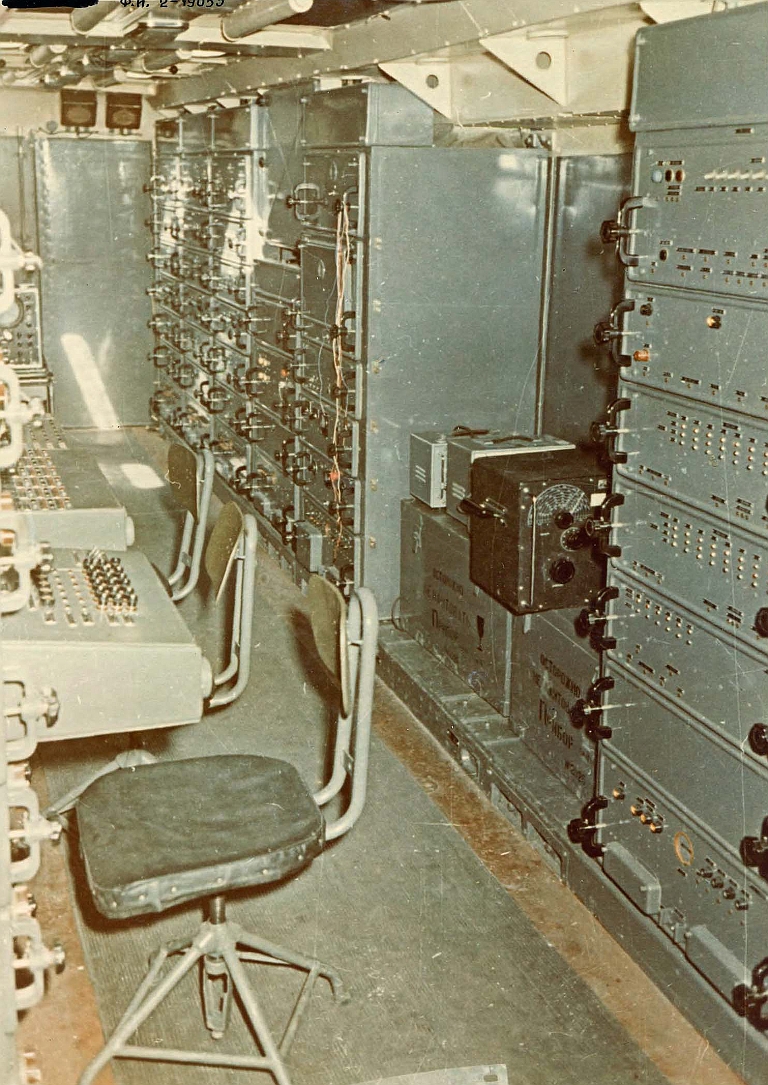
Above, below: Early model S-200A Angara K-3 Launch Control Centre van interior (Almaz brochure via Free SAM Simulator).
Almaz K-2 Fire Control Centre
|
K-2 Fire Control Centre Stations
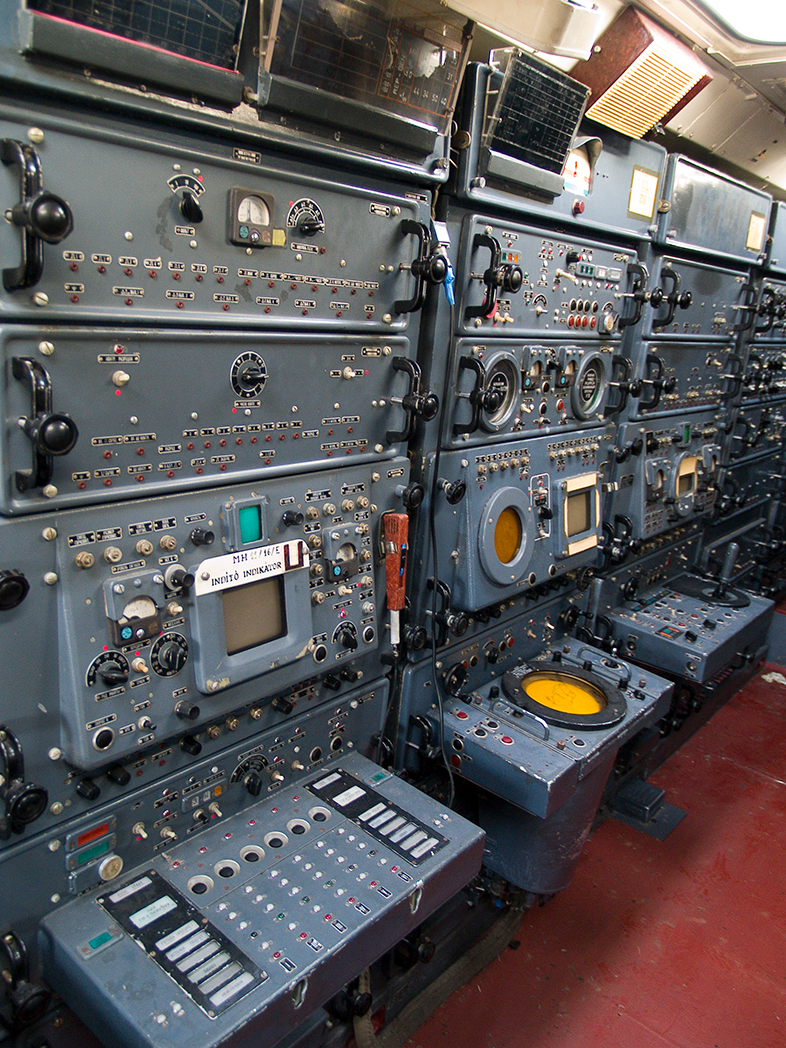 K-2 series Fire Control
Centre van crew stations (© 2010, Free SAM
Simulator, posted with permission).
The K-2 series Fire Control
Centre van would qualify in part, under Western nomenclature, as a fire
control van, and in part, as a radar control and management van for the
5N62 Square Pair. The 5N62 Square Pair is used to acquire the target,
perform fine tracking, and provide FMCW illumination for the
semi-active homing missile seekers. The K-2 van houses all of the radar
consoles, but also houses the Plamya fire control computer which
performs pre-launch and post launch missile trajectory calculations.
Missile telemetry and command link functions are all controlled from
the K-2 van.
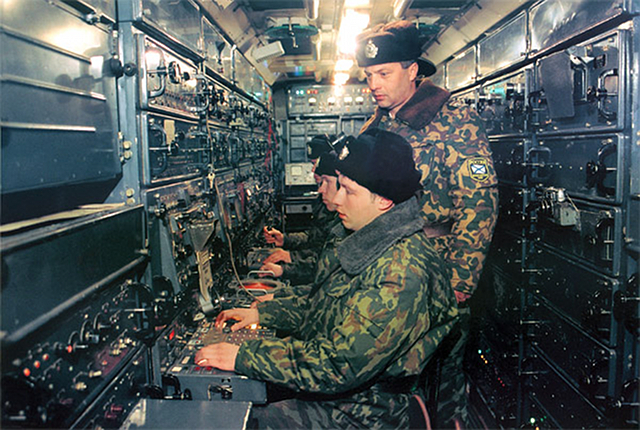 K-2 series Fire Control
Centre van crew (Russian
Internet via www.s200-wega.de).
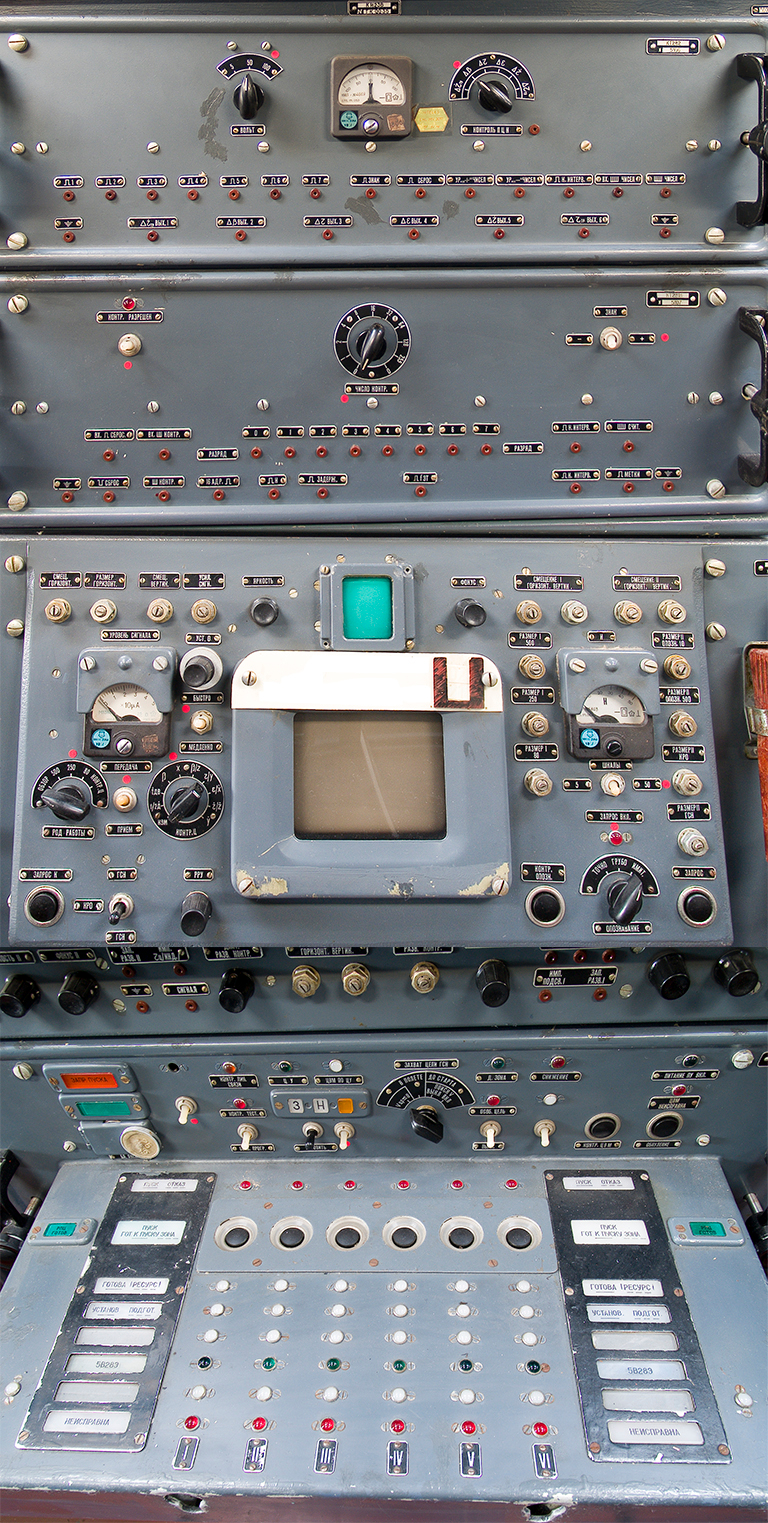 K-2 Fire Control station
console (© 2010, Free SAM Simulator, posted with
permission).
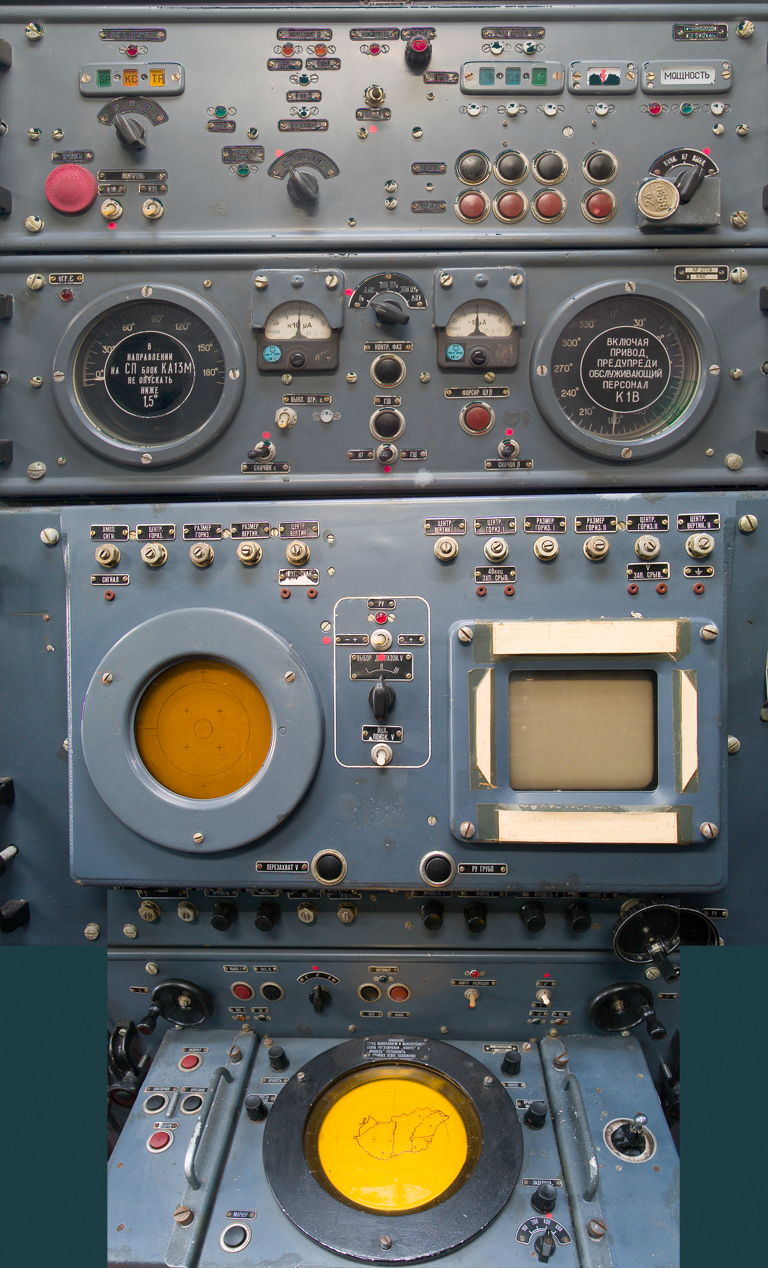 K-2 target acquisition
station console. The operator uses video from the Tall King, Odd Pair
and IADS track data to acquire the target using the FMCW 5N62 Square
Pair (©
2010,
Free SAM Simulator, posted with permission).
 K-2 target
tracking and illumination station console. The
operator maintains
a fine track of the target using the 5N62 Square Pair FMCW waveform, in
a
number of possible modes. CW illumination was fixed frequency and
without range tracking (© 2010, Free SAM
Simulator, posted with permission).
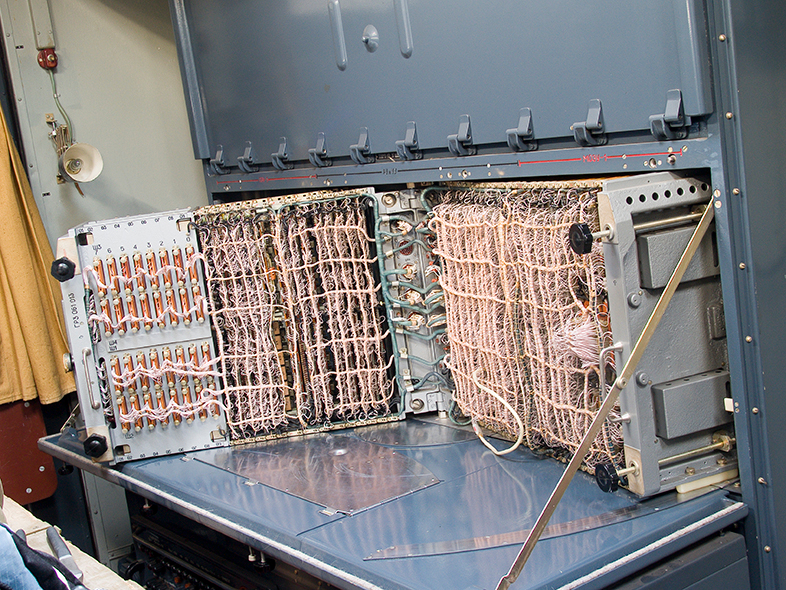
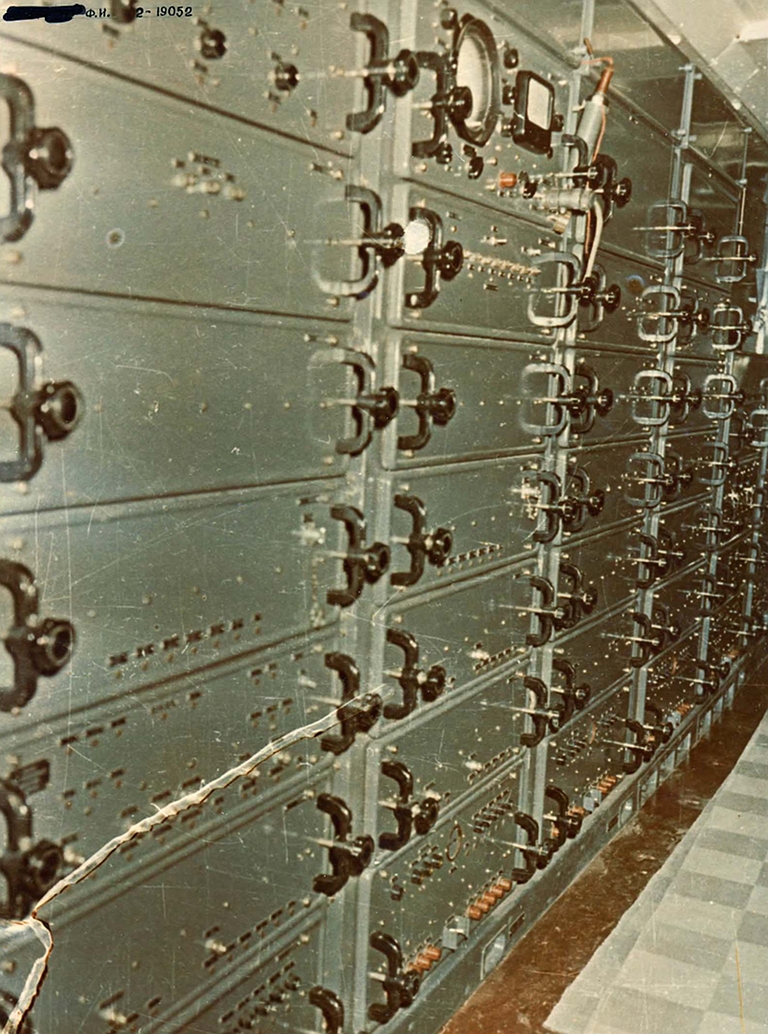
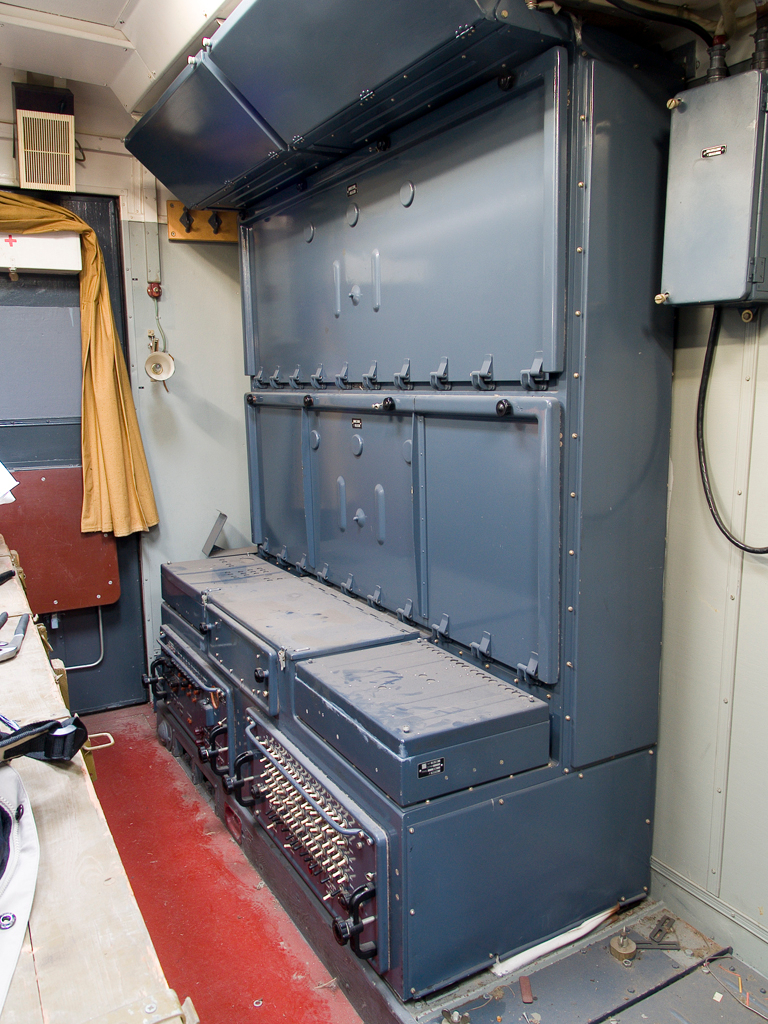 Above, below: K-2 van Plamya
KV fire control computer (© 2010, Free SAM
Simulator, posted with permission).
 |
||
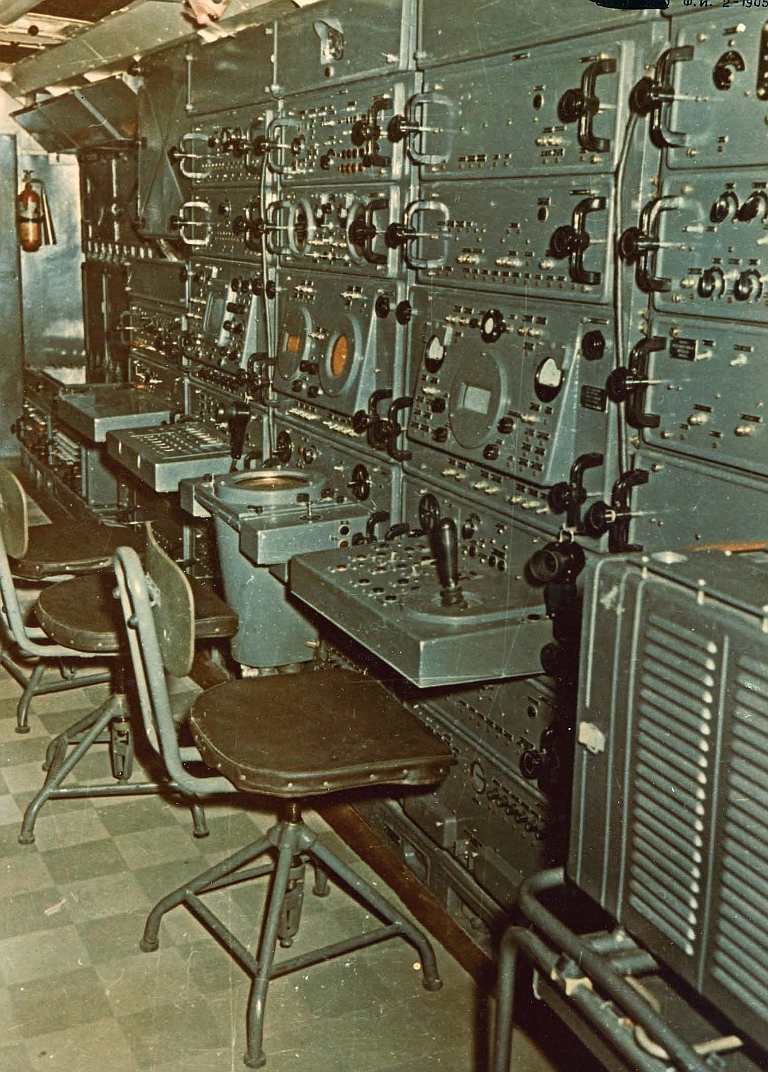

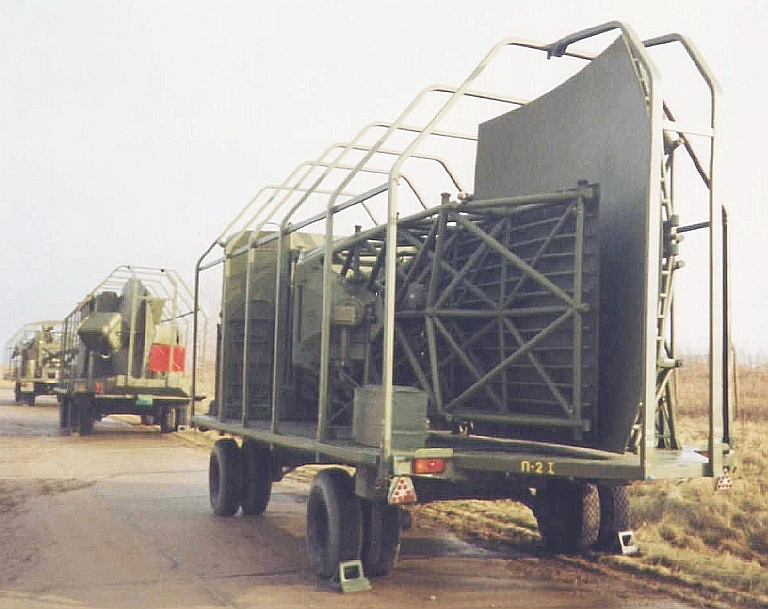
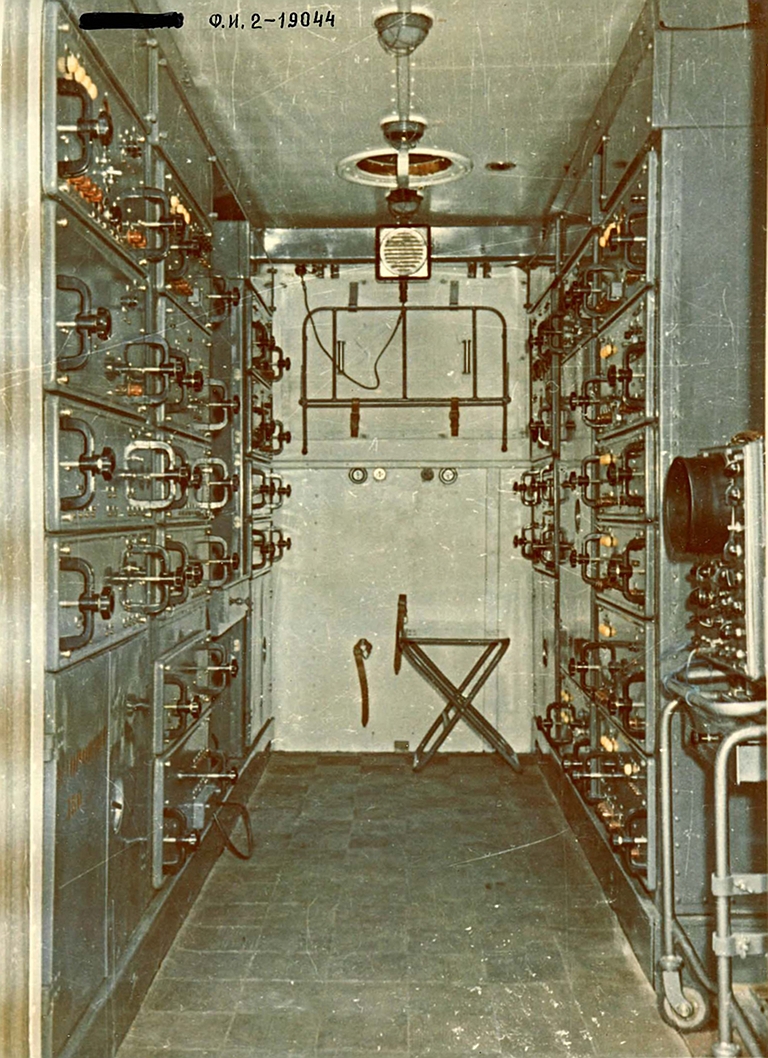
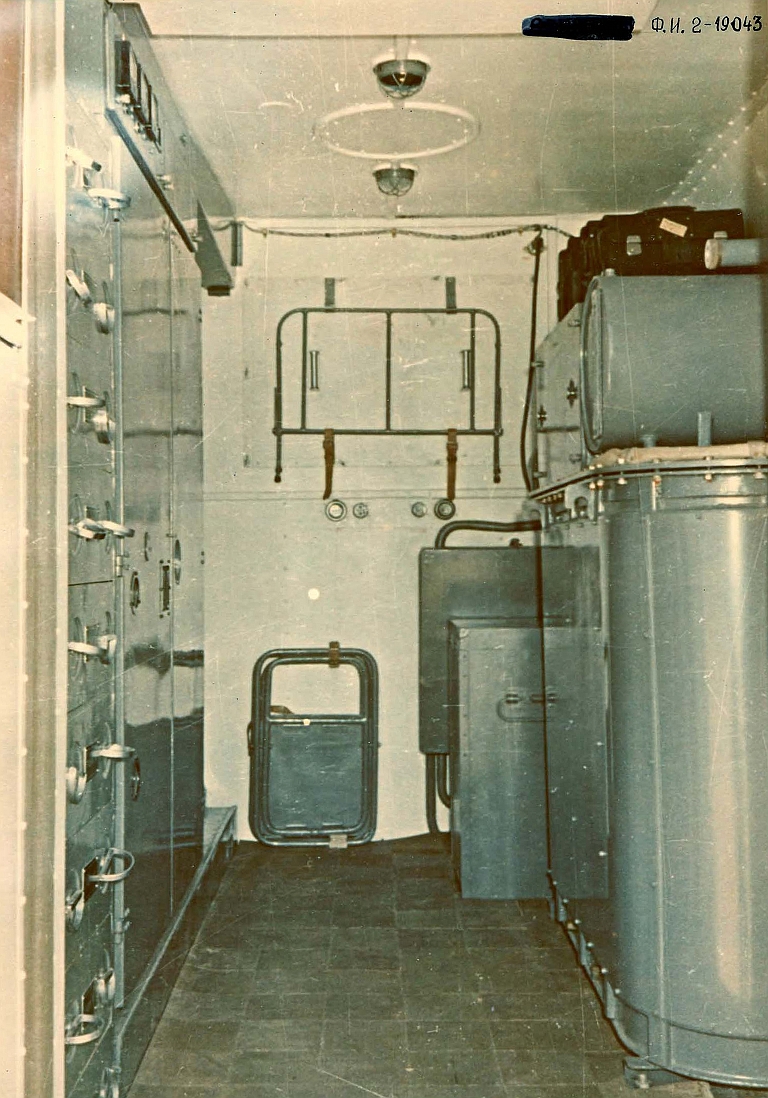
NITEL 5N84AE Oborona-14 / Tall King C Acquisition Radar
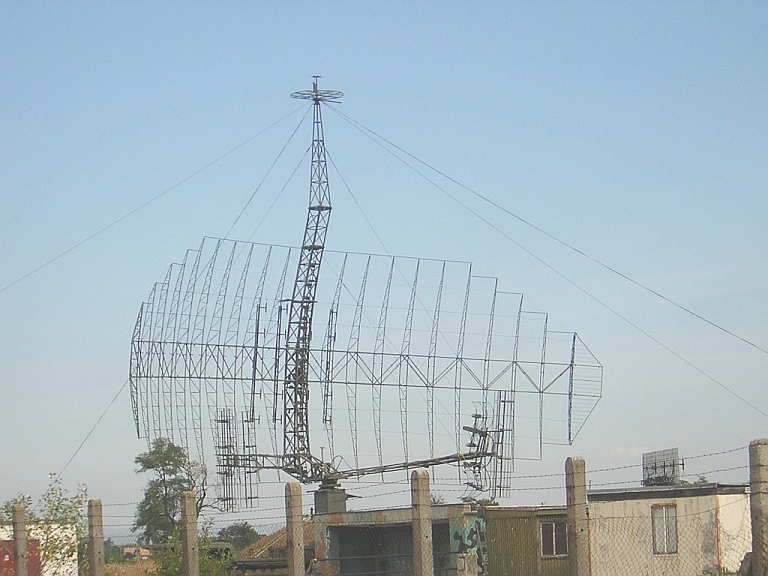
|
5N84AE Oborona-14 / Tall King C Crew
Stations
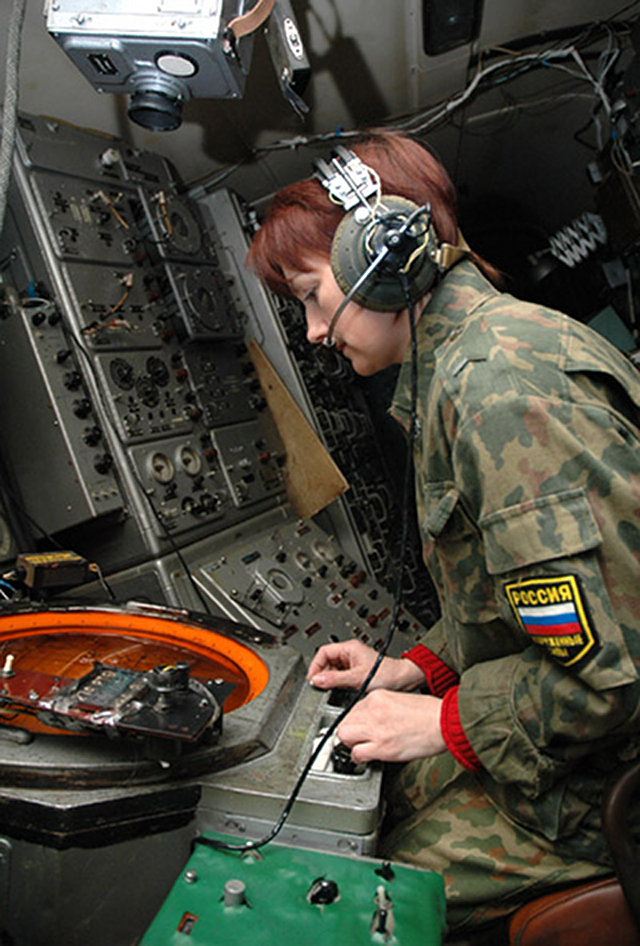 The large VHF-band Tall King
C was used as the primary acquisition element for the S-200VE battery.
It produced target azimuth and range tracks for the K-9 Battery Command
Post systems (Russian Internet via www.s200-wega.de).
|
||
PRV-17 Odd Pair Heightfinding Radar
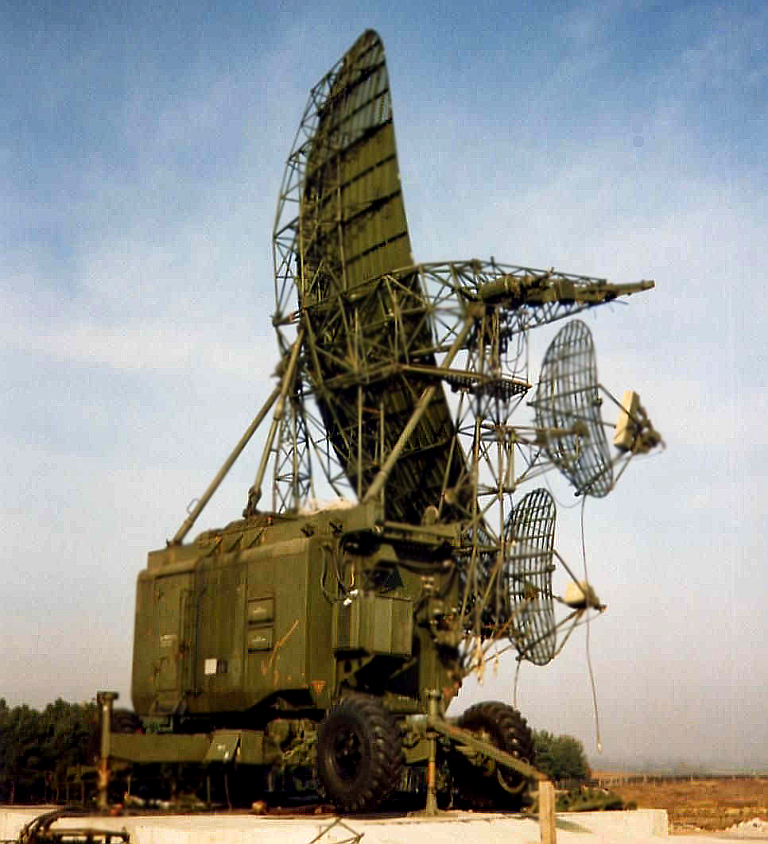
References/Sources
- Marek Lomnitz, S-200 / SA-5 Gammon, URL (Archive): http://web.archive.org/web/20071113101050/www.s-200.de/
- Said Aminov, Vestnik PVO, URL: http://pvo.guns.ru
- Peter's ADA - Theorie und Grundlagen der Fla, URL: http://peters-ada.de/
- Matthias Richter, Flaraketenkomplex S-200 Wega, URL: http://www.s200-wega.de/
- Petr Janda, Martin Korec, Petr Kunc, 9., 10. protiletadlový raketový oddíl Rapotice, součást Protiletadlové raketové skupiny VEGA Rapotice, URL: http://www.fortifikace.net/pov_pvos_skupina_vega_rapotice.html
- Miscellaneous original imagery of S-200VE van interiors provided by the Free SAM Simulator project, produced using an Olympus E-300.
- Almaz S-200A Angara technical brochure,
undated circa 1970, 22 pages.
|
|||||||||||||
|
|
|
|
|
|
|
|
|
|
|
|||
|
|
|
|
|
|
|
|
|
|
|
|||
 |
|
|
|||||||||||
| Artwork, graphic design, layout and text © 2004 - 2014 Carlo Kopp; Text © 2004 - 2014 Peter Goon; All rights reserved. Recommended browsers. Contact webmaster. Site navigation hints. Current hot topics. | |||||||||||||
|
Site Update
Status:
$Revision: 1.753 $
Site History: Notices
and
Updates / NLA Pandora Archive
|
|||||||||||||
|
|
Tweet | Follow @APA_Updates | |||||||||||
|
|
|||||||||||||
|
|
|||||||||||||