|
||||||||||||||||||||||
 |
||||||||||||||||||||||
![F-22A Raptor, FB-22, F-22E, F-22N and Variants Index Page [Click for more ...]](APA/f-fb-22.png "F-22A Raptor, FB-22, F-22E, F-22N and Variants Index Page [Click for more ...]") |
 |
![People's Liberation Army Air Power Index Page [Click for more ...]](APA/pla-air-pwr.png "People's Liberation Army Air Power Index Page [Click for more ...]") |
 |
 |
 |
 |
 |
 |
![Military Ethics, Culture, Education and Training Index Page [Click for more ...]](APA/ethx-culture.png "Military Ethics, Culture, Education and Training Index Page [Click for more ...]") |
 |
||||||||||||
 |
![Russian / Soviet Weapon Systems Index Page [Click for more ...]](APA/rus-weps.png "Russian / Soviet Weapon Systems Index Page [Click for more ...]") |
 |
 |
 |

|
 |
 |
 |
 |
 |
||||||||||||
 |
 |
|||||||||||||||||||||
| Last Updated: Mon Jan 27 11:18:09 UTC 2014 | ||||||||||||||||||||||
|
||||||||||||||||||||||
|
||||||||||||||||||||||
|
||||||||||||||||||||||
|
|
|
|
|
|
|
|
|
|
|
||||||||||||
|
|
|
|
|
|
|
|
|
|
|
||||||||||||
|
|
|||||||||||||||||||||
| Last Updated: Mon Jan 27 11:18:09 UTC 2014 | ||||||||||||||||||||||
|
||||||||||||||||||||||
| Texas Instruments (Raytheon) AGM-88 HARM | ||||
|
||||
 The AGM-88 HARM was test fired on the RAAF F-111C and has been bid as an anti-radiation weapon for the F-111. At this time no RAAF aircraft carries an antiradiation weapon - Author (image via F-111.net). The Anti Radiation Missile (ARM) is the principal hard kill tool used by aircraft to inflict attrition upon an opponent's electronic assets, be they Early Warning radars, Ground Control Intercept (GCI) radars, SAM system acquisition radars, SAM system fire control radars and AAA fire control radars. Without ARMs the task of attritting these assets is time consuming, difficult, and potentially costly in lost aircraft, more so with the latest generation of SAMs. The importance of the ARM in the modern electronic battle cannot be understated. During the Desert Storm campaign the Coalition's ability to saturate Iraqi air defences with ARM fire during the opening hours of the air war was a decisive factor in the overwhelming defeat of Iraq's IADS. Nearly 2200 ARMs were launched by US and RAF aircraft during this campaign. A decade earlier the decisive defeat inflicted upon the Syrians in the Bekaa' Valley by the Israelis was again largely attributable to the massed use of ARMs. The ARM first proved its worth over North Vietnam, where USAF Wild Weasels and USN Iron Hand aircraft fired the cheap and simple AGM-45 Shrike (derived from the Sparrow airframe) and more complex and expensive AGM-78 Standard (derived from the naval SAM) ARMs in large numbers. These missiles would home in on the transmissions of North Vietnamese radars and damage or destroy the antennas, radar heads and often receiver/transmitter vans of these targeted radars. Once the radar was down, it was unable to participate in the engagement until repaired or replaced. In assessing the worth of an ARM we must consider a wide range of performance parameters, while also considering the operational attributes of the weapon in relation to hostile capabilities. The most important parameters can be summarised as:
Clearly, the decision to select a particular type of ARM is not a trivial one, and requires a careful assessment of the weapons in question. The ultimate system level metric of usefulness is that of how many hostile radars can you take down for what dollar investment in ARMs, ARM support costs and aircraft integration costs. The Texas Instruments AGM-88 High speed Anti-Radiation Missile The TI HARM is the standard US tri-service ARM and is the most widely deployed weapon of its type worldwide. It owes its origins to the period following the SEA conflict, when it became clear to the US that a missile with performance superior to the established Shrike and Standard ARM (STARM) would be required to defeat Soviet air defences. The principal limitations of early missiles such as the Shrike lay in their poor seeker sensitivity and frequency coverage, relatively low speed and inability to get even close to a target should it shut down. Indeed, Shrikes had to be manually programmed for the intended target before take-off, by fitting a seeker tuned to the carrier frequency of the target. Initial studies were conducted in 1972 and in 1974 the USN Naval Weapons Center (NWC) at China Lake awarded a development contract to Texas Instruments, who together with Sperry-Rand dual source manufactured the Shrike missile. The AGM-88A HARM entered service in 1983 and constituted a major improvement over the earlier missiles. The weapon used a broadband spiral antenna, a software programmable seeker which was conceptually similar in design to an RWR, providing coverage from the C through to the J band (2-20 GHz). The missile used a steel cube blast fragmentation warhead, and a low smoke rocket motor. It was faster and longer ranging than the Shrike and Standard. The big innovation in the HARM was in its intelligent (radar) video processor based seeker, which was designed to recognise the characteristic Pulse Repetition Frequencies (PRF) of threat radars, in a manner similar to that performed by an RWR. This would allow the missile to select a specific radar operating in any given band. Indeed, the HARM offered higher sensitivity and frequency coverage than many earlier RWRs in US service, and aircraft carrying the HARM often used it to supplement the RWR. Because a programmable video processor was used, decision logic in the missile's software allowed it to select the highest threat target should the emitter it was fired at shut down. The use of an inertial midcourse guidance package allowed long range shots against emitters which could be difficult to home on at such ranges, once close enough the HARM would switch to its receiver and home to impact. 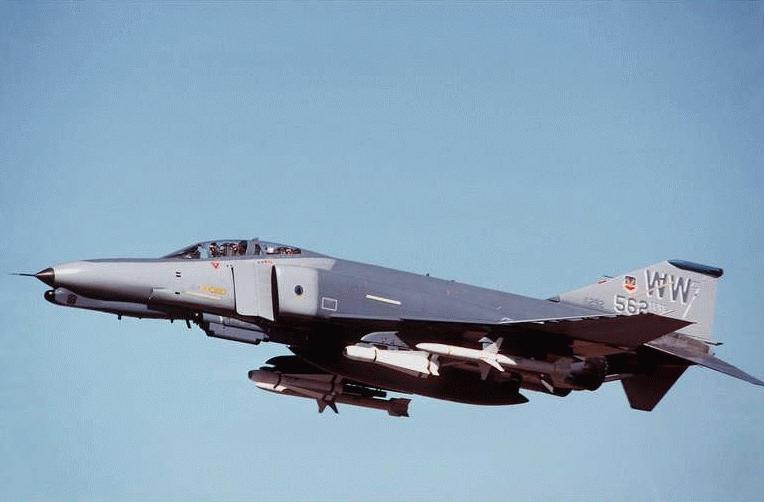 The HARM was rapidly deployed on a wide range of US aircraft. The USAF carried the missile on its dedicated F-4G Wild Weasel, and later on the F-16C/CJ. The USN deployed the HARM initially on the A-6E, A-7E and the then new F/A-18A, in all instances using a Command Launch Computer (CLC) to interface the missile to onboard avionics. Later the EA-6B Prowler was fitted with the CLC and a HARM Control Panel (HCP) to support the weapon and also deployed the missile. The most notable European deployment was by the Luftwaffe, which deployed the missile on the Tornado ECR (Electronic Combat-Recce) as well as the Tornado IDS (InterDiction-Strike). The Tornado ECR carries a TI Emitter Locating System (ELS) and is a dedicated SEAD variant analogous to the older F-4G. The HARM was blooded in two 1986 skirmishes with Libya, the most notable of which was the joint USN-USAF bombing raid on Tripoli and Benghazi. Reports from the period indicate that the HARM successfully engaged the SA-2, SA-3 and SA-5 acquisition and tracking radars. The Gulf War saw the HARM applied en-masse against the Iraqi IADS, which devastating results. Approximately 2000 rounds were fired and the missile by virtue of numbers alone must take credit for the largest number of Iraqi radar kills achieved.  The AGM-88C HARM The latest C-model HARM fits the form factor of the previous variants, with a 10 in diameter, 13.7 ft length, 44 in wing span and 800 lb launch weight. The missile is by design divided into four sections. The 70 lb 29.6 in long Guidance Section occupies the nose of the missile. A dielectric radome covers the fixed dual mode planar spiral high band antenna, which is supplemented by an eight element low band antenna array. The antenna is designed to provide a wide instantaneous field of view. The broadband receiver uses logarithmic amps to provide a wide dynamic range, with the receiver implemented using stripline techniques. The receiver employs Crystal Video Receiver (CVR) and Superheterodyne techniques, subject to frequency band. Reports indicate that the receiver processor is capable of sorting threat pulse trains in high density environments, from the C through to the J bands (0.5-20 GHz). The C-model HARM receiver has superior sensitivity and pulse de-interleaving performance over previous models, and is thus able to discriminate individual emitters in higher threat density environments, at greater ranges, compared to previous models. Because the missile is field reprogrammable, the missile can be programmed to engage not only the standard threat radars in its internal software library, but also arbitrary emitters such as ATC Primary and Secondary radars or weather radars. The Warhead Section of the missile contains the 146 lb preformed Tungsten casing blast fragmentation warhead. It is designed to spray high velocity Tungsten cubes to perforate not only the antenna, but also the target radar's electronics and structure. This is reported to double the lethality of the C-model over previous variants. The Control Section of the missile contains the Silver Zinc battery power supply and launch aircraft captive power supply, the strapdown inertial package and the electromechanical servoes used to actuate the wings, the aircraft electrical interface and the active optical proximity fusing system. The flight control employs roll stabilisation by differential actuation of the wings, which also provide pitch/yaw control. The wings are constructed as a steel casting with a honeycomb trailing edge. The latter half of the missile contains the Thiokol YSR113-TC-1 low smoke solid propellant rocket motor. The motor has a boost sustain burn profile, and weighs 400 lb at launch and 97 lb at burnout. The fixed steel casting tail surfaces attach to the motor casing. The HARM has four basic operating modes. The Pre-Brief, Pre-Emptive or Position-Known (PB/PE/POS) mode is a Lock On After Launch (LOAL) mode, and is used for standoff maximum range attacks on emitters of a known type and location, within several degrees of the missile boresight. This is the basic mode used by dedicated defence suppression (SEAD) aircraft such as the F-4G and Tornado ECR, or F-16CJ/HTS. In PB/PE/POS mode, as used by the Tornado ECR or F-4G, the aircraft's Emitter Locating System (ELS) determines the identity and position of the target, which are downloaded to the missile. The launch aircraft will then toss the missile to impart the best possible range. The missile flies on inertial guidance until it acquires the target, and then homes to impact. The PB/PE/POS mode is essentially offensive and most commonly used when taking down an IADS. A sub-mode of the PB/PE/POS mode is Equations-Of-Motion (EOM) mode which allows more precise selection of emitters at maximum range, in a high density environment. The EOM mode is more specific than PB mode in terms of target selection, and can engage off axis if required, but requires more precise target position information than the baseline PB mode. The target position data can be provided by an onboard receiver or datalinked from an external source (eg Rivet Joint to F-16CJ). The Target Of Opportunity (TOO) mode, also termed the HARM as Sensor (HAS) or Direct Attack (DA) mode is a lock-on-before-launch (LOBL) mode in which the missile receiver is used before launch to acquire the target. This mode allows off axis attacks on emitters within the field of view of the seeker. It is typically used as an offensive mode by non-dedicated strike aircraft to suppress emitters. The Self Protect or Launch Off RWR (SP/LOR) mode is a short to medium range mode used defensively to engage targets within 360 degrees of the launch aircraft. In SP mode the HARM is slaved to the aircraft's RWR and given a prioritised list of threats. The highest priority threat will be engaged after launch. The SP/LOR mode is similar to the TOO/HAS/DA mode, but provides a larger search footprint. It is worth noting at this point that the nomenclature for HARM modes can be confusing, as the USAF employed different names for essentially similar modes in the F-4G and F-16CJ, while the USN had its own names for these modes. In all modes the HARM employs flex logic, and will automatically acquire the next highest value (priority) target should the intended target go off the air. This ensures that the weapon is not wasted once it is committed. The range advantage of the PB/EOM mode stems from the missile's ability to fly a more energy efficient trajectory toward the target to the point where the seeker is activated and homing begins. Once the HARM initiates homing, the previous launch mode is irrelevant as the missile's trajectory is from that point determined by the homing algorithm (typically a variant of proportional navigation in such missiles). The homing performance of the missile is needless to say identical regardless of the initial launch mode. While the USAF could exploit the PB/EOM mode using the existing rangefinding capability of the F-4G ELS, and later the F-16CJ HTS, the USN has only ever operated the missile in range unknown modes. Most USN launches have been in TOO or PB mode, with occasional launches in SP mode. The full performance capability of the HARM can thus be exploited only by aircraft fitted with a rangefinding receiver as this allows the missile to be launched in range known PB/EOM modes and acquire the target enroute. Examples of such receivers are the APR-38/47 ELS on the F-4G, the Tornado ECR ELS, the HARM Targeting System (HTS - fitted more recently to F-16CJs) or the LM Target Acquisition System (TAS - recently tested on the F/A-18C). Once homing is initiated, the HARM will fly a shallow dive trajectory and arm its active optical proximity fuse as it approaches the target. Aircraft with less capable onboard systems must depend upon the missile to acquire the target before launch or shortly after launch, and this will limit achievable range. The AGM-88D Block 6 HARM Development effort continues on the HARM design to further refine its capabilities. The greatest weakness of established HARM variants is their inability to accurately home on targets which have ceased to emit. Often the missile may not guide close enough to inflict any useful damage. The AGM-88D Block 6 variant is intended to eliminate this limitation in the HARM, for range known launches. The Block 6 upgrade is a cooperative German-Italian-USN effort to fit the missile with a precision guidance kit, employing GPS-inertial guidance. The HARM fitted with this kit would fly a much more exact trajectory, using GPS to aid its inertial package, producing some improvement to the missile's existing 50-80 NMI range. Should the emitter be lost, the missile will continue its flight under GPS inertial control to impact. The CEP of the GPS guidance package will be of the order of 20 ft, however the limitation to lethality will be primarily imposed by the accuracy of targeting receiver used to initialise the missile. Since target GPS coordinates for known fixed targets may be determined by other means, the missile has potentially very high lethality against a fixed IADS installation. Development of the Block 6 started in 1998 for a planned 2003 IOC.  Current plans are for a follow on HARM seeker package which integrates an active MilliMetric Wave Imaging (MMWI) seeker, with the existing passive homing and inertial package, and GPS. This multimode package will allow the missile to continue the engagement even if the target is a mobile SAM system or SPAAG, which has ceased to emit and is attempting to escape. Should the signal from the target cease, the multimode seeker will fly under GPS/inertial control to a search footprint, within which the MMWI seeker will search for the target, allowing a precision homing attack. Existing MMWI seeker technology such as that in the MMWI Hellfire has the ability to recognise a specific target type by shape and fine Doppler modulations. The operational deployment of this HARM variant will spell the end of the mobile SAM system, as it effectively nullifies the shoot and scoot and the go off the air tactics which can frustrate existing in service variants of the HARM . As recent experience in the Balkans air war has shown, an intelligent opponent who exercises tight emission control discipline can significantly slow down the rate of attrition produced by sustained anti-radiation missile attack. Integration of the HARM The HARM employs the missile specific 10.4 HARM/Standard (STARM) Interface which is used to communicate targeting information to the missile, missile status to the aircraft, and feeds power from the aircraft's rails to the missile prior to launch. Earlier SEAD aircraft such as the F-4G had this interface integrated into the aircraft's avionic suite to support the Standard ARM, and to minimise integration effort and costs the early HARM adopted the existing interface. With the proliferation of the Mil-Std-1553B/1780 interface, an interface computer was provided on the launch aircraft. US Navy aircraft employ the CP1001/AWG-25A CLC, whereas the F-16C/CJ uses the ALIC (Aircraft Launcher Interface Computer). These computers act as intelligent Mil-Std-1553B bus terminals, translating protocols between the two interfaces, as well as providing other HARM specific functions. The CLC for instance couples tightly to the RWR (eg ALR-67) and automatically queues active threats. The ALIC provides for simple integration by interfacing to the Mil-Std-1780/1553B interface at the aircraft pylon. The ALIC attaches to the LAU-118 launcher, which is in turn attached to the pylon. In the simplest of terms, whereas dedicated aircraft such as the F-4G or Tornado ECR will have onboard hardware/software support for the HARM and will directly communicate target parameters to the missile before launch, non-dedicated aircraft must employ a separate computer to interface their nav-attack and RWR systems to the HARM.  This diagram displays three of the four basic operating modes of the HARM missile. Best standoff range performance is achieved with the EOM mode,which requires the use of a rangefinding targeting receiver or Emitter Locating System. In this mode the HARM is typically tossed by the launch aircraft andflies on inertial guidance until the trip point, where homing is commenced(TI).  During the Gulf War the F/A-18s of the USN and USMC fired a very large proportion of the total number of HARMs used, particularly during the opening phase of the air war. The most typical warload for the Desert Storm air campaign was a quartet of HARMs and a centreline fuel tank. The baseline F/A-18 uses a CLC interface which is coupled to the ALR-67 RWR, and can support only range unknownmodes (TI). 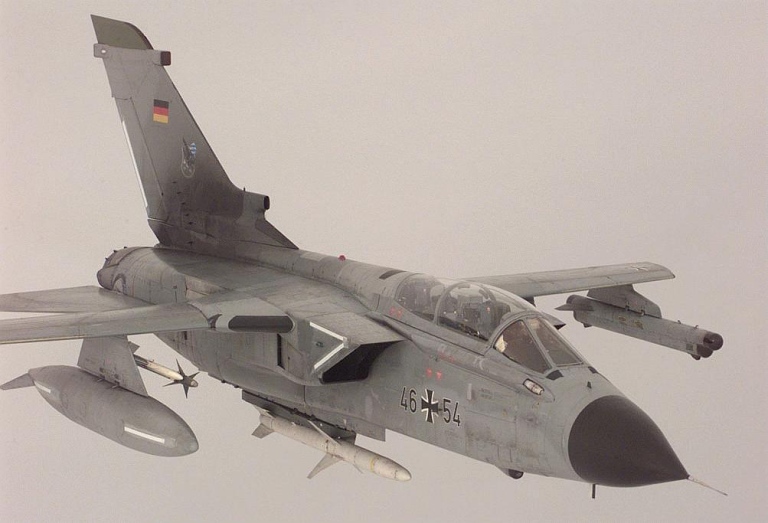 The F-4G Weasel and Luftwaffe Tornado ECR are both dedicated radar killers,fitted with precision rangefinding Emitter Locating Systems. While the Tornado ECR arrived too late for Gulf deployment, the F-4G proved to be the prime SEAD asset of the campaign. A typical configuration during the early days ofthe campaign was a load of four HARMs, and an F-15 centreline fuel tank.The F-4G uses the IBM APR-47 ELS which has full 360 degree coverage (TI). Targeting Receivers for the HARM One of the basic realities in using the current generation of Anti Radiation Missiles is that they deliver their best where fired in range known modes. This is true both in terms of available missile operating modes as well as in terms of achievable standoff delivery range. It is no secret that the most effective SAM and radar killer during the Gulf War was the USAF's then obsolescent F-4G Wild Weasel, equipped with the potent but even then aging APR-38/47 Radar Homing And Warning System. The APR-38/47 provided a unique capability, in that it could not only measure bearing to a threat emitter very accurately, but it could also measure range to the emitter by overlaying consecutive bearing measurements. The retirement of the F-4G has precipitated the development of a new generation of rangefinding homing receivers for use on semi-dedicated tactical aircraft. The USAF have deployed the HARM Targeting System (HTS), carried in a small pod on an F-16C/CJ Lantirn pylon, while the USN are currently testing the Targeting Avionic System (TAS) on the F/A-18C. A further system using Phase-Rate-of-Change techniques has been tested on the USAF F-15 by Raytheon (Hughes), originally for the proposed and later cancelled F-15 SEAD variant. These receiver systems differ fundamentally from the very complex and expensive APR-38/45 which required a dedicated airframe due sheer volume of avionics alone. Both the HTS and TAS are small, lightweight and relatively cheap systems, which provide less than 360 degree coverage, and can track a significantly lesser number of threat emitters compared to the APR-38. Exploiting recently developed passive rangefinding techniques, such as Phase-Rate-of-Change (PRC), Differential Doppler Shift (DDS), Differential Time Of Arrival (DTOA), high performance digital signal processing chips, and highly precise frequency or time references (clocks), these receivers can achieve similar or better accuracy performance and much faster response times than the APR-38/47. The result has been the emergence of semi-dedicated SEAD (Suppression of Enemy Air Defences) aircraft, which are essentially standard configuration tactical fighters fitted with such a rangefinding receiver and supporting software as an adjunct to the aircraft's existing EW suite, which will carry and shoot ARMs if required but are otherwise available and fully capable of performing the standard fighter bomber mission. The downside of the semi-dedicated SEAD aircraft is that the absence of a specialist EWO backseater, the limited angular coverage, and the limited target tracking capability of the rangefinding receiver limit the ability of such aircraft to perform the fully autonomous and independent high threat density SEAD mission in which the F-4G distinguished itself so well. Full angular coverage and an expert GIB are vital if the aircraft is to be able to fully autonomously hunt emitters, especially mobile SAM systems which pop-up unexpectedly. The USAF has worked around this limitation by deploying into theatre the previously strategic RC-135V/W Rivet Joint electronic recce aircraft. The Rivet Joint was originally built to eavesdrop on Soviet radar and air defence communications during the Cold War, the aircraft carries a comprehensive array of precision emitter locating equipment and communications intercept equipment (specifically the E-System's 55000 ELS and 85000 Sigint packages) with three dedicated EW operators, and with several dedicated and often foreign language skilled Sigint/Comint operators. In operation the Rivet Joint will orbit well out of the range of hostile air defences, and perform as an electronic vacuum cleaner, receiving, identifying and locating any radar or radio emissions in the area of interest. Should an emitter be considered a threat to US aircraft, HARM firing fighters are vectored by the Rivet Joint to engage the emitter. In this fashion the Rivet Joint provides the big picture situational awareness which the limited systems of semi-dedicated SEAD fighters cannot provide. The situational awareness advantage is not confined to SEAD aircraft alone, as the Rivet Joint may also broadcast general advisories to combat aircraft operating in the area, as well as coordinate standoff jamming operations by the EF-111A and EA-6B. Emitter details may also be passed to the E-3 AWACS via TADIL-A datalink. The limitation of the Rivet Joint is the accuracy with which it can locate emitters at standoff ranges, therefore the semi-dedicated SEAD fighter must carry a rangefinding/homing receiver to refine the position of the target for direct attack. Experience in Bosnia quickly suggested that the same issues arose as in the vectoring of fighters by AWACS using voice commands, and it is therefore expected that a datalink modem will be provided in the nearer future to allow the Rivet Joint to directly hand off targets to the fighters, much in the manner that the AWACS/JTIDS and E-2C/Link-14 operate. Effort at this time is being concentrated on coordinating the operation of the Rivet Joint and the JSTARS, with the intent of pooling target track data to locate particularly the mobile SAM threats. While the USN at the time of writing was yet to move on this issue, we can expect that their solution will be analogous. The electronic recce EP-3 (ES-3B Viking being tagged for early retirement), a less capable but functionally similar system to the Rivet Joint, would be used to perform a similar role and datalink target data to HARM firing F/A-18Cs. This Conops is in many respects less flexible than the F-4G/APR-38 model, and is the product of downsizing pressures upon the US military. The upside, for smaller air forces, is that this situation has produced both a Conops and a generation of equipment which would allow a smaller air force to acquire a very potent and credible electronic combat capability at a modest cost indeed, in a short timescale. 6 The Targeting Avionics System The TAS owes its existence to a 1991 technology demonstration contract by the USN, who sought to improve the effectiveness of their HARM firing F/A-18s in the wake of the Gulf War. USN HARM shooters typically used range unknown modes, often cueing the HARM with the relatively inaccurate, bearing only capable ALR-67 RWR. The TAS is a pylon mounted lightweight passive precision direction finding and rangefinding receiver, which provides its host aircraft with precise emitter position information without the cost, weight and complexity penalties of podded or internal ESM equipment. A typical TAS installation, such as that in the trial F/A-18C, has two TAS receiver packages fitted inside the outboard weapon pylons to provide 240 degrees of overlapping coverage over the forward and beam sectors of the aircraft. The aircraft is therefore capable of carrying the same weapon load as a standard aircraft. The TAS installation does not interfere with or limit the existing ALR-67/ALQ-126 EW suite. Each TAS receiver employs a pair of dual baseline precision interferometers to provide a bearing accuracy of better than one degree in azimuth and elevation over a 120 degree sector. Both the mid band and high band interferometers employ a set of five cavity backed spiral antennas, a scheme common to the F-4G APR-38 installation, to provide coverage from 2 to 18 GHz (E to J bands). It is important to note that this class of interferometer, if well designed, rigidly mounted and properly calibrated, can provide bearing accuracies of a small fraction of a degree. Modern rangefinding techniques such as PRC, DTOA and DDF can in turn provide ranging accuracies of hundreds of metres at tens of kilometres of range, with very quick response times compared to older multiple bearing measurement techniques. Aircraft using such receivers can therefore measure the location of an emitter with accuracies as high as of the order of one percent, in several seconds. Understandably, exact accuracy numbers for the TAS are not publicly available, moreover the specific rangefinding technique in use was classified at the time of writing. On the F/A-18, the TAS installation is wholly contained in the pylon. The forward section of the pylon mounts the interferometer array, offset by sixty degrees from boresight and covered by a dielectric panel. A discrete channelised RF front end receiver is fitted immediately behind the antenna array, together with the Digitally Tuned Local Oscillator (DTLO). The Intermediate Frequency (TAS is a Superhet) stages, logarithmic video amplifier, video digital signal processor (DSP), and threat library storage memory are packaged into a cylindrical case in the aft of centre cavity in the pylon. The pylon also houses the power supply, line filter and cooling fan. The whole TAS installation adds a mere 10 kg to the weight of the standard pylon. Lockheed Martin are understandably interested in making sales, and have proposed a pylon mounted installation for the F-16C, AV-8B and EA-6B, a glove mounted installation for the F-14, and installation on the E-2C. We can safely assume on the basis of published material that the system could be readily packaged in the leading edge of the F-111C/G strake, using a dedicated bay or sharing the forward ECM antenna bay. Understandably some software additions are required to the launch aircraft weapon system to accommodate the receiver. In an operational air-to-ground scenario, the TAS would be used to precisely locate surface emitters for attack with the HARM missile, or other lethal munitions such as JDAM or JSOW. Targets would include land based surveillance, and acquisition radars, and SAM/AAA fire control systems. As the HARM would be fired in a range known mode, its standoff range is maximised as is its likelihood of successfully hitting the chosen emitter. In an operational maritime scenario, the TAS can be employed to silently determine the position of a hostile surface vessel, positively identify it, and engage it with the AGM-142 or the Harpoon in a range known (RBL) mode to minimise the chances of hitting an unintended target. Because the TAS is passive, the target vessel will have no warning at all if the AGM-142 is used, or tens of seconds of warning when the Harpoon lights up for terminal homing, without detecting the launch aircraft due the detection range performance of the TAS receiver. In an operational air-air scenario, the TAS may be used to precisely measure the bearing to an airborne emitter, to cue a fighter's AI radar, thermal imager, InfraRed Search & Track or TV telescope for a Beyond Visual Range (BVR) missile attack. The angular coverage of the TAS is equal or greater to that of these existing air-air sensors, and the sensitivity of the receiver means that it will outrange other air-air sensors, as well as detect a hostile emitter well before it detects the host aircraft carrying the TAS. It has been reported that the F-16CJ HTS commonly tracks the AWG-7 radar from 200 NMI range. In practical terms, the TAS is a modern equivalent to the RAF's WW II Serrate homing receiver, which was used most effectively by RAF night fighters to hunt down Luftwaffe night fighters. As such receivers are wholly passive, the target has no warning that it is about to be engaged. The TAS has the capability to concurrently track eight emitters. While this is less than the F-4G/APR-38/47, it is a more than adequate capability for most low threat density environments. In late October, 1996, the NAWC F/A-18C TAS testbed aircraft performed the first live HARM shot in range known mode, at the China Lake weapons range. The F/A-18C popped up from behind a mountain range to measure target emitter range and bearing, and then descended below the line of sight to the target to fire a HARM in PB/EOM mode. The missile climbed above the line of sight to home in to impact. The TAS was undergoing a USN operational evaluation during 1997, after which a decision was expected on production and operational deployment. Summary It is clear that modern low cost rangefinding receivers such as the USN TAS and the USAF HTS provide a highly cost effective means of increasing the potency of aircraft performing both semi-dedicated SEAD as well as conventional air superiority and maritime missions. As such systems are relatively cheap and designed for simple integration, the entry cost barrier of more capable dedicated Emitter Locating Systems, which has prevented smaller air forces from developing a proper electronic combat capability, is about to fall. As a result, the cost arguments which have prevented smaller air forces in times past from fully developing an electronic combat capability are now quite irrelevant. There can be no doubt that this class of equipment is a powerful force multiplier across a wide range of missions, and we can hope that this technology will become more widely adopted in coming years. The payoff in capability is simply too good to ignore.   The Lockheed Martin Aeronutronics TAS is a pylon mounted, low cost, precisiondirection finding and rangefinding receiver, capable of rapidly and accuratelylocating the position of an emitting radar. The system provides 120 degrees ofcoverage in elevation, 240 degrees of coverage in azimuth, and adds a mere20 kg of weight to the aircraft. It can be used to dramatically improve theeffectiveness of anti-radiation missiles, as well as provide an additional longrange passive detection and sensor cueing capability in BVR air-air combat (Lockheed-Martin).  This photo shows the first trial launch of a HARM missile in range known mode on an F/A-18A, using the onboard TAS to find the range and bearing to the target radar. ARMs deliver their best range performance when launched in range-known modes, and low cost receivers such the TAS or HTS provide this capability without the cost, complexity and integration penalties of dedicated ESM receivers such as the Wild Weasel APR-38/47 or the Tornado ELS, albeit with some limitations in angular coverage (Lockheed-Martin).  The USAF's podded HARM Targeting System (HTS) fitted to the semi-dedicatedF-16CJ SEAD aircraft is the first of the new generation of lightweight rangefinding receivers to be operationally deployed. The receiver mounts on the forward starboardLantirn station, and provides 120 degree coverage over the forward sector. The F-16CJ/HTS is supported in theatre by the RC-135V/W Rivet Joint, which providesAWACS-like wide area coverage of hostile emitters, and vectors the F-16CJ to engage the target radar (USAF).  |
||||
|
|||||||||||||
|
|
|
|
|
|
|
|
|
|
|
|||
|
|
|
|
|
|
|
|
|
|
|
|||
 |
|
|
|||||||||||
| Artwork, graphic design, layout and text © 2004 - 2014 Carlo Kopp; Text © 2004 - 2014 Peter Goon; All rights reserved. Recommended browsers. Contact webmaster. Site navigation hints. Current hot topics. | |||||||||||||
|
Site Update
Status:
$Revision: 1.753 $
Site History: Notices
and
Updates / NLA Pandora Archive
|
|||||||||||||
|
|
Tweet | Follow @APA_Updates | |||||||||||
|
|
|||||||||||||
|
|
|||||||||||||






