|
||||||||||||||||||||||
 |
||||||||||||||||||||||
![F-22A Raptor, FB-22, F-22E, F-22N and Variants Index Page [Click for more ...]](APA/f-fb-22.png "F-22A Raptor, FB-22, F-22E, F-22N and Variants Index Page [Click for more ...]") |
 |
![People's Liberation Army Air Power Index Page [Click for more ...]](APA/pla-air-pwr.png "People's Liberation Army Air Power Index Page [Click for more ...]") |
 |
 |
 |
 |
 |
 |
![Military Ethics, Culture, Education and Training Index Page [Click for more ...]](APA/ethx-culture.png "Military Ethics, Culture, Education and Training Index Page [Click for more ...]") |
 |
||||||||||||
 |
![Russian / Soviet Weapon Systems Index Page [Click for more ...]](APA/rus-weps.png "Russian / Soviet Weapon Systems Index Page [Click for more ...]") |
 |
 |
 |

|
 |
 |
 |
 |
 |
||||||||||||
 |
 |
|||||||||||||||||||||
| Last Updated: Mon Jan 27 11:18:09 UTC 2014 | ||||||||||||||||||||||
|
||||||||||||||||||||||
|
||||||||||||||||||||||
|
||||||||||||||||||||||
|
|
|
|
|
|
|
|
|
|
|
||||||||||||
|
|
|
|
|
|
|
|
|
|
|
||||||||||||
|
|
|||||||||||||||||||||
| Last Updated: Mon Jan 27 11:18:09 UTC 2014 | ||||||||||||||||||||||
|
||||||||||||||||||||||
| PRECISION
GUIDED MUNITIONS The New Breed |
|||||
|
|||||
|
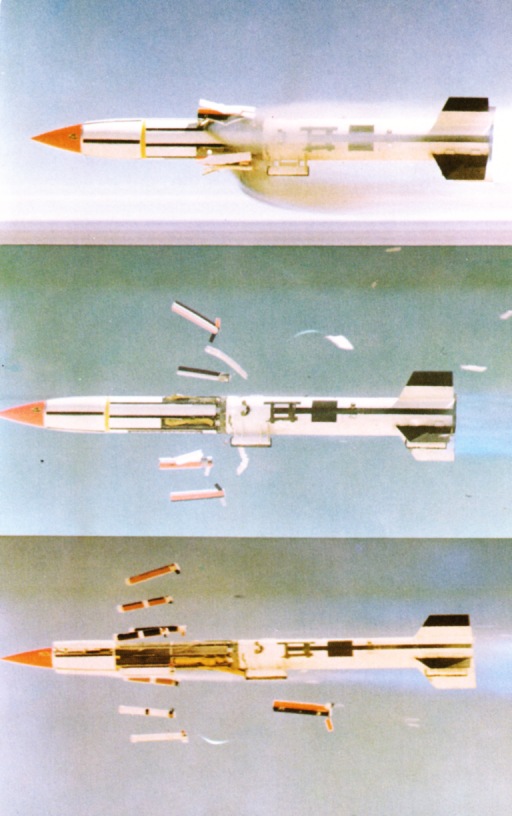
Precision Guided Munitions (PGMs) entered the world of warfare in the sixties, the basic species then maturing in the seventies. Though the weapons of the seventies were a far cry from the rather rudimentary systems of a decade earlier, they all had one essential characteristic in common: one weapon = one target. This was more than adequate for the period, but times change and so has the concentration of Soviet forces in the critical central European theatre. The Russians spent a lot of roubles, resulting in a substantial imbalance in both armour and aircraft. They are still spending a lot of roubles and many Western analysts predict they will continue to happily do so for some time yet. This has understandably affected Western PGM development, in the short term leading to multiple targeting systems, in the long term to the development of an entirely new generation of standoff PGMs. What need not be apparent at first sight is the fundamental change to warfare which is about to occur with the introduction of these systems. One vs one no longer really applies, the norm will be 'one vs many' at standoff ranges. The key element in this phase of weapons evolution is the microprocessor chip and its cousin, the dedicated VLSI signal processor chip. Both of these semi conductor devices will allow the weapons designer to package a lot (easily millions of instructions per second) of computing power into very small (typically tens of cubic inches) volumes with very little power consumption (Watts to tens of Watts). The end result is that the designer may program various degrees of intelligence and decision making capability into the weapon, just as he has the option of using very sophisticated target recognition techniques. Simple deceptive countermeasures such as infra-red (IR) flares cease to be effective to any degree, just as camouflage paint becomes a waste of time. The new generation of PGMs is thus certain to further widen the gap between the advanced Western powers and the Third World, while also painfully blunting whatever edge Warpac managed to gain in its post 1970 spending spree. The capacity to support and use these newer PGMs will in fact differentiate the advanced nations from the rest and could severely alter the world military balance in terms of non-nuclear military capability. Numerical strength will cease to have any bearing, once certain overkill ratios in PGM capability become established. To further our insight into these families of weapons, we will examine the more conventional target recognisers, which enhance the lethality of existing PGMs, and then review the basic principles behind the current philosophy in standoff PGM development. Target Recognisers - LANTIRN The central European theatre is a high threat environment,
crawling with nasties such as MiGs, SAMs, and radar directed AAA. By
the
same token it is a target-rich area, as it must support Soviet/Warpac
frontline forces as they attempt to penetrate into West Germany. Until
the early eighties Warpac air defences could hardly cope with NATO's
F-15s and F-16s, thus few air defence aircraft would remain to harass
the F-4s, F-16s, A-10s and F-111s tasked with eradicating the Warpac's
ground forces. The introduction of Foxhound, Fulcrum, large numbers of
advanced Floggers and newer SAM and AAA systems has however upset the
once favourable balance, enabling only the F-111 and Tornado to cope
with these defences, mainly by virtue of its terrain following ability.
The USAFE responded to this situation with the development of the Low
Altitude Navigation and Targeting Infra-Red system for Night, or
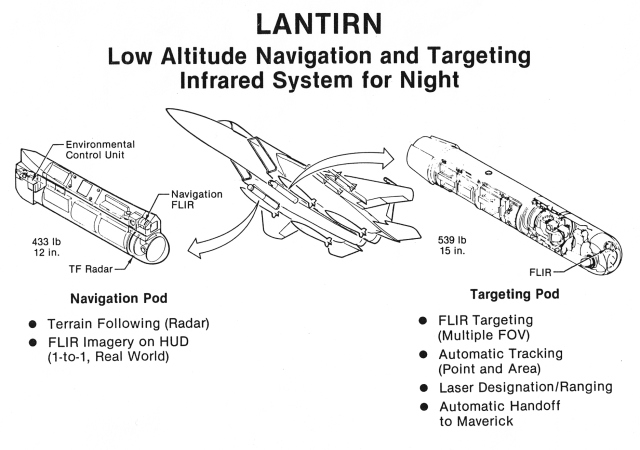
LANTIRN. LANTIRN is a compact podded system, to be fitted to the A-10,
the F-16C/D, but mainly the new F-15E Strike Eagle, providing terrain
following and targeting capability. The system resides in two dedicated
pods, tieing into the fire control of the aircraft and in particular,
into a dedicated Marconi wide angle HUD. The HUD uses a holographic
combiner (see TE, March 1981) and presents both calligraphic HUD
symbology and raster scan FLIR images, superimposed upon the outside
scene.
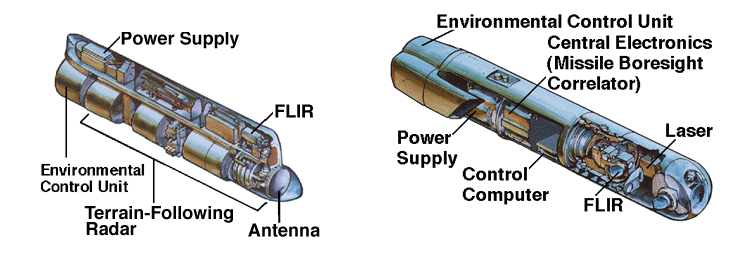
The FLIR imagery, for terrain following, avoidance and
navigation, is generated by a wide field of view FLIR sensor, sensor,
mounted in the port LANTIRN navigation pod, together with the terrain
following radar (TFR). The TFR is an advanced digital system which
automatically controls its power output, both in direction and time (it
will build up a terrain profile in its memory, store it, switch off and
turn on again only when necessary to rebuild the profile), is frequency
agile and can be configured for ground mapping. The frequency agility
and silent on/off operation make it very difficult to detect. The
second LANTIRN pod, starboard mounted, is termed the targeting pod. It
contains a narrow field of view FLIR sensor, boresighted with a laser
rangefinder/designator and importantly, in its later versions, an
automatic target recogniser.
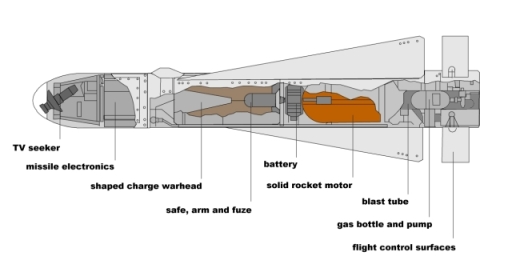
The FLIR / laser serves all of the usual purposes, providing navigation updates, rangefinding for bomb delivery and recognition/laser designation for laser PGM delivery, its imagery appearing on a cockpit head-down CRT. It serves another task, however, that being the targeting of the new imaging infra-red AGM-65D Maverick missile (see TE, June 1983). Prior to launch Maverick transmits a picture to the pilot, as viewed by its nose camera, the pilot then steers the boresight of Maverick's optics onto his desired target. He engages a contrast lock (see TE, March 1984) and launches the missile at the target. As is apparent, the pilot must devote attention to finding the target on his screen and then cueing the Maverick for launch. LANTIRN simplifies this task as it automatically cues the Maverick to its own boresight, using a boresight correlator; thus the pilot views the same target on his LANTIRN image as is viewed by the Maverick, but with far better picture quality and whatever cueing aids LANTIRN has to offer. This mode allows the cueing and launch of one round at a
time.
The target recogniser will change this. The recogniser is a dedicated
high speed computer which will snatch a single frame of the LANTIRN
FLIR
image and then proceed to analyse it for the presence of targets.
Various techniques are used, in principle the recogniser evaluates
first
the overall scene and separates out potential targets (for the
technically minded, it will search for bimodality in a gray scale pixel
histogram to locate by thresholding [adaptively] areas likely to be
targets, this including decluttering; these are then correlated with
areas possessing appropriate boundary gray scale gradients), it then
identifies these as either tanks, armoured vehicles or trucks, tags
them
and proceeds to prioritise them for killing, usually in the above
order.
(Suggested reading: Rosenfeld A. -Object Detection in Infra-red Images.)
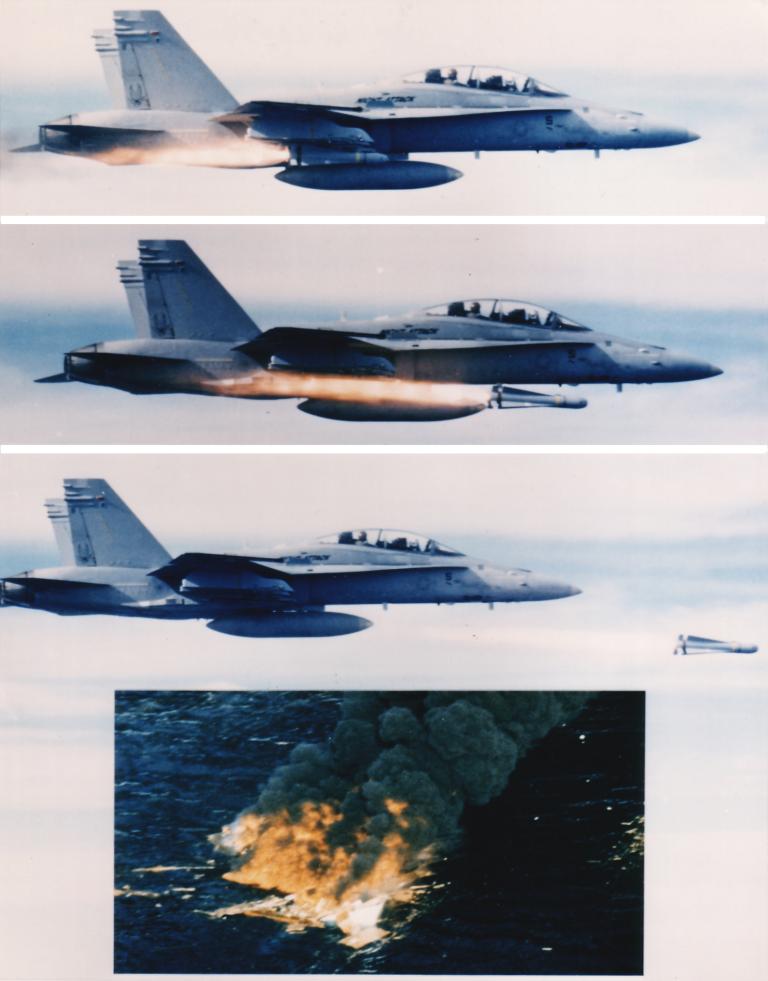
AGM-65D IIR Maverick
launch
from F/A-18D Night Attack variant. The Maverick proved very successful
in the subsequent Desert Storm campaign (MDC).
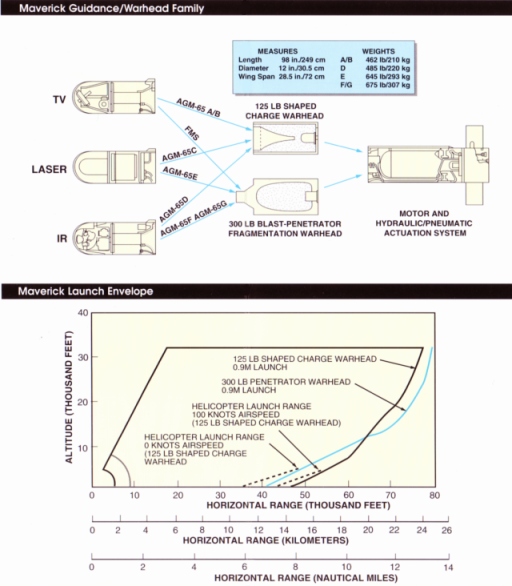 Hughes Aircraft Company images
At this stage the recogniser has several options available,
the USAF has not been specific, firstly it may place a marker or box
above targets in the pilot's viewed image, to assist in identifying the
highest priority target, and allow the pilot his single shot as
previously. Secondly it could cue a Maverick onto the highest priority
target and merely request that the pilot squeeze the trigger. Thirdly,
the recogniser may cue several Mavericks to several viewed targets,
sequentially, in the given priority and thus effectively ripple launch
all of them. This last mode is the significant one, all the pilot need
really do is point the LANTIRN FLIR at a cluster of targets and
activate
the recogniser, which will assign Maverick rounds and then fire them,
while the pilot manoeuvres to evade defences. At this stage the
recogniser has been a problem in LANTIRN development; basically it
seems
due to software problems and inadequate available computing power; as
one can see the recogniser is a very busy little machine. In fact so
busy, that there are few compact computers around capable of handling
the job.
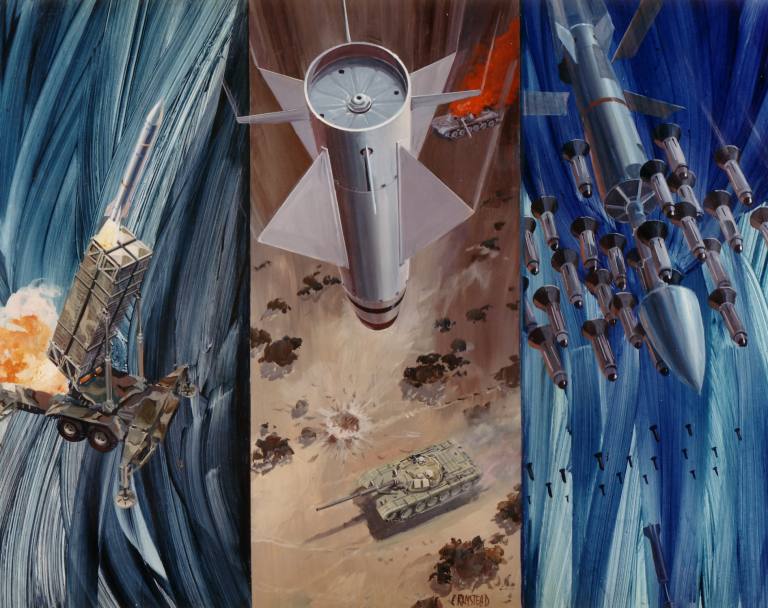
Assault Breaker in action. A Martin Marietta T-16 missile dispenses its payload of twelve submunitions, either TGSMs or SDVAs, as it dives at supersonic speed on to a tank formation. The submunitions have been released in a specific pattern to ensure coverage of the whole target array, be it circular, linear or other. The USAF intends to purchase 720 LANTIRN sets, with recognisers currently regarded as a definite growth option, hardly good news for the Warpac tank commander. A weapon system conceptually similar to LANTIRN/Maverick is
the German Messerschmitt-Bolkow-Blohm Vebal Syndrom pod. This pod
mounts
beneath a strike aircraft, and carries a set of sensors and an array of
about 25 rocket propelled munitions. When the strike aircraft overflies
a target or group of targets, the pod uses an infrared seeker, a laser
radar and millimetre wave detector to identify individual targets; only
those with a specific temperature gradient, height/cross-section and
metal body being regarded as legitimate. The pod then automatically
selects the munition best positioned to kill the target and fires it.
Conceptually the system has the advantage of using dirt cheap unguided
munitions (Mavericks are fairly expensive, at US$130,000 apiece) but
requires steady level overflight of the target, which need not be a
healthy practice in the presence of SAMs and AAA. In spite of this, MBB
are expending considerable effort in the current development phase,
much
to the amusement of many US observers who regard standoff launch as the
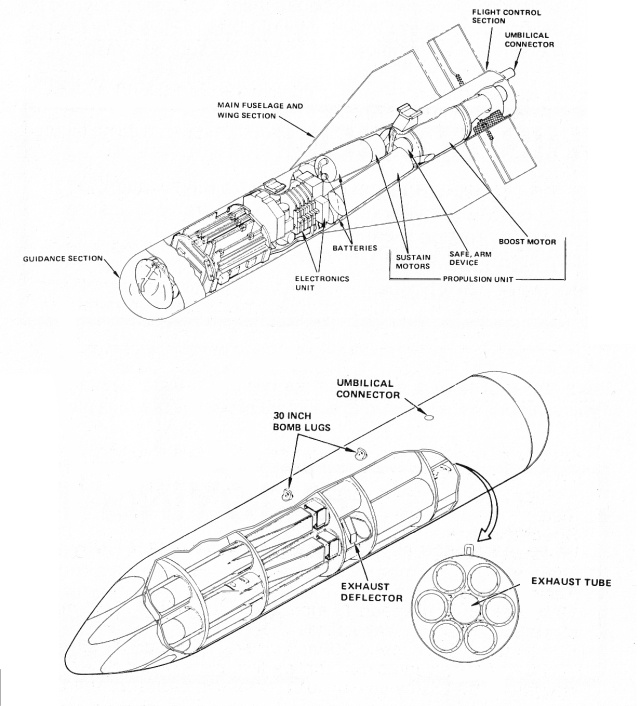
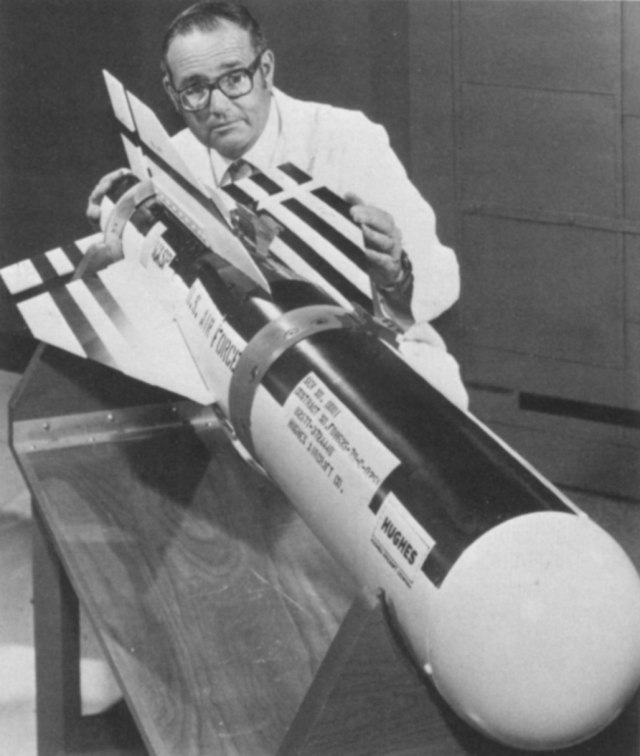
only safe technique. Another weapon system in this family is the now cancelled Hughes Wasp minimissile. Wasp was to be carried in sets of 12 (refer to P.39, June 1983 Australian Aviation), each set in a sealed pod. Upon detecting a group of targets, the pilot would activate the pod which would ripple launch all twelve rounds, the only targeting necessary being the pointing of the fighter in the direction of the enemy tanks. The swarm of missiles would then hug the terrain at around 200 feet, each scanning the ground with its millimetre wave radar seeker. Each Wasp knows its number in the swarm and each Wasp would fit all of the detected tanks into particular places in a preprogrammed target array (which it would also identify, shapewise). Each Wasp would then attack only particular targets in the array, ensuring no two rounds would hit the same tank. Wasp was a beautiful little missile, with all weather
capability, several miles of standoff range when launched from a
terrain
following aircraft and a jam-proof active radar seeker. An F-111 could
carry four pods and thus could annihilate a 50-strong tank formation in
one hit, without even revealing its approach. Hughes' test program was
very successful, culminating in a direct hit on a predesignated tank,
parked amidst a tank formation, in April 1983. The MMW active seeker
had
apparently demonstrated the ability to resolve tanks from armoured
vehicles and trucks, which was not even called for in the initial
specification. Unfortunately, the program was killed in mid-1983 due to
a combination of development cost factors and the anticipated
diminished survivability of interdiction aircraft within Warpac
airspace in the early nineties. Hughes were naturally disappointed, but
some sources suggest that the seeker will be adapted for use on the
Rockwell Hellfire antitank missile, to then be helicopter launched in
salvoes from safe standoff ranges, avoiding the need to laser designate
targets.
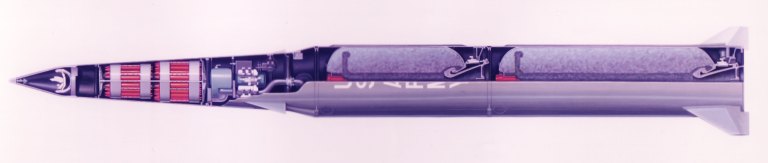
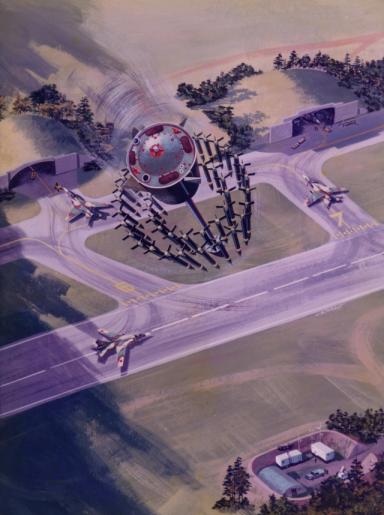
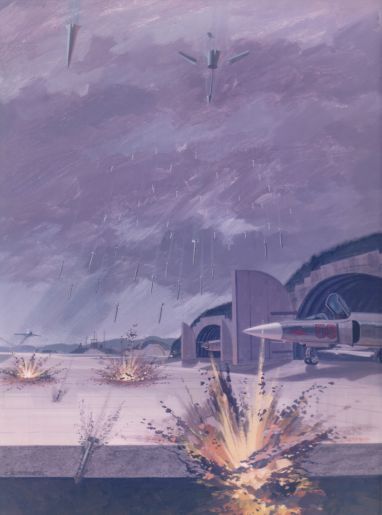
It is significant that of the above PGMs, the majority are conceptually single shot weapons, the delivery vehicle containing both the guidance and warhead. The emerging generation of PGMs derives from a different philosophy; that of a bus and submunition structure. The 'bus' is a delivery vehicle, be it bomb or missile, with only a navigation system (though often augmented with other guidance) to get it into the target area. The submunitions are then released, these being either guided or unguided, propelled or unpropelled, in both instances though with an effective range of the order of a mile or so. The structure has the immense advantages of standoff range and modularity, in either instance given by the specific bus and family of submunitions. The flexibility reflects in the choice of this weapon structure for both anti-armour and counter-air weapons. Counter-Air Weapons - AGM-109H MRASM The counter-air mission revolves about the necessity to disable the opponent's air power. The conventional way of doing it is flying in with a fighter bomber, e.g. an F-111, and obliterating the runways, taxiways and parked aircraft with 500 Ib iron bombs. Though appealing in its conceptual simplicity, this technique is ceasing to be viable due to the density of SAM and AAA defences which tend to be concentrated in high value target areas. The natural solution is the use of a standoff weapon to dispense submunitions over the above target. A submunition dispensing GBU-15 glidebomb is one way of tackling the problem, but it still forces the attacker to within several miles of defences, not always safe when dealing with SA-10 SAMs or lookdown/shootdown Foxhound and Flanker. The use of a Tomahawk cruise missile is a clean technique as the launch aircraft may stand off, attacking from several hundred miles away. The Medium Range Air to Surface Missile (MRASM) uses a basic AGM-109 cruise missile airframe, propulsion and guidance, but is fitted with a modular payload bay. The weapon is launched from 250 nm away, by a B-52 or F-16, and uses its TERCOM aided (see next TE) inertial navigator to approach the target, via a preprogrammed route. Once closing in on the target, it activates its DSMAC II optical terminal guidance to precisely identify features of the target, after which it overflies particular chosen areas dispensing munitions in a preprogrammed pattern. Munitions are ejected sideways, using inflatable airbags. The payload bay, fore of the wings, has a backbone which is a structural member to which payload modules are attached. The basic munition used is a BKEP (Boosted Kinetic Energy Penetrator), a compact cylindrical device which deploys a drogue chute after release, pitches nose down and fires its rocket engine. It then punches through the concrete/ taxiway surface and detonates, lifting the concrete. To further ease the opponent's repair efforts, BKEP modules may be substituted for with mines or CEBs (Combined Effects Bomblets). The total package represents the perfect tool for a pre-emptive counter-air strike, the MRASM virtually undetectable until it hits. A further advance in this art is the Martin Marietta CAM (Counter Air Missile). CAM is a rapid reaction weapon, utilising a Pershing II airframe as a delivery vehicle. Hitting Warpac targets, CAM has a flight time of minutes, launched from NATO territory. CAM is vertically launched from silos or mobile launchers and climbs to a suborbital altitude. There it re-enters the atmosphere, carries out a specific pullup/pulldown manoeuvre to stabilise its speed and activates its radar guidance. The guidance uses a radar area correlator to exactly locate its target within the landscape. Diving down at hypersonic velocities, CAM deflects its control surfaces and spins up to a considerable rotational velocity. It then strips its skin and releases unboosted KEP munitions in a specific pattern to cover preprogrammed areas of the target. Mines may also be dispensed. CAM is a frightening weapon, hitting the target within
minutes
at ranges beyond 500 nm, with surgical accuracy. As its cousin Pershing
II, it is difficult to hit with SAMs. The argument currently raised
against the development of CAM is simple - how will Ivan ever know
which
of the Pershings on his radar scope are CAMs and which are nuclear? He
may not take chances and go nuclear as soon as he sees it coming.
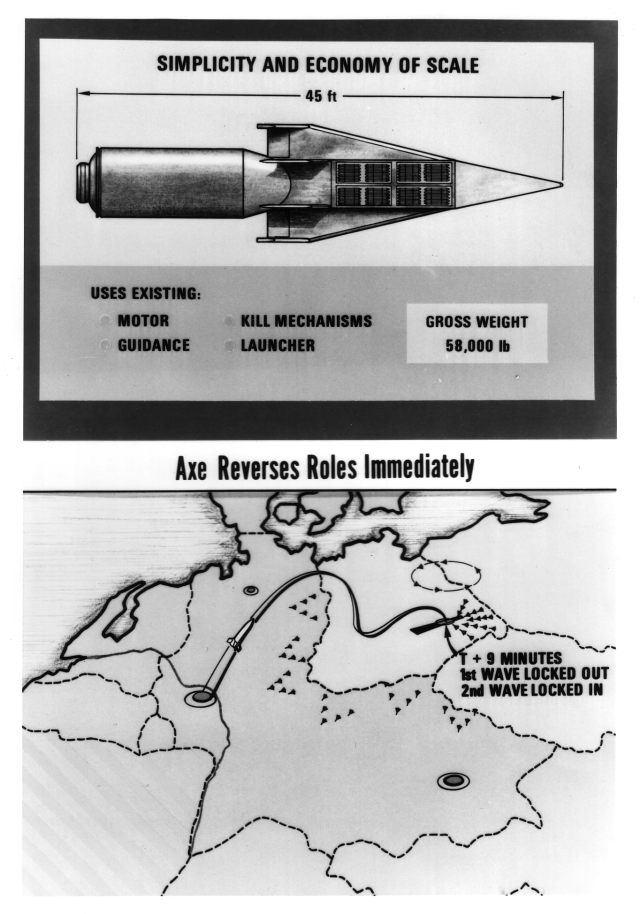
Lockheed Axe is conceptually similar to CAM, but uses a new winged armoured re-entry vehicle to attack not one but several airfields, coasting at high supersonic speeds along a preprogrammed flattish trajectory. As is very apparent, this family of weapons possesses all of the attributes of nuclear first strike weapons, aside from the political disadvantages associated with the use of tactical nukes. The conceptual approach used in these counter-air systems is also common to the emerging family of anti-armour weapons. These were physically demonstrated in the Assault Breaker weapons program, which served to prove the feasibility of the mass deployment and use of standoff anti-armour systems. Assault Breaker The Assault Breaker program was initiated by DARPA (US DoD Defence Advanced Research Projects Agency) in 1978, as a joint Army/USAF project with the task of integrating newer technologies in guidance, propulsion and radar to prove the applicability of such systems to the task of disrupting second echelon Warpac armoured forces. The weapon system developed in this process utilised an airborne sidelooking radar which could identify and track hostile armour from well over 100 km away, this tracking data was then used to target missiles launched from ground based launchers. The missiles would then enter enemy territory, under the control of a ground based command centre communicating via the airborne radar, position themselves over the targeted tank formation and dispense a large number of guided submunitions. Each munition would use its own guidance system to attack a particular tank. Though this system may initially appear to have weaknesses, such as datalinks which can be prone to jamming, it is actually very robust, which becomes apparent upon closer examination.
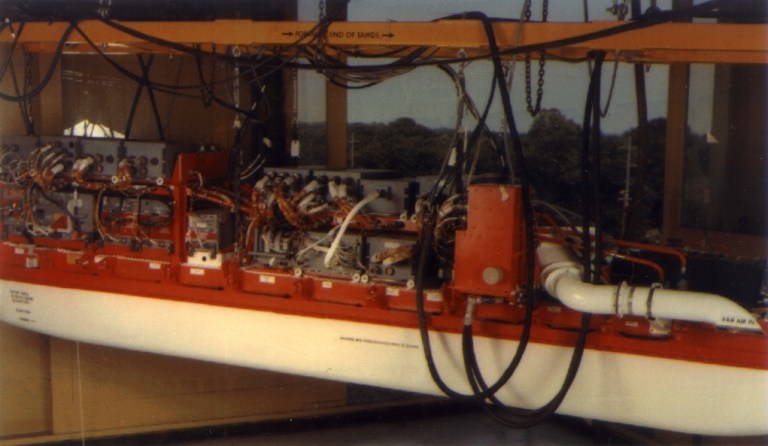
The key element in the system is the airborne Pave Mover long range surveillance and targeting radar. Pave Mover uses a large 10 ft electronically steerable array antenna, is frequency agile and jam resistant. Two radars were used in the program, a Grumman and a Hughes design, each carried in the weapons bay of an F-111. Pave Mover itself carries out only a limited amount of radar signal processing, as nearly all processing is done by a ground based Data Processing and Control Subsystem (DPCS) which receives raw radar data as digitised signals transmitted by a high speed datalink pod on the F-111. The radar itself is controlled by the DPCS, which transmits commands up to the radar via a similar datalink. The radar however fulfills a further function, as it acts as a relay in a data link chain between the DPCS and launched missile, transmitting commands. The imagery generated by Pave Mover is then viewed by an operator in the DPCS van, on a large colour graphics VDU terminal. Pave Mover operates in several modes. In surveillance mode it scans a very wide area, operating as a Moving Target Indicator (MTI - a Doppler mode which detects objects with a different velocity component w.r.t. the radar, as compared to underlying terrain) and simultaneously generating a coarse resolution groundmap image. This mode allows continuous surveillance of the whole battlefield area. A related mode is small area tracking where the radar compares computer records of terrain against target data to provide precise position data. SAR spot image uses synthetic aperture techniques (will be examined in later TE) to generate a very high resolution map of small areas, allowing detection of stationary targets. SAR techniques are very computation intensive and this mode is only used to supplement the others. All of these modes may be interleaved, the battlefield
commander thus being able to view the battlefield globally and in
detail
on his colour terminal, with map-like graphics presentation including
geographical grid data and target cluster data. Having decided upon
striking, the commander places the radar into precision target track
and
weapon delivery mode. This mode interleaves MTI and SAR modes to
locate,
track and attack six target clusters simultaneously in any area,
tracking the target clusters and the missiles as they approach them.
Two
types of missile were used in the tests, the Vought T22 derived from
Lance and the Martin Marietta T16 derived from the newer Patriot SAM.
The missiles are launched from mobile towed launchers, upon receiving
commands from the DPCS van, and are programmed with the target
location.
The T-22 used an advanced ring laser gyro for midcourse navigation,
whereas the T16 used an older mechanical inertial navigator
supplemented
by a stellar sensor telescope.
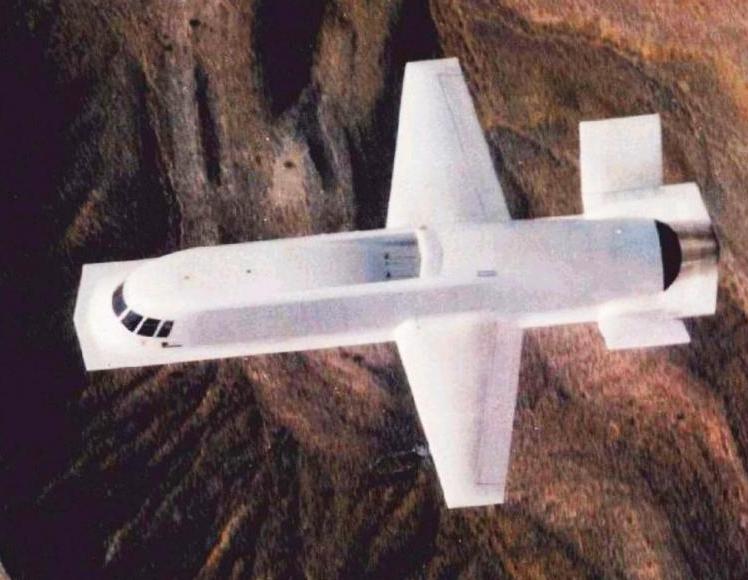
Counter Air Missile. Terminal phase of a CAM strike, the delivery vehicle spins up and dispenses its payload of penetrators, each of which will find its way through a runway or taxiway surface. CAM uses a Pershing airframe, including the radar area correlator for terminal guidance. CAM is not yet funded and one major drawback to the system is that a wave of CAM configured Pershings approaching Warpac air bases could well be mistaken for nuclear armed Pershings with resulting horrendous consequences. This was the first use of stellar inertial guidance in a non-strategic weapon. The missile then approaches the target area and enters the volume of space being scanned by Pave Mover's radar beam. The area where the missile is expected to be acquired is then illuminated by the radar, awaiting the missile. Once the missile is illuminated its radar transponder replies to Pave Mover and missile tracking is initiated. The DPCS thus maintains track of both the missile and the target, and uses this data to correct missile drift. The DPCS then talks to the missile, by encoding a digital
data
string on to the end of the transmitted Pave Mover radar pulses. The
data string contains missile position, target cluster centroid position
and velocity, cluster orientation and munitions dispensing pattern,
aside from other data. The missile then uses this data to correct its
own navigation errors and positions itself into the optimum altitude
position to begin releasing the submunitions. Apparently the system can
cope with a multitude of various cluster shapes and sizes.
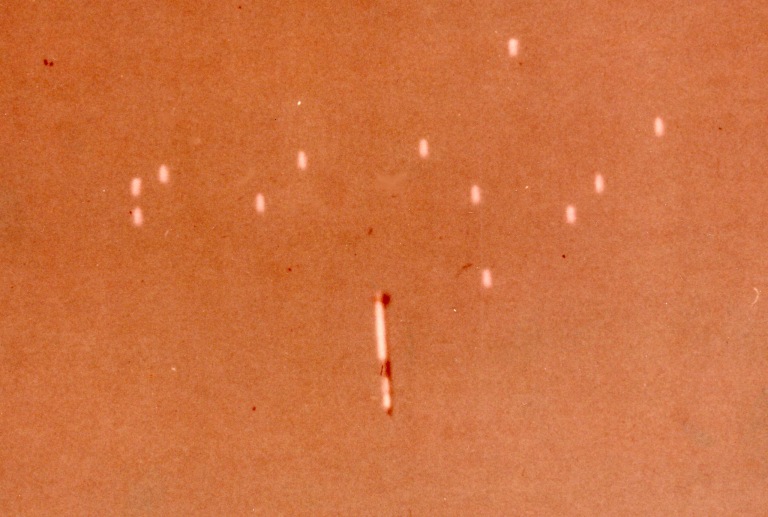
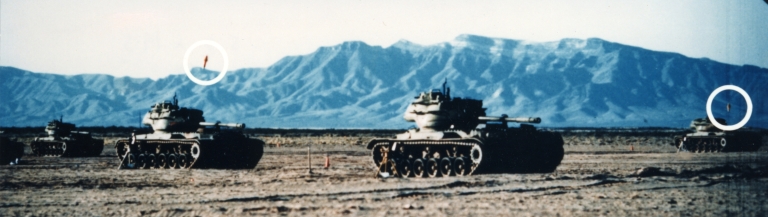
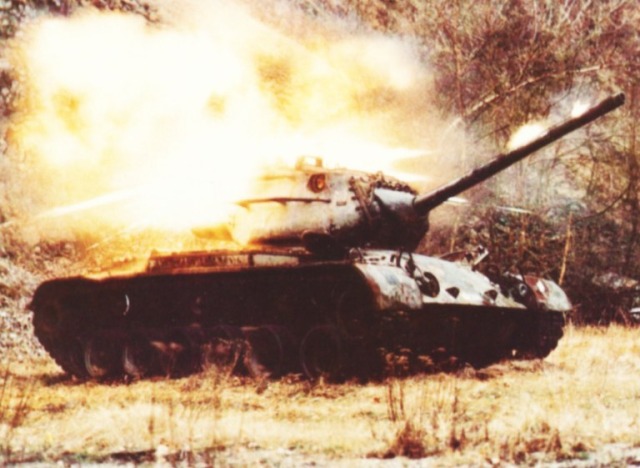
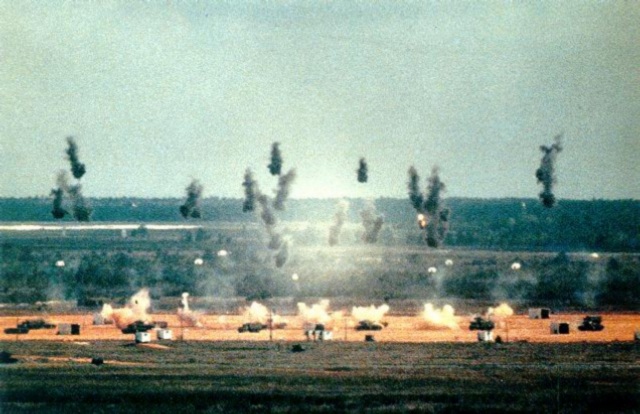
Assault Breaker in action. Terminal phase of a
multiple
TGSM strike against a tank formation. The TGSMs were dispensed to
attack
specific targets (5 out of 9); as one may observe this occurred
successfully. General Dynamics claim impacts within 4 inches of the
tank's hot spots; judging from the photograph it is probably not an
exaggeration. A JTACMS missile will carry twelve TGSMs or 48 Skeets,
either way not good news for Warpac ground forces. Below - TGSM
submunition, MMW seeker and effect (General Dynamics). 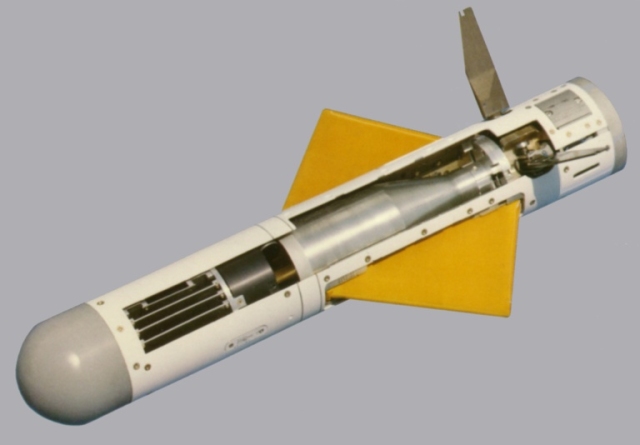
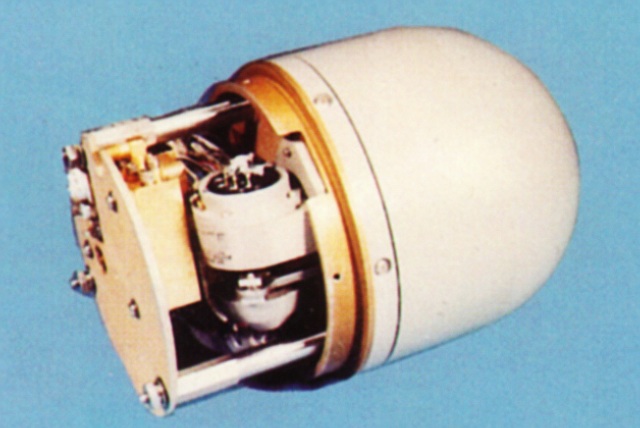
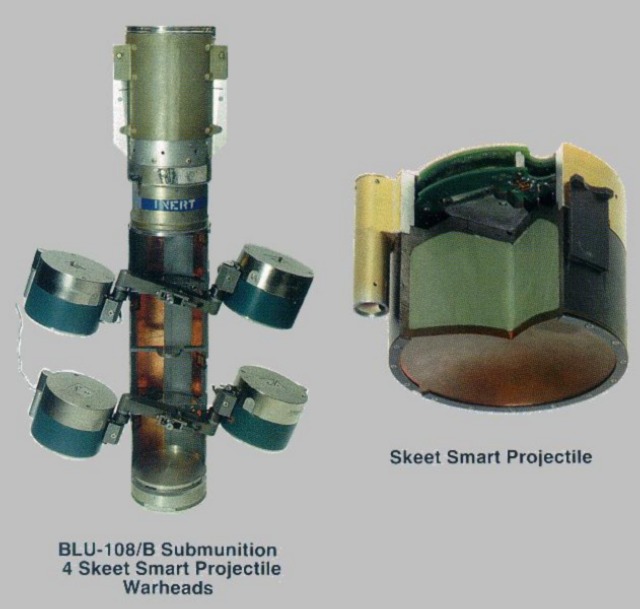
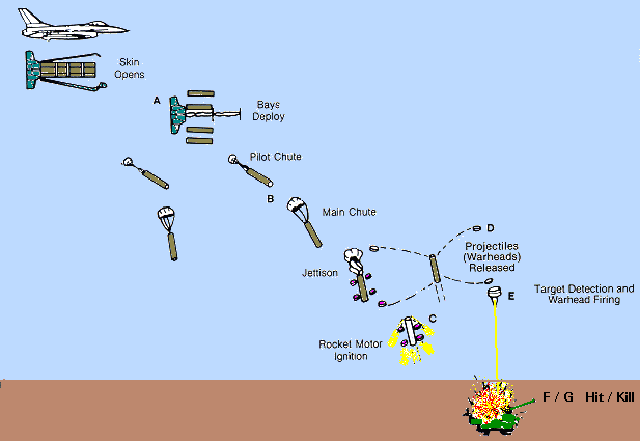
The submunitions are then released in the desired pattern. Two basic types of guided munition were used in the tests, the General Dynamics TGSM (Terminally Guided SubMunition - also to be used with the MLRS rocket system) and the Avco Skeet. Both are infrared guided. TGSMs are dispensed in a dive, each of the unpowered, fabric winged missiles deploying initially only its tails, then deploying a drag chute and wings. At 3000 feet, nose down, the TGSM activates its two-colour infrared seeker and initiates a spiral scan searching for its target. The seeker uses contrast and size in both IR bands as identification criteria and will reject false targets or co mmon countermeasures. If a target is not located, the search is repeated again at a lower altitude, allowing breakout from low cloud cover. Upon detecting the target, the chute is jettisoned, the TGSM diving on to the top of its target. GD claim impacts within four inches of the tank's hot spot. This basic version is to be supplemented by a millimetre wave radar guided derivative, which will easily cope with cloud cover down to zero altitude. The Skeet is an even more interesting system. Skeets are
squat
cylindrical munitions, 3 in high and 3.75 in in diameter, carried in
fours by a Skeet delivery vehicle assembly (SDVA), itself being about
the size of a TGSM. SDVAs are released much like TGSMs, in a dive,
similarly they deploy stabilising tails and a parachute. The similarity
ends here. At a programmed altitude the chute is released, the SDVA
falls until well clear and then fires its retro rocket which
accelerates
it vertically upward, while imparting spin. Instants before burnout,
the
SDVA then releases the Skeets in two pairs, milliseconds apart, to
achieve a spread pattern. The spinning Skeets follow their ballistic
trajectories, wobbling along due to the imbalance created by a side
mounted lug. This wobbling enables the Skeet's fixed IR seeker to scan
the terrain beneath it, looking for a specific rate of change of
temperature characteristic of a target. Once this is detected, the
Skeet
fires its self-forging warhead into the target. If it cannot find a
target it detonates just above the ground, acting as an anti-personnel
weapon.
Avco-Textron
images. Both Skeet and TGSM performed successfully in the test program, emphasising the robustness of the system. For instance, when some of the T16 missiles wandered off course due to difficulties with the stellar navigator, Pave Mover searched for and located the missiles, steering them back on course. DARPA were more than pleased with the program, authorising a go ahead for further development. This has led to the USAF JSTARS (Joint Surveillance and Target Attack Radar System) Pave Mover program being integrated with the Army/USAF JTACMS tactical missile program. The development program now envisages the mounting of a high power Pave Mover class radar on a USAF Boeing C-18 (707/C-137) providing over 150 nm of tracking range. This platform could relay data to command vans or to T-16/T-22 missile armed F-16 fighters (two rounds, outboard pylons) and B-52 bombers. Complementing this system, the army would fit a smaller derivative of Pave Mover on to an OV-1 Mohawk aircraft (and later no doubt JVX) for shorter range surveillance, also relaying data down to command vans. The Assault Breaker configuration using mobile ground based T-16/T-22 launchers would be retained. To complicate the matter, the DoD apparently wishes to see the JSTARS radar fitted to a TR-1 rather than the cheaper C-18. The program has all the initial symptoms of another TFX, as the USAF's radar and missile requirements diverge radically from the Army's. To add to the in-fighting, Northrop have proposed an ultra cheap, highly accurate stealthy cruise missile, the NV-150, as a substitute for the T-16/T-22. The NV 150, powered by a Williams International turbofan and equipped with a ring laser gyro aided by a satellite navigation system, is apparently highly accurate with over 200 nm range. The cost per unit was suggested at $300,000, low enough to provoke the USAF into disrupting the T-16/T-22 development program. One can have no doubts that the program will eventually stabilise, as the USAF and Army are determined to acquire their respective weapon systems [Editor's note 2005: this project became the AGM-137 TSSAM, later cancelled and replaced by the AGM-158 JASSM]. In perspective, the emergence of this family of weapons is
likely to cause radical changes in tactical warfare. Tanks may become
obsolete, lacking the agility of airborne platforms. Runways may become
a luxury, even deep inside friendly territory. Though some
countermeasures will exist, the USSR will have no other choice than to
destroy targeting platforms; by shifting its effort into this area it
is
then forced to compete in a technological area where it is
disadvantaged
due to a traditional weakness in propulsion and computer technology. As
suggested earlier, Third World nations are left with little hope of
deterring armed intrusions by the major Western powers; consider the
outcome of the Falklands conflict were Britain in possession of MRASM.
Surgical strikes at Falklands and mainland runways would have entirely
changed the character of the conflict.
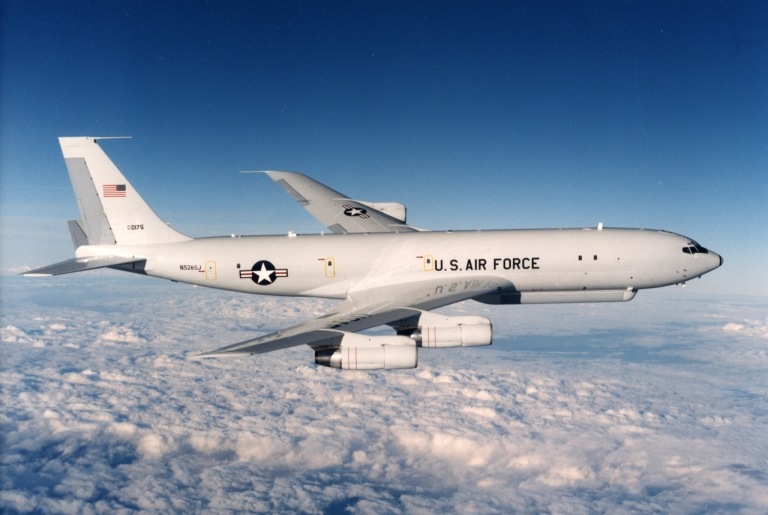
E-8A
JSTARS US Air Force image If the RAAF is allowed to further pursue its policy toward the deployment of standoff PGMs, acquiring versions of MRASM and perhaps later JTACMS, it will be in the position of being able to deter all levels of regional aggression without sacrificing aircrew or aircraft. The software programmable F-18A and later perhaps refitted F-111 are ideal delivery platforms, supported by the ubiquitous P-3 as a targeting/MRASM platform; the RAAF is very well placed to assimilate this family of weapons. If Australia wishes to exercise any measure of regional political influence, it must have the muscle to support itself. The new generation of PGMs offers just that, cost effectively. There is a way, all that is needed is the will. Editor's Note 1984: Since closing for press several changes have occurred re systems in this feature. The OV-1 targeting platform has been dropped, the TR-1 selected for USAF, JTACMS interface added to the F-15E and development of the Assault Breaker munition family deferred by the USAF/Army for cost reasons. pending review of newer electronic technologies. Editor's Note 2005: The Skeet
submunition evolved into the US Air Force Sensor Fused Weapon (SFW),
delivered by cluster munition, and the Army's SADARM, delivered by MLRS
rocket or 155 mm artillery. JSTARS ended up on refurbished and very
expensive to recondition used Boeing 707-338 airframes, the last being
delivered last year. LANTIRN never lived up to expectations and is
being
replaced by the Lockheed-Martin Pantera/Sniper pod. The 1991 Desert
Storm campaign saw the first operational use of the E-8A JSTARS, the
2003 OIF campaign saw the first combat use of the SFW, employed to
destroy Iraqi armour en-masse. |
|||||
|
|||||
|
|||||||||||||
|
|
|
|
|
|
|
|
|
|
|
|||
|
|
|
|
|
|
|
|
|
|
|
|||
 |
|
|
|||||||||||
| Artwork, graphic design, layout and text © 2004 - 2014 Carlo Kopp; Text © 2004 - 2014 Peter Goon; All rights reserved. Recommended browsers. Contact webmaster. Site navigation hints. Current hot topics. | |||||||||||||
|
Site Update
Status:
$Revision: 1.753 $
Site History: Notices
and
Updates / NLA Pandora Archive
|
|||||||||||||
|
|
Tweet | Follow @APA_Updates | |||||||||||
|
|
|||||||||||||
|
|
|||||||||||||