|
||||||||||||||||||||||
 |
||||||||||||||||||||||
![F-22A Raptor, FB-22, F-22E, F-22N and Variants Index Page [Click for more ...]](APA/f-fb-22.png "F-22A Raptor, FB-22, F-22E, F-22N and Variants Index Page [Click for more ...]") |
 |
![People's Liberation Army Air Power Index Page [Click for more ...]](APA/pla-air-pwr.png "People's Liberation Army Air Power Index Page [Click for more ...]") |
 |
 |
 |
 |
 |
 |
![Military Ethics, Culture, Education and Training Index Page [Click for more ...]](APA/ethx-culture.png "Military Ethics, Culture, Education and Training Index Page [Click for more ...]") |
 |
||||||||||||
 |
![Russian / Soviet Weapon Systems Index Page [Click for more ...]](APA/rus-weps.png "Russian / Soviet Weapon Systems Index Page [Click for more ...]") |
 |
 |
 |

|
 |
 |
 |
 |
 |
||||||||||||
 |
 |
|||||||||||||||||||||
| Last Updated: Mon Jan 27 11:18:09 UTC 2014 | ||||||||||||||||||||||
|
||||||||||||||||||||||
|
||||||||||||||||||||||
|
||||||||||||||||||||||
|
|
|
|
|
|
|
|
|
|
|
||||||||||||
|
|
|
|
|
|
|
|
|
|
|
||||||||||||
|
|
|||||||||||||||||||||
| Last Updated: Mon Jan 27 11:18:09 UTC 2014 | ||||||||||||||||||||||
|
||||||||||||||||||||||
| Pigs
Forever? |
|||||
|
|||||
|
Part 1 F-111 Life of Type
Victory will smile upon those who anticipate changes in the character of war, not upon those who wait to adapt themselves after changes occur. Gen.
Giulio Douhet
There is no doubt that the versatile F-111 is a central pillar of the new denial strategy, to use Prof Paul Dibb's terminology. It would be tasked in wartime with destroying opposing airbases, aircraft on the ground, ports, ships in port and in transit and other high value military targets, if necessary at very long ranges. Indeed, the long overdue and arguably underfunded commitment for boom equipped tankers will be central to the implementation of this strategy. The current government viewpoint is that of eventually replacing the aircraft, with no firm commitment as to the preferred way of doing it, but with manned aircraft provisionally budgeted for. With the role of the F-111 elevated in relative importance, against previous strategic doctrine, it is worth exploring some of the important issues which are likely to arise in coming years. Roles, Missions and Replacing the Pig The replacement of the F-111 is likely to be a tough decision for the RAAF, in the post 2010 period. There is no available equivalent in payload radius performance and aerodynamic design optimisation for trucking bombs. The two candidates arguably best suited to replacing the F/A-18A, i.e. the F-15E and F-22, both fall below the combat radius of the F-111 even if they are much better than all other air superiority and multirole fighters in the market. Whilst it is true that new weapons such as the Small Smart Bomb (SSB) loaded with high energy explosives like AFX-757, rather than established Tritonal and PBXN-109 compositions, would do much to offset the loss in delivered explosive tonnage, there will always be situations were tonnage is desirable. Good examples of tonnage intensive tasks are close air support against entrenched troops, a role in which the B-52 excels, obliteration of large area targets such as clustered runways and taxiways, or revetments, attacks on vehicle parks and saturation strikes with anti-shipping or land attack cruise missiles. Not surprisingly, many of these niche strike roles are allocated to the B-52 and B-1B by the USAF. At this the RAAF would use the F-111 for all of these tasks. It is worth considering that an F-111 loaded with 24 x Mk.82 500 lb bombs delivers about 30% of the tonnage of a B-52G/H. For the USAF, tonnage is not a priority for strike fighters, since the heavy bomber force will carry the weight, pun intended. For the RAAF, tonnage may well matter if the full role spectrum is to be covered completely. Numerous proposals have been floated in recent years for the F-111 replacement. These vary from the esoteric, such as UCAVs and widebody launched cruise missiles, to the conventional, such as F/A-18E/Fs, Typhoons or F-15Es, to advanced multirole fighters such as the F-22 and JSF. If a new manned aircraft is to be the eventual outcome, then an evolved F-22E would probably be the best fit given current alternatives, since it is the largest multirole fighter in the market. Whether this is the case in 2015-2020 still remains to be seen, however the most likely outcome is that the USAF will further evolve the strike capable baseline F-22A into an F-15E replacement (i.e. F-22E), the F-15E and F/A-18E/F will go out of production if the JSF proceeds on track, and the Europeans will opt out of the role completely shifting to costly cruise missiles which make for the perfect Euro-porkbarrel. In terms of the roles and missions to be performed, the F-111 covers what is clearly a very broad spectrum. Some of these tasks will be demanding in terms of aircraft survivability, as they involve penetrating maritime or land based defences to destroy high value targets, but not particularly demanding in payload. Others, such as cruise missile delivery, close air support or regional battlefield air interdiction would involve unopposed operations in sanitised airspace, and payload/range or delivery tonnage would be a clear priority over survivability. Survivability is however the ultimate constraint in this game, and that will determine the point in time when the F-111 becomes operationally non-viable, even if it remains systems-wise supportable and structurally sound. Here is however where the issue does become more complex. When the F-111 was designed, during the early sixties, it was optimised as a single penetrator, an aircraft designed to penetrate deep into hostile airspace individually, without escorts and evade fighters and surface air defences using high speed persistence, onboard jammers and terrain masking. The much larger B-1A was designed around the very same model, indeed it used various avionic items designed for the F-111. Until the deployment of the S-300P/PMU (SA-10/20) and S-300V (SA-12) family of SAMs, the A-50 AWACS and the look-down/shoot-down capable Su-27P and MiG-29 fighters, the F-111 was unstoppable by any Soviet IADS. The pulse Doppler radar technology in these AWACS, missile and fighter radars has however eroded the survivability of the unescorted F-111. This is not to say that it is an easy target, if well flown it can still be difficult to engage and destroy. However, in sustained air campaigns any loss rate above 0.5% per sortie will rapidly cause cumulative force size reduction and is not acceptable unless you are fighting World War III with nuclear weapons. The USAF dealt with this erosion of the F-111's technological advantage in several ways. The F-117A Nighthawk assumed the TAC single penetrator role, while the F-111 was escorted by the EF-111A tacjammer, F-4G Weasel SAM killer and the F-15C air superiority fighter, and supported by E-3 AWACS. The latter package was used to great effect in Desert Storm, with no F-111E/F lost in combat. The price to be paid is diminished economy, since many escorts must be assigned to every bomber package which drives operational costs up significantly. When we argue about the diminishing survivability of the F-111 in the developing regional air defence environment, we do so with the implicit assumption that the F-111 will be flown as a single penetrator into air defences comprising Su-27SK, Su-30MK, MiG-29, A-50 AWACS, SA-10/20 and SA-12. This is largely since the F/A-18A without a lot of tanker support simply cannot match the combat radius of the F-111, and is marginally competitive against the Su-27/30 even with advanced missiles.
The new look RAAF force structure will include Wedgetail AWACS, better tankers (although the adequacy of numbers vs size is yet to be determined), and ultimately a replacement for the F/A-18A, thereby introducing many of the strike package elements the USAF used to stretch the F-111, and now uses to support the B-52 and B-1B. The B-1B is of particular interest, insofar as it is not unlike the F-111 an aircraft designed originally for low level single penetration. Flying into the Serbian IADS, the B-1B was always supported by an escort package. The big question for the RAAF, given the White Paper strike capability goal, is how to address the strike capability in the longer term. The options are in a sense not that complex, given available technology. Either the RAAF opts for a conventional fighter, and thus remains with the strike packaging technique required to get an F-111 or other conventional aircraft through defences, or it opts for a stealthy single penetrator such as the F-22 and gains the economies resulting from the absence of escort fighters. The latter solution is attractive in many respects, insofar as the F-22 is a multirole aircraft capable of air superiority and air defence tasks, and with supersonic cruise capability has at least twice the productivity of its predecessor, the F-15C/E. Of the types we can expect to see in production post 2010, the F-22 is by far the best fit for an F-111 replacement, by virtue of size and performance alone. The difficult issue will be selling the F-22 to our political leadership of the day who will no doubt miss the point, as have many US politicians, that stealth and supercruise provide tremendous operational economies and amount to force multipliers in their own right. The short term bottom line is always an imperative in this game, since few politicians have the grit to make long term investments. The likely consequence of this that even should the RAAF choose to run with the F-22 as its AIR 6000 choice, it may be very difficult to get enough aircraft to fill the whole force structure. What happens then? A different type will be required to fill out the numbers, and more than likely this type will end up mostly tasked with dropping bombs or flying defensive CAPs in situations where the high survivability and agility of the F-22 are not a key imperative. The JSF is arguably a natural candidate for this task, but it is smaller than the F-22 and has somewhat shorter radius, due to its much smaller size. This means that it is not an optimal F-111 replacement, especially in the strategically vital long range maritime and land strike roles. With the very likely need to carry external fuel tanks to meet diversion ranges at extended radii, its advantage in having true stealth is largely nullified unless tanks are discarded on almost every such sortie. Are there other alternatives? It is unlikely that any teen series fighter will be in production post 2015-2020, possibly the F/A-18E/F/G may if difficulties arise with the USN JSF. The Eurocanards probably will be, but they are a best in a similar weight and radius class to the JSF, and lack genuine stealth and sustained fast supercruise. The unfortunate reality is that the F-111 will be hard to replace wholly since its uniquely large payload radius is not popular in this day and age of multirole fighters, designed around short term budgetary pressures rather than operational longevity and usefulness in sustained combat. F-111 Fleet Airframe Life What are the other alternatives? Cruise missiles lack sustainability in combat, indeed even the US has never managed a sustained cruise missile bombardment, and also flexibility for widely ranging and rapidly changing roles, characteristic of manned aircraft. UCAVs may grow into the JSF class role, but currently discussed alternatives tend to be centred in the 300-600 NMI radius class. Make the UCAV big enough to bomb at a 1,000 NMI+ radius and it becomes almost as big and expensive as any other 1,000 NMI radius combat aircraft. A big question worth asking is whether the retirement of the F-111 in 2015-2020 is inevitable, or whether the aircraft can be stretched any further. There are no show stoppers in avionics and systems - robust and affordable technology upgrade paths exist for all core avionic items, by repackaging off-the-shelf systems and equipment used in a range of current multirole fighters. The AUP WSSF/WSBU development environment at Amberley provides a very capable integration facility which can be exploited for this purpose. Engine replacement is also feasible, albeit much more expensive than avionics. The big show stopper is of course fatigue life and corrosion, and unless proven otherwise, these may be what ultimately forces the F-111 into retirement. Given the current DSTO effort to establish the life of the airframe, we should know the answer within the next 2-4 years. The DSTO AMRL F-111 Sole Operator Program aims to thoroughly investigate the structural integrity of the F-111 airframe and the long term supportability of the TF30-P-108/109 engine. To gain a better grasp of the problems to be dealt with, DSTO will test an ex-RAAF F-111 wing for 40,000 hrs or until it breaks, and an ex-USAF F-111 fuselage. These will then be torn down for inspection, using state of the art analysis tools and techniques, to isolate and identify cracks, corrosion and other aging damage. Since the aircraft uses large numbers of load bearing honeycomb sandwich panels, these will be subjected to non-destructive and destructive analysis to determine what degradation effects may arise, such as adhesive debonding and corrosion. The feasibility of replacing honeycomb with carbon-fibre or similar composite panels will be investigated. Of major concern will be the D6AC high tensile steel components, which have a long history of cracking due to the properties of the steel. D6AC is typically used for airliner undercarriage components. Wing pivot fittings, fuselage longerons, centre carry through box splice plates, tail booms and the all important centre fuselage carry through box, which mounts the wing pivots, are made from D6AC steel. The centre carry through boxes on operational F-111s have already been modified with stress relieving composite patches in known load bearing hot spots. DSTO's effort also includes the further development of a detailed finite element analysis software model, based on an LMTAS model, in order to accurately predict the stress seen in the structure as a result of flight loads. In turn this is intended to be used to optimise the shape of particular structural components to extend their useful life until 2020 if possible. Typically such shape optimisation involves identifying stress hot spots in the component and removing or adding material to eliminate these and thus reduce or eliminate the potential for fatigue cracking. The intent is to demonstrate these modifications with the full scale testing of a USAF wing. Other problem issues also need to be explored. One is the troublesome area of integral wing and especially fuselage fuel tank seals, which degrade and cause the aircraft to leak fuel. The established technique for dealing with this, the deseal-reseal process is labour intensive, time consuming and uses hazardous solvents. It must be periodically repeated as the replacement sealant typically degrades over time. A robust and permanent fix would much reduce the long term support costs of the airframe. At this point in time it is premature to speculate upon the final outcome of the SOP project. It will have pivotal implications for the long term future of the RAAF F-111 fleet, especially in terms of how much it would cost to rebuild the airframe for significantly longer life, and how much greater that life may be. The SOP analysis will also provide important insights into the feasibility of exploiting the large pool of structural components in the mothballed USAF F-111 fleet, or the scale of any effort to replace fatigued and corroding components with newly manufactured replacements. Pigs Post-2020? Let us however speculate on the choices which may exist should fatigue and corrosion life extension be performed to allow the aircraft to survive well beyond 2020. Is it worth keeping the F-111 in service beyond that date, and thus deferring the replacement and freeing up funds for a bigger/better F/A-18A replacement in larger numbers? The central issue then becomes the cost of structural and corrosion life extension of the F-111. This would involve the replacement or modification of key structural components, load bearing skin components and other components experiencing corrosion or fatigue damage effects. Costs could vary considerably with what proportion of the existing airframe must be replaced, and over what timescale this must be done. The big questions which follow are supportability and survivability. Both are difficult to answer completely at this time, given the timescales involved, but some reasonable conclusions can be drawn. For comparison, let us consider the 1999 USAF White Paper on Long Range Bombers which deals with the B-52, B-1B and B-2A fleets. The B-1B is of course the relevant case study, since it most closely resembles the F-111 in aerodynamics and systems and is the closest in age, given initial operational capability dates. The B-1B fleet is about a decade younger than the RAAF F-111 fleet in operational use, the B-52 about 1.5 decades older. Current usage rates and known structural fatigue limits on the B-1B place its retirement date currently at 2038, given a likely replacement of lower wing skins. Given an introduction date around 1985, this yields an operational life of 53 years. Current plans for the aircraft include a phased array radar upgrade using APG-68 technology, jammer/EW upgrades, towed decoys, JTIDS datalink, cockpit upgrade and a likely series of other upgrades to replace unsupportable hardware such as computers, displays and other avionics. Radar absorbent materials are also under consideration. In the longer term, engine support may also become an issue. These upgrades are being pursued even though the aircraft is generally not survivable without escorts, since its B-52 class payload radius performance is extremely difficult to replace. In a sense this is not unlike the problem faced by the RAAF with the F-111 over the longer term. Strategic bombers are hard to replace with anything other than another strategic bomber. Let us apply a similar argument to the F-111, assuming fatigue and corrosion life can be dealt with. Introduced around 1975, a 50+ year system life yields a retirement date somewhere between 2025 and 2030, or up to 15 years beyond the currently planned phase out commencement. Aligning the F-111 retirement with the intended B-1B retirement aligns radar, weapons and countermeasures technology bases, and escort tactics, all of which will need to be supported by the USAF until then. Should the opportunity exist to exploit the pool of around 295 USAF F-111 airframes collecting dust in the boneyard, then one alternative would be to acquire a package of 35 or more retired late model USAF airframes, and as the fatigue life expires on our existing fleet, progressively transplant engines, systems, wiring, plumbing and other components across to stripped and relifed structural spare airframes, thus rebuilding these into whatever is the then current F-111C/G systems and propulsion configuration. Providing that judicious choices are made in spare airframes, and components mixed and matched accordingly (F-111G/FB-111A wing tip extensions and higher weight undercarriage, F-111D/E/F fuselages and stabilators, etc), then a hybrid airframe very close to the existing F-111C would be feasible. However, this is all contingent upon whether the USAF airframes or portions thereof can be effectively reused. At this stage it is unclear what their long term storage life will be, especially due to corrosion effects upon the various materials used, even in boneyard storage. The DSTO SOP will no doubt shed light upon this. It is certainly something worth careful investigation given the potential payoff. To apply a contrived argument, let us speculate that each of the USAF airframes can provide at least 15 years of structural life. With almost 300 aircraft, this yields around 4500 airframe-years of life, or 128 years for a 35 aircraft fleet! Reality will almost certainly be much more mundane. Do other alternatives exist to the exploitation of USAF stocks? One choice is the manufacture of new or the remanufacture or modification to as new condition of wings, wing pivot fittings, centre carry through boxes and other primary and secondary structural components with known fatigue and/or corrosion problems. Honeycomb panels which cover most of the fuselage and stabilators would be replaced with new carbon fibre composite panels. Given enough knowledge of where problems arise, it may well be feasible to bring an F-111 airframe to the fatigue and corrosion condition, in flight critical components, of a new airframe. Moreover, should such knowledge be exploited to re-engineer such components for greater durability, the resulting rebuild could yield a better fatigue and corrosion life than the original airframe. Consider the implications of replacing all honeycomb panels with composite panels which do not experience the same degradation effects as Aluminium alloys. As noted, the big question is that of the cost of such a structural rebuild, which could be of the order of the cost of building a new fighter airframe if very extensive work is required. Given the unsuitability of most current production alternative fighters for the F-111's widely varied roles, a cost which is similar to that of a new build airframe (less propulsion and systems) may well be justifiable, especially if it yields an additional airframe life of another 25-30 years, or the expected life of a new conventional fighter. The avionics and propulsion of any new fighter will, once deployed, follow the same life cycle Given the choice of spending similar resources on an aerodynamically marginally or indeed ill-suited new build non-stealthy multirole fighter airframe, or on a rebuild of an aerodynamically optimal used F-111 airframe, both to yield a similar number of years of operating life, which is the better choice to make, assuming the cost of the new systems and new propulsion is about the same for both? The inevitable conclusion is that an F-111 rebuild to zero airframe fatigue and corrosion time could cost as much as a new build F-15E, F/A-18E or EF-2000 airframe and still amount to a good deal, in terms of bang per buck. If the F-111 can be operated survivably, via systems / propulsion upgrades and capable fighter escorts such as the F-22, then the only barrier to the aircraft's longevity will be the life of the existing airframes and what additional life can be extracted from structural modifications, USAF component stock reuse strategies or structural rebuilds with newly manufactured components. Part 2 will explore F-111 avionic upgrade issues in the context of more recently available technologies, and further expansion of the F-111's role.
The
tanker
supported F-111C/G is the centrepiece of the new regional denial
strategy defined in the White Paper, allowing Australia to project
firepower against any hostile assets or bases which might threaten
Australian interests within a wide radius of Australia. Of all
currently operational combat aircraft, it returns the largest payoff in
capability from an infusion of F-22/JSF generation technology, such as
powerplants and internally carried munitions, as it has an internal
bomb
bay, more than twice the internal fuel capacity of most current types
and a variable geometry wing. Significant life extension will depend
critically upon the fatigue and corrosion life of the airframe, and the
costs of airframe repair or rebuilding for service beyond 2015-2020,
both of which remain to be fully determined at this time.
Current USAF
planning sees the B-52H, introduced almost a decade before the F-111,
in
front line operational service until 2030. While the aircraft has poor
survivability under the best of conditions, its exceptional payload
range capability and the high cost of replacement will see it used in
future combat situations, defended by fighters. The
Boeing
B-1B is in concept much like a large F-111 with 4 engines, and early
prototypes and development aircraft were equipped with the same radar
package and other avionic components as the F-111. This aircraft will
remain in service until around 2040, since like the B-52H its payload
radius performance is considered very expensive to replace. The current
expectation is that ongoing structural rebuilds, especially to the
wings, and avionic upgrades will keep the aircraft viable over this
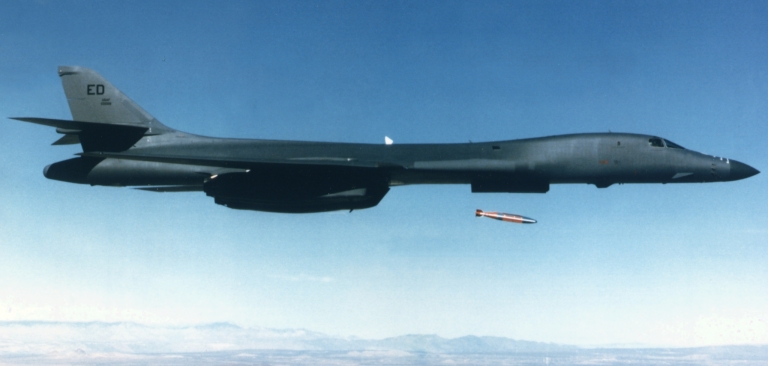
period. Like the B-52, the B-1B is always escorted in combat. The Northrop B-2A Spirit is the only highly survivable strategic bomber currently in operational service. It derives its survivability from stealth techniques which reduce its radar and heat signatures to the point where it is almost impossible to detect, track or engage. Despite this, given the small fleet size and potential for a loss causing political embarrassment, the USAF frequently supports the B-2A with EA-6B tacjammer escorts and F-15C fighter escorts. Future USAF planning sees a kick down the front door expeditionary force comprising 48 x F-22 and 12 x B-2A being formed, where the F-22s are used to sanitise airspace for the B-2 force (USAF).
|
|||||
|
Part 2 F-111 Missileers
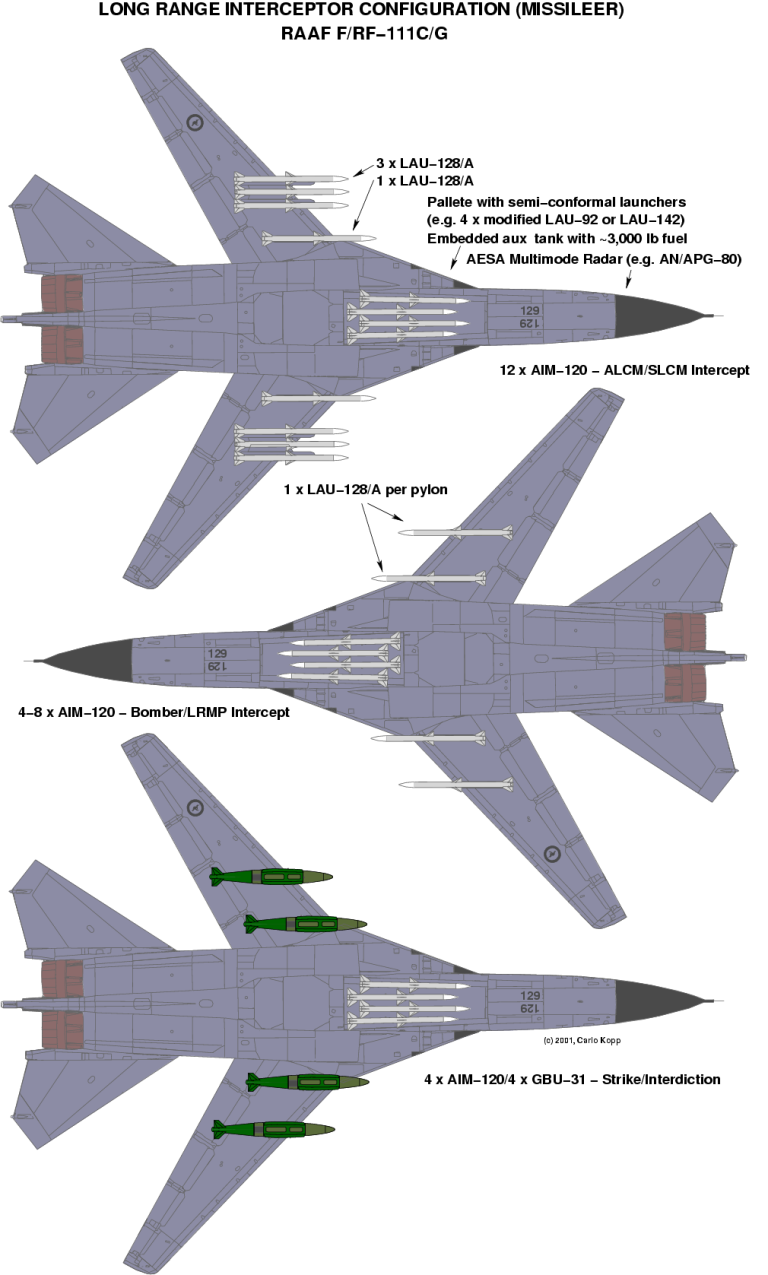
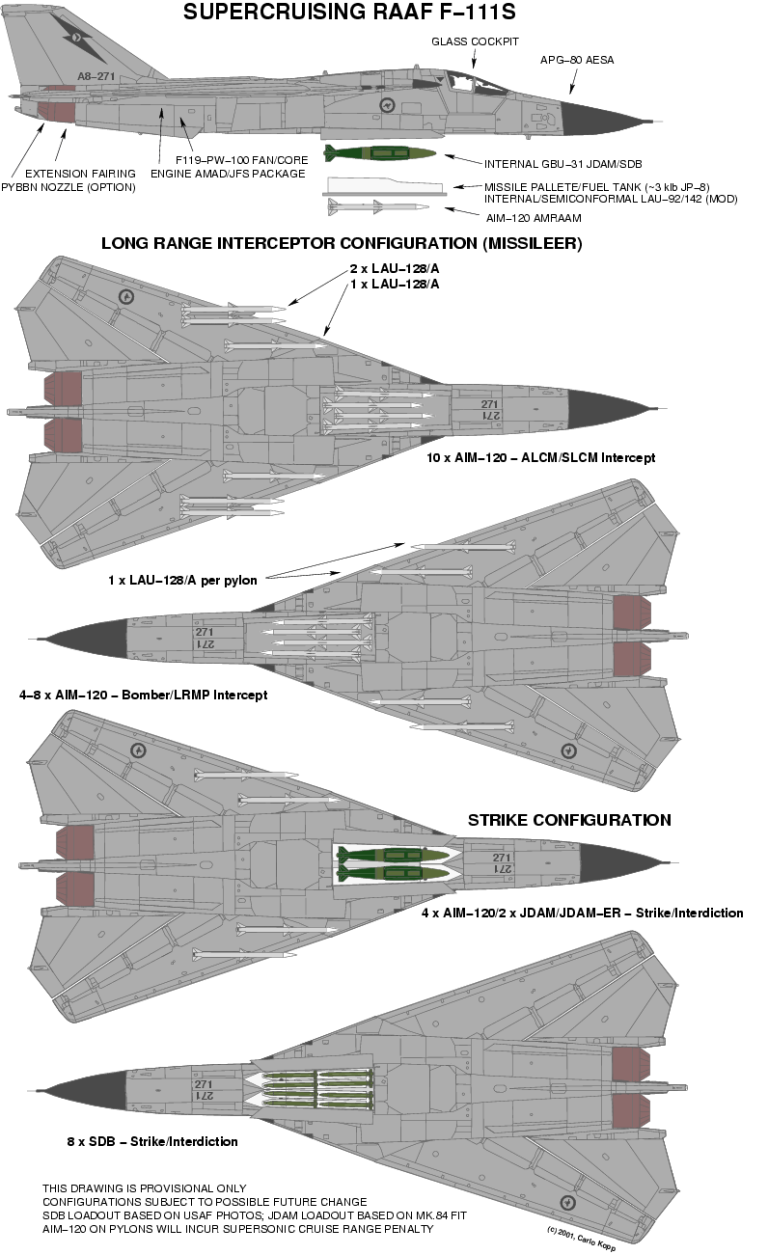
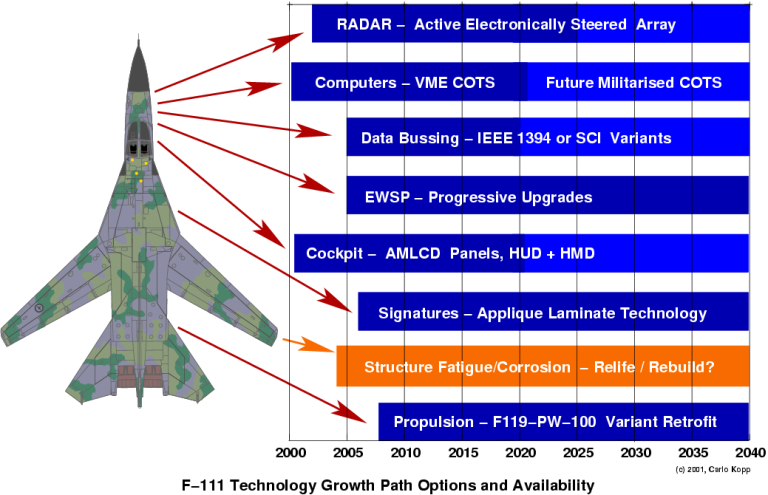
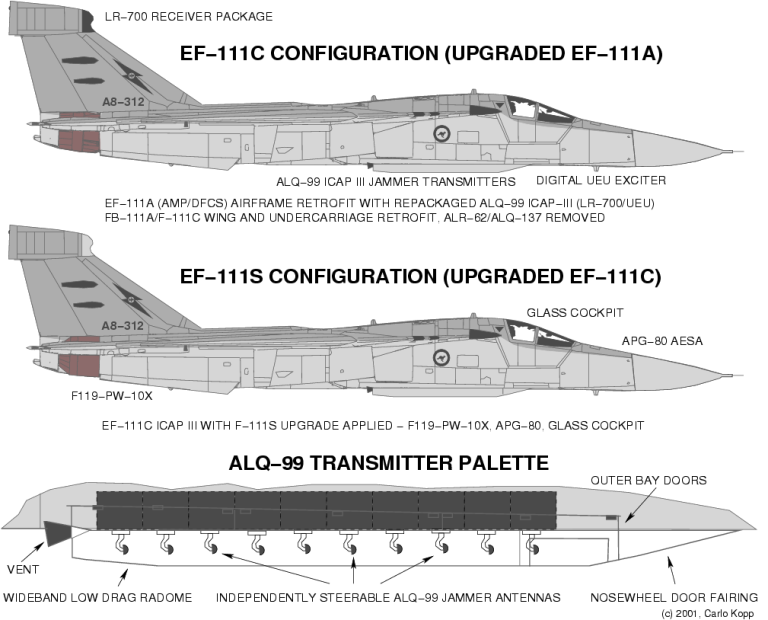
The reality is that without stealth and supersonic cruise, the F-111 or any other conventional fighter will require fighter and frequently support jammer escort to penetrate airspace defended by modern SAMs, AWACS and fighters, or it must be committed to shooting standoff or cruise missiles from outside the defensive perimeter. Accepting this caveat and the reduced economies of strike packaging, and assuming that F-111 airframe fatigue/corrosion life will be extended, then the remaining life extension issues boil down to the supportability of propulsion and systems, and survivability when escorted. Avionic Issues Supportability dictates the progressive replacement of obsoleted components with current production technology components where these can be adapted. At this time the RAAF is in an excellent position to pursue such a strategy, since the digital AUP system can be migrated over time on to newer computer technology (refer AGM-142 upgrade in this issue's WSBU feature), and it is the most expensive part of the system to replace. The key long term system support problems then become the radar, steamgauge cockpit and the engines. The latter especially once the F-14A is wholly retired later in the decade. The White Paper mandates the replacement of the F-111 electronic warfare package, the most likely candidates being the highly capable DSTO/BAeA ALR-2002A to replace the ALR-62 RHAWS, and an new technology internal jammer to replace the ALQ-94/137 DECM. The popular argument that an aircraft must be common to a large operator such as the USAF is now irrelevant. The F-111 is now unique to the ADF and this should be accepted as a starting point in how we view the F-111's future. The RAN's Collins class submarines are also a uniquely Australian asset and we never hear complaints about their uniqueness, indeed it is frequently touted as a virtue since it forces the maintenance of a domestic engineering capability to support and evolve the fleet. The same argument must now be applied to the F-111 fleet - those in the defence and treasury bureaucracies who may think otherwise are missing the point completely. Indeed, application of the traditional commonality argument to the F-111 yields only one answer - replace unique components such as radar, mission avionics and engines with types common to large volume production fighters such as the F-16C/B60, F/A-18E, F-22 and JSF. Australia has already made most of the upfront investment required for further F-111 avionic integration during the AUP program, by establishing the WSSF software development and integration facility at RAAF Amberley. The AUP is often criticised over its cost by uninformed observers, who typically fail to realise that the WSSF was the single costliest component of the AUP project. It is a long term investment which should be exploited to the fullest, and using it for follow-on avionic upgrades and ongoing design maintenance amounts to no more than sensibly recouping the initial investment (refer WSBU article). As detailed in the 4 part F-111 upgrade series (AA 10/98-1/99) over two years ago, the replacement of the attack radar and terrain following radar with a combined TFR/multimode active array radar (AESA - Active Electronically Steered Array) adapted from the F-16/B60 APG-80 (APG-68 Agile Beam Radar) or later F/A-18E/F APG-79 (APG-73 RUG III) is not only feasible, but relatively straightforward to perform. It would offer an unprecedented reliability and support cost improvement over the existing package (array MTBFs around 10,000 hrs), as well as addressing the capability, performance and signature limitations of the existing and now technologically obsolete sixties technology base radar package. The cost of such radars in baseline configuration, excluding TFR function and integration costs, is of the order of USD 2M per unit. Therefore a fleet of 34 aircraft would incur a basic cost of USD 70M for radar retrofit, and further costs for integration and qualification in the F-111. Such costs are of the order of the flyaway costs of one to three complete new build conventional fighters, which is not significant against the capability gains for a fleet of 34 F-111s. It is worth pointing out that the technical difficulty in producing a software emulation of the terrain following modes in the APQ-171 TFR is a tiny fraction of that experienced when the original APQ-110 TFR was developed during the sixties. In effect the proven functions of the existing TFR are replicated in software on a fully digital phased array. The wheel is not being re-invented, but rather re-implemented. A clever design would in fact reuse the existing, proven and highly reliable digital terrain following computers. Therefore the fears of some in Canberra that a radar upgrade amounts to a rerun of the APQ-110 saga are wholly misplaced. Centimetric Band High Power Jamming One function which is planned for the AESA in the F-22 and JSF, and very likely to also migrate down into the F/A-18E/F and F-16C/B60, is the use of the AESA radar as high power, highly directional centimetric band jammer. This is possible for two reasons, the first being the superior bandwidth of such antennas, the second being the ability to timeshare the radar modes and thus waveforms and beams. A jamming waveform pointed at a threat radar becomes just another digitally commanded waveform and beam to the AESA. The centimetric band is important since it is mostly used for fighter air intercept radars, newer SAM engagement radars, and missile seekers. Much effort was expended by the US over the last decade to field a hi-band jamming capability in the EF-111A, this capability later migrated into the EA-6B Prowler and its hoped for F/A-18G replacement. The latter is intended to be equipped with the AN/APG-79 AESA, with a jamming capability. While a centimetric band high power jamming capability will not provide the ability to disrupt long range wide area surveillance radars, it will provide its users with a Prowler-like capability to disrupt in-band interceptors and long range high altitude SAMs. Since the AESA will typically produce ten times more peak power than an onboard DECM trackbreaking jammer, it will provide significantly better capability against forward quarter threats operating within the bandwidth of the AESA. This will be particularly valuable in situations where the aircraft is attacking from medium to high altitudes, where large SAMs and fighters are the only serious threats. A multimode AESA radar on the F-111 provides a platform for this very useful growth capability. The F-111 Missileer Modern multimode AESA radars in this category are all capable of targeting the radar guided AIM-120 AMRAAM. This raises other interesting possibilities. While a radar of this aperture size is not the best choice for running down and killing cruise missiles over water, the tremendous endurance and payload of the F-111 does open up the possibility of using the aircraft in yet another role, as a long range interceptor to kill Bears, Backfires, Badgers and cruise missiles over the Indian ocean and Timor Sea. In this respect, putting a phased array on the F-111 and wiring it for AMRAAM would resurrect the original aims of the US SOR-183 requirement, for a USAF long range F-111 interceptor and the US Navy F-111B interceptor (see diagram), the latter a bomber and cruise missile killer. If the aircraft is to receive a new radar package, then the cost of integrating the AMRAAM is incremental, and mostly in adapting existing software, replacing LAU-7 launchers with LAU-128/A, wiring and doing clearance tests. Given that the impending obsolescence of the AIM-9L/M will almost certainly force the RAAF to integrate the new AIM-132 ASRAAM common to the F/A-18A HUG, which uses an AIM-120 AMRAAM digital umbilical interface and LAU-128/A, integration may boil down to software tweaks and clearance testing alone. If the AMRAAM is integrated, there is later growth potential for follow-on ramjet missiles such as the FMRAAM or ramjet AMRAAM derivatives. One could, however, do much better by adding an internal or semiconformal weapon bay pallete, which could be fitted or removed at depot level like a Pave Tack cradle or EF-111A jammer pallete. The pallete would carry semi-recessed missiles in the manner of the F-4/F-14/Tornado AIM-7/120 installation, or internal missiles like an F-22. With the pallete and dual or triple rail launchers and four swivel pylons, the payload of possibly up to 12 AAMs is in the required league for cruise missile hunting. This may well be the only viable stop-gap measure until the F/A-18A is replaced with a fighter better suited to this demanding role, such as the F-22. An internal weapon bay pallete would be particularly useful in this respect, since it can be used for additional auxiliary fuel carriage while still providing enough space for launcher hardware, e.g. modified LAU-92 or LAU-142. An efficient strategy would be to exploit mounting points for the Pave Tack cradle, and design the pallete from NC machined components as an integral fuel tank, with sealed internal cavities and channels into which the required launcher hardware, plumbing and wiring is mounted. Paper fit checks clearly show space for three and possibly up to four AIM-120C. The end product is a long range / long endurance interceptor with around 37,000 lb of internal fuel. With 3-4 internal or semiconformal AMRAAMs and a clean wing, an operating radius well in excess of 1,000 NMI would be feasible, without aerial refuelling. Arguably an unbeatable deterrent to regional Tu-22 Backfire, Tu-142 Bear and Tu-16/H-6 Badger operators, and a useful interceptor against the numerous regional lower tier strike aircraft like the MiG-19/J-6 Farmer, J-8-II, MiG-23BM Flogger, Jaguar, Il-28/H-5 Beagle and Q-5, as well as tankers and transports. An F-111 configured as a missileer is not a substitute for an air superiority fighter, such as the F/A-18A HUG or its eventual replacement, and never can be such since it is not competitive in agility against top end air superiority fighters such as the Su-27/30. Any expectations to the effect that a missileer F-111 fully solves the air defence problem in the deep north are illusory at best. However, it does offer a means of reducing demands upon scarce tanker resources, and provides significant force multiplication by freeing the air superiority fighters from long endurance or long range bomber/cruise missile defence patrols, allowing them to be used offensively or for escorting other F-111s on bomb trucking or maritime sorties. In a sense an F-111 missileer would be a re-run of the historically proven strategy of using heavy fighters to kill bombers, and more agile air superiority fighters to kill their escorts. Unlike historical examples, the F-111 missileer becomes a bomber again simply by retasking and loading a different weapons mix. Parts 3 and 4 will explore the technical, tactical and strategic implications of fitting current technology engines to the F-111.
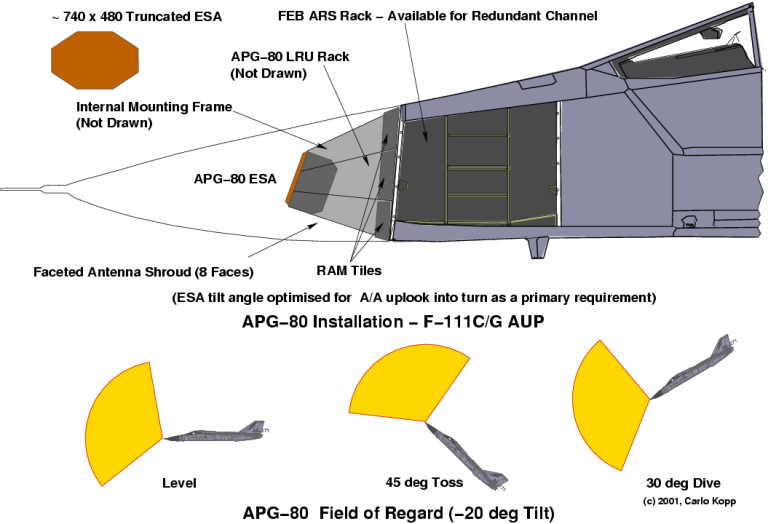
Flexible targeting of the planned new generation standoff munitions for the F-111, the AGM-142E SOW, the AGM-184 JASSM and especially the JDAM-ER glidebomb (if introduced), will require a much better radar than the sixties technology APQ-169 series. Indeed the existing radar package was designed to be supportable until 2010, and is likely to become more expensive to support over time given its mechanically steered antenna package. Even given the projected 2015-2020 retirement, a good case can be made for a modern phased array to replace the existing radar package, and should further life extension be viable it would become a necessity. Depicted is a notional active array multimode radar installation supplanting both the TFR and attack radar. It would provide a replacement for existing capabilities and growth capacity for centimetric band jamming [Editor's Note 2005: The current antenna shroud used on the F/A-18E/F APG-79 AESA installation is based on the same scattering geometry as this model, which predates it.] (Author).
One of the important facilities which could be gained by replacing the existing APQ-169/171 radar package with an off-the-shelf active phased array is the ability to target the AIM-120 AMRAAM. This is a standard facility built into in the F-16/B60's APG-80 radar. Since the LAU-128/A launchers and the wiring changes required to fully support the RAAF's new AIM-132 ASRAAM on the F-111 would be largely common to the AMRAAM, integrating this BVR missile would involve primarily incorporation of existing software into the F-111 OFPs and clearance testing of the missiles. A removable weapon bay pallete/fuel tank package could increase the missile payload by up to 4 rounds (Author).
The F-111B was the Navy side of the TFX equation, a heavy interceptor devised to counter the then emerging Soviet force of cruise missile firing long range bombers, typified by the Tu-22M Backfire series. In many respects the F-111B was the ideal aircraft for this role, with excellent loiter performance by virtue of its variable geometry wing and 34,000 lb of internal fuel, high supersonic dash speed, and the ability to carry a large payload of long range air-air missiles. Unfortunately, it was too large and heavy for carrier operations, and ill suited to close combat with nimble little MiGs, both factors which led to the demise of the aircraft. A little known aspect of the USAF requirement for the F-111 was a long range intercept role, which was never realised due to limitations in the radar technology of the period (USN).
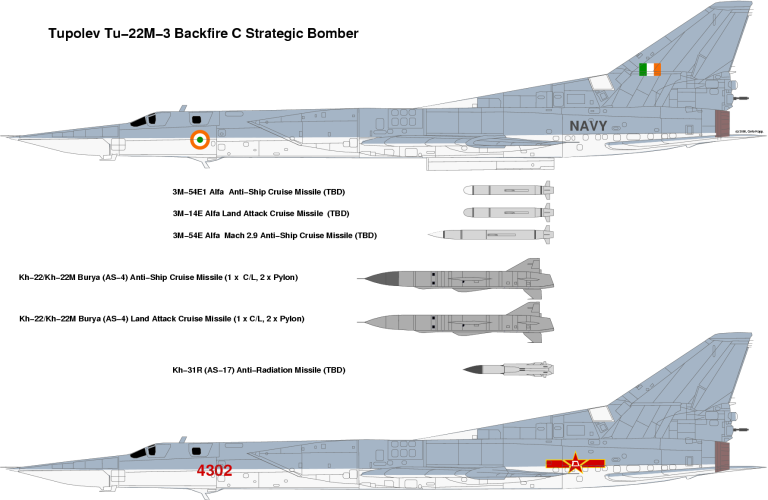
Recent reports indicate that India will soon deploy the Tu-22M-3 Backfire, armed with the potent Mach 2+ 200 NMI range Kh-22M/AS-4 Kitchen cruise missile, while it is completing a major upgrade to the Port Blair runway in the Andamans. China has to date not responded publicly, but given its recent disagreement with the US over the EP-3C Aries collision and subsequent US arms sale to Taiwan, the odds of a Chinese Backfire buy look increasingly stronger with time. The superb combat radius of the Backfire allows its users to project force from forward bases such as Port Blair or Hainan-Dao directly in to Australian airspace. The speed and persistence of a Backfire armed with supersonic cruise missiles dictate early interception, a task for which the small F/A-18A is not well suited. An F-111 with a phased array and AIM-120 AMRAAM would plug this capability gap until the F/A-18A replacement is deployed post 2012 (Author).
|
|||||
|
Part 3 F-111S - Supercruising the Pig
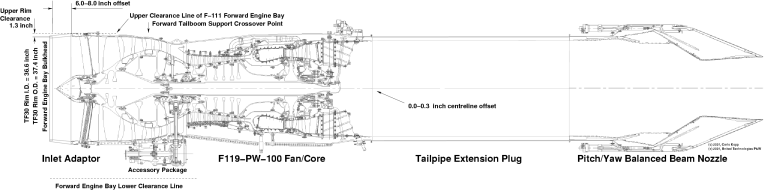
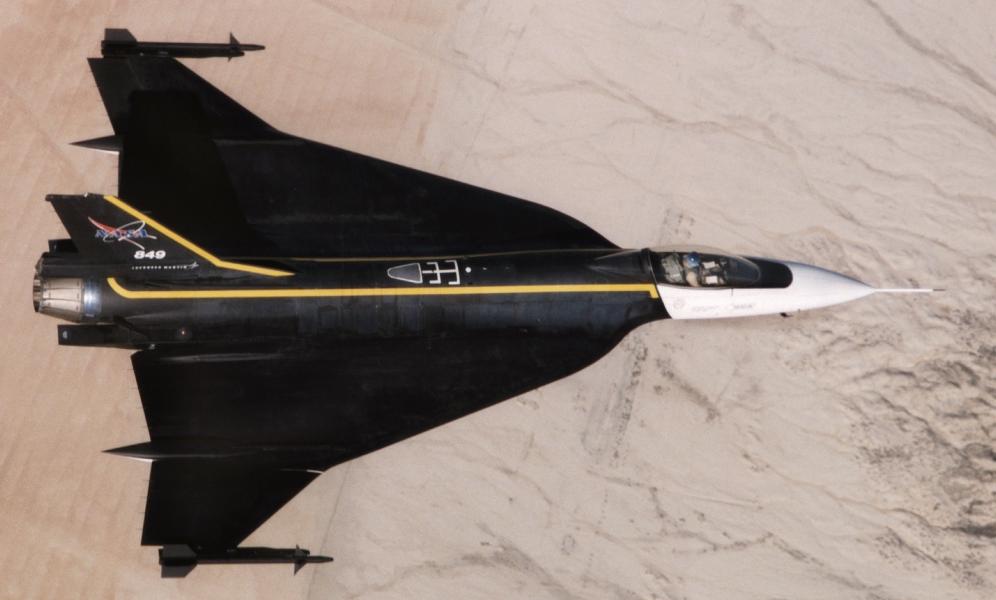
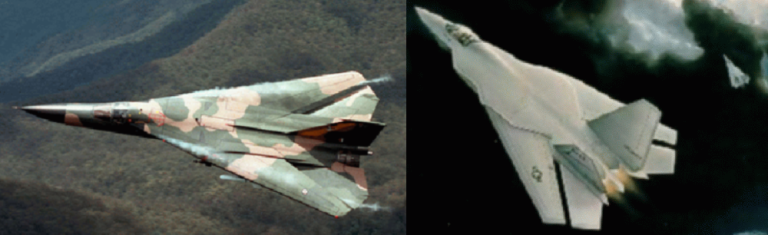
This leads us to what is perhaps the pivotal issue in any long term strategy for F-111 retention. This issue is the choice of a possible replacement powerplant. Supercruising the Pig The issue of engine replacement is no less interesting than radar replacement (discussed in last month's issue). Current planning envisages the use of the TF30-P-108/109 until the intended 2015-2020 retirement date. The cheapest near term alternative is to fit a late model GE F110 engine, e.g. the F110-GE-132, essentially common to late build F-16s, by using many of the adaptations devised to fit the F110 into the TF30 sized engine bays of the F-14B/D fighter. This engine would dramatically improve performance in all flight regimes due to higher thrust, and given the calculated 7 year payback time in maintenance and fuel burn costs projected for a USAF F-111 fleet engine replacement (this project entered design but was cancelled with the decision to retire the USAF F-111), it would almost certainly pay for itself if performed during the 2000-2005 timescale, even with a planned 2020 retirement date. The estimated NRE for the F110 retrofit was around USD 15-25M. Another alternative would be the P&W F100-PW-232 series similar in size and performance to the F110 and an interchangable option on the F-15E. However, if we assume for the purpose of argument that the F-111 is to be stretched well beyond 2020, then the F100/F110 become much less attractive as F-15E and F-16 production will most likely wind down toward the end of this decade. As a result, the number of F100s and F110s in service will start to decline past 2020 and support costs will increase. Is there another choice? Perhaps yes, this being the F119 family of engines which will be standard to the USAF F-22, JSF and the large number of USN, USMC and export JSFs. With the F-16 class JSF planned to be built in F-16 like numbers, the F119 would be available in quantity and thus would be easy and cheap to support in the post 2020 timescale, even if the basic engine is at this time more expensive than the mature F110 and F100. In particular, the F-22's F119-PW-100 version incurs a major cost penalty in the stealthy TVC nozzle, and the V/STOL JSF119 variants in V/STOL adaptations. An F119 variant using the F-22 fan and core, and CTOL JSF or PYBBN nozzles would be cheaper than the specialised variants of the engine and thus the target of any F-111 retrofit. What is particularly attractive about the F119 is that it is designed to be much cheaper to support than current generation engines. The commonly cited numbers are 60% the parts count of the F100-PW-200 and reliability/maintainability/supportability 80% better than the F100-PW-200, with around one half of the required support equipment. The F100-PW-200 is a generation beyond the early sixties TF30 series. The F119-PW-100 is a much simpler engine, which uses titanium Integrally Bladed Rotor (IBR) or blisk technology common to the commercial PW4000 for its three fan stages and six compressor stages. Hollow wide chord shroudless low aspect ratio fan blades are used in the first stage, to improve efficiency, bird-strike / FOD tolerance and stall margin. The combustor walls use both convection and film cooling. The low and high pressure spools are counter-rotating, to reduce gyro effects and improve efficiency. Both turbine stages are cooled, unlike most older fighter engines, using convection and film cooling techniques to accommodate the higher turbine inlet temperatures seen in sustained supercruise. P&W claim a design requirement for the F119-PW-100 was to build an engine capable of operating at much higher temperatures than the F100 series, without a reduction in operating life. The F119-PW-100 uses a very modern dual redundant Hamilton-Standard Full Authority Digital Engine Control (FADEC), which controls fuel flow and actuators for the variable guide vanes in the fan and compressor. Software in the FADEC, in part derived from the NASA Dryden HIDEC research project, runs a real-time model of the engine to optimise performance, and is capable of compensating for the loss of numerous engine sensors or actuators, providing some fail-safe capability. The FADEC software is written in ADA and likely to be hosted on PowerPC microprocessors, given the obsolescence of the 68040 chips used in development FADECs (an interesting side note is that the politically imposed delays to F-22 production have forced the repeated redesign of a large proportion of the computer hardware in the aircraft, since many chips became obsoleted over this period). A capable diagnostic system is integrated. P&W cite an average of 20 minutes to replace any of the 29 engine LRUs. On maintainability and support costs alone, the F119 is a gigantic leap beyond the F-111's highly complex first generation TF30, with 3 fan stages, 6 low pressure compressor stages, 7 high pressure compressor stages and 4 turbine stages, all requiring a large logistical tail to support. Other than maintainability, the key attribute of the F119-PW-100 is that it is capable of sustained supersonic cruise by use of a different operating cycle, advanced materials technology such as diffusion bonded titanium, and a significantly more effective internal cooling system in comparison with current engines. Genuine supercruising engines can maintain high dry thrust output at higher altitudes and Mach numbers, where conventional engines cannot deliver the needed dry thrust to sustain supersonic flight. Current technology demonstrations of the JSF119 using supercooling techniques have seen turbines operated at temperatures 200 to 250 deg C higher than the F100 turbine. Rated at around 26 klbf SL static dry and 36-40 klbf SL static afterburning thrust the F119 would arguably provide, even if derated for improved durability or limited due to inlet design or structural loads, much superior high altitude thrust even to the latest F100/F110 family engines (the cited figures are 200% of the dry thrust of an F100-PW-200, and 150% of the afterburning thrust). Given that the F-22 should be well established in production by 2005, availability would be constrained only by politics at the US end. Available USAF and P&W technical data for the F119-PW-100 indicates that this engine would fit into the TF30 bay without significant structural modification, although a proper engineering study is needed to prove this. The F119 engine is claimed to be much lighter than the F100-PW-200, which itself is about 75% of the weight of the TF30. Therefore even with additional mounting hardware, an inlet plug with a radar blocker as used in F/A-18E and tailpipe extension plug with another radar blocker as used in the F-22, the weight is very unlikely to exceed that of the TF30. Even with a modest aft position of the new engine fan face, there may be little ballasting change required for CoG adjustment, against the current configuration. Given that supersonic inlet behaviour is too complex to easily analyse, it is unclear whether the F-111C/G Triple Plow I and II inlet designs would provide adequate massflow for the F119-PW-100 to develop full thrust across the whole flight envelope.The F-22's fixed inlet design is sufficiently different to preclude simple comparisons. Again, a proper engineering study is needed to prove this. Given that the F119-PW-100 uses a capable FADEC, there may be some scope to adapt the engine's behaviour to the F-111 inlet, and still yield acceptable installed performance even if the installation is suboptimal against the F-22 inlet. Adapting the F110 to replace the F-14's TF30 required a 1.27 metre tailpipe plug, mounting adaptors and an adaptor sleeve to match the inlet to the fan. Various accessories had to be relocated to fit properly. Clearly an adaptation of the existing TF30 nozzle, or a new nozzle would be required for an F119/F-111 fit. An obvious choice is the P&W PYBBN nozzle design (trialled on the NASA TVC F-15), fitted in a similar manner to the nozzles on the stillborn F101 powered FB-111H proposal. This nozzle is smaller in diameter than the TF30 nozzle shroud. Another option may be a USAF Wright-Patterson EMDP devised adaptation of the F100-PW-229 nozzle, originally planned for retrofit to the F-111F's TF30-P-111 engine, but cancelled with the then impending F-111F retirement. Unlike the finicky sixties TF30, modern fans like the F100/F110/F119 are much more tolerant of poor quality inlet airflow since they are built from the outset for fixed inlets, short inlet tunnels and high alpha flight regimes. So the fears of some in Canberra that an engine retrofit would present the same problems seen with the TF30 in 1964 are arguably unreasonable. Forty years of engine technology evolution do indeed make a difference. The basic aerodynamics of the F-111 are particularly well suited to supersonic cruise, especially with the variable wing and inlet geometries which are not a feature of the F-22 design, and the internal bomb bay which is a feature common to the F-22 and JSF designs. The option of sweeping the wings fully aft to 72.5 degrees results in a significant reduction in supersonic drag, against a conventional fighter with a fixed sweep angle, indeed the F-16XL supercruiser used a 70 degree sweep on its major inner wing planform. The underpowered F-14A could match the supersonic speed of the F-15A for this very reason. The cancelled NATF, an F-22 derivative, used a variable geometry wing configuration remarkably similar to the F-111, perhaps not surprising given the involvement of GD Forth Worth in the proposal. The Implications of an F119-PW-100 Retrofit For the purpose of argument, let us consider the various implications of a hypothetical F-111S fitted with a pair of F119-PW-100 variant engines derived from the F-22/JSF.
Are there any complexities to be considered? Indeed there are, although they pale into insignificance against the strategic gains to be had.
In summary a retrofit of an F119-PW-100 variant into the F-111 could yield some remarkably useful gains both in capability and supportability. Part 4 will explore force structure issues arising from a relifed, supercruising F-111S/EF-111S fleet.
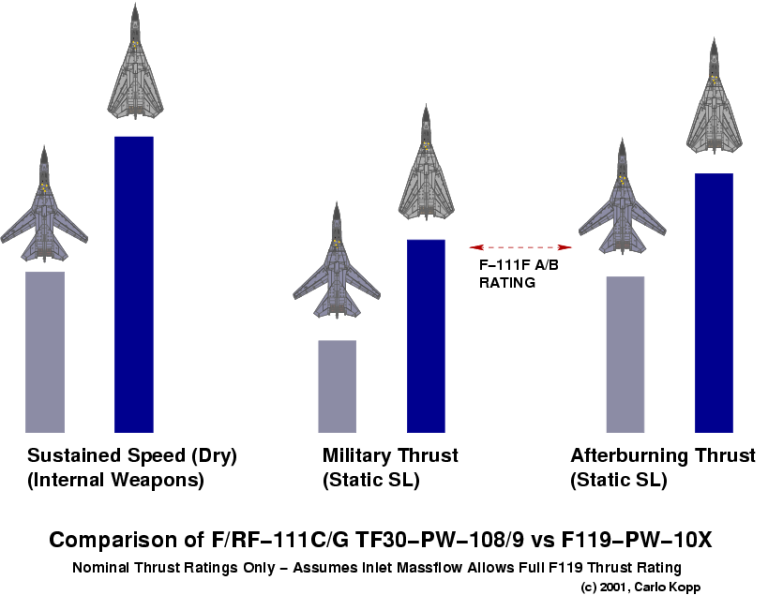
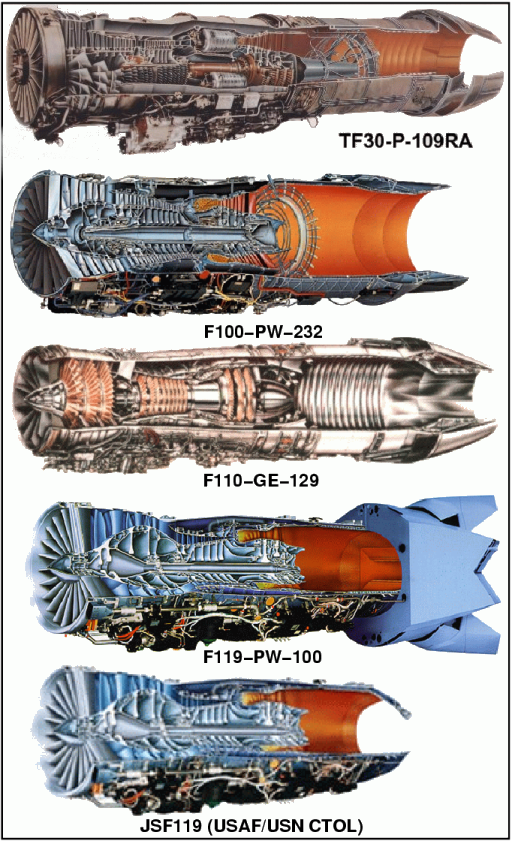 The F-111C/G is currently powered by either the TF30-PW-108 or -109, recently retrofitted from USAF stocks. Candidate powerplants for a possible future retrofit are the F110-GE-132, F100-PW-232 or later variants, exploiting engineering work performed for a never implemented USAF F-111 upgrade, and the supercruising F119-PW-100 engine, variants of which power the new F-22 and JSF fighters. In terms of reliability and support costs, the F119 series would yield the best results (Pratt&Whitney, General Electric).
The principal changes required to adapt the F119-PW-100 and PYBBN nozzle to the F-111 would most likely be the insertion of a tailpipe plug, an inlet adaptor, revised engine mounts, accessory position changes, FADEC firmware changes to drive the Triple Plow I/II inlet position and ballasting changes. As the fan section of the F119-PW-100 is slightly larger than the TF30 due to the vane controls, this engine would either need to be mounted slightly lower, or a slightly bulged panel used above the engine fan (Author/Pratt&Whitney).
Looking much like a cross between an F-22 and F-111, the LM/GD/Boeing Naval Advanced Tactical Fighter (NATF) or navalised F-22 was to have been a supercruising fighter bomber for US Navy carrier operations. Intended as an F-14 replacement, this aircraft program was cancelled due to USN budget reductions in the early nineties and the F/A-18E/F was developed to plug the resulting force structure gap. The configuration of this aircraft's variable geometry wing and stabilators bears a remarkable similarity to the F-111, perhaps not surprising given its Fort Worth heritage (RAAF, Lockheed-Martin).
The potential performance benefits of fitting a F119-PW-100 derivative to the F-111 are graphically illustrated by this diagram. At low level, this powerplant could potentially allow the F-111 to deliver performance in dry thrust ratings similar to existing full afterburning performance. Should the existing aft fuselage structure be unable to cope with such loads, the cheapest strategy is to modify the FADEC OFPs to limit afterburning thrust to known safe levels (Author).
A supercruising F-111S variant would employ a variant of the F-22's F119-PW-100 series engine, adapted to fit the F-111 airframe. A new engine would provide the opportunity to fit an Airframe Mounted Accessory Drive (AMAD) and a Jet Fuel Starter system, to reduce dependency upon ground facilities. With variable geometry inlets and wing, the F-111 is one of the very few operational types which could aerodynamically exploit the capabilities of the supercruising F119 engine. Only internal, semiconformal or low drag external stores would be used (Author). 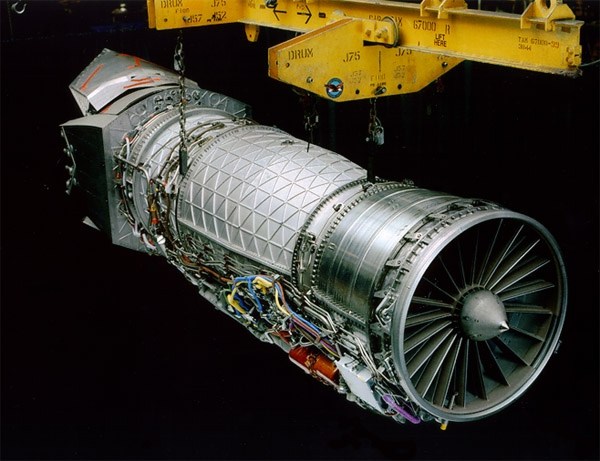 The
key to
the stunning performance advantage of the F-22 over all competitors is
the Pratt & Whitney F119-PW-100 powerplant. This engine was
designed
from the outset to operate at much higher temperatures than established
fighter engines, and uses substantial amounts of titanium in addition
to
a much more effective internal cooling system, compared to its
predecessors. The engine incorporates blisk technology and an
advanced
FADEC, capable of optimising performance for any given flight regime
(P&W).
|
|||||
|
The preceding three parts of this series explored issues in F-111 life extension into the 2030-2040 timescale, and the implications of a retrofit with the supercruising F119 powerplant common to the F-22 Raptor. This final part explores force structure issues which would arise from a relifed supercruising F-111S fleet. Force Structure Implications The retention of a comprehensively upgraded F-111S would necessarily change the complete rationale of the AIR 6000 project, which would become a program to primarily replace the F/A-18A with a better air superiority fighter, and plug capability areas not addressed by the F-111S. Australia's strategic position has altered somewhat as a result of the 11th September WTC attack. India has firmly aligned itself with the West, while China's track record of previously supporting Pakistan and Iran with military aid does little to alter its position in the longer term strategic picture. With the prospect of a drawn out coalition campaign by the West which is apt to involve ongoing air campaigns against states sponsoring terrorist activities, the most valuable asset US allies can provide are bombers with respectable combat radius. Runway access will be an ongoing issue for Infinite Justice, this being implicit to the geography and politics of the campaign. It is likely that any significant contribution by Australia to this campaign will alter all of the basic funding assumptions for AIR 6000 - less money is likely to be available at the end of this decade. This in its own right strengthens the case for F-111 life extension. The F-111 is an asset well suited to the coming campaigns by virtue of its combat radius, load carrying ability and accuracy, and its retention provides the RAAF with an opportunity to acquire a decent F/A-18 replacement despite the likelihood of funding difficulties downstream. If the F-111 fleet is to be committed at some stage to the Infinite Justice campaign or follow-on operations, putting a useful number of aircraft into a distant theatre will require that the RAAF acquire further F-111s from AMARC. This is to provide a large enough pool of aircraft to cover depot level maintenance and BUP effort, as well as providing enough aircraft at Amberley to sustain the training effort required to support rotations of aircrew in theatre. The aircraft which could be most quickly brought into service are 12 of the remaining 15 F-111Gs, with 24 or more additional F-111F Pave Tack capable airframes almost certainly a sound investment. The F-111F would require some further infrastructure to support its AUP-like but unique Pacer Strike bomb nav system, which was fitted to about 50% of the F-111F fleet before its retirement. At the time of writing it is unclear what path the government intends to pursue in the US-led campaign. Should it opt to send the F-111 to war, then it is very likely that it will have to invest in additional airframes for the commitment to be sustainable yet credible in numbers. Regardless of the unknowable
immediate future, it is well worth exploring the force structure issues
surrounding the possibility of a post AIR 6000 model incorporating an
evolved F-111.
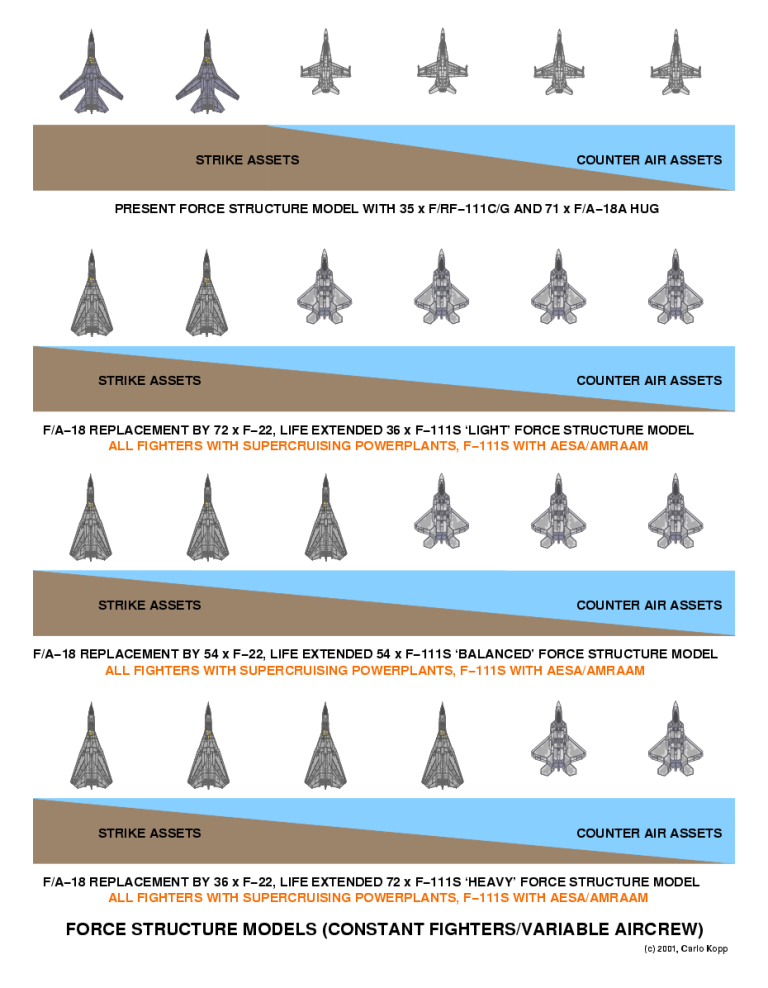
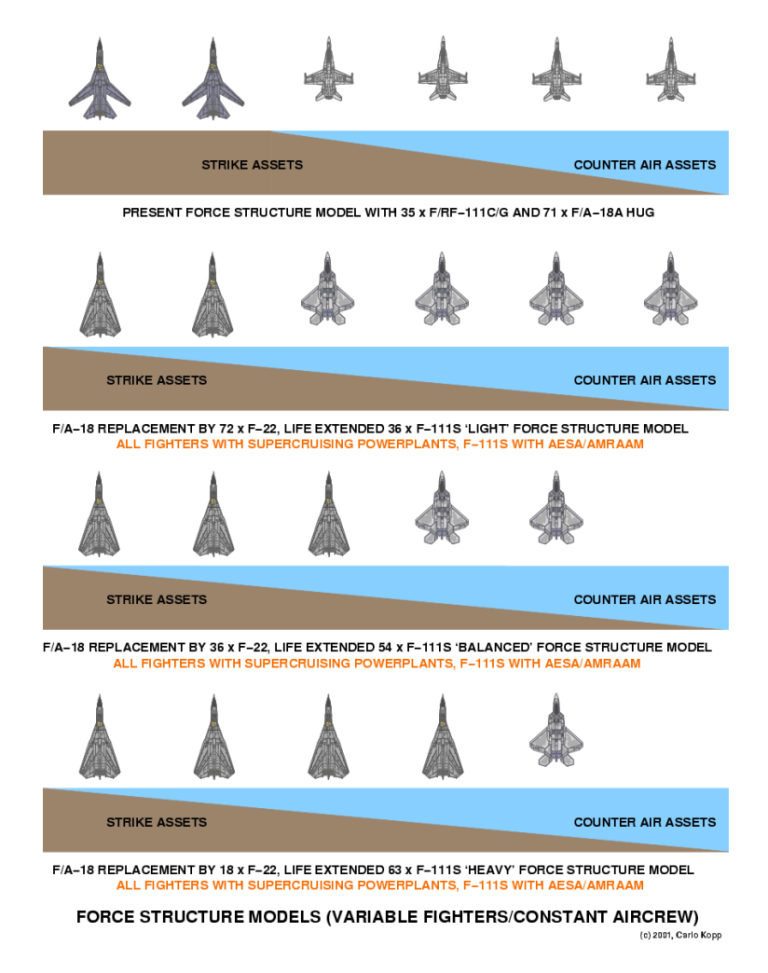
This evolved F-111 would have a respectable capability as an air defence interceptor armed with the AMRAAM or follow-on missiles. With high resolution attack radar modes the aircraft could perform strategic strike, battlefield interdiction, close air support and maritime strike, under any weather conditions. With radar back end provisions, this aircraft could supplement the Global Hawk as a radar reconnaissance asset. With a supercruise capability it could match the transit speed of the F-22. In practical terms, the evolved supercruising F-111 becomes a long range / long endurance multirole combat aircraft, with a limited capability to penetrate heavy defences unescorted, and lacking the agility to contest top tier air superiority fighters. With the exception of the highest risk air superiority and deep penetration strike roles, the evolved supercruising F-111 outperforms all contenders but the F-22. Retention of the F-111 well past 2020 inevitably results in a two type force structure, rather than the single type force structure which is the holy grail of many a force structuring debate. The remaining question in resolving AIR 6000 becomes which fighter to replace the F/A-18A with and in what numbers? The flexibility and versatility of the multirole evolved supercruising F-111 in turn leads to the question of whether the hypothetical future force structure, incorporating F-111s, should be bound to the current F-111 force size. As boneyard F-111s are a very cheap commodity, there are no fundamental obstacles to having an arbitrary number of multirole evolved supercruising F-111s in a force structure mix with another fighter. The existing RAAF force structure is in many respects an arbitary result of incremental evolution. Two squadrons of F-111C/G comprising 34 aircraft and four squadrons of F/A-18A comprising 72 aircraft, with the F-111 component dedicated to strike roles and the F/A-18A component performing OCA/DCA and supplementing the strike capabilities of the F-111 component. Figure 1 illustrates a range of force structure models, based upon a mix of the evolved F-111 and F-22, and the starting assumption that the White Paper constraint of a constant number of 100 fighters is observed. The F-22 would perform the most demanding high risk air superiority and deep penetration strike roles, and it would escort the evolved F-111 as required. The choice of the F-22 is not arbitrary: it provides engine commonality with the evolved F-111, and it is compatible in transit and penetration speeds. It is also the only fighter with the size to provide for safe diversion to the Cocos Islands, in the event of an AAR failure during an escort sortie to the outer bounds of the White Paper capability goal. The light model would be a simple one-for-one F/A-18A replacement by the F-22, complemented by the existing force size of two evolved F-111 squadrons. It would provide a highly effective capability to penetrate heavily defended airspace and overwhelm opposing air defences, but is also the most expensive due to the large fraction of F-22s, and it will demand the most supporting AAR capability. Aircrew demands are no different than the current model. We assume the current F-22A flyaway cost of USD 84M will hold. Given that the ultimate number of USAF F-22s could vary between ~ 295 and 750 aircraft, the flyaway cost could vary considerably. Insertion of cheaper JSF generation technology into the F-22 could significantly alter the cost of later build aircraft. The balanced model has a 50/50 split between the F-22 and evolved F-111, thus it is cheaper than the light model in initial acquisition outlays and supporting AAR resources, at the expense of its capability to defeat a very strong opponent. With 54 x F-22s it is similar in fighter strength to the USAF's GSTF AEF model which employs 48 x F-22 and 12 x B-2. With 54 x F-111 it has a bombload tonnage capacity 35\% greater than the GSTF B-2 force element, but with a lesser ability to penetrate heavily defended airspace due to the non-stealthy evolved F-111. In summary this model trades away some survivability but slightly exceeds the firepower of the USAF GSTF AEF model. Aircrew demands are up by a squadron sized contingent of F-111 navigators. The heavy model has 2
squadrons
of F-22s for air dominance and deep penetration strike in heavily
defended environments, and 4 squadrons of evolved F-111 for strike and
bomber / ALCM / SLCM interception. This model is the cheapest in
initial
acquisition outlays and supporting AAR resources needed, but is weakest
in its ability to penetrate heavily defended airspace due to the
smallest fraction of F-22s. It does however offer the strongest
capability to deliver bombload tonnage of all three models. The cost
advantages in the lower F-22 fraction will be offset by the need for
two
squadron sized contingents of F-111 navigators, which will increase the
outlay for aircrew by a non-trivial margin, especially over the longer
term.
If we set aircrew numbers to be the bounding factor in force structure size, refer Figure 2, then for every additional squadron of the evolved F-111, we must give away something to balance out the aircrew numbers. In this model it is a squadron of F-22s for every additional squadron of the evolved F-111. Again, this yields a heavy, (not quite) balanced and a light force structure model. The light model remains as is, the balanced model is 1/3 weaker in F-22 strength with the inevitable consequences which flow from that, and the heavy model arguably falls below critical mass in air superiority assets with a single F-22 squadron. In practical terms it would appear that three viable models exist:
The (1) model is by far the most lethal and survivable, but incurs cost penalties in having three F-22 squadrons and an additional squadron sized contingent of F-111 navigators. The (2) model with two F-22 squadrons loses some lethality and survivability, but incurs lower initial acquisition outlays with yet higher aircrew costs. The (3) model is neutral in terms of aircrew numbers against the nominal existing force structure, but loses 1/3 of the capability conferred by the F-22 component. In terms of lethality all of the three viable models far exceed the capabilities of the existing RAAF force structure. All three models meet or exceed the White Paper strike capability goals, and provide a substantial number of counter air assets to meet the airspace control capability goal. If we assume that adequate AAR
resources are available, then extending the RAAF's existing strike
capability to the outer bounds defined by the White Paper capability
goals would require nominally 34 evolved F-111s and enough F-22 escorts
to defend these F-111s. If we assume a ratio of two escorts to four
bombers, this yields a minimum of one squadron of 18 x F-22s. However,
in wartime the air superiority force cannot be wholly committed to long
range escorts without exposing the Arc of Vulnerability between the
Gascoyne and NT to potential attack. Making the reasonable assumption
that a single F-22, by virtue of supercruise and missile payload, can
perform the work of four F/A-18As, then a single squadron of 18 x F-22
would arguably provide a sufficient number of aircraft to provide
defensive coverage of the most important assets within the Arc of
Vulnerability.
This yields a basic force structure composition of 36 x F-22 and 36 (34) x F-111 aircraft, with no reserves, no support jammers and no allowance for F-111s in depot for overhauls or upgrades. If we assume 12 x EF-111 support jammers and 6 x F-111 to cover for aircraft in the depot, the total F-111 component is then 54 aircraft. This is indeed the same basic composition as the (3), or balanced with constant aircrew numbers model discussed previously. Given the stated assumptions, the 36 x F-22 + 54 x F-111/EF-111 force structure model provides an optimum, as it retains the current nominal number of aircrew, extends the current nominal F-111 strike capability to twice the existing combat radius, allows for support jammers, and provides enough F-22s to both escort the strike force and maintain a minimal continental air defence umbrella. What funding would be required to field this force structure? A good order of magnitude metric is to look at available flyaway costs. The current F-22 flyaway cost is stated to be USD 84M per unit - the FMS cost will differ by very little. A purchase of 36 x F-22 would require of the order of USD 3B. For comparison, the flyaway cost of 100 current non-stealthy multirole fighters would be of the order of USD 5.5B. If we make the assumption that the optimum F-22 + F-111 mix should cost no more than a block replacement with 100 current non-stealthy multirole fighters, then USD 2.5B would be available for upgrades and the acquisition of additional F-111s and EF-111s. Per F-111, on average this yields of the order of USD 46M available for upgrades including the F119 retrofit. Clearly a more exact costing model would be required, incorporating the costs of supporting infrastructure and facilities, in order to reach more definitive conclusions. However, it is clear that a mixed F-22 + F-111 force structure is credible alternative to the conventional single type models frequently discussed in this context. Specialised Roles: Reconnaissance Strategic and tactical reconnaissance capability to support RAAF strike operations is a long standing weakness in the ADF's force structure. This capability can be addressed in a number of ways, using oblique optical camera and synthetic aperture radar technology carried by manned aircraft or UAVs. Indeed, UAVs such as the now planned RQ-4A Global Hawk can provide exceptional capabilities in terms of range/endurance and the ability to transfer data in real time. While it is fashionable to portray the Global Hawk as a panacea, odds are the earliest the ADF might see production Global Hawks is later this decade or early in the next, especially with early production likely to be absorbed by USAF operational forces. By the same token there will be situations where a Global Hawk may not provide the response time or survivability required due to its slow subsonic cruise profile (eg Iraq has recently taken to firing SAMs at USAF U-2s). Whether we consider near term needs for reconnaissance or high threat situations, there is much to be said for equipping some proportion of the F-111 fleet with very high resolution synthetic aperture radars and supporting high speed digital recorders. If the F-111C/G were to receive a radar upgrade using AESA technology, then this opens up an opportunity to fit some of these radars with off-the-shelf very high resolution synthetic aperture imaging capability, available for the APG-79 and APG-80, and digital recorders for reconnaissance capability. The incremental cost in doing so is of the order of USD 250-500k per aircraft. Such a capability would not be a substitute for a Global Hawk or similar UAV, but rather a stop gap measure and later supplement for situations where UAVs are less than the ideal solution. Since it is an internal addition to the radar, it is compatible over the longer term with any supercruising engine upgrade which might be performed, unlike external radar pods. A similar argument can be applied to a LOROP camera pod, should it be adapted to stow on a Pave Tack cradle. Specialised Roles: Support Jamming Support jamming, as noted last year by AM Errol McCormick, is one of the remaining big holes in the ADF force structure and would be a potent tool used in the support of strike packages penetrating airspace defended by AWACS, while providing an excellent adversary training capability for the Wedgetail force and the RAN. Its importance cannot be understated, the US provides supporting tacjammers to cover even the stealthy B-2 and F-117A. An earlier analysis proposed the revival of several mothballed USAF EF-111A aircraft, fitted with an updated ALQ-99E tactical jamming package (refer http://F-111.net/CarloKopp/). The arguments for this capability remain not only valid, with A-50 AWACS and S-300PMU/300V series SAM systems now proliferating in the region the case is now stronger than ever before. A high power jamming capability against the A-50 or S-300 could nullify much of the advantage offered by these systems, as well as defeating the very many modern naval SAMs proliferating across the region. The EA-6B Prowler was a central component in the USN's Cold War blue water naval strategy, providing potent offensive and defensive capabilities to US naval forces. During the 1999 Serbian campaign, the EA-6B Prowler was considered a go/no-go item for all strike packages. With the trend to upgrade older Soviet SAM and radar systems with modern digital electronics, and the adoption of shoot and scoot or radiate only when shooting SAM tactics, tacjammers are yet again in the forefront of defence penetration technique. The ongoing needs of the Infinite Justice campaign are apt to see a strong demand for this capability. The key cost structure obstacle to date in reviving the EF-111A tacjammer has been the need to maintain compatibility between the defensive EW package and the ALQ-99 Tactical Jamming System (TJS). Without modification of the defensive EW package, problems arise with mutual interference between the jammers. Working around this incurs an ongoing expense requalifying modifications with every larger incremental upgrade of either system. With the impending demise of the F-111's specialised ALR-62/ALQ-94/ALQ-139 defensive package, and its extensively modified EF-111A variant, costly integration would need to be done on whatever replacements are chosen for the RAAF. This obstacle exists even for a podded tacjamming solution, on any fighter, which also may see difficulties with jammer spillover into receivers. Technological progress has however produced an alternate path. The latest USN ALQ-99 variants have the upper frequency band coverage and flexibility to subsume the functions of a tacjammer's defensive RWR and jammers. Therefore, the need to carry a defensive EW package on a tacjammer is in the process of becoming an artifact of EW history. The consequence of this is that the cost burdens of integrating a defensive RWR and jammers, and maintaining compatibility, will vanish in coming years, much altering the operational economics of a tacjamming capability. The unique defensive EW equipment devolves down to expendables, IR jammers and Missile Approach Warning Systems (MAWS). Operating a tacjammer using an ALQ-99 variant thus becomes cheaper, both in upfront costs and ongoing costs. To introduce a support jamming capability a suitable number of EF-111A aircraft would need to be recovered from AMARC, and eventually equipped with a repackaged variant of the latest ALQ-99J TJS to be used by the USN on the EA-6B Prowler, the planned F/A-18G Growler and proposed F-15G tacjammer/Weasel variant. Replacing the existing ALQ-99E in the EF-111A will be required at some stage, regardless of economics, since will become unsupportable, with many EF-111A/ALQ-99E systems cannibalised to keep older configuration EA-6B Prowlers operational. The comprehensive USAF EF-111A ALQ-99E System Improvement Program (SIP) was cancelled, limiting jamming modes and available upper band coverage as the new Digital-Based Exciter (DBE), upper band jammers and software/computer upgrade were never fitted. The latest USN EA-6B ICAP III ALQ-99 variant is to enter fleet squadrons in Q2 2005. It uses the new digital Universal Exciter Upgrade (UEU) unit, progressively evolved from the design developed for the cancelled EF-111A DBE, the new LR-700 receiver package which replaces the existing ALQ-99 receivers, an upgraded AYK-14 computer, new RISC/VME computers, and new low and high band jammers in addition to the new AN/USQ-113(V3) Radio Countermeasures Set for jamming communications. An additional feature is the Improved Data Modem (IDM) for datalinking to other platforms and MIDS provisions. The system has growth potential to perform electronic reconnaissance. The Litton LR-700 receiver package is of particular interest. It evolved from the LR-500 Precision Direction Finding System (PDFS) trialed on the USAF F-15, and the manufacturer claims it can provide precision passive radar threat detection, identification, precision geolocation, and jammer control. This places the LR-700 much in the category of an Emitter Location System (ELS) used on a Weasel, rather than an established jammer System Integration Receiver, allowing range-known mode HARM shots. The mothballed USAF EF-111As have already been upgraded to the USAF AMP/DFCS configuration, making the basic systems including radar largely compatible with the RAAF's F-111Gs, and were fitted with the TF30-P-109 common to the F-111C/G. FB-111A wingtip extensions and heavy duty undercarriage would be a simple retrofit. This would repeat the RAAF's earlier conversion of F-111As to F-111C configuration and would bring the aircraft to an EF-111C standard. The basic systems modification to the EF-111A would be the removal of the legacy ALQ-99E and its replacement with the new ICAP III system, including cockpit displays and controls, the removal of the current ALR-62/ALQ-137 variants without replacement, installation of the ALE-47 dispenser, and the possible integration of MAWS in the tailbooms and glove EW bays, using types selected for the upcoming F-111C/G EW upgrade. Integration effort is thus minimised. The EF-111A would then be subjected to the same progressive airframe relifing, radar, avionic and propulsion upgrades applied to the remainder of the RAAF F-111 fleet, if required eventually bringing them to a supercruising EF-111S configuration. This approach is clean, limits risk to an ALQ-99 ICAP III jammer upgrade, and exploits the US taxpayer's considerable investment into the development of ICAP-III and the integration of the ALQ-99E into the EF-111A airframe. Should the ADF make a commitment to F-111 retention beyond 2020, then the EF-111A is the most practical platform for deploying a high power jamming capability. This is not only due to its performance and range, but the large integration design investment previously made into the USAF EF-111A. Nothing is lost if Defence were to acquire e.g. twelve mothballed EF-111A aircraft from AMARC within the near future. In the current ALQ-99E configuration these could provide a training and limited operational electronic combat capability. A decision on performing an ICAP III and engine upgrade would best be done after the DSTO F-111 SOP findings are published in 2003-2004, in the context of AIR 6000. Twelve extra sets of spare parts for the F-111C/G fleet are the minimal return on investment. The deployment of the EF-111A would plug a long standing hole in the ADF force structure at a lower cost to any new build jammer aircraft, without the long term performance constraints imposed by an external jammer pod installation common to all of these types. Conclusions The basic conclusion to be drawn is that a hypothetical supercruise capable F-111 propulsion package would completely transform the F-111's performance and break many of the survivability assumptions valid for the current configuration of the aircraft. The aircraft's operational productivity would be roughly doubled, thereby doubling the return on every bit of expediture on the aircraft. For all practical purposes, re-engining the 34 F-111C/G fleet with F119s would yield the current strike capability at twice the combat radius of the existing force, with AAR support, thereby satisfying the White Paper capability goals without having to double the F-111 fleet size. Productivity gains aside, even a supercruising F-111 would require some fighter escort in an Su-27/30 + AWACS environment, and this would reduce the payoff, even if a lesser number of escorts is needed. Should that escort be the F-22, then its ability to perform the deep penetration F-117A low payload precision strike role by virtue of its stealth would allow it to assume the highest risk component of the F-111's many roles. By shifting the highest risk roles on to the F-22, the survivability issues driving F-111 replacement arguments are in turn much weakened. Retrofitting the F-111 with the F119 raises intriguing tactical, operational and strategic possibilities, but whether such an upgrade should be pursued depends on factors which are yet to be firmly established - structural life extension and F119 retrofit costs. Or the order of USD 50M could be spent on evolving the F-111, without costs exceeding flyaway costs of non-stealthy fighters, yet retaining the existing infrastructure investment. Importantly, an F-111 upgrade using F-22/JSF generation technology such as the F119 will go obsolete much later than any new build teen series or Eurocanard fighter. A similar argument can be applied to radar, computer and EW upgrades, where applicable, especially if JSF avionics/software are inserted post 2015. Given the possible option of a very long term commitment to an F-111 fleet, a good case can be made to engineer currently planned upgrades with a view to further design evolution. This discussion is by its nature speculative, moreso with the prospect of a protracted global conflict in coming years. What is clear is that many of the AIR 6000 funding assumptions planned for in forward estimates are likely to collapse over coming years. Given that the F-111 is the most suitable asset for contributing to Infinite Justice and follow-on campaigns, and one which is not committed to defending from potential kamikazes or dealing with border protection tasks, acquisition of additional airframes from AMARC to provide back end support for operational deployments makes good sense. It also positions the RAAF for further life extension, which may prove necessary to deal with future budgetary realities. If the F-111 can be stretched well beyond currently planned dates, then there is much to be said for taking this path as it would free up funding to allow a bigger investment into the F/A-18A replacement. It would also produce a respectable long term work package for our struggling domestic airframe and avionic industries, likely to further suffer from recent events. This would place less pressure upon the government to compromise capabilities in AIR 6000 to satisfy vocal industry lobby groups. Good cost reduction strategies in ongoing technology upgrades require long term commitments. No less importantly, F-111 life extension could be spread over a period of up to 2 decades, therefore producing a very flat funding profile without the sharp peaks which would result from larger buys of new fighters. This alone, given the precedent set by cabinet's handling of Wedgetail, should be reason enough to explore the relifed supercruising F-111 more carefully. It is worth reiterating that much of the support cost for the F-111 in its existing configuration is a direct consequence of continuing to operate sixties technology radars, instrumentation, engines and accessories, rather than replacing them with modern low maintenance hardware. Complaints about F-111 operating costs betray a lack of insight into how such costs arise. In summary, these considerations make a strong case for the DSTO F-111 SOP project to be extended in scope to explore life extension into the 2040 timescale, and to explore in detail re-engining with the supercruising F119. They also make a good case for the near term acquisition of 35 or more mothballed F-111G/F aircraft, to support possible operational deployments and protect from likely future budgetary problems in AIR 6000. This series was compiled as a speculative argument, with a premise that future funding pressures may clash with capability needs defined in the White Paper. As the events following the 11th September US kamikaze strikes have shown, this premise was closer to reality than anybody, including the author, could have ever imagined. Acknowledgements: The author is indebted to Kurt Todoroff, former USAF Captain and F-111D, EF-111A pilot, instructor pilot, flight examiner, and functional check flight pilot for his advice on F-111 high speed aerodynamics, and to Dr John Milthorpe of ADFA for his cogent comments on engine integration. Special thanks also to the many other reviewers who contributed experience, insight and critique to the drafts of this analysis. 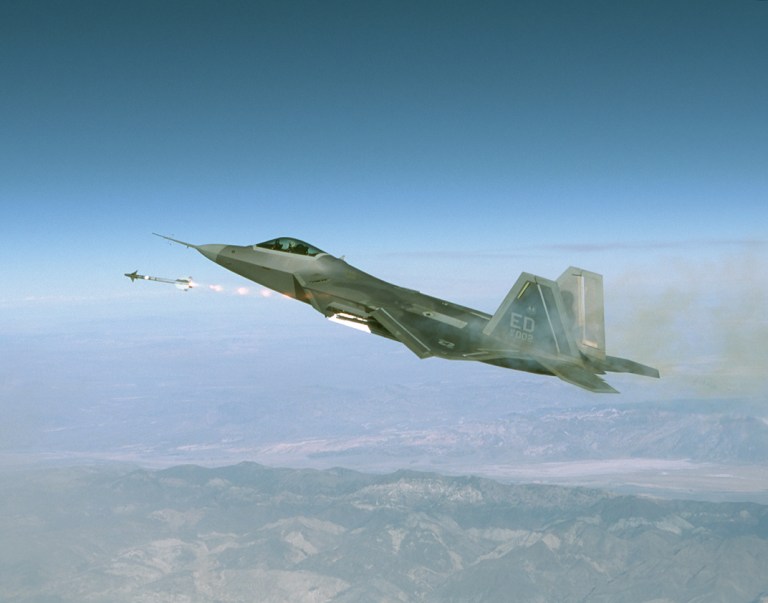 No matter how much radar absorbent material is attached to an F-111, it will never match the marble or golfball sized radar signature of an F-22 or JSF. Therefore in heavily defended environments, especially with AWACS supported Su-27/30, it will require a fighter escort to operate at acceptable levels of risk. In less contested environments, modest amounts of radar signature reduction, supercruising engines and glidebomb weapons would produce a good return in F-111 survivability. In effect the supercruising F-111 becomes an ersatz F-22 usable in lower threat environments (Lockheed-Martin).
A strong case can be made for the EF-111A to become the basic platform for a support jamming capability. This is not only because of its potential to supercruise, but also due to the massive prior investment made into integrating the US standard AN/ALQ-99 TJS into the EF-111A airframe. A new look EF-111A derivative would be based on a repackaged ALQ-99 ICAP III system with the LR-700 emitter locating receiver and digital UEU exciter hardware (Author). 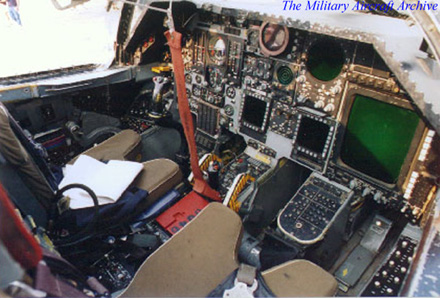 The USAF's small fleet of 34 EF-111A tacjammers was subjected to the digital Avionics Modernisation Program (AMP) avionic upgrade and the Digital Flight Control System (DFCS) upgrade, completed shortly before the aircraft were retired to the AMARC boneyard. The basic systems configuration is thus common to the RAAF's F-111G fleet, not presenting particularly unique support problems. Introducing the aircraft into RAAF service would require wing extension to FB-111A/F-111C standard, the installation of the heavy duty FB-111A/F-111C undercarriage, removal of the ALR-62/ALQ-137 and the integration of the new ALQ-99 ICAP III jamming package.
How to
best
escort a supercruising F-111? The obvious answer is with a fighter
capable of sustained supercruise with a respectable load of internal
weapons and fuel. This F-22A development aircraft is launching an
AIM-120 BVR missile. While a force structure wholly based on the F-22
is
attractive from a capability and a commonality perspective, at USD 83M
flyaway per aircraft cost will be a major political issue. A mixed
force
structure comprising relifed supercruising F-111s and standard F-22s
provides a means of padding out force structure numbers with a
potentially cheaper aircraft with similar supercruising productivity
(Lockheed-Martin).
An
important benefit of a domestic program to structurally rebuild, relife
and re-engine up to 54 F-111s is that it would keep a substantial
proportion of the AIR 6000 expediture in Australia, and would provide
the Australian industry base with higher value added work than
assembling a new fighter from imported components. The contractor base
would remain well equipped to support the aircraft indefinitely.
Moreover, such a program could be broken down into a large number of
small upgrade blocks and spread over 10-20 years thus avoiding the
large
funding spike otherwise seen with a new aircraft buy. If current
budgetary trends persist, securing funding for 100 new fighters, even
of
the least suitable types for Australia, will be challenging to say the
least - using a rejuvenated F-111 to pad out AIR 6000 numbers could
reduce this funding problem significantly (RAAF). |
|||||
|
|||||||||||||
|
|
|
|
|
|
|
|
|
|
|
|||
|
|
|
|
|
|
|
|
|
|
|
|||
 |
|
|
|||||||||||
| Artwork, graphic design, layout and text © 2004 - 2014 Carlo Kopp; Text © 2004 - 2014 Peter Goon; All rights reserved. Recommended browsers. Contact webmaster. Site navigation hints. Current hot topics. | |||||||||||||
|
Site Update
Status:
$Revision: 1.753 $
Site History: Notices
and
Updates / NLA Pandora Archive
|
|||||||||||||
|
|
Tweet | Follow @APA_Updates | |||||||||||
|
|
|||||||||||||
|
|
|||||||||||||