|
||||||||||||||||||||||
 |
||||||||||||||||||||||
![F-22A Raptor, FB-22, F-22E, F-22N and Variants Index Page [Click for more ...]](APA/f-fb-22.png "F-22A Raptor, FB-22, F-22E, F-22N and Variants Index Page [Click for more ...]") |
 |
![People's Liberation Army Air Power Index Page [Click for more ...]](APA/pla-air-pwr.png "People's Liberation Army Air Power Index Page [Click for more ...]") |
 |
 |
 |
 |
 |
 |
![Military Ethics, Culture, Education and Training Index Page [Click for more ...]](APA/ethx-culture.png "Military Ethics, Culture, Education and Training Index Page [Click for more ...]") |
 |
||||||||||||
 |
![Russian / Soviet Weapon Systems Index Page [Click for more ...]](APA/rus-weps.png "Russian / Soviet Weapon Systems Index Page [Click for more ...]") |
 |
 |
 |

|
 |
 |
 |
 |
 |
||||||||||||
 |
 |
|||||||||||||||||||||
| Last Updated: Mon Jan 27 11:18:09 UTC 2014 | ||||||||||||||||||||||
|
||||||||||||||||||||||
|
||||||||||||||||||||||
|
||||||||||||||||||||||
|
|
|
|
|
|
|
|
|
|
|
||||||||||||
|
|
|
|
|
|
|
|
|
|
|
||||||||||||
|
|
|||||||||||||||||||||
| Last Updated: Mon Jan 27 11:18:09 UTC 2014 | ||||||||||||||||||||||
|
||||||||||||||||||||||
| F-15E - Anatomy of Strike Fighter | ||||||||||||||||||||||||
|
||||||||||||||||||||||||
|
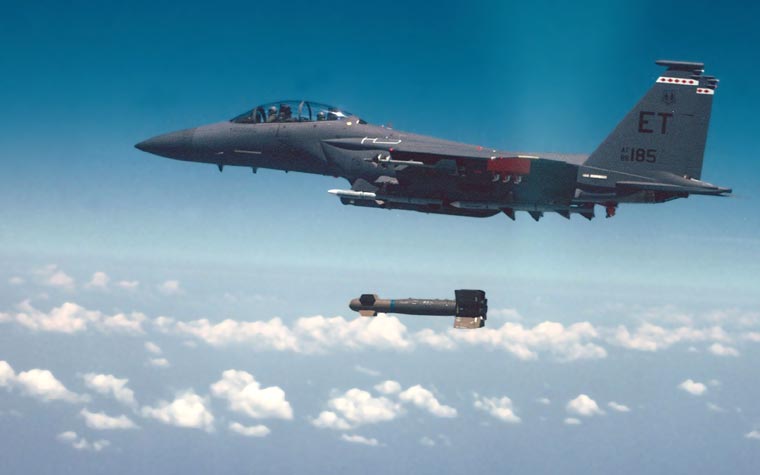
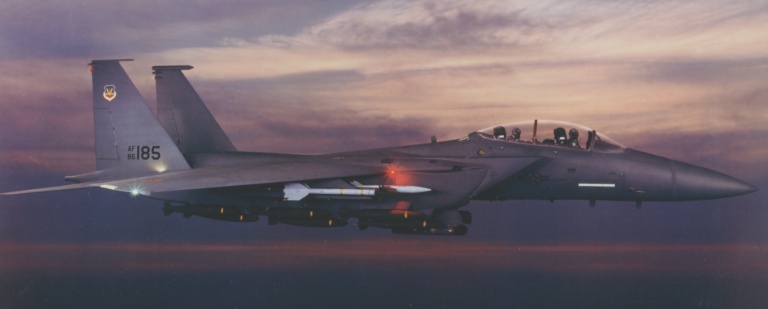
Conceptually the F-15E Dual Role Fighter (DRF) represents a further step in the implementation of a philosophy which is traditional to the USAF. The idea of using a long range fighter escort for strike duties emerged during World War 11, when the USAAF based in Europe employed its P-47s and P-51s and in particular, its twin-engined P-38 Lightnings for deep strike duties. The P-38s successfully disrupted transport, air defence operations and attacked even major industrial targets, such as petrochemical plants. The aircraft were usually led by two-seat pathfinders, after bombing the targets with 1000 pounders from medium or low altitude they would empty their guns at surface targets of opportunity or engage Luftwaffe fighters. The concept proved itself in spite of the inability of the USAAF to assert itself very effectively in combat with the nimbler Me-109Gs and FW-190As. Vietnam saw the reappearance of this philosophy, most of the hard work being done by the F-105s and later F-4C/D/Es. Often the aircraft would bomb from medium altitudes, led by an RB-66 pathfinder, though a very large proportion were in fact direct low altitude bomb/rocket/gun attacks on both preplanned targets and targets of opportunity. Though the latter tactic was essentially more devastating as the attackers could pay a lot of attention to individual targets, it became costlier as the communists increased the density of their SAM and AAA defences. The laser guided bomb and improved ECM allowed a return to medium attitude strikes to avoid the AAA while retaining the pinpoint accuracy, however the clear-weather-only constraint became very apparent. Flying bomb-laden fighter escorts at low level into an opponent's backyard serves several useful purposes. Firstly it forces the enemy to use his air defence fighters, which he may be tempted to leave on the ground if confronted by large numbers of long range air superiority aircraft. Destroying these aircraft not only reduces the opponent's ability to confront friendly bombers, it also provides the added benefit of demoralising the civilian population which will hardly be impressed by watching enemy fighters roaming through home airspace. The second advantage derives from the accuracy of low level delivery, far greater in this day of laser bomb guidance (one must note that the range of a laser target designator depends critically on the amount of water vapour in the atmosphere - under adverse weather conditions one has only a fraction of the range available in clear weather, therefore low level attack is necessary). The ability to locate and attack targets of opportunity translates into a third major advantage, as the opponent has no means of effectively predicting the nature or magnitude of the damage he will experience. The randomness and general unpredictability of these strikes will also affect morale. These are obviously excellent reasons far adopting such a philosophy, however one must be very realistic about the nature of enemy defences for this approach to be cost effective: The fighter aircraft must have the performance to subdue enemy air defence fighters and the aircrew must have the skills to engage in air combat (note past instances of P-38s being downed by Hungarian Me-410s or F-4s being hit by NVAF MiG-21s). The aircraft cannot be employed in an environment where they will fail victim to AAA and small arms. Vietnam saw the US observe both the above points, with Navy F-4s effectively hunting down the NVAF MiG force and USAF F-111As neatly evading defences through low level night/adverse weather penetration, however both of these instances were physically divided, employing different aircraft to perform essentially similar aspects of one mission. Ideally one would employ a single type with the capacity to perform both aspects of this mission. The European theatre of operations has the potential for becoming the ugliest aerial battlefield in history. The Russians by virtue of political doctrine have become increasingly aggressive, spending the last decade improving their offensive capability in Europe. This reflects in more armour and mechanised infantry, but also in growing numbers of Su-22 Fitter, Su-24 Fencer, Su-25 Frogfoot and MiG-23BM/27 Flogger tactical strike aircraft. In the event of a conflict these must be neutralised as soon as possible, observing this the Russians are deploying new SA-10 and SA-12 missiles (the latter supported with phased array radar), a new version of the ZSU-23 and a new generation of all-weather capable lookdown shootdown fighters supported by Airborne Early Warning. This represents a quantum leap in combat capability and the density of these defences will present a problem if not dealt with intelligently. The USAFE anticipated this development and as early as 1979 began formulating the idea of an all-weather deep strike fighter to perform anti-armour and counter-air strikes. Following this train of thought, development was initiated an a program termed LANTIRN (see Sept. 1984 TE), aimed at developing a pod set to convert day only fighters into all weather weapons. Attacking in adverse weather, the fighters would face only radar targeted AAA and SAMs which may be effectively countered with ECM, similarly Warpac air defence aircraft will be forced to employ radar while on intercepts. The LANTIRN pod set was initially aimed at the A-10 and F-16, both single seat aircraft with very limited all weather ability, however it was subsequently decided that a new all weather strike capable air superiority fighter was needed. A contest was initiated between McDonnell Douglas and General Dynamics, the prize a contract for the Dual Role Fighter (DRF). Essentially the USAFE was forced into the program, as the workload imposed upon its two UK based F-111E/F wings, already overcommitted, steadily grew and the situation could only worsen as the aircraft further aged. The new aircraft was to acquire a comparable penetration ability to the F-111, though at lesser range, while retaining its own full air-to-air capability. Of the two contenders, MDC was better placed with its flying F-15B two-seat Strike Eagle demonstrator, GD had the rather immature though otherwise exquisite cranked-arrow-wing F-16E. MDC's F-15B was fitted with a Synthetic Aperture Radar (SAR) and missionised rear cockpit (see Profile, Sept. 1984), it carried Conformal Fuel Tanks (CFTs) but retained the conventional pylon/hardpoint bomb carriage of the standard F-15B. Fitted with a Pave Tack FLIR pod, the aircraft served as a testbed for both demonstrating payload range performance, and integrating the SAR, FLIR and rear cockpit electronics. It was complemented by an F-15C fitted for semi-conformal (tangential) bomb carriage on its CFTs. This technique was found to reduce drag substantially thus improving payload/range performance. A competitive flyoff between the F-15E and F-16E (also two-seat, with dedicated rear cockpit and semiconformal bomb carriage) lasted through 1982 1982 and 1983, with the F-15E being selected in February 1984. MDC's win may be attributed to several factors, firstly the mature airframe and systems of the F-15, secondly the advanced state of the F-15E/APG-63 SAR development program which ran (company funded initially) since the late seventies, thirdly the F-15's ability to carry more bombs further, and finally the 87% spares commonality with the F-15C/D. The USAF will acquire 392 aircraft, which will be modified from F-15C/Ds. Initial delivery is scheduled for 1988, it is expected that the program will lead to follow-on F-15 orders, keeping production going beyond 1991. McDonnell Douglas F-15E Dual Role Fighter Structurally the F-15E differs little from its predecessors; in terms of component weight the commonality approaches 97%. Though the differences are few, they have significant effects. The structure has been strengthened in several areas which allows the aircraft full 9G manoeuvring capability when loaded. The undercarriage and associated load bearing structures have also been strengthened, lifting the allowed gross takeoff weight from 68,000 lb in the C/D to a full 81,000 lb. All F-15Es will be fitted with conformal fuel tanks, each of which is equipped with six tangential hardpoints, three outboard and three inboard. The outboard hardpoints are stressed for up to 1000 lb weapons, the inboard fore and aft for up to 2000 lb weapons. Quoted improvements in range when using tangential carriage against ejector racks vary from 28% to 41%, in any case it is significant. The aircraft retains the centreline station and both inboard and outboard wing stations. If fully loaded with 500 lb Mk 82 bombs (or Mk 20 cluster munitions), the aircraft will carry 12 bombs tangentially, six on its centreline and eight between its inboard wing stations, a total of 26 or 13,000 lb. Fully loaded with 2000 lb Mk 84 bombs, the aircraft carries four tangentially on its fore and aft inboard stations and one each on the centreline and inboard wing stations, totalling seven or 14,000 lb. This is respectable performance for a bomb-truck. The aircraft has two further stations; symmetrically just aft of the inlets these mount the LANTIRN pods, Targeting Pod port and Navigation Pod starboard. The aircraft retains the four fuselage AIM-7/AIM-120 stations together with the four wing pylon AIM-9 stations which are AIM-120 compatible. This allows an eight round AIM-120 Amraam load if necessary or conventional Sidewinder/Sparrow or Sidewinder/AMRAAM loads of 4 + 4. The aircraft will carry up to 15 GBU-12 or GBU-22 (low level) Laser guided bombs, up to seven GBU-10s, two GBU-15 glidebombs or their powered AGM-130 version, six AGM-65D Mavericks and up to five JTACMS missiles or free-fall nuclear devices. It is interesting to note that the aircraft is also cleared to carry three GPU-5A gun pods for close support missions. It is not clear whether the AGM-88 HARM will be adopted; as an anti-radar missile capable of launch from terrain-following aircraft it would be well matched to the mission. The F-15E has inflight refuelling provisions standard for all F-15s, it carries 13,500 lb of fuel internally, 9,750 lb in the conformal fuel tanks and may carry three 610 gallon external tanks. Externally the aircraft thus appears as a two-seat F-15D with added hardpoints, but the differences in internal systems are quite radical. The flight control system for instance employs a triple redundant fully digital Control Augmentation System (CAS) which replaces the existing analogue unit. The aft fuselage is configured to accept both the F110-GE-100 or F100-PW-220 afterburning turbofans and both have digital engine control units. The aircraft has a new radar, redesigned fore and aft cockpits, added avionic hardware and the interface to support the LANTIRN pods. The radar and the pods are powerful sensors; their particular features reflect in the cockpit design. Martin Marietta LANTIRN - Navigation Pod The Navigation Pod is the F-15E pilot's primary penetration tool, it contains both FLIR and Terrain Following Radar (TFR). The FLIR system is fixed forward and covers the pilot's field of view through the Head-Up-Display (HUD), it is designed to superimpose (1:1) an infrared image of the outside world over a real image to assist in night or reduced visibility terrain recognition and avoidance. The pilot may thus absorb both the visible terrain image (or its residue) and its infrared features simultaneously. The terrain avoidance/following radar (see TE, Sept. 84) is an advanced fully digital type, not only difficult to jam but also stealthy by virtue of beam direction and power control, intermittently switching off when not immediately generating a terrain profile. The TFR apparently generates throttle commands to avoid the need for energy management by the pilot. Combined, these two systems should eliminate the traditional worries of the night flying, terrain hugging pilot. The pod is currently under evaluation and is expected to be available in time for the F-15E. Martin Marietta LANTIRN - Targeting Pod The Targeting Pod is the F-15E System Operator's primary
target recognition tool, containing a narrow field of view FLIR camera
and laser rangefinder/designator. The pod was designed as a compact and
lightweight system, the departure from traditional design in some areas
has apparently contributed to developmental difficulties. The FLIR is
boresighted with a laser which maybe used to measure range for
navigation or weapon delivery; alternately it may be pulsed with a code
for guiding laser guided bombs. The pod is equipped with an automatic
point/area tracker and the FLIR has multiple fields of view, as is
customary in this class of system. The Targeting Pod weighs in at 540
lb, somewhat heavier than the 430 lb Navigation Pod. Both pods require
interface electronics to tie in to the aircraft's avionic hardware.
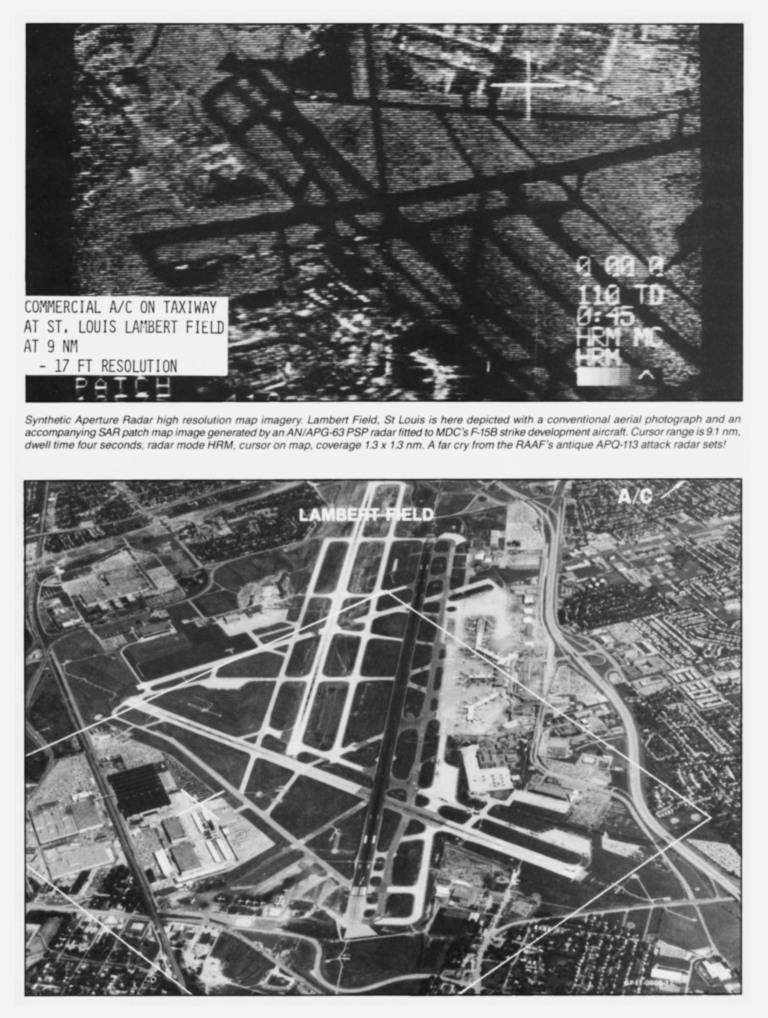
Hughes AN/APG-70 Multimode Radar The APG-70 is essentially a development of the late APG-63 radar as employed in the Strike Eagle demonstrator. The radar has all the basic air-to-air modes used in the MSIP II APG-63 PSP radar, which include three search modes, raid assessment, track-while scan, non-co-operative target recognition, the Supersearch, boresight, vertical and gun acquisition dogfight modes. The radar will illuminate for the AIM-7M, cue the AIM-9M and target the AIM-120A Amraam in single or multishot modes, aside from ranging for the M-61A1 cannon and supporting earlier versions of the Sparrow and Sidewinder. Where the radar is extraordinary is in its ability to provide near real time synthetic aperture imagery. The basic APG-63 offered real beam groundmapping and Doppler beam sharpened ground-mapping modes, but these were limited in resolution to the order of 50 feet. The synthetic aperture High Resolution Mapping (HRM) mode in the APG-70 offers a lot more. Synthetic aperture techniques exploit the Doppler effect to sharpen the beam in azimuth, as it is easy to improve range resolution by pulse compression in the radar receiver. The Doppler effect results in a frequency of the radar return; this is proportional to the relative velocity of the aircraft and the object reflecting the radar return. In effect we may visualise the locus of all directions with a particular Doppler as a cone aligned with the longitudinal axis of the aircraft. For each Doppler a particular cone, objects nearly abeam with little whereas objects ahead with a large . To take it a step further, we may note that these cones will intersect the ground below (assuming straight and level flight) in the form of parabolas (imagine the horseshoe shapes). A radar beam then transmitted at a reasonable angle (larger than 10 degrees) off the aircraft's axis will intersect this series of parabolas at various points. A synthetic aperture radar exploits this property, as it knows which Doppler shifts correspond to the axis of the beam it can manipulate the radar return data to narrow the beamwidth. The process is very intensive mathematically, to that degree that it is not currently practicable to attempt it in real time. The signal processor in the APG-70 must calculate for several
seconds before it can construct the synthetic aperture image from the
series of returns it picks up off the terrain it's mapping. Though it
is a complicated process demanding a powerful computer, the ability to
generate a high resolution photolike plan image of a patch of terrain
from a standoff position is very useful. Because radar can easily
penetrate cloud cover and precipitation, and that at low viewing angles
(several hundred feet of altitude at several miles), an aircraft
carrying this class of radar can map a target area from standoff range,
at a safe low altitude. As the resolution is high enough to recognise
vehicles and parked aircraft from several miles of range, it is
possible
to positively identify target areas such as production plants,
buildings, bridges and runways.
The HRM SAR mode in the APG-70 can perform with grazing angles down to 0.5 degrees, which translates into a 1000 feet altitude at 20 nm from the target. The aircraft must therefore pop up for several seconds (cca 3-7 sec) so the radar beam can 'dwell' on the mapped terrain to generate the image. Due to processor speed limits, further complicated by the timesharing operation of the radar which can simultaneously perform in other modes, the SAR mode will only generate patch maps of the immediate target area. The exercise is intensive; for instance the inertial navigator must furnish the radar with position updates six times faster while mapping. The image is built up on the operator's screen and then frozen to provide the operator with time to search for targets or offset aimpoints (OAP). Once a target or OAP is identified, the operator locks the cursor on to it and the aircraft's inertial nav attack system takes over, displaying steering cues on the pilot's HUD. On atypical strike mission, searching for an armoured formation known to be in a given area, the aircraft would drop into terrain following around 100 nm from the target area, which it would not approach directly but maintain at 45 degrees off the aircraft's axis for optimal SAR performance. At 50 nm range the aircraft would pop up and generate a 4.7 x 4.7 nm patch map of the general target area, selected for inclusion of known terrain features. A known feature would be used as a reference and the radar would be placed in Moving Target Indicator (MTI) mode to find the vehicles. These would appear as flashing rectangles superimposed over the map, however upon being illuminated they would do the sensible thing and stop to confuse the MTI. The F-15E is now approaching at 450 knots and 500 feet hugging the terrain. The radar is then used to generate another patch map, at 8 nm range, this time the 0.67 x 0.67 nm surrounding the detected vehicles. The resolution limit is 8.5 feet and the vehicles clearly appear against the terrain, as the foliage around them is virtually transparent to the SAR. The operator quickly decides upon attacking and places his cursor in the midst of the formation, locking in the nav attack. The pilot then drops even lower and using the FLIR in the nav pod, steers his way through the shallow hills to select a convenient approach. Following the steering cues he then overflies the targets, the computer automatically releasing the load of cluster bombs in a programmed pattern. A classical target such as a bridge would be tracked with the
LANTIRN Targeting Pod and hit with 2000 lb Laser Guided Bombs, after
initial identification. Significantly, this is a high workload exercise
for the aircrew who would also have to tackle air defences, albeit
reduced somewhat in capability due to the adverse weather conditions.
This has imposed the need for a very ergonomic cockpit and MDC took up
the challenge quite successfully.
The F-15E Crew Stations MDC took a giant step in the late seventies, with the design of the F-18A's electronic cockpit built around a set of computer driven Cathode Ray Tube (CRT) displays. This radical departure from tradition earned the eighteen the name Tron Machine, but was highly successful. The experience gained was translated into the F-15E, which is an improvement on both the F-18 and earlier F-15s. Physically the pilot's station appears much like a transposed F-18 cockpit, with three CRTs clustered around an Up-Front Control (UFC) panel and HUD. Armament control is to the left, above the undercarriage control panel. The similarity is superficial, because the two upper CRTs are in fact much larger six-inch units. The central CRT is a five-inch unit as in the 18, but is fitted with a colour tube. All three displays employ the menu driven technique of the 18, as evidenced by the encircling rows of selector buttons. The HUD is another step beyond the eighteen's conventional double combiner type, as it employs a curved diffractive (holographic) combiner. This will offer much better transparency and brighter symbology, including FLIR superimposed upon calligraphic symbols (the calligraphic symbols are written during the retrace periods of the FLIR TV scan). The aircraft has Hotas controls. The Weapon System Operator's (WSO) station is even more dedicated to the mission. Four CRTs form an array, two five-inch colour units flanking the two six-inch monochrome units directly ahead of the operator. If MDC follow the functional allocation used in the Strike Eagle demonstrator, the far left unit would carry menu and status data, the left-centre unit tactical situation data, the right-centre unit sensor data and the far right unit a repeat of the pilot's HUD data. This may not be followed in practice, as the software programmable displays are extremely flexible and the WSO could be expected to systematically call up various displays on each screen. The WSO has a set of flight controls and throttles, basic flight instruments and a repeater UFC panel. He also has a left and right hand controller for the CRT displays, typically used for cursor or FLIR aimpoint control. One can have no doubt that the cockpit will go a long way in assisting the crews in coping with a traditionally difficult mission. The F-15E will have provisions for further system growth, IFFC manoeuvring control and a Manoeuvring Attack System for manoeuvring ordnance delivery are both under consideration. A tactical flight management system for air-air and air-ground missions is under development. In terms of performance, the F-15E will differ little from its air superiority cousins. Thrust to weight on dry thrust will be in the 0.8 class, subject to fuel state, on reheat this will climb into the 1.2 class. Combat wing loading with air-to-air weapon load will approach 75 lb/sq ft. Though the aircraft is heavier than the baseline F-15C/D, it will be stressed for full 9G loaded which should maintain a decent turn capability. Even when loaded up with 8000 lb of ordnance, the F-15E program demonstrator aircraft apparently lost little energy in repeated 5G turns at 500 kts, with no significant reduction in roll rate due to ordnance load. As a bomber the F-15E will also put up a reasonable perform ance. Armed with four AIM-120As, four 2000 lb Mk 84s and fitted with LANTIRN and three drop tanks, the F-15E will manage a combat radius better than 750 nm with a Hi-Lo-Lo-Hi/100 nm dash mission profile. This compares favourably with the F-111's 900 nm class radius performance for an identical bombload. One area of concern associated with the F-15E is the subject of wingloading in low level flight. Though the aircraft can boast an excellent 133 lb/sq ft at maximum gross takeoff weight, this will fall with fuel state down into the area of 90 lb/sq ft when the aircraft dashes toward the target. It need not therefore offer the smooth ride customary with interdictors such as the F-111 and Tornado with wingloading in the 120 lb/sq ft class. This is unfortunately a factor which must be compromised against, as the lower wing loading is essential for dogfight performance and that cannot be sacrificed due to the nature of the mission profile. Though it is anticipated that the aircraft will spend two-thirds of their time flying strike missions, in practice one could expect a higher proportion of air-to-air engagements as the F-15E will often have to shoot its way through to the target. It is for this capability that the aircraft can be expected to displace the USAFE's F-111 E/Fs in the all-weather close support role which will inevitably demand the ability to tackle the Fulcrums, Flankers and Floggers of the Frontovaya Aviatsia (FA VVS = SovTAC), as compared to the dedicated deep strike role. The F-15E Dual Role Fighter is an impressive fighter bomber, with capabilities well matched to a demanding and dangerous mission profile. From the technical viewpoint it serves to illustrate that a sound airframe design can provide an excellent basis for later systems growth into other mission areas, a trend which is likely to grow in future years as the capability of avionic systems increases. It is unfortunate that Australia cannot afford to support fighters in the class of the F-15E, but on the brighter side McDonnell Douglas will be pouring a lot of their acquired experience into an enhanced two-seat A-18 Hornet fighter bomber which may eventually supplant the US Navy's A-6 bombers. Possessing the sensory capability of the F-15E and airframe commonality with the RAAF's F/A-18A aircraft, this aircraft could well become a viable growth option to the RAAF's strike capability. Only time will tell.
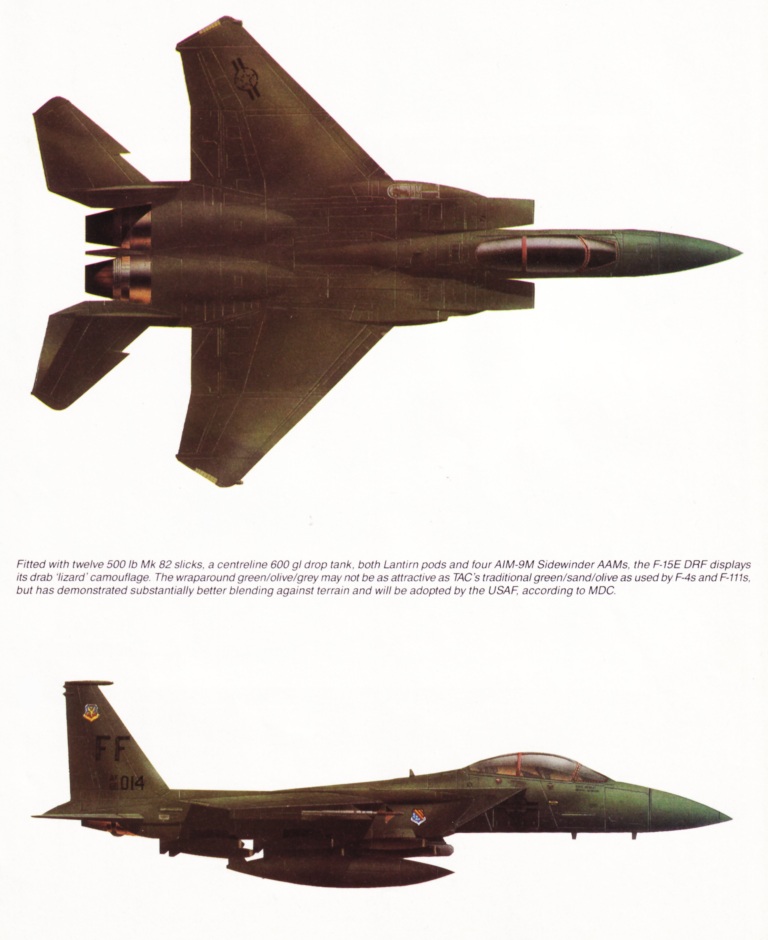
Fitted with twelve 500 lb Mk82 slicks, a centreline
600 USG
drop tank, both LANTIRN pods and four AIM-9M Sidewinder AAMs, the F-15E
DRF displays its drab lizard camouflage. The wraparound
green/olive/grey
may not be as attractive as TAC's traditional green/sand/olive as used
by F-4s and F-111s, but has demonstrated substantially better blending
against terrain and will be adopted by the USAF, according to MDC
(Artwork Mark Kopp). |
||||||||||||||||||||||||
|
|||||||||||||
|
|
|
|
|
|
|
|
|
|
|
|||
|
|
|
|
|
|
|
|
|
|
|
|||
 |
|
|
|||||||||||
| Artwork, graphic design, layout and text © 2004 - 2014 Carlo Kopp; Text © 2004 - 2014 Peter Goon; All rights reserved. Recommended browsers. Contact webmaster. Site navigation hints. Current hot topics. | |||||||||||||
|
Site Update
Status:
$Revision: 1.753 $
Site History: Notices
and
Updates / NLA Pandora Archive
|
|||||||||||||
|
|
Tweet | Follow @APA_Updates | |||||||||||
|
|
|||||||||||||
|
|
|||||||||||||