|
||||||||||||||||||||||
 |
||||||||||||||||||||||
![F-22A Raptor, FB-22, F-22E, F-22N and Variants Index Page [Click for more ...]](APA/f-fb-22.png "F-22A Raptor, FB-22, F-22E, F-22N and Variants Index Page [Click for more ...]") |
 |
![People's Liberation Army Air Power Index Page [Click for more ...]](APA/pla-air-pwr.png "People's Liberation Army Air Power Index Page [Click for more ...]") |
 |
 |
 |
 |
 |
 |
![Military Ethics, Culture, Education and Training Index Page [Click for more ...]](APA/ethx-culture.png "Military Ethics, Culture, Education and Training Index Page [Click for more ...]") |
 |
||||||||||||
 |
![Russian / Soviet Weapon Systems Index Page [Click for more ...]](APA/rus-weps.png "Russian / Soviet Weapon Systems Index Page [Click for more ...]") |
 |
 |
 |

|
 |
 |
 |
 |
 |
||||||||||||
 |
 |
|||||||||||||||||||||
| Last Updated: Mon Jan 27 11:18:09 UTC 2014 | ||||||||||||||||||||||
|
||||||||||||||||||||||
|
||||||||||||||||||||||
|
||||||||||||||||||||||
|
|
|
|
|
|
|
|
|
|
|
||||||||||||
|
|
|
|
|
|
|
|
|
|
|
||||||||||||
|
|
|||||||||||||||||||||
| Last Updated: Mon Jan 27 11:18:09 UTC 2014 | ||||||||||||||||||||||
|
||||||||||||||||||||||
| The
Dawn
of
the
Smart
Bomb Technical Report APA-TR-2011-0302 by Dr Carlo Kopp, AFAIAA, SMIEEE, PEng 26th March, 2011 Updated April, 2012 Text © 2006, 2011 Carlo Kopp |
||||||||||||||||||||
|
|
||||||||||||||||||||
Introduction |
||||||||||||||||||||
| Guided bombs are widely seen as a relatively
recent development in warfighting arsenals, at best prominent during
the latter part of the Vietnam conflict and the 1991 Desert Storm
campaign. What is seldom appreciated is that they were first used in
combat sixty three years ago, with remarkable success given the
unsophisticated technology they were then being built from. The earliest origins of guided bomb technology fall into the immediate pre-WW2 period and early years of the war, when US and German researchers independently pursued their own research. It is notable that many experimental or prototype designs were built both in the US and Germany, but of these only a handful of designs were operationally deployed and used in combat. These were the Luftwaffe's Henschel HS-293 rocket propelled glidebomb and Ruhrstahl PC 1400 X, the US Navy's ASM-N-2 Bat radar guided glide bomb and US Army Air Corp's VB-1 Azon radio controlled bomb. |
||||||||||||||||||||
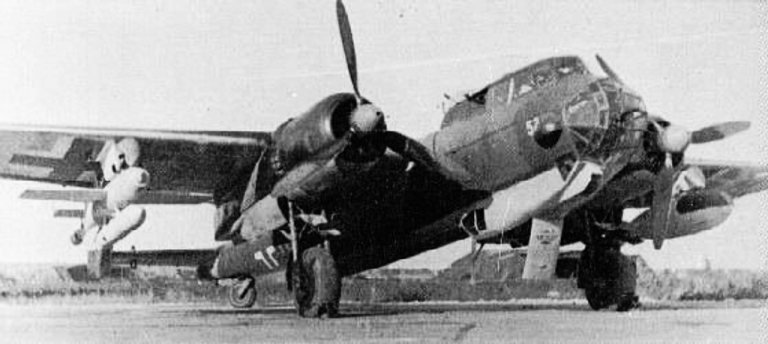
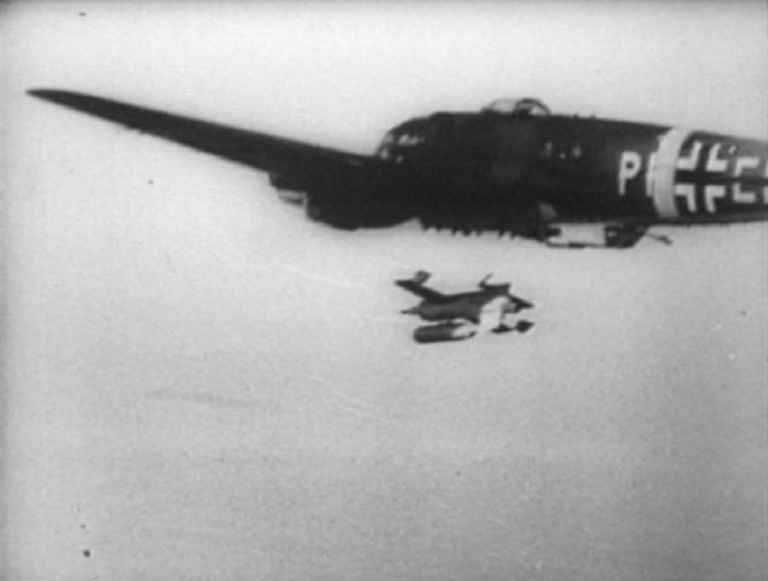
Henschel Hs-293 GlidebombThe Henschel Hs-293 family of glidebombs was the first to be used in combat and the first to enter advanced development. Henschel's mainstay in this development effort was the outstanding Prof. Dr. Herbert A. Wagner, a former Junkers engineer hired in 1940, who took over leadership of a development team comprising Reinhard Lahde, Otto Bohlmann, Wilfried Hell, Josef Schwarzmann, Dr. Hinrici, further supported in guidance system development by Theodor Sturm of the Stassfurter Rundfunk Gessellschaft. This team of engineers and scientists can take credit for the first operational guided bomb.
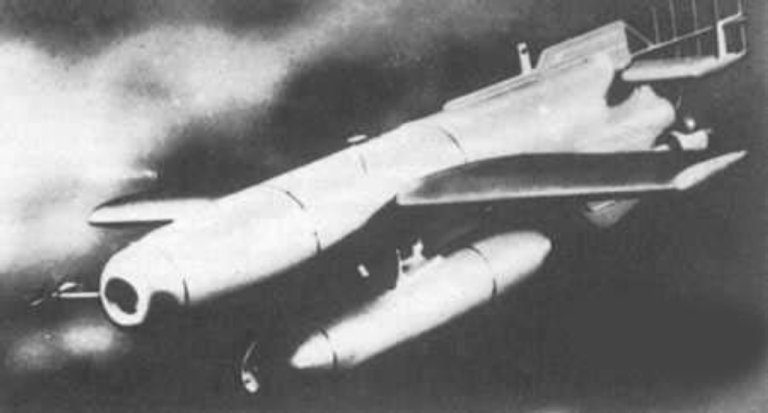
Henschel's team started development in 1939 using a glidebomb concept devised by in 1937 by Gustav Schwarz Propellerwerke. This concept evolved through the Hs-293V-1 and Hs-293V-2/FZ21 to the Hs-293V-3, tested in mid 1940. The unpowered Hs-293V-3 lacked the terminal velocity to punch through the skin of a warship, the intended target type for these weapons, and this led to the decision to add a rocket booster to increase speed and range. The Hs-293A-0 was the preproduction configuration which combined the basic airframe and guidance package with a Walter HWK-109-507B rocket booster pack. This rocket motor used T-Stoff (hydrogen peroxide) and Z-Stoff (aqueous solution of calcium or potassium permanganate), using compressed air bottles to drive the hypergolic propellant mix into a reaction chamber. It delivered an initial 1,320 lbf (600 kp) of thrust, declining to 800 lbf (400 kp) before fuel exhaustion 12 seconds later. The basic warhead for this weapon was the Luftwaffe's standard 500 kg SC-500 (Sprengbombe Cylindrisch) thin walled bomb casing, containing 650 lb of Trialen 105 explosive (15% RDX, 70% TNT, 15% aluminum powder), with an impact fuse. This choice of warhead was later shown to be a major limitation with best effect against small surface warships and transports. The airframe was a simple mid
wing monoplane configuration with slight anhedral, and a booster pack
mounted on ventral brackets.
The guidance package was built around a Horn gyroscope, OPTA Radio control signal decoder, a Strassburg FuG-230b/E230 radio command link receiver, all powered by DEAG one shot batteries, and used to drive Hornasser solenoid control actuators for the ailerons and elevators. In operation, the launch aircraft would send commands using a FuG-203 Kehl III radio transmitter, which received by the FuG-230b would be demodulated to generate steering commands for the control actuators. Eighteen preset frequencies in the 48-50 MHz bands were available. This was the first air launched Command to Line Of Sight (CLOS) guidance system ever used. A red coloured flare on the tail of the weapon was used to cue the operator when steering the weapon. Performance claims include a glide range of 11 km for a 3,300 ft AGL release, and speeds between 235 and 486 KTAS. The Hs-293A-0 entered production in November 1941, followed by the more refined Hs-293A-1 in January, 1942. Trials were conducted in 1941 using a prototype Heinkel He 177A-0, followed by a pair of He 177A-1 Greif aircraft. The Hs-293 was operationally deployed with KampfGeschwader 100 (KG 100) in the Mediterranean and KampfGeschwader 40 (KG 40) in France, for antishipping strike operations. The first documented combat use was on the 25th August, 1943, when KG 40 Do-217 bombers attacked a Royal Navy U-boot patrol in the Bay of Biscay, damaging the HMS Landguard and Bideford. Two days later a strike by 18 KG 40 Do-217s sank the corvette HMS Egret, killing 194 sailors, making this the first known sinking of a ship by a guided bomb. In 1944, after the D-Day landings, Do-217 aircraft used the Hs-293 to attack bridges at River See and River Selume on the Cherbourg penisula, in an attempt to stall the Allied advance from the bridgehead. Other claimed casualties for the Hs-293 include the frigate HMS Jervis damaged in January, 1944, the Liberty ship Elihu Hale sunk, LCT-35 sunk, the destroyer HMS Intrepid sunk in the Aegean, September, 1943, the destroyer HMS Inglefield sunk in February, 1944, the destroyer HMS Boadicea sunk in June, 1944, the destroyer RHS Vasillisa Olga, sunk in September, 1943. The weapon is credited with a total of 400,000 tonnes of sunk shipping [click for more ....]. Luftwaffe activity in Italy led to the compromising of the Hs-293A series when Allied forces captured intact crated Fritz-X and Hs-293 hardware at Foggia airfield, and were able to devise a radio command link jammer, rapidly built and deployed to fleet units. The Hs-293B was devised as a counter to FuG-230b jamming, and used a wire guidance scheme, unwinding up to 12 kilometres of cable from a spool attached to the tail of the weapon. A FuG-207 Dortmund transmitter and FuGz-237 Duisburg receiver replaced the Kehl III/FuG-230b radio link. Source disagree on the number of Hs-293B built and used in combat. A small number of the Hs-293C were built, equipped to attack ships below the waterline. This unsuccessful design evolved into the Hs-294 air delivered torpedo system, conceptually not unlike Australia's Ikara. While Greman sources claim up to 160 variants of the Hs-294 were built, none were reported used.
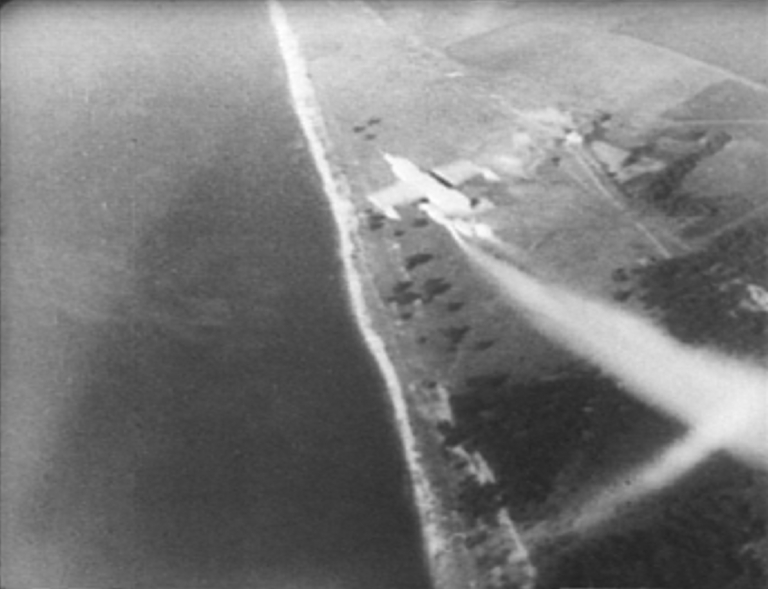
The Hs-293D was an important milestone since it introduced a nose mounted television camera and radio uplink to the launch aircraft, the aim being for the bomber to attack through an overcast. This variant was distinctive due to the use of a tail mounted Yagi array for the video uplink, and a reshaped nose for the camera aperture. The first successful trials were conducted in August, 1944, using Seedorf 3 and Tonne 4a guidance equipment. German sources claim 255 were built, and at least one source claims a Royal Navy warship was hit by a Hs-293D. The Hs-293E was an improved C-model, or which only 18 were built. The Hs-293F, with a delta wing, was abandoned in late 1943. The Hs-293G, built for steep dive attacks with a terminal homing seeker, never finished trials. The Hs-293H was a attempt to adapt the Hs-293A as an air to air missile for attacking bomber formations. It was equipped with a pair of HWK-109-542 or Schmidding 109-513 rocket motors, an acoustic promiximity fuse, and a new guidance package. Eight prototypes were built. The final Hs-293I was built around a larger warhead, but never entered production. The novelty and complexity of the Hs-293 were reflected in frequent hardware failures and manufacturing faults, resulting in what German sources claim was a dud rate of 28% per launch for KG 40 and 25% for KG 100, against a successful hit rate of 31% for KG 40 and 55% for KG 100. The Hs-293 was carried by the Fw-200 Condor, He-177 Greif, He-111H and Do-217K, with most installations including an exhaust duct to heat the rocket motor before release. In perspective, the Hs-293 proved to be useful weapon, but dilution of development effort into too many variants hampered the refinement of the basic models.
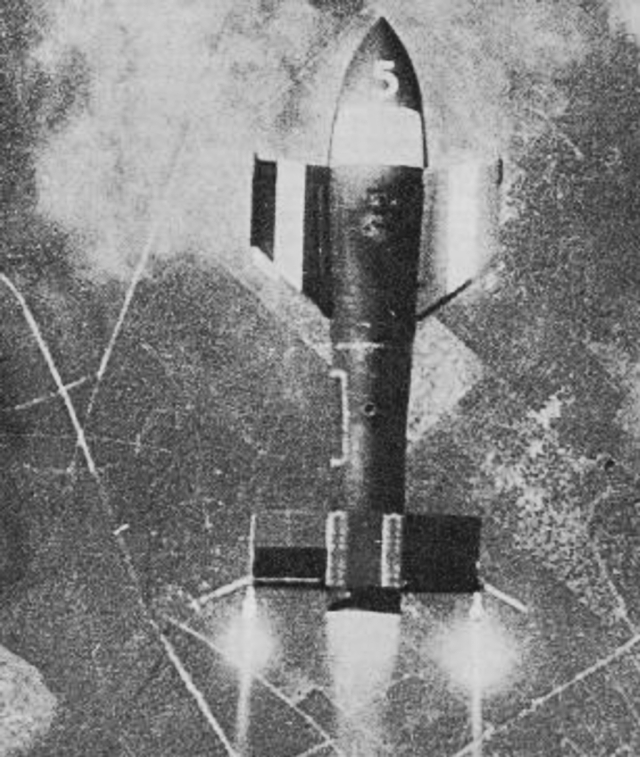
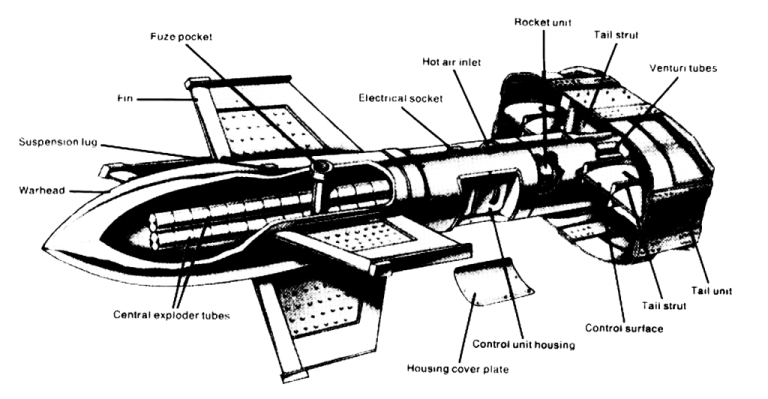
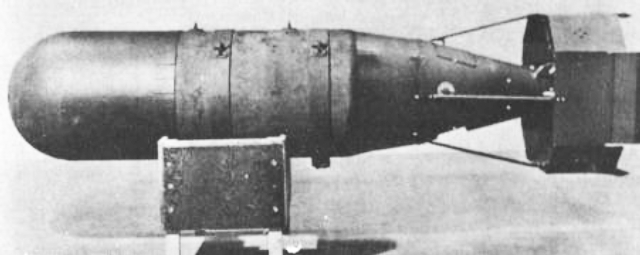
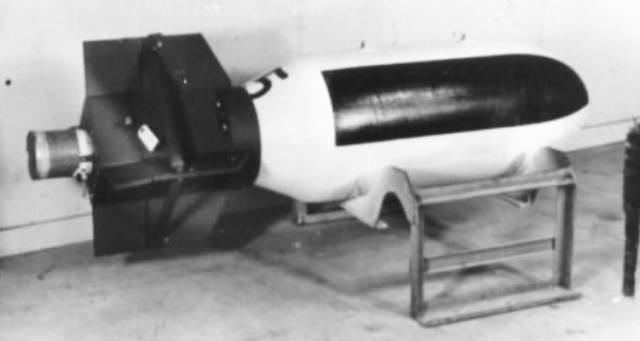
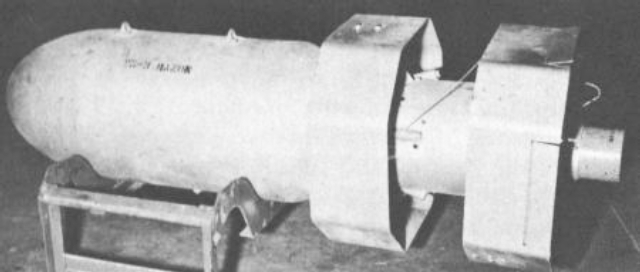
Ruhrstahl AG SD-1400X “Fritz-X”Development of the SD-1400X started in 1939, led by Dr. Max Kramer of the DVL (German Aviation Research Institute / Deutsche Versuchsansalt fuer Luftfahrt). While the PC 1400X shared the FuG-203 Kehl III / FuG-230b Strassburg guidance package, it had a unique gyro package for roll stabilisation, and an entirely different airframe design. Kramer's early experiments with a SC 250 and annular tail surfaces were sufficiently successful, that funding was made available for the adaptation of the PC 1400 Fritz, a 3,000 lb class armour and concrete piercing bomb. The new SD-1400X used a cruciform wing, angled at 28 degrees, and a segmented annular tail, with electromagnetically activated spoilers for pitch and yaw control. Experiments with pneumatic actuators are claimed to have caused problems at low ambient temperatures. The annular tail arrangement was intended to introduce drag at high speed and thus limit weapon terminal velocity, which proved an early impediment to accurate aiming - nevertheless the weapon's terminal velocity was transonic. Part of the tail was electrically insulated to act as a conformal antenna for the radio link. The spoiler arrangement was situated between boundary layer fences, and six pairs were used, two pairs in the guidance control loop for pitch/yaw steering, and one pair for roll stabilisation, controlled by the rate gyro. Claimed trial Circualr Error Probable was 100 ft. The machined steel bomb
penetrator casing contained three internal tubes with 320 kg of Amatol
explosive, impact fused. The weapon was usually carried on a ETC
2000/XII rack.
The operator tracked the weapon through the standard Lofte 7 bombsight, using a smokeless white/blue tail mounted flare or lamp, after problems with flare smoke plumes and green or red flares. Flare reliability is claimed to have been a problem. The guidance package was powered by a 24 Volt battery, this including the command link receiver, roll stabilisation loop and actuators. The weapon was to designed to be compatible with a range of FuG-203/FuG-230 datalinks up to the Kehl IV variant. An attempt to adapt the Duran/Detmold FuG 208/238 wire guidance system was abandoned. The guidance package was externally heated by air from the launch aircraft's deicing system prior to launch. The SD-1400 delivery profile involved typically overflight at 20,000 ft AGL, bomb release after throttling back, with the bombardier then using a joystick to steer the bomb until impact. The Fritz-X proved to be a devastating weapon when used effectively. During the September Salerno landings, the Brooklyn class light cruiser USS Savannah was hit by a Fritz X, killing nearly 200 crewmembers and putting the ship out of use for 12 months. Shortly after, the Queen Elizabeth-class battleship HMS Warspite sustained heavy damage after taking three hits by Fritz X rounds, which caused the penetration of six decks and blew a hole in the hull, putting the ship out action until the Normandy landings and killing nine crew. The 42,000-ton Italian Vittorio Veneto class battleship Roma sank after fires caused by two Fritz-X hits ignited her magazines, killing over 1600 sailors, including the CIC Admiral Carlo Bergamini. Other casualties included the Brooklyn class light cruiser USS Philadelphia, which lost several crew to a Fritz-X attack, and the Bellona class light cruiser HMS Spartan off Anzio after a Fritz-X attack. The Fritz-X was also claimed to have been used to destroy the bridge at Pontaubault, to stop the advance of the US 6th Armoured Division, in August 1944 [click for more ....]. Most reported deliveries of the Fritx-X were flown by Do-217K-3 or He-177 aircraft of KG 40 and KG 100. The Fritz-X was a far more
effective weapon than the Hs-293, but was shorter ranging and demanded
higher operato skills. Around 1400 Fritz-X rounds were build, with
around half expended in trials and training.
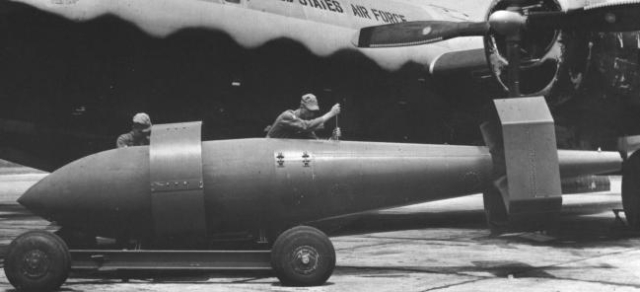
ATSC VB-1/VB-2 Azon and VB-3/VB-4 Razon Guided BombsThe Azon series were the first US guided bombs to be used operationally. The VB-1 Azon - short for 'Azimuth Only' - was a radio command link controlled tailkit attached to a standard M44 and later AN-M65 1,000 lb bomb body. The Azon entered production in 1943, after earlier development by USAAC's Air Technical Service Command. The Azon used an annular tail assembly like the Fritz-X, was roll stabilised like the Fritz-X, but could only be steered in azimuth and thus it range error on delivery was similar to a dumb bomb. The Azon guidance package was limited to five preset radio channels, limiting the number of concurrent drops during a raid. The Azon kit was produced until November, 1944, by which time 15,000 units were built. It was deployed in the ETO from February, 1944, and used extensively in Burma for bridge dropping strikes. The 15th AF in the Mediterranean is credited with Azon attacks on the Danube river locks, and the Avisio viaduct. In Burma, Azons were used to destroy 27 bridges using 493 rounds, including the famous Kwai River bridge. In parallel with the Azon, ATSC developed the more sophisticated Razon, which used a dual channel control link for range and azimuth guidance. The VB-3 was based on the 1,000 lb and VB-4 the 2,000 lb warheads. The Razons used two tandem annular wing assemblies, the aft assembly used for control. The guidance command link used up to 47 preset channels. Around 3,000 Razons were built during 1945, but the weapon did not see significant use until the Korean conflict, where B-29s carrying up to 8 rounds were use to attack bridges. The VB-5 was an Azon derivative with a optical homing seeker which never saw production, the VB-6 Felix used an infrared seeker but was cancelled in 1945. The Douglas VB-9 was a radar guided cruciform wing glidebomb, also cancelled in 1945. The VB-10/VB-11/VB-12 Roc used tandem annular surfaces, with TV, heatseeking and command link guidance. All were cancelled in early 1945. The largest weapon in this family was the Bell VB-13/ASM-A-1 Tarzon, which was a guided derivative of the RAF's 12,000 lb earther penetrating Tallboy bomb. It used tandem annular surfaces, and the guidance used an AN/ARW-38 command link transmitter and AN/URW-2 guidance receiver, with a flare in the tail like the Fritz-X/ The Tarzon was used during the Korean conflict and is credited with six bridges.
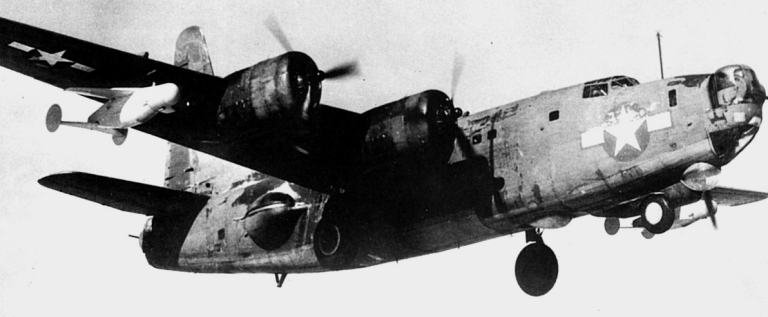
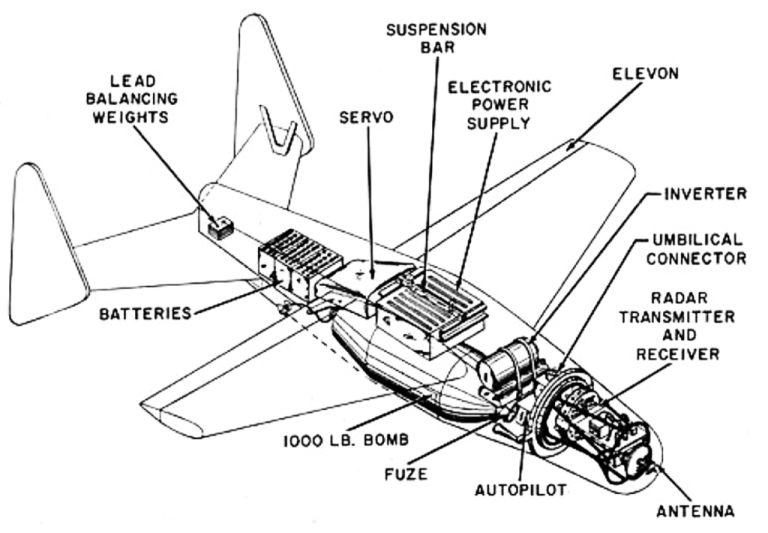
SWOD MK 9 / ASM-N-2 Bat Glide BombThe SWOD Mk.9 (Special Weapon Ordnance Device) Bat radar guided glidebomb was arguably the most advanced of the early guided bombs. It was developed by the US Navy as a standoff anti-shipping weapon, with a secondary role of attacking coastal targets with good radar contrast, such as moored shipping, fuel storage tanks or warehouses. The Bat was the first fire and forget guided weapon, and the first radar homing antishipping weapon. The Bat used a Bell Telephone
Laboratories developed S-band active radar seeker, and a 1,000 lb
warhead with an impact fuse. The 1,700 lb weapon was released at medium
to low altitudes and would home on its target once the seeker was
activated. The US Navy built 2580 rounds and they continued in use
until the early 1950s.
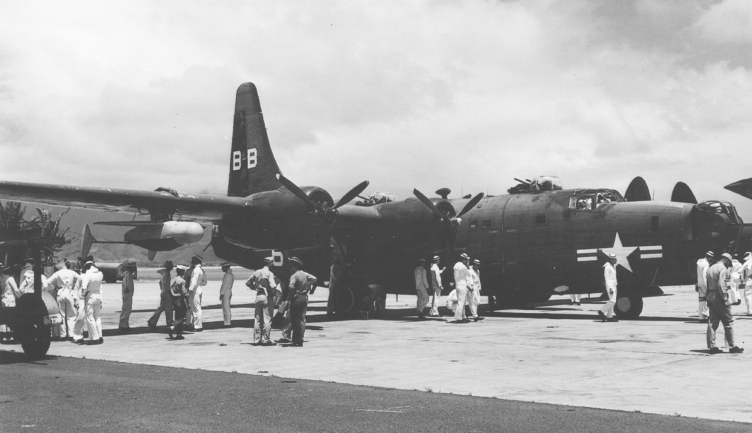
The primary delivery platform was the Convair PB4Y-2B Privateer, a single tail stretched derivative of the B-24 series. Each Privateer carried one Bat under each wing. The weapon was later cleared on the F4U-4 Corsair, SB2C Helldiver, PBM Mariner, JM-1 Marauder, PV-1 Hudson and PB-1 Flying Fortress. The Bat was first used in April, 1945, when two Privateers of VPB-109 attacked Japanese shipping near Borneo. Subsequently VPB-123 and VPB-124 were equipped with the Bat. The Bat suffered all of the limitations of a rudimentary active radar seeker, especially its propensity to be seduced by littoral coastal clutter, a genuine problem for operations in the Indonesian archipelago and Philippines. Its historical significance is
that it is forerunner of the numerous radar guided anti-shipping
missiles so widely used today. Editor's Note: If you have material
to contribute, especially photographs or information on target damage,
please contact the APA webmaster @ webmaster@ausairpower.net. Contributed
Links: |
||||||||||||||||||||
|
|
||||||||||||||||||||
 |
||||||||||||||||||||
|
Technical Report APA-TR-2011-0302 |
||||||||||||||||||||
|
|||||||||||||
|
|
|
|
|
|
|
|
|
|
|
|||
|
|
|
|
|
|
|
|
|
|
|
|||
 |
|
|
|||||||||||
| Artwork, graphic design, layout and text © 2004 - 2014 Carlo Kopp; Text © 2004 - 2014 Peter Goon; All rights reserved. Recommended browsers. Contact webmaster. Site navigation hints. Current hot topics. | |||||||||||||
|
Site Update
Status:
$Revision: 1.753 $
Site History: Notices
and
Updates / NLA Pandora Archive
|
|||||||||||||
|
|
Tweet | Follow @APA_Updates | |||||||||||
|
|
|||||||||||||
|
|
|||||||||||||