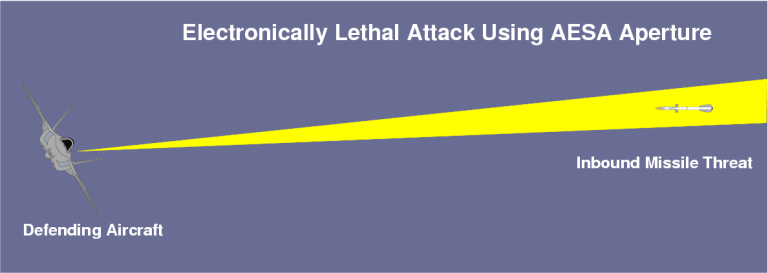
|
||||||||||||||||||||||
 |
||||||||||||||||||||||
![F-22A Raptor, FB-22, F-22E, F-22N and Variants Index Page [Click for more ...]](APA/f-fb-22.png "F-22A Raptor, FB-22, F-22E, F-22N and Variants Index Page [Click for more ...]") |
 |
![People's Liberation Army Air Power Index Page [Click for more ...]](APA/pla-air-pwr.png "People's Liberation Army Air Power Index Page [Click for more ...]") |
 |
 |
 |
 |
 |
 |
![Military Ethics, Culture, Education and Training Index Page [Click for more ...]](APA/ethx-culture.png "Military Ethics, Culture, Education and Training Index Page [Click for more ...]") |
 |
||||||||||||
 |
![Russian / Soviet Weapon Systems Index Page [Click for more ...]](APA/rus-weps.png "Russian / Soviet Weapon Systems Index Page [Click for more ...]") |
 |
 |
 |

|
 |
 |
 |
 |
 |
||||||||||||
 |
 |
 |
||||||||||||||||||||
| Last Updated: Mon Jan 27 11:18:09 UTC 2014 | ||||||||||||||||||||||
|
||||||||||||||||||||||
|
||||||||||||||||||||||
|
||||||||||||||||||||||
|
|
|
|
|
|
|
|
|
|
|
||||||||||||
|
|
|
|
|
|
|
|
|
|
|
||||||||||||
| |
|
|
||||||||||||||||||||
| Last Updated: Mon Jan 27 11:18:09 UTC 2014 | ||||||||||||||||||||||
|
||||||||||||||||||||||
Grisha's Radar «Fry-Off» |
||||||||
|
Air Power
Australia - Australia's Independent Defence Think Tank
|
||||||||
| Air Power Australia NOTAM 13th April, 2008 |
||||||||
|
||||||||
|
||||||||
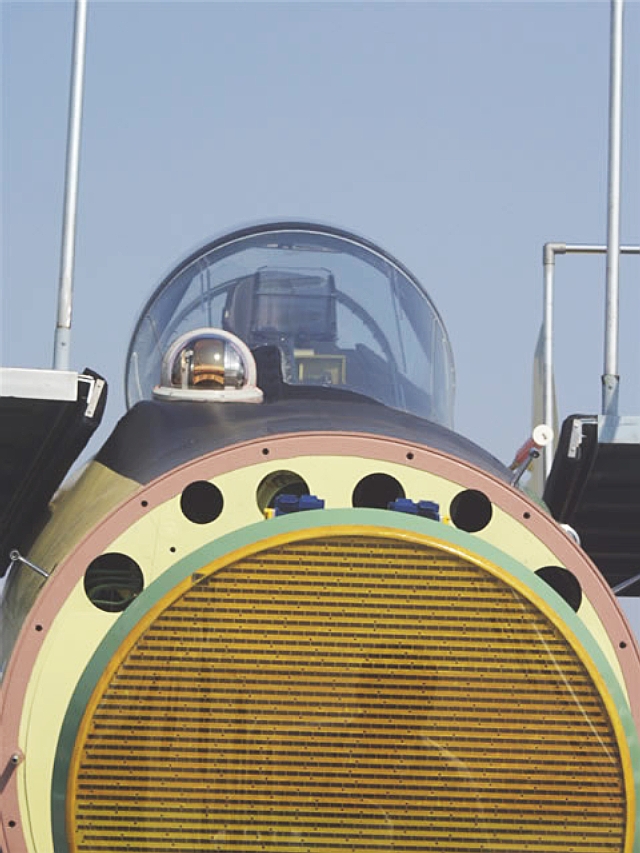 Su-35 demonstrator
with exposed Irbis-E phased array. The now well established trend in
Russian sensors
for BVR combat is increasing range performance and countermeasures
resistance. The 20 kiloWatt peak power class Irbis E ESA radar is the
most
powerful in its class. (KnAAPO). [Click
for more ...]
Good Friends, Grisha has some new stories to tell. Two new radio locators [Ed: radars] to discuss. NIIR Fazotron make Zhuk-AE for MiG-35, and plan much bigger Zhuk-ASE for Flankers, Tikhomirov NIIP make IRBIS-E for Su-35BM. These are in English say 'very hot items' and performance in these radio locators like best Amerikanski radio locators. Now we have fry-off contest to see who does what to who – and first. Make observation. To dazzle enemy, need three factors: power, antenna size and duty cycle. Chuck often laugh at big Russki warplane, but as Comrade Stalin used to saying, ‘quantity has a quality of its own.’ In these big FARs [Ed: FAR=ESA; AFAR=AESA radars] 'quantity of channels has a quality of its own.’ This time, the 960 mm size of the Sukhoi antenna has many uses. More power, sharper beam, more signal detect, more place to remove heat. Amerikanski AFAR modules now better than Fazotron modules, but Russia catch soon. Sukhoi can take better AFAR modules in IRBIS-E or ZHUK-ASE upgrade, but Super Hornet, Lightning II and Raptor cannot take bigger antenna. Then Russki overpower Amerikanski stuff - zap Super Hornet, fry Lightning II and even burn tail-feathers of Raptor. So, how to use these new killer-watts and big antenna? Russian Institute of Radio Physics and Electronics says Zhuk-AE and IRBIS-E see Super Hornet outside AIM-120D range. Lightning II only safe from head on and if clean – two Sukhois fly around Lightning II in pincer manoeuvre to take side or rear shot. Sukhoi has choice of missiles – R-172, R-37, R-27 and R-77M. RVV-AE-PD ready soon. Here
is Su-35 fight tactic. Detect APG-79 / APG-81 radio locator
transmissions long way out with Khibiny complex
[Ed: Radio Frequency Surveillance (RFS) system] and big FAR antenna,
climb to 15,000 metres and Mach 1.5. When detect Super Hornet
or Lightning II, fire salvo, and turn 110 degrees while directing
missiles to Amerikanski fighter. IRBIS-E has hydraulic slew on
antenna, so can retreat and still guide missiles. Give AIM-120D
long chase – he not catch Grisha.
Amerikanski think to use AFAR to blow up incoming missiles. Russian Institute of Radio Physics and Electronics think of this too. Have upgrade kit for all new style Russki missiles. Add protection to radio-locator inputs, and antenna servoes. Take old radio fuze out and replace with laser fuze, cover hole with metal grid so no energy gets inside. Body covered with special coating to spread radio waves and stop radio locator energy getting inside to fry electronika. Self
guidance head [Ed:seeker] software upgrade tilt antenna reflection
away from target so use phase steering to track. Lot of SHF
absorber material [Ed: RAM - radar absorbent material] behind self
guidance
head. Some fancy shapes near rocket motor exhaust to spread
creeping
radio location wave. This upgrade not cost much, but send reflection
away from target so missile get very close to target before
detection, and make much harder to kill with AFAR beam. Also,
salvo firing force AFAR radio locator to jump beam between incoming
missiles.
Maybe Chuck not thinking of attack geometry. Grisha likes towed decoys – when missile warning complex [Ed: MAWS] goes off, turn to put incoming missile 130 degrees off nose so decoy masks aircraft. Amerikanski AFAR sweep 60-70 degrees off nose, so to fry missile, Chuck must turn to face incoming. This time aircraft mask decoy. Not so good. I think Chuck very brave or very stupid to rely on AFAR to blow up missiles. This tactic may blow up in his face and cook his own pidgeon. Of course, two can play the ‘fry the missile’ game. Su-35 has OLS-35 detector to see hot missile incoming, so have two complex to find missile. Turn radio locator antenna on incoming missile, so Snow Leopard can jump and fry its brain with 20 KiloWatts. New Fazotron Zhuk-ASE AFAR even better. More kiloWatts so can fry more AIM-120D. Maybe Chuck in Super Hornet or JSF with little AFAR antenna should think more about warming Pizza than stopping our Vympels [Ed: Russian missile manufacturer]. |
||||||||
|
Critical
Analysis
Dr Carlo Kopp, SMAIAA, MIEEE, PEng Editor APA The notion of using a high
power electronically steered radar to 'fry' the onboard electronics of
a guided missile is neither new nor particularly original. The idea
emerged during the 1990s in the aftermath of the debate surrounding
E-bombs and other electromagnetic weapons. The essence of the concept
is that modern missile seekers and guidance systems are complex digital
electronic devices which can suffer electronic upsets or even
electrical damage if exposed to microwave radiation of sufficiently
high intensity.
The reasoning behind this regime of electronic attack is that rather than to deceive the inbound missile as to the location of the target, i.e. defending aircraft, the target actively defends itself by using the very high power rating of the radar and its exceptional beamsteering agility - virtually identical for all electronically steered US AESAs and Russian hybrid ESAs or AESAs - to illuminate the incoming missile and cause either an upset to its guidance electronics or lethal electrical damage to its analogue and/or digital electronic hardware. The idea was so popular during this period that it spawned a specialised product, the ground based Raytheon Vigilant Eagle, essentially a very large AESA radar intended to protect airliners from shoulder launched missile attacks by illuminating them with an microwave beam of very high power to cause electronics failures. There are however some important differences between fighter borne AESA/ESA radars and the multiple square metre array of the Vigilant Eagle system, primarily in the intensity of microwave illumination they can produce. To what extent are claims of using a fighter AESA radar as a microwave beam weapon to electrically kill inbound missiles reasonable? A senior US Air Force officer was quoted in the September 5, 2005, issue of Aviation Week & Space Technology, thus: "AESA radars on fighter aircraft aren't particularly suited to create weapons effects on missiles because of limited antenna size, power and field of view...". This observation is entirely correct, for a number of good technical reasons. These all have to do with how much microwave power is needed to disrupt or damage electronic components versus how much power can be delivered by a fighter carried radar into the target missile. A number of studies have been performed in recent years to determine the electrical field strengths needed to achieve disruptive and lethal effects against electronic equipment, mostly in the context of High Power Microwave weapons such as E-bombs. The results are essentially that electrically lethal effects are produced at field strengths of kiloVolts/metre, and disruptive effects at hundreds of Volts/metre. These studies generally involved commercial electronic equipment, rather than hardened military equipment, and usually involved direct exposure of the equipment to microwave radiation. If we plot the achievable field strength against distance, for a number of Russian phased array radars, we get interesting results: 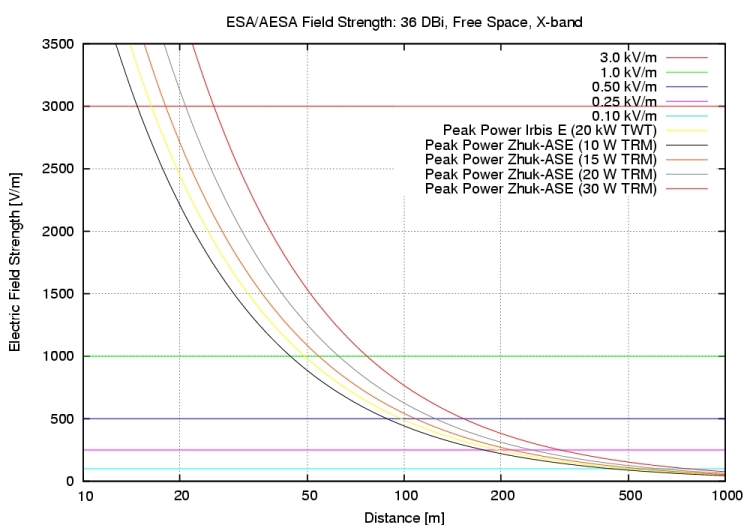 Potentially lethal effects are produced only inside 100 metres range, and disruptive effects at distances of the order of one kilometre. Radars with lesser power-aperture performance, such as the APG-79 (Super Hornet) and APG-81 (JSF) would produce lesser effect at a given distance. This is contingent on the assumption that the internal electronics of the missile are exposed to the full intensity of the impinging microwave beam. The latter is very optimistic for a variety of reasons. Microwave radiation can couple into a missile via two paths.
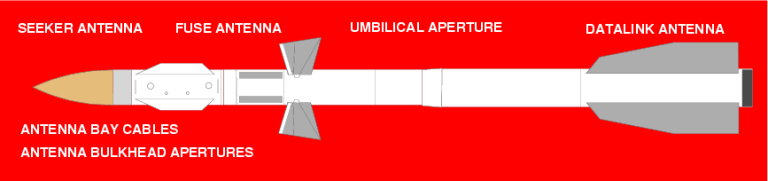
If the aim is to couple into the missile via its seeker antenna, this will only be feasible for older semi-active homing missiles like the AIM-7 and R-27R series, which rely on illumination by the launch aircraft and thus must operate in the same band as the radar guiding the missile. Most active radar guided missile seekers operate in the Ku-Band or above it, as a result of which most of the impinging X-band radiation will couple in very poorly as the missile antenna is designed for half the wavelength, or less, compared to an X-band radar. Another consideration is that many missile seekers in this class will include active protection devices designed to protect the sensitive receiver circuits from leakage from the missile's transmitter circuits. So what X-band radiation can get in via the antenna is apt to be soaked up by the protection devices. Radar fuses and datalink antennas are potentially more susceptible to penetration as they are low gain designs which are inherently wideband, and likely to lack protection devices. However, the fuse antennas point sideways relative to the target until the missile is within milliseconds of impact, and the datalink antenna is always pointing away from the target. Therefore the combination of antenna location and low gain makes them poor candidates for delivering a lethal dose of X-band radiation. The electronic warfare literature is very specific about the challenges in jamming these channels, as exceptionally high power is required for effect. Microwave lethal effect requires even more power. Indirect coupling via cables and through hole apertures behind an antenna or infrared seeker head, or via the missile umbilical connector on its back should also be considered, as these are the only other apertures usually available on an air to air missile. The former might be feasible if the missile designers did not take care to put protection devices and proper shielding in. If the drive transistor on the antenna gimbal servo melts, the missile will be killed. Unfortunately for the attacker in this game, such components are very robust, and shielding and protection devices easy to add in. The bottom line in this game is that other than some very specific missile types with X-band antennas, and specific vulnerabilities in particular active radar guided or infrared homing missiles, the opportunities to deliver lethal electrical damage with forseeable fighter radar technology will not be many. The defensive countermeasures an opposing missile designer can apply are neither expensive nor technically difficult to implement. Most would not require replacement of the missile seeker, but rather depot level fixes which could be applied during scheduled missile servicings. So Colonel Medved's arguments stand up to scrutiny here, and only a very courageous air force would rely on using a fighter radar to burn out an incoming missile guidance system in a real combat environment. Further Reading:
|
||||||||
| Footnote: Col. Grisha Medved is a former retired fighter pilot. |
||||||||
| Air
Power Australia Website - http://www.ausairpower.net/ Air Power Australia Research and Analysis - http://www.ausairpower.net/research.html |
||||||||
 |
||||||||
| |
||||||||
|
|||||||||||||
|
|
|
|
|
|
|
|
|
|
|
|||
|
|
|
|
|
|
|
|
|
|
|
|||
| |
|
|
|||||||||||
| Artwork, graphic design, layout and text © 2004 - 2014 Carlo Kopp; Text © 2004 - 2014 Peter Goon; All rights reserved. Recommended browsers. Contact webmaster. Site navigation hints. Current hot topics. | |||||||||||||
|
Site Update
Status:
$Revision: 1.753 $
Site History: Notices
and
Updates / NLA Pandora Archive
|
|||||||||||||
|
|
Tweet | Follow @APA_Updates | |||||||||||
|
|
|||||||||||||
|
|
|||||||||||||