Russian
/ Soviet Point Defence Weapons
Technical Report APA-TR-2008-0502
|
by
Dr Carlo Kopp, AFAIAA, SMIEEE, PEng
May, 2008
Updated June, 2008
Updated March, July, 2009
Updated April, 2012
|
| ©
2008 - 2012 Carlo Kopp |
|
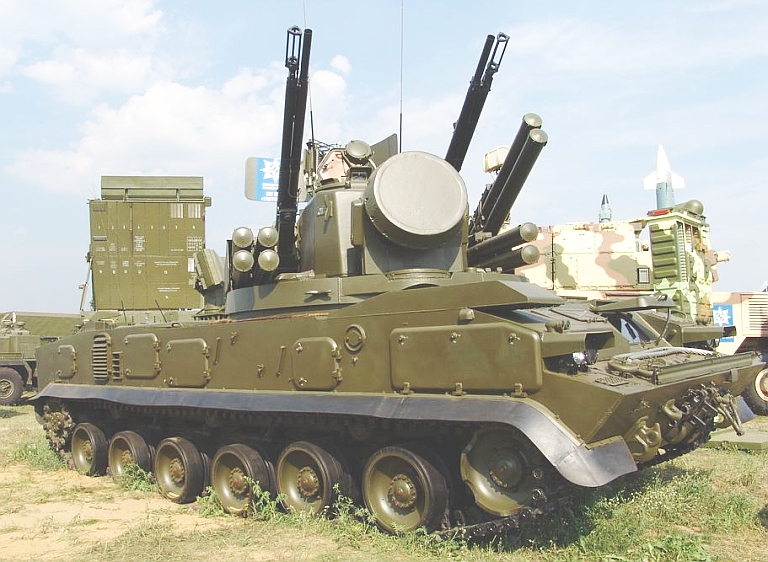
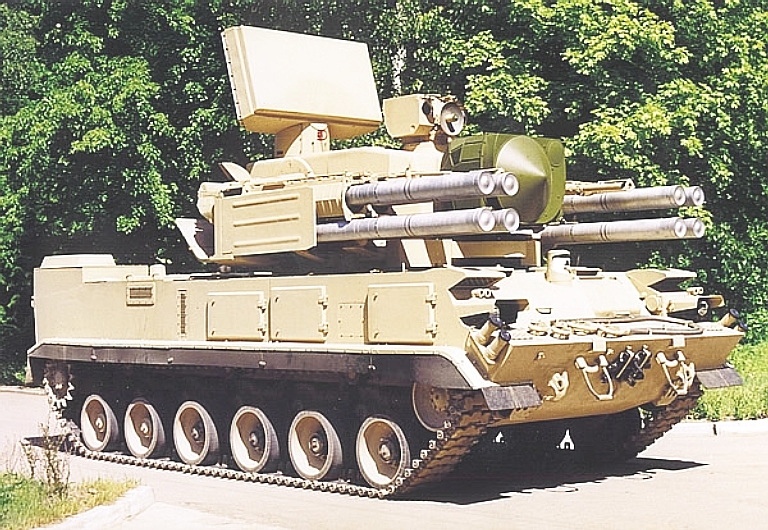
The 2S6 Tunguska/ SA-19 Grison is the
replacement for the ZSU-23-4P SPAAG. It has spawned a series of
variants, including the potent Pantsir S1 / SA-22 Greyhound, equipped
with a phased array engagement radar derived from an aircraft design
(Russian internet image).
|
|
|
|
|
Background
A topic which has received less
than its due attention in the recent defence debate is that of the
evolving role of point defence weapons.
Historically such weapons were employed mostly to stop 'leakers',
aircraft which managed to penetrate through fighter defences and area
defence SAM belts. Early Russian point defence weapons such as the SA-8
Gecko and ZSU-23-4P were mostly tasked with this role, defending
armoured forces on the move and fixed installations against air attack.
After the enormously successful debut of the wire guided TOW missile in
Vietnam, NATO forces deployed large numbers of helicopters armed with
anti-tank missiles, initially wire guided, later sem-active laser
homing and most recently, with active millimetric band radar seekers.
The tank killing helicopter was supplemented by the tank killing A-10
Thunderbolt, armed with the AGM-65 Maverick anti-armour missile and a
potent 30 mm gun.
The Soviet response to these highly effective anti-armour systems was
to develop a new generation of highly mobile point defence weapons,
these being the 2S6 Tunguska / SA-19 Grison and Tor / SA-15 Gauntlet,
both designed to rapidly react to pop-up threats and engage them with
fire before they could conceal themselves behind terrain.
With the end of the Cold War came the Desert Storm campaign, followed
by US air campaigns against Serbia in 1999 and Iraq in 2003. All three
of these campaigns saw the massed use of Precision Guided Munitions
(PGM), more than often from standoff ranges.
Russian planners identified the PGM as the primary risk to their fixed
and ground force installations, and pursued further evolution of the
SA-15 and SA-19 to defeat this threat.
The latest Pantsir S1 / SA-22 Greyhound and Tor M2 / SA-15 Gauntlet
systems are equipped with phased array engagement radars, very fast
SAMs, and are designed to rapidly react to incoming PGMs and destroy
them before they hit their targets. In a fundamental sense, Russia's
designers have followed much the same path as Western naval air defence
artitects have, reacting to late Cold War and subsequent anti-shipping
missile capabilities. The problem is much the same.
From a force structure planning perspective, such point defence systems
will over time render non-stealthy subsonic PGMs irrelevant, as these
will be easily tracked and engaged. The future lies in PGMs which are
stealthier and faster than existing designs.
This APA analysis surveys the most important Russian systems currently
deployed and in the market.
|
References
- «Оса»,
(9К33, SA-8, SA-8A, Gecko) зенитный ракетный комплекс
- The OSA
anti-aircraft missile system, JSC "Izhevsk Electromechanical Plant
"Kupol".
- The
TOR-M1 anti-aircraft missile system, JSC "Izhevsk Electromechanical
Plant "Kupol".
- The
TOR-M2E anti-aircraft missile system, JSC "Izhevsk
Electromechanical Plant "Kupol".
- Miroslav Gyürösi, Russian companies team to develop
wheeled
Tor-M2E , Jane's Missiles &
Rockets, October 01, 2007.
- Pantsir-S1
Air Defense Missile/Gun System, KBP Instrument Design
Bureau, 59
Shcheglovskaya Zaseka St., 300001 Tula, Russia.
- Tunguska-M1
Air Defense Missile/Gun System, KBP Instrument Design
Bureau, 59
Shcheglovskaya Zaseka St., 300001 Tula, Russia.
- 30
mm 2A38M Automatic Anti-Aircraft Gun, KBP Instrument Design
Bureau, 59
Shcheglovskaya Zaseka St., 300001 Tula, Russia.
- Phazotron
Shlem air defence radar system, Phazotron NIIR.
- Martin Rosenkranz, MAKS 2007
Spezial: Pantsir-S1 (SA-22), Russlands neuestes Flugabwehrsystem.
- PGZ95
Self-Propelled Anti-Aircraft Artillery, Chinese Defence Today.
- HQ-7
(FM-80) Surface-to-Air Missile System, Chinese Defence Today.
- HQ-61A
Surface-to-Air Missile, Chinese Defence Today.
- Schamiloglu E, High Power Electromagnetic Threats to
the
Civilian Infrastructure - A New Concern for a New Age, IFIS
Briefing,
November, 2004, URL: http://www.ece.unm.edu/ifis/papers/CyberSecurity.ppt
.
- Kopp, C., Air Power
Australia - May
2008 -
High
Energy Laser Directed Energy Weapons
- ГСКБ "Алмаз-Антей", Лазерные
технологии, 125190, Российская Федерация, г.
Москва, Ленинградский
проспект, д. 80, корпус 16.
- Australian
Aviation -
December 1981 - High Energy
Laser
Weapons
- Air Power
Australia - May
2008 -
High
Energy Laser Directed Energy Weapons
- ГСКБ "Алмаз-Антей", Лазерные
технологии,125190, Российская Федерация, г.
Москва, Ленинградский
проспект, д. 80, корпус 16
- Air Power Australia - December
2006 - Almaz
S-300PT/PS/PMU-1/2, S-400
Triumf, S-400M Samoderzhets
- Northrop-Grumman - Mobile
Tactical High Energy Laser (MTHEL) [Includes papers]
- Northrop-Grumman - THEL
Summary (Video)
- Northrop-Grumman - THEL
Mortar Shootdown (Video)
- Northrop-Grumman - THEL
Multiple-Rocket Shootdown (Video)
- Image sources: RuMoD,
Rosoboronexport, Almaz-Antey, KBP, Kupol, Vestnik PVO, Other.
Russian/Soviet
Point Defence Systems
|

KBP 96K6
Pantsir
S/S1/S1E / SA-22 SPAAGM
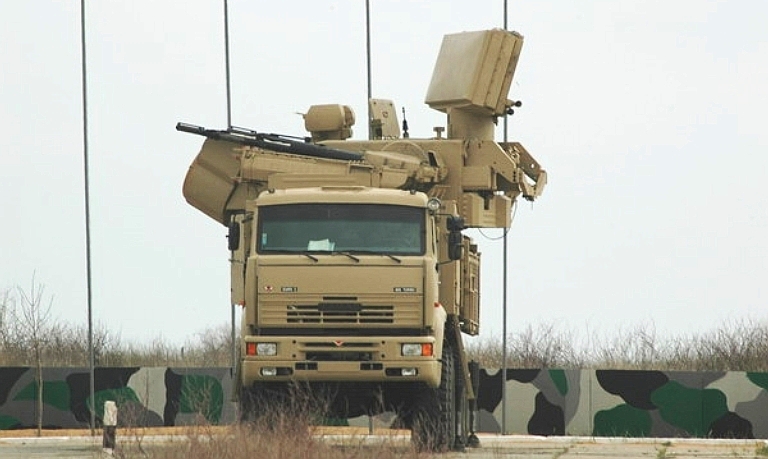
The
latest
Pantsir S1 configuration at MAKS-2007, carried by an 8 x 8 KAMAZ-6560
chassis. This variant incorporates a new Phazotron designed agile beam
phased array engagement radar, derived from Phazotron's earlier effort
on the Zhuk MF PESA air intercept radar.

(Images via KBP, Vestnik
PVO)
The KBP Panstsir S1 / SA-22B
Greyhound is the most recent derivative of the Tunguska system,
incorporating a range of improvements over the baseline Pantsir S, and
its predecessor, the 2S6M Tunguska M SPAAG/SAM system.
This family of systems combines the 2A38M 30 mm automatic cannon system
with the high velocity 9M311M two stage CLOS missile.
The 9M311M series SAM is unusual in it class as it is a two stage
weapon, designed for exceptionally high acceleration to effect
snapshots against fleeting targets such as heicopters. Compared to the
earlier 9M311 variants, the higher impulse booster stage pushes the
second stage to 1,100 m/s. KBP are marketing the system as a capability
to engage and destroy the full spectrum of airborne targets, comprising
aircraft, UAVs, cruise missiles, precision guided weapons, ballistic
missiles and soft skinned surface targets.
KBP define the basic capabilities of the Pantsir series thus:
- High jamming immunity in intensive ECM environment;
- High survivability in massive employment of HARM-type
antiradar missiles;
- A capability of destroying high precision weapons, such as
Tomahawk cruise missile, Walleye 2 guided air bomb, Maverick guided
missile etc.;
- A capability of engaging fixed- and rotary- wing aircraft,
RPVs, etc.;
- Effectiveness at any time of night and day, in good and
adverse weather;
- High mobility, specifically for protecting motorized and
armor units;
- High availability and reliability.
The Pantsir S introduced a 12 round missile capability, a thermal
imaging system to complement the optical tracker, and revised
engagement radar component.
While the Pantsir series is offered on a tracked chassis like the
Tunguska, it has been primarily marketed in the road mobile
configuration, which is less costly to acquire and maintain, and trades
away off-road mobility for much higher 90 km/h road speed.
The Pantsir S1 introduces a number of important improvements over the
baseline Pantsir S. The new 9M335/57E6 missile replaces the established
9M331 series, this weapon provide 20 km range, 70% more than the
9M331M1, a significantly higher maximum target altitude, challenging
many area defence missiles, a larger 20 kg warhead, and more thrust to
accelerate the missile to 1,300 m/s in 2 seconds. The radar package is
also replaced, with a new planar array (claimed to be a PESA) search
radar, and an X-band engagement radar derived from Phazotron's fighter
phased arrays.
The new engagement radar is claimed to have a 45° off boresight
deflection angle, yielding coverage inside a 90° solid angle, with
mechanical elevation to provide up to 85° of vertical angular coverage.
It can track 20 targets and automatically prioritise the top three for
engagement, and four missiles can be concurrently gathered and tracked.
An opto-electronic search and tracking function is provides, in the
midwave and shortwave infrared bands. The missiles can be alternately
tracked by the engagement radar or the OE system. A digital datalink is
provide to permit networking multiple Pantsir S1 systems in a battery.
The Pantsir has been ordered by the UAE, Syria and Algeria. European
sources claim the PLA and Greece are negotiating for the system. The
system is offered on the 8x8 KAMAZ-6560, 8x8 MZKT-7930 and
tracked GM 352M1E chassis.
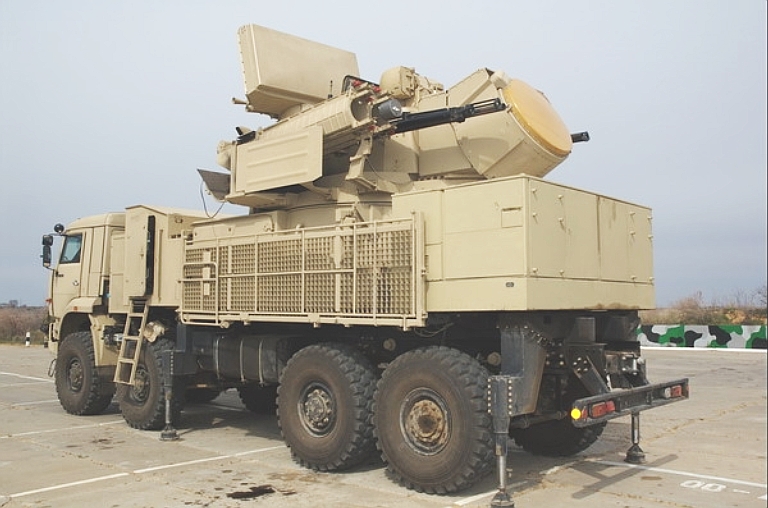
Stowed configuration for transit. The
SA-22 lives up to its name, providing very high mobility.
The most recent Pantsir S1 variant has a PESA engagement radar and a
planar array search radar antenna, with much better sidelobe
performance compared to the concave reflective design in the Pantsir S.
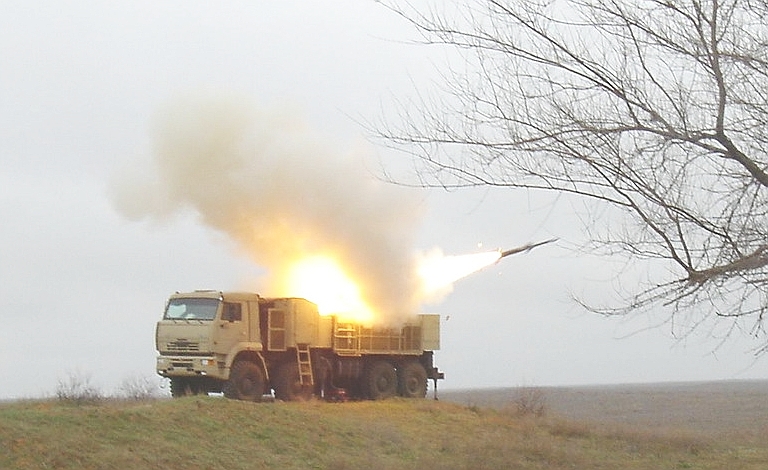
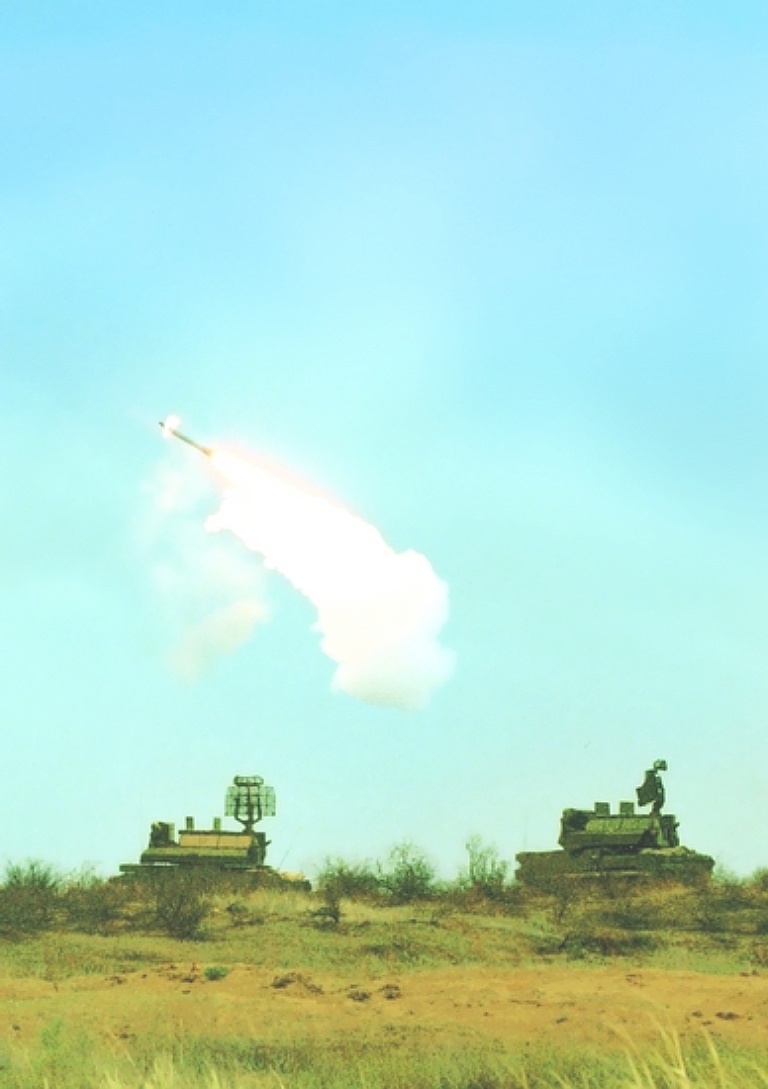
Pantsyr S1 launching a missile on a test range (KBP).

Basic
Characteristics (KBP)
|
| Armament |
missile/gun |
| Ammunition
load, pcs |
|
ready-to-fire missiles |
12 |
|
30mm rounds |
1400 |
| Control
system |
multiple-band
radar-optical |
| Aircraft
engagement zone, m: |
|
by missiles: |
|
range |
1200-20000
|
|
altitude |
5-10000 |
|
by guns: |
|
range |
200-4000 |
|
altitude |
0-3000
|
| Reaction
time, s |
4-6 |
| Number
of
targets simultaneously fired at |
2 |
| Fire
on the
move by SAMs and guns |
provided
(for CV on tracked chassis) |
| Crew |
|
|
Basic
tactical and technical characteristics of the "Shlem" weapon control
system (Phazotron)
|
| TARGET ACQUISITION RANGE (RCS=2 m2),
km |
24-28 |
| TARGET
POSITIONING ERROR (MSE): |
| ANGULAR
COORDINATES, mrad |
0,2-0,3 |
| RANGE,
m |
5 |
| SAM GUIDANCE |
RADIO COMMAND |
| OPERATION
ON THE MOVE |
YES |
| HAS
A BUILT-IN TEST SYSTEM |
|
KBP 2K22M1/2S6M1 Tunguska-M1/
SA-19 Grison SPAAGM
The modernised 2S6M1 Tunguska M1 employs a
planar array search radar, and a distinctive radome for the engagement
radar component.
First introduced in 1982, the
Tunguska series of hybrid SPAAG/SAM systems was deployed by the PVO-SV
to provide a replacement for the legacy ZSU-23-4P, which despite its
success in Vietnam and the Middle East, was recognised as vulnerable to
the then new A-10 Thunderbolt, and to helicopters firing anti-armour
missiles, such as the Hellfire equipped AH-64A
Apache. From the Soviet perspective, both of these threats would
popu up briefly above the radar/visual horizon, fire at Soviet tanks or
SPAAGs, and then disappear below the horizon before the ZSU-23-4P or
Romb / SA-8 systems could respond with defensive weapon fire.
The Soviets needed a weapon system which could win in a 'high noon'
shootout with the A-10 or a nap-of-ther-earth pop-up rotary wing
threat. This became one of the defining requirements for the Tunguska,
and led to the development of the high speed 9M311 SAM, intended to
cross the distance between the Tunguska and the target before the
latter could hide below the horizon line. This capability would be
supplemented by a 30 mm gun system, the Soviets clearly coveting the
BundesWehr's Krauss-Maffei Wegmann FLAKPanzer Gepard SPAAG.
The missile requirement led to the unusual two stage 9M311 design, in
which the first stage boosted the round to 900 m/s at burnout, the
sustainer in the terminal stage burning to impact and maintaing a 600
m/s velocity. The missile employs command link guidance, with an
automatic Command to
Line Of Sight (CLOS) control loop for the terminal phase to impact,
with an 18G capability. The
engagement radar component of the 1RL144M Hot Shot system is claimed to
operate
in the millimetric band, using jam resistant monopulse angle tracking;
a 1A29M optical sight is boresighted with the radar. A 1RL138 IFF
system is included. Conceptually the 2S6 missile package has its
closest Western equivalents in the Franco-German Roland system, and the
UK Rapier Blindfire and Seawold systems.
The gun requirement led to the adaptation of the 30 mm GSh-30
aircraft cannon,
carried by Russian fighters: the 2A38 series liquid cooled 30 mm gun
delivers a rate of fire of 1950-2500
rds/min, a muzzle velocity of 960 m/s, using the 2A42 cartridge and
0.39 kg projectile.
The initial 1982 2S6 Tunguska variant was superceded by the 2K22M/2S6M
Tunguska M in 1990, and the 2K22M1/2S6M1 Tunguska M1 in 2003. The
product line has been further developed as the Pantsir S, primarily in
a road mobile configuration.
The 9M113-M1 SAM has a higher impulse booster, and radio rather than
laser fusing to improve effect against cruise missiles and precision
guided munitions. Defeating the latter has become one of the primary
requirements for late variants of the 2S6 and the newer Pantsir S.
Within the region, the Tunguska has been acquired by India, with claims
that Burma also acquired the system.
Further analysis can be found under KBP 96K6 Pantsir S/S1 /
SA-22 SPAAGM.
Basic Characteristics |
| Armament |
missile/gun |
| Ammunition
load, pcs |
|
ready-to-fire missiles |
8 |
|
30mm rounds |
1904 |
| Control
system |
radar-optical |
| Aircraft
engagement envelope, m: |
|
by missiles: |
|
range |
2500-10000 |
|
altitude |
15-3500 |
|
by guns: |
|
range |
up to 4000 |
|
altitude |
up to 3000 |
| Combat
vehicle weight, t |
|
|
|
Almaz-Antey/Kupol
9K331M/M1 Tor M/M1 SA-15B/C Gauntlet Air
Defense Missile System
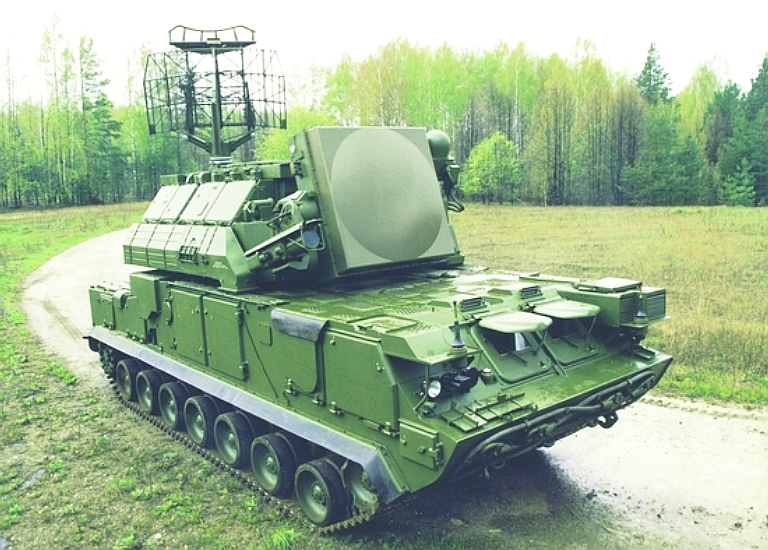
Tor
M1 / SA-15B Gauntlet system (Kupol
JSC).
The
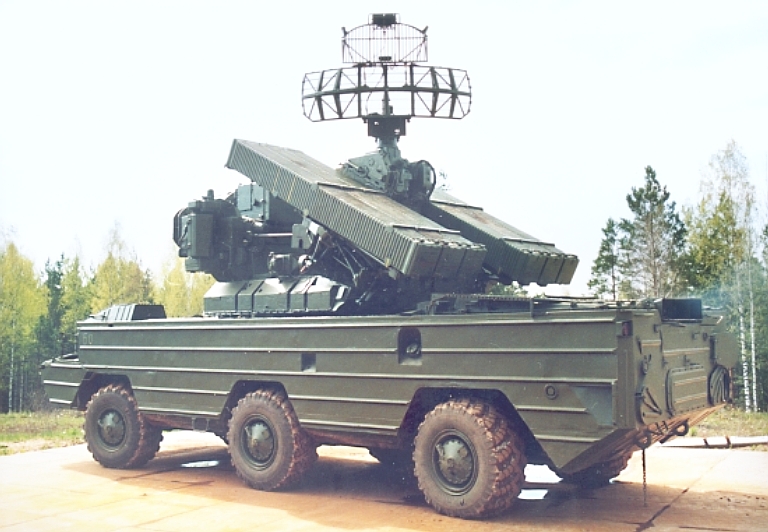
9K331 Tor-M1 / SA-15 Gauntlet system, a highly mobile rapid reaction
SAM built to replace the Cold War era SA-8 Gecko system. Like the
SA-8 Gecko, the Tor M1 TELAR is a fully self contained package, with
a search radar, a monopulse tracking and engagement radar, and a
magazine of Automatic Command to Line Of Sight guided missiles. The
design aims of the Gauntlet were however broader than those for the
Gecko, and not only are low flying aircraft and helicopters intended
targets, but also cruise missiles, standoff missiles and smart bombs
during their terminal flight phase. Russian thinking is that
S-300PMU/S-400 battery elements such as radars and command posts are
to be covered by Gauntlet point defence systems, intended to engage
and destroy guided munitions targeting the S-300PMU/S-400 battery
elements.
The
Gauntlet is carried on a GM-355 or GM-5955 series tracked chassis. The E/F-band
folding surveillance radar is carried on the top of the turret, and
the G/H-band engagement radar, claimed to be a phased array design,
is mounted on the front. Eight vertically launched 9K331
SAM rounds are carried in sealed magazines, these are vertically
ejected before ignition using the cold launch technique. Once clear
of the TELAR, the canard missiles use nose rocket thrusters to pitch
over in the direction of the target and effect the engagement.
Reaction time to threats is credited in seconds between track
confirmation and launch.
While in conceptual
terms the Gauntlet compares well to the Franco-German Roland, the
missile is more advanced and the TELAR far more capable than the
Roland ever could be.
Tor M1
system
launching a missile. The Tor series uses the 'cold launch' technique,
whereby the round is ejected vertically from the tube, and once clear
ignites its motor. Note the nose mounted thrusters used to rapidly
pivot the missile in the direction of the target.
The current production Tor
M1 variant incorporates a range of design improvements over the
baseline Tor/Tor M variants.
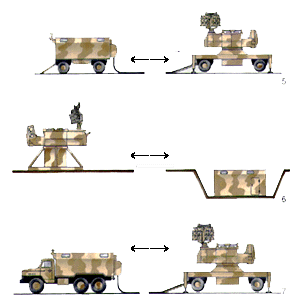
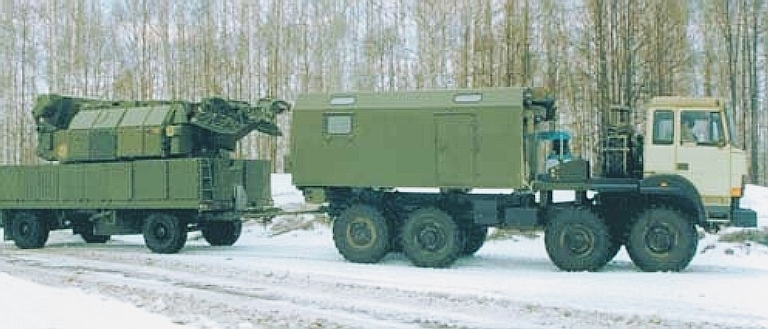
A towed semi-mobile variant of the Tor M1
is on offer, sacrificing
mobility for lower cost (Rosoboronexport).
During
the 1990s the PLA procured the Russian 9K331M1
Tor-M1 / SA-15C Gauntlet system. Chinese
sources put the SA-15 inventory at around 25 systems, deployed with
the 31st and 38th Army
Groups. The Russians have exported this system to Greece and Iran.
A more detailed discussion of the design of this system can be found
under Kupol 9K330/9K331/9K332 Tor M/M1/M2
Self Propelled Air Defence System / SA-15 Gauntlet.
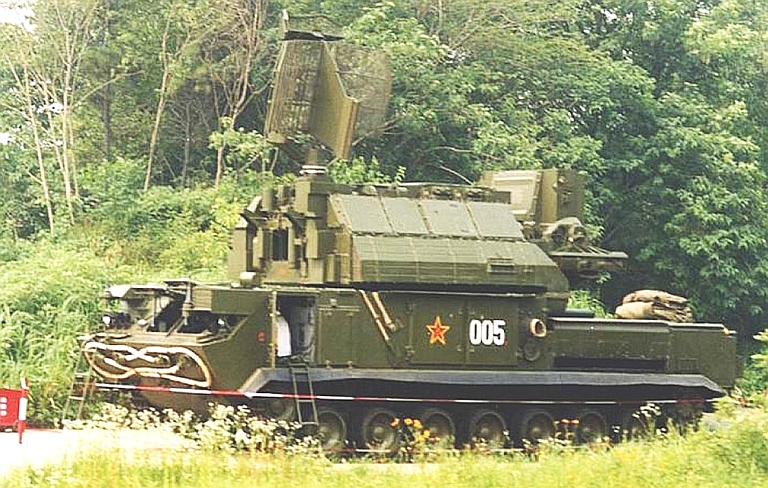
SA-15C Gauntlet of the PLA
deployed with search radar fully elevated.
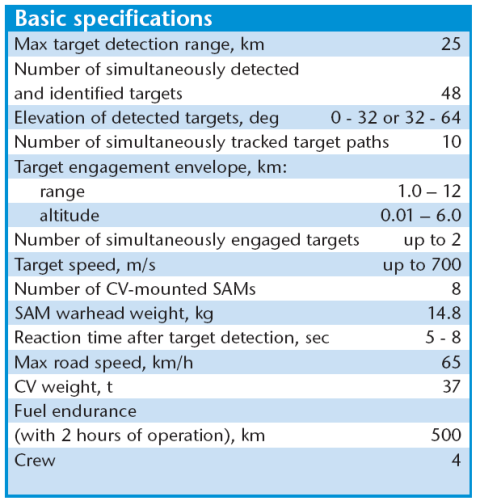 Tor M1 Specifications
Almaz-Antey/Kupol
9K331MK2/MU2 Tor M2/M2E SA-15 Gauntlet Air
Defense Missile System
The Russian Tor M2
or
SA-15D
Gauntlet is by far the most capable point defence SAM system deployed
by Russia and its clientele. It is used to defend against low flying
aircraft as well as cruise missiles and guided weapons like smart
bombs. It is available on a tracked chassis, and more recently, a
purpose designed semi-hardened MZKT-6922 6 x 6
all terrain vehicle. Depicted deployed configuration (Kupol JSC).
The Tor M2/M2E is a 'deep modernisation' of the baseline Tor M1 weapon
system, available on the legacy tracked chassis, or the entirely new
low profile wheeled MZKT-6922
6 x 6 chassis as the 9A331MK, the latter specifically developed by the
ByeloRussian manufacturer for this application. Russian sources claim
the Russian MoD sought the same KAMAZ chassis as used with the SA-22 /
Pantsir S1, but the manufacturer was unhappy with the overall height
and hardness of the vehicle, and contracted MZKT in Minsk to develop a
new vehicle. The MZKT-6922 is semi-hardened, and intended to protect
the crew and systems from small arms fire, shrapnel and spall. The new
vehicle weighs 17 tonnes, with a maximum gross weight of 30 tonnes. It
is powered by a 420 SHP YaMZ-7513.10 diesel, using an MZKT GMP-400
transmission, delivering a road speed of 80 km/h.
The Tor M2E has an improved weapon system. The new planar array
surveillance radar can track up to 48 targets concurrently, retaining
the range performance of the legacy system. The revised phased array
engagement radar uses new phase shifters, and is capable of tracking
targets within a claimed 30° solid angle around the antenna boresight.
Paired command link antennas are mounted on both sides of the array,
used to acquire the missiles post launch, while they are out of the
field of view of the engagement radar array. Missiles can be launched 2
seconds apart. The manufacturer has identified the missile design as an
area of future improvement, the turret permitting the carriage of a
large number of smaller and lighter future missiles.
The envisaged Tor M2E battery structure comprises four 9A331MK TELARs,
one 9S737MK Ranzhir-MK mobile command post, two 9T244 transloader
vehicles, and one 9V887M2K engineering support vehicle.
While the Tor M2E offers incremental gains in system capability, its
key advance over earlier variants is its much higher in-theatre
mobility, and intra-theatre deployability, making it a much more
practical asset for defending infrastructure targets than the legacy
Tor/Tor-M1 variants, optimised to escort armoured battlefield manouvre
formations. The Tor M2E is well suited for the envisaged role of
protecting fixed targets and highly mobile S-300PMU2/S-400 missile
batteries from PGM attack.
A more
detailed discussion of the design of this system can be found under Kupol 9K330/9K331/9K332 Tor M/M1/M2 Self
Propelled Air Defence System / SA-15 Gauntlet.
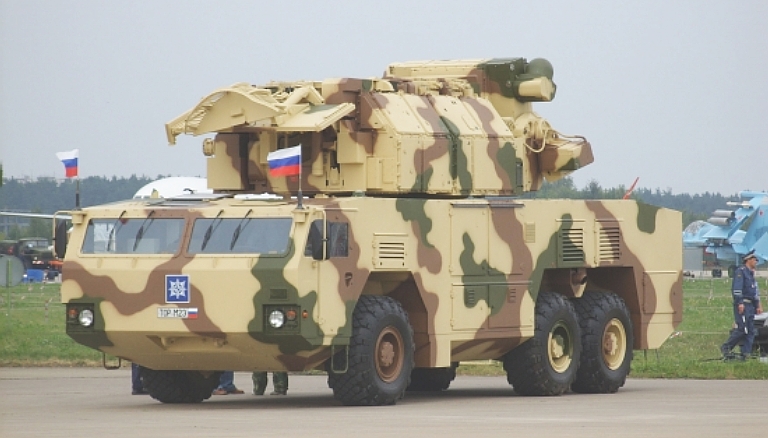
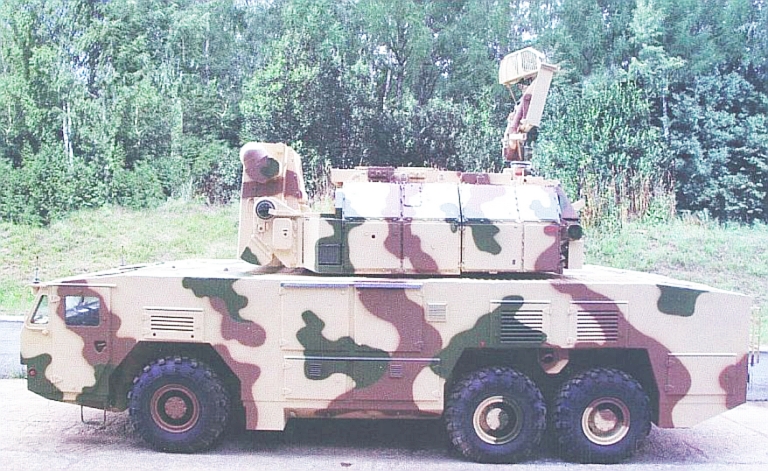
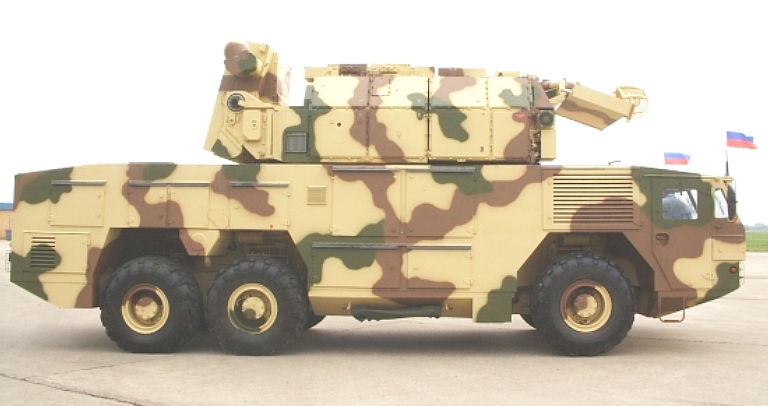
The
improved Tor M2E variant is to
deploy with Russian PVO-SV units in 2009, and has been marketed on a
purpose designed 6
x 6 MZKT-6922 wheeled
vehicle. Images depict stowed configuration (Kupol JSC
images).
|
Almaz-Antey High
Energy Laser Directed Energy Weapon
The interest in the use of High
Energy Laser (HEL) Directed Energy Weapons (DEW) observed in the US, EU
and Israel is paralleled by a development effort at Almaz-Antey aimed
at trialling HEL DEW technology for air defence applications.
Little has been disclosed by Almaz-Antey on the detail of this program.
It clearly intended to build up expertise and experience across the
whole spectrum of necessary capabilities, in this instance beam
director optics, adaptive optics, tracking capabilities, and high
continuous wave power level laser designs.
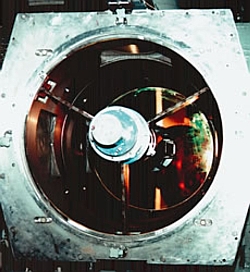
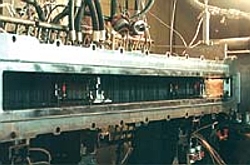
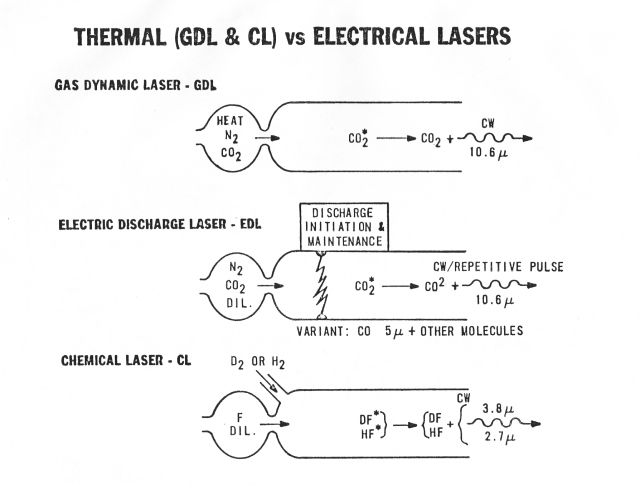
The laser depicted is a CO 2 Gas Dynamic Laser (GDL), the
same technology used by the US Air Force during the 1990s Airborne Laser Laboratory (ALL)
program. It operates in the LWIR band at 10.6 microns, and is
operationally attractive due to its simple fuel supply in comparison
with Deuterium Fluoride (DF) and Chemical Oxygen Iodine Laser (COIL).
What is less attractive about CO 2 GDLs is that tropospheric
CO 2 molecules increase propagation losses, and aluminium,
the primary structural material in many potential targets, has a very
high reflectance in this band, thus reducing power coupling efficiency
into the target, and increasing dwell time.
What has not been disclosed by Almaz-Antey is the progress on this
project, especially in the critical area of adaptive optics and
wavefront sensor technology for controlling adaptive mirrors. GDL
technology is relatively mature, and derivative chemical laser designs
will be largely determined by Russian capabilities in developing power
modules for a given laser type. The choice of CO 2 GDL may
have been simply determined by its availability and low risk, as a
means of demonstrating and proving other more sensitive system
components.
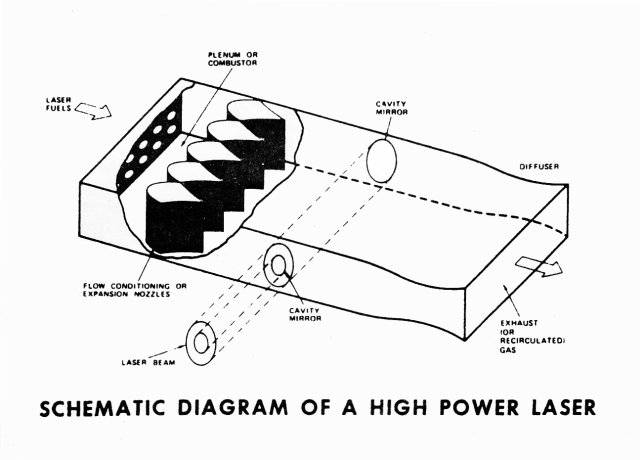
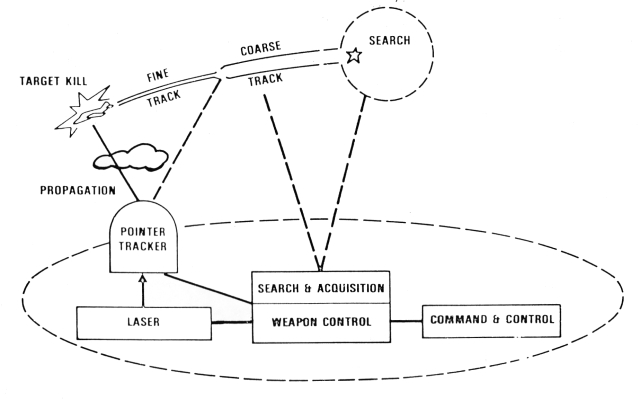
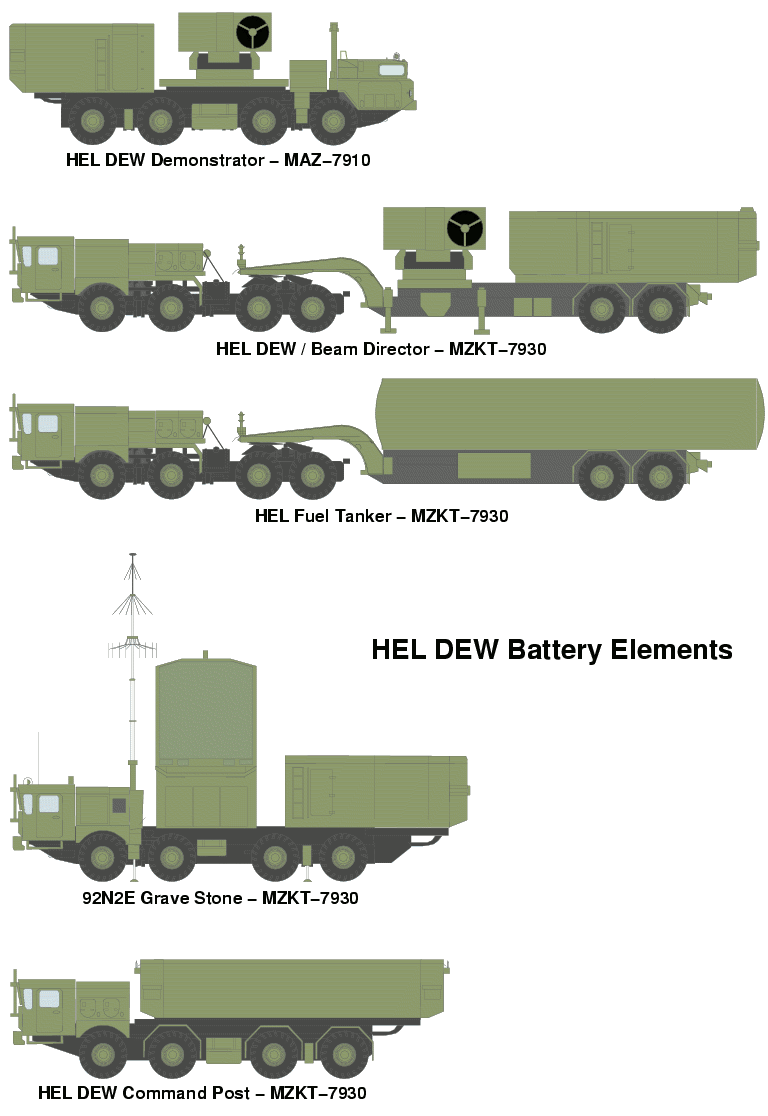
An operational HEL DEW air
defence system will emerge only once the laser and beam director
technology has matured to the point where a robust deployable design
can be built. Given the Russian penchant for robustness and incremental
evolution of designs, it is not difficult to postulate a configuration
for such a system:
- Beam Director Platform
(BDP): an evolution of the existing demonstrator carried on an
8 x 8 MZKT-7930, or towed by an MZKT-7930 in an articulated
semi-trailer arrangement.
- HEL Power Stage System
(PSS): ideally integrated on the BDP vehicle to maximise
mobility, but may need to be carried separately if volume is too great,
the latter impairing mobility.
- Engagement Radar System: a
derivative of the existing 92N2E Grave
Stone carried on an 8 x 8 MZKT-7930.
- Fuel Supply Vehicles: 8
x 8 MZKT-7930, probably based on an existing fuel tanker.
The CONOPS for such a system
would be similar to the US Army MTHEL system, although it is likely the
Russians will pursue a fully mobile configuration, consistent with
their doctrine for SAM systems (refer below). It is likely that a key
role of such a DEW would be the interception of PGMs, this placing the
weapon system firmly in the domain of point defence.
Until we see further disclosures
from the Russian MoD or Almaz-Antey, a more detailed assessment of this
system is not feasible. Given the sensitivity of HEL weapon lethality
performance to operating wavelength and beam quality, any predictions
of achievable range performance would be at best speculative. For a
system to be operationally effective, a sustained power output of the
order of a MegaWatt would be required.
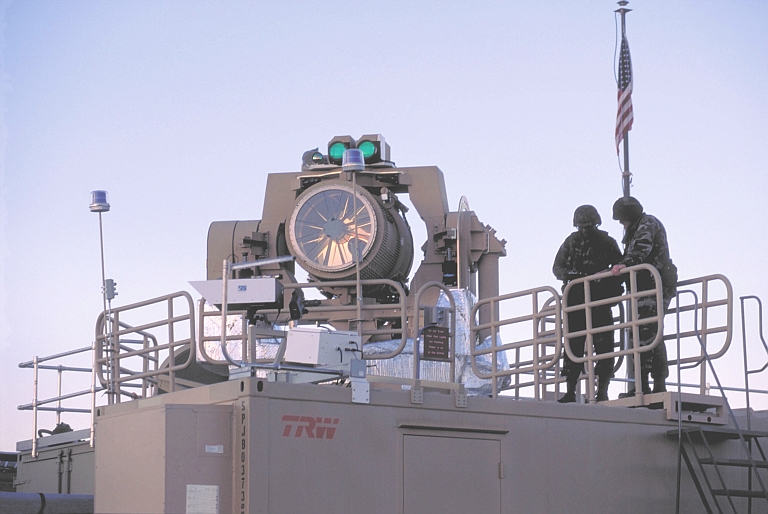
Above:
US Army Tactical High Energy Laser (THEL) beam director turret. Below:
THEL ACTD CONOPS.
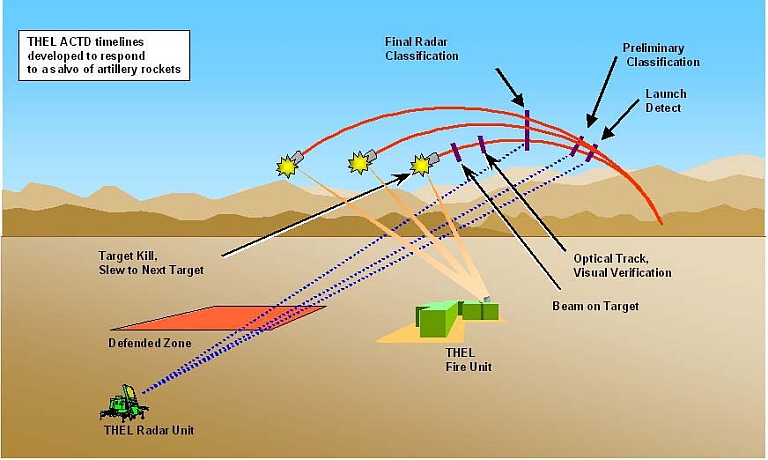
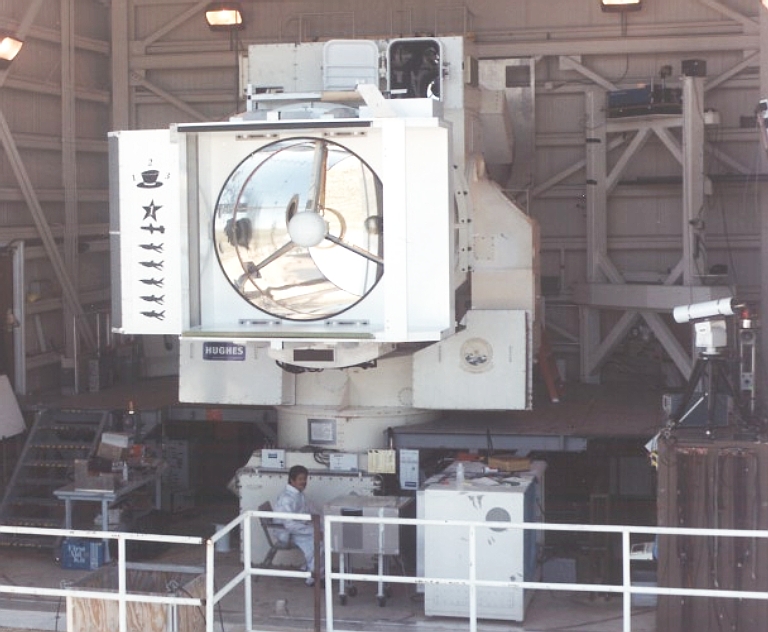
US
Navy MIRACL beam director turret.
|
Ranets
E High Power
Microwave Directed
Energy Weapon
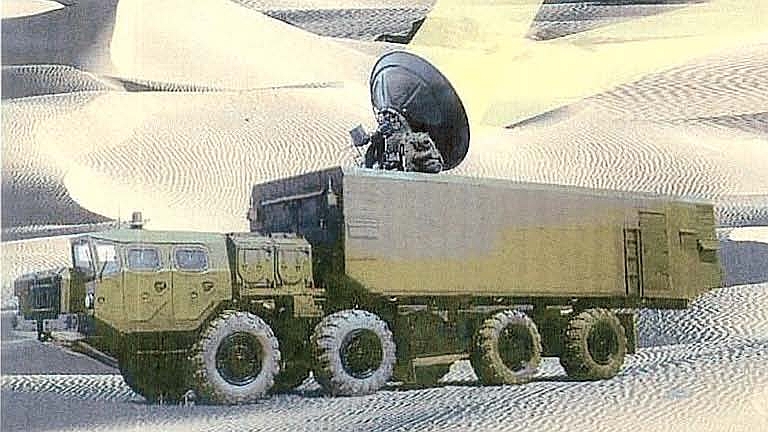
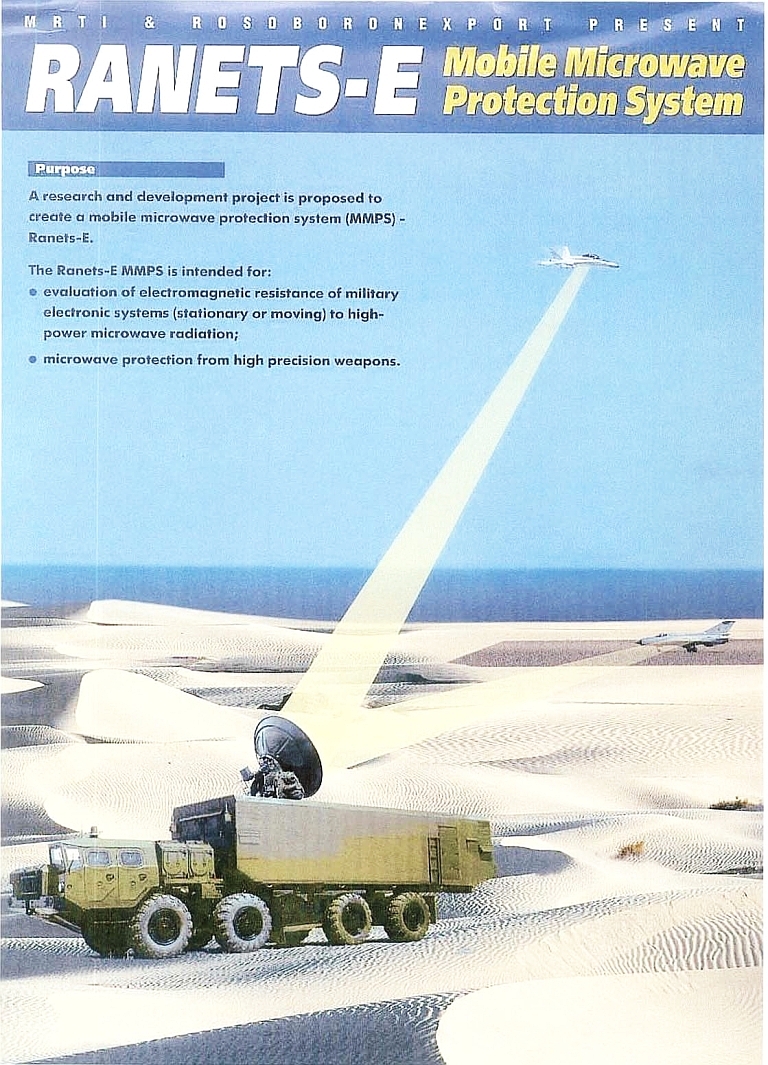
The Ranets E is a High Power
Microwave (HPM) weapon system intended to produce electrically lethal
damage or disruption and dysfunction in opposing airborne systems, be
they aircraft or guided munitions in flight. The system was first
disclosed by Rosoboronexport in 2001, but little technical detail has
been disclosed since then.
The weapon uses an X-band pulsed 500 MegaWatt HPM source, generating 10
to 20 nanosecond pulses at a 500 Hz PRF, and average output power of
2.5 to 5 kiloWatts. The antenna is large enough to provide a gain of 45
to 50 dB in the X-band, for a total weapon weight of 5 tonnes. The
weapon has been described as a "radio-frequency cannon" and Russian
sources credit it with a lethal range of 20 miles against the
electronic guidance systems of PGMs and aircraft avionic systems.
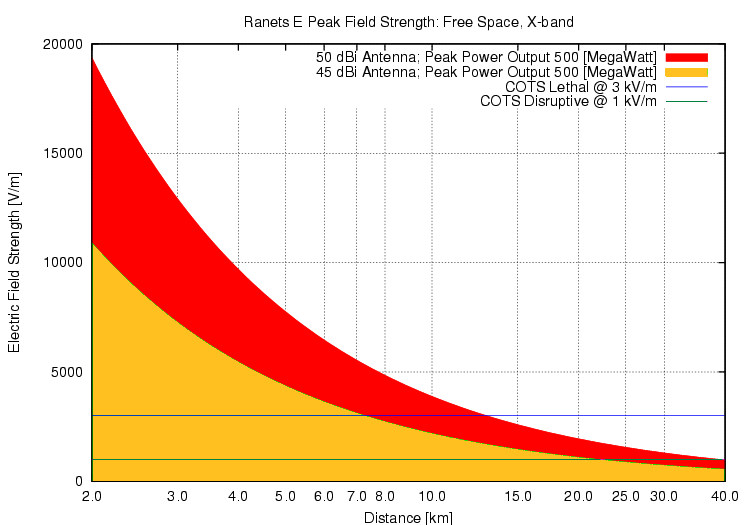
Plot
- Author 31/05/2008.
The cited lethal range figures are predicated on the assumption that
the target is vulnerable to a field strength of the order of ~1.0
kiloVolt/m and the antenna has a gain between 45 and 50 dBi. If we
assume target hardness for typical COTS electronics, the lethal radius
is between 3.8 and 7.0 nautical miles, if the target hardness is
greater, the lethal footprint is reduced accordingly. What is clear is
that the Ranets E will be a credible electrically lethal weapon at
ranges typical for a terminal point defence weapon weapon.
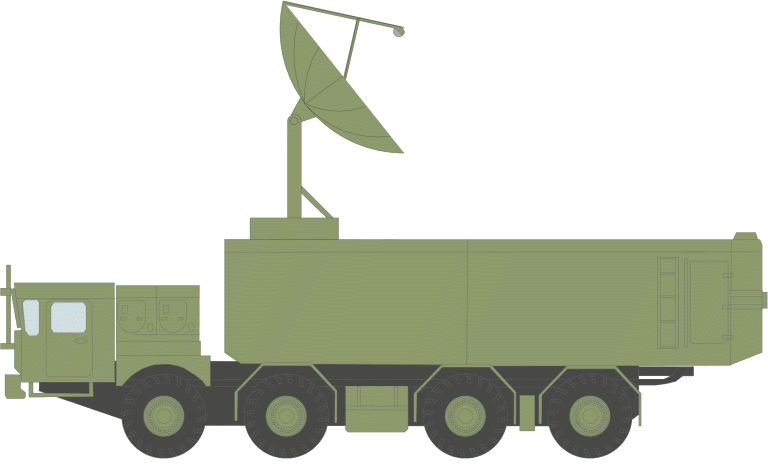
The product brochure for the weapon shows its deployment on the
MAZ-7910 chassis using the 54K6 command post cabin to house the Ranets
system, with an roof mounted turntable for the steerable parabolic
antenna. Other lower quality illustrations (not reproduced) show the
Ranets E vehicle linked via cables to a 85V6 Vega/Orion Emitter
Locating System (ELS) used as the targeting element. In the absence of
an integrated targeting system on the Ranets E - problematic due to the
risk of fratricide as even sidelobes would be electrically lethal at
short ranges - it is likely that an operational system would be
remotely aimed by another asset. Other than an ELS a SAM system
engagement radar with sufficient angular accuracy would be suitable.
The CONOPS for the system would involve attaching one or more Ranets E
systems to a battery of SAMs and integrating them with the battery fire
control system, such that the Ranets E systems would be cued, aimed and
fired remotely.
The APA illustration shows the system deployed on the MZKT-7930 chassis
as that is the current production replacement for the original MAZ-7910.
|
Legacy
Point Defence Systems
|
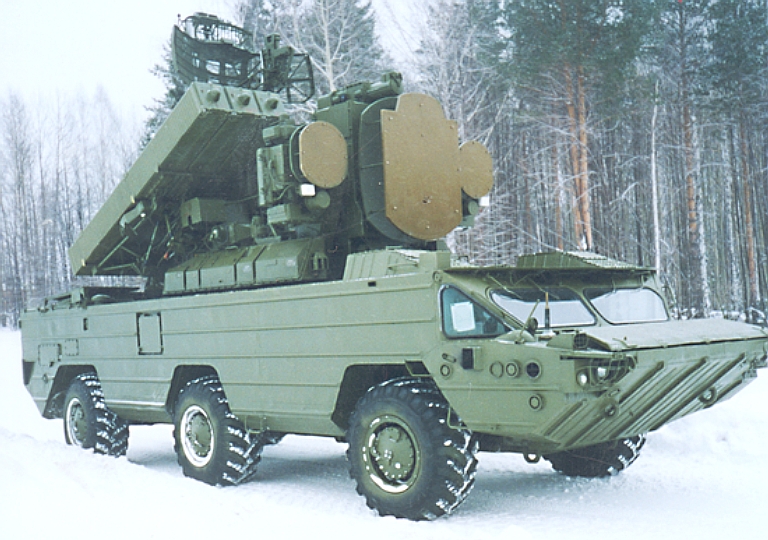
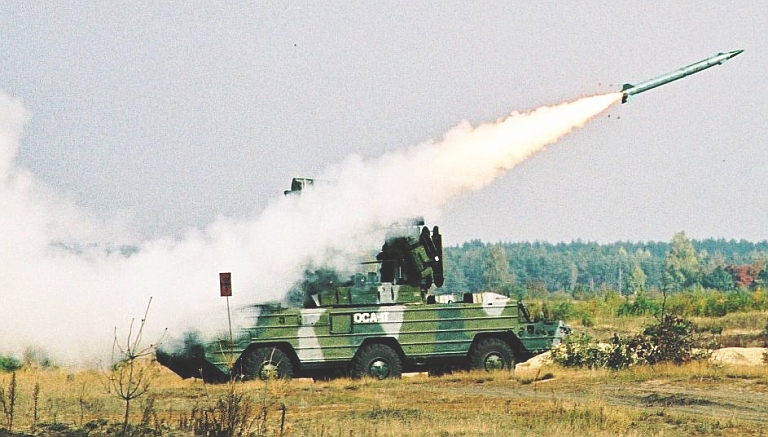
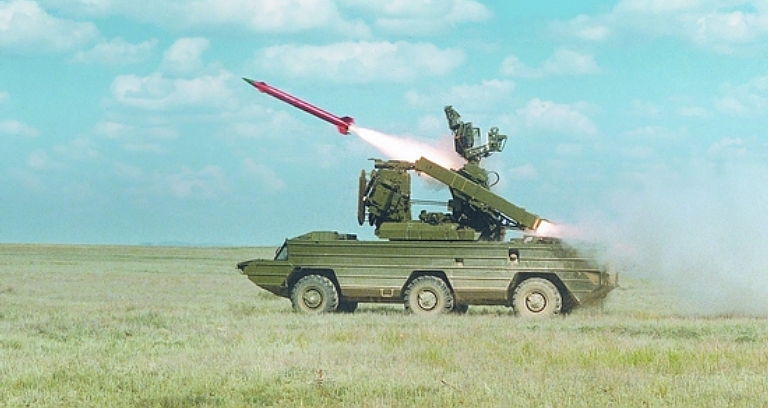
9K33/9K33M2/M3
Osa AK/AKM / Romb / SA-8 Gecko
Air Defense Missile System
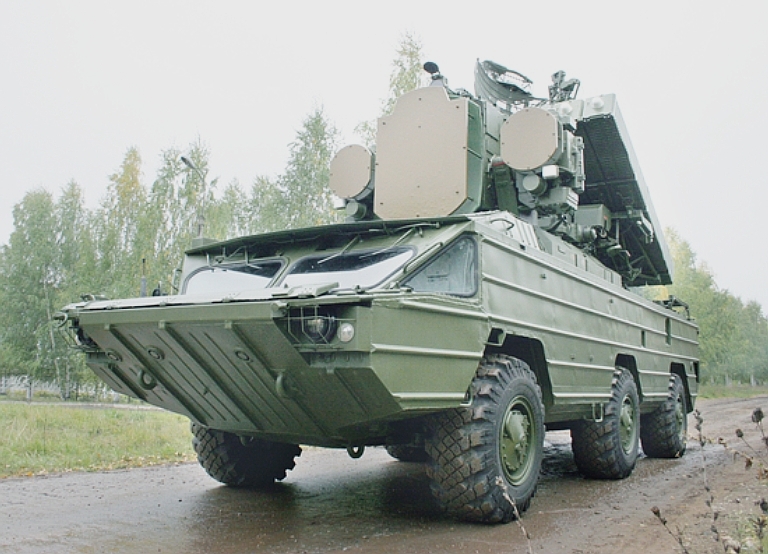
(JSC Kupol images)
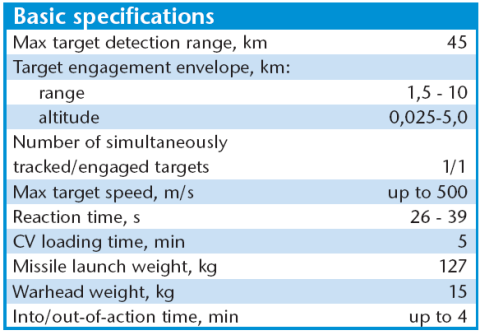
Сравнительные
характеристики ЗРК «Оса», «Оса-АК» и «Оса-АКМ»
Principal
Manufacturer
|
|
|
|
Основной
разработчик |
НИЭМИ |
Year
of
Service Acceptance
|
|
|
|
Год принятия на вооружение |
1972 |
1975 |
1980 |
Engagement
Range, km
|
|
|
|
Зона поражения по
дальности, км |
2-9 |
1,5-10 |
1,5-10 |
Engagement
Altitude, km
|
|
|
|
Зона поражения по высоте, км |
0,05-5 |
0,025-5 |
0,025-5 |
|
|
|
|
Курсовой параметр, км |
4-6 |
до 6 |
до
6 |
Single
Shot Kill
Probability
|
|
|
|
Вероятность поражения одной
ЗУР |
|
|
|
aircraft
|
|
|
|
самолета |
0,35-0,85 |
0,5-0,85 |
0,5-0,85 |
helicopter
|
|
|
|
вертолета |
0,3-0,4 |
до 0,45 |
0,6-0,85 |
cruise missile
|
|
|
|
КР |
до 0,4 |
до 0,4 |
до
0,6 |
ballistic
missile
|
|
|
|
БР |
- |
- |
- |
UAV
|
|
|
|
ДПЛА |
до 0,7 |
до 0,8 |
до
0,8 |
Maximum
target speed, m/s
|
|
|
|
Максимальная скорость цели,
м/с |
до 420 |
до 500 |
до
500 |
Reaction
time, sec
|
|
|
|
Время реакции, с |
26-34 |
26-34 |
26-34 |
System
weight, kg
|
|
|
|
Масса БМ, кг |
около 1900 |
около 1900 |
18680 |
Missile/warhead
weight, kg
|
|
|
|
Масса ЗУР/БЧ, кг |
128/15 |
128/15 |
128/15 |
Deployment/stow
time, min
|
|
|
|
Время перевода в
боевое/походное положение, мин |
3-5/3-5 |
3-5/3-5 |
3-5/3-5 |
Maximum
road speed, km/h
|
|
|
|
Максимальная скорость
движения, км/ч |
до 80 |
до 80 |
до
80 |
|
9K35M/M2/M3
Strela
10M/M2/M3 Gyurza / SA-13 Gopher SAM
System
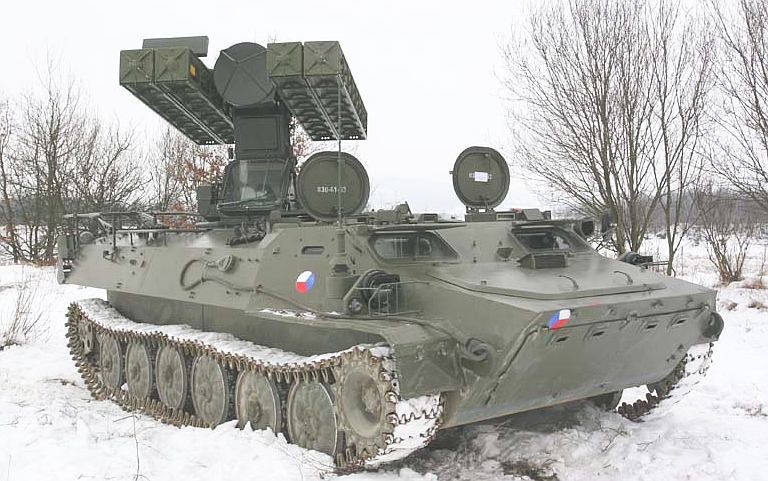
9A35M / SA-13 Gopher TELAR of the
Czech Army, which acquired the system during the Cold War. The 9S86
Snap Shot rangefinding radar is located between the launchers (Czech
Army).
The 9K35 / SA-13 Gopher was developed as a replacement for
the 9K31 / SA-9 Gaskin, and was intended to provide a system with
better mobility and a longer ranging and more lethal missile design.
The system employs a coherent pulse Doppler millimetric band 9S86
Snap Shot range and radial velocity finding radar, with the 9A35 TELAR
equipped with the
9S16 Flat
Box-B radar warning and cueing sensor, and the 9A34 without it.
Typically one 9A35 was deployed with three 9A34 TELARs. All TELARs
carry four ready rounds and four stowed reloads.
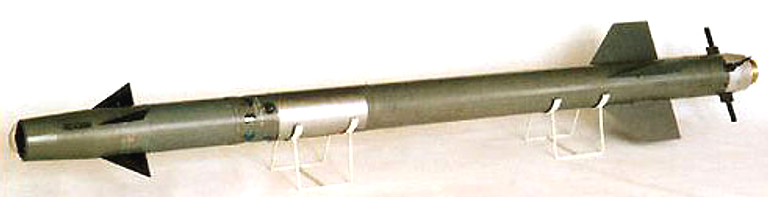
A number of different missile variants are employed with this system.
These include the baseline 9M37 Strela-10SV with a two colour
infrared/visible band seeker deployed on the 9K35 TELAR
from 1976, the 9K37M Strela-10M deployed on the 9K35M TELAR from 1979,
and the 9K37M2 Strela-10M2 deployed on the 9K35M2 TELAR from 1981.
The
last Cold War variant was the Strela-10M3 deployed on the 9K35M3 TELAR
from 1989, this variant using the 9M333 missile which was supplied with
three channel seeker, the first infrared, the second
using a visible band television contrast lock design, and the third a
passive homing channel intended to home on the emissions from jamming
equipment. The 9M333 included a new autopilot and IR background
rejection processing, as well as a laser proximity fuse with eight
rather than four lobes for engaging small targets,and a larger and more
lethal warhead. The 9K35M3 included an improved optical sighting system
for the gunner with WFOV and NFOV modes.
A typical battery deploys four TELARS and a single PPRU-1/1M command
post, often equipped with the X-band 9S80/9S80M/M1 Ovod / Dog Ear
battery acquisition
radar. A digital variant of the this command post, the PPRU-1M-2, has
been recently displayed, equipped with an entirely new planar array
solid state digital 9S80M1-2 radar.
This system was
primarily exported to Warsaw Pact nations. Yugoslavia rehosted the
system on an indigenous tracked chassis. A number of upgrades exist for
the basic system, and the late model 9K35M3 Kolchan variant is also
available on a wheeled 8 x 8 BTR-60 chassis.
A more detailed analysis can be found under 9K35 Strela 10 Self Propelled Air
Defence System . Upgrades are discussed further under 9K35A Gyurza /
Strela 10M / SA-13 Gopher SAM System Upgrades.
Launch
of a 9M37M / SA-13
Gopher SAM (Russian MoD).
| Основные
характеристики ЗРК типа "Стрела-10" |
|
Комплекс
System
|
Стрела-10СВ
Strela 10SV
|
Стрела-10М
Strela 10M
|
Стрела-10М2
Strela 10M2
|
Стрела-10М3
Strela 10M3
|
|
Ракета
Missile
|
9М37
|
9М37М
|
9М37М
|
9М333
|
БМ
TELAR
|
9A35/9A34
|
9A35M/9A34M |
9A35M2/9A34M2 |
9A35M3/9A34M3 |
|
Зона поражения, км
Engagment Envelope [km]
- по дальности
- in range
|
0,8..5
|
0,8..5
|
0,8..5
|
0,8..5
|
|
- по высоте
- in altitude
|
0,025..3,5
|
0,025..3,5
|
0,025..3,5
|
0,01..3,5
|
|
- по параметру
|
до 3
|
до 3
|
до 3
|
до 3
|
|
Вероятность поражения истребителя
одной ЗУР
Single Shot Pk for Fighter Type Target
|
0,1..0,5
|
0,1..0,5
|
0,3..0,6
|
0,3..0,6
|
|
Макс. скорость поражаемых целей
(навстр./вдогон), м/с
Max veolicty of defeated target (approaching/receding) [m/s]
|
415/310
|
415/310
|
415/310
|
415/310
|
|
Скорость полета ЗУР, м/с
missile velocity [m/s]
|
517
|
517
|
517
|
517
|
|
Время реакции, с
Reaction time [s]
|
6,5
|
8,5
|
6,5
|
7,0
|
|
Масса ракеты, кг
Missile mass [kg]
|
40
|
40
|
40
|
42
|
|
Масса боевой части, кг
Warhead mass [kg]
|
3
|
3
|
3
|
5
|
|
Число ракет на боевой машине
Number of missiles on TELAR
|
4+4
|
4+4 |
4+4 |
4+4 |
|
Год принятия на вооружение
IOC
|
1976
|
1979
|
1981
|
1989
|
Table: Said Aminov Vestnik PVO
|
|
|
|
|
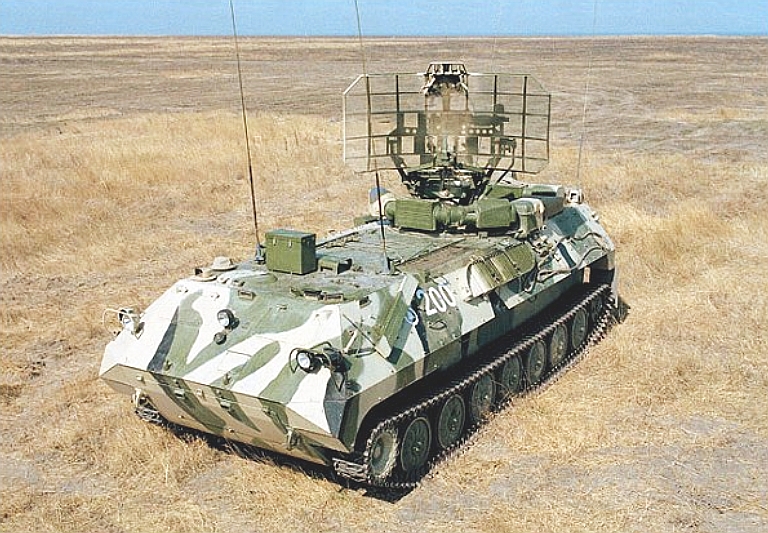
The PPRU-1/1M command post includes the
X-band 9S80/9S80M/M1 Ovod / Dog Ear battery acquisition
radar (RuMoD).
9K31/9K31M
Strela 1/1M /
SA-9A/B Gaskin
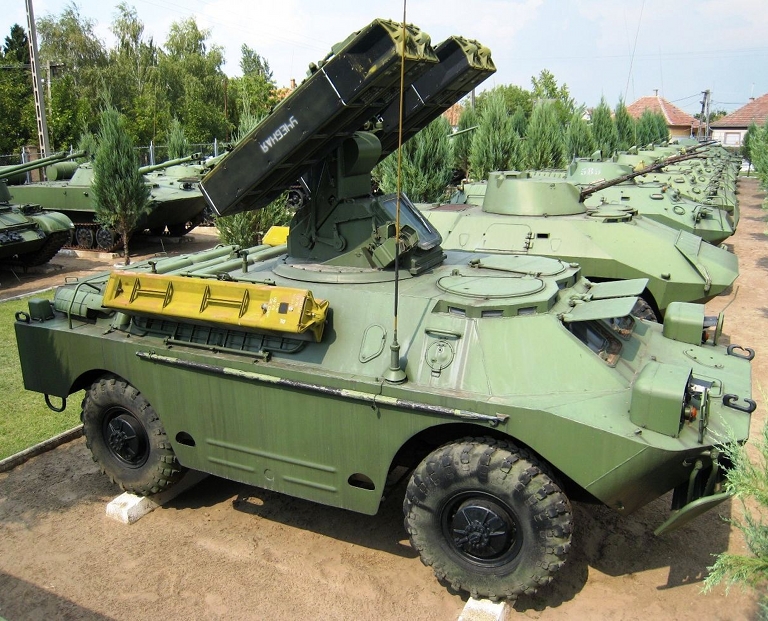
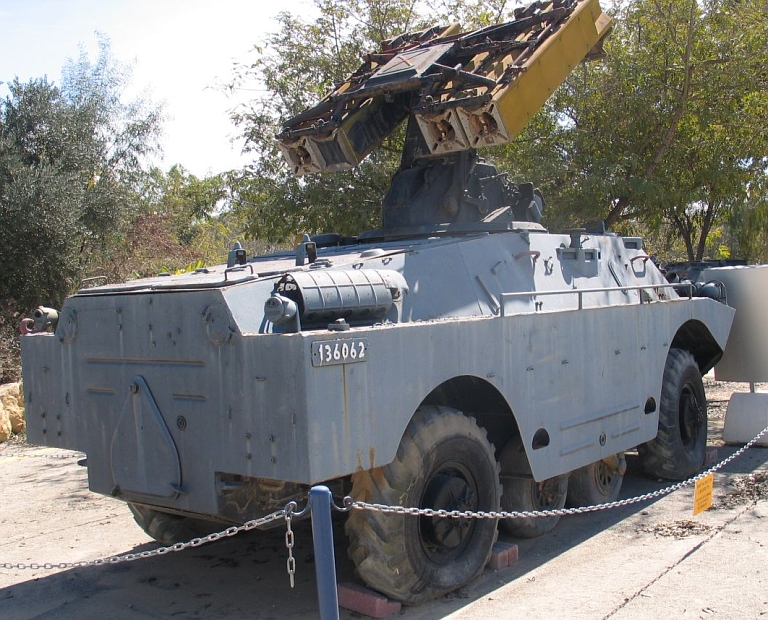
9K31M
/ SA-9B Gaskin on display at Kecel
in Hungary. Note the reload tubes (Image © Miroslav
Gyűrösi).
The 9K31 Strela 1 / SA-9 was
the first Soviet heatseeking point defence SAM system. The fully
self-propelled design was hosted on the 7 tonne amphibious
BDRM-2/BTR-40 scout vehicle. It was deployed in concert with the
ZSU-23-4P Shilka SPAAG, to provide the final layer of air defence
capability for combined arms and armoured divisions.
The intent of the designers was to produce an equivalent to the US
MIM-72A/M48 Chapparel, which was based on the AIM-9D Sidewinder
heatseeking air-to-air missile and M113 APC. The 9M31 missile round was
similar to the AIM-9B and K-13A / AA-2 Atoll, using canard controls, an
uncooled infrared seeker, and slipstream driven tailfin stabilisers.
The 9K31/SA-9 Gaskin was very widely exported by the Soviets, and used
operationally in the Middle East and Africa.
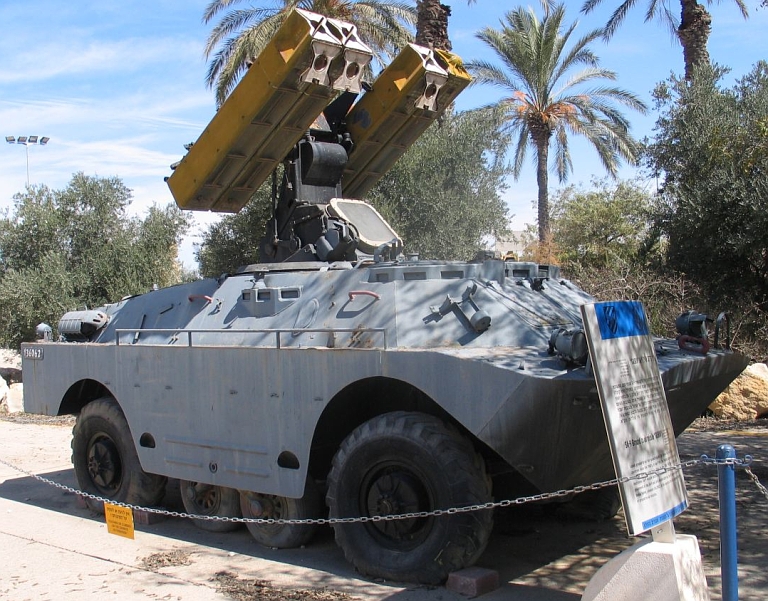
Captured 9K31M / SA-9B Gaskin on
display
at the Muzeyon Heyl ha-Avir, Hatzerim airbase, Israel in 2006
(Wikipedia image).
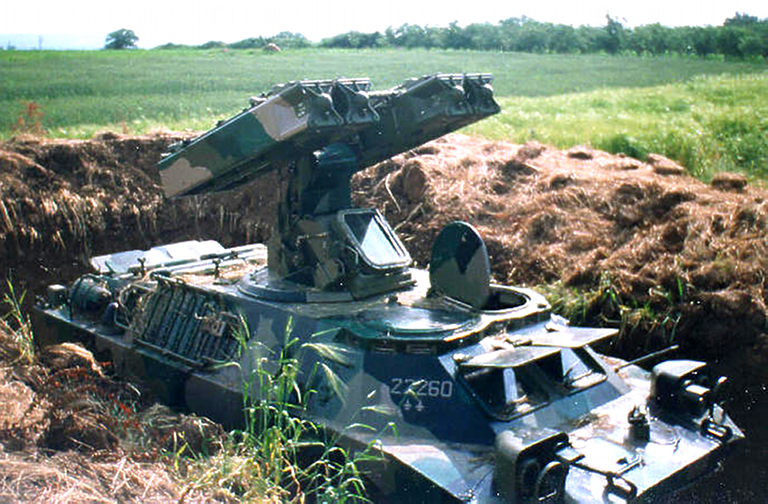
Croatian 9K31 / SA-9 Gaskin. A
common
Soviet practice was to deploy these systems in excavated ditches to
deny early visual acquisition (via Vestnik PVO).
Основные
характеристики ЗРК типа "Стрела-1"
Principal
Characteristics SA-9 Gaskin
|
Комплекс
System
|
Стрела-1
SA-9A
|
Стрела-1М
SA-9B
|
| Ракета |
9М31
|
9М31M
|
Зона
поражения, км
Engagement Zone [km]
- по дальности
- in range
|
1..4,2
|
0,5..4,2
|
- по высоте
- in altitude
|
0,05..3
|
0,03..3,5
|
| - по
параметру |
до 3
|
до 3,5
|
Вероятность
поражения истребителя одной ЗУР
Single Shot Pk for Fighter Type Target
|
0,1..0,6
|
0,1..0,7
|
Макс.
скорость поражаемых целей (навстр./вдогон), м/с
Max Velocity of destroyed target [m/s]
|
310/220
|
310/220
|
Скорость
полета ЗУР, м/с
Missile Velocity [m/s]
|
420
|
420
|
Время
реакции, с
Reaction time [s]
|
8,5
|
8,5
|
Масса
ракеты, кг
Missile mass [kg]
|
30
|
30,5
|
Масса боевой
части, кг
Warhead mass [kg]
|
3
|
3
|
Число ракет
на боевой машине
Number of missiles on TEL
|
4
|
4
|
Год принятия
на вооружение
IOC
|
1968
|
1970
|
Source: Vestnik PVO
|
|
|
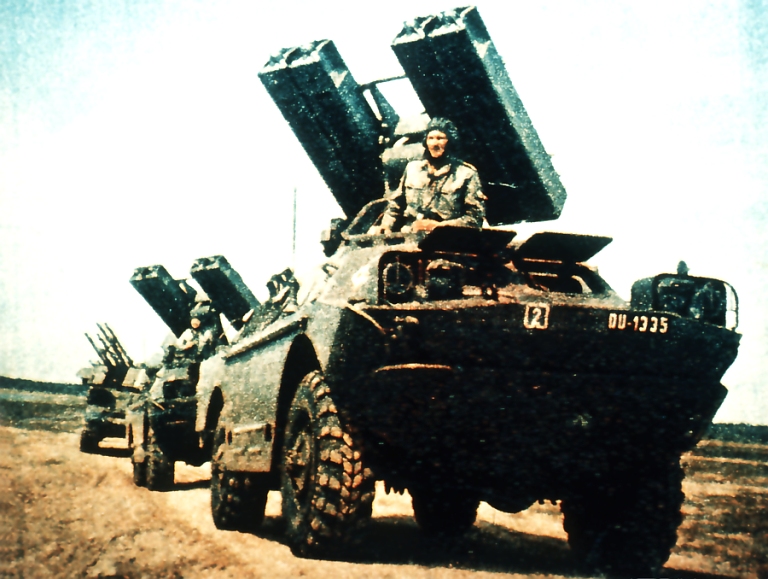
Soviet era propaganda
image of
the 9K31M / SA-9B Gaskin (US DoD).
ZSU-23-4 Shilka
SPAAG
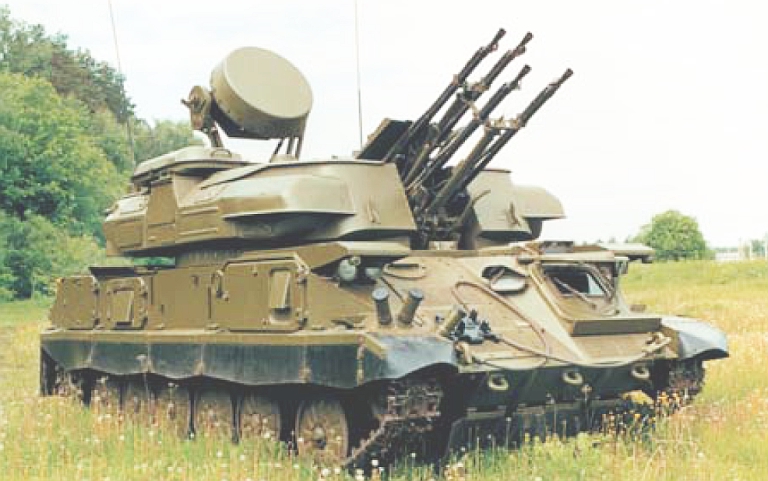
ZSU-23-4 Shilka SPAAG.
The ZSU-23-4P Shilka was a
mainstay of Red Army and Warsaw Pact air defences from the mid 1960s
until the 1980s, when it was progressively replaced in Soviet service
by the 2K22 Tunguska / SA-19 Grison.
The system is armed with four AZP-23 23 mm water cooled automatic guns.
The X-band 1RL33 Tobol / Gun Dish radar provides an acquisition and
fire control tracking capability for gunlaying.
Russian references list no less than eight variants, specifically the
ZSU-23-4, ZSU-23-4V, ZSU-23-4M, ZSU-23-4M1, ZSU-23-4M2, ZSU-23-4M3,
ZSU-23-4M4 and ZSU-23-4M5.
The ZSU-23-4M4
is detailed under upgrades.
Технические
характеристики ЗСУ-23-4
Technical Characteristics of the ZSU-23-4
|
|
Длина
Length
|
6,54 м
|
|
Высоты
Height
|
2,25 м
|
|
Ширина
Width
|
2,95 м
|
|
Боевая масса
Conbat weight
|
20,5 т
|
|
Вооружение
Armament
|
4х23 мм водяного охлаждения
пушки АЗП-23
4 x 23 water cooled AZP-23 Guns
|
|
Максимальная дальность стрельбы
Maximum Range
|
2000 м
|
|
Минимальная дальность стрельбы
Minimum Range
|
200 м
|
|
Максимальная высота стрельбы
Maximum Altitude
|
1500 м
|
|
Минимальная высота стрельбы
Minimum Altitude
|
0 м
|
|
Боезапас
Ammo Load
|
2000 снарядов
|
|
Темп стрельбы
Rate of Fire
|
800-1000 выст/мин/ствол
|
|
Шасси
Chassis
|
ГМ-575
|
|
Максимальная скорость движения
Maximum Speed
|
50 км/ч
|
|
Запас хода по шоссе
Range
|
450 км
|
|
Бронирование
Armour
|
9,2 мм шасси, 8,3 мм башня
|
Table Said Aminov Vestnik PVO
|
|
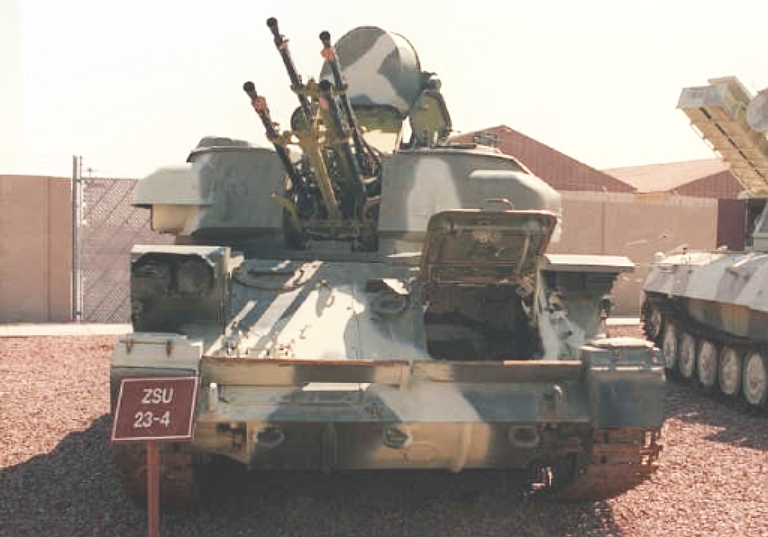
A captured ZSU-23-4 on
display
in the US (US DoD).
|
|
PLA Point
Defence Weapons [Click for more ...]
Technical Report APA-TR-2008-0502
|
|

![F-22A Raptor, FB-22, F-22E, F-22N and Variants Index Page [Click for more ...]](APA/f-fb-22.png "F-22A Raptor, FB-22, F-22E, F-22N and Variants Index Page [Click for more ...]")

![People's Liberation Army Air Power Index Page [Click for more ...]](APA/pla-air-pwr.png "People's Liberation Army Air Power Index Page [Click for more ...]")


![Military Ethics, Culture, Education and Training Index Page [Click for more ...]](APA/ethx-culture.png "Military Ethics, Culture, Education and Training Index Page [Click for more ...]")


![Russian / Soviet Weapon Systems Index Page [Click for more ...]](APA/rus-weps.png "Russian / Soviet Weapon Systems Index Page [Click for more ...]")