|
||||||||||||||||||||||
![Australia's First Online Journal Covering Air Power Issues [ISSN 1832-2433]](APA/APA-Title-Analyses.png "Australia's First Online Journal Covering Air Power Issues [ISSN 1832-2433]") |
||||||||||||||||||||||
![F-22A Raptor, FB-22, F-22E, F-22N and Variants Index Page [Click for more ...]](APA/f-fb-22.png "F-22A Raptor, FB-22, F-22E, F-22N and Variants Index Page [Click for more ...]") |
 |
![People's Liberation Army Air Power Index Page [Click for more ...]](APA/pla-air-pwr.png "People's Liberation Army Air Power Index Page [Click for more ...]") |
 |
 |
 |
 |
 |
 |
![Military Ethics, Culture, Education and Training Index Page [Click for more ...]](APA/ethx-culture.png "Military Ethics, Culture, Education and Training Index Page [Click for more ...]") |
 |
||||||||||||
 |
![Russian / Soviet Weapon Systems Index Page [Click for more ...]](APA/rus-weps.png "Russian / Soviet Weapon Systems Index Page [Click for more ...]") |
 |
 |
 |

|
 |
 |
 |
 |
 |
||||||||||||
 |
 |
 |
||||||||||||||||||||
| Last Updated: Mon Jan 27 11:18:09 UTC 2014 | ||||||||||||||||||||||
|
||||||||||||||||||||||
|
||||||||||||||||||||||
|
||||||||||||||||||||||
|
|
|
|
|
|
|
|
|
|
|
||||||||||||
|
|
|
|
|
|
|
|
|
|
|
||||||||||||
| |
|
|
||||||||||||||||||||
| Last Updated: Mon Jan 27 11:18:09 UTC 2014 | ||||||||||||||||||||||
|
||||||||||||||||||||||
| The
Impact of Russian
High Technology Weapons: Transforming the Strategic Balance in Asia
|
||||||
|
||||||
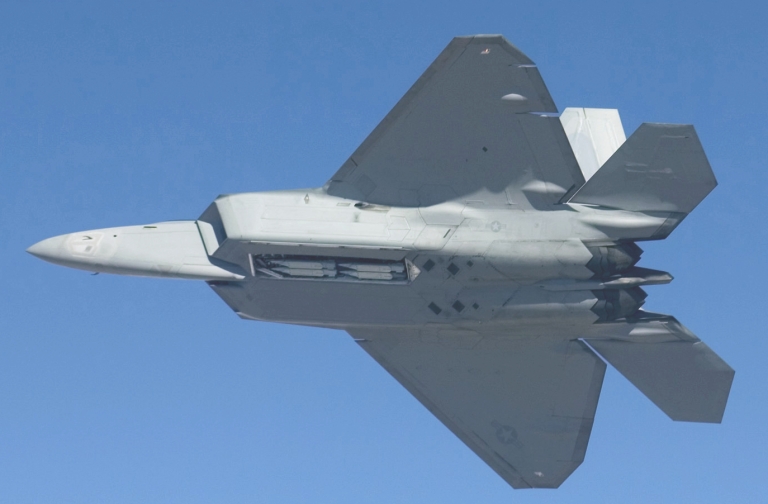 The F-22A Raptor, B-2A Spirit and planned “2018
bomber” are the only US designs capable of surviving in the
technological environment presented by the current and emerging
generation of Russian high technology weapons. The 'Fulda
Gap optimised' F-35
Joint Strike Fighter is not capable of surviving in this environment
and is for all intents and purposes now a strategically irrelevant
design, which is draining scarce funds away from programs which are
strategically much more important (Image US AIr Force).
|
||||||
|
||||||
Russian high technology weapons are transforming the strategic landscape in Asia, as the defence industries of the former Soviet Republics export some of the most advanced weapons designed and built to date. This strategic has important long term implications for US policy makers, yet as the current debate over the future of the US Air Force shows, the matter is neither well understood or indeed widely understood in Washington circles. The Former Soviet Defence Industrial BaseThe end of the Cold War was a mixed blessing for the Soviet defense industrial base, as the collapse of hitherto secure high volume funding flows was balanced by unfettered access to a global market for high technology weapons and the high technology required to develop and manufacture them. Nearly two decades after the disintegration of the USSR, the former Soviet industry, now based across the independent nations of Russia, ByeloRussia, the Ukraine and other former Soviet republics, has returned to the global stage with considerable effect. This industry has provided China, India and smaller players in Asia with a wide range and often large quantities of sophisticated weapons, many of which challenge or simply outperform US and EU designs. The result is an increasing in the strategic balance in Asia, wholly at the expense of the US, and its closest regional allies, Japan and Australia. The crown jewels of the Soviet military technology base appeared in the export market after 1992. Earnings initially funded the survival of the industry, and later financed the the development of derivative weapons, and entirely new weapons. Other than energy, Russia's principal exports are now weapons, military equipment spare parts, services and consultancy. The range of high technology products spans the full spectrum, including supercavitating torpedoes, laser, electro-optical, and satellite guided smart bombs and missiles, anti-ship and land attack cruise missiles, advanced surface to air, and air to air missiles, two metre band 'counter-stealth' radars, passive radio frequency sensors, active and passive phased array radars for fighter aircraft, high power radio frequency beam weapons, and according to some sources, high energy laser weapons technology. The single most successful export has been the KnAAPO/Irkut Sukhoi Flanker fighter, with China and India alone accounting for around 750 orders. Whereas Soviet weapons of the late Cold War were mostly built using analogue and hardwired digital technology, contemporary products are mostly digital, and more than often built using the same chips or technologies used in US, EU and Israeli designs. An Agat 9B1348 missile seeker built around a Texas Instruments TMS-320 processor chip compares closely to its Western counterparts. A Polyana or Ranzhir mobile command post uses LCD display panels and other COTS computer hardware, the basic COTS components likely sourced from the same OEMs as US integrators do. While the US retains a lead in many key technologies, such as stealth shaping, stealth materials, and X-band module technology for radars, the globalised and commodified market has allowed Russian industry to close the gap across most other basic technologies. An Su-35BM Flanker now built at Komsomolsk na Amure will not only outperform an F-15E built in St Louis, but it will have many systems built with newer and more advanced basic technology, from cockpit displays to electronic warfare equipment. Unlike the US industry which has to compete with Silicon Valley to retain talent, in the former Soviet Union the defence industry is the only high technology industry of substance. Abundant Russian language web based job placement advertising shows exactly how good Russian talent is. Advanced Russian weapons such as the supersonic air/sea/sub/land launched 3M-55 Yakhont / SS-N-26, 3M-54 Club / SS-N-27 Sizzler and 3M80/81/82 Moskit / SS-N-22 Sunburn present the most capable threat to date to naval surface fleets, and land attack cruise missiles such as the Kh-55 Granat (AS-15 Kent), Kh-65, and their Chinese clones, will produce a Tomahawk class capability to any player with the budget. However, the biggest strategic impact will arise from weapons built to fight and win air wars. |
||||||
The Russian Approach to Defeating US Air PowerThe stunning success of the US Air Force in 1991, followed by the 1999, 2001 and 2003 air campaigns, has been a double edged sword. While it validated the late Cold War paradigm developed by US Air Force strategists, and proved a wide range of doctrinal ideas, strategy and technology, it has also produced unintended and damaging consequences. The first is that it stimulated a nearly two decade long effort by Russian and Chinese industry to defeat advanced US technologies, an effort now resulting in competitive products. The second consequence has been an unwarranted sense of superiority and confidence in Washington, and indeed elsewhere in Western defence departments. The third consequence during this decade has been the large scale downsizing of US technical intelligence gathering and analysis capabilities, leaving US analysts more than often blind to technological advancements in Russia and China. During the Cold War era, Soviet technological strategy was driven mostly by an overarching central plan, more than often crafted to meet strategic agendas and counter specific US capabilities. The new paradigm is entirely different, and driven by bottom up market pressures rather than top down bureaucratic directives. The former Soviet industry is now free to exercise its design creativity without hindrance, driven by profit motive and competitive pressures. The privatisation of much of the industry into Joint Stock Companies, and incessant takeovers of smaller manufacturers, has created a commercial hothouse environment in which new ideas and new markets thrive. The nearest comparison is the US industry during the Reagan era, where creative thinking was more than often handsomely rewarded with contracts. In Russia today the primary market for the most advanced products is the export market, not the Russian Armed Forces, who more than often are equipped with variants predating the export product. At the end of the Cold War the US possessed several key and decisive capability advantages, and usually a monopoly on the technology involved. These included stealth technology – the F-117A, with the B-2 entering production and the F-22 development, a diverse range of sophisticated precision guided munitions including cruise missiles, and a large fleet of standoff Intelligence Surveillance Reconnaissance (ISR) platforms including the AWACS, JSTARS, Rivet Joint, and U-2. It should come as no surprise that the strategic imperative for nations not aligned with the US in the new multi-polar world is the defeat of these capabilities, and as a result these have produced distinct foci in Russian weapons development. Typically an equivalent product to the US design is on offer, or where out of reach, a product designed to asymmetrically deny use of the US capability is offered. The issue of countering US ISR capabilities is a good example. The industry has provided the Chinese with assistance on their KJ-2000 AWACS system, based on the Ilyushin Il-78 airframe. Of much greater concern is however the asymmetric development of ultra long range Air to Air and Surface to Air missiles specifically intended to destroy ISR platforms or deny their use. These include the Fakel 200 nautical mile SAM developed for the S-400 Triumf / SA-21 Growler system, and the 162 nautical mile Vympel R-37 and 200 nautical mile Novator R-127/K-100 AAMs developed to arm the Flanker family of fighter aircraft. A stated secondary role for these missiles is destroying US aerial refuelling tankers and standoff jammers such as the EC-130, EA-6B and EF-18G. By the middle of the coming decade all of these weapons will be well established in the global market, presenting interesting challenges for US forces. In the domain of Precision Guided Munitions (PGM) and cruise missiles, the former Soviet industry has become a major global player, competing directly against the US, EU and Israeli industries. This presents another symmetric response to US capabilities, and one which is clearly having an impact. In guided bombs, the GNPP KAB-250, KAB-500 and KAB-1500 occupy the same niche as the US GBU-10/12/16/24/27 Paveway II/III, the GBU-15 and the GBU-31/32/35/38 JDAM series. The basic KAB-500/1500 bomb airframes may be supplied with penetrating, general purpose blast, thermobaric or gaseous Fuel Air Explosive warheads. No less interesting is that the same airframes can be supplied with an Electro-Optical (EO) correlation terminal seeker, modelled on the Tomahawk DSMAC, a datalink supported EO or thermal imaging seeker modelled on the GBU-15 or Walleye, a laser seeker very similar to the Paveway II, or a satellite inertial guidance package modelled on the US JDAM. The latter has twenty channels, capable of using both US GPS and Russian Glonass satellites. Another hot seller has been the 3M-54/3M-14 Club / Sizzler family of cruise missiles, now deployed by China and India on Kilo SSKs, and being marketed in an air launch configuration, ship launch configuration and land mobile coastal defence configuration. The land attack Sizzler variant, the 3M14E/AE, best compares to the AGM-109H/L Tomahawk MRASM derivatives. Of much greater interest is however the asymmetric technological response to US dominance in smart munitions. Russian strategy is that PGMs and cruise missiles should be shot down in flight, and this has seen a large scale reorientation of development across a range of air defence weapons. The basic idea is that a deluge of US smart weapons will be countered with intensive missile and directed energy weapon defensive fire against these weapons. Of interest is that the US AGM-88 HARM anti-radiation missile is a cited target type for every single point defence weapon now on offer. In 1991 the Soviets were producing the Tor / SA-15A/B Gauntlet SAM and Tunguska / SA-19 Grison SAM/SPAAG system on tracked chassis, intended to defend Red Army land manoeuver forces against pop up helicopter and fighter threats. Both of these systems have evolved considerably since then, and their replacements are tasked primarily with defeating smart munitions, while protecting long range SAM batteries, early warning radars and fixed infrastructure targets. The new Tor M2E / SA-15D is road mobile on a hardened 6 x 6 MZKT6922 vehicle, and the new Pantsir S1E / SA-22 Greyhound is carried by an 8 x 8 KAMAZ-6560. Both systems have digital processing and a phased array engagement radar, in the SA-22 it is directly derived from Phazotron's Zhuk-MFE originally built for the MiG-29 Fulcrum fighter. There are no direct Western equivalents to either the SA-15D or SA-22, either in capabilities or mobility. The drive to counter smart munitions has also seen the development of the Fakel 9M96E1/E2 interceptor missiles for the Almaz-Antey S-400 Triumf / SA-21 Growler system, these weapons being equivalent to the Patriot PAC-3 ERINT interceptor. Unlike the PAC-3, these designs were built from the outset to also kill smart munitions targeting the missile battery. While the S-400 is mostly designed to provide outer layer long and medium range SAM and ABM capabilities, as demonstrated by the inclusion of counter-ISR and point defence missiles, it is much more than its predecessors, the S-300PS/PM/PMU / SA-10 Grumble and S-300PMU1/2 Favorit / SA-20 Gargoyle. The latter SAM systems have been exported to China in large numbers, and form the basis of the Chinese HQ-12/15 SAM systems. The S-400 is a fully digital design, and has been reintegrated on new MZKT, BAZ and KAMAZ vehicles for improved road mobility. The system's 55K6 command post is designed to also control legacy missile systems such as the S-200 / SA-5 Gammon. Directed energy weapons are another capability which is seen by the Russians and Chinese as critical to defeating massed attacks by US smart munitions and cruise missiles. The Russians have been marketing the 500 MegaWatt Ranets E pulsed microwave beam weapon, using a mobile beam director dish on a 8 x 8 MZKT-7930 truck. This system will be electrically lethal to aircraft avionics and guided munition electronics at a range of 7 nautical miles or greater. The status of High Energy Laser weapons is less clear at this time. Almaz-Antey developed the Soviet 100 kiloWatt plus class carbon dioxide chemical lasers, and built a system comparable to the US THEL/MTHEL, but highly mobile on an 8 x 8 MAZ-7910 chassis. This plethora of diverse and capable air defence weapons all share the important attributes of high mobility and deployment and stow times of minutes, to facilitate 'shoot and scoot' operations. Defeat of highly mobile air defence weapons remains a problem, as demonstrated in 1999. While 743 HARMs were fired, only 12 percent of Serbian mobile 9M9 / SA-6 Gainful SAM systems were destroyed. Networked with digital radio links, and equipped with low sidelobe agile beam phased array radars, the current generation of Russian air defence weapons will be much harder to kill than the 1970s SA-6B. Countering US stealth capabilities has been a high priority for Russian manufacturers. The symmetric response has been the development of a range of radar absorbent coatings and laminates for use on legacy aircraft. Russian sources claim the absorbent coating used in the Su-35BM Flanker will reduce engine inlet tunnel signatures thirty-fold in the X-band. We have yet to see the new PAK-FA stealth fighter, so assessment of Russian progress in airframe shaping techniques is not yet feasible. The asymmetric aspect of Russia's counter stealth effort is far more visible. It is centred on the use of two metre or VHF band radar technology, and the networking and integration of other sensors, including passive emitter locating systems. Most recent Russian effort in the development of early warning and surveillance radars has been in the two metre band. All of these new radars, and upgrade packages for legacy Soviet era radars, are digital and mostly solid state designs. Many include sophisticated adaptive processing techniques for rejection of ground clutter and jamming, a technology to date seen mostly in recent US radar designs. The focus on the two metre radio band, used primarily for TV broadcasting, is that it largely defeats stealth airframe shaping techniques designed for the decimetre and centimetre band radar. The Russians are adamant that US stealthy fighter aircraft will appear as beachball sized radar targets in the VHF band, rather than marble sized targets. Raleigh scattering regime physics support the Russian view. A key development is the emergence of new technology VHF designs, built for high mobility to support mobile SAM batteries. The NNIIRT 1L119 Nebo SVU is the first ever VHF band Active Electronically Steered Array (AESA), and is accurate enough to provide midcourse guidance for a missile. Russian thinking on counter-stealth technique is to fly the missile close enough for its seeker to lock on despite the stealthiness of the target, using datalinking from a stealth defeating sensor. This radar can be deployed and stowed in 45 minutes. The new ByeloRussian KBR Vostok E wins the mobility game with an 8 minute deploy and stow time, using a hydraulically folded and elevated antenna. This new VHF radar is also fully digital, solid state, and employs an innovative "Kharchenko" square ring antenna element design. Defeat of US stealth is a primary claim by its designers, who state the ability to track an F-117A at 190 nautical mile range. The effort in VHF radar is paralleled by developments in Emitter Locating Systems, specifically the networked 85V6 Orion/Vega and Topaz Kolchuga systems. Users of the earlier Tamara / Trash Can system claimed the ability to track the position of US aircraft with emitting JTIDS/Link-16 terminals. Other counter-stealth technology includes a VHF band multistatic radar being developed by NNIIRT. Other important developments include the 20 kiloWatt class N-035 Irbis E hybrid phased array radar for the Su-35BM, which outperforms all US legacy fighter radars, the APG-79 in the Super Hornet, and APG-81 in the F-35. Russia's first AESA radar, the Zhuk AE, is being scaled up for the Flanker, and promises performance in the class of the latest US APG-77(V)2 and APG-63(V)3 AESAs. |
||||||
|
Contemporary Russian Weapons
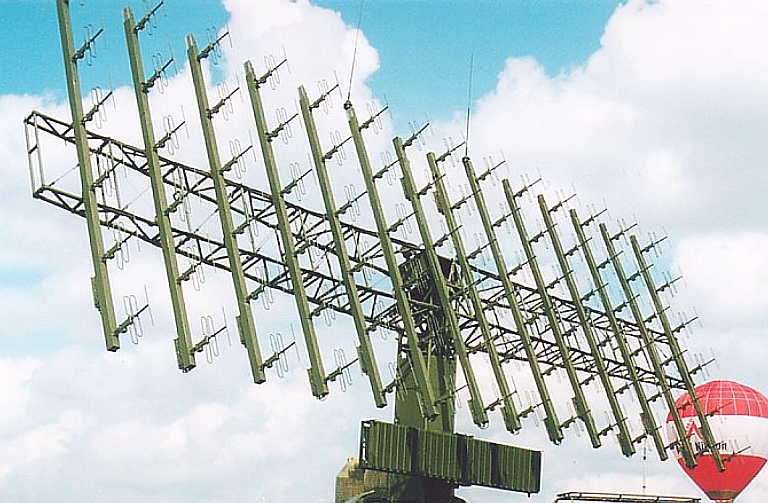 The
new 3 dimensional NNIIRT
1L119 Nebo SVU AESA
is an improved new
technology VHF
band SAM battery acquisition radar, and with
20 minutes to deploy.
Stated tracking accuracy is 200 metres in range, 0.5° in
azimuth,
and 1.5° in elevation, making it suitable as an
acquisition radar for the S-300PMU-1/2 and S-400 systems.
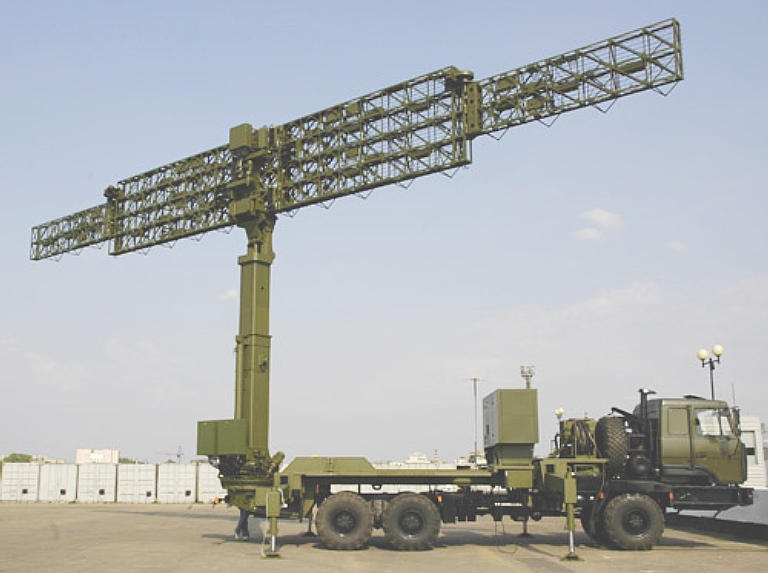 The
ByeloRussian KB Radar (Agat) Vostok E is an entirely new 2D VHF radar
design, using
a
unique wideband "Kharchenko" square ring radiating element
design, in a
diamond lattice pattern. It can stow or deploy in only 8 minutes.
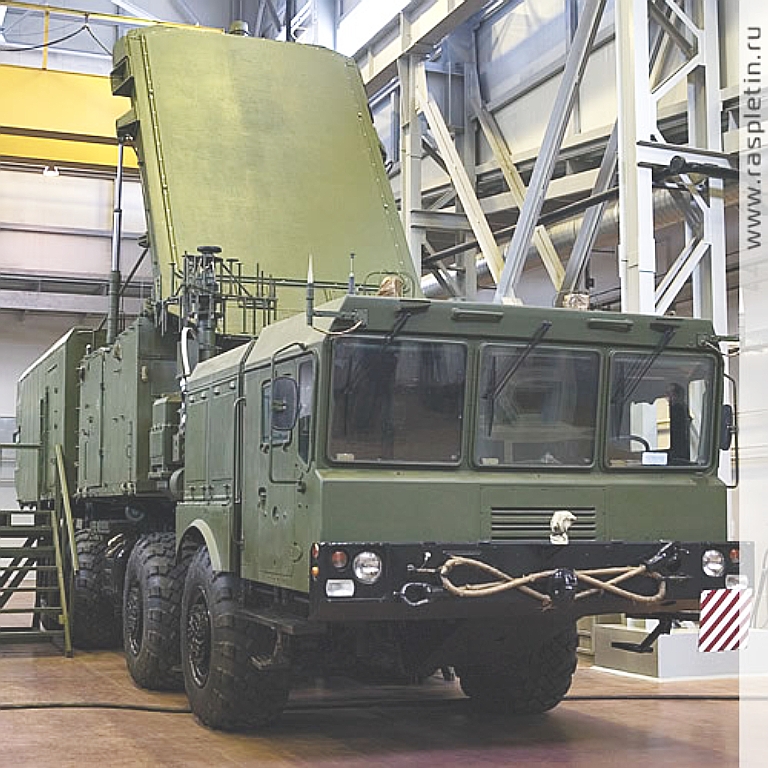 S-400 Triumf 92N2 Grave Stone X-band high power-aperture engagement radar deployed. 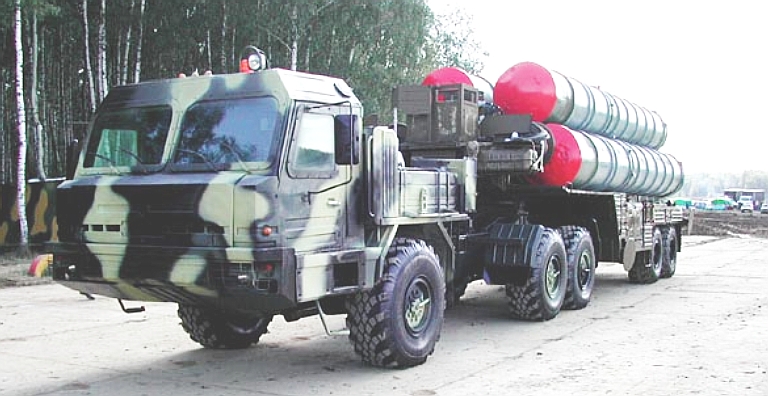 S-400
Triumf 5P85TE2 TEL deployed.
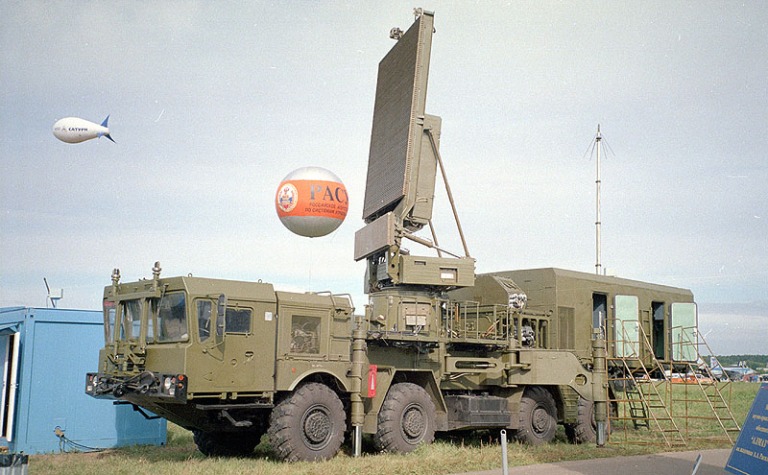 S-400 Triumf LEMZ 96L6E
Cheese Board L-band acquisition radar deployed. It replaces Cold War
era S-band radars such as the 76N6 Clam Shell and 36D6/ST-68U Tin
Shield series.
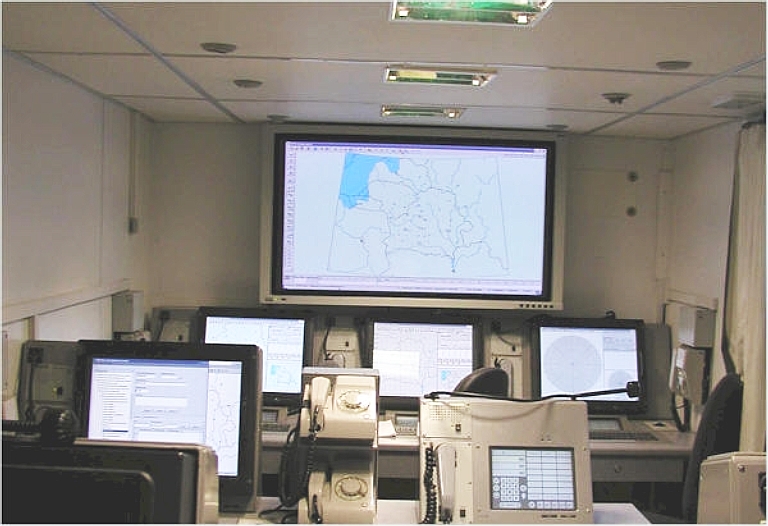
Agat Panorama TsM - Air Defence
Area /
Sector Mobile Command Post. The advent of COTS technology computing
hardware and open
source software tools has seen explosive growth in the integration
capabilities available to Russian designers.
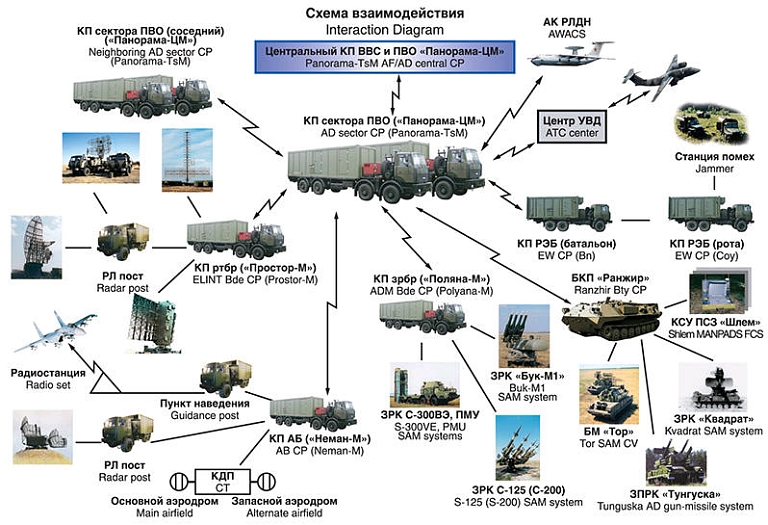 The Agat Panorama TsM Air Defence Area /
Sector Mobile Command Post (above, below) is a good
example of the highly integrated systems approach taken in the design
of contemporary IADS. It also illustrates the level of penetration
achieved by COTS computing technology in modern Russian designs. Note
that both legacy and contemporary missile batteries are supported, as
well as VHF band and microwave radars (Agat).
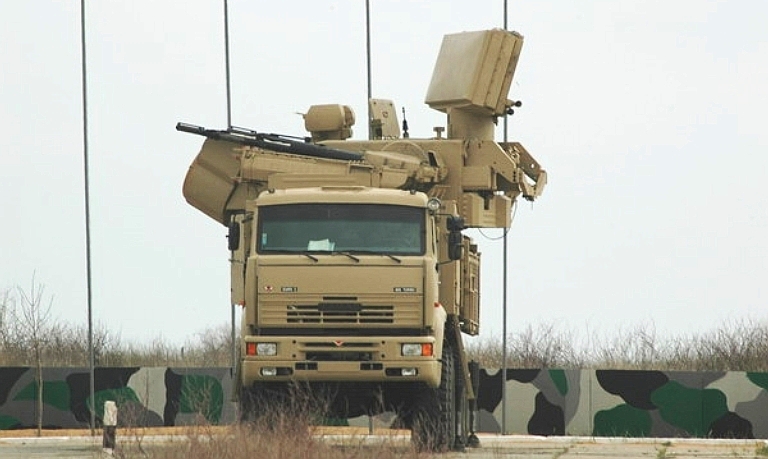 The latest Pantsir S1 configuration at MAKS-2007, which incorporates a new Phazotron designed agile beam phased array engagement radar, derived from Phazotron's earlier effort on the Zhuk MF PESA air intercept radar for the MiG-29 fighter. It is intended to defend radars and missile batteries from attacks using anti-radiation missiles or other weapons. 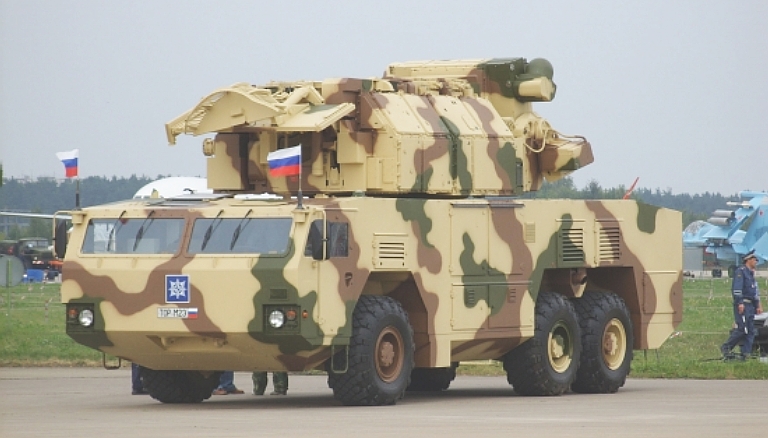 The Russian Tor M2E or SA-15D Gauntlet is used to defend against low flying aircraft as well as cruise missiles and guided weapons like smart bombs. It is available on a tracked chassis, and more recently, a purpose designed semi-hardened MZKT-6922 6 x 6 all terrain vehicle. The acquistion and engagement radars are both PESA technology (Kupol JSC).
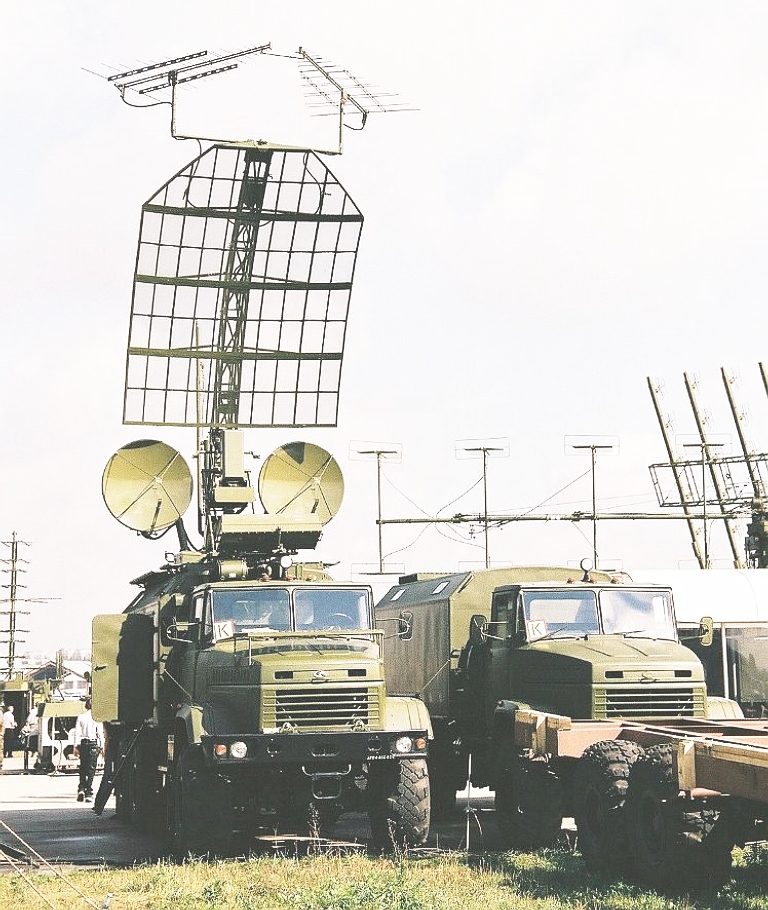 The Ukrainian Topaz Kolchuga ESM
system
has received considerable press over the last decade, mostly related to
alleged illegal sales to Saddam's regime preceding Operation Iraqi
Freedom (Image © Miroslav Gyűrösi).
 The
MiG-35
Zhuk AE AESA multimode radar designed by Phazotron is
the first Russian
AESA design and
is
expected to spawn AESA upgrade packages for a number of regional
Flanker variants (RSK MiG).
 Su-35BM/Su-35-1
cockpit. This new Flanker outperforms all US fighters other than the
F-22A Raptor.
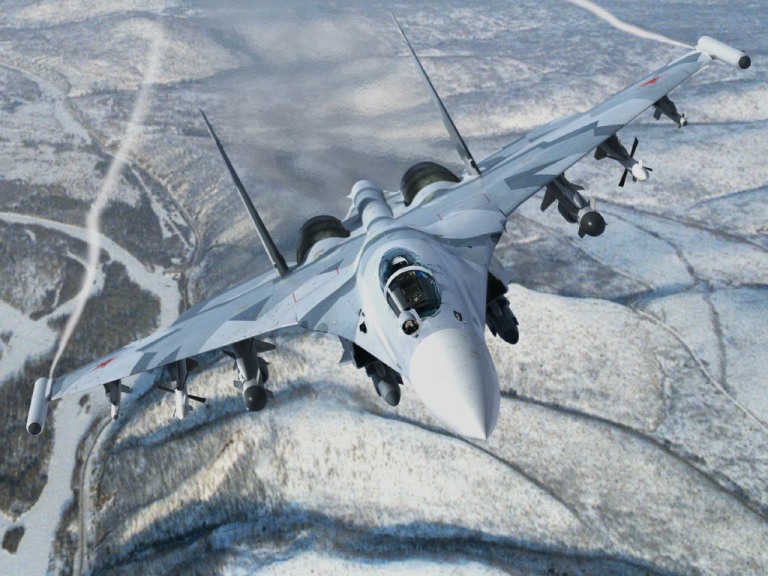 Su-35 Flanker E (KnAAPO Image).
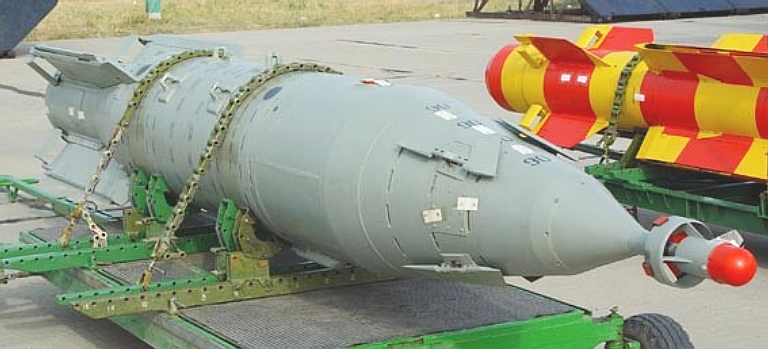
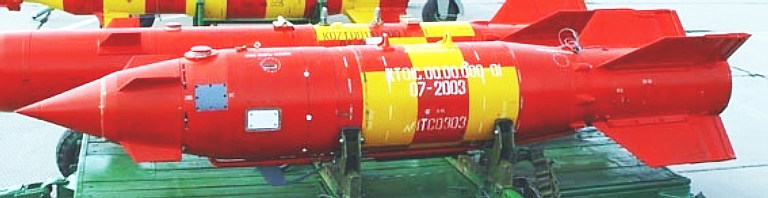
KAB-1500L Laser Guided Bomb. This Russian weapon is a 3,000 lb class equivalent to the US Paveway II/III series weapons (GNPP image).
 Digital
upgrades to legacy Soviet era weapons such as this S-125/SA-3 Goa not
only render Cold War era electronic countermeasures ineffective, but
typically improve performance and reliability. During trials Tetraedr
achieved twice the maximum range with this 1970s technology missile,
simply by improving the midcourse guidance algorithm. Depcited the
Pechora 2M TEL is based on
a 6 x 6 MZKT chassis and the two round 5P71 launcher (Defence
Systems).
|
||||||
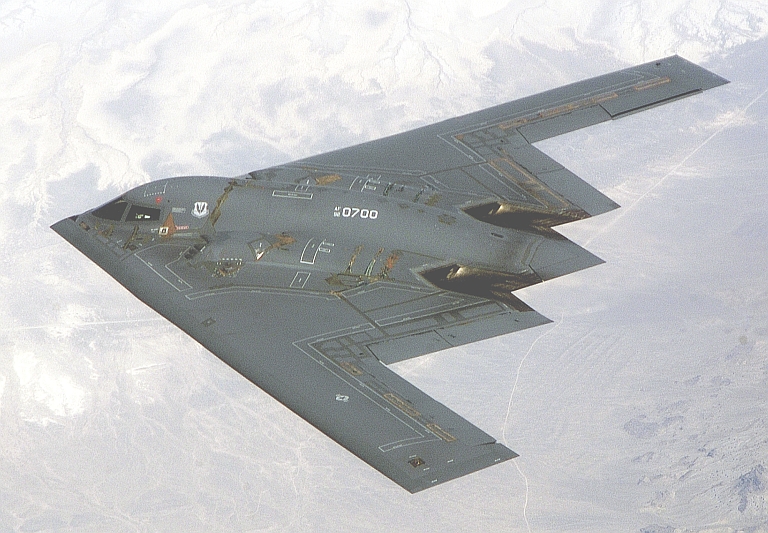 The Northrop-Grumman B-2A 'Batwing'.
Current planning sees the US deploying only 20 B-2As and 183 F-22As
between now and 2020, prior to the deployment of the planned “2018
bomber”. New technology Russian weapons will
present an inpenetrable barrier to all other US types (US DoD).
|
||||||
Strategic Implications for the United StatesAdvanced
Russian technology exports present a major strategic risk for the US,
whether operated by China, or smaller players like Iran or Venezuela.
These systems will deny access to most US ISR and combat aircraft,
with only the B-2A, the “2018 bomber” and the F-22A
designed to penetrate such defences. With its compromised X-band
optimised stealth, the F-35 JSF will simply not be survivable in this
environment.
The fallback position of standoff bombardment with cruise missiles is not viable. Only a fraction will reach their targets through such defences, and the economics of trading $500k cruise missiles for $100k interceptors, or hundreds of dollars of laser propellant, favour the defender. Time of flight is problematic given the high mobility of air defence targets, and targeting the cruise missiles no less problematic given denial of ISR coverage. The US will require a penetrating capability for ISR collection and for lethal suppression of highly mobile SAM, laser and radio-frequency Directed Energy Weapon batteries. This is over and above the need to deliver saturation attacks with the Small Diameter Bomb against actual targets of strategic or tactical interest. Current planning for 180 F-22As and the legacy fleet of 20 B-2As is simply not credible given the diversity of roles and missions, and sheer sortie count required to deal with anything above a trivial opponent. If the US is to maintain its pre-eminent global strategic position, its force structure planning for the Air Force requires a fundamental rethink. A starting point should be the cancellation of the 'Fulda Gap optimised' F-35 JSF, investment of the freed funding into more F-22s, and further enhancement of the already formidable penetrating ISR and strike capabilites of the F-22. Further technological innovation will also be required across the full spectrum of US air capabilities. If the US chooses to optimise its Air Force for the Global War On Terror, it will only accelerate the relative decline of US global power. |
||||||
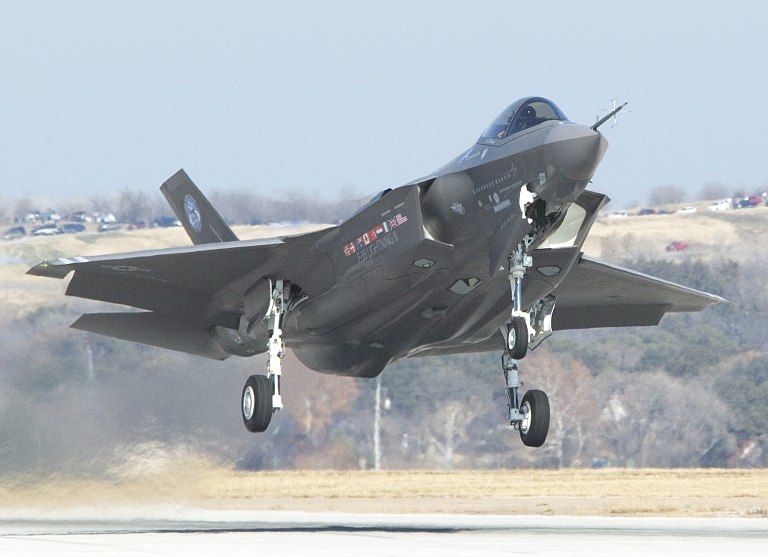 The inferior stealth shaping of the F-355
SDD design compared to other US stealth aircraft makes it nonviable in
the threat environment presented by contemporary and future Russian
high technology weapons (Imagery
via Air Force Link).
|
||||||
|
Imagery
Sources: Author; www.jsf.mil, US DoD.
|
||||||
|
Air Power Australia Analyses ISSN 1832-2433  |
||||||
|
|||||||||||||
|
|
|
|
|
|
|
|
|
|
|
|||
|
|
|
|
|
|
|
|
|
|
|
|||
| |
 |
|
|||||||||||
| Artwork, graphic design, layout and text © 2004 - 2014 Carlo Kopp; Text © 2004 - 2014 Peter Goon; All rights reserved. Recommended browsers. Contact webmaster. Site navigation hints. Current hot topics. | |||||||||||||
|
Site Update
Status:
$Revision: 1.753 $
Site History: Notices
and
Updates / NLA Pandora Archive
|
|||||||||||||
|
|
Tweet | Follow @APA_Updates | |||||||||||
|
|
|||||||||||||
|
|
|||||||||||||